• Skip to primary navigation
  • Skip to main content
  • Skip to primary sidebar

Carnegie Museum of Natural History

One of the Four Carnegie Museums of Pittsburgh

  • Visit
    • Buy Tickets
    • Visitor Information
    • Exhibitions
    • Events
    • Dining at the Museum
    • Celebrate at the Museum
    • Powdermill Nature Reserve
    • Event Venue Rental
    • Gift Cards
  • Learn
    • Field Trips
    • Educator Information
    • Programs at the Museum
    • Bring the Museum to You
    • Guided Programs FAQ
    • Programs Online
    • Climate and Rural Systems Partnership
  • Research
    • Scientific Sections
    • Science Stories
    • Science Videos
    • Senior Science & Research Staff
    • Museum Library
    • Science Seminars
    • Scientific Publications
    • Specimen and Artifact Identification
  • About
    • Mission & Commitments
    • Directors Team
    • Museum History
  • Tickets
  • Give
  • Shop

Patrick McShea

July 11, 2016 by wpengine

Front Door Owls

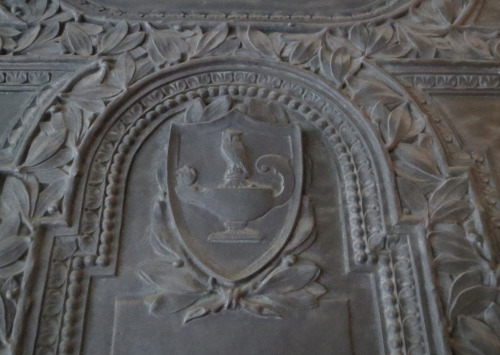
Owl engraved on a metal door

by Patrick McShea

You have to know where to look to spot the owls on the front door of Carnegie Museum of Natural History’s Carriage Drive entrance.

Amid the bronze relief art work on each of two massive doors, a tiny owl perches atop a flaming oil lamp, symbolically marking the building as a place of wisdom and illumination.

The association of owls with wisdom dates at least to ancient Greece, where Athena, goddess of wisdom, favored the owl among all feathered creatures. Physical features might well have influenced Athena’s judgment, for an owl’s large round head and huge forward-facing eyes endow the creature with a human-like face.
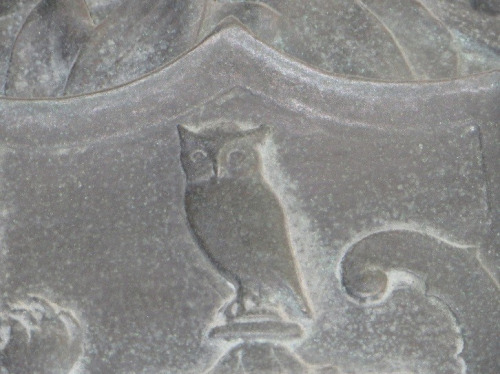
Owl engraving on a metal door

These physical features, which are adaptations for nocturnal hunting, are available for close inspection at Discovery Basecamp, where an array of owl taxidermy mounts greets visitors.

Although the eyes of the taxidermy mounts are made of glass, their size, color, and placement accurately mimics the remarkable light-gathering structures of the living birds. The feathers of each mount are real, and those creating the flat facial disc of each owl are visually different than the surrounding plumage. The shape, stiffness, and placement of these feathers makes each owls face a satellite dish for gathering sound and transmitting it to the creature’s ears.
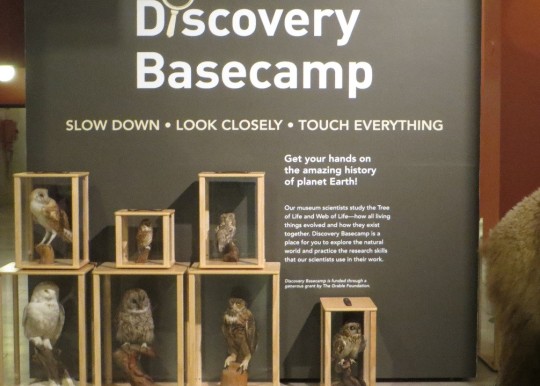
Display of taxidermy owls in Discovery Basecamp

Patrick McShea works in the Education and Visitor Experience department of Carnegie Museum of Natural History. Museum employees are encouraged to blog about their unique experiences and knowledge gained from working at the museum.
Filed Under: Blog Tagged With: architecture, Birds, owls, Patrick McShea

July 6, 2016 by wpengine

Historic Reference in Taxidermy?

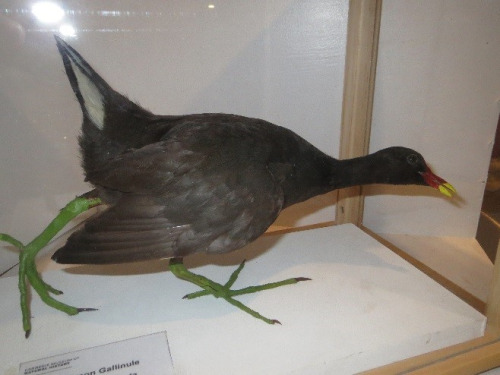
right-foot-leading bird taxidermy mount

by Patrick McShea

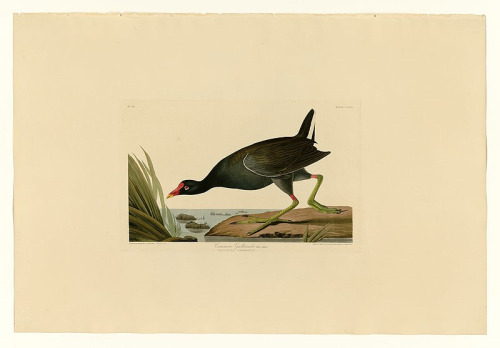
Taxidermists working to position animal remains in life-like postures rely on photographs to supplement firsthand observations. In the case of the common gallinule pictured above, reference materials might well have included John James Audubon’s 1835 portrait of the chicken-sized marsh bird. There’s only so many ways for the species to be posed, of course, and current records for the 14-inch-long mount do not list the taxidermist who prepared it.

In the absence of certainty you may decide for yourself. The right-foot-leading taxidermy mount is available for close inspection in Discovery Basecamp, Carnegie Museum of Natural History’s new permanent gallery. Audubon’s left-foot-leading bird (image below), along with many of his other works, can be studied in great detail at a University of Pittsburgh digital library website featuring a complete set of images from the artist’s monumental work, The Birds of America.

right-foot-leading bird drawing
Photo courtesy: The Birds of America, Vols. I – IV, Special Collections, University Library System, University of Pittsburgh.

Patrick McShea works in the Education and Visitor Experience department of Carnegie Museum of Natural History. Museum employees are encouraged to blog about their unique experiences and knowledge gained from working at the museum.
Filed Under: Blog Tagged With: Patrick McShea, taxidermy

June 22, 2016 by wpengine

What’s up with the dead birds?

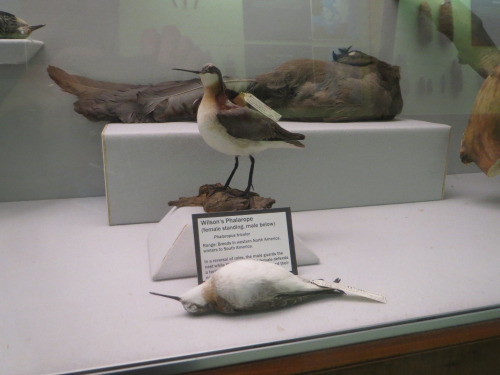
A study skin displayed below a taxidermy mount in Bird Hall.

by Patrick McShea

Museum visitors sometimes offer spontaneous testimony to the deceptive power of taxidermy.

“There’s a dead bird!” is a comment frequently voiced by people encountering a bird specimen lying on its back in Bird Hall, such as the Wilson’s phalarope pictured below. These specimens, so often called “dead birds”, are actually called study skins.

study skin of a Wilson's Palarope bird

Study skins are a traditional form of specimen preparation for birds in scientific collections. Unlike taxidermy mounts, which attain a pretense of life through concealed body forms, strategically positioned wires,
and glass eyes of the appropriate size and color, the cotton-stuffed study skins appear lifeless.

The more than 154,000 bird study skins in the museum’s research collection have all undergone similar preparation. For each specimen the full skin of the bird was carefully removed from the underlying muscle,
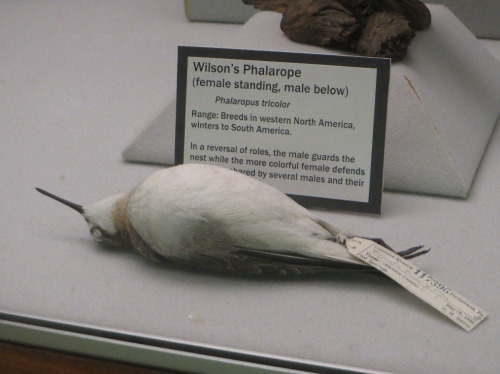
skeleton core, and internal organs, preserving every feather of the creature. Such Uniform preparation creates a standard for comparisons of features between both similar and strikingly different specimens. In addition, the low profile of study skins allows for their storage in shallow cabinet drawers in the manner of the passenger pigeon study skins pictured below.

bird study skins in a drawer

Although taxidermy mounts far outnumber study skins in Bird Hall display cases, the “skins” play an important role by representing the most numerous form of preserved specimens in the museum’s vast bird collection. Whether or not adjacent taxidermy mounts seem more alive because they share display space with the skins is something you may judge for yourself during your next museum visit.

Patrick McShea works in the Education and Visitor Experience department of Carnegie Museum of Natural History. Museum employees are encouraged to blog about their unique experiences of working at the museum.

Carnegie Museum of Natural History Blog Citation Information

Blog author: Patrick McShea
Publication date: June 22, 2016

Share this post!

  • Share on Twitter Share on Twitter
  • Share on Facebook Share on Facebook
  • Share on Pinterest Share on Pinterest
  • Share on LinkedIn Share on LinkedIn
  • Share on Reddit Share on Reddit
  • Share via Email Share via Email

Filed Under: Blog Tagged With: bird hall, Birds, museums, nature, Patrick McShea, Pittsburgh, research

June 3, 2016 by wpengine

Play in the Savannah

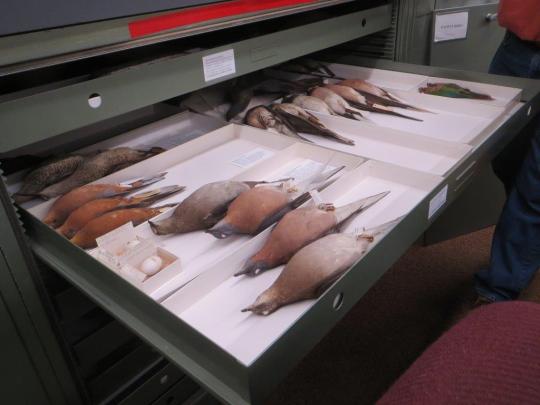
Hall of African Wildlife at Carnegie Museum of Natural History

by Patrick McShea

Amid the life sized, realistic diorama’s in Carnegie Museum of Natural History’s Hall of African Wildlife, there is a low table with adjacent seating that is reserved for play on a smaller scale.

Sturdy scale models of Africa’s emblematic species provide all that’s necessary for visitors to make associations, create scenes, simulate and imagine action, and engage in conversation.

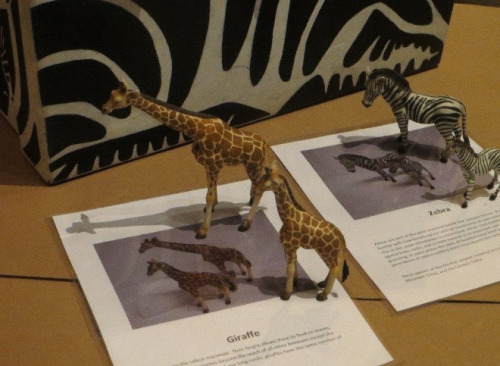
The plastic menagerie is housed in a zebra-striped toolbox, which also contains brief information sheets about featured creatures. Based upon the arrangements I’ve found while checking the table’s animal inventory, a popular pastime involves matching models with respective information sheets.

Giraffe and zebra miniature models

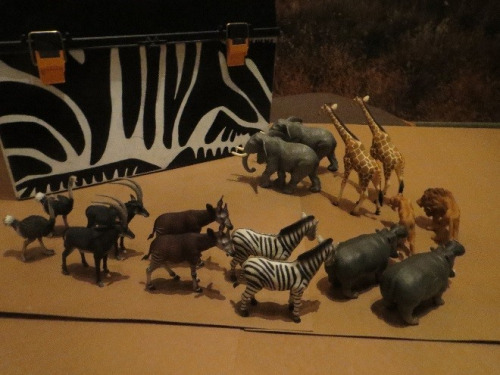
Novel uses include using the toolbox as a prop. Below the box stands-in for Noah’s Ark with the paired animal models in an orderly boarding line.

Savannah animals arranged in pairs

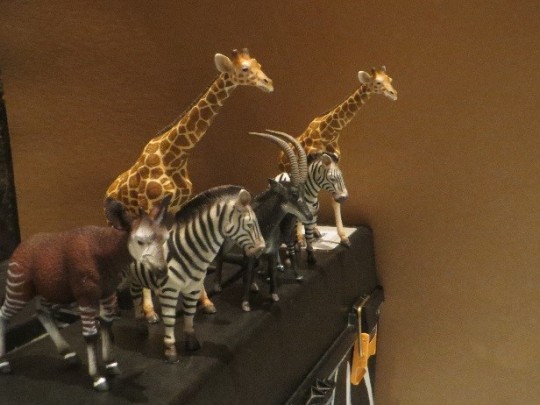
The creator of another scene appeared to imagine toolbox as a mesa with a line of grazers and browsers looking out to scout for predators or perhaps greener feeding grounds.

Savannah animal models

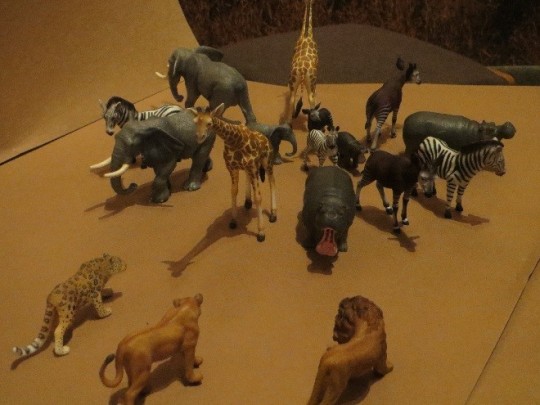
If the replicas’ proximity to dioramas containing life-sized taxidermy mounts invites discussion of scale, the plastic menagerie’s mix of carnivores and herbivores certainly leads to talk of predator and prey relationships. Below a dramatic visitor-constructed scene features a circle of full grown plant-eaters protecting their young from approaching meat-eaters.

Savannah animal models

Patrick McShea works in the Education and Visitor Experience department of Carnegie Museum of Natural History. Museum employees are encouraged to blog about their unique experiences and knowledge gained from working at the museum.
Filed Under: Blog Tagged With: African Wildlife, Education, Hall of African Wildlife, museums, Patrick McShea, Pittsburgh

May 18, 2016 by wpengine

Flow to Pittsburgh

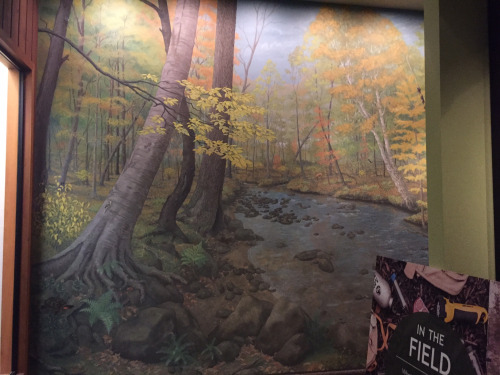
mural of a stream

by Patrick McShea

The scene in a new mural on the second floor of Carnegie Museum of Natural History is a fall morning at Powdermill Nature Reserve, the museum’s field research station which is located some 55 miles southeast of Pittsburgh.

The view is upstream along Powdermill Run, just below the place where the stream absorbs the flow of a tributary known as White Oak Run. These waters, gathered from a portion the western slope of Laurel Ridge, eventually flow through Pittsburgh. Their path to the city, a vertical descent of some 650 feet via the meanders of Loyalhanna Creek, the Kiskiminitas, and Allegheny River, is nearly twice the length of the highway route.

As a vital element of the forested landscape, the stream provides a focal point for considering the diverse life forms supported on Powdermill Nature Reserve’s 2,200 acres.

The artists who created the mural paid careful attention to vegetation, depicting specific trees, shrubs, and grasses. They also populated the scene with a variety of creatures. The closer you study the mural the more living details you’ll notice.

See how many plants and animals you can locate and identify, then make plans to visit Powdermill Nature Reserve at any season of the year.

Curious about Powdermill? Visit on June 4 for the annual public day!

Patrick McShea works in the Education and Visitor Experience department of Carnegie Museum of Natural History. Museum employees are encouraged to blog about their unique experiences and knowledge gained from working at the museum.
Filed Under: Blog Tagged With: conservation, nature, Patrick McShea, Pittsburgh, Powdermill, water

May 11, 2016 by wpengine

Front Line Birds

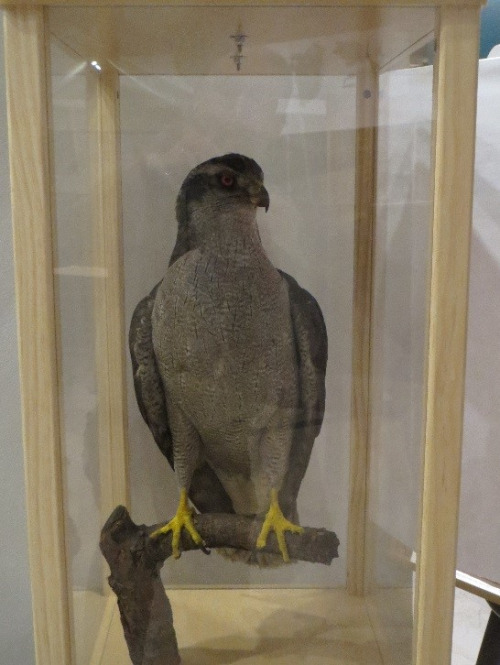
hawk in a display case
Carnegie Museum of Natural History’s taxidermied Goshawk

By Patrick McShea

Best-selling books aren’t usually discussed during our daily 15-minute customer service personnel briefings.

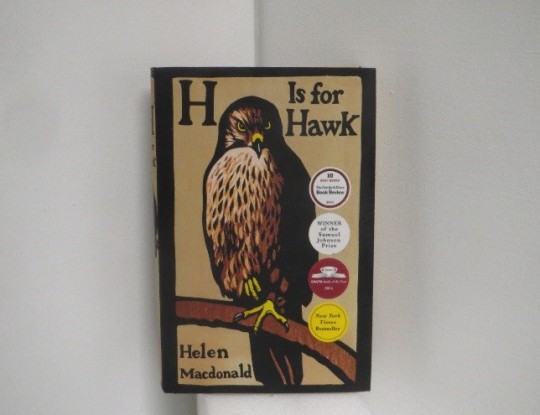
During a recent briefing focused on the museum’s extensive loan program,  an old taxidermy mount in a new portable display case steered discussion to H Is for Hawk, the award winning 2014 non-fiction work by Helen Macdonald.

“That’s a Goshawk?” exclaimed one staff member, pointing to the life-like preserved remains of a big gray and white raptor perched in a 28 inch high plexi-glass sided box. “The bird is huge!” She went on to explain that as part of a book club, she had been reading, if not always enjoying, H is for Hawk, which features a young Goshawk as pivotal character.

As someone then halfway through the book I was able to affirm the narrative’s difficult passages and take advantage of the fleeting teachable moment. H Is for Hawk can be a tough read because it addresses grief and depression and the historically frequent misinterpretation of the lessons people should take from highly adapted predators. I pointed out that the stuffed bird that was in front of us presented several physical adaptations for the efficient capture and killing of prey.

Whether you’ve read the book or not, you can gain a fuller appreciation for the physical attributes of birds of prey by closely examining the taxidermy mounts of hawks and owls currently on display at Carnegie Museum of Natural History’s interactive exhibition Discovery Basecamp, which is on the first floor of the museum.

H Is for Hawk
H Is for Hawk book

Additional information about the CMNH loan program can be found at: http://www.carnegiemnh.org/programs/loan/

As part of the Pittsburgh Arts and Lectures series, Helen Macdonald will speak at Carnegie Music Hall on January 30, 2017: http://pittsburghlectures.org/2015-16-literary-evenings/

Patrick McShea works in the Education and Visitor Experience department of Carnegie Museum of Natural History. Museum employees are encouraged to blog about their unique experiences and knowledge gained from working at the museum.
Filed Under: Blog Tagged With: bird hall, museums, Patrick McShea, taxidermy

  • « Go to Previous Page
  • Page 1
  • Interim pages omitted …
  • Page 6
  • Page 7
  • Page 8
  • Page 9
  • Go to Next Page »

sidebar

About

  • Mission & Commitments
  • Directors Team
  • Museum History

Get Involved

  • Volunteer
  • Membership
  • Carnegie Discoverers
  • Donate
  • Employment
  • Events

Bring a Group

  • Groups of 10 or More
  • Birthday Parties at the Museum
  • Field Trips

Powdermill

  • Powdermill Nature Reserve
  • Powdermill Field Trips
  • Powdermill Staff
  • Research at Powdermill

More Information

  • Image Permission Requests
  • Science Stories
  • Accessibility
  • Shopping Cart
  • Contact
  • Visitor Policies
Stay in the loop! Sign up for our newsletter(s).
One of the Four Carnegie Museums | © Carnegie Institute | Privacy Policy | Terms of Use | Accessibility
Rad works here logo