• Skip to primary navigation
  • Skip to main content
  • Skip to primary sidebar

Carnegie Museum of Natural History

One of the Four Carnegie Museums of Pittsburgh

  • Visit
    • Buy Tickets
    • Visitor Information
    • Exhibitions
    • Events
    • Dining at the Museum
    • Celebrate at the Museum
    • Powdermill Nature Reserve
    • Event Venue Rental
    • Gift Cards
  • Learn
    • Field Trips
    • Educator Information
    • Programs at the Museum
    • Bring the Museum to You
    • Guided Programs FAQ
    • Programs Online
    • Climate and Rural Systems Partnership
  • Research
    • Scientific Sections
    • Science Stories
    • Science Videos
    • Senior Science & Research Staff
    • Museum Library
    • Science Seminars
    • Scientific Publications
    • Specimen and Artifact Identification
  • About
    • Mission & Commitments
    • Directors Team
    • Museum History
  • Tickets
  • Give
  • Shop

Blogs from our Scientific Researchers

Carnegie Museum of Natural History is home to active research and vast scientific collections. Our scientific researchers regularly contribute to the blog at the museum.

June 28, 2024 by Erin Southerland

Mineral Gazing

by Debra Wilson

Have you ever gazed up at the sky and noticed a cloud that looks like a face, or an animal, or an object? You can apply the same concept when you visit Hillman Hall of Minerals and Gems! Many minerals on display have nicknames because of how they resemble certain animals, objects, or even characters from movies or TV shows. As you walk through the exhibits, let your imagination wander and search for minerals that look like things. Here are some to get you started.

Silver mineral that looks like an American flag
“The Flag” – Silver in the Native Elements case of the Systematic Mineral Collection
Image of the American flag that says "we here highly resolve that these dead shall not have died in vain...rememeber Dec. 7th!"
Photo credit: Allen Saalburg, Public domain, via Wikimedia Commons.
Nessie silver mineral
“Nessie” – Silver in Minerals from the Former Soviet Union exhibit
Loch Ness monster sculpture in the water
Photo credit: Immanuel Giel, Public domain, via Wikimedia Commons
snowball calcite on quartz
“Snowball” – Calcite on quartz in the Maramures District of Romania exhibit
snowball held in mitten-covered hands
Photo from Shutterstock.
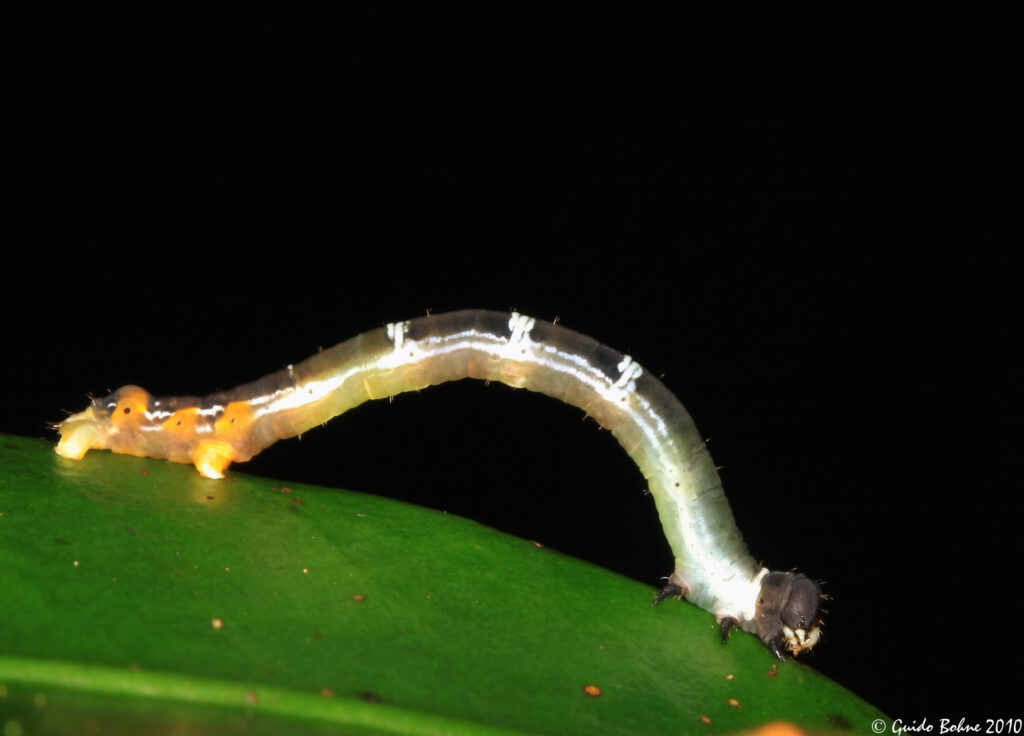
Inch Worm berthierite on quartz
“Inch Worm” – Berthierite on quartz in The Maramures District of Romania exhibit
photo of an inch worm
Photo credit: gbohne from Berlin, Germany, CC BY-SA 2.0, via Wikimedia Commons
The Scream septarian concretion
“The Scream” – Septarian concretion in the Weathering Processes exhibit
"The Scream" painting
Image credit: Edvard Munch, Public domain, via Wikimedia Commons
the oyster natrolite on quartz
“The Oyster” –  Natrolite on quartz in the Deccan Plateau of India exhibit
oyster shell with a pearl
Photo from Shutterstock.
French fries laumontite
“French Fries” – Laumontite in Masterpiece Gallery
cup of French fries
Image by ha11ok from Pixabay.

As you enter Hillman Hall, check out the minerals in the Entrance Cube, their nicknames are on the labels. There are many more minerals on display throughout the hall that have acquired nicknames. Here’s just a handful of other nicknames for minerals in the exhibits, see if you can find them. Good luck and enjoy your mineral gazing!

NicknameExhibit
The BatIgneous Rocks
Polar BearWeathering Processes
Sea SlugThe Maramures District of Romania
The ChariotsThe Maramures District of Romania
Smog MonsterThe Maramures District of Romania
Sea SerpentPennsylvania Minerals and Gems
Pine Trees On a CliffOxides
BBQ ChipsMasterpiece Gallery
Cookies and CreamMasterpiece Gallery

Debra Wilson is Collection Manager for the Section of Minerals at Carnegie Museum of Natural History.

Related Content

How Do Minerals Get Their Names?

What Does Pittsburgh Have in Common with Mount Vesuvius?

Master of Optical Illusion

Carnegie Museum of Natural History Blog Citation Information

Blog author: Wilson, Debra
Publication date: June 28, 2024

Share this post!

  • Share on Twitter Share on Twitter
  • Share on Facebook Share on Facebook
  • Share on Pinterest Share on Pinterest
  • Share on LinkedIn Share on LinkedIn
  • Share on Reddit Share on Reddit
  • Share via Email Share via Email

Filed Under: Blog Tagged With: Deb Wilson, Debra Wilson, Hillman Hall, Hillman Hall of Minerals and Gems, minerals, Science News

May 15, 2024 by Erin Southerland

Slipper Snails Slide Between Sexes in Stacks

Or, Crepidula fornicata say, “Trans Rights!”

…if they don’t get eaten by their siblings first.

by Sabrina Spiher Robinson
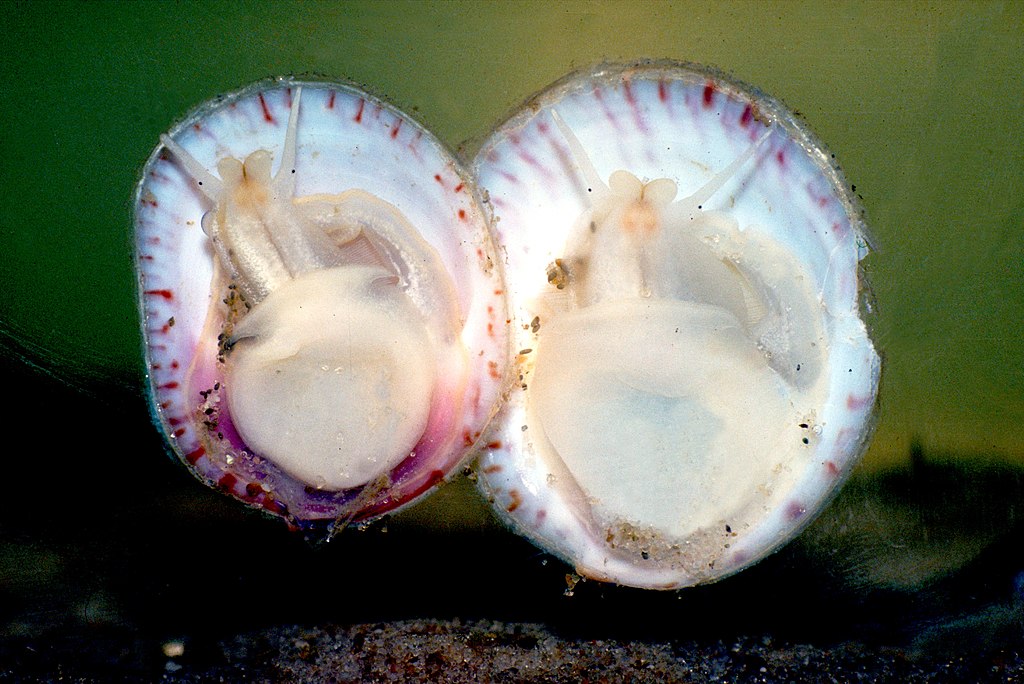
A pair of slipper snails seen from below.
A pair of slipper snails seen from below. Image credit: Ecomare/Sytske Dijksen, CC BY-SA 4.0 https://creativecommons.org/licenses/by-sa/4.0, via Wikimedia Commons
A stack of Crepidula fornicata, grown together (with a little chiton, another type of mollusk, hanging out on the top of the family).
A stack of Crepidula fornicata, grown together (with a little chiton, another type of mollusk, hanging out on the top of the family). Image credit: User Lamiot on fr.wikipedia, CC BY-SA 1.0 https://creativecommons.org/licenses/by-sa/1.0, via Wikimedia Commons

Slipper snails, Crepidula fornicata, are a common find for shell collectors along the American east coast, and in some places on the west coast as well, where they have been accidentally introduced as an invasive species. But just because they’re common, doesn’t mean they’re not interesting – in fact, they’re one of the most well-studied marine snails, and all of that study has revealed a creature with a fascinating life cycle.

Crepidula are protandrous hermaphrodites – this means that all slipper snails begin their lives as male, and end their lives as female. As juveniles, they wander over the substrate, preferring hard surfaces like rocks, dock pilings, other shells, and even horseshoe crabs. But most C. fornicata will choose to settle on top of another C. fornicata, who might be settled atop another, and another, and so on. They live in stacks, sometimes of up to a dozen animals, one balancing on top of the next until their shells grow around each other, and they can no longer move, becoming sessile (stationary) by default.

Of course, a stack of all males won’t get very far reproductively. So, it’s time for at least a few C. fornicata to begin the next stage in their lives, and transition to females. Several things influence when the change takes place, primarily the animal’s size, because producing gametes is energetically costly: more sperm takes more energy than less sperm, and eggs take more energy than sperm altogether. But it’s not so straightforward as just growing to a certain size and changing sex. If there are no females around, for instance, some males will transition to females at smaller sizes than they usually would.¹  Alan Carillo-Boltodano and Rachel Collin write:

“In our experiment, pairs of snails (one small and one large) were kept in cups, either together or partitioned off with fine or coarse mesh, or partitioned, but switched from side to side to allow contact with the cup mate’s pedal mucus. The larger snails that were allowed contact with the smaller companions grew faster, and generally changed sex sooner, than did the larger snails in the barrier treatments, which allowed no physical contact. The smaller snails that were allowed contact with the larger cup mate delayed sex change compared to those separated from their cup mates … Our results suggest that the cue that affects size and time to sex change requires some kind of physical interaction that is lost when the snails are separated. Furthermore, contact with another snail’s pedal mucus does not compensate for the loss of physical contact.”²

In other words, when the slipper snails are in actual contact with each other, they seem to send signals to one another that help to coordinate growth and sex change.

In general, though, males will wait until they’re a certain size to transition, because larger males are more reproductively successful than smaller males, as determined by experiments that genetically test offspring to see whose genes were most successful in the stack. There’s one exception to this though – sneaky little guys! Male Crepidula inseminate females directly, so in general the male right on top of the female at the bottom of the stack will be the most successful fertilizer, and then the male on top of him, and then the others on top of them can’t reach and are out of luck for the moment. But! The smallest juvenile Crepidula, who have not yet chosen a stack of their own, have been found to sneak up on the substrate next to the female, inseminate her, and sneak away, using a strategy that gets around “bigger = more sperm.”³

Larger males might have more reproductive success than smaller males, but no one has more reproductive success than slipper snails who have transitioned to females. Eggs are a much bigger energy investment for an animal than sperm are, and so becoming a female requires a certain size to make the transition worthwhile. But once a slipper snail is female, she has a couple reproductive advantages: in the first place, she can hoard sperm for a long time, including her own from when she was a male, so she always has plenty of material to fertilize her eggs. This also means that while only a third or a quarter of the embryos will have a given male’s DNA, they’ll all have hers. Secondly, Crepidula females brood their young. Unlike many marine mollusks, who release their eggs and sperm into the water column where they meet and the embryo has to grow up among the plankton, at risk of becoming a meal for many things before they ever even get to grow into larvae, Crepidula keep their eggs in brooding pouches. Females keep between 15 and 20 pouches inside their shells, each containing between 50 and 450 embryos. She’ll brood them until they turn into larvae that can swim about on their own, keeping them safe to grow at least for a little while.

And thus, every Crepidula fornicata begins their life as a tiny, and sometimes sneaky, roaming male, sowing his wild oats; eventually he finds a nice stack to settle down on to become a dad; and then they transition sexes and live out her days as mother and base of the stack, brooding little babies in safety until they’re ready to hatch into larvae. Slipper snails make small stacks, but big happy families.

However, perhaps nowhere is safe. Once the eggs are brooding in their capsules, the mother slipper snail has no way to transfer additional nutrients or oxygen to the embryos.  This environment of scarcity leads some species of Crepidula embryos to start cannibalizing each other! The embryos of Crepidula coquimbensis, a species of Crepidula first described in Chile, have at least been found to be choosy about eating their brothers and sisters. Brood capsules are fertilized by multiple males, meaning all the embryos have the same mother, but not every embryo has the same father. It was discovered that cannibalistic embryos were much more likely to eat their half-siblings than their full siblings, thus protecting embryos they shared a complete set of DNA with. It’s still not known how these embryos recognize kinship, though.⁴ In another species of Crepidula, Crepidula navicella, a gene in some of the embryos in each capsule switches on and arrests their development, basically turning them into meals for their siblings, a genetic predisposition to being either a cannibalizer or a cannibalizee.⁵

Of course, once the larvae are released into open water, all bets are off, and a lot of filter-feeding animals, including other mollusks, including other Crepidula, might eat them. However, Jan Pechenik reports:

“… in our study the same adults usually ingested their own larvae at much slower rates than predicted from the rates at which they cleared water of phytoplankton. These slower rates may in part reflect an inability or reluctance of adults to ingest particles of such large size …  However, most of the larvae that we observed being entrained into adult feeding currents were ingested, and later appeared in feces, and adults were capable of ingesting larvae that were larger … Thus, lower than predicted rates of [larvae eating] by C. fornicata more likely reflect larval behavior – deliberate or not – reducing the likelihood of [getting drawn] into the adult feeding current, as suggested previously from studies with [other marine filter feeders].”⁶

At least baby Crepidula, once free, seem to have developed a way to avoid being eaten by their parents, if not their siblings!

Sabrina Spiher Robinson is Collection Assistant for the Section of Mollusks at Carnegie Museum of Natural History.

References:

[1] Proestou, Dina A., Goldsmith, Marian, Twombly, Sarah (2008) “Patterns of Male Reproductive Success in Crepidula fornicata Provide New Insight for Sex Allocation and Optimal Sex Change.” The Biological Bulletin (Lancaster), vol. 214, no. 2, 2008, pp. 194–202, https://doi.org/10.2307/25066676.

[2] Carrillo-Baltodano, Allan, and Collin, Rachel (2015). “Crepidula Slipper Limpets Alter Sex Change in Response to Physical Contact with Conspecifics.” The Biological Bulletin (Lancaster), vol. 229, no. 3, 2015, pp. 232–42, https://doi.org/10.1086/BBLv229n3p232.

[3] Broquet, Thomas, et al. “The Size Advantage Model of Sex Allocation in the Protandrous Sex-Changer Crepidula fornicata: Role of the Mating System, Sperm Storage, and Male Mobility.” The American Naturalist, vol. 186, no. 3, 2015, pp. 404–20, https://doi.org/10.1086/682361.

[4] Brante A, Fernández M, Viard F (2013) Non-Random Sibling Cannibalism in the Marine Gastropod Crepidula coquimbensis. PLoS ONE 8(6): e67050, doi:10.1371/journal.pone.0067050

[5] Lesoway, MP, Collin, R, Abouheif, E. (2017) “Early activation of MAPK and apoptosis in nutritive embryos of calyptraeid gastropods.” J. Exp. Zool. (Mol. Dev. Evol.) 328B: 449–461. doi:10.1002/jez.b.22745.

[6] Pechenik, Jan, Blanchard, Michel, Rotjan, Randi (2004) “Susceptibility of Larval Crepidula fornicata to Predation by Suspension-Feeding Adults.” Journal of Experimental Marine Biology and Ecology., vol. 306, no. 1, 2004, pp. 75–94, https://doi.org/10.1016/j.jembe.2004.01.004.

Related Content

Oysters Swim Towards a Siren Soundscape

Shark-ish Beasts versus Cephalopods: Which is Predator, Which is Prey, and is One an Artist?

Diet-wise, Snails are Like Cows, Not Bugs

Carnegie Museum of Natural History Blog Citation Information

Blog author: Robinson, Sabrina Spiher
Publication date: May 15, 2024

Share this post!

  • Share on Twitter Share on Twitter
  • Share on Facebook Share on Facebook
  • Share on Pinterest Share on Pinterest
  • Share on LinkedIn Share on LinkedIn
  • Share on Reddit Share on Reddit
  • Share via Email Share via Email

Filed Under: Blog Tagged With: mollusks, Sabrina Spiher Robinson, Science News, Spotlight on Science, Spotlight on Science Mollusks

May 2, 2024 by Erin Southerland

Type Specimens: What are they and why are they important?

by Timothy A. Pearce and Rachel Thomas Beckel

What do we mean when we say we have type specimens in the Carnegie Museum of Natural History (CMNH) collections?  

Type specimens are (usually) the specimen(s) a person describing a new species looks at as they write the description (it’s this tall, this wide, this color, sculptured with bumps like this, etc.) and type specimens are the official name bearers for the whole species. 

There are many kinds of type specimens, but the most important kind is the holotype. Paratypes (other specimens the original describer believes are the same new taxon) are also important, but holotypes are the most important. Two other kinds of type specimen are lectotypes (selected from the paratypes if the holotype is lost) and neotypes (selected from any specimen if all type material is lost). Every time we add another holotype it bolsters the significance of CMNH’s already significant collections. It raises our visibility on the “radar” of researchers and puts us on the map for that taxon.

Carnegie Museum collaborator Dr. Aydin Örstan recently named a new subspecies of snail Albinaria coa tek (Örstan & Yildirim 2023). He deposited the holotype and 12 paratypes of the new subspecies in the Mollusks collection at CMNH.  

Holotype of Albinaria coa tek Örstan, 2023. Image from Örstan & Yildirim (2023).

If a researcher wants to know if they have found another specimen of Dr. Örstan’s new subspecies, they could read his description. However, to be absolutely sure, a researcher might need to compare their finding to the type specimen. 

Think of types as the gold standard. Because of their importance to nomenclature and taxonomy (the science of naming species), most museums (including CMNH) keep their type specimens securely locked in a special cabinet.

With regard to this land snail holotype, for Carnegie Museum to have the holotype of Albinaria coa tek means that people studying that subspecies or closely related taxa might need to travel to the museum to examine the type specimen or ask for additional information about it. For their research paper to be complete, they would need to refer to that holotype specimen. In addition to the holotype, Dr. Örstan gave CMNH paratypes of Albinaria coa tek, which can be important for understanding the range of variation in the subspecies.

Albinaria are land snails that occur in SE Europe and the Middle East and are typically found on limestone. In some cases, they appear to have been able to form new colonies when ancient humans moved limestone around for buildings (the snails likely hitchhiked on the limestone blocks). That means we can trace trade routes over which ancient humans were moving limestone.

The family Clausiliidae (which contains the genus Albinaria) are of interest because they bear a clausilium, a kind of door for closing the shell (hence the common name “door snails”), which is unique to the family and is very different from the operculum, which is a different kind of door in many sea snails and some land snails. Furthermore, most snails in the family Clausiliidae coil counterclockwise, which is the opposite direction of more than 99% of all other snails. Additionally, Clausiliidae have a peculiar global distribution, being found in western Europe, Eastern Asia, and northern South America. People who study biogeography (how species came to be living where they are now) scratch their heads wondering how Clausiliidae came to be living in those three separate places without any individuals being found in between – for example, if they migrated from Europe to northern South America, why don’t any Clausiliidae occur in North America?

In addition to this new holotype (and paratypes) in the Section of Mollusks, holotype specimens of new species of vertebrates and paratypes of a new species of insect were named in 2023 and deposited in the relevant sections of the CMNH collection:

Pietro Calzoni, from the Universitá di Padova, Italy, and colleagues designated a CMNH Vertebrate Paleontology fossil as the holotype of a new bony fish species, Rhamphosus tubulirostris (Calzoni et al. 2023). 

Three new species of the insectivore mammal genus Plagioctenoides (P. cryptos, P. dawsonae, and P.goliath), and one new species of Cuetholestes (C. acerbus), were recently named from CMNH Vertebrate Paleontology fossils (Jones and Beard 2023). 

A CMNH Vertebrate Paleontology gekko fossil was designated as the holotype of Limnoscansor digitatellus (Meyer et al. 2023). CMNH visitors can view this specimen  on display in the Solnhofen case in the Dinosaurs in Their Time exhibition.

Limnoscansor digitatellus

A male and six female moths from the CMNH Invertebrate Zoology collection were named the new moth species Meganaclia johannae (Ignatev et al. 2023). The moths were collected between 1918 and 1925 in Cameroon and were housed in the Invertebrate Zoology collection awaiting discovery as new species. 

While CMNH welcomes hundreds of thousands of visitors per year to the public galleries, scores of researchers work behind the scenes to expand our understanding of the different kinds of organisms, as evidenced by their type specimens, that are present in our incredible world. As the moth example demonstrates, Carnegie Museum of Natural History (and other museums around the world) hold specimens that have yet to be recognized as new species!

Timothy A. Pearce is Curator of Mollusks and Rachel Thomas Beckel is Administrative Coordinator for Science & Research at Carnegie Museum of Natural History.

References

Calzoni, P., J. Amalfitano, L. Giusberti, M. Carnevale, and G. Carnevale. 2023. Eocene Rhamphosisdae (Teleostei: Syngnathiformes) from the Bolca Lagerstätte, Italy. Rivista Italiana di Paleontologia e Strigrafia, 129(3): 573-607. 

Ignatev, N., G.M. László, A. Paśnik, Z.F. Fric, H. Sulak, and G.C. Müller. 2023. Five new species of the genus Meganaclia Aurivillius, 1892 (Lepidoptera: Erebidae: Arctiinae: Syntomini). Zootaxa, 5296: 457–474. 

Jones, M., and K.C. Beard. 2023. Nyctitheriidae (Mammalia, ?Eulipotyphla) from the Late Paleocene of Big Multi Quarry, southern Wyoming, and a revision of the subfamily Placentidentinae. Annals of Carnegie Museum, 88(2): 115-159.

Meyer, D., C.D. Brownstein, K.M. Jenkins, and J. Gauthier. 2023. A Morrison stem gekkotan reveals gecko evolution and Jurassic biogeography. Proceedings of the Royal Society B., 290: 20232284.

Örstan, A., and M.Z. Yildirim. 2023. A new insular land snail, Albinaria coa tek Örstan, from Marmaris, Türkiye (Clausiliidae: Alopiinae). Archiv für Molluskenkunde, 152(2): 175-182. 

Related Content

The Strange Saga of Spinosaurus, the Semiaquatic Dinosaurian Superpredator

The Bromacker Fossil Project Part XI: Dimedtrodon teutonis, an Apex Predator

Tiger Beetle Lost, Tiger Beetle Found

Carnegie Museum of Natural History Blog Citation Information

Blog author: Pearce, Timothy A.; Beckel, Rachel Thomas
Publication date: May 2, 2024

Share this post!

  • Share on Twitter Share on Twitter
  • Share on Facebook Share on Facebook
  • Share on Pinterest Share on Pinterest
  • Share on LinkedIn Share on LinkedIn
  • Share on Reddit Share on Reddit
  • Share via Email Share via Email

Filed Under: Blog Tagged With: Rachel Thomas Beckel, Science News, Tim Pearce

March 19, 2024 by Erin Southerland

Celebrating Women in the Natural History Art Collection

by Olivia Buehler

Within the collections of the Carnegie Museum of Natural History, one may be surprised to find more than the biological specimens, fossils, and extensive anthropological and archaeological materials that the museum is best known for. As a major scientific institution that collects and conducts research, the Carnegie Museum of Natural History also has its own “Natural History Art” Collection, formerly known as the M. Graham Netting Animal Portraiture Collection, named after the herpetologist, former CMNH director, and founder of the collection. Consisting mostly of mid-twentieth-century naturalist and scientific illustrations, this collection serves as a useful addition to the museum’s resources that complements its research activities. Naturalist and scientific illustration involves skills beyond image-making and can resemble scientific research in that it requires artists to closely observe, and often travel to, their subjects to fully understand them and render them accurately. 

Within the collection are several women artists and scientific illustrators who each contributed to the genres of naturalist and scientific illustration. In this post I will feature the artists Winifred Austen, Germaine A. Bernier-Boulanger, Florence Malewotkuk, and an artist only identified (for now) as “Deirdre E. L.,” who are all worth celebrating this Women’s History Month. Although greatly outnumbered in the collection by their male counterparts, the women in CMNH’s Natural History Art Collection, and their respective works, speak volumes. With some pieces dating to over one hundred years ago, these artworks are proof that women have always had important roles to play in art and science, and it is just the conditions of patriarchal societies that have limited them. Despite their existence as a minority in the field of naturalist and scientific illustration, and the associated income and opportunity disparities that came with that status, these women persevered to create the beautiful, informative, and humorous art below.

Winifred Austen

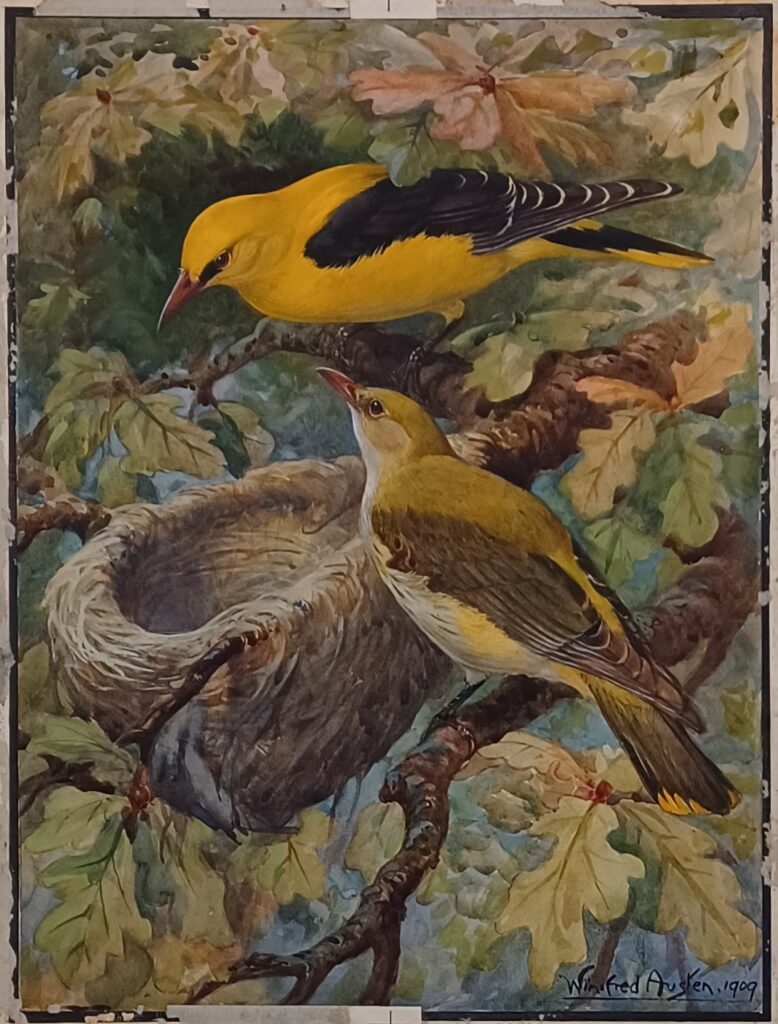
watercolor painting of two golden orioles near their nest in a tree
Winifred Austen, Golden Orioles (1909), Watercolor on board, 20 x 27 in., NHA 28.266 

One such artist is Winifred Austen, an English painter, etcher, and engraver whose work became most popular in the 1940s and 1950s with her wildlife illustrations in books and magazines. Produced as an illustration for F.B. Kirkman’s British Bird Book, Austen’s Golden Orioles (1909) is a lovely example of her expertise in wildlife painting, specifically birds. While the orioles are painted with a thoughtful hand in precise, impressive detail, their surrounding environment is rendered in a far more impressionistic style, emphasizing Austen’s utilization of her formal training in the arts, but also her choice to employ individualistic, stylistic expression and creativity. Even though these watercolors were intended to act as visual references for the texts they were accompanying, Austen still managed to contribute in a manner that was unique to her. Austen’s art can be praised for the dynamism of her subjects, and her portrayal of birds as they would appear in their natural environments, rather than in the static and perfectly poised way some other naturalist illustrators tend to favor.

Austen attended and trained formally at the London County Council School of Arts and Crafts and exhibited her work often with the Royal Society of Painter-Etchers, following a similar trajectory as many of her male contemporaries. With that being said, Austen also made incredible progress despite being a minority in her practice, for example, she was the only woman to be published in the British Bird Book.

Germaine A. Bernier-Boulanger

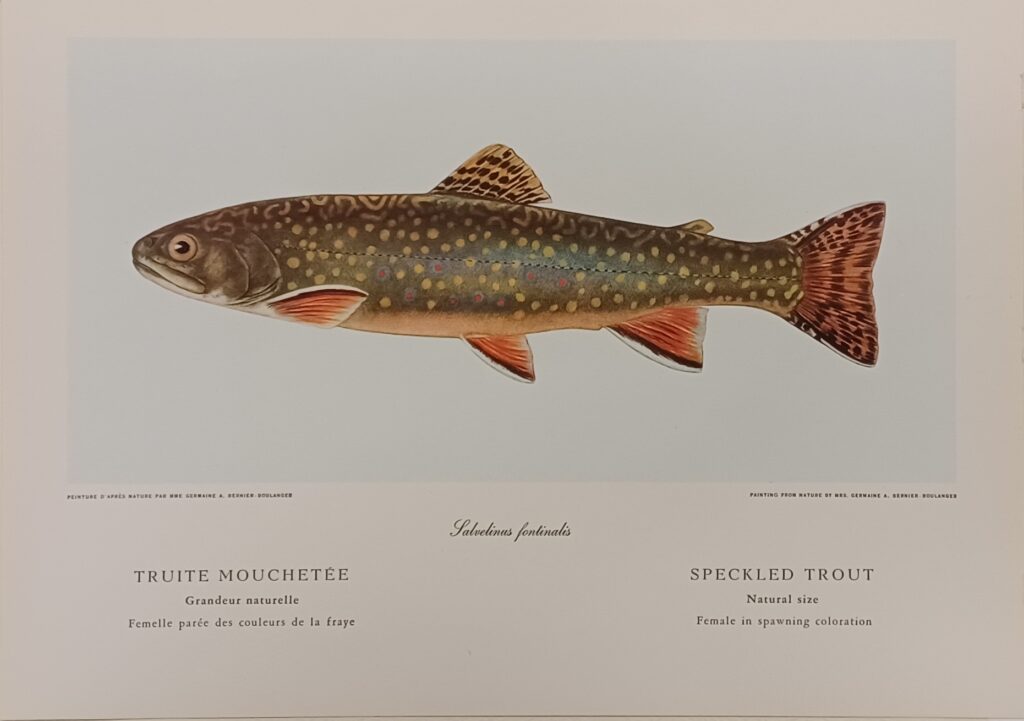
print of a speckled trout
Germaine A. Bernier-Boulanger, Salvelinus fontinalis, female (c. 1953), Print, 14.25 x 19.25 in., NHA 29.136-23 

A prime example of a woman who knew her worth as a scientist, educator, and artist, and settled for nothing less, is Germaine A. Bernier-Boulanger (1909-1989). Salvelinus fontinalis, female (c. 1953), a highly detailed, scientific illustration of a female spotted trout, is one of three prints in the collection by Bernier-Boulanger. Unlike the more painterly quality of Austen’s watercolors, Bernier-Boulanger’s work highlights the more research-intensive, “art for science’s sake” approach to wildlife illustration that contributed greatly to the discipline of non-photographic specimen documentation. Bernier-Boulanger had formally studied embryology and invertebrate zoology and didn’t become a professional illustrator until after the age of forty. Before focusing on her art, Bernier-Boulanger was employed at the Montreal Botanical Institute, and later, the University of Montreal, where she left her post as an educator after experiencing no change in her career trajectory, despite voicing her disapproval of the discrepancies in pay and career advancement between herself and her male colleagues in the natural sciences department. During Women’s History Month, it is especially important to tell the stories of women like Bernier-Boulanger, not only because of their knowledge, skill, and contributions to their respective fields, but also because they challenged long-standing discriminatory practices against women within the institutions they worked for, acting as catalysts for change.

Florence Malewotkuk

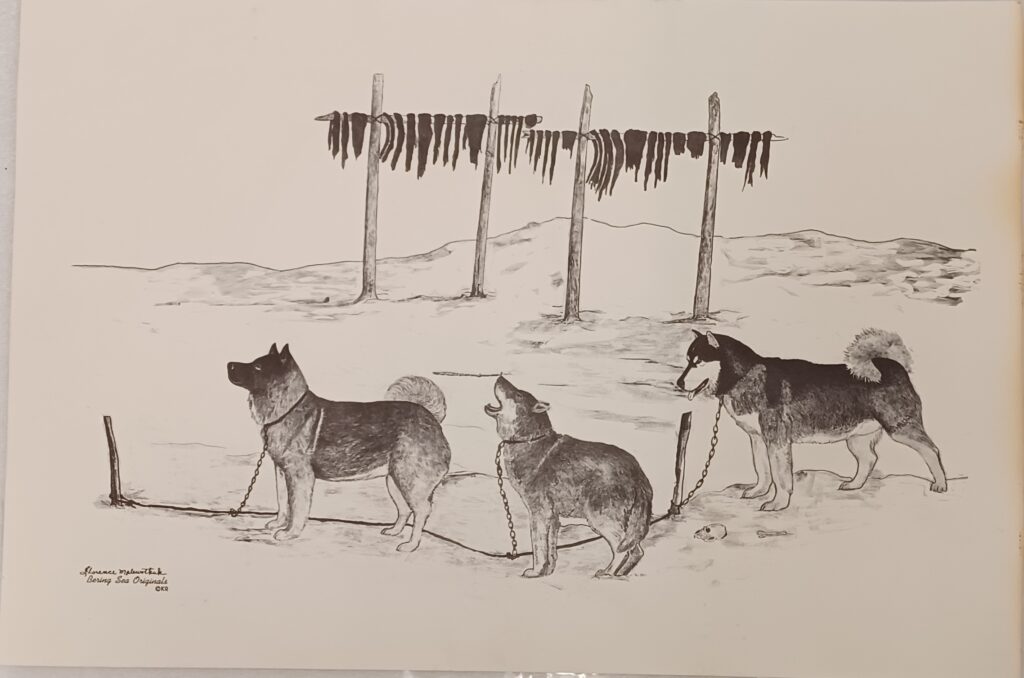
black and white drawing of three huskies
Florence Malewotkuk, Husky Dog Team (c. 1950s-60s), Print, 16 x 10.5 in., NHA 30.115-23 

Florence Malewotkuk (1906-1971) (Yup’ik) was born in a village on St. Lawrence Island on the Bering Sea, which is part of Alaska. Malewotkuk’s Husky Dog Team (circa 1950s-60s) is one of three prints by the artist in the collection by Malewotkuk, each part of a series she titled “Bering Sea Originals.” Depicting husky dogs lined up in front of drying pelts, this print, along with the others in the collection depicting walrus and polar bears, offers unembellished images of local wildlife, and the intersection with nonhuman animals and Yup’ik communities. Showing talent from an early age, Malewotkuk began working as a professional artist in her early twenties when commissioned by Otto William Geist, an archaeologist, to capture everyday scenes of Yup’ik life. Further commissions followed for Malewotkuk later in life, and today her art is housed in collections across North America. Malewotkuk’s story indicates the opportunities that art production offers to women, and the importance of having members of Indigenous groups, especially women, depict their culture from their point of view.

Deirdre E. L.

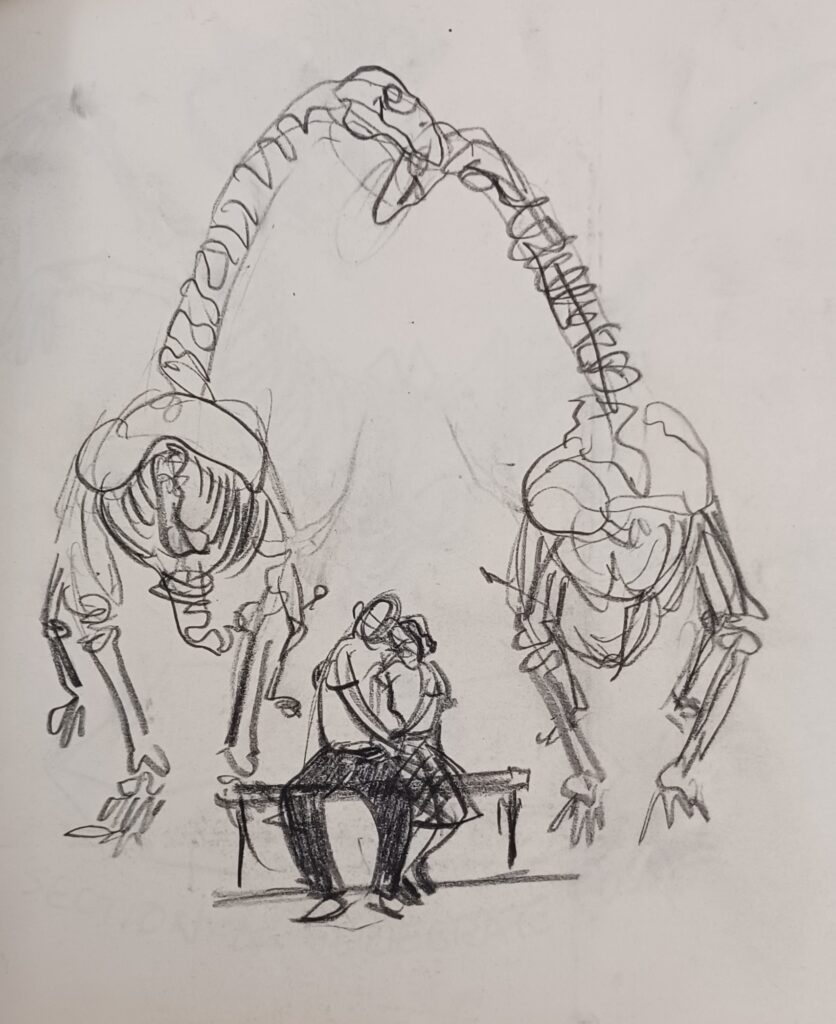
charcoal sketch of two people in front of two sauropod dinosaur fossil skeletons
Deirdre E. L., Untitled Sketch (c. 1940s), Charcoal on paper, 8.5 x 11 in.
Deirdre E. L., Untitled Sketch (c. 1940s), Charcoal on parchment, 9 x 6.5 in.

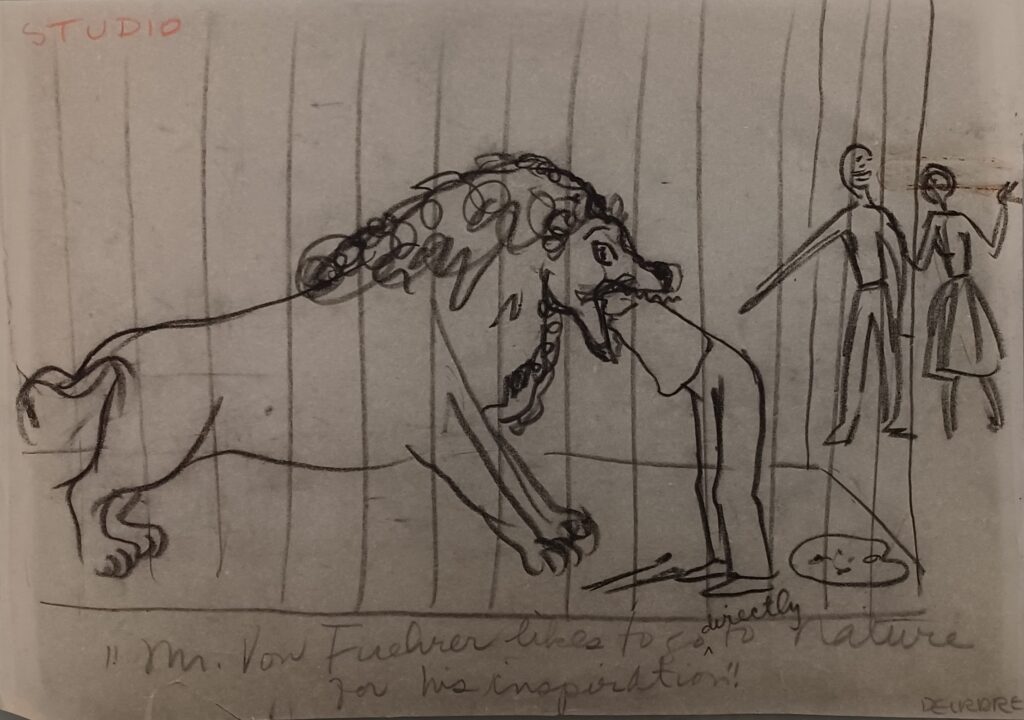
Tucked away in a drawer of archival ephemera in the Natural History Art Collection is a folder of comedic cartoon illustrations by the artist Deirdre E. L. With the signature “Deirdre” at the bottom of the sketches being the only source of information available on the artist, it would seem that we must let her work speak where a biography is absent. Perhaps designed for the amusement of CMNH staff or for print in museum publications, Deirdre’s sketches combine silly captions and quirky caricatures with relevant information about the museum. Her sketch of CMNH chief staff artist Ottmar Von Fuehrer jokes about his going “directly to nature” (by sticking his head in a lion’s mouth) for inspiration, and is a fine example of this fun dichotomy. Her heart-warming sketch of a couple embracing under an equally affectionate pair of dinosaur fossils captures her sketchy, endearing drawing style. 

In this brief survey, I hope to have captured a glimpse of the talented women artists and scientific illustrators in CMNH’s Natural History Art collection. As a History of Art and Architecture and Museum Studies student at Pitt, I have been very interested in exploring the many intersections that exist between the disciplines of art and natural histories, including questions like: What distinguishes a scientific illustrator from an artist, if there is any distinction at all? How do women fit into and contribute to these respective disciplines historically? And how do studies of gender reveal vital information about science and art history? I look forward to discovering new artists as I continue to work with the Natural History Art Collection as an intern, especially women whose presence in the collection inspire me to learn more about those who challenged, and continue to challenge, societal expectations and make lasting contributions to the worlds of art and science. 

Olivia Buehler is an intern in the Section of Anthropology at Carnegie Museum of Natural History.

Related Content

How I Became an Archaeologist

Mary Anning: For the Love of the Blue Lias

Echoes of Freedom in an Owl’s Call

Carnegie Museum of Natural History Blog Citation Information

Blog author: Buehler, Olivia
Publication date: March 19, 2024

Share this post!

  • Share on Twitter Share on Twitter
  • Share on Facebook Share on Facebook
  • Share on Pinterest Share on Pinterest
  • Share on LinkedIn Share on LinkedIn
  • Share on Reddit Share on Reddit
  • Share via Email Share via Email

Filed Under: Blog Tagged With: anthropology, Olivia Buehler, Science News, Women's History Month

March 5, 2024 by Erin Southerland

Carnegie Museum of Natural History Announces Kathy Hollis as Inaugural Director of Collections Care and Access

Kathy Hollis, Director of Collections Care and Access at Carnegie Museum of Natural History.

Following an international search, Carnegie Museum of Natural History (CMNH) welcomes Kathy Hollis as its inaugural Director of Collections Care and Access. The new leadership position exemplifies the museum’s strategic commitment to future-proofing its historic collections of approximately 22 million specimens and objects and making them more accessible to scientists and students around the world, as well as to visitors in Pittsburgh. Hollis officially joined CMNH on March 4, 2024.  

Since 2011, Hollis served as the Collection Manager for Paleobiology at the Smithsonian National Museum of Natural History in Washington, DC. In this role, she developed and implemented the collections management strategy for the National Fossil Collection, which includes some 40 million specimens. In addition to overseeing large collections acquisitions, moves, and facility upgrades, she managed numerous digitization projects. Prior to her time at the Smithsonian, Kathy served in several collections roles at the University of Colorado Museum of Natural History, where she received her M.S. in Museum and Field Studies. She also holds an M.S. in Geology from the Ohio State University and a B.A. in Geology from the College of Wooster.  

Hollis will report directly to Gretchen Baker, Daniel G. and Carole L. Kamin Director of Carnegie Museum of Natural History and Vice President of Carnegie Museums of Pittsburgh. She will manage staff across all the museum’s collecting areas: Anthropology, Botany, Mineralogy, Herpetology, Malacology, Mammalogy, Ornithology, Invertebrate Zoology, Invertebrate Paleontology, Paleobotany, and Vertebrate Paleontology. Hollis will lead initiatives to make the collections more accessible for research and public engagement and will also oversee conservation, archives, database systems, and registration. 

“The diversity of collections held in natural history museums can be dizzying—from pinned insects to dinosaur bones to human remains. And the issues in managing them are equally complex.” said Baker “This position emerged as a priority during our recent strategic planning process. We were looking for a leader to help us realize a future-forward vision for this historic collection and to knit together a novel cross-disciplinary team. We are thrilled to have found Kathy and can’t wait to welcome her to CMNH.”  

“I am honored to join CMNH’s incredible team dedicated to the values of scientific inquiry, shared experience, and sense of wonder and curiosity about our world,” said Hollis. “I am eager to help support the museum’s commitment to strong collections stewardship so that the collections in the museum’s care are accessible to the communities we serve. Having grown up along the Ohio River, I’m also excited to return to the Ohio River valley and call Pittsburgh home!” 

Filed Under: Press Release Tagged With: Science News

March 1, 2024 by Erin Southerland

When Nature Meets Art: Crinoid Fossils as Cultural Beads

by Elizabeth A. Begley and Albert D. Kollar

Did you know that invertebrate fossils make up more than 50% of the specimens on exhibit in Dinosaurs in Their Time (DITT)? It’s true! But these fossils can be easy to miss among the giant dinosaurs and vertebrate reptiles. Luckily, ongoing research on the biodiversity within our gallery spaces, from locations including England, Germany, and the United States, will help visitors better understand the importance of the Carnegie Museum of Natural History’s Invertebrate Paleontology collection research, exhibition, and education initiatives1. With few exceptions, these specimens are part of the vast Ernest de Bayet fossil collection purchased for the museum by Andrew Carnegie in 19031,2.

What are Crinoids?

Among these invertebrates are a unique group of sea bearing animals called crinoids. Crinoids are an ancient fossil group that belong to the phylum Echinodermata. Crinoids first appeared in the fossil record in the mid-Cambrian Period of the Paleozoic Era (490 – 250 million years ago) and became a significant group that formed mid-Silurian reefs in Dudley, Wales; Gotland Island, Sweden; and Milwaukee, Wisconsin. In the Mesozoic Era, crinoids formed the famous middle Triassic reefs of Germany3. Few crinoid groups live in oceans today. Examples of crinoids are on display in the museum’s Triassic Seas, Holzmaden, and Solnhofen dioramas (all locations in Germany)1. Crinoids are also called sea lilies because they look like flowers – but don’t be fooled, they’re animals! Crinoids are related to starfish, sea urchins, and brittle stars; this relationship can be noted in the crinoids five-part radial symmetry3,4. They lived on stems (or stalks) and attached to the sea floor by roots, as in the Triassic Muschelkalk Formation, but were floating animals in the Jurassic Holzmaden seas. They relied on waves and currents to bring small food particles past their petal-like arms which opened as a mode of filter-feeding micro-organic food3,4. Today, Crinoids are few in numbers living among shallow coral reefs and in the deep sea. The Bayet Collection of crinoid fossils are represented from the Silurian, Mississippian, and Triassic rock formations1.

Fig. 1. In DITT, you may see crinoid fossils such as the specimen sketched above, CM29840. This crinoid’s scientific name is Encrinus liliiformis and comes from the famous middle Triassic Muschelkalk Formation in Brunswick, Germany. This specimen was collected by Dr. Fredrick Krantz within the Bayet Collection. Several parts make up the crinoid. Once dead, the crinoid’s muscles decompose resulting in the disarticulation of the arms, calyx, stem, and individual columnals4. Most crinoid fossils are found in separate parts for this reason. Artwork by Elizabeth Begley. 

However, crinoid fossils are more than scientific material reserved for use by paleontologists alone, in fact, this invertebrate animal is unique as it gives us the opportunity to see how humans have long interacted with nature. Specifically, fossilized crinoid stems have been used in several communities and throughout history as beads. This is due to their small size, cylindrical shape, and the usual occurrence of a hole in the center (fig. 2). So, let’s explore how crinoid fossils have been used on different continents and in different eras of human history.

Fig. 2. CM63017 consists of crinoid parts from the Vanport Limestone, Lower Pennsylvanian age (~312 million years ago), Butler Co., PA. These crinoid fragments illustrate crinoid stem cross-sections and side profiles from the Invertebrate Paleontology collection. The cross-section view offers insight into the crinoid’s bead-like build. Artwork by Elizabeth Begley.

Crinoid Beads in North America

In Kentucky, amateur fossil hunters commonly refer to crinoid stem fossils as beads5 and the Illinois Archaeological Survey has reported “crinoid stems suggested to function as beads” at a historic site in Buckman Flats6. This finding joins crinoid stems already uncovered in Kickapoo territories in 2011 and 1992 as well as a 2001 discovery at a Potawatomi settlement6. To illustrate an example of historic beadwork by North American indigenous groups, Harvard’s Peabody Museum of Archaeology and Ethnology has published a photograph depicting a “string of prehistoric beads made from different sizes of fossilized crinoid stem[s]” discovered in Tennessee7.

Crinoid Beads in Asia

From the lower paleolithic period in Israel, a deposit at the archaeological site of Gesher Benot Ya’aqov revealed two “beadlike” crinoid fossils among stone artwork and polished wood artifacts. This collection is thought to hint at the group’s cognitive ability regarding the manipulation of nature for artistic and cultural purposes and has brought the hypothesis that lower paleolithic hominids collecting crinoid stems, among other marine objects, may be the origin of the modern bead shape8. The thought process behind this theory relies on our understanding that crinoids, and their fossilized stems, have existed for far longer than the modern bead has. Bednarik argues, “perhaps this is how the very concept came into being, and the humanly made disc beads were merely substitutes for the fossils that were in short supply”9.

Crinoid Beads in Europe

While there are several instances of crinoid stems being recognized in historic European art and culture, the cemetery at Zvejnieki in Latvia is a unique case as the stems, or “beads,” seem to be a part of funerary practice. Zvejnieki was in use during the region’s Mesolithic and Neolithic periods and rediscovered by archaeologists in the 1960s. Work at the site has continued and a re-analysis of a double burial revealed that a beaded ornament among the remains, previously believed to have been made of bird bone, is a string of fossilized crinoid stems10. This case brings us to an interesting question in assessing the use of fossils, such as crinoid stems, throughout human history, and the impact of such encounters on our current relationship with the natural world.

Fig. 3: Threaded crinoid beads. Photo credit: L. Larsson, CC BY¹⁰

So, the next time you walk through the museum, we invite you to take a closer look at the crinoids, and other invertebrate fossils on display, and imagine how else we may incorporate them in our lives!

Elizabeth A. Begley is Collection Assistant and Albert D. Kollar Collection Manger in the Section of Invertebrate Paleontology at Carnegie Museum of Natural History.

References: 

  1. Kollar, A.D., J. L. Wilson, and S.K. Mills. 2024. The Ernest de Bayet Fossil Collection at the Carnegie Museum of Natural History: A Century of Stewardship in Exhibition. Annals of Carnegie Museum.
  2. Wilson, J. L., A.D. Kollar, and S.K. Mills. 2024. Unraveling the 120 Year Mystery of Ernest Bayet and his Fossil Collection at Carnegie Museum. Annals of Carnegie Museum.
  3. Hess, H., W. I. Ausich, C. E. Brett, and M.J. Simms. 1999. Fossil Crinoids. Cambridge University Press.  
  1. Brezinski, D.K., and A.D. Kollar. 2008. Geology and Fossils of the Tri-State Region Learning/Activities/Coloring Book. PAlS Publication 8. 
  2. Kentucky Geological Survey. Identifying Unknown Fossils. https://www.uky.edu/KGS/fossils/fossilid.php
  3. Fishel, R. 2017. The Historic Indian Artifact Assemblage at Buckman Flats, Knox County, Illinois. Illinois Archaeology Vol. 29. 
  4. Peabody Museum of Archaeology and Ethnology. String of prehistoric beads made from different sizes of fossilized crinoid stem. Artstor. https://www-jstor-org.cmu.idm.oclc.org/stable/community.20420806
  5. Bednarik, R. 1994. The Pleistocene Art of Asia. Journal of World Prehistory, 8(4), 351–375. http://www.jstor.org/stable/25800655
  6. Bednarik, R. 2005 .Middle Pleistocene Beads and Symbolism. Anthropos, 100(2), 537-552. http://www.jstor.org/stable/40466555  
  7. Macāne, A. 2020. Petrified animals: Fossil beads from a Neolithic hunter-gatherer double burial at Zvejnieki in Latvia. Antiquity, 94(376), 916-931. doi:10.15184/aqy.2020.124 https://www.cambridge.org/core/journals/antiquity/article/petrified-animals-fossil-beads-from-a-neolithic-huntergatherer-double-burial-at-zvejnieki-in-latvia/A325BCCE572DA6DD3AE913E7C22C18C2

Related Content

Meet the Mysterious Mr. Ernest Bayet

Behind the Scenes with the Baron de Bayet and L.W. Stilwell Collection, Part 1: Crossing the Atlantic with a Boatload of Fossils

Bayet and Krantz: 16 Words (Part 1)

Carnegie Museum of Natural History Blog Citation Information

Blog author: Begley, Elizabeth A.; Kollar, Albert D.
Publication date: March 1, 2024

Share this post!

  • Share on Twitter Share on Twitter
  • Share on Facebook Share on Facebook
  • Share on Pinterest Share on Pinterest
  • Share on LinkedIn Share on LinkedIn
  • Share on Reddit Share on Reddit
  • Share via Email Share via Email

Filed Under: Blog Tagged With: Albert Kollar, Elizabeth Begley, invertebrate paleontology, Science News

  • « Go to Previous Page
  • Page 1
  • Page 2
  • Page 3
  • Page 4
  • Interim pages omitted …
  • Page 43
  • Go to Next Page »

sidebar

About

  • Mission & Commitments
  • Directors Team
  • Museum History

Get Involved

  • Volunteer
  • Membership
  • Carnegie Discoverers
  • Donate
  • Employment
  • Events

Bring a Group

  • Groups of 10 or More
  • Birthday Parties at the Museum
  • Field Trips

Powdermill

  • Powdermill Nature Reserve
  • Powdermill Field Trips
  • Powdermill Staff
  • Research at Powdermill

More Information

  • Image Permission Requests
  • Science Stories
  • Accessibility
  • Shopping Cart
  • Contact
  • Visitor Policies
One of the Four Carnegie Museums | © Carnegie Institute | Privacy Policy | Terms of Use | Accessibility
Rad works here logo