• Skip to primary navigation
  • Skip to main content
  • Skip to primary sidebar

Carnegie Museum of Natural History

One of the Four Carnegie Museums of Pittsburgh

  • Visit
    • Buy Tickets
    • Visitor Information
    • Exhibitions
    • Events
    • Dining at the Museum
    • Celebrate at the Museum
    • Powdermill Nature Reserve
    • Event Venue Rental
  • Learn
    • Field Trips
    • Educator Information
    • Programs at the Museum
    • Bring the Museum to You
    • Guided Programs FAQ
    • Programs Online
    • Climate and Rural Systems Partnership
  • Research
    • Scientific Sections
    • Science Stories
    • Science Videos
    • Senior Science & Research Staff
    • Museum Library
    • Science Seminars
    • Scientific Publications
    • Specimen and Artifact Identification
  • About
    • Mission & Commitments
    • Directors Team
    • Museum History
  • Tickets
  • Give
  • Shop

Blogs from our Scientific Researchers

Carnegie Museum of Natural History is home to active research and vast scientific collections. Our scientific researchers regularly contribute to the blog at the museum.

May 27, 2020 by wpengine

Mesozoic Monthly: Citipati

The month of May that we’re living in is very different from the one we all anticipated at the start of the year. However, society somehow manages to march on. College students are still graduating, moms are still being celebrated, and Mesozoic Monthly continues! Our honoree for the month of May is known to have been a dedicated parent due to several specimens that show adults guarding eggs. Say hello to Citipati osmolskae!
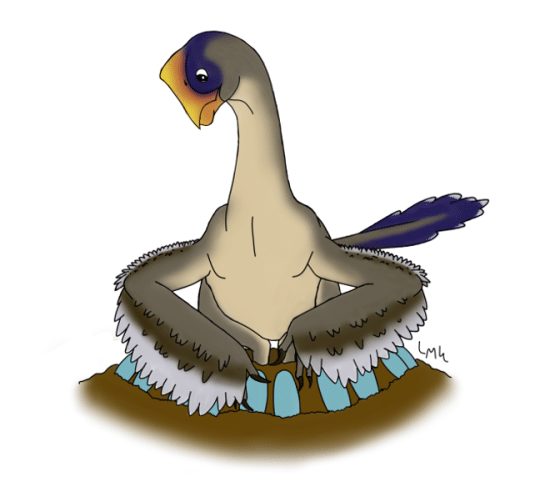
illustration of Citipati, a dinosaur that looks similar to a bird, on a nest of blue eggs

A devoted Citipati parent guarding its nest. Some evidence suggests that the Citipati skeletons found atop nests may have been males (rather than females as was originally thought). Also, recent research indicates that—believe it or not—oviraptorid eggs were blue! Art by ginjaraptor on DeviantArt.

It might not look like it, but Citipati is a theropod, like the more famous dinosaurs Tyrannosaurus, Allosaurus, and Velociraptor. Most theropods were carnivores, sporting skulls with big toothy grins, but not all theropods were ravenous predators! There are several groups of theropods that evolved toothless beaks for specialized diets. One of the stars of Jurassic Park, Gallimimus, was part of a predominantly herbivorous group of beaked theropods called Ornithomimidae. Citipati belongs to another group of beaked theropods called Oviraptoridae. “Oviraptor” means “egg thief,” in reference to an old hypothesis that oviraptorids stole and ate eggs from other dinosaurs’ nests. The discovery of a Citipati skeleton perched in a brooding position atop a nest of eggs was pivotal in changing this idea. We now know that instead of stealing others’ eggs to eat, fossilized oviraptorids preserved near eggs were actually protecting their own eggs! The eggs in an oviraptorid’s nest were arranged in circles with a space in the center for the parent to sit and spread their feathered arms over their incubating young.
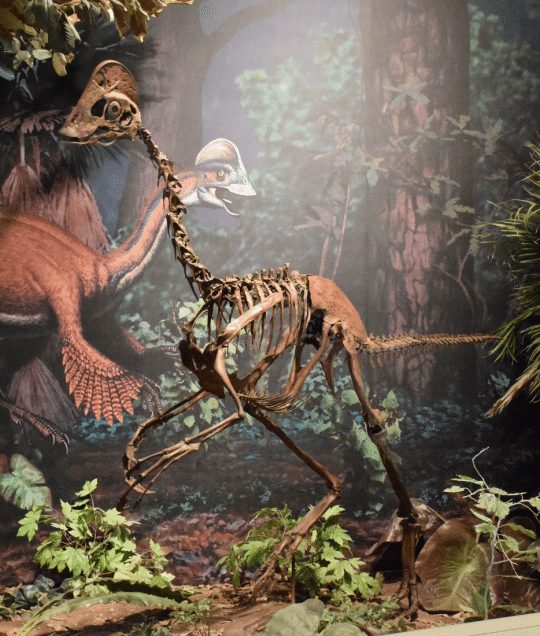
photograph of Anzu dinosaur fossil

Citipati and other oviraptorids are closely related to one of Carnegie Museum of Natural History’s most bizarre dinosaurs, the ‘Chicken from Hell’ Anzu wyliei, shown here on display in the museum’s Dinosaurs in Their Time exhibition.

So, instead of eggs, what would the toothless beak of Citipati have been used to eat? Because most oviraptorid beaks are very deep, like those of modern parrots, most paleontologists infer that these dinosaurs ate mostly plants. However, this doesn’t necessarily mean that meat was off the menu; it would still have been possible for oviraptorids to have eaten small animals, making them omnivores. On top of its thick skull, Citipati possessed a tall, triangular crest that gave its small head a square-shaped profile. This crest was not as impressive as those on some other dinosaurs, but since Citipati grew to ten feet (three meters) long, the animal would still have been quite imposing. I certainly wouldn’t want to get between a Citipati parent and its eggs!

Citipati fossils are found in the modern Gobi Desert of Mongolia, in rocks known as the Djadokhta Formation. The Djadokhta rocks are made of sediments that were deposited late in the Cretaceous Period, preserving details of the ecosystem that existed there roughly 80–75 million years ago. The name Citipati means “funeral pyre lord,” which is fitting due to the hot environment in which this oviraptorid lived. Also, Citipati shares its name with a Buddhist deity that is believed to protect cemeteries from thieves, which is an appropriate parallel considering how the skeleton of this dinosaur was found guarding its fossilized nest.

Although the habitat Citipati lived in was a desert, like the Gobi Desert that is there today, this prehistoric desert was probably not as dry. In the event of rain, water gathered in temporary streams that drained the water to basins and oases. Since desert rain events are by definition few and far between, any animals that did not live near these oases would have needed to have adaptations for going without water for a long period of time. Some of the animals that lived in this unwelcoming environment alongside Citipati included everyone’s favorite small theropod Velociraptor, the hornless ceratopsian Protoceratops, and the tail-club wielding ankylosaur Pinacosaurus.

Lindsay Kastroll is a volunteer and paleontology student working in the Section of Vertebrate Paleontology at Carnegie Museum of Natural History. Museum staff, volunteers, and interns are encouraged to blog about their unique experiences and knowledge gained from working at the museum.
Filed Under: Blog Tagged With: dinosaurs in their time, Lindsay Kastroll, Mesozoic Monthly, Museum from Home, Science News, Vertebrate Paleontology

May 21, 2020 by wpengine

The Bromacker Fossil Project Part III: Fossil Preparation

New to this series? Read The Bromacker Fossil Project Part I and Part II.

Most of the important fossil discoveries from the Bromacker quarry, located in the Thuringian Forest, central Germany, were shipped to the Carnegie Museum of Natural History (CMNH) for scientific preparation. Between 1993 and 2005 I was the principal preparator of Bromacker fossils.

At CMNH the arrival of a field season’s worth of fossil crates was highly anticipated by Curator Dr. Dave Berman and myself. I’d be often notified of the crate’s early morning delivery by either a grinning security guard or shipping and receiving personnel upon my arrival at the museum. Later that day it would take a team of able-bodied staff from various departments to move the crate from the loading dock to the basement preparation lab, and to lift the plaster and burlap encased block from the crate onto a table.

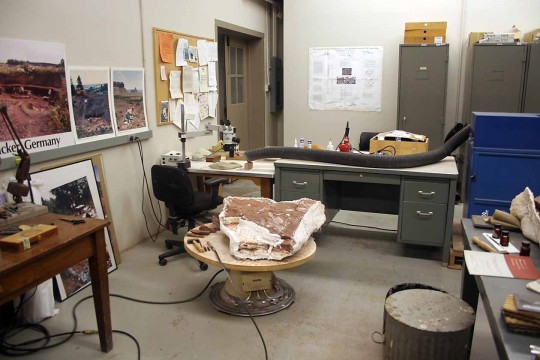
photo of fossil preparation lab
My work area in the basement preparation lab. The table in the center is my main work table and is a made from a dentist chair. The blue cabinet with a hose extending from it is a dust collector, and the microscope (seen at the end of the hose) is mounted on an articulated arm to make it easier to maneuver over a block. Photo by the author, 2007.

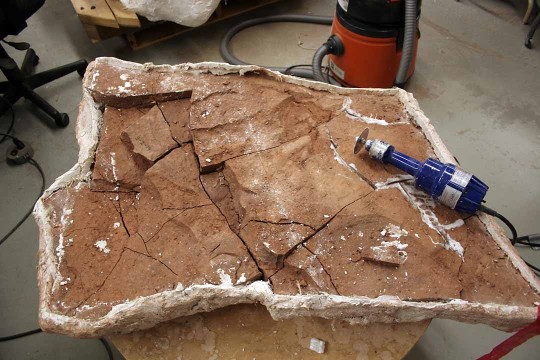
The first step of the preparation process involved opening the block; that is, removing the top of the jacket. I’d use a cast cutter, the same tool doctors use to remove a cast protecting a person’s broken bone, to cut through the top perimeter of the plaster jacket. If all went well, the top would easily lift off the block. But if the top of the jacket stuck to the block or wedged in an undercut, I’d have to cut it into smaller pieces to remove it.

photo of fossil preparation: a block of rock with a cast cutter on top
The block collected in the 2006 field season with its top removed. Exposed bone can be seen left of center. The blue tool resting on the surface of the block is a cast cutter.

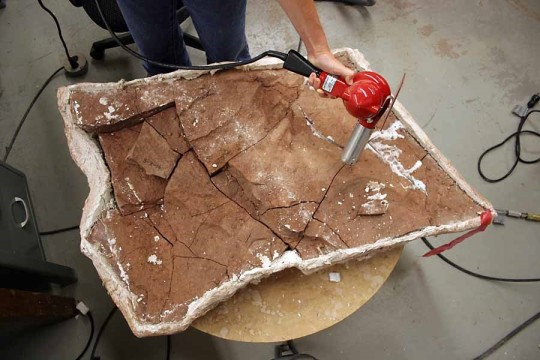
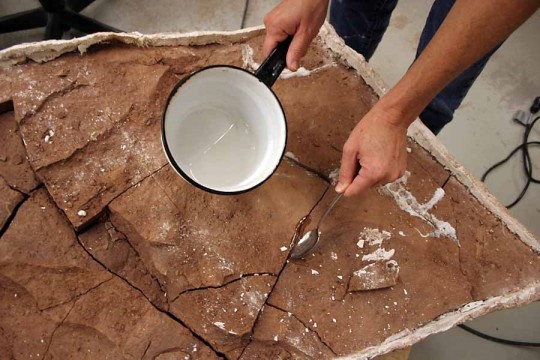
Blocks from the Bromacker quarry typically have numerous cracks coursing through them, which must be stabilized before preparation begins. The product Carbowax works well for filling cracks, because, unlike plaster, it doesn’t shrink when it solidifies. Carbowax comes as a powder, which I’d melt it in a double boiler. Before pouring the hot wax into a crack, I’d heat the surrounding rock with a heat gun so that the wax could penetrate additional cracks not visible from the surface. I’d typically repeat this process numerous times during the preparation process.

image of using a heat gun on a slab of rock in the process of fossil preparation
Using a heat gun to heat the rock before pouring wax into a crack. I’d have to carefully watch the direction I aimed the heat gun so that strands of burlap sticking out of the plaster jacket wouldn’t catch fire. Photo by Norman Wuerthele, 2007.

image
Spooning hot Carbowax into a crack. The spoon was heated beforehand so that the wax wouldn’t solidify on it. It was a delicate balance between getting the spoon hot enough so the wax stayed melted but not so hot that the spoon handle burned my hand. Photo by Norman Wuerthele, 2007.

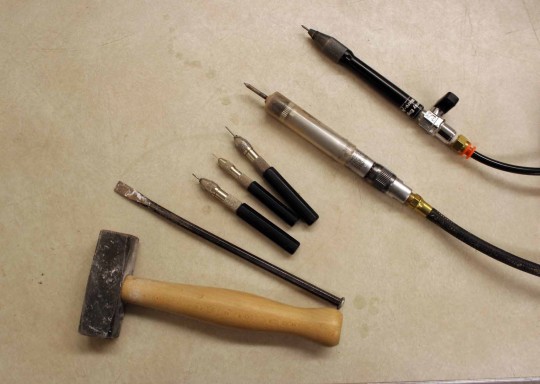
Once the block was stabilized, I began removing rock to expose the fossil. Where thick rock covered the fossil – and it sometimes was more than six inches – I’d use a small hammer and chisel to chip away chunks of rock. As I’d get closer to the fossil, I’d switch to an airscribe, which can be likened to a miniature pneumatic jack hammer. Although fossilized bone from the Bromacker was softer than the surrounding rock, the airscribe would flake the rock from the fossilized bone, leaving behind a thin veneer of rock that I’d remove using a pin vise. I’d also use the pin vise to scrape rock from bone in tight and/or delicate areas, such as teeth. All this work was performed while looking through a microscope.

photo of seven tools used for fossil preparation
Pictured are the tools that I’d use the most when preparing Bromacker fossils. From bottom left to upper right: small hammer and chisel, three pin vises that hold a rod of tungsten carbide of varying thickness and ground to different shaped tips, and two airscribes. Photo by the author, 2007.

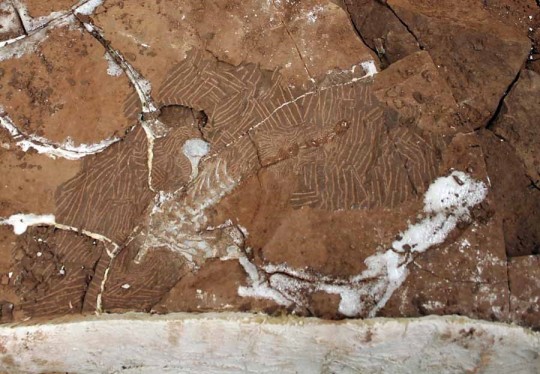
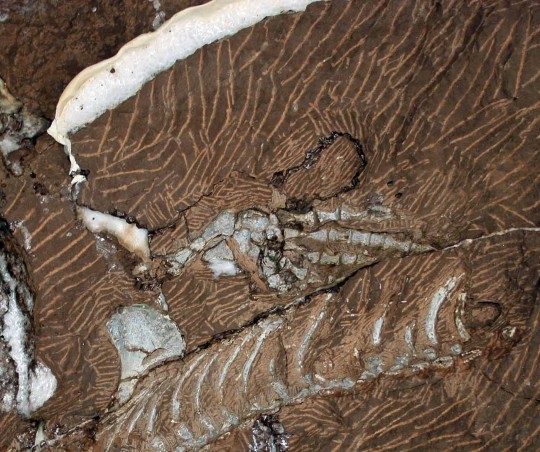
In the block pictured in this post, I could see some tips of some vertebral spines (these are the bumps that you feel down the midline of your back) poking from the rock surface, so I began exposing them first. Because I was working on an articulated specimen (one bone connected to the next bone), I exposed it from front to the rear by simply following one bone to the next bone.

image
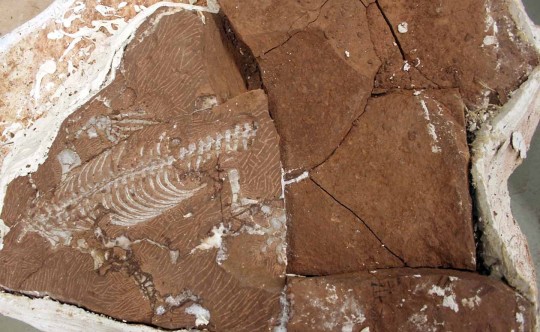
The skeleton emerging from the rock—vertebrae, ribs, and the right upper arm bone (humerus) are visible. Notice also the tips of vertebral spines leading away from the exposed portion of the skeleton. The lines in the rock were made by the airscribe. The white substance along cracks is Carbowax. Photo by the author, 2007.

image
Closeup view of the right foreleg and ribs. Horizontal cracks underneath the fossil made preparation difficult, because they formed gaps underlying the bone. I had to build a dam (upper left) to contain the hot wax so that the wax would penetrate the horizontal crack underlying the bone, instead of running all over the block. Photo by the author, 2007.

image
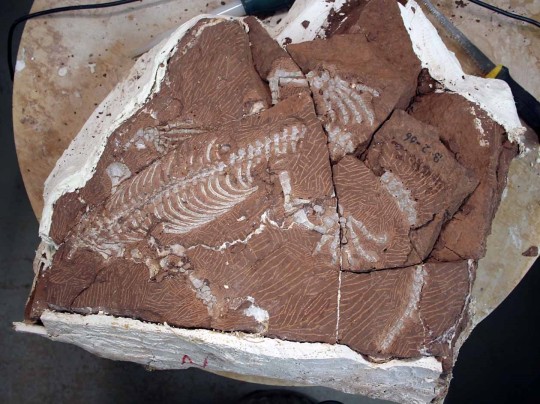
More of the fossil skeleton is exposed, including the torso, the right foreleg, part of the left foreleg, and most of the left hind leg. Photo by the author, 2007.

Parts of the hind legs and tail were collected separate from the block, because rock pieces containing them inadvertently had been tossed on the dump pile. This occurred before the specimen had been discovered, and the bone in these pieces was covered by mud and dirt. Instead of gluing them back in the block before preparation, I prepared them individually at a table under the microscope, as it made for easier viewing. Once all the fossil had been exposed and prepared, I removed excess rock to make the block smaller and lighter weight.

image
My work on the block has been completed, except for adding some plaster bandages to the end where I had removed excess rock to make the block smaller and lighter. Photo by the author, 2007.

Dave Berman and I later transported the block to a colleague’s lab at the University of Toronto, Mississauga, Canada, where the lab staff and students completed detailed preparation and scientific illustrations of the specimen. This specimen along with several others were recently described as a new genus and species, Martensius bromackerensis, in a paper published in the Annals of Carnegie Museum. This ancient creature will be the topic of a future post. To whet your appetite, here is a link to the news release announcing the publication.

Amy Henrici is Collection Manager in the Section of Vertebrate Paleontology at Carnegie Museum of Natural History. Museum employees are encouraged to blog about their unique experiences and knowledge gained from working at the museum.
Keep Reading

The Bromacker Fossil Project Part IV: Diadectes absitus, A Project-Saving Fossil

Filed Under: Blog Tagged With: Amy Henrici, Museum from Home, Science News, Section of Vertebrate Paleontology

May 18, 2020 by wpengine

Garden for the Birds (or bees, or butterflies, or creepy crawlies, or you get the picture)…

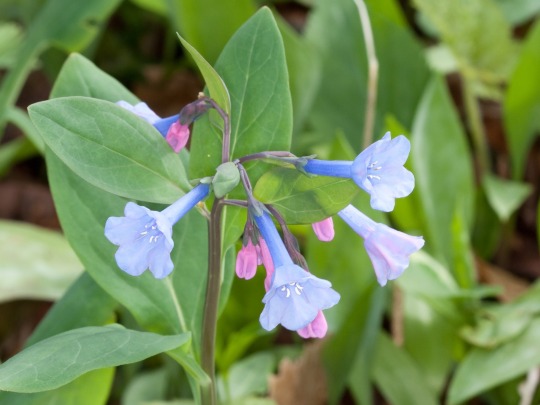
detail photo of blue and pink flowers

“What do I plant?” you may be wondering as spring starts to set in. Maybe you are a master gardener, or maybe you are a novice trying to fill the time during quarantine. Nevertheless, putting plants in the ground is on your mind. What if I told you that choosing native plants over non-native ornamentals does more than create a beautiful landscape – it creates habitat for native wildlife, connects our backyards to bigger natural landscapes, and can help mitigate negative impacts of environmental change.

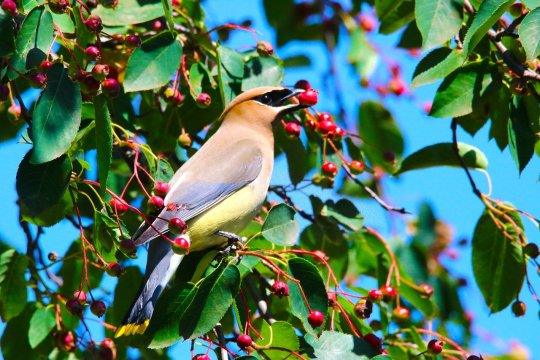
photo of cedar waxwing on a serviceberry branch with a berry in its mouth

Native plants are the plants that occur naturally in the area, and they have evolved with the local environmental conditions and other plants and wildlife that occur in the area. Because of this, native plants often provide the necessary shelter and food needed for local wildlife while requiring little to no fertilizers, pesticides, or water after they are established. Having more native plants in your backyard increases wildlife habitat, reduces air pollution (no mowing required!), decreases erosion (choose plants with deep root systems over non-native grassy lawns), reduces chemicals and excess water use (easy maintenance!), and adds natural beauty to your very own backyard or patio!

Imagine a world where our backyards, patios, and shared spaces are full of native plants – creating a completely connected world full of beautiful plants and providing food and shelter for wildlife. Our landscapes don’t have to be “Developed” OR “Wild”. Our landscapes can be a mosaic of varying levels and sizes of native habitats and local ecosystems – but always with some habitat, connecting one place to the next.

If you want to know more about the benefits of native plants, the sites below are a good place to start.

Benefits of Native Plants for Birds and People

Where I found my inspiration to plant native 

What do I plant? 

Heather Hulton VanTassel, PhD is the Carnegie Museum of Natural History’s Assistant Director of Science and Research. Museum staff, volunteers, and interns are encouraged to blog about their unique experiences and knowledge gained from working at the museum.
Filed Under: Blog Tagged With: Anthropocene, Anthropocene Living Room, Heather Hulton VanTassel, Museum from Home, Science News, We Are Nature 2

May 18, 2020 by wpengine

Air Quality and Urban Gardening

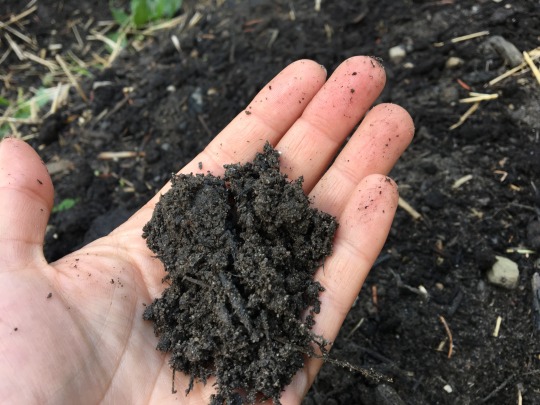
close up photo of hand full of soil

Transforming my ultra-tiny backyard into a garden has been a kind of mental, physical, and spiritual therapy for me during this COVID-19 pandemic. It’s work, even at this scale. But is it healthy? I’m new to Pittsburgh, and unlike my past community gardening experiences at places with better air quality and soil ratings, I now wonder if it’s safe to eat the plants I grow. When I look at the soil, I wonder what more than 150 years of air pollution has done to it. How can I amend past damage, manage the current risks and then eat from it?

I’m not alone in this work. Before I dive in, I want to share a quote by Robin Wall Kimmerer, author of Braiding Sweetgrass: Indigenous Wisdom, Scientific Knowledge and the Teachings of Plants:

“Even a wounded world is feeding us. Even a wounded world holds us, giving us moments of wonder and joy. I choose joy over despair. Not because I have my head in the sand, but because joy is what the earth gives me daily and I must return the gift.”

Professional advice guided my urban garden work. If you are contemplating a similar project, information at the sites listed below will be valuable.

Resources: amending the soil, soil testing, garden planning, and a cool foraging app

Grow Pittsburgh: Info Hub

University of Minnesota: How to Manage Soil and Nutrients in Home Gardens

Phipps Conservatory: Modifying PH Levels in Soil

Falling Fruit – Map the Urban Harvest!

Resources: dangers and benefits of urban gardening and foraging

The Geological Society of America: Hunting Down Hidden Dangers and Health Benefits of Urban Fruit

EurekAlert!: Risk of Lead Poisoning from Urban Gardening is Low, New Study Finds

Oxford Academic: Phytoremediation of Lead: What Works, What Doesn’t

First Step: Soil Test

The work I did to make my soil safe for gardening began with a soil test. A City of Pittsburgh site directed me to a Penn State University Agriculture Extension Office, where for a $9.00 fee, postage to mail a soil sample, and a couple of weeks’ time for testing, I learned that my typical Pittsburgh soil is full of clay and in need of compost and lime.

My front yard faces a busy intersection and contains lead and other contaminants. I decided to try phytostabilization, which is a cheap way to use plants, lime, and compost to both reduce the mobility of heavy metals in the soil and lower the bioavailability of contaminants to the food chain. I wore a mask and gloves when I tilled this soil because contaminants can bind to soil particles and can be inhaled. I mixed some nearby oak leaves into the soil to break up the clay, mixed in some lime, and planted sunflowers. (Any additions of lime should be done according to package directions about how much to use and when to plant.)

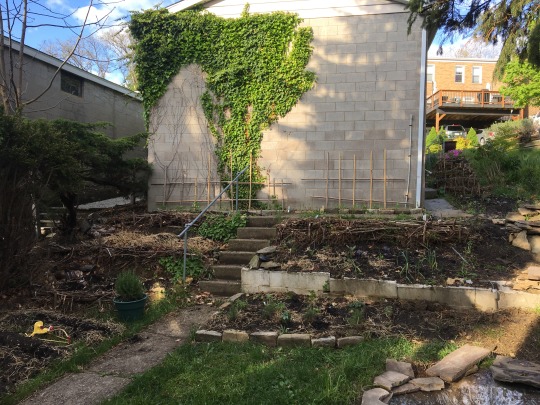
photo of a backyard garden under construction

Soil conditions in my backyard were better, requiring only lime to adjust the pH and lots and lots of compost. The backyard is where I will grow vegetables. I learned during my research that pH and compost are the key elements to healthy soil. If the air quality fluctuates during the gardening season, I will be fine as long as I wash the produce thoroughly before consuming and wash my hands after gardening. Now, after long days of online meetings, I’m able to retreat to my garden and, in good way, work myself tired. I feel better now. I feel happy.

I confess, I’m a renter, and I’m doing this work (with my landlord’s approval of course) even though I don’t own the property. My homeowner neighbors ask me why I care and put in so much energy and money into something I don’t own. I think it’s an easy answer: I live here for now, and I do this work to improve my quality of life, and because “joy is what the earth gives me daily and I must return the gift.”

Asia Ward is CMNH Anthropocene Program Manager and Science Communication Fellow. Museum staff, volunteers, and interns are encouraged to blog about their unique experiences and knowledge gained from working at the museum.
Filed Under: Blog Tagged With: Anthropocene, Anthropocene Living Room, Asia Ward, Museum from Home, Science News, We Are Nature 2

May 14, 2020 by wpengine

The Bromacker Fossil Project Part II: The Hunt for Fossils

New to this series? Read The Bromacker Fossil Project Part 1 here.

Finding fossils at the Bromacker quarry was tedious and physically demanding, but it was extremely rewarding when a fossil is discovered. Our annual summer field season generally lasted three and a half weeks. Because the weather usually wasn’t conducive to camping or cooking outdoors, we stayed at the same hotel and dined at the hotel or local restaurants.

The original 1993 fossil quarry was opened using heavy equipment and operators from the nearby commercial quarry, and in the early years we relied on these people to expand the fossil quarry’s boundaries as needed. When the commercial quarry was temporarily shut down due to the lack of contracts for building stone, our collaborator Dr. Thomas Martens fortunately was able to obtain funding to annually rent a Bobcat, which he became skilled at operating. Thereafter, Thomas would use the Bobcat to expand the quarry and remove soil and weathered rock layers, so that we could begin our yearly excavation on unweathered rock.

image
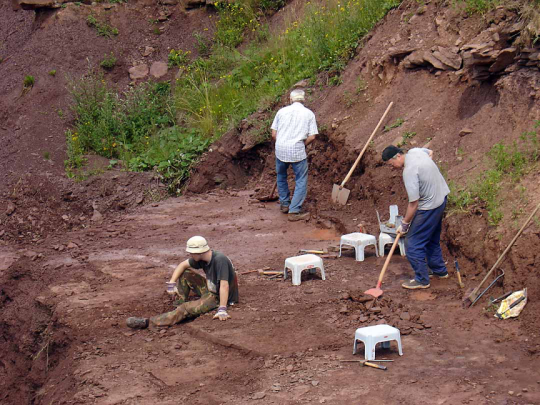
The Bromacker quarry on the first day of fieldwork in the 2006 field season. Shovels were used to clear loose rock from the surface of the quarry. Pictured (counterclockwise from left) graduate student Andrej Čerňanský and Dr. Jozef Klembara (Comenius University, Bratislava, Slovak Republic) and Dr. Dave Berman (Carnegie Museum of Natural History [CMNH]). Photo by the author, 2006.

We would each stake out an area of the quarry to work in and then proceed to work through the rock layers by using a hammer and chisel or pry bar to free a piece of rock. Its surfaces and edges would be checked for fossil bone, and if there was none, the rock piece would be broken into smaller pieces, which were also checked for bone. As is the case at many other fossil sites, the rock tended to split along the plane a fossil was preserved in, because the fossil would create a zone of weakness.

image
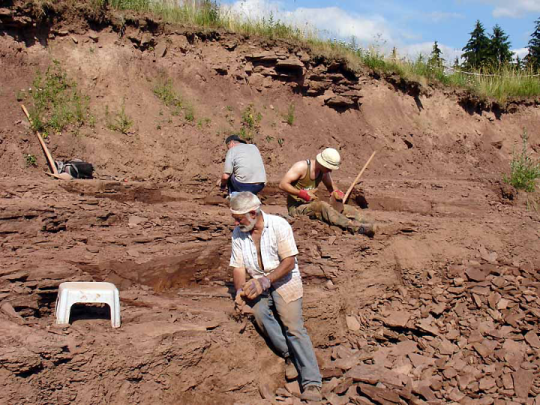
The quarry after a couple days of excavation. Pictured (clockwise from front) are Dave Berman, Jozef Klembara, and Andrej Čerňanský. Photo by the author, 2006.

Once a fossil specimen was discovered—and there were a few frustrating years when this didn’t happen—the hard work of extracting it from the quarry began. Here, I’ll use a fossil discovered during the 2006 field season as an example of how this was done.

image
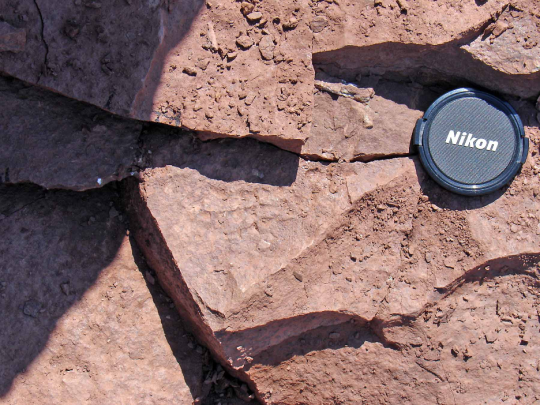
A discovery! Fossil bone and bone impression are exposed to the left of the lens cap. Photo by the author, 2006.

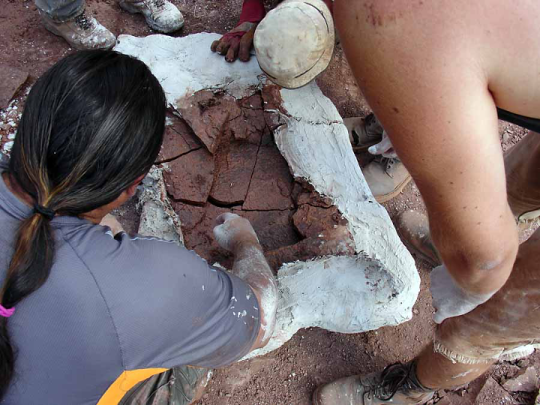
First, we would isolate the fossil specimen from the surrounding rock, exposing as little of the fossil as possible while determining its extent, because it would have been easy to lose pieces of bone in the dirt and mud. Then we would encase the specimen in a plaster and burlap jacket to protect it during extraction, shipping, and preparation.

To make the jacket, we’d coat cut strips of burlap in wet plaster and then spread them across the surfaces of the rock containing the specimen, or block. A layer of plastic (plastic bags worked well) was applied to the top surface of the block to keep plaster from sticking to any exposed bone.

image
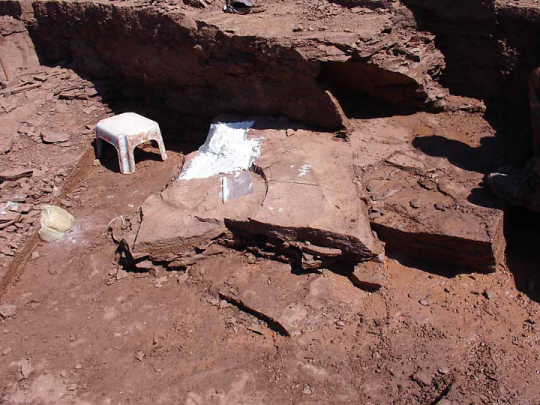
The block is partially isolated from surrounding rock. In this case, we decided to encase the top and some sides of the block in plaster and burlap bandages to hold the rock pieces together before we finished isolating the block from surrounding rock. Photo by the author, 2006.

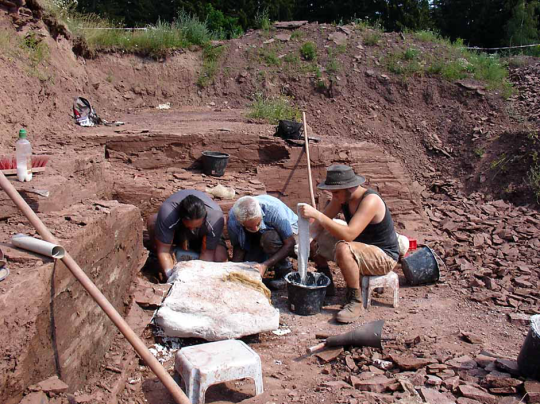
After a couple layers of plaster bandages were applied to the top and sides of the block, the block was undercut, with plaster bandages added periodically to hold the undercut rock in place.

image
Pictured (left to right) are Dr. Stuart Sumida (California State University, San Bernardino, CA), Dave Berman, and Mr. Jerome Gores (Museum der Natur, Gotha [MNG]). Jerome is holding a plaster and burlap bandage while Dave and Stuart are pressing plaster bandages against the bottom of the block. They must hold the bandages in place until the plaster sets. Photo by the author, 2006.

image
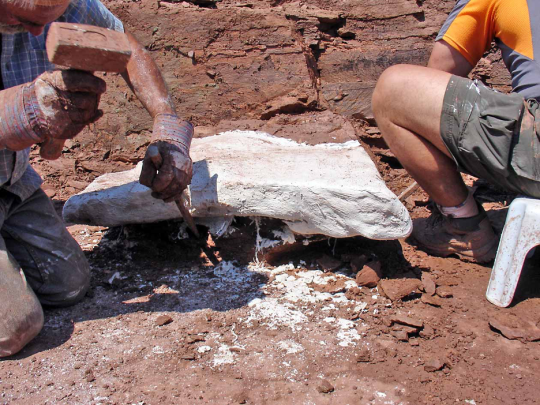
Using hammers and chisels to undercut the block. Photo by the author, 2006.

When deemed safe, we would crack the block free from the quarry floor using hammers and chisels, and flip it over, unless it broke free on its own. Excess rock would be removed from the bottom of the block to make it lighter in weight. Then we would apply burlap and plaster bandages to the bottom of the block. The block would be removed from the quarry and stored at the MNG until it was shipped to Pittsburgh.

image
The block has now been safely flipped over and excess rock is being removed. Photo by the author, 2006.

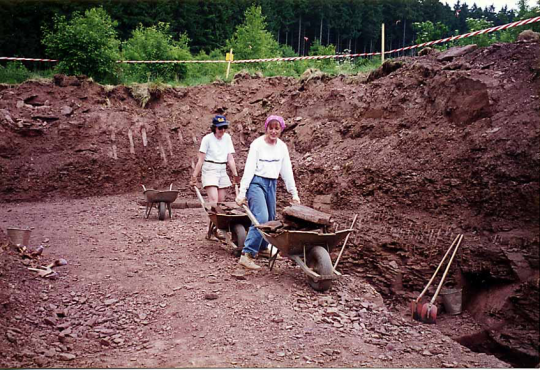
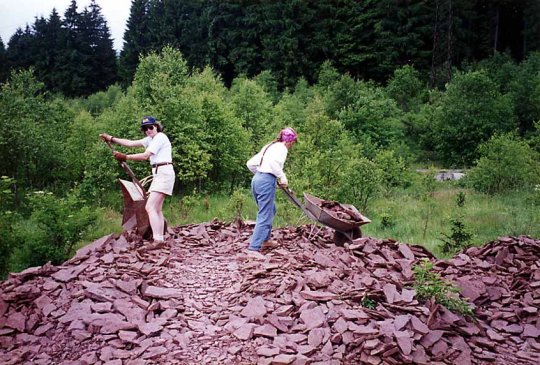
We encountered several problems during our quarry operations over the years. As we worked our way through the rock column in the quarry, processed rock piled up on the quarry floor. In the early years, we tossed or shoveled the processed rock into wheelbarrows and pushed the heavy, unwieldy wheelbarrows out of the quarry to a dump pile. Fortunately, the Bobcat eventually replaced the wheelbarrows for moving processed rock. As we ran out of space outside the quarry to dump processed rock, the rock was used to backfill older portions of the quarry.

image
Former CMNH volunteer Linda Rickets (front, right) and the author (left, rear) line up to push loaded wheelbarrows out of the quarry to the dump pile. Photo by Dave Berman, 1996.

image
At the dump pile. Over time rain and the freeze/thaw cycle would break down the rock and vegetation would grow on it. Photo by Dave Berman, 1996.

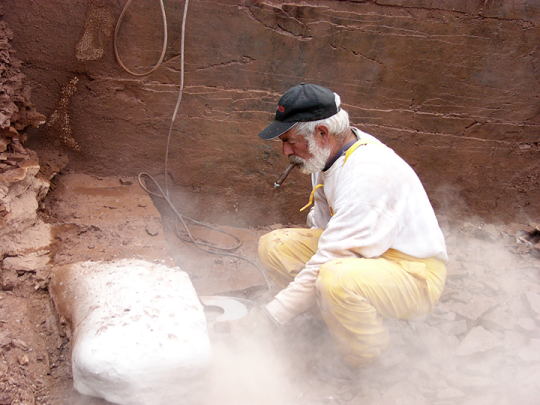
Another problem was that fossils found at the bottom of the quarry were often extremely difficult to undercut because the rock so was hard. Sometimes a well-hit chisel would just bounce off the rock instead of cracking or penetrating it. One year we had to resort to a rock saw to undercut a block.

image
Dave Berman uses a rock saw to undercut a block. Photo by the author, 2004.

Rain was always a problem. We would shelter in our cars during intervals of rain, or work at the museum if the rain was heavy and persistent. Occasionally heavy rain would flood the quarry, forcing us to work in the ‘dry’ areas of the quarry while a pump drained the water. Of course, we had contests to see who could skip a rock the farthest or make the biggest splash.

image
A flooded quarry greeted us in the morning after heavy overnight rain. Pictured are Thomas Martens (front) and Stuart Sumida (rear). Photo by the author, 2010.

Next week’s post will describe the process of fossil preparation, that is, removing rock to reveal a specimen in the lab. The fossil collected in the 2006 field season will be used as an example.

Here are some videos taken by taken by Thomas Martens’ wife, Steffi, during the 1993 and 2006 field seasons. These show the process of searching for fossils (1993 video) and collecting the fossil highlighted in this post (2006 videos).

Bromacker Quarry 1993

https://youtu.be/DAEG0l1NotE

Bromacker Quarry 2006

https://youtu.be/UNL1s5ycJSM

https://youtu.be/lqYxheOZLQY

https://youtu.be/HrmSBrhde_E

Amy Henrici is Collection Manager in the Section of Vertebrate Paleontology at Carnegie Museum of Natural History. Museum staff, volunteers, and interns are encouraged to blog about their unique experiences and knowledge gained from working at the museum.
Keep Reading

The Bromacker Fossil Project Part III: Fossil Preparation

Filed Under: Blog Tagged With: Amy Henrici, dinosaurs in their time, fossils, Museum from Home, Science News, Vertebrate Paleontology

May 1, 2020 by wpengine

The Giant Eurypterid Trackway: A Great Fossil Discovery on Display in the Carnegie Museum of Natural History

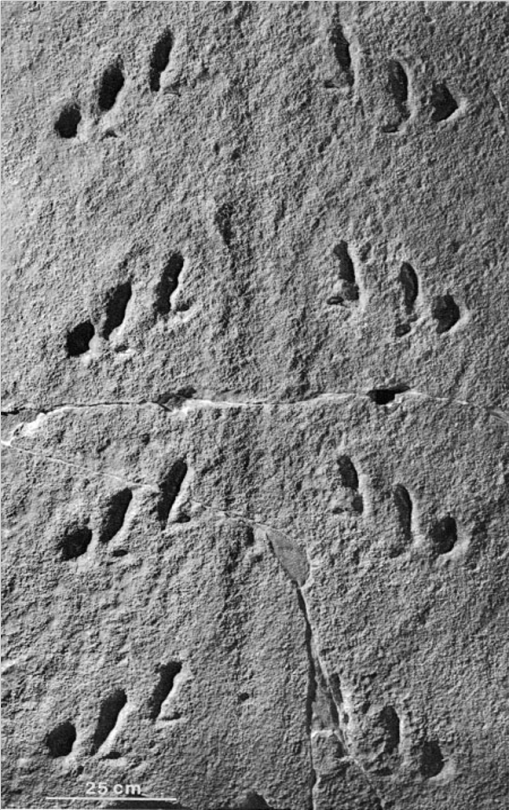
Figure 1.

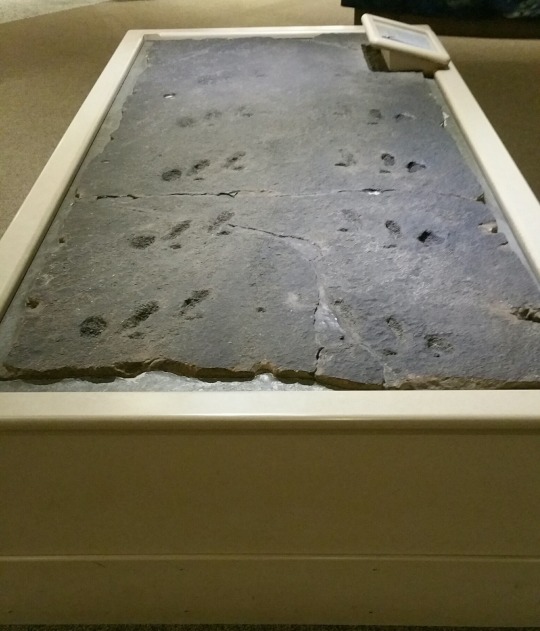
When museum patrons enter Carnegie Museum of Natural History’s Benedum Hall of Geology, they encounter a one-ton block of coarse sandstone with a series of bilateral footprints encased on the rock’s surface. Most visitors don’t know what type of creature made these footprints (Fig. 1) or realize that this fossil trackway represents one of the great fossil discoveries in the history of western Pennsylvania paleontology.

Figure 2. Illustration by Kay Hughes.

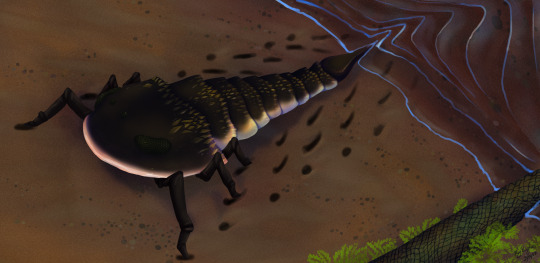
Last month, the cover of Pennsylvania Geology (Fig. 2) helped address both deficiencies. The magazine bears a colorful illustration by Kay Hughes of a 315 million-year-old scene: a large six-legged arthropod emerging from the water and dragging its tail onto a sand bar among fallen Lepidodendron logs. The intruder is a Giant Eurypterid, a creature known to science as Palmichnium kosinskiorum, and a member of an extinct family of arthropods informally called “sea scorpions” that are distant biological cousins.

Within the journal is a fuller explanation for the artistic interpretation of the creature behind the Benedum Hall trackway, an article I co-wrote with Kay Hughes and John Harper titled, Reflections on Palmichnium kosinskiorum-The Footprints of Pennsylvania’s Elusive Elk County Monster.

Fortuitous Discovery

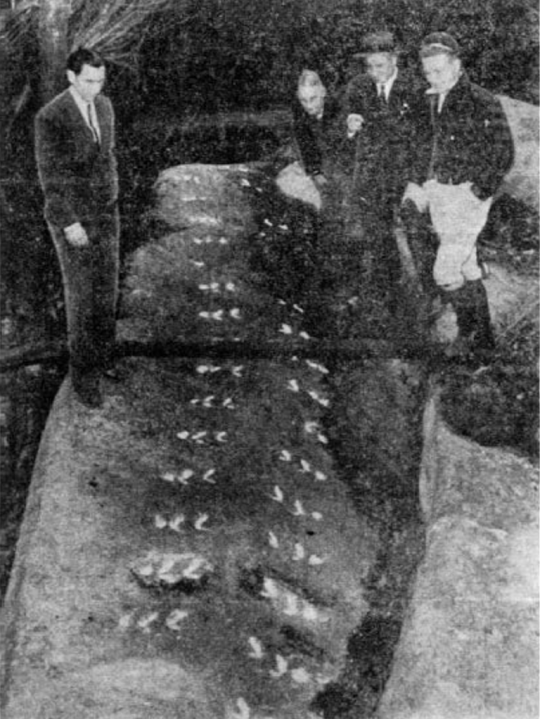
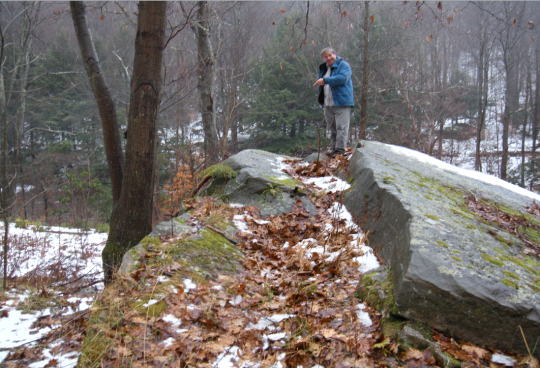
Figure 3. Photograph of Elk County in situ trackway looking southward (Brezinski and Kollar 2016).

Figure 4. Trackway closeup showing tail drag on display in Benedum Hall of Geology (Brezinski and Kollar 2016)

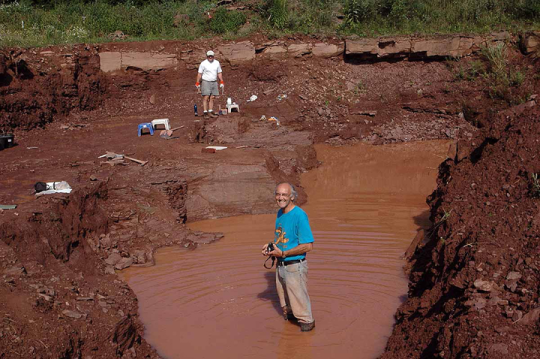
Seventy-two years ago, in an Elk County section of the Allegheny National Forest, James Kosinski, a preparator in the Education Department of Carnegie Museum of Natural History, and his brother Michael were hunting deer in heavily wooded terrain. When Michael stumbled upon a large sandstone boulder bearing a pattern of unusual impressions, he informed James, who (Fig. 3) immediately recognized the impressions as the fossil tracks of an unknown animal (Fig. 4).

Later, when James described the discovery to Carnegie Museum’s Dr. E. Rudy Eller, Curator of the Section of Invertebrate Paleontology, and Dr. J. Leroy Kay, Curator of Vertebrate Paleontology, plans were made to remove a section of the boulder containing the best-preserved section of the trackway and transport the heavy block to the museum.

Exhibit History

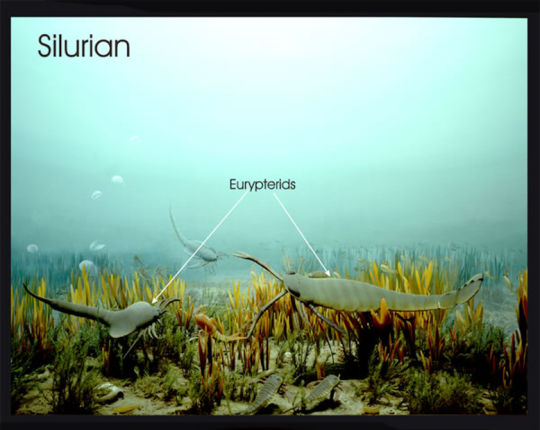
Figure 5. Former Paleozoic Hall Silurian Period Marine Diorama with Eurypterids.

Upon arrival at the museum in 1948, the sandstone block was prepared for exhibition and placed near the museum’s Coal Forest exhibit in 1949. In 1965, the trackway was incorporated as a floor centerpiece in the newly open Paleozoic Hall which featured dioramas of characteristic life forms of that Era’s time periods (Cambrian, Ordovician, Silurian, Devonian, Pennsylvanian, and Permian) along with representative fossils from the museum collection. (Fig. 5) In 1998, when Paleozoic Hall was dismantled, the trackway was placed temporarily in the Invertebrate Paleontology lab. The trackway returned to public view in 2007 as part of Bizarre Beasts, a temporary exhibition in the R. P. Simmons Family Gallery about unusual life forms. When Bizarre Beasts closed, I worked with James Senior, Chair of the museum’s Exhibit Department, to place the trackway in the Benedum Hall of Geology entrance as an introduction to great fossil discoveries from western Pennsylvania.

The Research – Locality Data Supports Recent Theory

The fossil trackway was initially identified by Dr. Kay as a hopping reptile inhabiting a Pennsylvanian coal forest 300 million years ago. Although Dr. Eller, citing his own research, suggested the track was formed by a crawling eurypterid, it would take 35 more years for the fossil trackway to be studied by expert arthropod paleontologists from Europe.

The eventual designation of Palmichnium kosinskiorum as a holotype specimen (CM 34388), a category of first order scientific importance, dates to the fossil’s description as a eurypterid trackway in a 1983 research paper by Dr. Derek E. G., Briggs and Dr. W. D. J. Rolfe, titled, A giant arthropod trackway from the Lower Mississippian of Pennsylvania (Journal of Paleontology, 57, 377 – 390). In paleontology, when a non-scientist such as Michael Kosinski discovers a fossil of importance, paleontologists, in this case Derek Briggs and Ian Rolfe, name the new fossil species after the founder, hence P. kosinskiorum.

For years, paleontologists in the Section of Invertebrate Paleontology assumed the scientific conclusions of Briggs and Rolfe (1983) about the eurypterid trackway were beyond dispute. This situation changed in 2009, when Yale University Professor Adolph Seilacher, a world-renowned expert on fossil trackways visited the museum. While Briggs and Rolfe concluded the trackway formed in a marine sandstone, Seilacher explained to me that the trackway was likely formed in an eolian or wind-blown sand environment. He also recommended that someone investigate the rocks at the fossil location in Elk County to substantiate his hypothesis.

Figure 6. D.K. Brezinski at trackway. 

Later that year, when I accompanied David K. Brezinski, Associate Curator Adjunct, Section of Invertebrate Paleontology, to re-locate and re-examine the sandstone boulder with the remaining tracks, we discovered the original geologic and deposition conclusion by Briggs and Rolfe (1983) was incorrect (Fig. 6). In 2011, we reported these new findings at the Northeastern Sectional Meeting of the Geological Society of America in Pittsburgh.  After the meeting, we continued our research and eventually published our conclusion that the geologic age of the trackway was Early Pennsylvanian age and the embedded footprints represented a fluvial sand bar environment of deposition.(Reevaluation of the Age and Provenance of the Giant Palmichnium Kosinskiorum Eurypterid Trackway, from Elk County, Pennsylvania, Brezinski and Kollar (2016),  Annals of Carnegie Museum 84, 39 – 45,)

School Groups and Museum Interpreters

Based upon repeated anecdotal reports from the Interpreters who guide tour groups through the museum’s exhibit halls, the eurypterid trackway is one of the most celebrated education stops for elementary school students. According to Interpreter Patty Dineen, the appealing factors of the trackway include the size and possible scariness of the creature who made the tracks, the fact the track-maker lived long before the dinosaurs, the fossil’s local origin, and the sheer amount for information that can be gathered from the ancient preserved tracks.

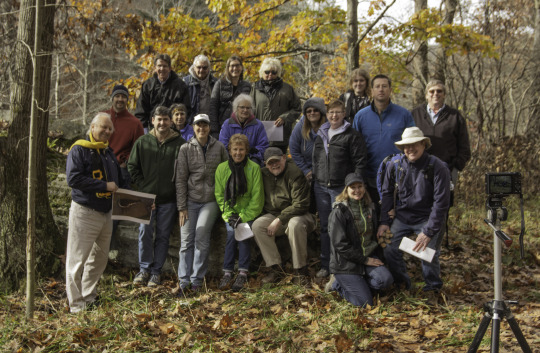
Figure 7. Interpreter field trip.

As part of an effort to better inform school groups about the eurypterid trackway, in 2017 Patty Dineen and Joann Wilson, co-coordinators and instructors for the museum’s Natural History Interpreters, arranged for six Interpreters to participate in a PAlS geology fall field trip to the fossil site in Elk County. (Fig. 7) An important by-product of field excursion was the creation of an instructional video that explains how museum scientists conduct research.

“Treasures of the Carnegie” Planning for a better Trackway Experience

Now that an illustration exists (Fig. 1) of the eurypterid that shaped the trackway walking out of the 315 million-year-old Olean River onto a sand bar, it might be time to consider how to best devise an improved visual and virtual tour experience for the Carnegie patrons and school groups.

Albert D. Kollar is Collections Manager for the Section of Invertebrate Paleontology at Carnegie Museum of Natural History. Museum staff, volunteers, and interns are encouraged to blog about their unique experiences and knowledge gained from working at the museum.
Filed Under: Blog Tagged With: Albert Kollar, Benedum Hall of Geology, invertebrate paleontology, Museum from Home, Science News

  • « Go to Previous Page
  • Page 1
  • Interim pages omitted …
  • Page 36
  • Page 37
  • Page 38
  • Page 39
  • Page 40
  • Interim pages omitted …
  • Page 43
  • Go to Next Page »

sidebar

About

  • Mission & Commitments
  • Directors Team
  • Museum History

Get Involved

  • Volunteer
  • Membership
  • Carnegie Discoverers
  • Donate
  • Employment
  • Events

Bring a Group

  • Groups of 10 or More
  • Birthday Parties at the Museum
  • Field Trips

Powdermill

  • Powdermill Nature Reserve
  • Powdermill Field Trips
  • Powdermill Staff
  • Research at Powdermill

More Information

  • Image Permission Requests
  • Science Stories
  • Accessibility
  • Shopping Cart
  • Contact
  • Visitor Policies
One of the Four Carnegie Museums | © Carnegie Institute | Privacy Policy | Terms of Use | Accessibility
Rad works here logo