• Skip to primary navigation
  • Skip to main content
  • Skip to primary sidebar

Carnegie Museum of Natural History

One of the Four Carnegie Museums of Pittsburgh

  • Visit
    • Buy Tickets
    • Visitor Information
    • Exhibitions
    • Events
    • Dining at the Museum
    • Celebrate at the Museum
    • Powdermill Nature Reserve
    • Event Venue Rental
  • Learn
    • Field Trips
    • Educator Information
    • Programs at the Museum
    • Bring the Museum to You
    • Guided Programs FAQ
    • Programs Online
    • Climate and Rural Systems Partnership
  • Research
    • Scientific Sections
    • Science Stories
    • Science Videos
    • Senior Science & Research Staff
    • Museum Library
    • Science Seminars
    • Scientific Publications
    • Specimen and Artifact Identification
  • About
    • Mission & Commitments
    • Directors Team
    • Museum History
  • Tickets
  • Give
  • Shop

Blogs from our Scientific Researchers

Carnegie Museum of Natural History is home to active research and vast scientific collections. Our scientific researchers regularly contribute to the blog at the museum.

April 13, 2020 by wpengine

Smoking Fossils

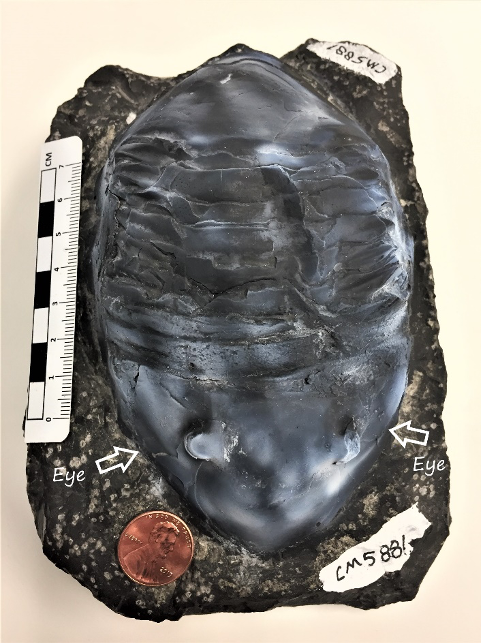
Figure 1: CM 5881 Trilobite (Isotelus maximus) with “smoke”                    
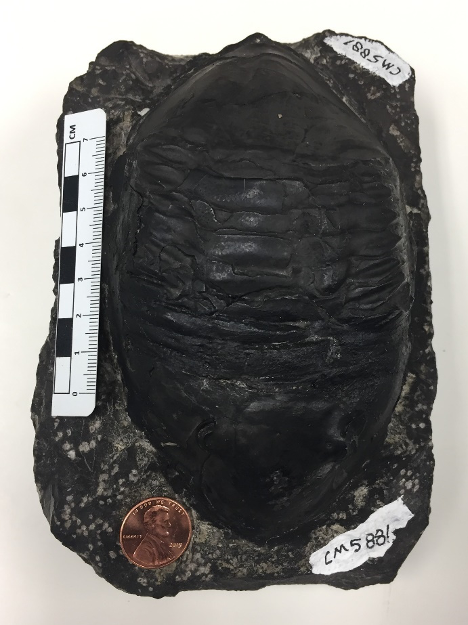
Figure 2: Same Trilobite without “smoke”

Ever wonder how scientists make fossils jump off the printed page?  Enter a centuries-old technique known as “smoking fossils.”   While there are many ways to “smoke” a fossil, one of the more commonly used methods was refined by paleontologist-geologist, Dr. Curtis Teichert.   In 1948, he developed a process to heat aluminum chloride powder in a test tube with the result creating a white vapor that could be applied with a pump to a fossil.    Although the Teichert process involves vapor rather than smoke; you will hear it informally referred to as “smoking fossils.”  Today, Dr. Teichert’s method is still practiced behind a set of metal doors in the basement of the Carnegie Museum of Natural History with one modification: a ventilator hood runs at a low hum in order to remove vapors circulating in the air during the “smoking” process.  

A few weeks ago, Albert Kollar, Collections Manager for the Section of Invertebrate Paleontology, “smoked” a few fossils for an upcoming blog post on state fossils.  As Teichert noted in 1948, “…  the application of a white coating to fossils is essential for photographic reproduction in order to eliminate spottiness and to bring about fine structural details otherwise lost on a black background.”   One of the fossils selected by Albert was a 480-million-year-old trilobite (Figures 1 and 2).  Trilobites are an extinct group of marine animals with an exoskeleton.   In Figure 1, all three segments of the body are easy to see.   The cephalon (head), thorax (mid-section), and pygidium (end) are well defined and the calcite crystal eyes stand out.   By contrast, the same fossil without “smoke” (Figure 2) is difficult to study because it appears to merge with the rock.  

It takes years of practice to add the aluminum chloride vapor with precision.   Too much vapor gives the fossil a hazy appearance and it makes it difficult to see the fine details, while too little vapor imparts a splotchy appearance with some details visible and others disappearing into the stone.   Albert selected a “death assemblage,” or group of fossils that died on the sea floor, to illustrate the art of getting the vapor just right (Figure 3).    And how long does the vapor last?    Albert explained that the effect can last up to a week if left in a closed cabinet, but it can also be removed with a damp cloth anytime.    
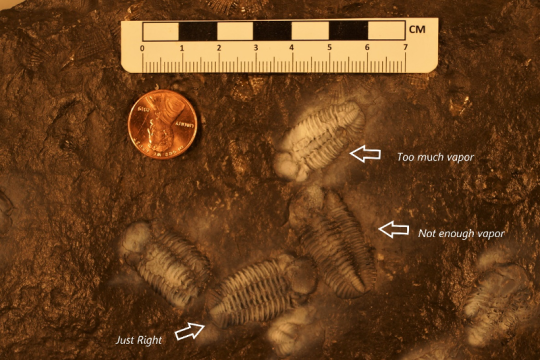
Figure 3: PA State Fossil (CM 53898) – Trilobite (Phacops rana) with too much, not enough and just enough “smoke”

So, the next time you are enjoying a photo of a fossil on exhibit or in a magazine, look for evidence of “smoke.”   It is just one more way that scientists help to bring ancient creatures to life.    

Joann Wilson is a volunteer with the Section of Invertebrate Paleontology and Albert Kollar is Collections Manager for the Section of Invertebrate Paleontology at Carnegie Museum of Natural History. Museum staff, volunteers, and interns are encouraged to blog about their unique experiences and knowledge gained from working at the museum.
Filed Under: Blog Tagged With: invertebrate paleontology, Museum from Home, Science News

April 13, 2020 by wpengine

Behind the Scenes…a Life in the Details

Perhaps on a past visit to the museum you have noticed the large, heavy wooden doors and wondered what lay beyond. You might have seen staff members using these doors to access the mysterious spaces beyond and wondered what they do.  Maybe when you think of the museum, you think in terms of its ‘collections,’ which are vast—specimens, artifacts, dinosaur bones, gems, and more. Indeed, many of the museum staff do manage the collections, tirelessly cataloguing, preparing, and preserving our Natural History.

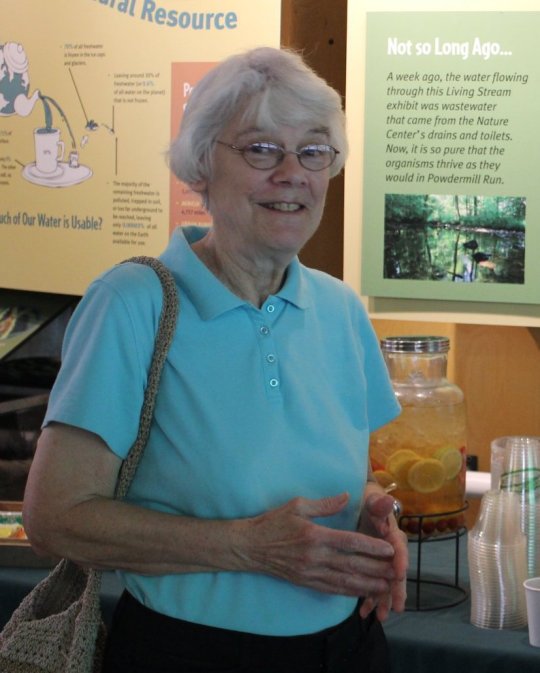
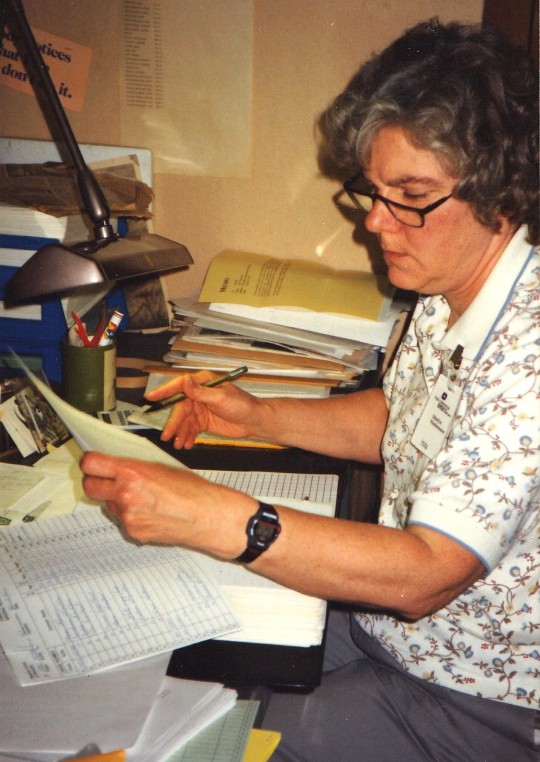
This past January, we had the opportunity to celebrate the work of Marilyn Niedermeier who was employed at the museum for almost 43 years! In a quiet corner of the third floor, behind a door labeled “Section of Birds,” Marilyn spent her career caring for a collection of data.

Since 2007, Marilyn was the person in charge of data gathered at the Bird Banding Lab at Powdermill Nature Reserve, the Carnegie Museum’s scientific research station in the Laurel Highlands, about an hour (58 miles) southeast of Oakland.

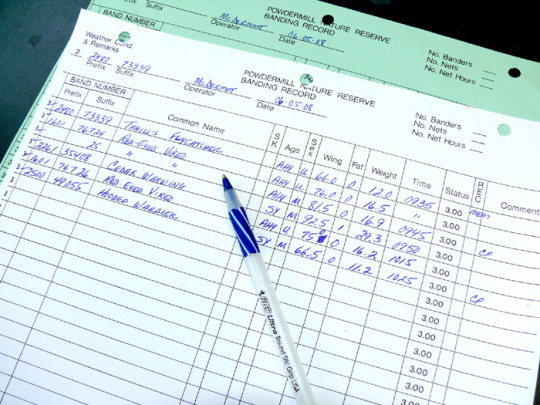
Started in 1961, the Powdermill Avian Research Center bands about 10,000 birds per year and processes another 3-4,000 recaptured birds (already banded). Marilyn’s job was to organize, proof, catalogue and submit those data to the National Banding Lab. How did she do all that from 58 miles away, and what does that collection of data look like?

In the early days, long before the invention of desktop computers, Powdermill data were handwritten on paper data sheets which were hand-delivered to the museum up until 2010! Although they rarely met face-to-face, Bob Leberman (founder of the banding program) and Marilyn frequently exchanged hand-written letters to resolve discrepancies in the data.  Reports to the banding lab were prepared on a typewriter and snail-mailed to Maryland.

Over the years, as the database grew bird by bird, Marilyn witnessed many changes in the way the data was handled, from the antiquated computer punch cards (so advanced for the time) to the evolving world of desktop computing. As the binders filled up with datasheets, Marilyn navigated through several iterations of software needed to maintain the growing database and soon hand-written letters were replaced by email and eventually the data sheets were replaced by a direct-entry program at the Powdermill banding lab. Even with direct-entry of data, it doesn’t end there. The data must still be checked for accuracy and consistency and then submitted to the national lab.

For the over two decades, Marilyn worked tirelessly, with a ready smile, under a sign above her desk that read “No one notices what I do until I don’t do it!” Through her efforts and that of the scientists at Powdermill who faithfully collect the data each banding day, the dataset of the Powdermill Avian Research Center is one of the largest and most accurate in the country. Marilyn, we wanted to say, “We noticed,” and we couldn’t have done it without you!

Mary Shidel is a Field Assistant at Carnegie Museum of Natural History’s Powdermill Nature Reserve. Museum employees are encouraged to blog about their unique experiences and knowledge gained from working at the museum.
Filed Under: Blog Tagged With: Museum from Home, parc, Science News

April 13, 2020 by wpengine

A Quarantine Art and Science Collaboration

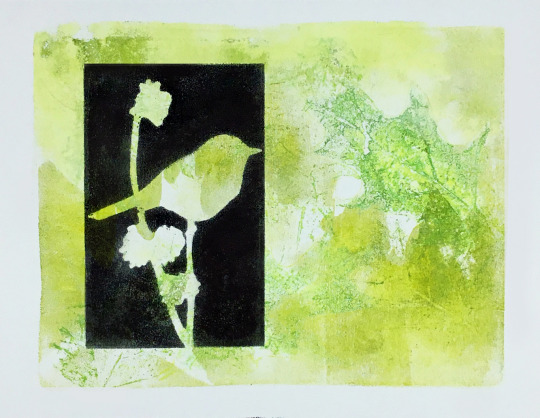
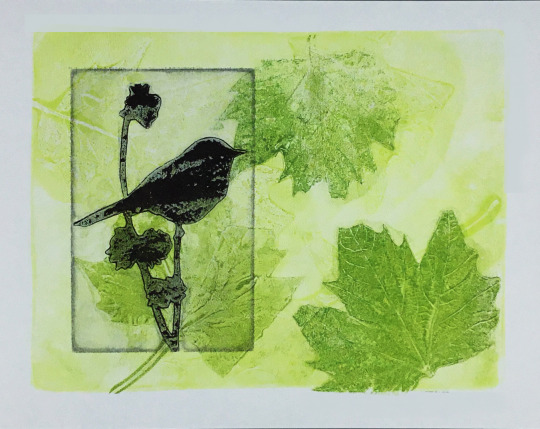
Local environmental artist Ann Rosenthal creates two prints inspired by the research of Mason Heberling, Assistant Curator of Botany at Carnegie Museum of Natural History during this quarantine art and science collaboration.

Ann Rosenthal is an environmental artist and educator who examines the intersections of nature and culture through timely issues, including climate change, biodiversity, and biophilia. In 2019, she co-curated “Crafting Conversations: A Call and Response to Our Changing Climate” for Creatives for Climate through Contemporary Craft’s BNY Mellon Satellite Gallery in Pittsburgh. She is currently one of four editors for a field guide on ecoart practices on behalf of an international network of ecoartists.

“I am interested in the relationships within and between the human and natural worlds. In this unprecedented time, we can see systems and relationships more clearly; for example, how just a few weeks of staying at home has cleared our air and water,” says Ann Rosenthal. “I am fascinated by the research CMNH botanist Mason Heberling is conducting in forests around Pittsburgh, including at Beechwood Farms. He and collaborators from the University of Pittsburgh and Boston University are studying how climate change is driving the early leaf-out of the tree canopy and how that, in turn, impacts what grows and lives in the understory. 

“My monoprint is inspired by those relationships: the red maple and red oak spring leaves suggest the tree canopy under which a hooded warbler perches on a spicebush branch. All of these species can be seen at Beechwood. The trees depicted are part of Heberling’s current and past research, and Thoreau studied their leaf-out in the 1850s. Researchers can thus compare Thoreau’s findings with their own. I hope my print will prompt readers to pause and consider the invisible threads that bind us to one another and to nature.” As Thoreau counseled, “Shall I not have intelligence with the earth? Am I not partly leaves and vegetable mould myself?”

See more of Ann’s work at locusartstudio.org.

Ann Rosenthal is an environmental artist. Asia Ward is an Anthropocene Science Communication Fellow at the Carnegie Museum of Natural History. Museum employees are encouraged to blog about their unique experiences working at the museum.

Filed Under: Blog Tagged With: Anthropocene, Museum from Home, Science News

April 9, 2020 by wpengine

Building Webs and Making Connections: Working with the Arachnid Collection

At one point in the long history of Invertebrate Zoology, we went by the name “Section of Insects & Spiders.” It may be surprising to some readers, but spiders aren’t actually insects. Insects and Arachnids (spiders and their kin) are two very distinct groups of animals that make up part of the mega-diverse lineage of organisms known as the Arthropods (phylum Arthropoda; which also includes the crustaceans (crabs, shrimps, and lobsters, etc.) and myriapods (centipedes and millipedes).

Arthropods are characterized by having segmented bodies, the presence of an exoskeleton, bilateral symmetry, and paired jointed appendages. Within this phylum, the classes Insecta and Arachnida vary in several key ways. Arachnids have a fused head and thorax (called a cephalothorax) with a separate abdomen, while insects have three distinct regions: a head, thorax, and abdomen, typically unfused. Additionally, insects have 6 legs, while spiders have 8.

Within arachnids, there are several orders, including Araneae (spiders), Acari (mites & ticks), Opiliones (Harvestmen/“Daddy Long Legs”), Scorpionida (scorpions), Solifugae (camel or sun spiders), and others. Spiders comprise the majority of the order Araneae and includes the tarantulas.

Historically, spiders have been treated differently from most of the insects housed here in IZ. As largely a section of entomology, the main focus has been on class Insecta, while still building on donated arachnid materials where applicable.

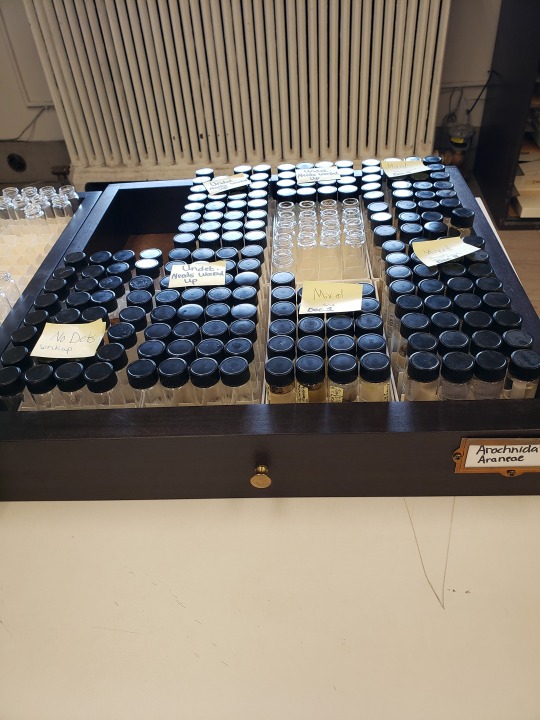
In early 2019, I was tasked with bringing the arachnid holdings together and began databasing its contents. This was part of a larger digitization initiative pioneered in IZ as well as many museum collections world-wide. As with many soft-bodied organisms, we store our spider specimens in alcohol (80% ethanol), as shown in Figure 1.

Figure 1. A standard alcohol drawer, containing arachnid specimens in 6 dram vials.

I began by bringing determined material together taxonomically. Determined materials are those that an expert has identified to the genus and/or species level. I can then catalogue that information into a database so that the holdings here can be shared electronically to other arachnologists around the globe.

Currently, we have over 900 spiders databased of the estimated 2700+ arachnids in our collection. Most of our spiders are from field expeditions to the Dominican Republic, from a large donated collection from Brazil, and from a former curator’s backyard in Gibsonia, PA.

We plan to move on to other arachnid groups in the future, and ultimately hope to have our specimens completely digitized and available for loans to the scientific community.

I’d like to give a special thank you to two of our wonderful volunteers, J. Murphy and A. Bianco. Their dedication and hard work have allowed this project to really blossom and our “web” of arachnid lovers to grow ever larger.

Catherine Giles is the Curatorial Assistant of Invertebrate Zoology at the Carnegie Museum of Natural History. Museum employees are encouraged to blog about their unique experiences working at the museum.

Filed Under: Blog Tagged With: Catherine Giles, Invertebrate Zoology, Museum from Home, Science News

April 8, 2020 by wpengine

The Largest Snail I Have Ever Seen

An inquiry came in (with the subject line: urgent snail question) asking, “How big is the biggest snail you’ve ever seen?” Thinking that others might be interested, here is my answer.

The largest snail? There could be many ways of answering that question. Size could refer to length, diameter, volume, or mass. The longest mollusk I have seen is the giant squid on display at the Smithsonian, but that is a cephalopod, not a snail, and it doesn’t have a shell. The largest shell I have seen is a fossil ammonite that was more than 2 meters in diameter, but that is also a cephalopod, not a snail, and maybe fossils are not acceptable for this answer.

The largest modern shell I have seen is that of a giant clam, but that is a bivalve, not a snail. The largest bona fide snail I have seen could be the snail in the Dr. Dolittle movie that carried Dr. Dolittle under the sea, but movies don’t always depict reality (sorry), so maybe that one doesn’t count. Another large snail I read about is a fossil sea snail from the Eocene Epoch (34-56 million years ago) called Campanile giganteum, which grew up to 1 meter long (Houbrick, 1984). But I haven’t actually seen one, which is really what you asked, and maybe you don’t want to include fossils.

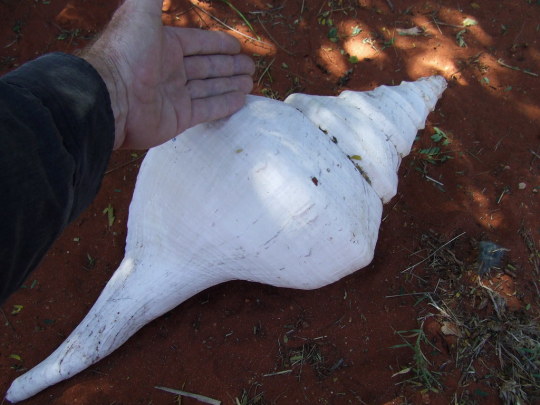
Real answers start here. I would have to say the largest modern snail shell I have seen is that of the Australian sea snail Syrinx aruanus (which gets up to 91 cm long). The two largest shells of that species I have seen are at the Delaware Museum and the Philadelphia Academy, both of which were shorter than 91 cm; I didn’t measure them, but my memory suggests they were probably 65 to 75 cm long, which is pretty big for a snail! Given that slugs are also snails (gastropods), there are reports of slug-like sea hares (family Aplysiidae) whose bodies can get nearly a meter long, but the longest one I ever saw was around 25 cm long, so the Syrinx still wins for what I have seen. Another way to answer your question about largest is not longest but instead greatest volume. For that, the sea snail Melo melo might have the greatest volume (although it’s possible a large Syrinx might also win at volume, I’m not sure).

image

Syrinx auruanus by Bill & Mark Bell is licensed under CC BY-NC-SA 2.0 .

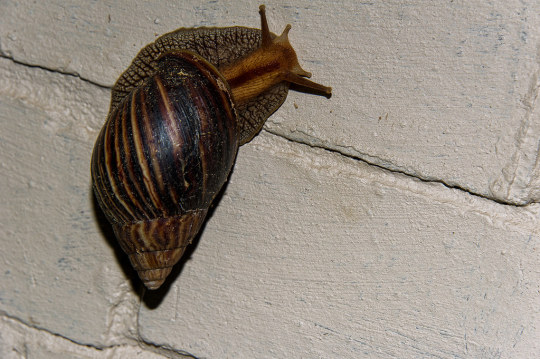
Then again, given that my specialty is land snails, you might be asking about the largest land snail I have seen. That would be the giant African snails in the family Achatinidae. I have seen plenty of living Achatina fulica, with shells up to about 12 cm, but I have seen shells of larger species, such as Achatina achatina and Archachatina marginata. Note that we do have some large snails native to South America in the family Strophocheilidae (including a very large extinct one), but the giant African snails are larger.

image

Giant african land snail by Steve Slater (used to be Wildlife Encounters) is licensed under CC BY 2.0 . Shell estimated to be 10-15cm (4-6 inches) long.

Or maybe today is opposite day and you are really asking about the smallest snail I have seen. Although I do know about a minute sea snail, Ammonicera minortalia, at 0.4 mm diameter reported to be the smallest snail in the United States (Bieler & Mikkelsen 1998), I have never seen one. If you mean land snails, I recall that Wenz (1938-1944) reported some land snails in the family Diplommatinidae to be 0.5 mm, although I have not seen any Diplommatinidae that small, and I wonder if Wenz was reporting shell diameter rather than maximum dimension (most Diplommatinidae are taller than wide). (On the subject of narrow snails, I have seen the minute Carychium nannodes, which is only 0.4 mm diameter, but it is about 1.4 mm tall.) I do know some tiny snails from east Asia got a lot of press a few years ago for being able to fit into the eye of a needle (Páll-Gergely et al. 2015), and at 0.8 mm in greatest dimension, they are certainly minute, but again, I have never seen one.

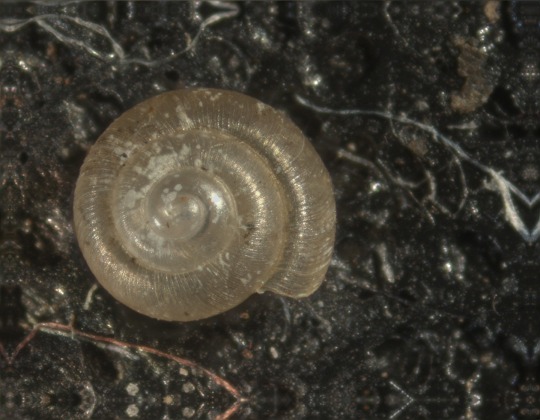
The smallest adult land snails I have seen are either Punctum minutissimum or Guppya sterkii, both on the order of 1 mm diameter. Of course, their babies are even smaller, and I have seen babies of both those species, especially of P. minutissimum. Amazingly, Punctum minutissimum appears to be one of the most abundant land snails in northeastern North America, but it is rarely noticed due to its minute size.

image

Punctum minutissimum. Shell 1 mm (1/25 inch) diameter. 

To recap (and more directly answer your question), the largest snail shell I have seen is Syrinx aruanus, the largest land snail shell I have seen is one of the giant African land snails, the largest living land snail I have seen is Achatina fulica, and the smallest land snail I have seen is babies of Punctum minutissimum.

Timothy A. Pearce, PhD, is the head of the mollusks section at Carnegie Museum of Natural History. Museum employees are encouraged to blog about their unique experiences and knowledge gained from working at the museum.
References

Bieler, R. & Mikkelsen, P.M. 1998. Ammonicera in Florida: notes on the smallest living gastropod in the United States and comments on other species of Omalogyridae (Heterobranchia). The Nautilus 111(1): 1-12.

Houbrick, R.S. 1984. The giant creeper, Campanile symbolicum Iredale, an Australian relic marine snail. In: Eldredge N. & Stanley S.M. (eds.), Living Fossils. Casebooks in Earth Sciences. Springer-Verlag, New York.

Páll-Gergely, B., Hunyadi, A., Jochum, A. & Asami, T. 2015. Seven new hypselostomatid species from China, including some of the world’s smallest land snails (Gastropoda, Pulmonata, Orthurethra). ZooKeys 523: 31–62. doi: 10.3897/zookeys.523.6114.

Wenz, W. 1938-1944, Gastropoda, Teil 1, Allgemeiner Teil und Prosobranchia. In: Schindewolf, Handbuch der Palaozoologie, v. 6. Borntraeger, Berlin. vii + 1639 p.

Filed Under: Blog Tagged With: mollusks, Museum from Home, Science News, Tim Pearce

March 31, 2020 by wpengine

Mesozoic Monthly: Nemicolopterus

Welcome back to Mesozoic Monthly! Spring has sprung, and you know what that means: baby animals are coming! It only makes sense that the star of this month’s post should be as small and cute as chicks or puppies. With a wingspan of less than 10 inches (25 centimeters), Nemicolopterus crypticus is one of the tiniest known pterosaurs – about the size of an American Robin!

Life reconstruction of the adorable little pterosaur (flying reptile) Nemicolopterus crypticus by paleoartist Connor Ashbridge, used with permission. You can find Connor’s other work on Instagram @pantydraco.

Nemicolopterus is a pterosaur, a kind of prehistoric animal that is commonly called a “pterodactyl” or “flying dinosaur.” However, pterosaurs are not dinosaurs! Dinosaurs are all animals within a specific group of reptiles known as the Dinosauria. Pterosaurs comprise a separate group of reptiles that were specialized for flight, called the Pterosauria. These flying reptiles are extraordinary; they not only represent the earliest-known flying vertebrates (animals with backbones), but they also achieved flight in a different manner than did modern flying vertebrates (birds and bats)! Over half the length of a pterosaur’s wing was made up by a single super-long finger (specifically, the fourth finger, aka the ‘ring finger’ of a human) that anchored a broad skin membrane. It might seem like it’d be impossible to fly on just one finger, but many pterosaurs managed to grow to gargantuan sizes. Cousins of Nemicolopterus known as azhdarchids (one of which, Quetzalcoatlus, soars above T. rex in Carnegie Museum of Natural History’s Dinosaurs in Their Time exhibition) could reach estimated wingspans of 39 feet (12 meters). That’s as big as a small airplane!

Tiny, fuzzy, and adorable, Nemicolopterus would have looked a lot like a baby bird if you could take a trip back to the Cretaceous and see this pterosaur in the wild. In fact, the only specimen we have of Nemicolopterus may have been a baby! It’s often difficult to tell just based on its fossilized skeleton whether a prehistoric animal was fully mature or still in the process of growing and changing when it died. One way of telling if a fossil reflects an adult is whether certain bones have completely fused together (the technical term is coossified). You may know that humans have more separate bones as babies than we do as adults; this is because, as a person grows, certain bones like the ones that make up your skull fuse together along lines called sutures. Many baby bones also tend to be soft and flexible because they start out as cartilage, which is replaced by solid bone over time through a process called ossification. Several important bones in the Nemicolopterus fossil are ossified, so we can be sure that it was not a hatchling. However, since paleontologists agree that this specimen was still young when it died, and also that baby pterosaurs were precocial (i.e., able to effectively move about and find food on their own shortly after hatching), there’s still a significant chance that the Nemicolopterus fossil represents a young life stage of another, larger pterosaur.

There’s a good candidate for which pterosaur might be the adult form of Nemicolopterus, if indeed the only known fossil is just a baby of another species: Sinopterus is a tapejarid pterosaur that lived at the same time and place as the little fellow. Tapejarids are unique because they were likely arboreal and had beaks that appear useful for eating plants or fruit. Nemicolopterus crypticus was named the “hidden flying forest dweller” as an homage to the forested wetlands in which it lived roughly 120 million years ago, in what is now Liaoning Province in northeastern China. It spent its time in the trees, attempting to avoid predatory dinosaurs such as the famously bird-like dromaeosaurid Microraptor or the distant T. rex relative Sinotyrannus.

Lindsay Kastroll is a volunteer and paleontology student working in the Section of Vertebrate Paleontology at Carnegie Museum of Natural History. Museum staff, volunteers, and interns are encouraged to blog about their unique experiences and knowledge gained from working at the museum.
Filed Under: Blog Tagged With: Museum from Home, Science News, Vertebrate Paleontology

  • « Go to Previous Page
  • Page 1
  • Interim pages omitted …
  • Page 38
  • Page 39
  • Page 40
  • Page 41
  • Page 42
  • Page 43
  • Go to Next Page »

sidebar

About

  • Mission & Commitments
  • Directors Team
  • Museum History

Get Involved

  • Volunteer
  • Membership
  • Carnegie Discoverers
  • Donate
  • Employment
  • Events

Bring a Group

  • Groups of 10 or More
  • Birthday Parties at the Museum
  • Field Trips

Powdermill

  • Powdermill Nature Reserve
  • Powdermill Field Trips
  • Powdermill Staff
  • Research at Powdermill

More Information

  • Image Permission Requests
  • Science Stories
  • Accessibility
  • Shopping Cart
  • Contact
  • Visitor Policies
One of the Four Carnegie Museums | © Carnegie Institute | Privacy Policy | Terms of Use | Accessibility
Rad works here logo