• Skip to primary navigation
  • Skip to main content
  • Skip to primary sidebar

Carnegie Museum of Natural History

One of the Four Carnegie Museums of Pittsburgh

  • Visit
    • Buy Tickets
    • Visitor Information
    • Exhibitions
    • Events
    • Dining at the Museum
    • Celebrate at the Museum
    • Powdermill Nature Reserve
    • Event Venue Rental
  • Learn
    • Field Trips
    • Educator Information
    • Programs at the Museum
    • Bring the Museum to You
    • Guided Programs FAQ
    • Programs Online
    • Climate and Rural Systems Partnership
  • Research
    • Scientific Sections
    • Science Stories
    • Science Videos
    • Senior Science & Research Staff
    • Museum Library
    • Science Seminars
    • Scientific Publications
    • Specimen and Artifact Identification
  • About
    • Mission & Commitments
    • Directors Team
    • Museum History
  • Tickets
  • Give
  • Shop

Amy Henrici

September 17, 2021 by wpengine

Hunting For Fossil Frogs In Wyoming

by Amy Henrici

Collection managers at Carnegie Museum of Natural History (CMNH) typically spend their time on collection-based tasks. Sometimes, however, we are called on to clean out the office of a former curator in our respective sections. With the death of Section of Vertebrate Paleontology (VP) Curator Emerita Mary Dawson late last year, I’ve been spending time in her office sorting through numerous items she accumulated during her nearly 58-year career at the museum. While there, I can’t help but think of a conversation we had in her office many years ago when I expressed interest in obtaining a Master of Science degree in geology and paleontology at the University of Pittsburgh.

Mary agreed to be my advisor and suggested fossil fishes as a topic for my thesis, because at that time not many paleontologists were studying this group. She arranged for me to join a field crew from our Section led by curators Kris Krishtalka and Richard Stucky who planned to spend the summer of 1984 searching Eocene sediments (~56–34 million years ago) in the Wind River Basin of central Wyoming for fossils of mammals and other vertebrates. She instructed them to take me to the north end of Lysite Mountain, where during a 1965 reconnaissance geologist Dave Love (of the United States Geological Survey [USGS]) and his student Kirby Bay and others showed her some fish fossils.
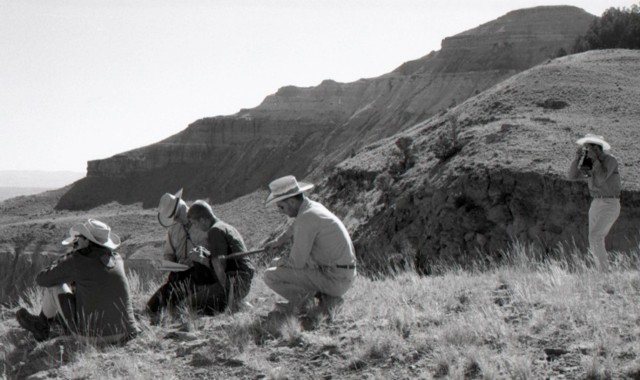
Black and white candid photo of people on a rocky hillside.
1965 reconnaissance of the north end of Lysite Mountain. The fish locality lies further below the group. Left to right, Dave Foster, USGS geologist Dave Love, Love’s student Kirby Bay, then CMNH VP Curator Craig Black, and Ted Gard. Photo by Mary Dawson, July 28, 1965.

As planned, in late June I set out from Pittsburgh in my un-airconditioned car on a three-day drive to Wyoming to join the crew who had arrived before me. Some of my time in the field was spent assisting the crew in their search for mammal fossils, something I had no experience with. My previous field work involved collecting ancient amphibian, reptile, and dinosaur fossils from the time before most mammals had evolved. Indeed, the first set of “fossils” that I collected on this trip turned out to be fragments of modern rabbit bones that Kris unceremoniously dumped into his ashtray while identifying the day’s haul after dinner. Fortunately, my skills at finding mammal fossils improved.

After a few days we went on the first of several reconnaissance trips to Lysite Mountain, which lies north of the Wind River Basin and forms part of the southern escarpment of the Bighorn Basin. To get there we drove deeply rutted and sometimes rocky dirt roads. Once there, the crew spread out in search of fossils. While some of us searched for and found incomplete and disarticulated fish fossils, others discovered a unit that produced frog fossils. When Kris and Richard showed me the frog fossils, they strongly urged me to base my thesis on the frogs instead of the scrappy fish I had collected. I quickly agreed, which was a decision that I never regretted.

We returned to our routine of prospecting for fossils in the Wind River Basin, until the planned arrival of Pat McShea (now my husband and Program Officer in the CMNH Department of Education) via a Trailways bus. The original plan was for Pat and me to drive my car daily to Lysite Mountain, but this was not feasible, given the condition of the roads. Instead the crew dropped us off with our camping gear for four days of fossil frog collecting. This was followed by a second field season in 1986, in which my sister, Ellen Henrici, joined us with her off-road capable SUV.
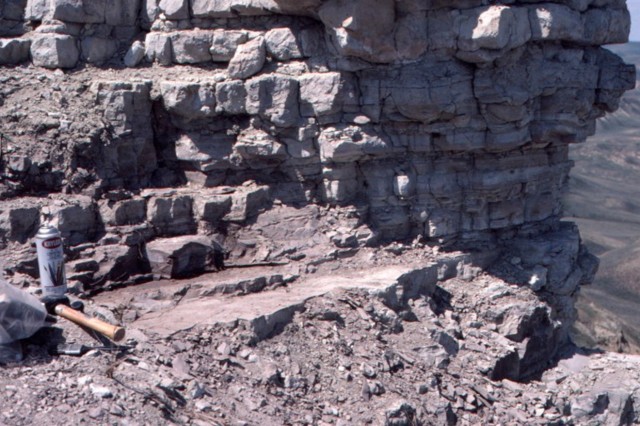
Rocky landscape with tools set out on the left side of the image.
The frog quarry, with the Bighorn Basin below, to right of quarry. Photo by the author, 1984.

Using a hammer and chisel to pry open pieces of rock, we collected nearly 150 specimens of frog fossils in varying degrees of completeness. The preparation of the fossils and the identification of the various bones took me a long time. I eventually figured out that they were all the same type of frog and represented a new genus and species in the family Rhinophrynidae, which today is known by a single species: Rhinophrynus dorsalis, the Mexican burrowing toad. The fossil collection even includes tadpoles in various stages of development, as well as a mortality layer preserving the scattered bones of many individuals. I named this new genus and species Chelomophrynus bayi in a 1991 paper published in CMNH’s scientific journal, the Annals of Carnegie Museum.
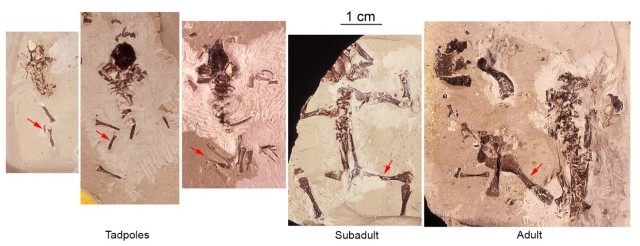
From left to right: three tadpole fossils, a subadult frog fossil, an adult frog fossil
Growth series of Chelomophrynus bayi, arranged in order of maturity from youngest (left) to oldest (right). The red arrow points to the thigh bone (femur). A tail, not preserved, would have been present in the tadpoles. Photos by the author, 2015.

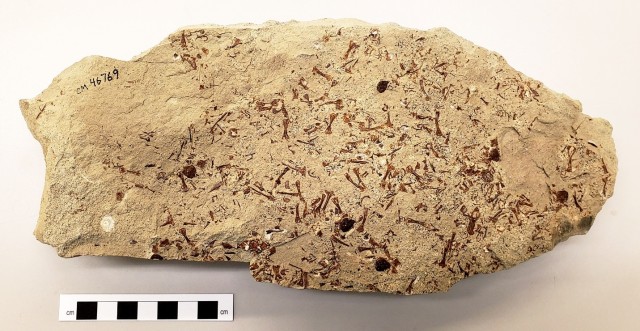
Mortality layer rock sample.
Sample of the extensive mortality layer of Chelomophrynus bayi. Cause of death might have been disease. Photo by the author, 2021.

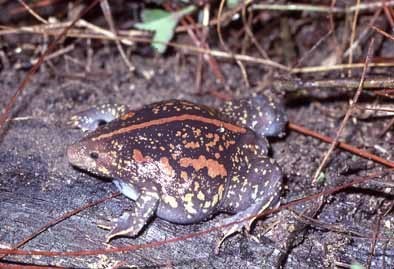
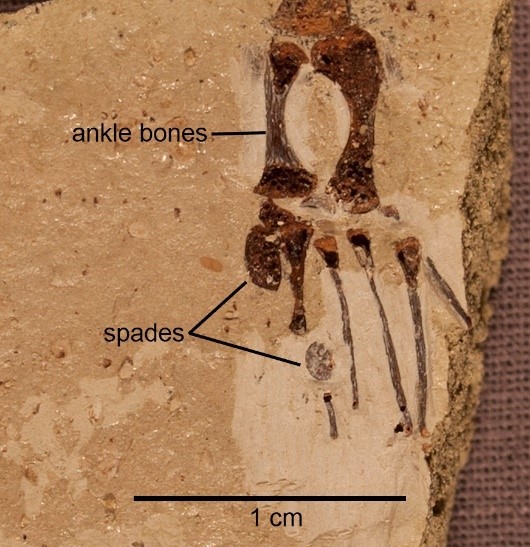
In paleontology, the study of living creatures can inform our understanding of fossils. The Mexican burrowing toad is very unusual in that it spends most of its life underground and only emerges to breed after heavy rain. The species currently inhabits dry tropical to subtropical forests along coastal lowlands in extreme southern Texas southward into Mexico and Central America. It has two bony spades on each hind foot that help it to efficiently dig, hind feet first, into the ground. Once underground, other skeletal specializations enable it to use its front feet and nose to penetrate termite and ant tunnels and then protrude its tongue into the tunnel to catch insects. Chelomophrynus possesses a number of these specializations (though some are not as well developed as in the modern Rhinophrynus), which strongly suggests that it too was able to burrow underground to feed on subterranean insects.
frog on the forest floor
Rhinophrynus dorsalis, the modern Mexican burrowing toad. Image from the CMNH Section of Herpetology.

Partial fossilized frog hind foot with labels for ankle bones and spades.
Partial hind foot of Chelomophrynus bayi, which preserves two bony spades that in life would have been covered in a keratinous sheath and used for digging feet-first into the ground. Photo by the author.

Rhinophrynids once occurred as far north as southwestern Saskatchewan, Canada around 36 million years ago. Their southward retreat to their current range could be because they apparently never developed the ability to hibernate in burrows, which would have protected them from seasonal sub-freezing temperatures which began developing around 34 million years ago.

The oldest rhinophrynid is Rhadinosteus parvus, a frog that lived with dinosaurs. In 1998, I was able to name and describe it based upon several late-stage tadpoles collected earlier from Dinosaur National Monument, Utah, a site where many of the dinosaurs on exhibit in CMNH came from. A cast of Rhadinosteus is displayed in CMNH’s Dinosaurs in Their Time gallery.

Amy Henrici is the Collection Manager in the Section of Vertebrate Paleontology at Carnegie Museum of Natural History. Museum employees are encouraged to share their unique experiences from working at the museum.

Related Content

Super Science Saturday: Scientist Takeover (September 25, 2021)

The Bromacker Fossil Project Part I: Introduction and History

Fossil Matrix Under the Microscope

Carnegie Museum of Natural History Blog Citation Information

Blog author: Henrici, Amy
Publication date: September 17, 2021
Share this post!

  • Share on Twitter Share on Twitter
  • Share on Facebook Share on Facebook
  • Share on Pinterest Share on Pinterest
  • Share on LinkedIn Share on LinkedIn
  • Share on Reddit Share on Reddit
  • Share via Email Share via Email

Share this post!

  • Share on Twitter Share on Twitter
  • Share on Facebook Share on Facebook
  • Share on Pinterest Share on Pinterest
  • Share on LinkedIn Share on LinkedIn
  • Share on Reddit Share on Reddit
  • Share via Email Share via Email

Filed Under: Blog Tagged With: Amy Henrici, Science News, ssstakeover, SWK2, Vertebrate Paleontology

December 30, 2020 by wpengine

The Bromacker Fossil Project Part XIII: What We Learned

New to this series? Need to catch up on your reading? Here are all the previous posts for the Bromacker Fossil Project: Part I, Part II, Part III, Part IV, Part V, Part VI, Part VII, Part VIII, Part IX, Part X, Part XI, and Part XII. 

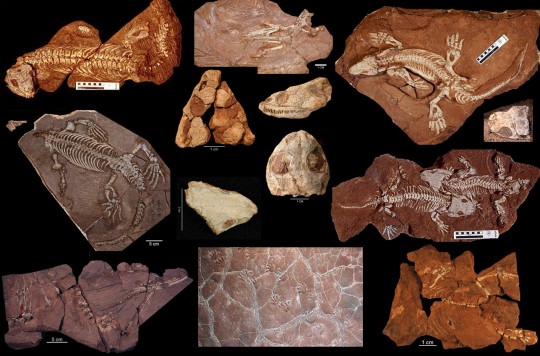
Collage of the fossils highlighted in this series. Images not to scale. Photos by the author, Dave Berman, and Thomas Martens.

The Bromacker quarry is a rare site in that it preserves exquisite, articulated fossils of a unique vertebrate fauna that lived in an atypical or rarely recorded Early Permian (~290 million years ago) setting. Early in our work at the Bromacker, we became aware that the fossil vertebrates we were finding were unknown or extremely rare in Europe but were closely related or identical to species commonly found in North America. Until then, most of the fossil vertebrates found in Europe were discovered in gray to black sediments deposited in ancient lake beds, whereas the fossils from the Bromacker quarry occurred in red beds representing a terrestrial setting. Paleontologists looking for fossils in Europe typically prospected the gray to black sediments where fossils were relatively plentiful rather than red beds, which were thought to represent arid environments not conducive to fossil preservation.

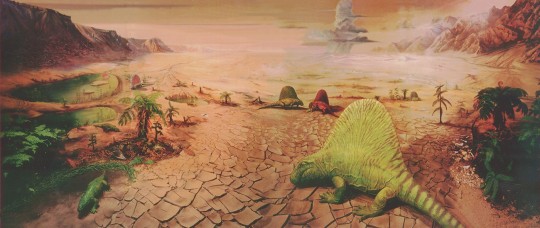
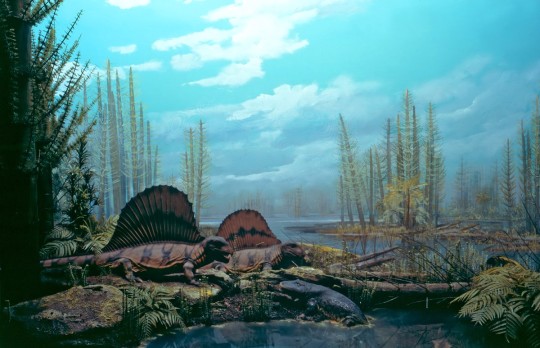
Photograph of a diorama showing the Tambach Basin 290 million years ago, which was once exhibited at the Museum der Natur, Gotha. It was built in 1996, so many of the inhabitants of the basin weren’t yet discovered. One of these is Dimetrodon teutonis, which was inadvertently depicted as being large and numerous. Image provided by Thomas Martens, 2020.

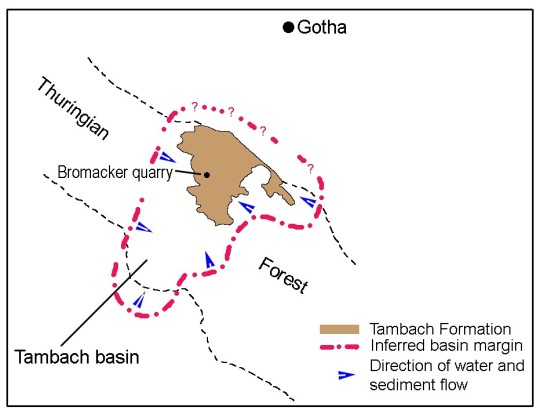
In a collaborative effort to help determine how the fossil deposit at the Bromacker quarry formed and why its vertebrate fauna is unique, Dave Berman invited his colleague David Eberth to join us for the 1998 field season. David is a geologist/vertebrate paleontologist who was then employed by the Royal Tyrrell Museum of Palaeontology in Canada but is now retired. The sediments preserving the Bromacker fossils are part of a rock unit called the Tambach Formation and were deposited in the Tambach Basin. The results of David’s study, built in part upon investigations by other geologists and paleontologists, indicate that the Tambach Basin was situated within an ancient mountain range and isolated from river systems. At the time the fossils were deposited, the basin was internally drained, and as a result, when it rained, water would flow towards the basin center and form ephemeral ponds and lakes. Based on the geology, fossil plant assemblage, and geographic setting of the Tambach Basin, David concluded that the climate was possibly similar to the wet‑and‑dry tropical climate of modern North African savannas, Brazilian Campos, or the Venezuelan Llanos.

Map showing the areal extent of the Tambach Formation today and the inferred boundary of the Tambach Basin, with arrows indicating direction of water flow. The northern boundary of the basin is not preserved, but it was thought to have been closed when the Bromacker fossil deposit formed. Modified from Eberth et al., 1997.

Most of the fossils discovered at the Bromacker quarry came from two massive units, the more fossiliferous of which is about 21 inches thick, that formed in separate major flooding events. David theorized that these deposits formed when heavy rain caused a sheet-flood of sediment‑laden water to sweep down the sides of the Tambach Basin and across the basin floor, killing any animals that couldn’t escape the flow. The sheet-flood transported the carcasses to the basin center where they were deposited, rapidly buried, and eventually fossilized. These deposits record a unique snapshot of vertebrate life in the Tambach Basin, because only animals inhabiting the basin would have been captured by the sheet-flood.

In contrast, most Early Permian fossil‑bearing deposits in North America formed on coastal or alluvial plains. Carcasses would’ve been transported to the deposition sites by rivers, some of which had a large geographic reach. These types of deposits can accumulate over a long period of time and have potential to mix together fossils from different environments.

Photograph of a diorama once exhibited at Carnegie Museum of Natural History that shows a typical Early Permian peat swamp or backwater swamp of a major river system. A similar modern environment would be the Okefenokee Swamp, Georgia. Photo by Mindy McNaugher, 2007.

Besides having an atypical geographic setting, the makeup of the Bromacker vertebrate fauna differs from those known from other Early Permian sites. The Bromacker vertebrate fauna has a low diversity of terrestrial tetrapods, but more importantly, it lacks fishes and aquatic to semi‑aquatic constituents. This is probably due to the Tambach Basin’s isolation from regional river systems and because it experienced seasonal to sub‑seasonal drying, making it difficult for water-reliant vertebrates to become established. Based on numeric counts of individual specimens, we determined that the relatively large‑sized herbivores Diadectes, Orobates, and Martensius greatly outnumbered the synapsid apex predators Dimetrodon and Tambacarnifex. We think the rarity and low diversity of synapsid carnivores is probably due to the lack of an aquatic to semi‑aquatic component in the food chain.

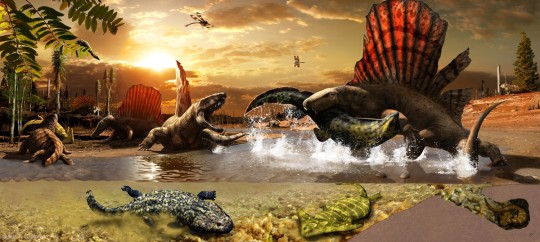
In contrast, most Early Permian North American localities preserve a diverse, mixed aquatic‑terrestrial fauna that either lived in water or was closely associated with water and aquatic food chains. Herbivores were rare in terms of both diversity and numbers, whereas synapsid apex predators were diverse and numerous.

A more dynamic North American Early Permian scene that includes a mixed aquatic‑terrestrial vertebrate fauna. The Dimetrodon on the right has caught a freshwater shark, demonstrating the importance of aquatic animals in the food chain. © Julius Csotonyi/Houston Museum of Natural Science.

The Bromacker is the oldest known terrestrial vertebrate ecosystem in which herbivores greatly outnumber apex carnivores, and in that respect, it resembles terrestrial vertebrate ecosystems of today. A modern example is the African savanna in which large herds of herbivores such as zebra, wildebeest, and buffalo provide a food source for a much smaller number of carnivores including lions, cheetahs, and hyaenas. Indeed, we consider the Bromacker to represent an early stage in the development of the modern terrestrial vertebrate ecosystem and that these early stages were restricted to upland areas isolated from aquatic‑based food chains.

This summary concludes the Bromacker Fossil Project blog post series. I hope that you’ve enjoyed reading it. Cast replicas of many of the fossils described in this series are exhibited in the Fossil Frontiers display case in CMNH’s Dinosaurs in Their Time exhibition, so be sure to look for them on your next visit. I’m grateful to Dave Berman, Albert Kollar, Thomas Martens, and Stuart Sumida, who answered numerous questions and provided photographs, and to Patrick McShea and Matt Lamanna for their editing skills. Click here to read the paper by Eberth et al. 2000.

Amy Henrici is Collection Manager in the Section of Vertebrate Paleontology at Carnegie Museum of Natural History. Museum employees are encouraged to blog about their unique experiences and knowledge gained from working at the museum.

Related Content

Vertebrate Fossils from Bears Ears National Monument, Utah

Mesozoic Monthly: Scipionyx

Ask a Scientist: What is the “Crazy Beast?”

Filed Under: Blog Tagged With: Amy Henrici, dinosaurs in their time, Museum from Home, Science News, Vertebrate Paleontology

December 9, 2020 by wpengine

The Bromacker Fossil Project Part XII: Tambacarnifex unguifalcatus, the Tambach executioner

New to this series? Read The Bromacker Fossil Project Part I, Part II, Part III, Part IV, Part V, Part VI, Part VII, Part VIII, Part IX, Part X, and Part XI. 

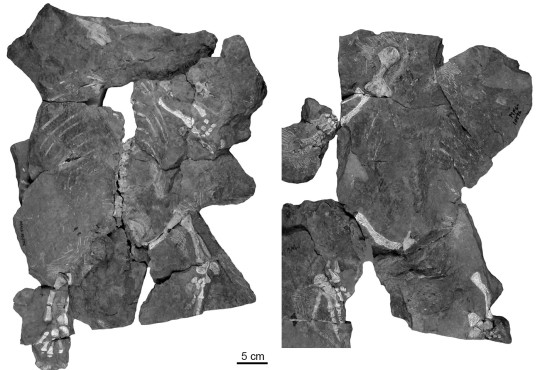
Holotype specimen of Tambacarnifex unguifalcatus, preserved in couterparts. Photographs by Dave Berman, 2010.

Tambacarnifex unguifalcatus was discovered by Thomas Martens and his father Max in 1995 in the same pocket of fossils from which the first-discovered specimen of the herbivorous basal synapsid Martensius bromackerensis was recovered. Because numerous fossil animals were jumbled together, Thomas and Max weren’t able to collect individual specimens from the bone pocket using our standard technique of surrounding a specimen in a plaster and burlap jacket. Instead, they collected all the individual pieces of rock that contained bone or at least appeared to contain bone, as most rock pieces were coated in goopy mud. Thomas cleaned the rock pieces with water to reveal the bone, and then pieced together the various specimens.

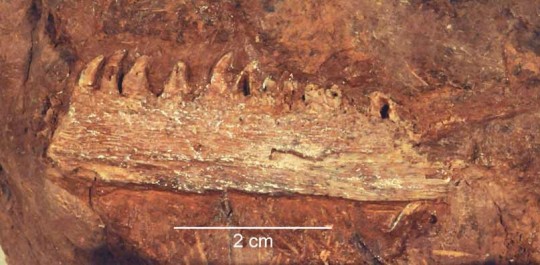
He eventually sent us the specimen that became the holotype of Tambacarnifex, along with pieces that he thought might go with it. Dave and I spent hours piecing together the remainder of the skeleton, and we searched the collections at the Museum der Natur, Gotha for missing pieces in subsequent field seasons. The majority of the specimen was recovered, but the skull, a few vertebrae, and distal finger and toe bones are missing. A rock piece with the greater portion of a lower jaw with teeth was also collected from the bone pocket, though it couldn’t be associated with the skeleton and may represent a second individual. A lot of bone was lost from the specimen, but impressions of missing bone were preserved, which proved useful for identifying wrist and ankle bones, among others. Dave used a white pencil to color in the bone impressions so they would stand out for study and in photographs of the specimen. Ultimately, we realized that Martensius and Tambacarnifex were preserved one on top of the other, though separated by several inches of rock.

The lower jaw piece of Tambacarnifex unguifalcatus. Photograph by Dave Berman, 2008.

The teeth of Tambacarnifex preserved in the lower jaw are strongly recurved and flattened side-to-side, which, along with other features preserved in the skeleton, indicate it is a member of the basal synapsid group (family) Varanopidae and in the subfamily Varanopinae. The Varanopidae have been likened to the actively predaceous modern monitor lizards in the family Varanidae, hence the similar name. Varanopids were the most diverse and longest-surviving basal synapsids, being known from the Late Carboniferous–Middle Permian (~309–260 million years ago) of North America, Europe, Asia, and Africa. With their sharp, recurved teeth and a gracile skeleton, scientists think varanopids were agile predators, at least compared to other animals of their time. They range from about 12–78 inches in length, with the smallest ones probably being insectivorous and the larger ones carnivorous. Tambacarnifex has an estimated body size of about 35 inches, and as a medium-sized varanopid with gracile limbs it would have been an agile carnivore, preying on on any of the Bromacker vertebrates that it could catch.

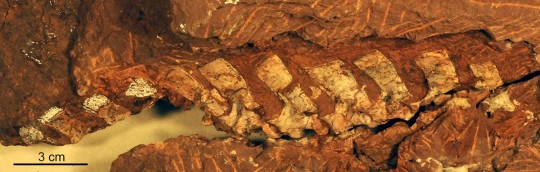
An articulated but incompletely preserved series of 11 vertebrae of Tambacarnifex unguifalcatus. Notice that the neural spines are low and subrectangular, so it is unlikely that they supported a sail, as occurs in some other basal synapsids such as Dimetrodon teutonis. The front of the animal is to the left. Photo by Dave Berman, 2008.

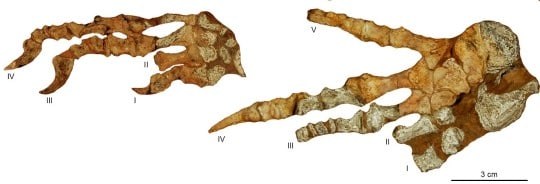
Unlike Dimetrodon teutonis, the other apex predator at the Bromacker, Tambacarnifex has broad, low neural spines that alternate in height. It differs from other varanopines in the shape and anterior inclination of its neural spines and in having greatly elongated and recurved bony claw supports in its hands and feet. The generic name Tambacarnifex was coined in reference to its position in the food chain: “Tamba,” for the Tambach Basin, which the holotype inhabited, and the Latin “carnifex,” meaning executioner, for its role as an apex predator. “Unguifalcatus” was derived from the Latin “unguis,” nail or claw, and “falcatus,” meaning sickle-shaped, in reference to the long, strongly recurved bony claw supports.

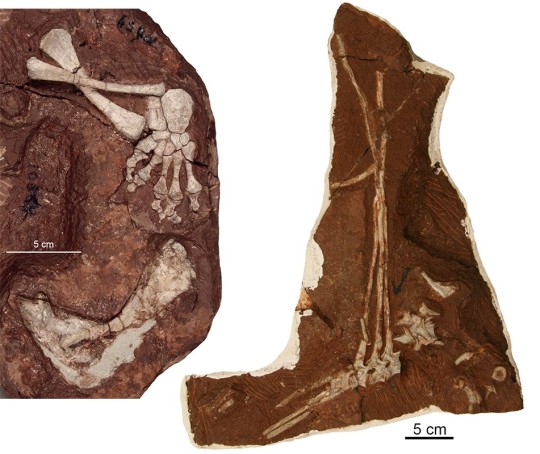
Incomplete front (left) and hind (right) feet of Tambacarnifex unguifalcatus. Notice the extremely long bony claw supports preserved on the first, third, and fourth fingers of the front foot and the fourth toe of the hind foot. I–V refer to finger and toe numbers. Photos by Dave Berman, 2008.

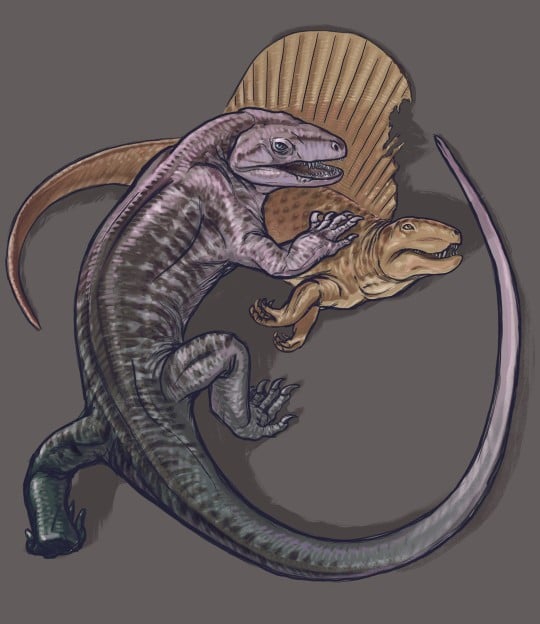
Illustration of Tambacarnifex unguifalcatus consuming a Dimetrodon teutonis carcass. Outline drawing by Matt Celeskey, colored (with permission) by Carnegie Museum of Natural History Vertebrate Paleontology Scientific Illustrator Andrew McAfee.

Stay tuned for the final post of this series, which will summarize what we’ve learned about the Bromacker. Click here if you would like to download your own copy of the outline drawing of Tambacarnifex consuming Dimetrodon to color in. The paper describing Tambacarnifex unguifalcatus can be viewed by clicking here.

Amy Henrici is Collection Manager in the Section of Vertebrate Paleontology at Carnegie Museum of Natural History. Museum employees are encouraged to blog about their unique experiences and knowledge gained from working at the museum.

Related Content

Ask a Scientist: What is it like to discover a new species? 

Mesozoic Monthly: Gargoyleosaurus

Cephalopod Fossils from Lyme Regis, England

Filed Under: Blog Tagged With: Amy Henrici, dinosaurs in their time, Museum from Home, Science News, Vertebrate Paleontology

November 4, 2020 by wpengine

The Bromacker Fossil Project Part XI: Dimetrodon teutonis, an apex predator

New to this series? Read The Bromacker Fossil Project Part I, Part II, Part III, Part IV, Part V, Part VI, Part VII, Part VIII, Part IX, and Part X. 

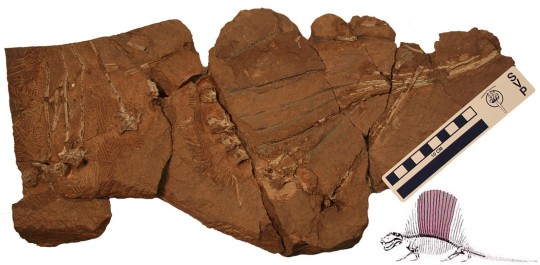
Holotype specimen of Dimetrodon teutonis, which consists of a partial vertebral column. The preserved portion of this vertebral column is highlighted in the reconstruction of Dimetrodon (lower right). Photograph by the author, 2007. Dimetrodon reconstruction modified from Romer and Price, 1940.

Specimens of two top predators have been discovered at the Bromacker quarry. Like Martensius, both are basal members of the group Synapsida, the later members of which gave rise to mammals. You might be familiar with one of them – Dimetrodon, a synapsid sometimes incorrectly portrayed with dinosaurs, which carried a tall sail on its back that was supported by bony spines. The other is a new genus and species that will be presented in my next post.

The fossil pictured above, the first-discovered specimen of Dimetrodon from the Bromacker quarry, may not look like much, but it was the first record of Dimetrodon outside of North America. The circumstances under which it was found were very different from the discovery of other fossils from the Bromacker quarry. Before Dave Berman and I arrived for the 1999 field season, Thomas Martens noticed that someone, possibly a fossil poacher, had been in the quarry overnight and knocked some rocks off the quarry lip. The rocks apparently broke upon hitting the ground, which exposed some bones. Thomas carefully picked them up and took them to his lab at the Museum der Natur, Gotha (MNG). When Dave and I met Thomas at the quarry on our first day of the field season, Thomas mentioned the find and told us that he thought the bones were ribs. We didn’t think much of it, other than horror at learning a fossil poacher might have visited the quarry overnight, one of our worst fears.

As planned, Dave and I spent the last day of the field season in the museum collections, and when Thomas let us in that morning, he reminded us to look at the potential ribs and told us where they were. Shortly after we began examining them, Dave and I simultaneously realized that the “ribs” were actually spines of Dimetrodon. We couldn’t believe our eyes, because of all the Early Permian fossils known from North America, Dimetrodon was Thomas’ favorite. Indeed, he’d used an image of it on signs at the Bromacker and included a model of Dimetrodon in a diorama, once on display in the MNG, that showed models of Bromacker animals in their environment. Thomas jumped for joy later that day when we gave him the news.

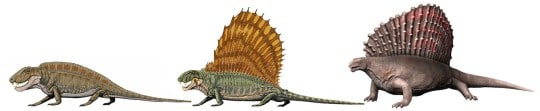
So how did Dave and I so quickly realize that the “ribs” were spines of Dimetrodon? Besides Dimetrodon, some other basal synapsids had sails, the function of which remains unknown, though scientists have speculated they could’ve been used for display or regulating body temperature. The spines (known as neural spines) supporting the sails vary in shape and length, with those of Dimetrodon and its herbivorous relative Edaphosaurus being tall and narrow, and those of another relative, the carnivorous Sphenacodon, being shorter and blade-like. Neural spines of Dimetrodon are easy to distinguish, because in addition to being long they bear fore and aft grooves, which create a dumbbell-shaped cross-sectional outline, and they lack the ‘crossbars’ that occur on the long neural spines of Edaphosaurus. When Dave and I saw the fore and aft grooves, the dumbbell-shaped cross-sectional outline of some broken spine ends, and an absence of crossbars, we knew that the “ribs” were indeed spines of Dimetrodon.

Flesh reconstructions of Sphenacodon sp. (left), Dimetrodon grandis (middle), and Edaphosaurus pogonias (right) to show the differences between their sails. Note that Dimetrodon and Sphenacodon are more closely related to one another than they are to Edaphosaurus, despite their different sail shapes. Reconstructions of Sphenacodon and Dimetrodon by Dmitry Bogdanov and that of Edaphosaurus by Nobu Tamura, all from Wikimedia Commons.

The Bromacker Dimetrodon is considerably smaller than other known species of the genus, and this is one character among other more detailed anatomical features that distinguishes it. For the new species name, Dave selected the Latin “teutonis,” which means an individual of a German tribe, in reference to the geographic origin of the holotype specimen.

Two additional specimens of Dimetrodon teutonis. Left, hindleg and shoulder girdle bone (fused scapulocoracoid) and right, several vertebrae bearing complete to nearly complete neural spines of an individual that was larger and presumably more mature than the holotype. Photographs by the author, 2007.

Dave was able to use a mathematical equation involving measurements of the vertebrae to estimate the holotype’s weight as a living animal at 31 pounds. In contrast, other known Dimetrodon species have estimated weights of about 81–550 pounds. We later discovered additional partial specimens of Dimetrodon at the Bromacker quarry, and Dave estimated the weight of the largest specimen with vertebrae at 53 pounds, still considerably less than that of what had previously been the smallest species, D. natalis from Texas. Dimetrodon is otherwise known from numerous species from the American mid-continent and southwest that generally got larger through time.

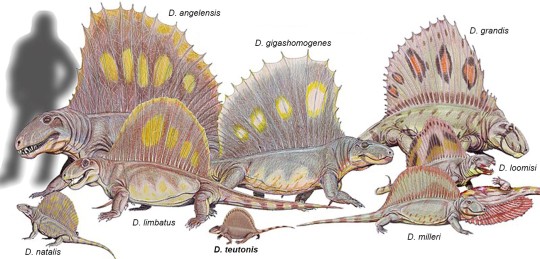
Reconstructions of various species of Dimetrodon drawn to scale. The diminutive D. teutonis is at bottom center and D. natalis, no longer the smallest species, is at bottom left. Illustration adapted from Dmitry Bogdanov via Wikimedia Commons.

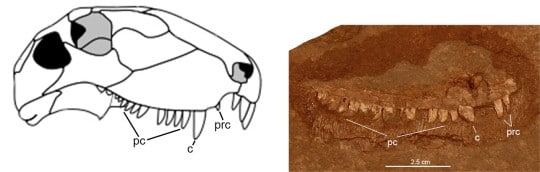
All Dimetrodon species have teeth adapted for meat-eating in being teardrop-shaped with sharp edges for slashing flesh. By size and jaw position these sharp teeth are divided into precanines, canines, and postcanines of varying numbers. Unlike D. teutonis, some species even had fine serrations on their tooth edges. The only known upper jaw bone of Dimetrodon teutonis clearly has two canines, but one is missing and represented by a large gap in the tooth row that would have accommodated this tooth. The second canine is represented only by its broad base, but it too must have been large. Although it was a small animal, the teeth of D. teutonis indicate that it was a meat-eater and as such would have preyed on other vertebrates from the Bromacker, many of which were even smaller.

Diagrammatic drawing of the skull of Dimetrodon (left) and photograph of the maxilla or upper jaw bone (right) of D.teutonis. Abbreviations: c, canine; pc, postcanine; prc, precanine. Photographs by the author, 2007. Drawing of skull from Wikimedia Commons.

Stay tuned for my next post, which will be about the second-known apex carnivore from the Bromacker. In the meantime, here are links to scientific papers on Dimetrodon teutonis:

https://www.researchgate.net/publication/325670232_A_new_species_of_Dimetrodon_Synapsida_Sphenacodontidae_from_the_Lower_Permian_of_Germany_records_first_occurrence_of_genus_outside_of_North_America

https://www.researchgate.net/publication/288544821_New_materials_of_Dimetrodon_teutonis_Synapsida_Sphenacodontidae_from_the_Lower_Permian_of_Germany

Amy Henrici is Collection Manager in the Section of Vertebrate Paleontology at Carnegie Museum of Natural History. Museum employees are encouraged to blog about their unique experiences and knowledge gained from working at the museum.

Keep Reading

The Bromacker Fossil Project Part XII: Tambacarnifex unguifalcatus, the Tambach Executioner 

Filed Under: Blog Tagged With: Amy Henrici, Museum from Home, Science News, Section of Vertebrate Paleontology, The Bromacker Fossil Project, Vertebrate Paleontology

October 1, 2020 by wpengine

The Bromacker Fossil Project Part X: Tambaroter carrolli, an amphibian with a wedge-shaped head

New to this series? Read The Bromacker Fossil Project Part I, Part II, Part III, Part IV, Part V, Part VI, Part VII, Part VIII, and Part IX. 

Thomas Martens at the construction site for a new store in Tambach-Dietharz where he found fossils by checking loose pieces of rock on the excavation floor. Photo by Stephanie Martens, 2008.

Paleontologist Thomas Martens has an amazing ability to find fossils. After he discovered the first vertebrate fossils at the Bromacker site in an abandoned commercial quarry in 1974, he and his father Max found additional fossils in the bottom of a deep pit they’d dug with hand tools, an excavation that Dave Berman, Stuart Sumida, and I fondly dubbed the “elevator shaft.” Years later, Thomas used funding from the German federal government to drill rock cores in the field surrounding the Bromacker quarry to help understand the geology of the fossil deposit. Amazingly, at one of the spots Thomas had selected, the drill core penetrated a skeleton of Diadectes absitus. So, it wasn’t surprising that in 2008 Thomas found a skull and partial skeleton of D. absitus and a small skull of a fossil animal new to science at a construction site for a new store in the nearby village of Tambach-Dietharz.

Dave Berman (left) and Stuart Sumida (right) pose with a shopping cart in front of the Netto Discount Store, which was built in the excavation site where Tambaroter was found. Rocks of the Tambach Formation can be seen behind the retaining wall. Photo by the author, 2008.

It makes sense, however, that vertebrate fossils were found close to the Bromacker quarry. Fossils from the Bromacker were preserved in the Tambach Formation, a 200–400-foot-thick unit of sediments that were deposited in the small intermontane Tambach Basin about 290—283 million years ago during the Early Permian Epoch. The Tambach Basin covered an area of about 155 square miles and was internally drained; that is, there were no rivers or streams flowing into and out of the basin. During periods of extremely heavy rain, water and mud would flow down the basin sides in what are called sheet floods and pool in the basin center, which is where the present day Bromacker quarry and Tambach-Dietharz are thought to be located. Any animals killed during these events would be carried by the sheet floods to the basin center where they’d have been quickly and deeply buried in mud settling out of the ponded water and later become fossilized. It is assumed that animals captured by the sheet flood events inhabited the Tambach Basin, because carcasses couldn’t have been carried into the basin by rivers and streams.

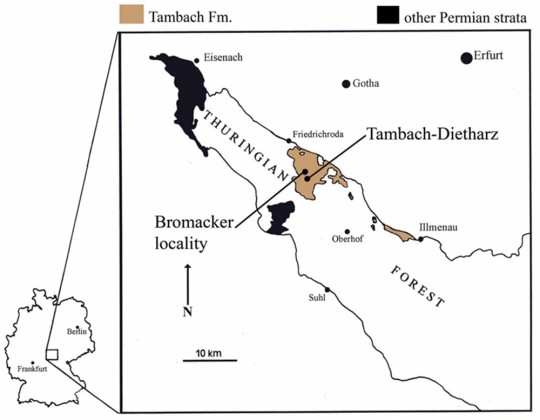
Map of Germany with inset showing the Bromacker locality and the nearby town of Tambach-Dietharz. Although the Tambach Basin in which the Tambach Formation was deposited covers about 155 square miles, outcrops of the Tambach Formation today occur in an area of only about 31 square miles.

While preparing Bromacker fossils, I’d typically read literature related to the fossil I was working on, write notes on what I thought were important features in the fossil, and give my notes to the person leading the project. When Dave was the lead, we’d typically have lots of discussion about certain features preserved in the animal, conversations that often directed the course of preparation. This time, in addition to preparing the new find, I was designated as the lead author for the publication that would name and describe it.

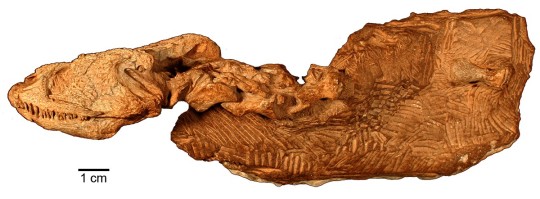
View of the underside of the skull of Tambaroter carrolli before preparation. The shiny area surrounding the skull is glue, which I applied to a crack to stabilize the specimen before preparation could begin. I had to free the skull from the surrounding rock before exposing as much of it as possible through preparation. Photo by the author, 2008.

Tambaroter is a member of the Microsauria, a diverse group of small amphibians that were once thought to be reptiles, a hypothesis that some paleontologists are currently revisiting. Microsaurs inhabited a variety of habitats and exhibited a range of body forms. Some were highly terrestrial with limb proportions similar to those of lizards, whereas others were aquatic and had elongated bodies and reduced girdles and limbs. Still others were adapted for burrowing or rooting through leaf litter. Tambaroter belongs to this latter-most group, which is named Recumbirostra for their recurved snout, in which the front of the mouth is overhung by the snout.

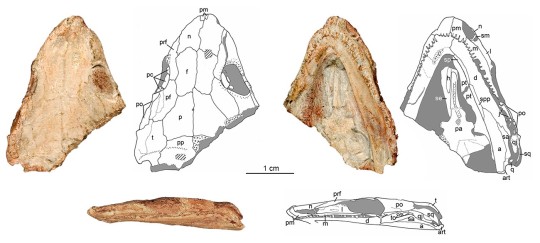
Photographs and line drawings of the skull of Tambaroter carrolli in (clockwise from upper left) dorsal (top), ventral (underside), and left lateral (side) views. Photographs by the author, 2008 and drawings by the author and modified from Henrici et al., 2011.

Tambaroter is member of the recumbirostran subgroup Ostodolepidae. I coined the name Tambaroter, which is derived from “Tamb,” for the Tambach Formation, and the Greek “aroter,” meaning plowman, in reference to the snout shape. Two previously named ostodolepids, Micraroter and Nannaroter, have the “aroter, suffix in their name, so usage of the “aroter” suffix was a continuation of this. The species name, carrolli, honors microsaur expert Robert Carroll (then Curator Emeritus at the Redpath Museum, McGill University, Montreal, Canada).

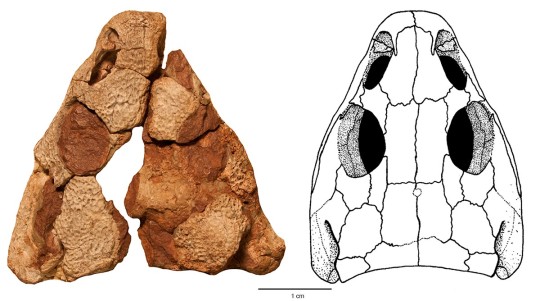
Skulls of representative ostodolepid microsaurs from geologically oldest (left) to youngest (right). A reconstruction drawing of the skull of Tambaroter was used instead of a photograph for comparison because the original fossil skull is extremely flattened (see previous image). Photographs, except for that of Nannaroter, by the author, 2009. The photograph of Nannaroter was modified from Anderson et al., 2009. Tambaroter skull reconstruction by the author and modified from Henrici et al., 2011. Scale bar of the tiny Nannaroter and other ostodolepids equals 1 cm.

When Tambaroter was published on in 2011, it was the first ostodolepid to be found outside of the USA (the others are from Oklahoma and Texas) and is the oldest one known. Other, possible ostodolepids have since been described from the American Midwest and Germany. All ostodolepids have a wedge-shaped skull and recumbent snout, which is accentuated in Pelodosotis. Based on these features, scientists think that ostodolepids burrowed or searched for worms and other prey in leaf litter. Remarkably, the skull of the tiny Nannaroter is so strongly built that it could have withstood burrowing headfirst into the ground by using its shovel-like snout to loosen dirt and its broad, flat head to push soil against the burrow ceiling. Because the sutures between individual skull bones in the Tambaroter type specimen are not tightly fused together, we think it belonged to a juvenile, so we don’t know if the adult skull would’ve been as strongly built as that of Nannaroter.

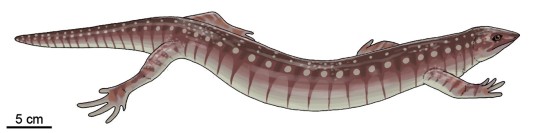
Life drawing of the ostodolepid microsaur Pelodosotis elongatum, which is known by a nearly complete specimen. Tambaroter probably had a similar body shape, though its skull would not have been as strongly wedge-shaped. Drawing modified by Carnegie Museum of Natural History Scientific Illustrator Andrew McAfee from outline drawing in Carroll and Gaskill (1978).

Stay tuned for my next post, which will feature one of the Bromacker’s top carnivores. To learn more about Tambaroter, read the publication that described the animal here.

Amy Henrici is Collection Manager in the Section of Vertebrate Paleontology at Carnegie Museum of Natural History. Museum employees are encouraged to blog about their unique experiences and knowledge gained from working at the museum.

Keep Reading

The Bromacker Fossil Project Part XI: Dimetrodon teutonis, an apex predator

Filed Under: Blog Tagged With: Amy Henrici, Museum from Home, Science News, The Bromacker Fossil Project, Vertebrate Paleontology

August 21, 2020 by wpengine

The Bromacker Fossil Project Part IX: The Dissorophoid Amphibians Tambachia, Rotaryus, and Georgenthalia, Capable Travelers

New to this series? Read The Bromacker Fossil Project Part I, Part II, Part III, Part IV, Part V, Part VI, Part VII, and Part VIII.

The Dissorophoidea are a group of ancient amphibians that were common about 290 million years ago, when the animals fossilized in the Bromacker quarry were alive. The group consists of small to medium-sized water- and land-dwelling vertebrates (animals with backbones) that ate invertebrates (e.g., dragonflies, cockroaches, and millipedes) and vertebrates smaller than themselves. Most scientists agree that modern amphibians (frogs, salamanders, and the reclusive, worm-like, subterreanean caecilians) had their origins among the dissorophoids. Three disssorophoid species are currently known from the Bromacker quarry, and at least one and possibly two more are yet to be described. Two of the described species, Tambachia trogallas and Rotaryus gothae, are members of the dissorophoid subgroup Trematopidae, and the other, Georgenthalia clavinasica, is a member of the subgroup Amphibamiformes. All of them inhabited the terrestrial realm and most likely only returned to water to breed.

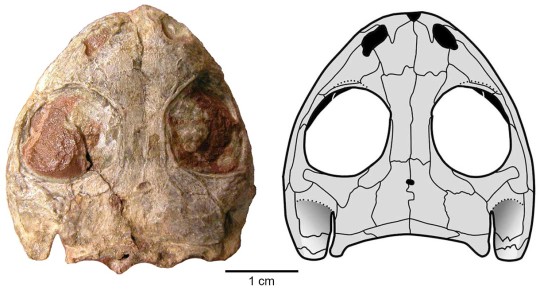
Photograph (left) and reconstruction (right) of the skull of the holotype and only known specimen of Tambachia trogallas in dorsal (= top) view. Photograph by the author (2013) and reconstruction by Stuart Sumida, modified from Sumida et al. (1998).

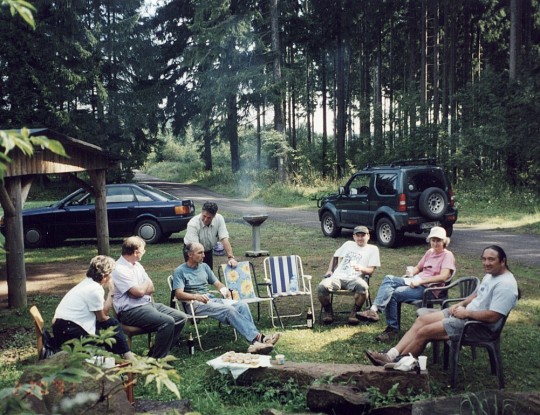
The first trematopid discovered in the Bromacker quarry was found by Thomas Martens in 1980, and it is represented by a poorly preserved skull and skeleton. Stuart Sumida, as lead author of the scientific paper presenting it, coined the name Tambachia trogallas. Tambachia refers to the Tambach Formation, the rock unit preserving the Bromacker fossils, which in turn is named after the nearby village of Tambach, which is now merged with the adjacent town Dietharz to become Tambach-Dietharz. “Trogallas” is from the Greek “trogo,” meaning munch or nibble, and “allas,” meaning sausage, in reference to all of the bratwurst consumed during Bromacker field seasons by the authors of the Tambachia publication (Stuart, Dave Berman, and Thomas). The state where the the quarry is located, Thuringia, is famous for its bratwurst and rightly so. A hot bratwurst for lunch was always welcomed when we experienced what Thomas called “Scandanavian summers,” which were cold and rainy. The then-Bürgermeister (mayor) of Tambach-Dietharz, who also was a butcher, was so thrilled by the name that he hosted an annual bratwurst lunch featuring brats that he’d made. This tradition was carried on by subsequent Bürgermeisters, though they had to buy the featured main course.

Bratwurst lunch in the Thuringian Forest close to the Bromacker quarry. Seated are (from left to right) unknown, Rainer Samietz (then Director of the Museum der Natur Gotha, now retired), Thomas Martens, Johannes Müller (then field assistant and now Professor at Museum für Naturkunde, Berlin), the author, and Stuart Sumida. The Bürgermeister is standing behind Thomas. His bratwurst grill, which he transported in his SUV, is between the vehicles. Photo by Dave Berman (2002).
Skull and partial skeleton of Rotaryus gothae in left lateral (= side) view. Photograph by the author, 2008.

When Rotaryus gothae was found in 1998, only part of the skull was exposed, so we took out a large block expecting a complete skeleton to be preserved, as typically occurs at the Bromacker. Once I began preparing the specimen, however, I was extremely disappointed to find that only a small portion of the body of the animal was present. At least we had the skull, the most scientifically important part of the skeleton. Dave led the scientific study of Rotaryus, and he named it in honor of the Gotha Rotary Club, an organization that generously provided financial support for Bromacker fieldwork. Dave sent the head of the Gotha Rotary Club three choices for the fossil’s name, and the members voted on which one to use.

At the time that Tambachia and Rotaryus were named and described in scientific publications in 1998 and 2011, respectively, trematopids were known only from the USA. Their presence at the Bromacker added to the growing list of animals previously thought to only inhabit North America, such as Diadectes and Seymouria. In hindsight, it is not surprising that trematopids also had a more cosmopolitan distribution, because although they are amphibians, their skeletons were strong enough to support their body out of water and withstand the effects of gravity, thus enabling them to disperse to far corners of the world (though hypotheses of such dispersal assume that no physical or climatic barriers prevented movement).

I was the lucky person who discovered, in 2002, the amphibamiform Georgenthalia clavinasica. I recall lifting up a block of rock that I had loosened with a hammer and chisel and seeing two ghostly eye openings staring back at me. The rest of the skeleton was preserved with the skull, but unfortunately all bone beyond the skull was extremely eroded from groundwater and had the consistency of mashed potatoes.

Photograph (left) and reconstruction (right) of the skull of Georgenthalia clavinasica in dorsal (= top) view. Both by Jason Anderson, 2007.

After Tambachia was named, the Bürgermeister of the nearby village of Georgenthal, whose boundaries included the Bromacker quarry, approached Dave about naming a fossil after his village. Dave then asked Jason Anderson, a colleague from the University of Calgary and the project’s lead researcher, to name it Georgenthalia. Jason created clavinasica from the Latin “clavis” for key, and “nasica” for nostril, in reference to the fossil’s keyhole-shaped nostril, a unique feature that differentiates Georgenthalia from all other amphibamiforms.

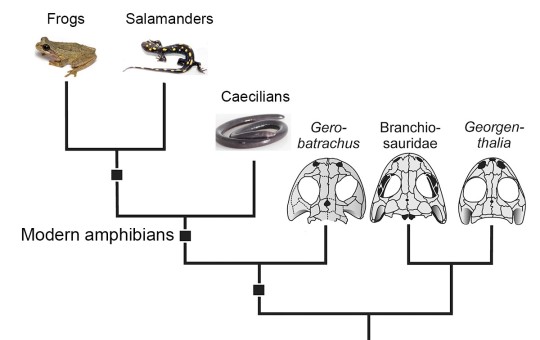
Jason, as lead author of a 2008 scientific publication, concluded that the relationship of Georgenthalia to other amphibamiforms was uncertain. Computer algorithms are used to analyze relationships of organisms by tabulating the proportion of unique characteristics shared between the members of the group under study. A group of organisms that share unique characters is called a clade, and members of a clade are considered to be more closely related to each other than they are to members of other clades. These relationships are depicted in a diagram of relatedness called a cladogram.

A 2019 study by dissorophoid expert Rainer Schoch (Curator, Naturkunde Museum Stuttgart) that investigated the ancestry of modern amphibians revealed Georganthalia as a member of a clade that also includes modern amphibians (see figure below). The fossil Gerobatrachus, however, is more closely related to modern amphibians than it is to the clade consisting of Georgenthalia and Branchiosauridae (a group of aquatic amphibamiforms). This indicates that although Georgenthalia (along with Branchiosauridae) is in the clade containing modern amphibians, it is not directly ancestral to them.

Cladogram showing the relationship of Georgenthalia (far right) to modern amphibians. Cladogram modified from Schoch (2019); images of modern amphibians from Wikimedia Commons.

Stay tuned for my next post, which will feature yet another terrestrial amphibian, a fossil from a locality in Tambach-Dietharz.

If you would like to learn more about Tambachia, Rotaryus, or Georgenthalia, please follow the links below.

Tambachia

Rotaryus

Georgenthalia

Amy Henrici is Collection Manager in the Section of Vertebrate Paleontology at Carnegie Museum of Natural History. Museum employees are encouraged to blog about their unique experiences and knowledge gained from working at the museum.

Keep Reading

The Bromacker Fossil Project Part X: Tambaroter carrolli, an Amphibian with a Wedge-Shaped Head 

Filed Under: Blog Tagged With: Amy Henrici, Museum from Home, Science News, Section of Vertebrate Paleontology, The Bromacker Fossil Project, Vertebrate Paleontology

  • Page 1
  • Page 2
  • Page 3
  • Interim pages omitted …
  • Page 5
  • Go to Next Page »

sidebar

About

  • Mission & Commitments
  • Directors Team
  • Museum History

Get Involved

  • Volunteer
  • Membership
  • Carnegie Discoverers
  • Donate
  • Employment
  • Events

Bring a Group

  • Groups of 10 or More
  • Birthday Parties at the Museum
  • Field Trips

Powdermill

  • Powdermill Nature Reserve
  • Powdermill Field Trips
  • Powdermill Staff
  • Research at Powdermill

More Information

  • Image Permission Requests
  • Science Stories
  • Accessibility
  • Shopping Cart
  • Contact
  • Visitor Policies
One of the Four Carnegie Museums | © Carnegie Institute | Privacy Policy | Terms of Use | Accessibility
Rad works here logo