• Skip to primary navigation
  • Skip to main content
  • Skip to primary sidebar

Carnegie Museum of Natural History

One of the Four Carnegie Museums of Pittsburgh

  • Visit
    • Buy Tickets
    • Visitor Information
    • Exhibitions
    • Events
    • Dining at the Museum
    • Celebrate at the Museum
    • Powdermill Nature Reserve
    • Event Venue Rental
    • Gift Cards
  • Learn
    • Field Trips
    • Educator Information
    • Programs at the Museum
    • Bring the Museum to You
    • Guided Programs FAQ
    • Programs Online
    • Climate and Rural Systems Partnership
  • Research
    • Scientific Sections
    • Science Stories
    • Science Videos
    • Senior Science & Research Staff
    • Museum Library
    • Science Seminars
    • Scientific Publications
    • Specimen and Artifact Identification
  • About
    • Mission & Commitments
    • Directors Team
    • Museum History
  • Tickets
  • Give
  • Shop

Blogs about Birds

Birds are incredibly important to Carnegie Museum of Natural History. The museum's Section of Birds contains nearly 190,000 specimens of birds. The most important of these are the 555 holotypes and syntypes. The Section of Birds staff also cares for approximately 196 specimens of extinct birds as well as specimens of many rare species collected decades—if not more than a century—ago.

September 4, 2018 by wpengine

Fire Destroys Brazilian Museum Once Called House of the Birds

by Chase D. Mendenhall

One of Latin America’s most important museums burned Sunday night —destroying up to 20 million scientific and historical artifacts. It is unclear how many of the irreplaceable treasures housed at the National Museum in Rio de Janeiro were lost. The museum was established in 1818 by the King of Portugal and in its early days was known as the “Casa dos Pássaros,” or House of the Birds, for its impressive bird collections.

Today, the museum was best known for its exhibits of the Americas consisting of mammals, birds, reptiles, amphibians, insects, minerals, aboriginal collections of utensils, Egyptian mummies, South American archaeological artifacts, meteorites, fossils and many other findings. Sadly, many of these invaluable objects are permanently lost.

Novelist Paulo Coelho described the reaction to the fire by saying, “the country is in tears.” Others have demonstrated their pain by carrying signs that say “200 years of history, 20 million items, reduced to ashes.”

We find comfort knowing that some pieces of Brazilian history are safely stored in other museums around the world. The Carnegie Museum of Natural History represents Brazil strongly in its collections, especially in the Section of Birds. We house one of the most comprehensive collections of Brazilian birds outside of Rio de Janeiro. We have 885 species of birds from Brazil, represented by 20,292 specimens—4,357 of which are on loan around the world.

Museums generate millions of data points and inform published scientific debates that are shared through networks. Today, these networks of knowledge and sharing define museum collections and exist precisely to safeguard against disasters.
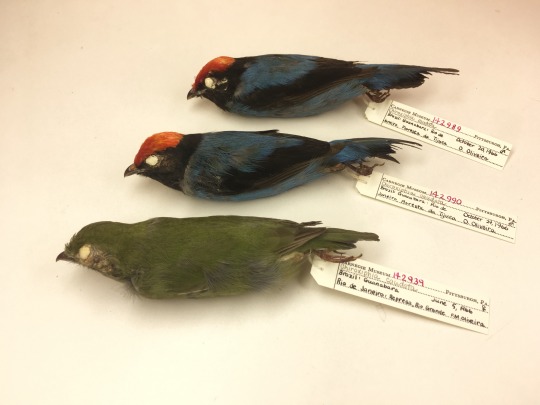
Chiroxiphia caudata study skins

Birds from the Carnegie Museum of Natural History collected from Rio de Janero include Blue Manakins (Chiroxiphia caudata), a species with one of the best examples of a cooperative breeding behavior. Males (red, black, and blue birds in background) meet in groups to dance in a coordinated, circular loop to breed with the solitary females (green bird in foreground) who raise the young on their own.
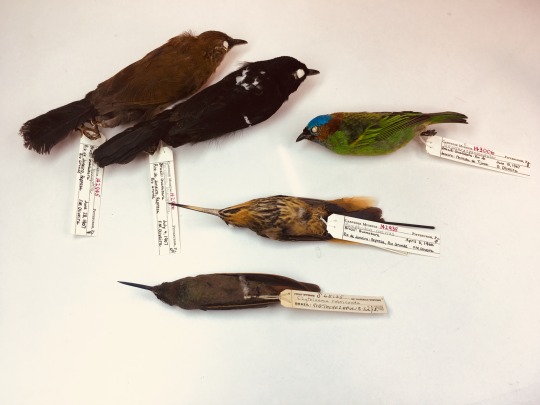
study skins of Brazilian birds

Other birds representing Brazil from the collections at the Carnegie Museum of Natural History include a pair of White-shouldered Fire-eye (Pyriglena leucoptera), a Red-necked Tanager (Tangara cyanocephala), a Saw-billed Hermit (Ramphodon naevius), and a Brazilian Ruby (Clytolaema rubricauda). Specimens are listed in the image from top to bottom.

Chase Mendenhall is Assistant Curator of Birds, Ecology, and Conservation at Carnegie Museum of Natural History. Museum employees are encouraged to blog about their unique experiences and knowledge gained from working at the museum.
Filed Under: Blog Tagged With: bird hall, Birds, Chase Mendenhall, Mason Heberling, Section of Birds

August 7, 2018 by wpengine

Unscrambling the Science of the Egg

By Chase D. Mendenhall

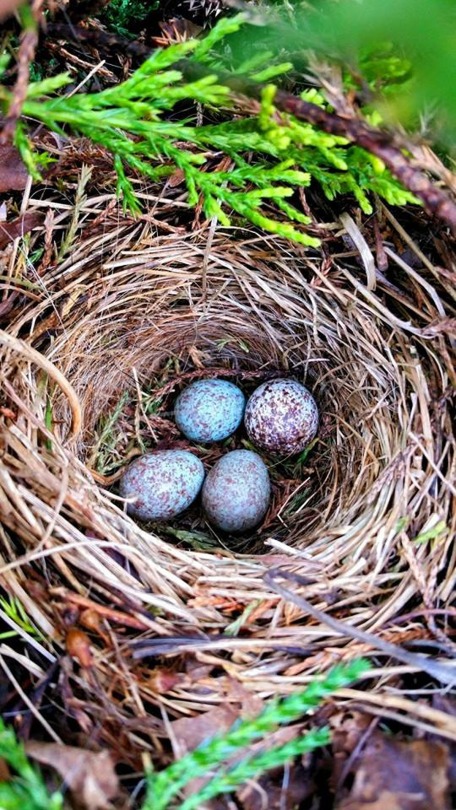
eggs in a nest

What came first, the chicken or the egg? The answer to this riddle is the egg. Eggs are universal among all vertebrates, including humans, but reptiles are responsible for the development of the eggshells typical of terrestrial birds and early mammals. Eggs are virtually self-contained life support systems that freed the first reptiles to wander away from water for reproduction, separating them from amphibians. Eggs are packed with most of the ingredients needed to grow the animal inside. All they require for the embryo to develop properly are warmth and gas exchange.

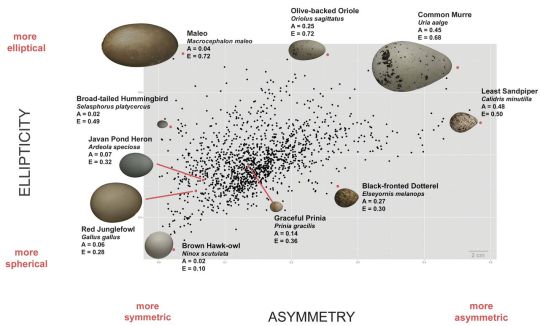
Bird eggs vary tremendously. Shape, size, coloration, and contents have often been associated with life histories of the species that lay them. For example, asymmetrical eggs with one pointed end were thought to be the result of nesting on a cliff—these eggs roll in tight circles instead of straight off the edge. Similar stories have been written about extensively to explain the jelly bean shape of the hummingbird eggs, elongated ellipses of swifts, and the spherical nature of owl eggs—but new work done in museum collections may have answered the riddle of egg shape definitively. Specifically, scientists now have evidence to suggest that selection for flight adaptations is most likely to be responsible for most of the variation.

chart of egg shapes

Measurements of nearly 50,000 eggs in museum collection from 1,400 bird species by Dr. Mary Stoddard and colleagues revealed stunning evidence that egg shape is related to flight. Dr. Stoddard’s star variables for testing her hypothesis were egg asymmetry and ellipticity. Symmetric eggs have similar shapes at each end, like the hummingbird’s jellybean shaped eggs, and asymmetric eggs are pointed at one end, like a sandpiper egg. Ellipticity is related to length and volume of the egg—for example, owls lay spherical eggs, while Orioles and Swifts lay long zeppelin-shaped eggs. The two variables of asymmetry and ellipticity interact with one another, allowing scientists to categorize egg shape across two axes that provide information about the way the egg was shaped in the shell gland after passing through the uterus.

Stoddard discovered that mother birds shape their eggs mechanically, apply pressure to the egg membranes as layers of calcium carbonate crystals form the eggshell. The shape of the egg determines the space in which the young bird completes the process of building its body for flight. Like all multi-cellular vertebrates, one cell divides into many—differentiating into trillions of cells with specialized architecture and function. According to Stoddard’s analysis of egg shape in relationship to phylogenetic history, she was able to demonstrate that egg shape explained wing shape. Spherical eggs, like those of the owl, are symmetric and score low on the ellipiticity scale and tend to belong to birds who spend little time flying. Elongated, asymmetric eggs—like those belonging to sandpipers, are associated with champion flyers who might spend many days airborne.

Chase Mendenhall is Assistant Curator of Birds, Ecology, and Conservation at Carnegie Museum of Natural History. Museum employees are encouraged to blog about their unique experiences and knowledge gained from working at the museum.
Filed Under: Blog Tagged With: Birds, egg laying, eggs, evolution

July 20, 2018 by wpengine

Powerlifting Poultry and Mallards that Marathon

By Chase D. Mendenhall

Fried, roasted or barbequed—most of us have a preference for cuts of light or dark meat when chicken is for dinner. But why the striking differences between dark and light meat?

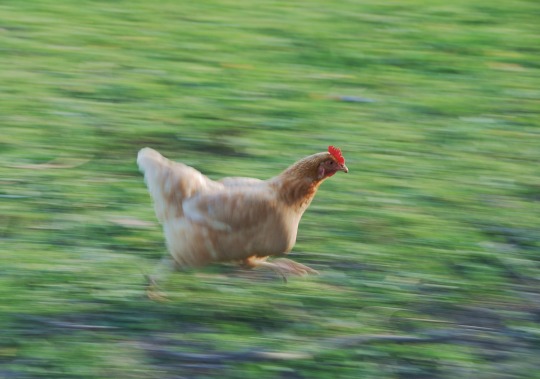
Chickens are gallinaceous birds, meaning they belong to a group of heavy-bodied, ground-feeding birds that generally prefer not to fly. Their leg muscles are used for standing, walking, and running throughout the day. Like a marathon runner, chickens build muscles in their legs that are highly resistant to fatigue and require lots of oxygen for the aerobic exercise being on foot all day. In fact, drumsticks and thighs get their color from the iron held in a special muscle fiber, myoglobin. The myoglobin in the dark muscles breaks down during cooking, giving the cooked meat a brownish color.

chicken running

Chickens build muscles in their wings and breasts for explosive bursts of flight from a resting position, similar to a bodybuilder maxing out their bench press. The flight of a chicken is mostly an anaerobic exercise, meaning that muscles are reacting quickly and doing extremely hard work in the absence of oxygen. Lighter muscle fibers take up sugars to fuel the explosive movement of flight from a standstill, but these muscles fatigue very quickly. When muscles with very little myoglobin muscle fibers are cooked, the proteins in the muscle fibers denature and coagulate, resulting in the white, opaque appearance we associate with a chicken breast.

But what about duck breast, isn’t it dark meat? Duck à l’orange and Pan Roasted Duck only have darker cuts of meat for us to choose from—including the breasts. Because ducks use their flight muscles to sustain long-distance flights, they stock their flight muscles with myoglobin to sustain aerobic flight. The aerobic demands of flight for a duck means that their meat is a darker color when served for supper.

Chase Mendenhall is Assistant Curator of Birds, Ecology, and Conservation at Carnegie Museum of Natural History. Museum employees are encouraged to blog about their unique experiences and knowledge gained from working at the museum.
Filed Under: Blog Tagged With: Birds, Chase Mendenhall, Section of Birds

July 10, 2018 by wpengine

Adult Flycatcher

Adult Flycatcher

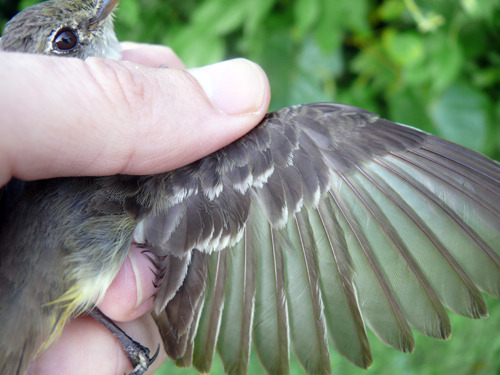
This adult Flycatcher undergoes the pre-basic molt of the wintering grounds. These adults can be readily identified by their white bars and wear on the feather tips.


Powdermill Nature Reserve’s avian research center is part of Carnegie Museum of Natural History’s biological research station in Rector, Pennsylvania.  The research center operates a bird banding station, conducts bioacoustical research, and performs flight tunnel analysis with the goal of reducing window collisions.


Filed Under: Blog Tagged With: avian research, bird banding, birding, Birds, nature, parc, Powdermill, Powdermill Nature Reserve, research

July 10, 2018 by wpengine

Acadian Flycatcher

acadian flycatcher

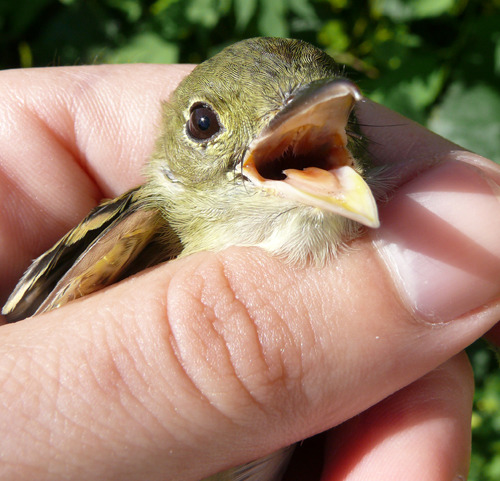
This Flycatcher has a pale yellow mouth lining.


Powdermill Nature Reserve’s avian research center is part of Carnegie Museum of Natural History’s biological research station in Rector, Pennsylvania.  The research center operates a bird banding station, conducts bioacoustical research, and performs flight tunnel analysis with the goal of reducing window collisions.


Filed Under: Blog Tagged With: avian research, avian research center, bird banding, Birds, nature, parc, Powdermill, Powdermill Nature Reserve, research

July 10, 2018 by wpengine

How Birds Breathe with their Butts

by Chase D. Mendenhall

The avian respiratory system is the most efficient in the animal kingdom, which explains how birds get enough oxygen to power flight, even at high altitudes where oxygen is scarce. A key feature that makes avian respiration special is the fact that they have static lungs and breath unidirectionally by breathing with air sacs throughout their body instead of diaphragms common in other land animals.

When a bird draws in a breath of air, it travels through the nares (or nostrils) down the trachea into a series of posterior air sacs located in the thorax and rump—in their butts. When a bird exhales that same breath, it does not leave the body as it does with mammals but rather moves into the lung where oxygen is absorbed and carbon dioxide expelled. When a bird inhales for the second time, that same breath of air moves from the lungs into the anterior air sacs. The second and last exhalation is when the stale air leaves the bird’s body through the nares.

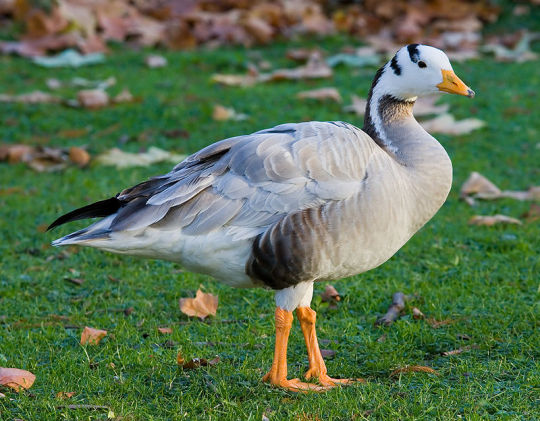
Every breath a bird takes requires two breathing cycles to complete a single breath, making the air passing through the lung unidirectional and always fresh and full of oxygen. Bird lungs are small and rigid, with the gas exchange region of their anatomy organized into a series of parallel tubes that bring deoxygenated blood into the lung at the opposite direction the air is flowing. This “counter-current” gas exchange is efficient and unique to bird lungs and partly enables species, such as the Bar-headed Goose (Anser indicus), to fly over the summit of Mt. Everest without issue. Human explorers, on the other hand, struggle for fresh air at 29,029 feet above sea level because mammalian lungs never expel all the stale air during exhalation, making mammalian explorers long for the ability to use their butts to breath continuous fresh air like the birds.


Chase Mendenhall is Assistant Curator of Birds, Ecology, and Conservation at Carnegie Museum of Natural History. Museum employees are encouraged to blog about their unique experiences and knowledge gained from working at the museum.
Filed Under: Blog Tagged With: birding, Birds, Chase Mendenhall, nature

  • « Go to Previous Page
  • Page 1
  • Interim pages omitted …
  • Page 9
  • Page 10
  • Page 11
  • Page 12
  • Page 13
  • Interim pages omitted …
  • Page 20
  • Go to Next Page »

sidebar

About

  • Mission & Commitments
  • Directors Team
  • Museum History

Get Involved

  • Volunteer
  • Membership
  • Carnegie Discoverers
  • Donate
  • Employment
  • Events

Bring a Group

  • Groups of 10 or More
  • Birthday Parties at the Museum
  • Field Trips

Powdermill

  • Powdermill Nature Reserve
  • Powdermill Field Trips
  • Powdermill Staff
  • Research at Powdermill

More Information

  • Image Permission Requests
  • Science Stories
  • Accessibility
  • Shopping Cart
  • Contact
  • Visitor Policies
One of the Four Carnegie Museums | © Carnegie Institute | Privacy Policy | Terms of Use | Accessibility
Rad works here logo