• Skip to primary navigation
  • Skip to main content
  • Skip to primary sidebar

Carnegie Museum of Natural History

One of the Four Carnegie Museums of Pittsburgh

  • Visit
    • Buy Tickets
    • Visitor Information
    • Exhibitions
    • Events
    • Dining at the Museum
    • Celebrate at the Museum
    • Powdermill Nature Reserve
    • Event Venue Rental
    • Gift Cards
  • Learn
    • Field Trips
    • Educator Information
    • Programs at the Museum
    • Bring the Museum to You
    • Guided Programs FAQ
    • Programs Online
    • Climate and Rural Systems Partnership
  • Research
    • Scientific Sections
    • Science Stories
    • Science Videos
    • Senior Science & Research Staff
    • Museum Library
    • Science Seminars
    • Scientific Publications
    • Specimen and Artifact Identification
  • About
    • Mission & Commitments
    • Directors Team
    • Museum History
  • Tickets
  • Give
  • Shop

Blogs about Birds

Birds are incredibly important to Carnegie Museum of Natural History. The museum's Section of Birds contains nearly 190,000 specimens of birds. The most important of these are the 555 holotypes and syntypes. The Section of Birds staff also cares for approximately 196 specimens of extinct birds as well as specimens of many rare species collected decades—if not more than a century—ago.

October 5, 2017 by wpengine

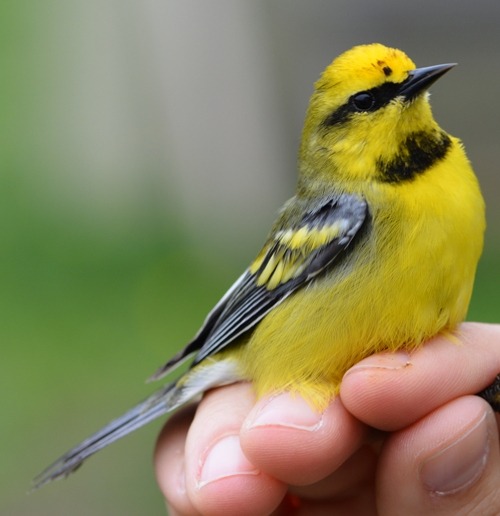
 Lawrence’s Warbler

 Lawrence’s Warbler, a bright yellow bird

 Lawrence’s Warbler

This bright yellow bird is a rare hybrid that was banded at Powdermill Nature Reserve, the museum’s environmental research center, in spring 2017.

This hybridization occurs when a golden-winged warbler mates with a blue-winged warbler.  This individual was just the 12th Lawrence’s warbler banded at Powdermill in our 55 years of banding.


Powdermill Nature Reserve’s avian research center is part of Carnegie Museum of Natural History’s biological research station in Rector, Pennsylvania.  The research center operates a bird banding station, conducts bioacoustical research, and performs flight tunnel analysis with the goal of reducing window collisions.
Filed Under: Blog Tagged With: Birds, Powdermill Nature Reserve

September 11, 2017 by wpengine

Herons and Henry David Thoreau

by Patrick McShea

Two hundred years after the birth of naturalist Henry David Thoreau, his writing continues to challenge us to be better observers of animals, plants, weather patterns, sounds, and landscapes.

Although the Concord, Massachusetts native would insist that such emulation occur outdoors, selected quotes from his works can add much to our appreciation of details preserved in museum exhibits.

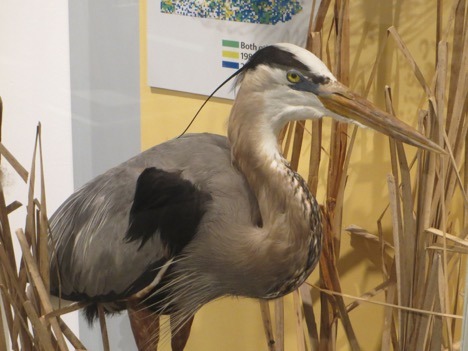
Heron on display in Population Impact

Consider, for example, Thoreau’s precise word-rendering of a subtle shade of color. He described the plumage of a great blue heron’s wing as “a tempered blue as of the sky and dark water commingled.” In Population Impact, museum visitors can verify the accuracy of the poetic description while viewing the great blue heron taxidermy mount displayed in the third-floor exhibition.

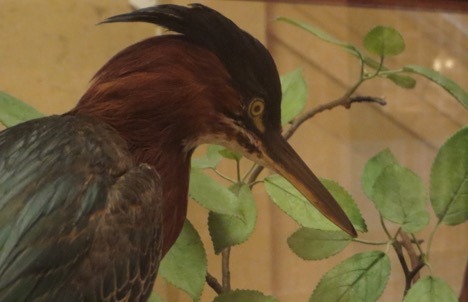
A more challenging exercise involves viewing the recently restored, century-old diorama of nesting green herons now displayed at the first-floor level of the Grand Staircase.

display of green herons

In an 1840 journal entry about observing a green heron along a New England river, Thoreau expressed envy for the wading bird’s experience of the world:

“It has looked out from its dull eye for so long, standing on one leg, on moon and stars sparkling through silence and dark, and now what a rich experience is its! What says it of stagnant pools, and reeds, and damp night fogs? It would be worth while to look in the eye which has been open and seeing at such hours and in such solitudes. When I behold that dull yellowish green, I wonder if my own soul is not a bright invisible green. I would fain lay my eye side by side with its and learn of it.”


Patrick McShea works in the Education and Visitor Experience department of Carnegie Museum of Natural History. Museum employees are encouraged to blog about their unique experiences of working at the museum.

Filed Under: Blog Tagged With: Birds, Patrick McShea

August 21, 2017 by wpengine

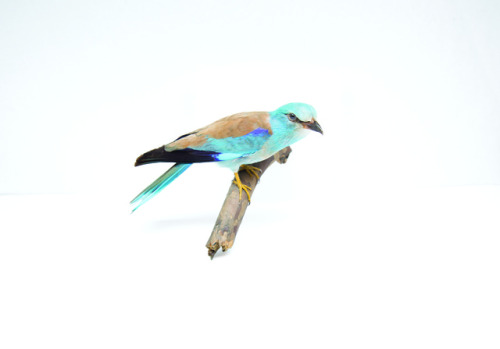
European Roller

European Roller (Coracias garrulus) taxidery mount

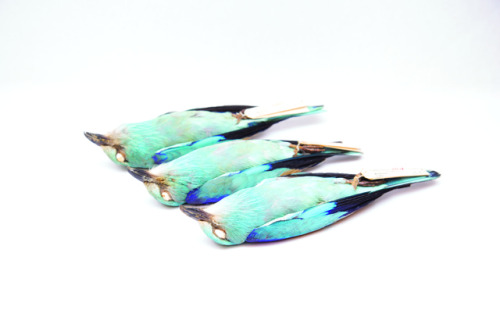
European Roller study skins

The bright blue European Roller (Coracias garrulus) breeds in southern and eastern Europe through to Siberia and winters in Africa.

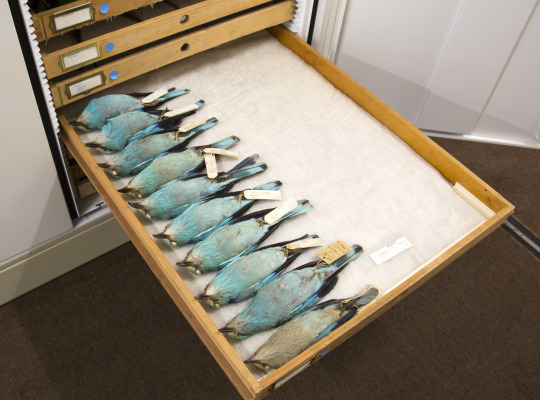
These specimens from Carnegie Museum of Natural History are preserved as both study skins and a taxidermy mount. The Section of Birds is home to several drawers of eight species of rollers in the genus Coracias, which are part of the museum’s large holding of birds from Africa and Europe and were collected between 1891 and 1982.

European Roller study skins in a drawer

Filed Under: Blog Tagged With: Birds

August 21, 2017 by wpengine

Specimen Preservation

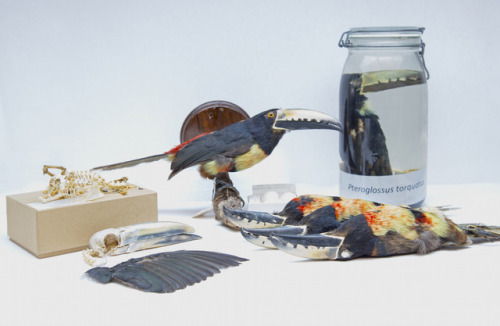
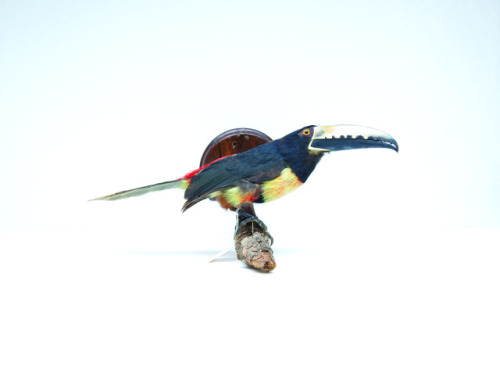
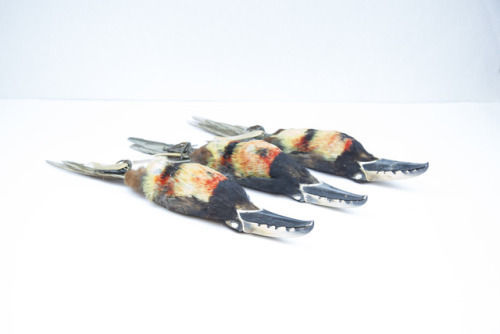
examples of different kinds of bird preservation

taxidermy mount of a tropical bird with a long beak
Taxidermy mount
Study skins of three balck, red, and yellow birds
Study skins

When you stroll down Bird Hall at Carnegie Museum of Natural History, most of the birds you will see in the cases are sitting on branches or faux ground surfaces, seemingly alive but frozen in time.

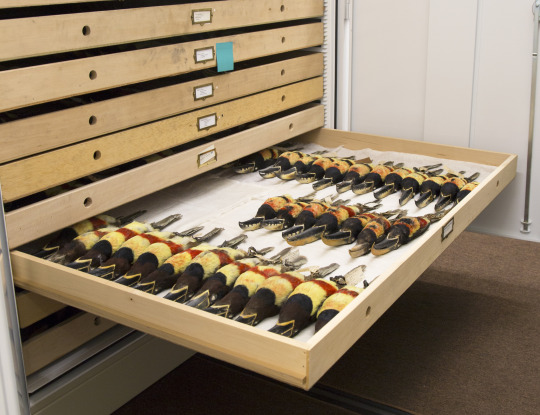
But the roughly 190,000 birds in the museum’s collection are preserved and stored in a variety of ways for different purposes that include display and scientific study.

As seen in the photo above, stored specimens can be taxidermy mounts (preserved as they would have been seen in life), specimen skins (which are seen lying on their backs), skeletons, dried spread wings, and eggs. A select few birds, like this Collared Aracari (Pteroglossus torquatus), are even stored in 70% ethanol alcohol.

Each type of preparation has a purpose. Taxidermy mounts are for education and display. Skeleton preparations allow study of bones, which is helpful in understanding evolution, especially since often that is what is left in fossils found by vertebrate paleontologists.

Eggs document breeding localities and can even show changes in size and number through time as a method of climate change. Fluid specimens can be used for dissection in study of anatomy (muscles, brains, stomach contents, etc.) and recently have been used in CT scanning methods that even outline muscles and organ systems without dissection. Spread wings can show molt patterns and color patterns, which are often important in mating.

Finally, the study skin is the most common preparation type as it, as well as other preps, document the exact location, time, and condition of the bird when collected or salvaged. The feathers often indicate the age class of the bird, and it can serve in other more modern ways. DNA can be obtained from tissue and stable isotope data can be obtained from feathers allowing study of shifts in breeding ranges through time.

bird study skins in a drawer

Filed Under: Blog Tagged With: bird hall, Birds

August 18, 2017 by wpengine

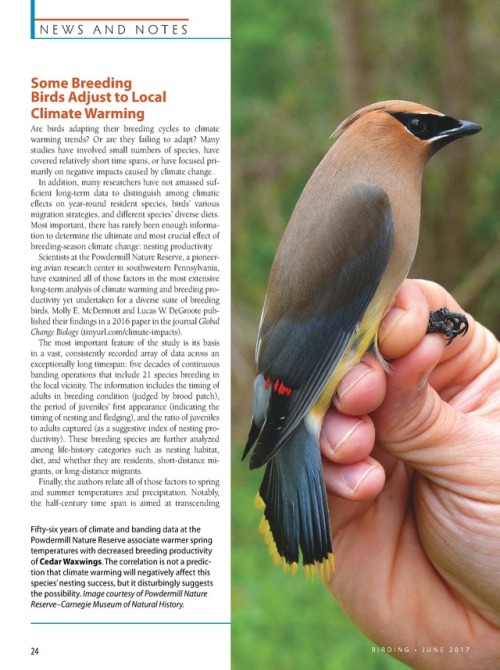
Some Breeding Birds Adjust to Local Climate Warming

First page of the article in Birding Magazine

Birding magazine recently featured the research of Luke DeGroote, the avian research coordinator at Carnegie Museum of Natural History’s environmental research center Powdermill Nature Reserve. Check out the June 2017 issue for the full article.

Filed Under: Blog Tagged With: Birds, Luke DeGroote, parc, Powdermill Nature Reserve

August 18, 2017 by wpengine

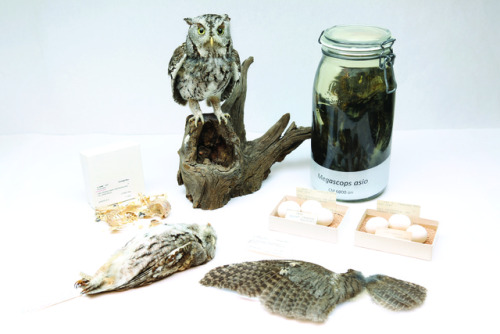
Screech Owl Collection

Screech Owl Collection objects

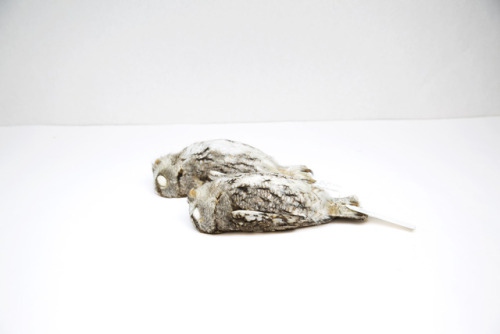
screech owl study skins
Study skins
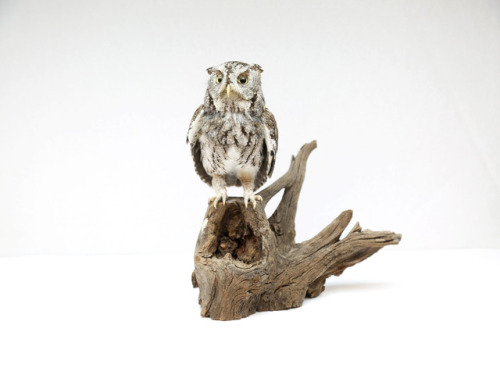
Taxidermy mount of a screech owl
Taxidermy mount

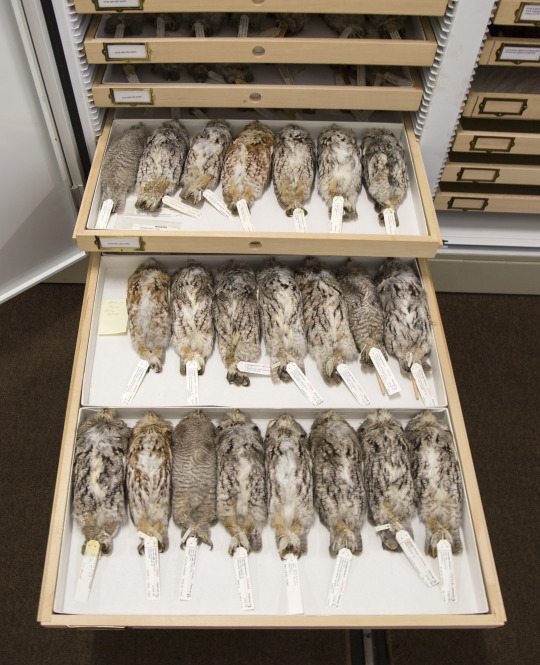
These Eastern Screech Owls (Megascops asio) are preserved in a variety of different ways in Carnegie Museum of Natural History’s collection—from eggs to fluid preserved specimens in alcohol. Each type of preparation allows different types of study.

Screech owls are small owls that can be found throughout Pennsylvania and are occasionally banded at Powdermill Nature Reserve—the museum’s environmental research center in Rector, Pennsylvania—and many live within the Pittsburgh city limits.

study skins in a drawer

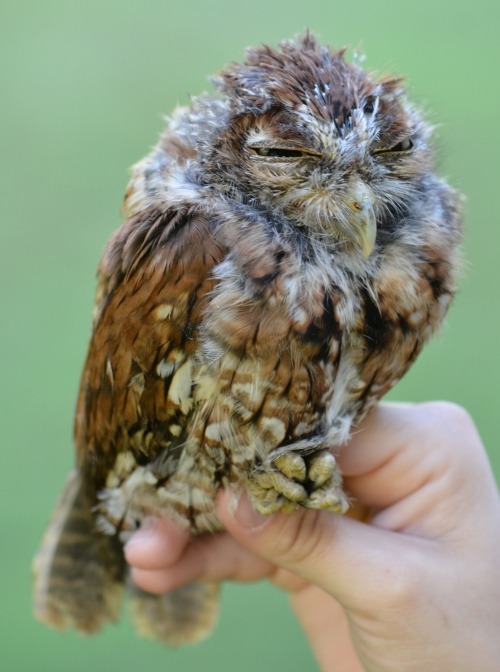
live screech owl with eye closed
A live screech owl banded at Powdermill Nature Reserve in 2015.

Filed Under: Blog Tagged With: Birds, Powdermill Nature Reserve

  • « Go to Previous Page
  • Page 1
  • Interim pages omitted …
  • Page 14
  • Page 15
  • Page 16
  • Page 17
  • Page 18
  • Interim pages omitted …
  • Page 20
  • Go to Next Page »

sidebar

About

  • Mission & Commitments
  • Directors Team
  • Museum History

Get Involved

  • Volunteer
  • Membership
  • Carnegie Discoverers
  • Donate
  • Employment
  • Events

Bring a Group

  • Groups of 10 or More
  • Birthday Parties at the Museum
  • Field Trips

Powdermill

  • Powdermill Nature Reserve
  • Powdermill Field Trips
  • Powdermill Staff
  • Research at Powdermill

More Information

  • Image Permission Requests
  • Science Stories
  • Accessibility
  • Shopping Cart
  • Contact
  • Visitor Policies
Stay in the loop! Sign up for our newsletter(s).
One of the Four Carnegie Museums | © Carnegie Institute | Privacy Policy | Terms of Use | Accessibility
Rad works here logo