• Skip to primary navigation
  • Skip to main content
  • Skip to primary sidebar

Carnegie Museum of Natural History

One of the Four Carnegie Museums of Pittsburgh

  • Visit
    • Buy Tickets
    • Visitor Information
    • Exhibitions
    • Events
    • Dining at the Museum
    • Celebrate at the Museum
    • Powdermill Nature Reserve
    • Event Venue Rental
    • Gift Cards
  • Learn
    • Field Trips
    • Educator Information
    • Programs at the Museum
    • Bring the Museum to You
    • Guided Programs FAQ
    • Programs Online
    • Climate and Rural Systems Partnership
  • Research
    • Scientific Sections
    • Science Stories
    • Science Videos
    • Senior Science & Research Staff
    • Museum Library
    • Science Seminars
    • Scientific Publications
    • Specimen and Artifact Identification
  • About
    • Mission & Commitments
    • Directors Team
    • Museum History
  • Tickets
  • Give
  • Shop

Education

October 30, 2019 by wpengine

“Minecraft™ Lied to Me!?”

On October 19, 2019, the Section of Anthropology once again had the pleasure of assisting the Education and Interpreter staff in awarding the BSA Scouts Merit Badge for archaeology. The Scouts spent the day learning how to excavate artifacts from dig boxes and creating mini-exhibits for museum visitors to enjoy. The mini-exhibits were focused on typology. Scouts were asked to organize lithics (mostly arrow heads and spear points) by physical characteristics. Stem and shoulder shape, cross section, and flaking styles are often used by archaeologists to categorize objects. Other basic morphological typology categories can rely on color, weight, or material.

The Scouts were asked to create labels for their mini-exhibits to explain the reasoning behind their classifications. Some Scouts organized objects by size, while others chose to compare the different shapes. One Scout was organizing objects by material, specifically obsidian. He asked if it was nearly indestructible like in Minecraft™ and I had to tell him that obsidian is actually volcanic glass that breaks pretty easily resulting in a conchoidal fracture, which is why people have made so many arrow heads and spear points out of it. He replied, “well, next you’ll tell me that it doesn’t create portals into a nether dimension.” Sorry Scout, to my knowledge it does not.
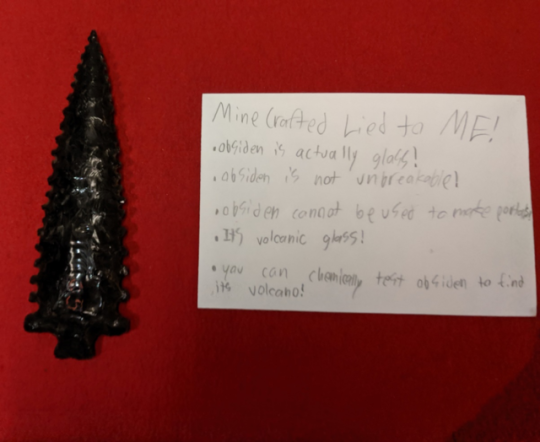
black arrow head with index card that says Minecraft lied to me, obsidian is actually glass, obsidian is not unbreakable, obsidian cannot be used to make portals, it's volcanic glass, you can chemically test obsidian to find its volcano!

To investigate further into how obsidian is used in Minecraft™, I called the most knowledgeable gamer I know. My nephew, Zak, was happy to explain to me that in the game you combine lava and water to create obsidian blocks. This isn’t exactly true. Obsidian is formed when molten rock material cools so fast it cannot form a crystalline structure at an atomic level. It usually solidifies on the Earth’s surface, making it an extrusive rock. According to Zak, the obsidian in Minecraft™ can be used to create a very strong wall or to access the nether dimension that I had learned about from the Scout. Weapons are not made from it and it is very hard to break. In reality, obsidian is easily broken by human action and can also be worn down by the weather. This would make it a terrible substance from which to build a fortress. While obsidian is not used to build indestructible walls or portals, it is used to make surgical tools. It can be made sharper than steel and can be placed in scalpels for precision procedures. So, while the obsidian in Minecraft™is different than obsidian on Earth, at least it sparked a conversation.
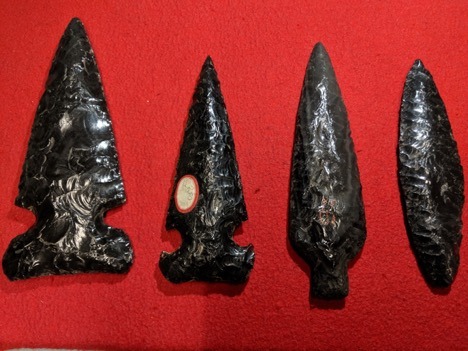
four obsidian artifacts

The obsidian artifacts in this photo are a part of the educational collection maintained by the Section of Anthropology.

To learn more about the BSA Merit Badge for archaeology visit: https://meritbadge.org/wiki/index.php/Archaeology

To read another CMNH blog about obsidian visit: https://carnegiemnh.org/tag/emerald-obsidianite/

Amy L. Covell-Murthy is the Archaeology Collection Manager at Carnegie Museum of Natural History. Museum employees are encouraged to blog about their unique experiences and knowledge gained from working at the museum.
Filed Under: Blog Tagged With: Amy Covell-Murthy, archaeology, Boy Scouts, Education, gems and minerals

October 24, 2019 by wpengine

Centipede or Millipede? What’s the Difference?

Quick, what was that? It scuttled by in a flash, but you caught a few defining characteristics. It had many legs and a long, segmented, wiggling body. You know you’ve seen one before. Was it a centipede or a millipede?

A few unique characteristics help define which of our many-legged friends is which.

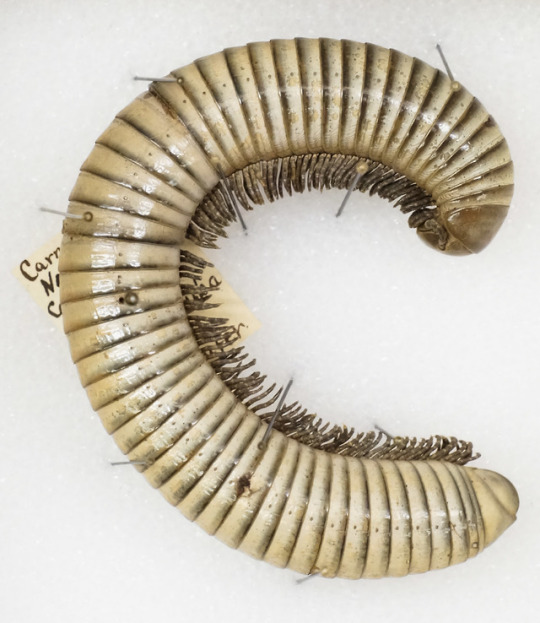
centipede specimen

What’s the difference?

Both centipedes and millipedes are made up of segments that link together to form one, long body. With this body form in common, it might be hard to tell the difference between the two at first glance. Here are a few tips to spot the differences:

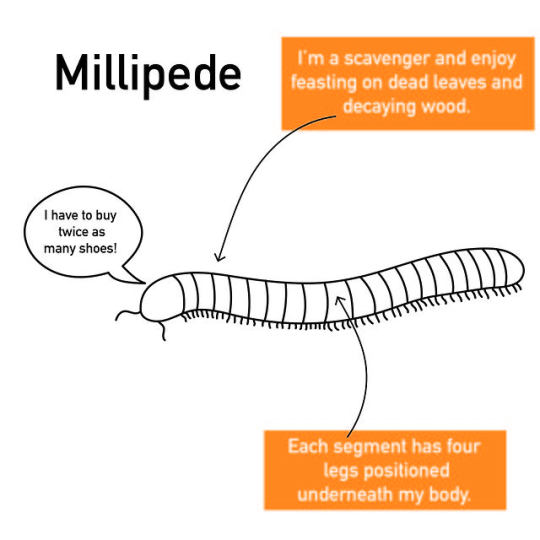
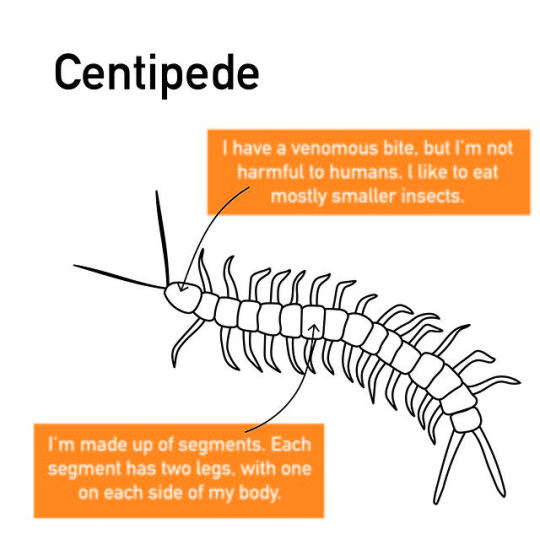
  • Millipedes have two sets of legs per segment positioned directly under their body. Centipedes have one set of legs per segment positioned on the side of their body.
  • Centipedes mostly eat insects after killing them with their venom. Millipedes feast on decomposing plants.
  • If looking from the side, centipedes have a flatter body while millipedes are more rounded.
  • They respond to threats in different ways. A millipede will coil up and release a smelly secretion. Centipedes can bite (which is typically harmless to humans) and run away quickly.
drawing of a millipede
drawing of a centipede

It’s all in the “family”

These two also have enough in common to make them “cousins” in the animal kingdom.

  • Scientists have grouped them together because of their similar segmented bodies.
  • Both have poor or non-existent vision and rely on other senses, like the feel of vibrations.
  • They prefer to live in dark environments, which is why you may have seen them in an unlit corner of your basement.
  • The longest species of each measure about six inches in length.

Say no to “Nope!”

Of course, they may not be the most pleasant creatures to some folks. There is, however, plenty to observe and you’ll find they really are quite fascinating! At the Carnegie Museum of Natural History, Curatorial Assistant Catherine Giles and Collection Assistant Vanessa Verdecia study these animals and many more in the Section of Invertebrate Zoology. Scientists like them across the world could use your help!

There are not many known studies of centipedes or millipedes, even though they are incredibly common and span the globe. Catherine said she would urge people not to say “Nope!” when it comes to centipedes and millipedes. Instead, we should be curious. Studies need to be done in the field with live specimens (ecology) and in labs or offices classifying specimens (taxonomy).

There are more than 3,000 known and an estimated 8,000 species of centipedes. There are upwards of 7,000 known and 80,000 estimated species of millipedes. Millipedes can be found in moist forest areas, while centipedes prefer dry environments. Try and find examples of both species. Take a closer look. Do you notice the differences outlined here? What about the similarities? If you were to study these creatures, would you prefer to be on the scene or in the lab? There’s no wrong answer as long as you don’t say, “Nope!”

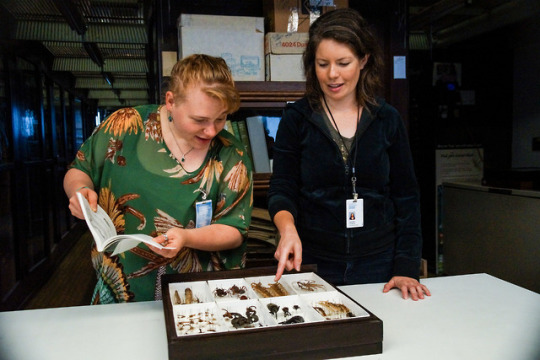
Curatorial Assistant Catherine Giles and Collection Assistant Vanessa Verdecia with a box of specimens

Fun Fact

“Milli” is a latin prefix for 1,000 and “centi” is for 100.  Don’t assume that’s exactly how many legs each has on its entire body, though!

Some species of millipedes can have as many as 750 legs. Centipedes can have more than 350 legs.

Learn more in Nature Lab!

Filed Under: Blog Tagged With: Centipede, Education, Invertebrate Zoology, Nature 360, Nature Lab

October 22, 2019 by wpengine

Bright Flying Mammal

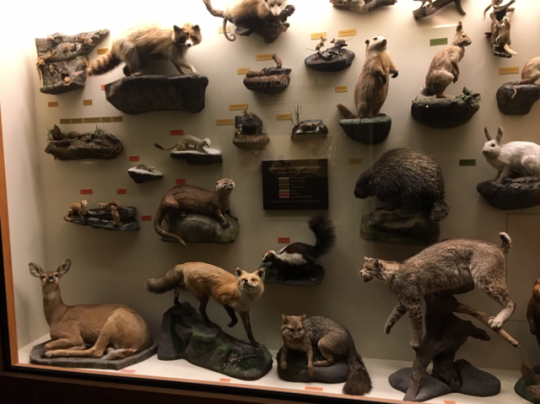
museum display of mammals found in Pennsylvania
Mammals of Pennsylvania within the Hall of North American Wildlife

Can you name our region’s most colorful mammal? If the question was asked in front of the museum’s Mammals of Pennsylvania display, many people would choose the red fox near the center of the exhibit’s floor-level row.

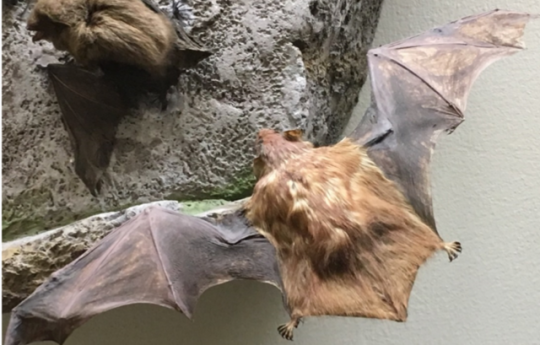
Five feet above fox, and just inches from the tip of a raccoon’s tail, a far smaller, but equally bright alternate exists in the form of a gliding eastern red bat.

Eastern red bat
Eastern Red Bat, known to science as Lasiurus borealis

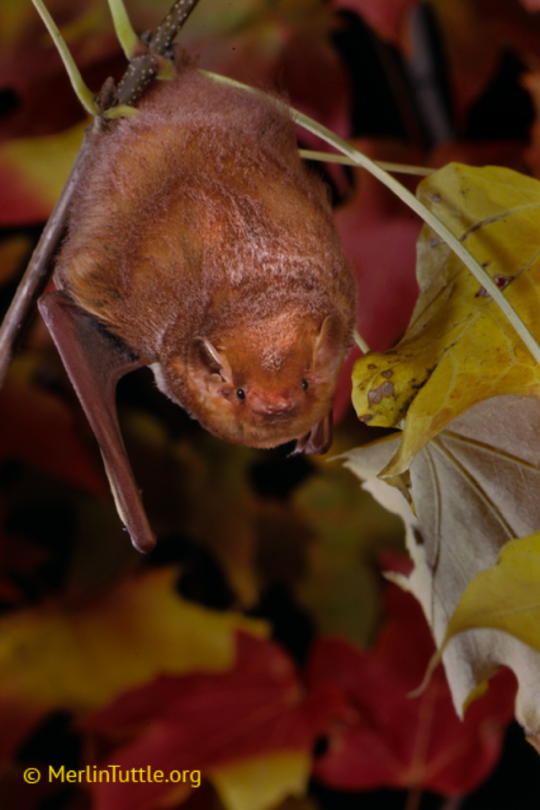
In color, red bat fur ranges from golden brown to bright rusty orange, with males typically sporting brighter shades than females. The bright fur coats of this widespread insect-eating species provide surprisingly effective camouflage when the bats are at rest. Red bats are tree bats, a term that indicates the species’ preference for spending daylight hours roosting within the foliage of deciduous and sometimes evergreen trees.

Eastern red bat
Eastern Red Bat

With wings folded, they hang upside-down from the grip of a single foot, looking, to casual observers, like dead leaves or pine cones.

Red Bats have so far escaped the devastating effects of white-nose syndrome, a fungal disease that since 2007 has caused mortality rates as high as 90% at hibernation sites of many other bat species. Remarkably, on fall migration flights to southern portions of their North American range, red bats have been known to cross long stretches of territory with flocks of migrating birds.

For more information about eastern red bats, please check the species account prepared by Bat Conservation International.

For information about the vital ecosystem contributions of the world’s 1,300 bat species please visit Merlin Tuttle’s Bat Conservation.

Patrick McShea works in the Education and Visitor Experience department of Carnegie Museum of Natural History. Museum employees are encouraged to blog about their unique experiences and knowledge gained from working at the museum.
Filed Under: Blog Tagged With: Education, Hall of North American Wildlife, mammals, Pat McShea, Patrick McShea

September 3, 2019 by wpengine

How to Use a Lensatic Compass

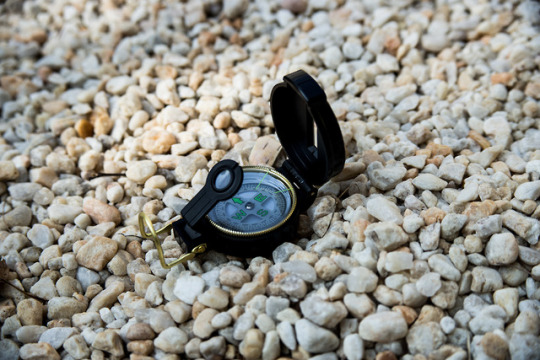
compass open on rocky ground

Have you ever heard someone say they need to find their bearings? It dates back to the Age of Discovery and refers to the bearings inside a compass that move the directional needle. That saying has lived on and so has the simple compass! Let’s learn about the military’s preferred version, the lensatic compass. It’s incredibly precise, affordably priced at just a couple of dollars, and easy to find in your local big box or sporting goods store.

What you’ll need

Lensatic compass

Enough room to rotate in a circle

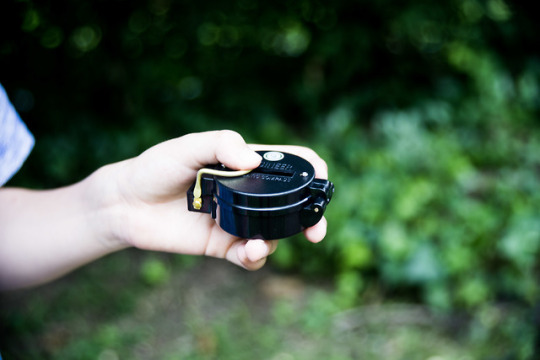
Step 1

closed compass in hand

●     Hold the compass in the hand that you write with.

●     Make sure the side facing up has the open slot in the cover.

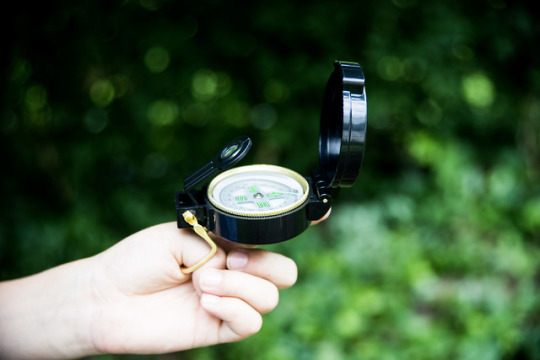
Step 2

open compass in hand

●     Use your thumb to pull the thumb ring back about halfway.

●     Flip up the lid to a 90-degree angle.

●     Flip up the small magnifying glass.

●     Pull the ring underneath the compass and put your thumb through.

●     Wrap your middle, ring and pinky finger around your thumb for support. Use your index finger to steady the front of the compass.

Step 3

open compass in two hands

●     Notice the slot in the lid has a sight wire running down the middle.

●     Turn the dial until the larger line aligns with the sight wire.

●     Notice the second line of numbers surrounding the outside of the dial goes from 0 to 360 degrees to represent a full circle. That provides a more accurate direction. Saying an object is at 340 degrees Northwest is more accurate than saying it is Northwest.

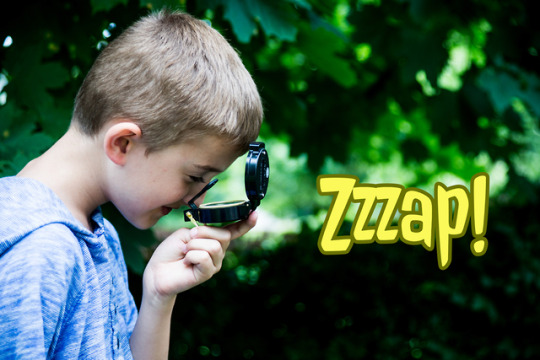
Step 4

child reading compass

●     Hold the compass in front of your nose with the lid facing out.

●     Pick an object, rotate your entire body (not just the compass), and align the object with the sight wire.

●     Look through the magnifying glass and find the green line that we matched to the sight wire.

●     Locate the number on the inner dial. You will also see the directions North, South, East, and West. Congratulations, you found your bearings!

●     Pretend your compass is a cool space laser and say “Zzzap!” as you pretend to fire away at your landmark….OK that last part isn’t necessary, but might be fun!

Fun Fact

The lensatic compass is very versatile. You can also use it as you would a standard compass by pulling back the lid and magnifying glass to fully show directions North, South, East, and West. Hold your elbows tight against your body and the compass near your waist to get your bearings and find out which direction you are facing!

parts of the compass diagram


“There’s an app for that”

True, but learning how to read a compass can come in handy.

Do you have a phone or tablet? Look down and check the battery life. How about the WiFi and cellular service? Remember, batteries lose their charge and service can be unreliable in some areas.

Learn this skill in familiar territory like your backyard or a local park.

That way, if you need to use it in unfamiliar territory, you will be ready.

Can you com-pass this text? Give it a try!

Now that you know how to use the compass, let’s put your knowledge to the test! Head into your yard or an outdoors area to begin. Ready? Set? Go!

Locate North. What do you see? _______________

Rotate to the East. What do you see? _______________

Now West. What do you see? _______________

Find South. What do you see?  _______________

Great job so far! Let’s make things a little more challenging by incorporating the degrees.

Locate 340 degrees Northwest. What do you see? _______________

Now turn to 120 degrees Southeast. What do you see? _______________

You are now part of a group of navigators that goes back hundreds of years. Research dates the use of the magnetized mineral lodestone as a compass all the way back to the year 1,000. Ancient Chinese explorers learned that they could float the stone on a small piece of wood in a cup of water and the stone would always point to the north pole. Sailors later discovered that rubbing a needle against a piece of lodestone made the needle magnetic and the evolution of the modern compass began, along with superstitions. Prior to the scientific explanation, sailors thought the compass was a magical object that could tell fortunes and cure illness. They also thought that onions and garlic could block the magnetic force, so those ingredients never boarded their ships.

Luckily, we know that compasses today are useful tools that help us find our bearings – no magic required. Congratulations on joining the club of compass navigators!

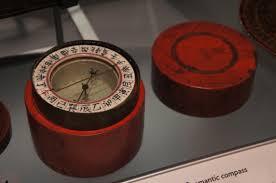
The ancient Chinese are believed to have created the first compass. This version was used on a ship around 1760.

Blog post by Eddie Phillips. Graphics by Megan Jones. 

Learn more in Nature Lab!

Filed Under: Blog Tagged With: Eddie Phillips, Education, Megan Jones, Nature 360, Nature Lab

August 26, 2019 by wpengine

Make Your own Cloud

Are you the kind of person who always has their head in the clouds? Come back down to earth, but bring the clouds with you. With just a few household items, you’ll get to see clouds form right in front of you!

Here’s What You Need:

  • A glass jar with a lid
  • Hot (almost boiling) water
  • Ice
  • Aerosol hairspray

Here’s What To Do:

  1. Fill your jar about 1/3 full with hot water.
  2. Place the lid upside-down on top of the jar.
  3. Fill the lid with as many ice cubes as will fit.
  4. Let the jar sit for about 10 seconds.
  5. Quickly, lift the lid and spray some hairspray into the jar.
  6. Place the lid with ice back on top of the jar.
  7. Watch as a cloud forms above the water!

For step-by-step visuals, check out this quick animation!

https://carnegiemnh.org/wp-content/uploads/2019/08/Cloud-in-a-Jar-animation.mp4

Here’s How It Works:

Clouds are formed when water vapor (the gaseous form of water) condenses (turns from a gas into a liquid) into very small, visible droplets.  The water vapor condenses onto other particles in the air, like dust or smoke. In the jar, the hot water gives off water vapor that cools when it reaches the ice on the top of the jar. By spraying hairspray in the jar, we give the water vapor particles to condense onto.  The water vapor condenses into tiny droplets that we see as a miniature cloud.

Go outside and take a look at the clouds. How do they compare to the cloud you saw in your jar? What is the same? What is different?

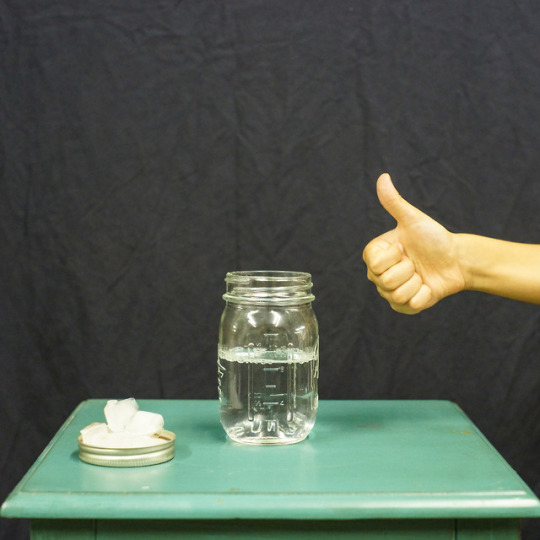
mason jar filled with water, mason jar lid with ice, and thumbs up

mason jar filled with water beside mason jar lid with ice

Fun Fact:

Clouds are actually quite heavy. Those white, fluffy clouds that look weightless as they float through the air can contain millions, billions, or even trillions of pounds of water! Clouds float because they are not as dense or heavy  as the dry air beneath them. It’s similar to the way that oil floats on water.

Blog post by Eddie Phillips. 

Learn more in Nature Lab!

Filed Under: Blog Tagged With: Eddie Phillips, Education, Educators, nature, Nature 360, Nature Lab

August 14, 2019 by wpengine

Frontier History Wizards

white snakeroot plant
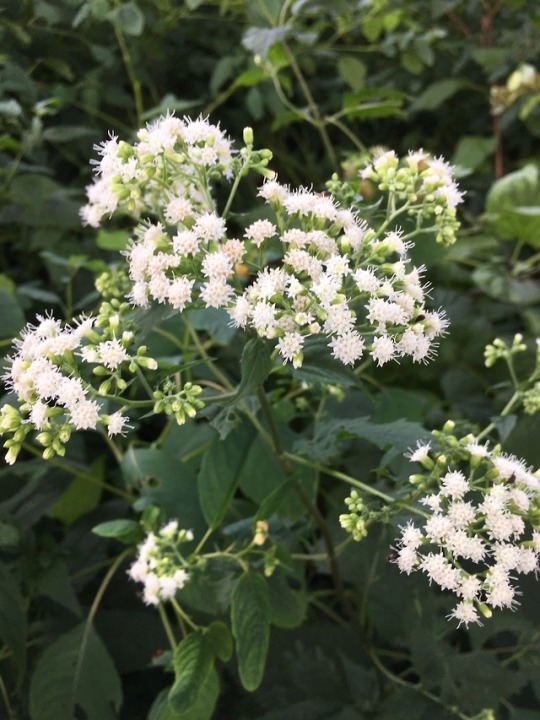
White snakeroot blooming along the Allegheny River shoreline in early August.

Written descriptions for Carnegie Museum of Natural History summer camp, Wizard Academy, invite 8 – 10-year-old participants to experience a collision between “magic and science.” Based upon my recent experience with campers in the popular Harry Potter-themed program, the advertised subject could also include “history.”

During a discussion of poisonous plants with two dozen want-to-be wizards in the Hall of Botany, I drew the group’s attention to a display labeled “LOCAL SPECIES TO AVOID.”

The focus for my remarks was white snakeroot (Ageratina altissima) a straight-stemmed and flower-topped species in the display’s front row. I explained how the plant’s common name is an historic reference to its alleged value in treating snake bites, and that its designation as a plant to avoid was based upon on its connection to an often-fatal illness know as milk sickness.

The disease, which occurred when people drank milk from cows that had fed upon white snakeroot, was a scourge of pioneer life during the early nineteenth century, the decades-long period when settlement across what was then the American frontier dramatically altered vast forests west of the Appalachians.

One of the campers assisted my narration by reading from a handout about how Abraham Lincoln’s mother, Nancy Hanks Lincoln, died from milk sickness. When another camper asked how the plant-to-cow connection was “figured-out,” I confessed ignorance but promised to find out.

herbarium sheet of white snakeroot
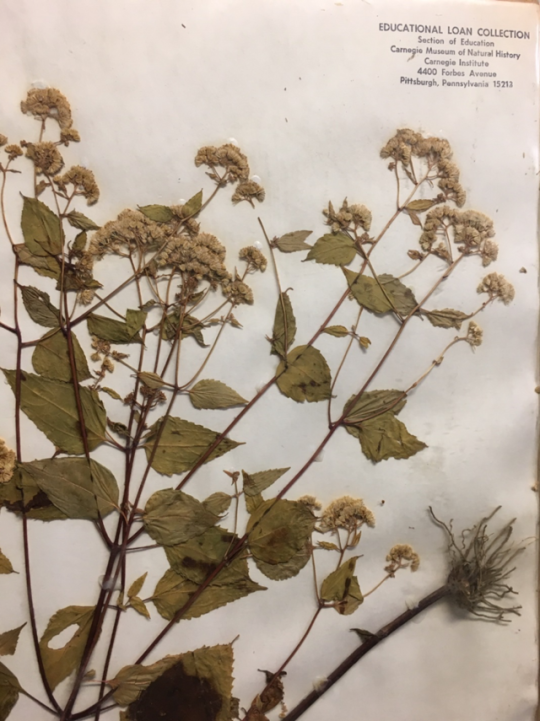
White snakeroot herbarium sheet, part of the Educator Loan Collection’s “Poisonous Plants of Pennsylvania” box.

Much of the life-saving credit, I learned, belongs to a pair of women whose friendship crossed conflicting cultures of 1820’s Illinois; a frontier doctor, and an elderly fugitive of the federal government’s forced relocation of the Shawnee to territory further west. The doctor, Anna Pierce, lost family members to milk sickness and, based upon observations of disease occurrence, promoted the avoidance of milk drinking between June and the plant-killing frosts of autumn. The relocation resister, known to settlers as Aunt Shawnee, took Dr. Pierce into the woods to show her white snakeroot and explain the plant’s lethal properties. Pierce then conducted experiments to confirm the plant’s toxicity and shared her findings with other doctors.

More than 70 years later carefully controlled scientific studies documented year-to-year and geographic variations in the toxicity levels of white snakeroot, but it wasn’t until 1928 that the plant’s toxic chemical, an alcohol termed tremetol was isolated in a laboratory. Today, largely because of better pasture management, milk sickness is not a concern in commercial dairy operations.

The takeaway lesson, kindled when a ten-year-old camper’s question illuminated a nearly 200-year-old ethnobotany story, is to more fully value the indigenous knowledge of the vibrant Native cultures that continue to exist across our country.

(Information source: Natural History, July 1990, “Land of Milk and Honey” by David Duffy Cameron)

Patrick McShea works in the Education and Visitor Experience department of Carnegie Museum of Natural History. Museum employees are encouraged to blog about their unique experiences and knowledge gained from working at the museum.
Filed Under: Blog Tagged With: Education, Educator Loan Program, Educator Loans, Educator Resources, Pat McShea, Patrick McShea

  • « Go to Previous Page
  • Page 1
  • Interim pages omitted …
  • Page 11
  • Page 12
  • Page 13
  • Page 14
  • Page 15
  • Go to Next Page »

sidebar

About

  • Mission & Commitments
  • Directors Team
  • Museum History

Get Involved

  • Volunteer
  • Membership
  • Carnegie Discoverers
  • Donate
  • Employment
  • Events

Bring a Group

  • Groups of 10 or More
  • Birthday Parties at the Museum
  • Field Trips

Powdermill

  • Powdermill Nature Reserve
  • Powdermill Field Trips
  • Powdermill Staff
  • Research at Powdermill

More Information

  • Image Permission Requests
  • Science Stories
  • Accessibility
  • Shopping Cart
  • Contact
  • Visitor Policies
Stay in the loop! Sign up for our newsletter(s).
One of the Four Carnegie Museums | © Carnegie Institute | Privacy Policy | Terms of Use | Accessibility
Rad works here logo