• Skip to primary navigation
  • Skip to main content
  • Skip to primary sidebar

Carnegie Museum of Natural History

One of the Four Carnegie Museums of Pittsburgh

  • Visit
    • Buy Tickets
    • Visitor Information
    • Exhibitions
    • Events
    • Dining at the Museum
    • Celebrate at the Museum
    • Powdermill Nature Reserve
    • Event Venue Rental
    • Gift Cards
  • Learn
    • Field Trips
    • Educator Information
    • Programs at the Museum
    • Bring the Museum to You
    • Guided Programs FAQ
    • Programs Online
    • Climate and Rural Systems Partnership
  • Research
    • Scientific Sections
    • Science Stories
    • Science Videos
    • Senior Science & Research Staff
    • Museum Library
    • Science Seminars
    • Scientific Publications
    • Specimen and Artifact Identification
  • About
    • Mission & Commitments
    • Directors Team
    • Museum History
  • Tickets
  • Give
  • Shop

Hall of Botany

May 16, 2019 by wpengine

A Lot to be Fascinated By in the Herbarium

wildflowers in the woods

Are you fascinated by plants? Fascination of Plants Day is upon us (don’t worry, we didn’t know it was a thing either, but agree celebration is in order!). As you might guess, we in the Section of Botany at the Carnegie Museum of Natural History are definitely into any and all things plants. Plants are inextricable from our daily lives and play critical roles in our environment.  Plus, they are just pretty cool, too. Amid chirping birds or a lion chasing a gazelle, they might be easy to overlook, but they are well worth your attention. From the sidewalk cracks in front of the museum to a remote tropical rainforest, there is a lot to celebrate.

With over half a million plant specimens in the Carnegie Museum herbarium, we have a lot to be fascinated by. Botanists here at the museum and across the world are making new discoveries about plants through these collections. On this 5th annual Fascination of Plants Day, I’d like to share some exciting new work in our collection – extracting fungal DNA from herbarium specimen roots collected over a hundred years ago.
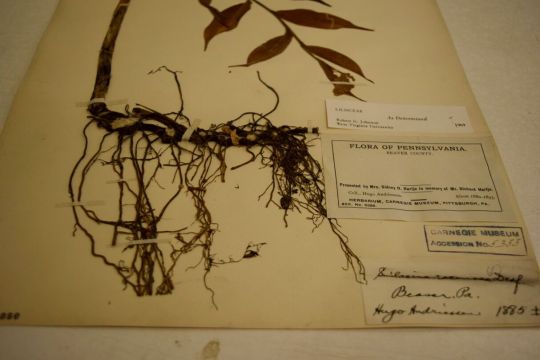
plant specimen with long roots on herbarium sheet

Unexpected inspiration often comes from looking at old specimens in new ways. Museum specimens were collected for many different reasons. The uses of specimens are many, and recently, being used in new ways.  Museum specimens have a lot to tell us. If we look.

Recently, I became fascinated by something often ignored – roots on herbarium specimens. Why do herbarium specimens have roots?
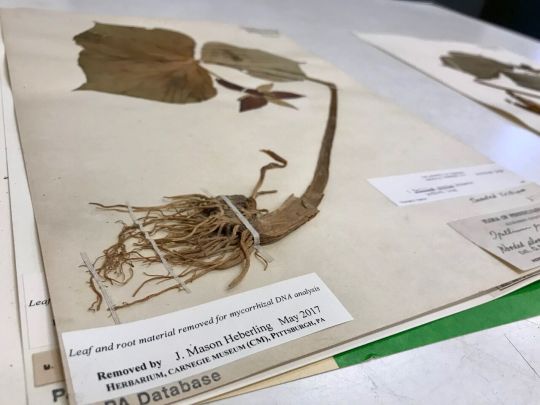
dried plant specimen on herbarium sheet

It is standard practice for botanists to collect the entire plant when possible.  Of course, that isn’t possible for a huge tree, but many plants can fit nicely on an herbarium sheet, roots and all. And  not only do many specimens have roots, but they have soil too.

For some plants, roots can be very helpful for identification. But for the most part, roots on herbarium specimens have not been generally used. But what can 100-year-old roots tell us?

With this new fascination with herbarium specimen roots, I contacted  Dr. David Burke, a microbial ecologist and expert in belowground forest ecology at the Holden Arboretum in Kirkland, Ohio. David studies belowground microbial soil communities and their interactions with plant roots. Nearly 75% of all flowering plant species form close relationships with mycorrhizal fungi. Many plant species in our forests across the eastern United States rely upon these mycorrhizal fungi to obtain water and nutrients necessary for growth. In return, the fungi get food (sugars) from the plant.
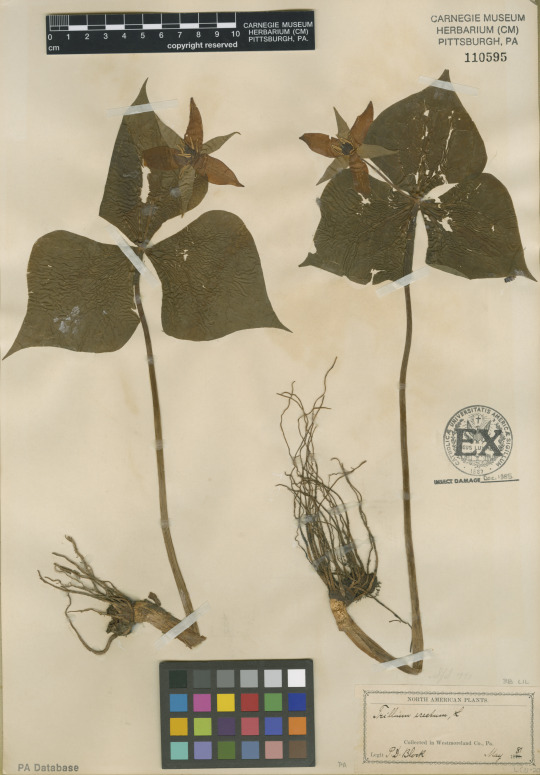
herbarium sheet of dried flower with roots

Can herbarium specimen roots tell us about relationships between mycorrhizal fungi and plants?  And perhaps more importantly: Have human activities affected these plant-fungal relationships over the past century?

David Burke had not extracted fungal DNA from herbarium specimen roots, but he was eager to try. (In fact, to our knowledge, no one had done this with herbarium specimen roots before.)  We sampled roots from herbarium specimens of four common forest wildflowers collected in western Pennsylvania between 1881 to 2008. These species included some favorites familiar in our area: red trillium, large-flowered trillium, false Solomon’s seal, and jack-in-the-pulpit.
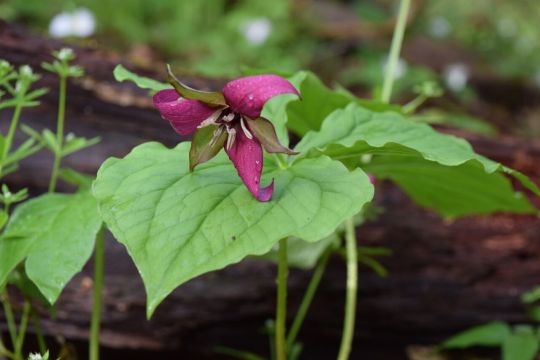
red-purple flower in the woods

David was able to extract and sequence fungal DNA from plant roots as old as 137 years old! We published our results in a special issue on belowground botany in Applications in Plant Sciences. You can read the full study here.  While there is still much to be done, we showed that museum collections across the world hold enormous potential to provide new insights in the basic belowground biology of plants. They can also help us understand how human activities may affect the web of life in overlooked ways.

Herbarium specimen roots have a lot to tell us about the past, present, and future of our forests in the Anthropocene. And that is fascinating!
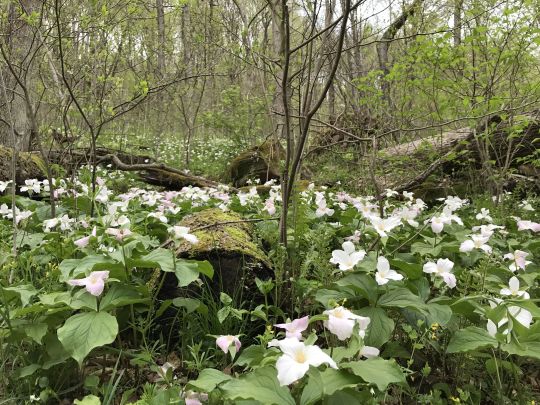
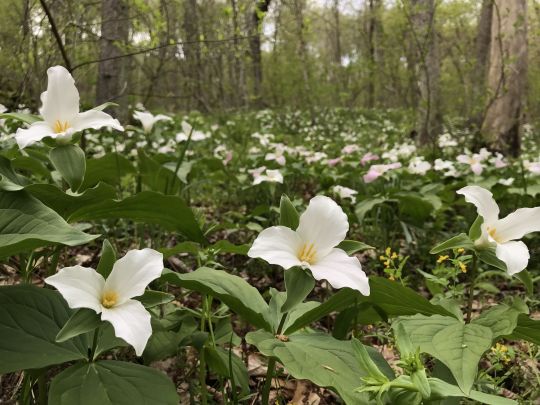
woods with many spring wildflowers in bloom

Mason Heberling is Assistant Curator of Botany at the Carnegie Museum of Natural History. Museum employees are encouraged to blog about their unique experiences and knowledge gained from working at the museum.
Filed Under: Blog Tagged With: Botany, Hall of Botany, herbarium, Mason Heberling, plants, Section of Botany

February 6, 2019 by wpengine

Red Bird

By Patrick McShea

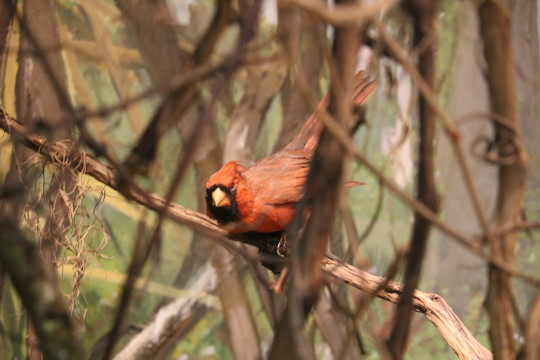
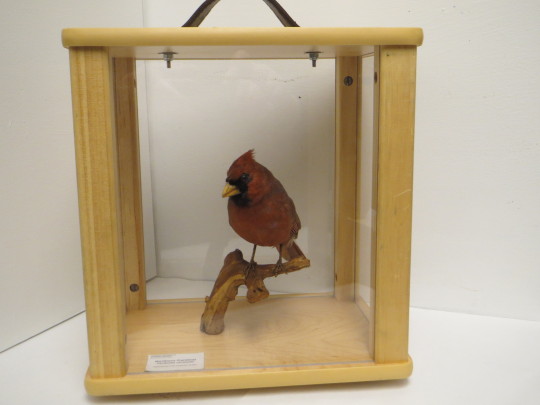
cardinal diorama

A detail in a Hall of Botany diorama can add much to our understanding of a popular songbird. Pictured above is a male Northern Cardinal, a species widely portrayed on cards and calendars amid snowy scenery.

Cardinals are certainly noticeable under winter conditions. The bright red of the male’s feathers and the reddish-brown plumage of the female stand out in snow covered landscapes. The range for this non-migratory species is enormous, however, and includes tropical regions.

The Hall of Botany bird, for example, adds color to a three-dimensional recreation of a tiny patch of Florida Everglades. Northern Cardinals have also long occupied suitable habitat much further south in Mexico and Guatemala.

The species, which has been deemed the official avian representative for seven U.S. states, was rarely seen anywhere in Pennsylvania until the 1890s. In Birds of Western Pennsylvania, the encyclopedic volume published in 1940 by the museum’s then Curator of Ornithology, W.E. Clyde Todd, growth of the local cardinal population is noted:

In recent years it has invaded the parks and residential sections of Pittsburgh in gradually increasing numbers, and it is seemingly as much at home there as it is in the wooded ravines in the vicinity of the city.”

cardinal diorama
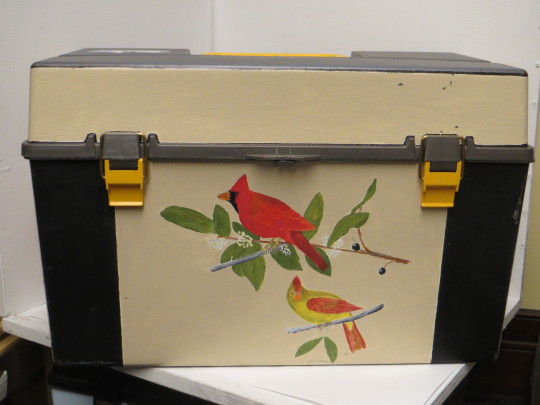
tool box with painted cardinals

One measure of the Northern Cardinal’s continued popularity is requests by elementary teachers to borrow taxidermy mounts of the species from the museum’s Educator Loan Collection. Pictured above are a taxidermy mount and the “toolbox” it travels in. The illustration on the box is a recreation of John James Audubon’s cardinal portrait by Museum Educator Assistant John Franc.

Patrick McShea works in the Education and Visitor Experience department of Carnegie Museum of Natural History. Museum employees are encouraged to blog about their unique experiences and knowledge gained from working at the museum.
Filed Under: Blog Tagged With: bird hall, Birds, botany hall, Education, Educator Loans, Hall of Botany, Patrick McShea, pennsylvania, western pennsylvania

December 31, 2018 by wpengine

Expanding the value of herbarium specimens with citizen science app, iNaturalist

By Mason Heberling

Biological collections are at the heart of the natural history museum. Biological collections are large and diverse, with specimens of shells, bugs, birds, fossils, bones, plants, and more. They were collected anywhere from the sidewalk in front of the museum this past spring to a remote jungle on the other side of the world a century ago.

Each of the roughly 22 million objects at the Carnegie Museum of Natural History have valuable scientific stories to tell. Knowledge derived from museum specimens motivate or inform nearly every aspect of museum practice. Specimens are used directly in museum exhibitions and programming. Specimens are sources of scientific data, used by researchers both at the museum and across the world to understand the past, present, and future of life. And these specimens continue to be used in new and innovative ways to inform us about the world and the impact of humans in the Anthropocene.

Collecting from nature for admiration and study is an ancient practice, with plant collecting among the oldest. The oldest known collection of plants, known as an herbarium (plural: herbaria), dates to 16thcentury Italy!

But specimen collecting is not a dated practice; it is not just something botanists used to do. Plant collecting remains to this day an active and necessary part of botanical science. With over half a million plant specimens, the Carnegie Museum herbarium is not stagnant.  Our collection continues to grow. New specimens are collected and added to the herbarium each year, expanding the scope of the collection and therefore its scientific and societal relevance. In fact, in the recent era of rapid environmental change, new collections are all the more important.

Despite the continued importance of this practice, the standard process for collecting new specimens has change remarkably little through time. Major changes in collection practices include the use of GPS coordinates and to a lesser extent, specific sampling methods for genetic analyses.

In the Section of Botany, Bonnie Isaac (Collections Manager) and I are developing innovative ways to maximize the future use of our collections. One way we are doing this is by linking our collections to the popular citizen science platform, iNaturalist (inaturalist.org). iNaturalist is a free resource available online or as a mobile app that allows users to record biodiversity observations. We are using iNaturalist in the field and in the herbarium to facilitate new collections and expand the research value of specimens.

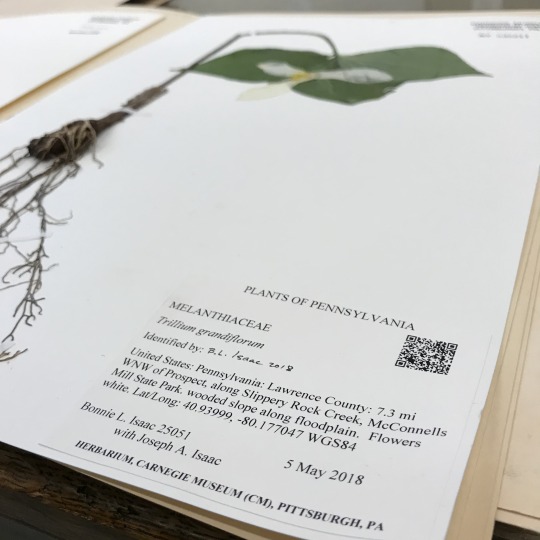
Herbarium specimen of large flowered trillium (Trillium grandiflorum) with QR code on label
Herbarium specimen of large flowered trillium (Trillium grandiflorum) with QR code on label that directs researchers to the associated iNaturalist observation, including images of the plant in the wild.

Before collecting a specimen, we take images in the field of the specimen in real life. These images are uploaded to iNaturalist, including other data such as date, time, location, and species identification. Other iNaturalist users can also contribute directly through verifying the identity of the specimen or making other comments.

Back in the herbarium, we export this information from iNaturalist to create unique herbarium labels for each specimen. We are using QR codes to link the specimens to the online iNaturalist observation. These QR codes can be read by most mobile devices. Among other information, the iNaturalist observation account online permanently links images from the field to the physical specimens in the herbarium.

What color were the flower petals? What was the size of the plant? Did it have a unique pattern on the bark?  What was the branching pattern? These questions and more can be asked to place herbarium specimens in a more complete context.

We envision a future where researchers can go through the herbarium with a mobile device such as a tablet or smart phone, scan QR codes on specimens, and be immediately directed to images of the specimen in the field.

Our article outlining this approach is available for free online:

Heberling, J. M., and B. L. Isaac. 2018. iNaturalist as a tool to expand the research value of museum specimens. Applications in Plant Sciences 6(11): e1193.  https://bsapubs.onlinelibrary.wiley.com/doi/epdf/10.1002/aps3.1193

Mason Heberling is Assistant Curator of Botany at the Carnegie Museum of Natural History.


Check back for more! Botanists at the Carnegie Museum of Natural History have embarked on a three-year project to digitize nearly 190,000 plant specimens collected in the region, making images and other data publicly available online. This effort is part of the Mid-Atlantic Megalopolis Project (mamdigitization.org), a network of thirteen herbaria spanning the densely populated urban corridor from Washington, D.C. to New York City to achieve a greater understanding of our urban areas, including the unique industrial and environmental history of the greater Pittsburgh region. This project is made possible by the National Science Foundation under grant no. 1801022. Any opinions, findings, and conclusions or recommendations expressed in this material are those of the author(s) and do not necessarily reflect the views of the National Science Foundation.

Filed Under: Blog Tagged With: Bonnie Isaac, Botany, Hall of Botany, herbarium, iNaturalist, Mason Heberling, plants

  • « Go to Previous Page
  • Page 1
  • Page 2
  • Page 3
  • Page 4

sidebar

About

  • Mission & Commitments
  • Directors Team
  • Museum History

Get Involved

  • Volunteer
  • Membership
  • Carnegie Discoverers
  • Donate
  • Employment
  • Events

Bring a Group

  • Groups of 10 or More
  • Birthday Parties at the Museum
  • Field Trips

Powdermill

  • Powdermill Nature Reserve
  • Powdermill Field Trips
  • Powdermill Staff
  • Research at Powdermill

More Information

  • Image Permission Requests
  • Science Stories
  • Accessibility
  • Shopping Cart
  • Contact
  • Visitor Policies
Stay in the loop! Sign up for our newsletter(s).
One of the Four Carnegie Museums | © Carnegie Institute | Privacy Policy | Terms of Use | Accessibility
Rad works here logo