• Skip to primary navigation
  • Skip to main content
  • Skip to primary sidebar

Carnegie Museum of Natural History

One of the Four Carnegie Museums of Pittsburgh

  • Visit
    • Buy Tickets
    • Visitor Information
    • Exhibitions
    • Events
    • Dining at the Museum
    • Celebrate at the Museum
    • Powdermill Nature Reserve
    • Event Venue Rental
    • Gift Cards
  • Learn
    • Field Trips
    • Educator Information
    • Programs at the Museum
    • Bring the Museum to You
    • Guided Programs FAQ
    • Programs Online
    • Climate and Rural Systems Partnership
  • Research
    • Scientific Sections
    • Science Stories
    • Science Videos
    • Senior Science & Research Staff
    • Museum Library
    • Science Seminars
    • Scientific Publications
    • Specimen and Artifact Identification
  • About
    • Mission & Commitments
    • Directors Team
    • Museum History
  • Tickets
  • Give
  • Shop

Enjoy the Museum from Home via our Blog

Can't make it to the museum in person? We've done our best to help cultivate resources for you to enjoy from home. Activities for the whole family, different ways to experience our exhibitions and more are included in these blogs.

May 14, 2020 by wpengine

The Bromacker Fossil Project Part II: The Hunt for Fossils

New to this series? Read The Bromacker Fossil Project Part 1 here.

Finding fossils at the Bromacker quarry was tedious and physically demanding, but it was extremely rewarding when a fossil is discovered. Our annual summer field season generally lasted three and a half weeks. Because the weather usually wasn’t conducive to camping or cooking outdoors, we stayed at the same hotel and dined at the hotel or local restaurants.

The original 1993 fossil quarry was opened using heavy equipment and operators from the nearby commercial quarry, and in the early years we relied on these people to expand the fossil quarry’s boundaries as needed. When the commercial quarry was temporarily shut down due to the lack of contracts for building stone, our collaborator Dr. Thomas Martens fortunately was able to obtain funding to annually rent a Bobcat, which he became skilled at operating. Thereafter, Thomas would use the Bobcat to expand the quarry and remove soil and weathered rock layers, so that we could begin our yearly excavation on unweathered rock.
image
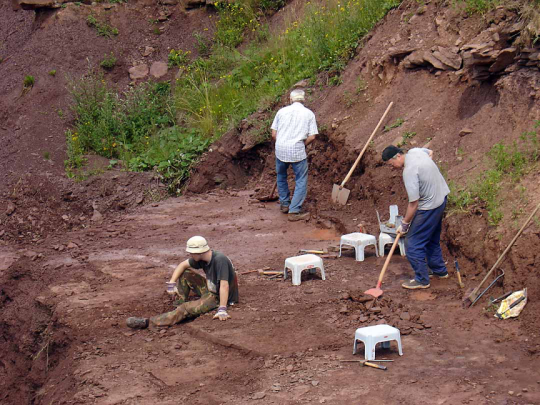
The Bromacker quarry on the first day of fieldwork in the 2006 field season. Shovels were used to clear loose rock from the surface of the quarry. Pictured (counterclockwise from left) graduate student Andrej Čerňanský and Dr. Jozef Klembara (Comenius University, Bratislava, Slovak Republic) and Dr. Dave Berman (Carnegie Museum of Natural History [CMNH]). Photo by the author, 2006.

We would each stake out an area of the quarry to work in and then proceed to work through the rock layers by using a hammer and chisel or pry bar to free a piece of rock. Its surfaces and edges would be checked for fossil bone, and if there was none, the rock piece would be broken into smaller pieces, which were also checked for bone. As is the case at many other fossil sites, the rock tended to split along the plane a fossil was preserved in, because the fossil would create a zone of weakness.
image
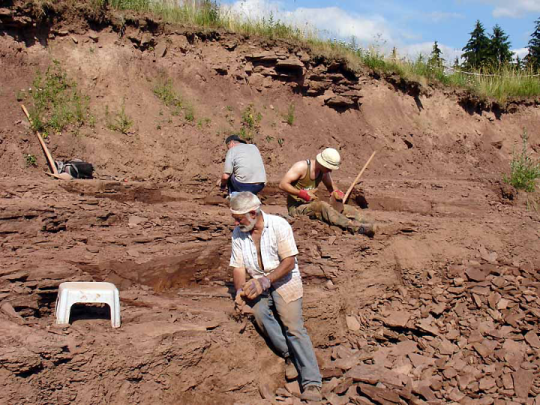
The quarry after a couple days of excavation. Pictured (clockwise from front) are Dave Berman, Jozef Klembara, and Andrej Čerňanský. Photo by the author, 2006.

Once a fossil specimen was discovered—and there were a few frustrating years when this didn’t happen—the hard work of extracting it from the quarry began. Here, I’ll use a fossil discovered during the 2006 field season as an example of how this was done.
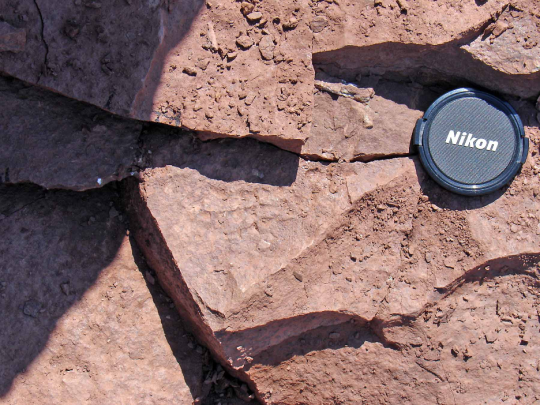
image
A discovery! Fossil bone and bone impression are exposed to the left of the lens cap. Photo by the author, 2006.

First, we would isolate the fossil specimen from the surrounding rock, exposing as little of the fossil as possible while determining its extent, because it would have been easy to lose pieces of bone in the dirt and mud. Then we would encase the specimen in a plaster and burlap jacket to protect it during extraction, shipping, and preparation.

To make the jacket, we’d coat cut strips of burlap in wet plaster and then spread them across the surfaces of the rock containing the specimen, or block. A layer of plastic (plastic bags worked well) was applied to the top surface of the block to keep plaster from sticking to any exposed bone.
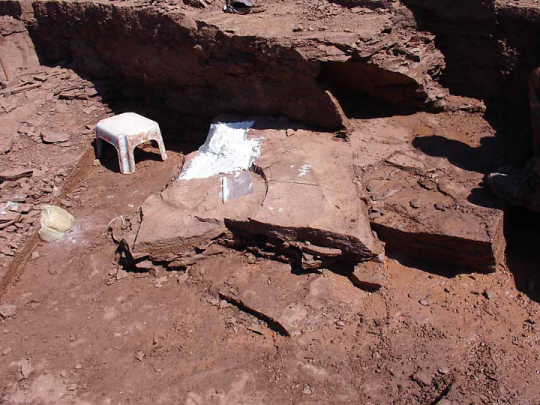
image
The block is partially isolated from surrounding rock. In this case, we decided to encase the top and some sides of the block in plaster and burlap bandages to hold the rock pieces together before we finished isolating the block from surrounding rock. Photo by the author, 2006.

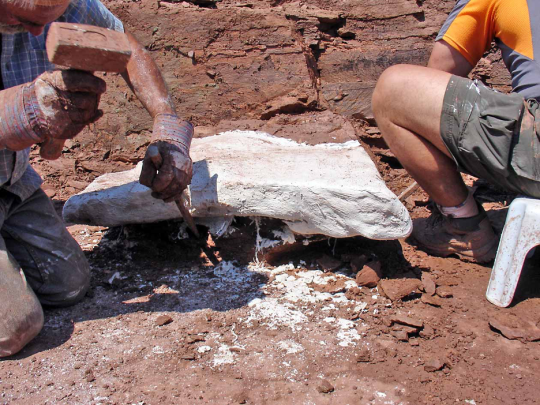
After a couple layers of plaster bandages were applied to the top and sides of the block, the block was undercut, with plaster bandages added periodically to hold the undercut rock in place.
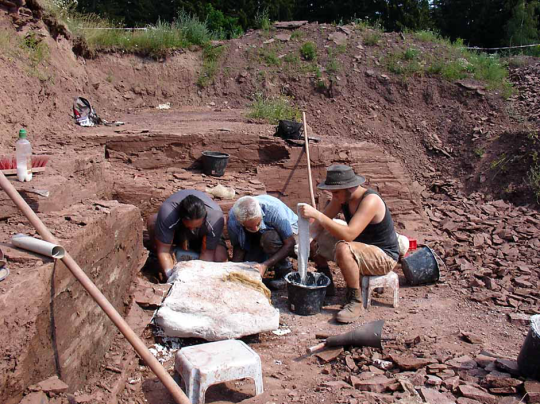
image
Pictured (left to right) are Dr. Stuart Sumida (California State University, San Bernardino, CA), Dave Berman, and Mr. Jerome Gores (Museum der Natur, Gotha [MNG]). Jerome is holding a plaster and burlap bandage while Dave and Stuart are pressing plaster bandages against the bottom of the block. They must hold the bandages in place until the plaster sets. Photo by the author, 2006.

image
Using hammers and chisels to undercut the block. Photo by the author, 2006.

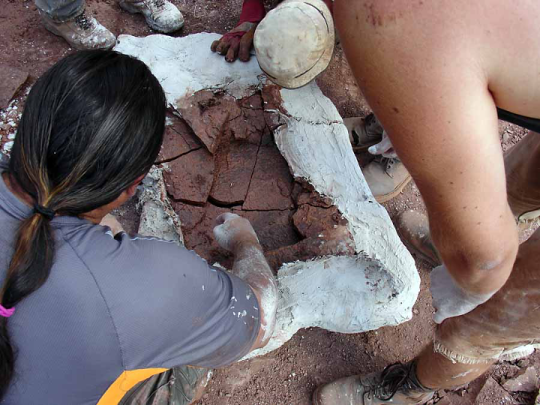
When deemed safe, we would crack the block free from the quarry floor using hammers and chisels, and flip it over, unless it broke free on its own. Excess rock would be removed from the bottom of the block to make it lighter in weight. Then we would apply burlap and plaster bandages to the bottom of the block. The block would be removed from the quarry and stored at the MNG until it was shipped to Pittsburgh.
image
The block has now been safely flipped over and excess rock is being removed. Photo by the author, 2006.

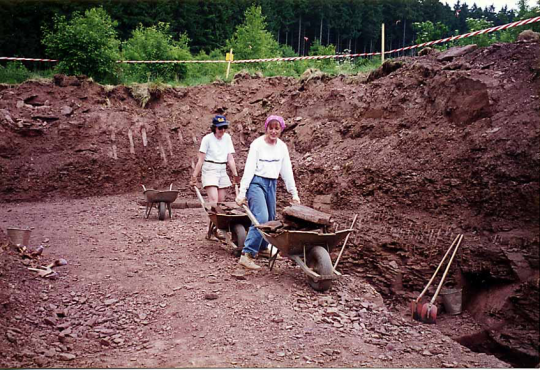
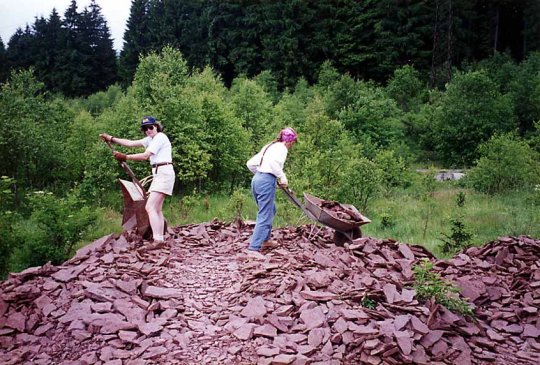
We encountered several problems during our quarry operations over the years. As we worked our way through the rock column in the quarry, processed rock piled up on the quarry floor. In the early years, we tossed or shoveled the processed rock into wheelbarrows and pushed the heavy, unwieldy wheelbarrows out of the quarry to a dump pile. Fortunately, the Bobcat eventually replaced the wheelbarrows for moving processed rock. As we ran out of space outside the quarry to dump processed rock, the rock was used to backfill older portions of the quarry.
image
Former CMNH volunteer Linda Rickets (front, right) and the author (left, rear) line up to push loaded wheelbarrows out of the quarry to the dump pile. Photo by Dave Berman, 1996.

image
At the dump pile. Over time rain and the freeze/thaw cycle would break down the rock and vegetation would grow on it. Photo by Dave Berman, 1996.

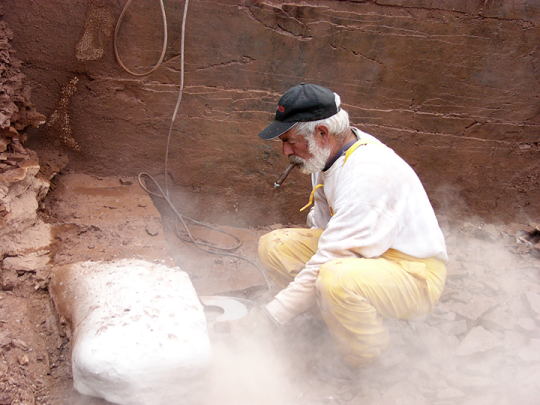
Another problem was that fossils found at the bottom of the quarry were often extremely difficult to undercut because the rock so was hard. Sometimes a well-hit chisel would just bounce off the rock instead of cracking or penetrating it. One year we had to resort to a rock saw to undercut a block.
image
Dave Berman uses a rock saw to undercut a block. Photo by the author, 2004.

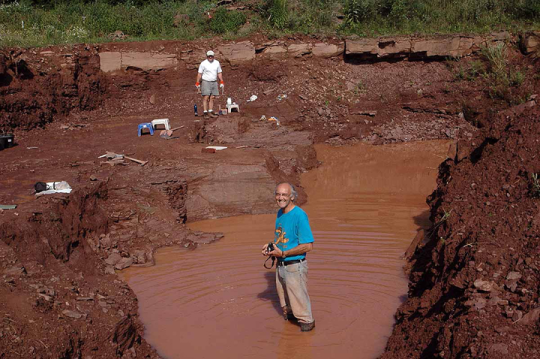
Rain was always a problem. We would shelter in our cars during intervals of rain, or work at the museum if the rain was heavy and persistent. Occasionally heavy rain would flood the quarry, forcing us to work in the ‘dry’ areas of the quarry while a pump drained the water. Of course, we had contests to see who could skip a rock the farthest or make the biggest splash.
image
A flooded quarry greeted us in the morning after heavy overnight rain. Pictured are Thomas Martens (front) and Stuart Sumida (rear). Photo by the author, 2010.

Next week’s post will describe the process of fossil preparation, that is, removing rock to reveal a specimen in the lab. The fossil collected in the 2006 field season will be used as an example.

Here are some videos taken by taken by Thomas Martens’ wife, Steffi, during the 1993 and 2006 field seasons. These show the process of searching for fossils (1993 video) and collecting the fossil highlighted in this post (2006 videos).

Bromacker Quarry 1993

https://youtu.be/DAEG0l1NotE

Bromacker Quarry 2006

https://youtu.be/UNL1s5ycJSM

https://youtu.be/lqYxheOZLQY

https://youtu.be/HrmSBrhde_E

Amy Henrici is Collection Manager in the Section of Vertebrate Paleontology at Carnegie Museum of Natural History. Museum staff, volunteers, and interns are encouraged to blog about their unique experiences and knowledge gained from working at the museum.
Keep Reading

The Bromacker Fossil Project Part III: Fossil Preparation

Filed Under: Blog Tagged With: Amy Henrici, dinosaurs in their time, fossils, Museum from Home, Science News, Vertebrate Paleontology

May 13, 2020 by wpengine

Spring is in the Air, Botanists are in the Field

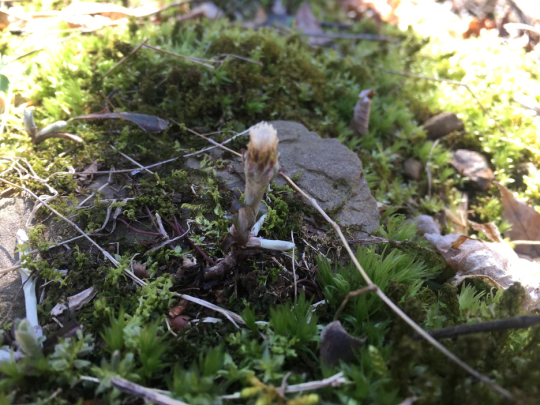
Antennaria solitaria in Ryerson Station State Park. Photo: BL Isaac.

With the arrival of warmer weather, botanists stop dreaming about what plants will be blooming and get out and look. CMNH botanists managed to make an early spring trip to the southwestern corner of Pennsylvania, visiting Ryerson Station State Park in Greene County. At Ryerson, we found some of the more common spring flowering species along with some non-native invasive species. While collecting more than a dozen plants as current vouchers for ongoing phenology comparisons with older specimens, we also visited a known site for a Pennsylvania proposed Endangered plant species, the single headed pussy-toes, or Antennaria solitaria.

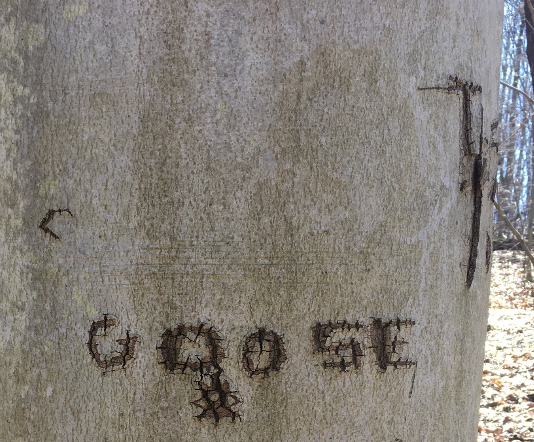
While out and about, I am always interested to see how well plants that have been labeled are identified. Over the years I have found some gross misidentifications on signs along trails. Last year I visited a boy scout camp that had a tree trail with over half of the trees misidentified. I found an especially egregious label along one of the trails in Ryerson Station State Park. This one was not on a park sign but was placed there by some misguided soul. What is obviously a beech tree (Fagus grandifolia) is clearly labeled as a goose (Branta canadensis). Evidently there were no scientific editors around when this mislabeling abuse took place by someone who not only can’t tell the forest for the trees but can’t tell a tree from a bird.

Beech tree in Ryerson Station State Park. Photo: BL Isaac.

All silliness aside, as spring moved along important field work stalled. With visits to Yellow Creek State Park and Cook Forest State Park in the works, we were notified by the Bureau of State Parks that all scientific permit holders must suspend collecting in the parks until further notice. So, our state park project, which has been running since 2017, was temporarily suspended due to the COVID-19 pandemic.

Collecting restrictions were lifted weeks later, however, we have missed one of the most important seasons for our long-term state park phenology study. With our 10-year plan in place it may be another decade before we can collect to evaluate Yellow Creek State Park flora. Hopefully we can double up on parks next year, so we won’t have to wait another 10 years to get these parks involved in our phenology project.

Bonnie Isaac is the Collection Manager in the Section of Botany. Museum employees are encouraged to blog about their unique experiences and knowledge gained from working at the museum.
Filed Under: Blog Tagged With: Bonnie Isaac, Botany, Hall of Botany, Museum from Home, Section of Botany

May 12, 2020 by wpengine

Draw a Flower

This is the season of colorful flowers and we can truly appreciate their vibrance after a typical grey and chilly winter.  One way to make the beauty last and keep a reminder of springtime all year-round is to draw a flower.

Andrey Avinoff was an entomologist and Director of the Carnegie Museum of Natural History from 1926 to 1946.  But he was also an illustrator and painter in his free time!  Many of his beautiful illustrations can be found in “Wild Flowers of Western Pennsylvania and the Upper Ohio Basin,” a botanical guide authored by the botanist Otto E Jennings, and later Director of the Carnegie Museum of Natural History.

One of the most ubiquitous flowers of the season, for me, is the violet.  I love the way they sprout up through lawns and in the forest alike.  They come in a dazzling array of colors—pink, white, yellow, blue, and purple—and the detail when you look closely is inspiring.  There are about 600 species in the Viola genus, so there are plenty to choose from.

Before we get started you might need to gather some supplies.  Use a pencil and eraser, just in case you make some mistakes (it’s okay to make a mistake).  Get some paper and a comfy spot to draw—make sure you cover your table to avoid making marks on it.  Don’t forget the colors!  I like colored pencils, but you can use markers, crayons, paint, or anything else to color with.

Here’s a tip: try out some ideas on scrap paper so that you know what works best for you.  Practice makes perfect!

Step 1: Shapes

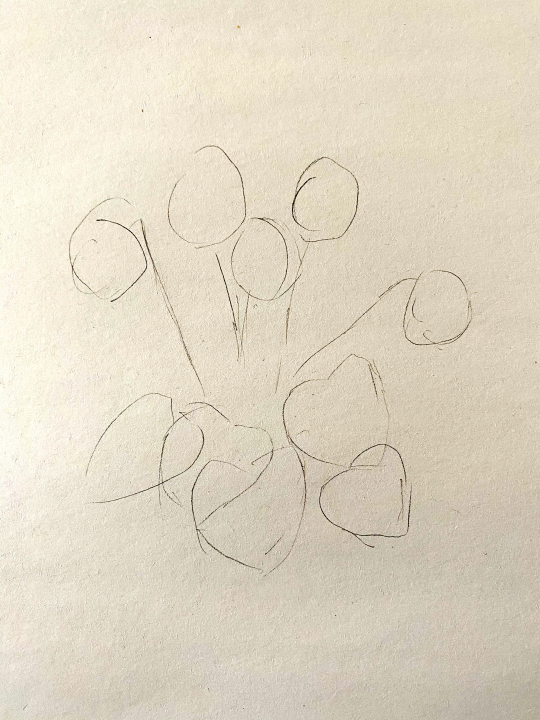
circles and lines drawn in pencil to show the basic shapes to begin drawing flowers

Use some basic shapes—circles, triangles, squares, and lines—to make up the general shape of your flower.  You can draw little lollipops or popsicles for now and we’ll add more details as we go.  Use light pencil strokes so that they’ll be easy to erase later.

Try to keep all of your flower shapes the same size—you want all your flowers to be similar in size.

I also draw some leaf shapes.  Make sure your leaves are balanced to your flowers and don’t worry about how they overlap just yet.

I also like to have a photo that I’ve taken or found online to use as a reference for what I’m drawing.  I even picked some flowers to get a good idea of what they look like—just make sure you leave some flowers for the wildlife.

If you want to take it to the next level, you can also check out some botanical illustrations (like Andrey Avinoff’s) where individual flower parts, seeds, leaves, and roots are sometimes drawn to help with identification.

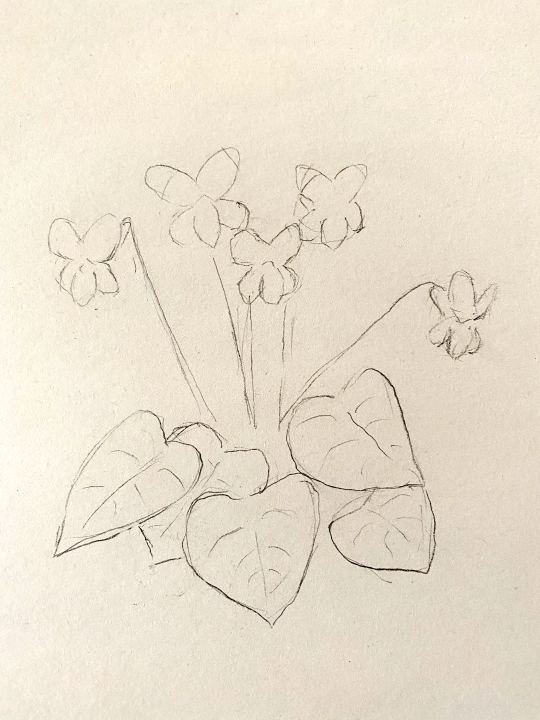
Step 2: Silhouette

basic pencil drawing of flowers

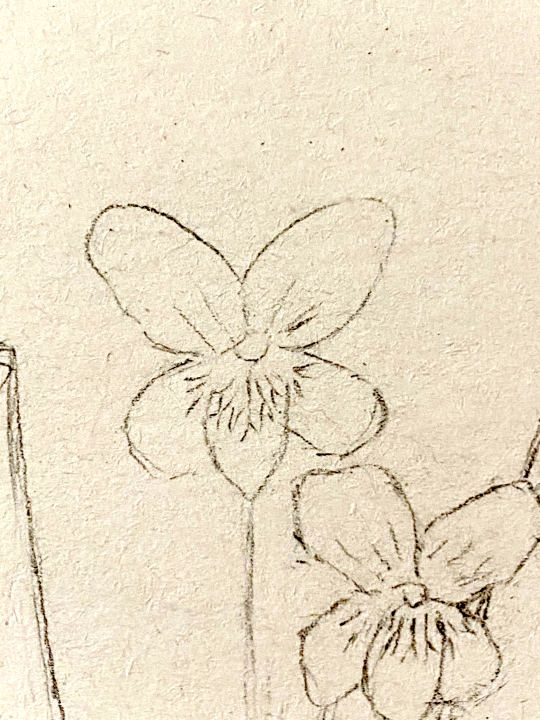
Next let’s draw individual flower petals.  It’s good to know how many petals your flower has and how they look—violets have five that look a little like a butterfly.  Flowers come in a lot of shapes, so take some time studying the flower and practice drawing the shape.  If you haven’t already, you can also draw the flower stalks, or petioles.

The leaf shape is important too, leaves come in lots of shapes like the violet’s heart-shaped leaves.

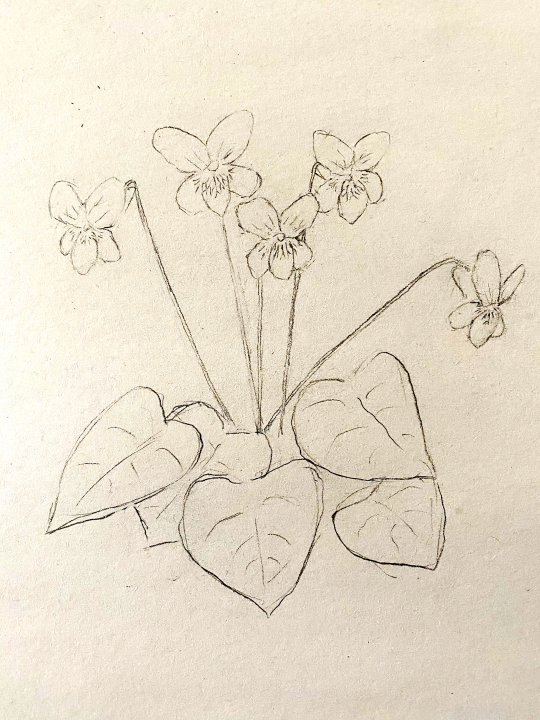
Step 3: Details

detailed pencil drawing of flowers

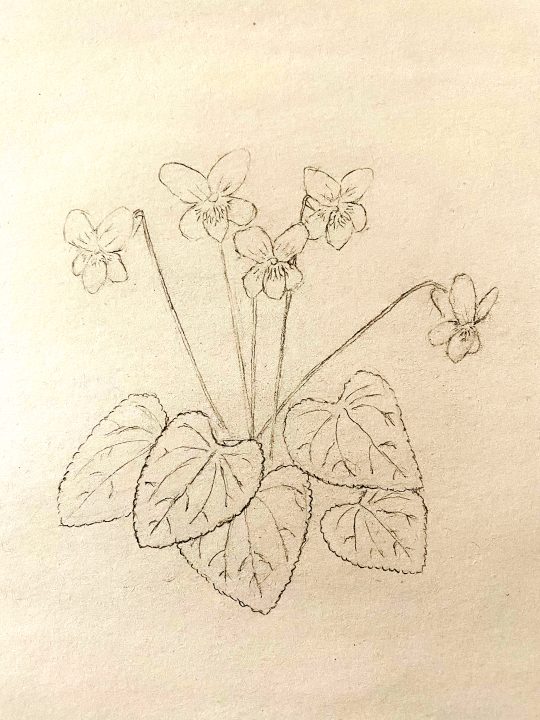
Add more details.  Mark where colors might change on flower petals and if there are any veins on the leaves or petals.  You can add details to the leaf edges to make them wavy, scalloped, or toothed.

detail of pencil drawing of flowers

It’s also important in this step to know how detailed you want to be. Remember: a smaller sketch doesn’t need as much detail, but a bigger sketch can have more.  Whatever you think looks best.

detailed pencil sketch of flowers

Step 4: Color

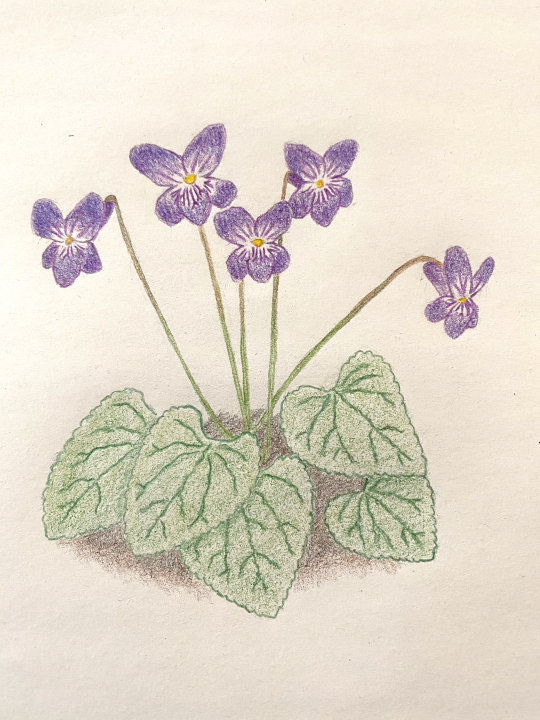
colored drawing of flowers with purple petals, yellow centers, and green stems and leaves

This step is optional, sometimes a black and white sketch can tell a great story.  However, if you have some time, then adding color to your drawing can also really bring it to life.

You can use crayons, markers, paint, or any other color tool you want.  It’s always a good idea to test your colors on a separate piece of paper to see if they’re right for you or to try out a mix of colors.  Flowers are many colors, so you can be really creative!

Be proud of your sketches!  No one else could have made it the same way that you did.  By drawing and coloring plants, animals, and other nature you can sharpen your observation skills and gain a better appreciation for the beauty and uniqueness of all life.

Aaron Young is a museum educator on Carnegie Museum of Natural History’s Outreach team. Museum staff, volunteers, and interns are encouraged to blog about their unique experiences and knowledge gained from working at the museum.
Filed Under: Blog Tagged With: Aaron S. Young, activities, Education, Educators, Museum from Home, Nature 360, Nature Lab

May 8, 2020 by wpengine

City Nature Challenge Recap

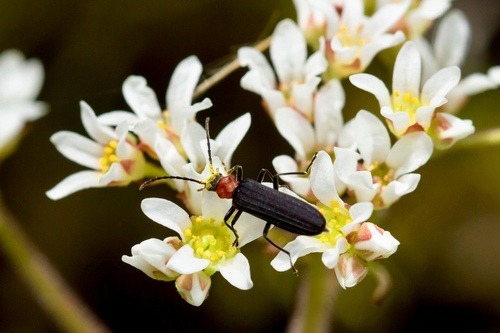
photo of black and red bug on white flowers

With the COVID-19 pandemic hitting, the entire world had to adapt how we participated in this year’s City Nature Challenge. This year we focused on a global collaboration instead of a competition, and physical distancing over public events. We are amazed at the creativity and resilience that we saw – and 2020’s City Nature Challenge results show just how important it was both globally and in the Pittsburgh region.

City Nature Challenge Results

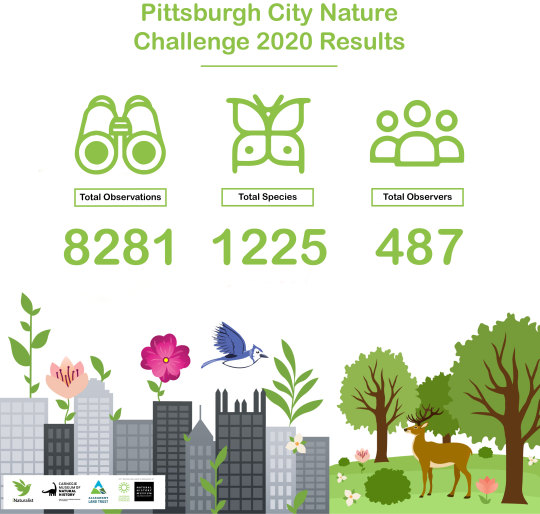
graphic of Pittsburgh City Nature Challenge 2020 Results: 8281 total observation, 1225 total species, and 487 total observers

This year, over 40,000 people around the world came together virtually to participate in the City Nature Challenge.  Collectively we shared over 800,000 observations of nature near our homes, and documented 135,435 different species of fungi, plants, and animals. Want to see what was found in any of the more than 200 cities that participated? You can explore at this link.

Pittsburgh’s numbers are incredible too. At the end of the challenge, the Pittsburgh region ended up having 487 observers, 8,281 observations, and 1,225 different species. We almost doubled the number of observers from last year!

The identification phase was a success as well with 419 users helping identify 13,446 different observations. You can explore all the Pittsburgh Region’s observations from this year at this link.

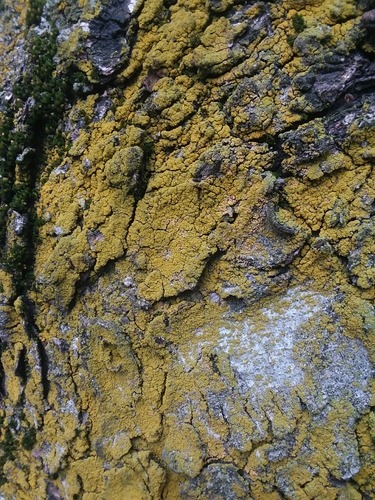
photo of candle flame lichen
Pete Peng has 1,310 observations and these Candleflame Lichens are beautiful.

Don’t Stop Observing!

We can’t put into words how thankful we are for everyone’s resilience and hard work. The results from this year’s City Nature Challenge prove that even though we have to distance from each other right now, we can still come together to accomplish something awesome.

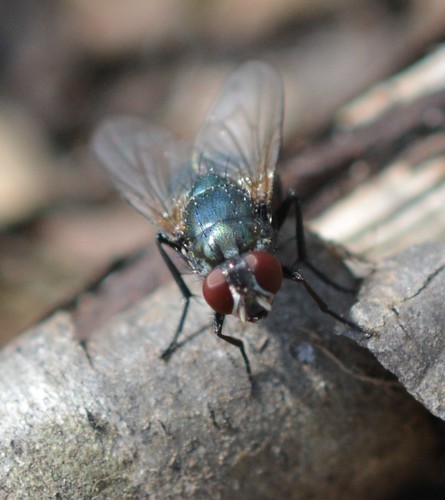
closeup photo of a fly
Check out this observation of a fly from Julia Schwierking!

The City Nature Challenge may be over, but the observations don’t have to end here. Nature is around you 24/7 and waiting to be observed. You can use the iNaturalist app anytime to share what you find!

We’d love to see your observations. Email them to nature360@carnegiemnh.org or tag us on social media @CarnegieMNH.

Get more nature activity ideas from Nature Lab!

Filed Under: Blog Tagged With: City Nature Challenge, Education, Educators, Museum from Home, Nature 360, Nature Lab

May 6, 2020 by wpengine

The Bromacker Fossil Project Part I: Introduction and History

If you follow Carnegie Museum of Natural History (CMNH) on social media, then you may have seen a post announcing that Section of Vertebrate Paleontology (VP) Curator Emeritus Dr. Dave Berman and I, along with our collaborators, had recently published a new genus and species of caseid synapsid (a large lizard-like, very distant relative of mammals), Martensius bromackerensis, the specimens of which were discovered at the Bromacker quarry, central Germany. Dave and I are part of an international team from Canada, Germany, Slovakia, and the USA who have discovered, named, and described exquisitely-preserved fossils from the Bromacker quarry over the past 27 years. This recent publication most likely represents the last of the new Bromacker discoveries that Dave and I will publish on, due, in part, to the quarry having been closed to excavation for the past nine years.

With CMNH’s role in the Bromacker project winding down, and much of the world currently staying home and practicing social distancing, I thought this might be a good time to present the project’s highlights as a series of blog posts for you to enjoy. This post will introduce and present the history of the project, while topics of subsequent posts will include the discovery and collection of the fossils, fossil preparation, descriptions of the animals discovered, the geologic history of the quarry, and, finally, a summary of what we learned.

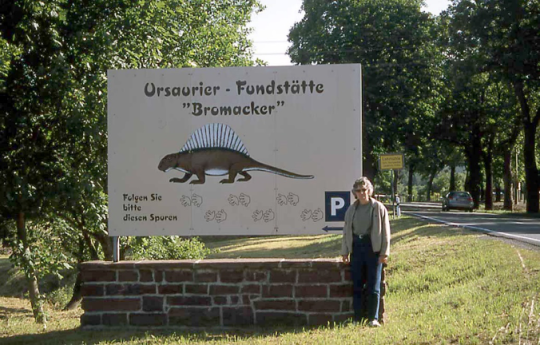
The author (Amy Henrici) standing next to a road sign for the Bromacker quarry in the Thuringian Forest of central Germany. Translation is as follows: “Ursaurier Discovery Site ‘Bromacker.’ Please follow these tracks.” Dr. Thomas Martens coined the term “Ursaurier,” which he translates as “primary saurian,” to indicate that the fossil animals from the Bromacker predate dinosaurs. Photo by Dave Berman.

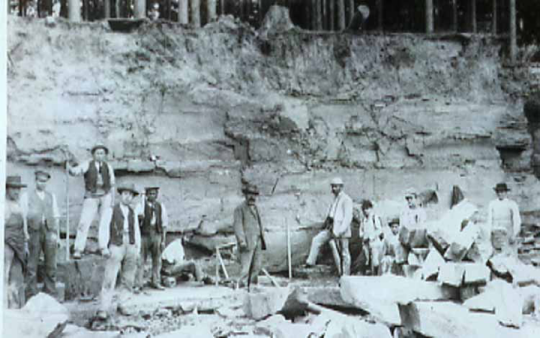
In the Bromacker area of Thuringia, central Germany, a thick rock layer known as the Tambach sandstone has been intermittently quarried for use as a building stone for more than 150 years. Evidence of life preserved in the Tambach sandstone in the form of tetrapod (four-footed backboned animal) footprints was discovered in 1887 and later studied by Professor Wilhelm Pabst from 1890 to 1908. Pabst was an amateur paleontologist who taught high school in the nearby city of Gotha.

Undated photograph showing quarry workers and Professor Pabst (right center in white jacket and hat). Photo provided by Thomas Martens.

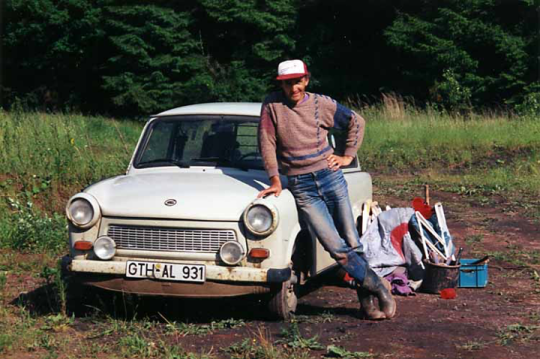
Dr. Thomas Martens (now retired Curator, Museum der Natur Gotha [MNG]) discovered the first vertebrate (backboned animal) body fossils at the Bromacker quarry in the summer of 1974. He was trained as an invertebrate paleontologist and was sent there by his major professor to look for fossils of conchostracans (‘clam shrimp’), a type of very small crustacean. After his first discovery, Thomas continued to collect at the Bromacker from 1975 to 1991, finding a variety of early Permian-aged (approximately 290-million-year-old) fossil vertebrates that were otherwise known only from North America. At that time, Thuringia was part of East Germany, so Thomas’ travel to other countries was restricted by his government, but fortunately he could communicate by mail with paleontologists overseas. He eventually began a correspondence with an expert on the types of fossils that he was discovering, CMNH’s Dave Berman (then Associate Curator). In 1992, two years after the reunification of Germany, CMNH sponsored Thomas to come to Pittsburgh to study with Dave for six months, which began a long and productive collaboration.

Thomas Martens with his East Germany-produced Trabant automobile. Though Thomas had to endure a long waiting list before he was able to purchase this car, he replaced it shortly after the reunification of Germany in 1990. The Trabant then became his field vehicle. Photo by the author, 1994.

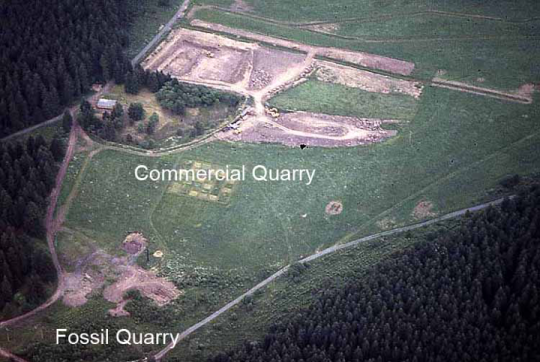
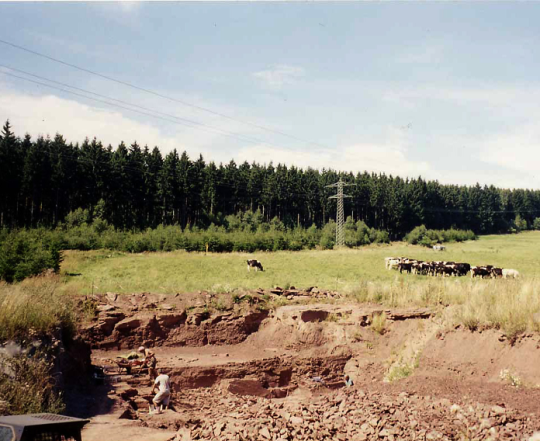
The Bromacker quarry is in the Thuringian Forest near the village of Tambach-Dietharz. It lies in a large field surrounded by thick forest traversed by dirt roads. People from the surrounding villages who regularly visited the Bromacker area to walk, ride their bikes, and pick wild mushrooms would stop to ask us what we were doing. School groups came regularly to learn about the fossil ‘diggings’ and to watch us work.

Aerial view of the commercial rock quarry and the fossil quarry at the Bromacker site. Photo provided by Thomas Martens.

View of the fossil excavation at the Bromacker quarry. Photo by the author.

Field work at the Bromacker was conducted annually from 1993 to 2010 by Dave, Thomas, myself, and our other collaborators, which led to the discovery, collection, and scientific preparation and description of 13 fossil vertebrate species, 12 of which were new to science. Most of the fossils discovered were shipped to CMNH, where I prepared them in the paleontology lab in the museum’s basement. Once the fossils had been published in scientific journals, they would be shipped back to the MNG, because that museum is the legal repository for the Bromacker fossils. CMNH retained cast replicas made by VP staff of some of the more exquisite specimens, and some of these are exhibited in the Fossil Frontiers display case in the Dinosaurs in Their Time exhibition. Be sure to look for these once the museum reopens. And stay tuned for my next post, that will describe how we found and collected the fossils!

Amy Henrici is Collection Manager in the Section of Vertebrate Paleontology at Carnegie Museum of Natural History. Museum staff, volunteers, and interns are encouraged to blog about their unique experiences and knowledge gained from working at the museum.
Keep Reading

The Bromacker Fossil Project Part II: The Hunt for Fossils

Filed Under: Blog Tagged With: Amy Henrici, dinosaurs in their time, Museum from Home, Section of Vertebrate Paleontology, Vertebrate Paleontology

May 5, 2020 by wpengine

Pokémon Inspired by Animals

When Pokémon launched as a franchise in 1996, quickly becoming a worldwide multimedia phenomenon, the Pokémon creators had their work cut out for them imagining a whole new world with new creatures that we had never seen before. Or had we? Believe it or not, most Pokémon creatures have real-life animal inspirations!

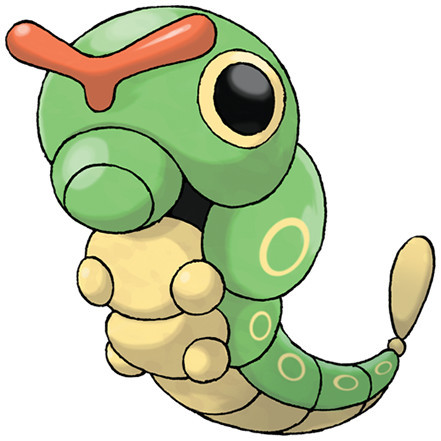
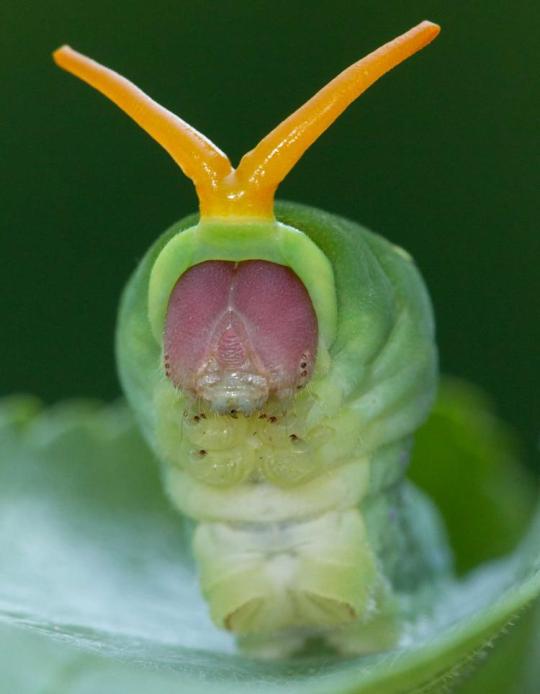
Caterpie and Eastern Tiger Swallowtail Caterpillar

illustration of Caterpie
photo of Eastern Tiger Swallowtail caterpillar

Caterpie is a bug type Pokémon. It’s known for devouring leaves bigger than its body and releasing an intense odor from its orange antennas when battling another Pokémon. You can’t miss the similarities between Caterpie and the eastern tiger swallowtail caterpillar. Both creatures have a distinct green body with bright orange antennas.

The eastern tiger swallowtail is a butterfly native to eastern North America. Similar to Caterpie, the swallowtail caterpillar possesses something called an osmeterium, an orange fleshy organ that emits a foul smell to ward off enemies when threatened.

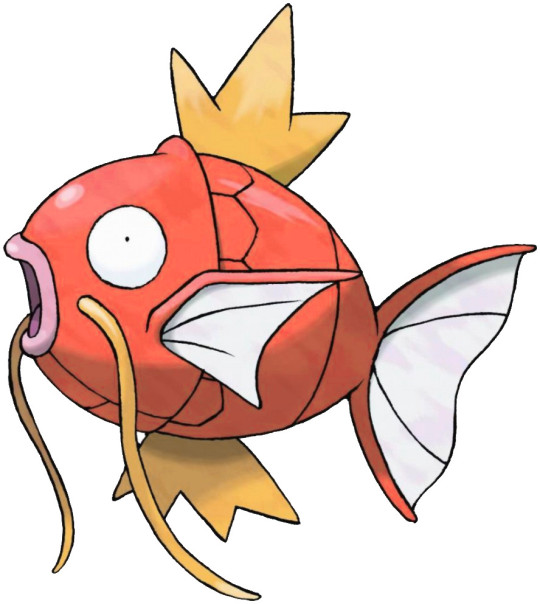
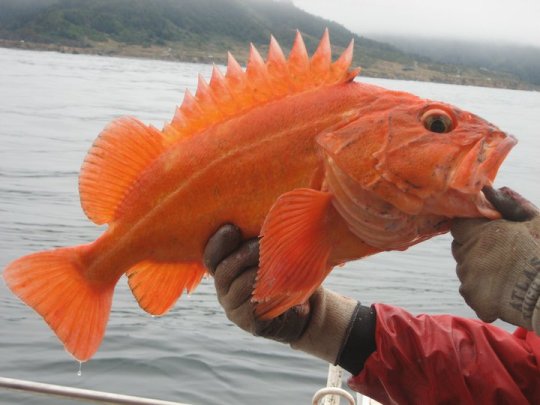
Magikarp and Yelloweye Rockfish

illustration of Magikarp
photo of Yelloweye rockfish held out of water

Magikarp is a water Pokémon and a large fish with orange scales. Magikarp flops around while blinking its large bulging eyes with its mouth open.

Yelloweye rockfish are one of the biggest members of the genus Sebastes and are prized for their meat. Both the real fish and the Pokémon are orange in color and have long rigid head spines to protect them from predators. Yelloweyes also have bulging eyes and a gaping mouth like Magikarp.

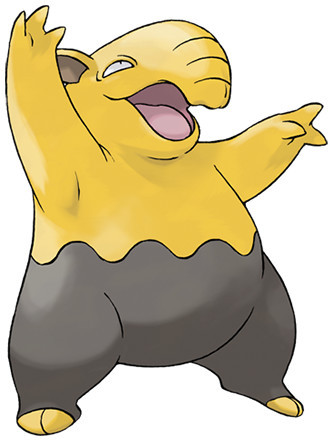
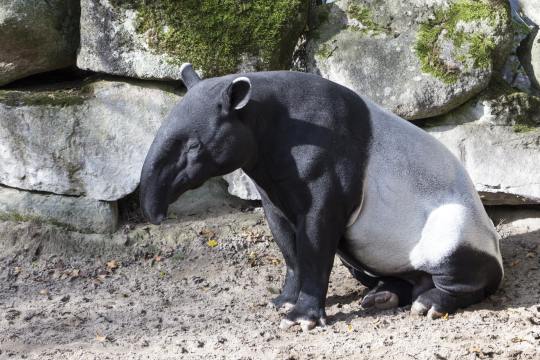
Drowzee and Malayan Tapir

illustration of Drowzee
photo of Malayan Tapir

What about Drowzee, a hypnosis Pokémon with insomnia who senses dreams with its trunk-like nose? Drowzee has beady eyes and triangular brown ears.

It can’t sense your dreams like Drowzee, but the Malayan tapir has many resemblances to the Pokémon. The tapir is a large mammal with a short trunk. It uses its snout to pick up things or as a snorkel when in water. Aside from both having a short snout, Drowzee seems to have been inspired by the tapir’s two-toned coloring.

What other Pokémon/real-life animal resemblances have you noticed?

Fun Fact

Poliwag, Poliwhirl, and Poliwrath are all based on tadpoles. They each have a spiral on their stomach that resembles the intestines which are visible through a tadpole’s translucent stomach.

Filed Under: Blog Tagged With: Education, Educators, Museum from Home, Nature 360, Nature Lab, Pokemon

  • « Go to Previous Page
  • Page 1
  • Interim pages omitted …
  • Page 18
  • Page 19
  • Page 20
  • Page 21
  • Page 22
  • Interim pages omitted …
  • Page 26
  • Go to Next Page »

sidebar

About

  • Mission & Commitments
  • Directors Team
  • Museum History

Get Involved

  • Volunteer
  • Membership
  • Carnegie Discoverers
  • Donate
  • Employment
  • Events

Bring a Group

  • Groups of 10 or More
  • Birthday Parties at the Museum
  • Field Trips

Powdermill

  • Powdermill Nature Reserve
  • Powdermill Field Trips
  • Powdermill Staff
  • Research at Powdermill

More Information

  • Image Permission Requests
  • Science Stories
  • Accessibility
  • Shopping Cart
  • Contact
  • Visitor Policies
Stay in the loop! Sign up for our newsletter(s).
One of the Four Carnegie Museums | © Carnegie Institute | Privacy Policy | Terms of Use | Accessibility
Rad works here logo