• Skip to primary navigation
  • Skip to main content
  • Skip to primary sidebar

Carnegie Museum of Natural History

One of the Four Carnegie Museums of Pittsburgh

  • Visit
    • Buy Tickets
    • Visitor Information
    • Exhibitions
    • Events
    • Dining at the Museum
    • Celebrate at the Museum
    • Powdermill Nature Reserve
    • Event Venue Rental
    • Gift Cards
  • Learn
    • Field Trips
    • Educator Information
    • Programs at the Museum
    • Bring the Museum to You
    • Guided Programs FAQ
    • Programs Online
    • Climate and Rural Systems Partnership
  • Research
    • Scientific Sections
    • Science Stories
    • Science Videos
    • Senior Science & Research Staff
    • Museum Library
    • Science Seminars
    • Scientific Publications
    • Specimen and Artifact Identification
  • About
    • Mission & Commitments
    • Directors Team
    • Museum History
  • Tickets
  • Give
  • Shop

Erin Southerland

February 7, 2024 by Erin Southerland

The Hermit Crab and the Moon Snail

by Timothy A. Pearce and Mandi Lyon

When a snail needs a larger shell, it simply grows its shell larger, continuing the spiral. However, when a hermit crab needs a larger shell, it must find a larger shell to move into. Consequently, hermit crabs depend on snails to provide housing. Hermit crabs have soft abdomens, which are vulnerable to predators, so they keep their abdomens protected inside of snail shells.

There are amusing stories of several hermit crabs lining up in order of shell size, in a type of pecking order. When a new shell becomes available, the hermit crab highest on the pecking order holds onto the new shell and keeps a tight grip on its current shell as well. It tries out the new shell, and if it is an improvement, the crab will quickly move from one shell to the other, releasing the old shell. The old  shell then becomes available to the next crab in the pecking order who examines it, and so on down the line.

Apparently, hermit crabs don’t kill snails to get the shells, but instead appear to move into already empty shells. 

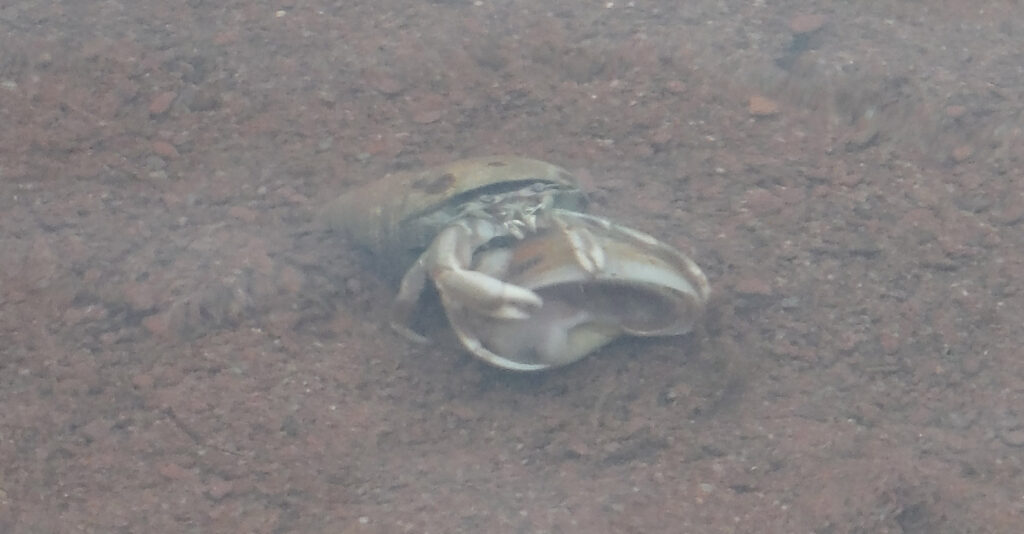
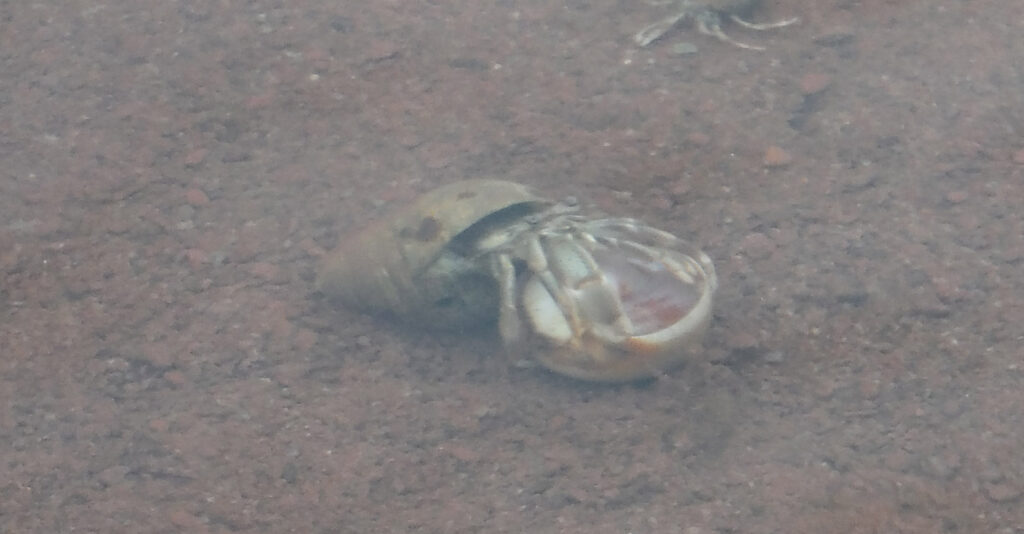
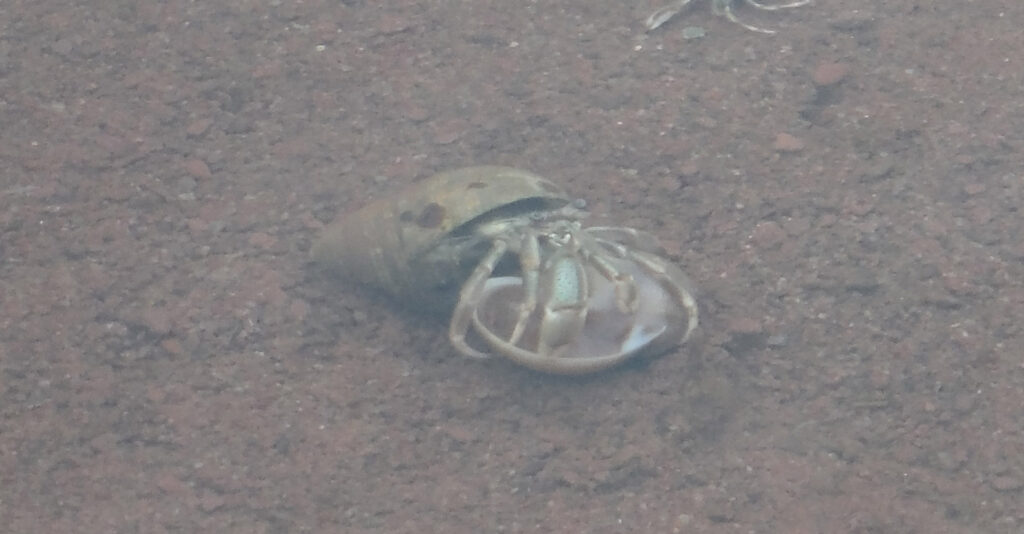
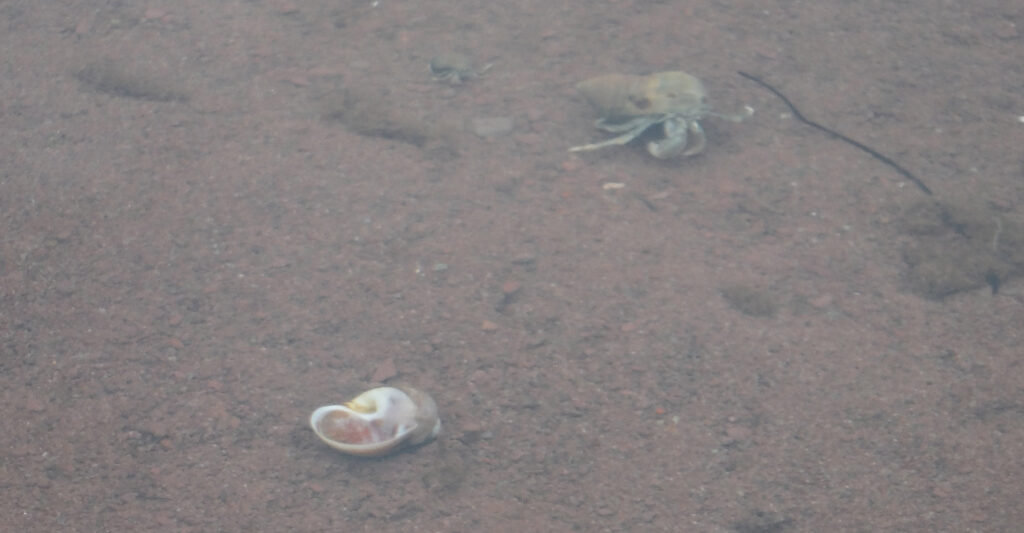
This series of photos was taken in the evening of August 12, 2017, at Amherst Shore Provincial Park on the Northumberland Strait in Nova Scotia. The photos show a hermit crab wearing the shell of a Dog Whelk (Nucella lapillus) encountering a Spotted Northern Moonsnail (Lunatia triseriata). The entire interaction took about a minute or so. The hermit crab approaches (Fig. 1) and climbs onto the moon snail (Fig. 2). The snail pulls its body into its shell and blocks the shell opening with its horny operculum, like a door that shuts the opening tightly (Fig. 3). The crab flips the shell over and the reddish colored operculum is visible (Fig. 4). The crab probes into the aperture (Fig. 5). Then the crab walks away (Fig. 6), evidently convinced that the shell is not available.

It’s hard to tell whether the hermit crab feels crowded in its current shell; it looks fine to us, but maybe hermit crabs are always on the lookout for better accommodations. The crab approached from the snail’s backside, so perhaps the crab didn’t notice that the snail is alive. The crab flipped the shell over, probed into the aperture where it bumped into the operculum.

How fortunate to be able to witness such an interaction, and to have a camera to record the episode!
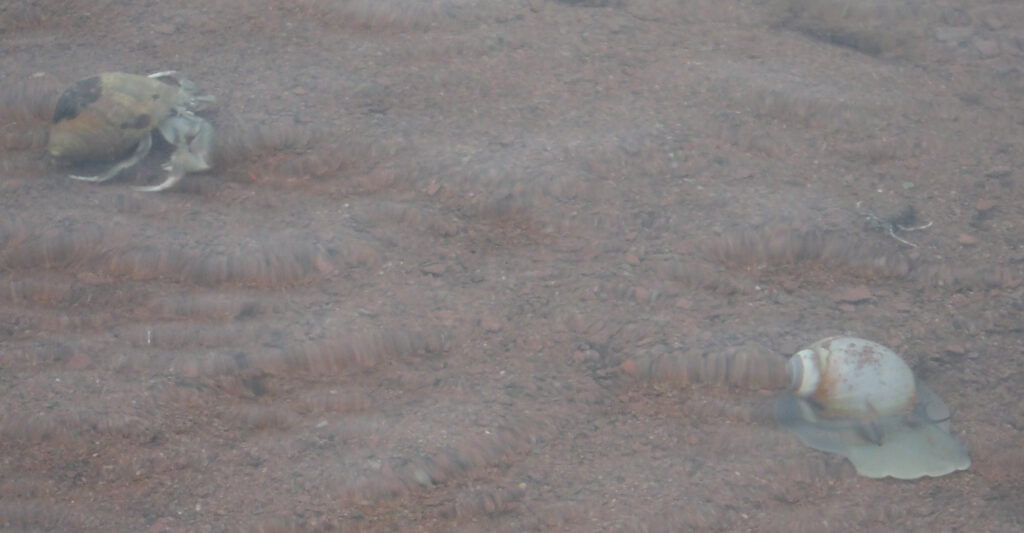
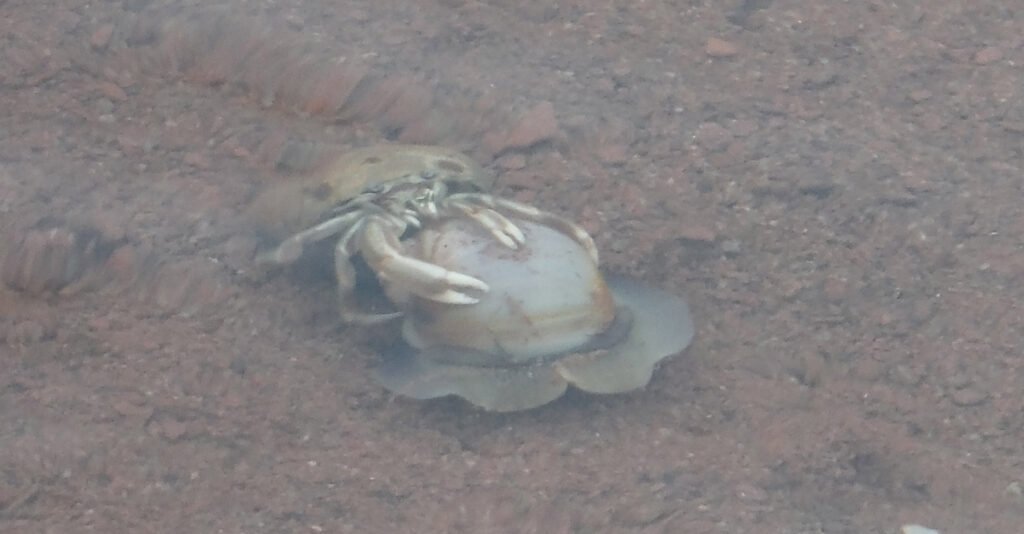
Fig. 1. Hermit crab approaches snail. Photo by M. Lyon.
Fig. 2. Hermit crab climbs onto snail. Photo by M. Lyon.
Fig. 3. Snail withdraws into shell blocking opening with operculum. Photo by M. Lyon.
Fig. 4. Hermit crab flips the shell over (note reddish operculum). Photo by M. Lyon.
Fig. 5. Hermit crab probes into the shell aperture, knocking on the door-like operculum. Photo by M. Lyon.
Fig. 6. Hermit crab walks away. Photo by M. Lyon.

Mandi Lyon is the Program Manager for Schools & Groups and Timothy A. Pearce is Curator of Mollusks at Carnegie Museum of Natural History.

Related Content

Can Snails Feel Love?

Prozac and Caffeine in Our Wastewater: Effect on Freshwater Mollusks

Diet-wise, Snails are Like Cows, Not Bugs

Carnegie Museum of Natural History Blog Citation Information

Blog author: Lyon, Mandi; Pearce, Timothy A.
Publication date: February 7, 2024
Share this post!

  • Share on Twitter Share on Twitter
  • Share on Facebook Share on Facebook
  • Share on Pinterest Share on Pinterest
  • Share on LinkedIn Share on LinkedIn
  • Share on Reddit Share on Reddit
  • Share via Email Share via Email

Filed Under: Blog Tagged With: Mandi Lyon, mollusks, Science News, Tim Pearce

February 2, 2024 by Erin Southerland

Groundhog Day 2024: Punxsutawney Phil’s Alpine Cousin

by Suzanne McLaren and John Wible

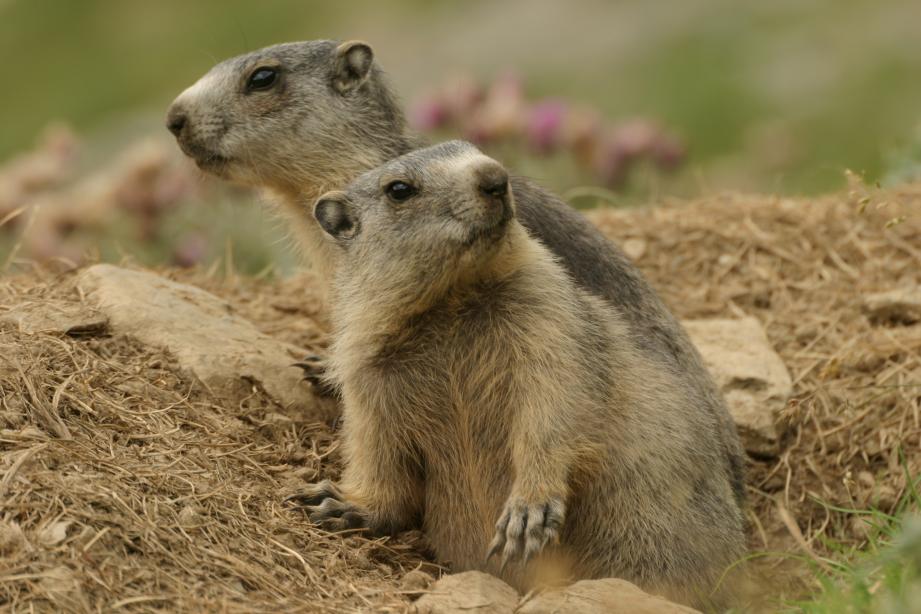
Beginning in 1887 in Punxsutawney, Pennsylvania, the celebration of Groundhog Day has made the groundhog (Marmota monax) a familiar animal to people who live far beyond the range of this species. While this large ground squirrel may get the most publicity, especially on February 2nd every year, there are twelve related species that live elsewhere in North America, Europe, and Asia. In Europe, the Alpine marmot (Marmota marmota), which lives in mountainous areas of the continent’s central and western regions, is particularly well-known. Like the groundhog, it spends most of the year fattening up so that it can survive the winter months by hibernating.  

two alpine marmots
Credit: Sylvouille at French Wikipedia. – Transferred from fr.wikipedia to Commons., CC BY-SA 1.0

While our local groundhog leads a more solitary existence, the Alpine marmot lives in a communal setting that includes a single breeding pair and around 15-20 of their offspring. They live in underground burrows that are passed down for generations within the family group, expanding over time into complex systems of tunnels. The tunnels eventually lead to a large chamber or den, where the entire family hibernates during the winter months. This concentrates body heat among the group and helps younger individuals to survive. Similar to prairie dogs, family members are friendly and playful with each other, grooming and touching noses when they greet. One individual, serving as a guard at the mouth of the burrow, will give off a loud whistle, to warn the rest of the family about the approach of an enemy – either a predator or even a non-family member of its own species.  

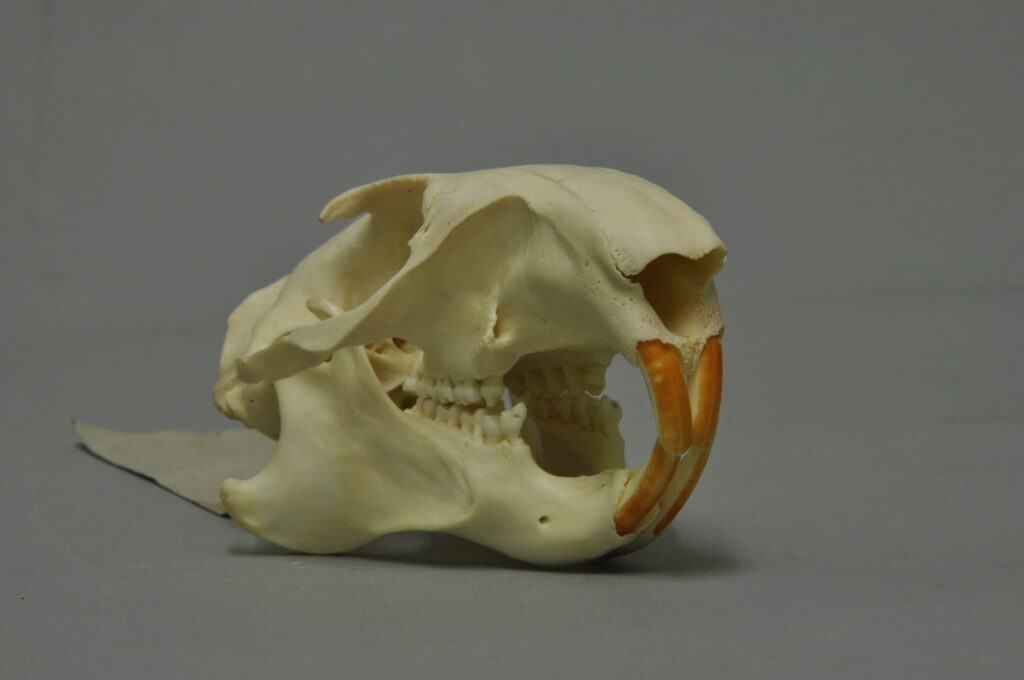
Humans have hunted this species for hundreds of years for its meat. They are still hunted by the thousands for sport in Switzerland and Austria, with the large, ever-growing, yellowish-orange upper incisors sometimes displayed on hunters’ belts.

alpine marmot skull
Picture of Alpine marmot skull showing large incisors, Klaus Rassinger und Gerhard Cammerer, Museum Wiesbaden, CC BY-SA 3.0, via Wikimedia Commons

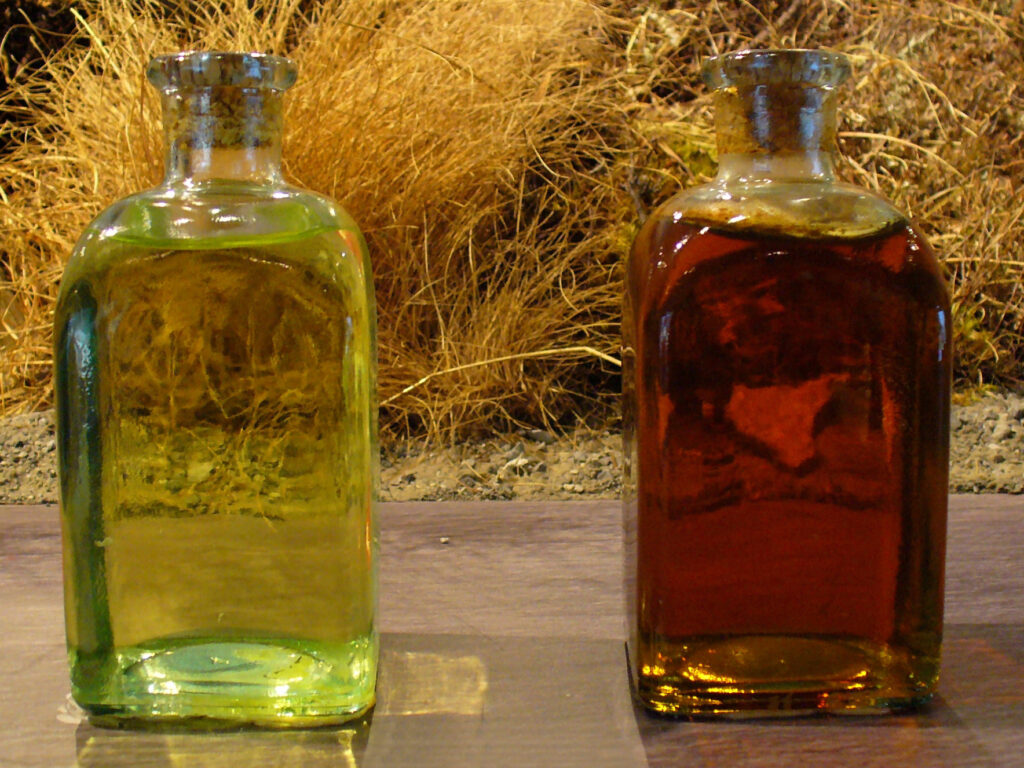
It is also reported that rendered Alpine marmot fat is still sought after as a folk remedy for arthritis. It is not taken internally but rubbed on sore joints.  

two glass containers of rendered marmot fat
Picture of rendered marmot fat. Credit: H. Zell, CC BY-SA 3.0

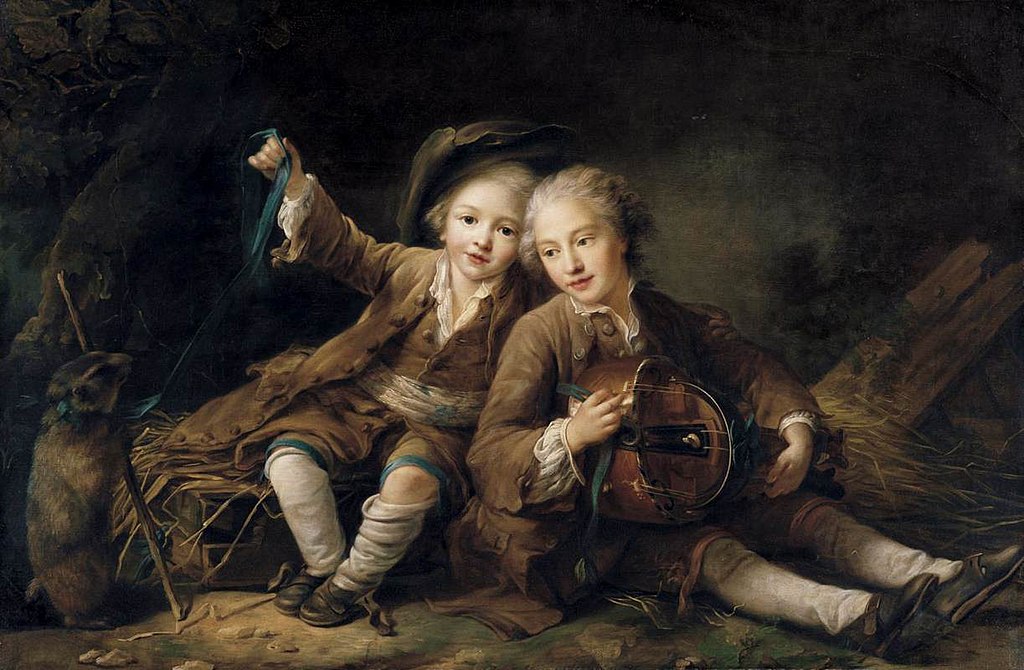
Perhaps the most surprising anecdote about the interaction of humans and the Alpine marmot is the use of the animal for entertainment, though not for weather forecasting like Punxsutawney Phil. Stories of a trained Alpine marmot on a leash, accompanying a “hurdy-gurdy man”, somewhat like the organ grinder and his monkey, date to at least the mid-1700s as evidenced by François Hubert Drouais’ painting Les Enfants d’ Ilustre Naissance. Here, two boys sit together, one playing the hurdy-gurdy, a stringed instrument, and the other holding a dancing marmot on a leash. The traveling entertainer carried his marmot from town to town in a box. If you’ve ever witnessed the belligerent behavior of a local groundhog you might find it hard to believe that any Pennsylvania groundhog, other than Punxsutawney Phil, would allow itself to be led around on a leash or kept in a box!

picture of the painting "The Children of the Duc de Bouillion" by Francois-Hubert Drouais
Credit: François-Hubert Drouais, Public domain PD-US, via Wikimedia Commons

Suzanne McLaren is Collection Manager of Mammals and John Wible is Curator of Mammals at Carnegie Museum of Natural History.

Related Content

Groundhog Day 2023

Groundhog Architecture

Groundhog Day 2020!

Carnegie Museum of Natural History Blog Citation Information

Blog author: McLaren, Suzanne; Wible, John
Publication date: February 2, 2024

Share this post!

  • Share on Twitter Share on Twitter
  • Share on Facebook Share on Facebook
  • Share on Pinterest Share on Pinterest
  • Share on LinkedIn Share on LinkedIn
  • Share on Reddit Share on Reddit
  • Share via Email Share via Email

Filed Under: Blog Tagged With: John Wible, mammals, Science News, Suzanne McLaren

January 24, 2024 by Erin Southerland

2023 Rector Christmas Bird Count Results

by Annie Lindsay
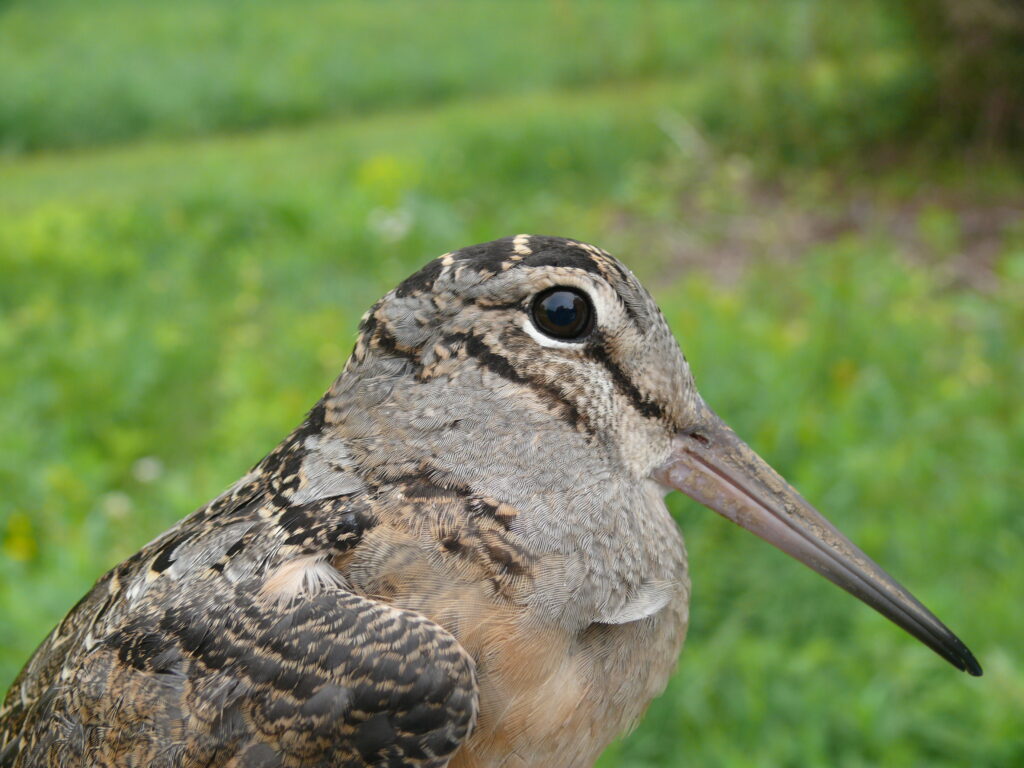
American Woodcock. Photo by Powdermill Avian Research Center.

For a few hours before dawn on the chilly morning of December 16, several intrepid birders scoured the Rector Christmas Bird Count circle for owls, and with a bit of luck, counted four species. Eastern Screech-Owl is a common, year-round resident and a respectable 14 individuals were heard calling that morning, in addition to one encounter each of Great Horned Owl, Barred Owl, and Northern Saw-whet Owl.

Once the sun rose that morning, the owlers were joined by many other birders to spend the day systematically searching for and tallying all the birds they could see and hear throughout the day. The Christmas Bird Count (CBC) is an annual citizen science tradition that began in 1900 with the goal of counting all the birds that participants encounter within an established 15-mile diameter circle on a selected day between December 14 and January 5. The Rector count, centered just northwest of Powdermill Nature Reserve, covers a variety of habitats and elevations spanning from the Chestnut Ridge to the Laurel Ridge, and has been going strong since 1974. Because of the diversity of habitats and the dedication of participants, Rector CBCers have totaled 132 species within the circle, including a new species added this year.

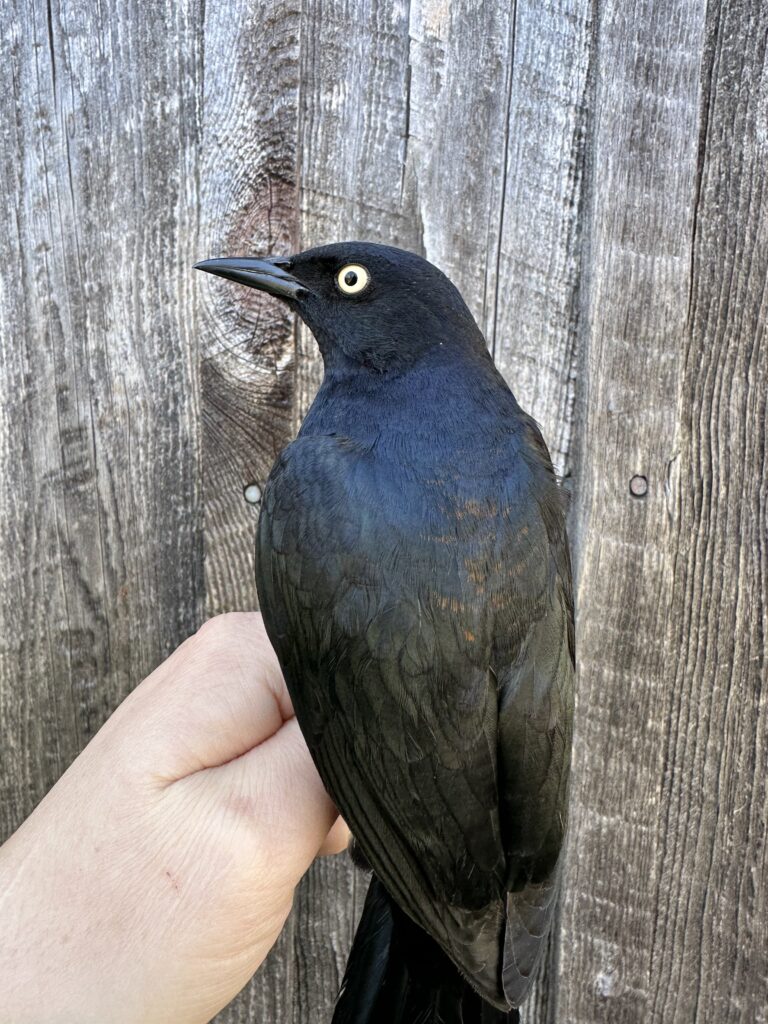
Rusty Blackbird. Photo by Powdermill Avian Research Center.

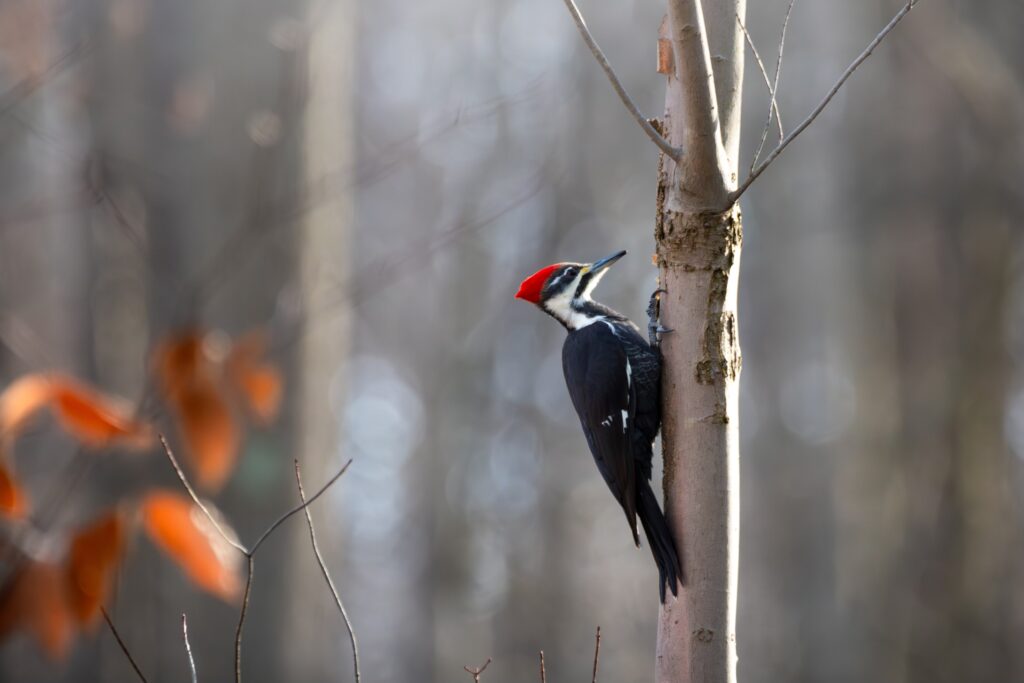
The Rector count circle is divided into sectors, and this year’s 43 participants fanned out to cover as much territory as they could within their assigned sectors, some opting to hike trails in the state parks and forest, some traveling the roads by car, stopping periodically to listen and watch, and eight birders counted the species they saw visiting their feeders and yards. At the end of the day, everyone gathered at Powdermill for the tally dinner, an evening to chat about the day’s events, share a delicious meal, and to add up the birds each group counted. This year’s total was above average with 6,131 individuals of 76 species tallied, surpassed in recent years only by 2021, a year with unseasonably warm temperatures extending quite late into the fall that garnered several species not normally expected to persist into December. Many species set new high-count records this year, including Canada Goose, Black Vulture, Red-tailed Hawk, American Woodcock, Red-bellied Woodpecker, Yellow-bellied Sapsucker, Hairy Woodpecker, Pileated Woodpecker, Carolina Wren, Eastern Bluebird, Northern Mockingbird, and Red-winged Blackbird. Although some of these high counts likely can be attributed to increased effort and number of participants, almost all of these species seem to be expanding their ranges northward, or are occurring in southwestern Pennsylvania in greater numbers, often year-round, a trend ornithologists have been noticing in recent years.

Pileated Woodpecker. Photo by Alex Busato.

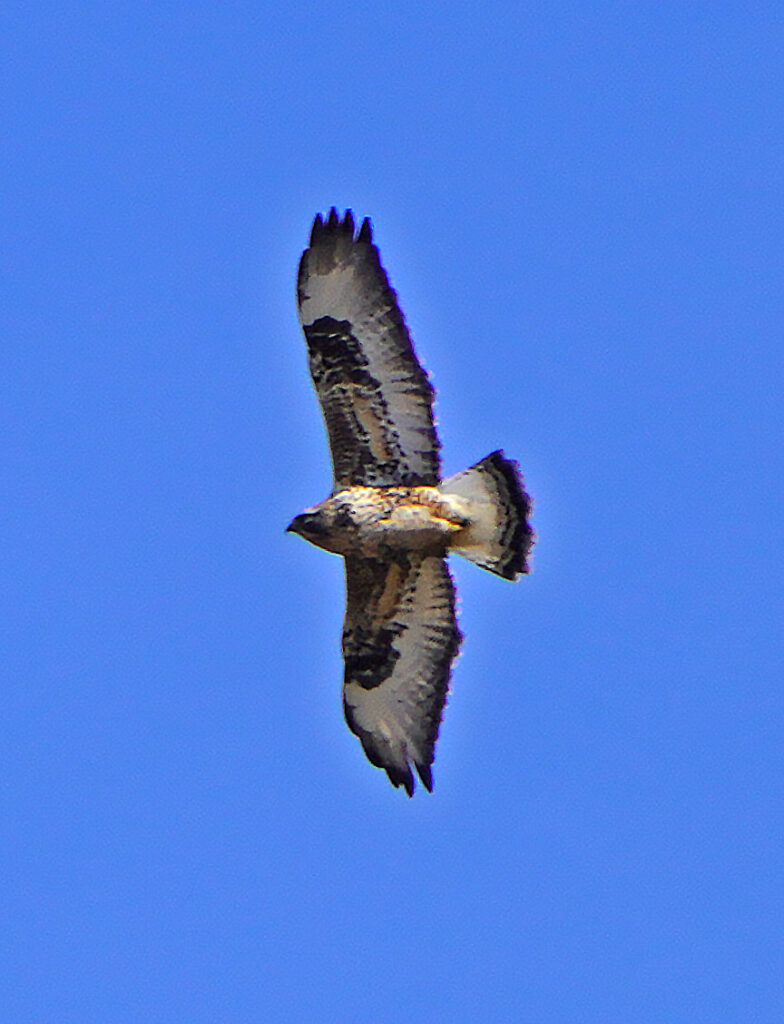
Excitement is always high at the tally, and this year was no exception. Highlights of the count were plentiful as participants shared photos and stories about their birds-of-the-day. One group found two Ruby-crowned Kinglets (nearly matching the count’s high total of three set in 2021) and a massive flock of 915 Canada Geese, which was the bulk of the day’s record-setting total. Another group found an Eastern Phoebe, a species recorded only twice before on the Rector CBC, perched in a tree pumping its tail up and down. Three participants photographed a Rough-legged Hawk, a species uncommon enough that they knew they would have to “prove” their identification, soaring over farm fields while driving to get lunch. And another group reported a flock of 150 Red-winged and 20 Rusty Blackbirds, setting a record for Red-wingeds and the highest count of Rusties since the mid-1990s. They also spotted an American Woodcock, a new species for the count, doing its bobbing walk in a wet spot along a road. 

Rough-legged Hawk. Photo by Mark McConaughy.

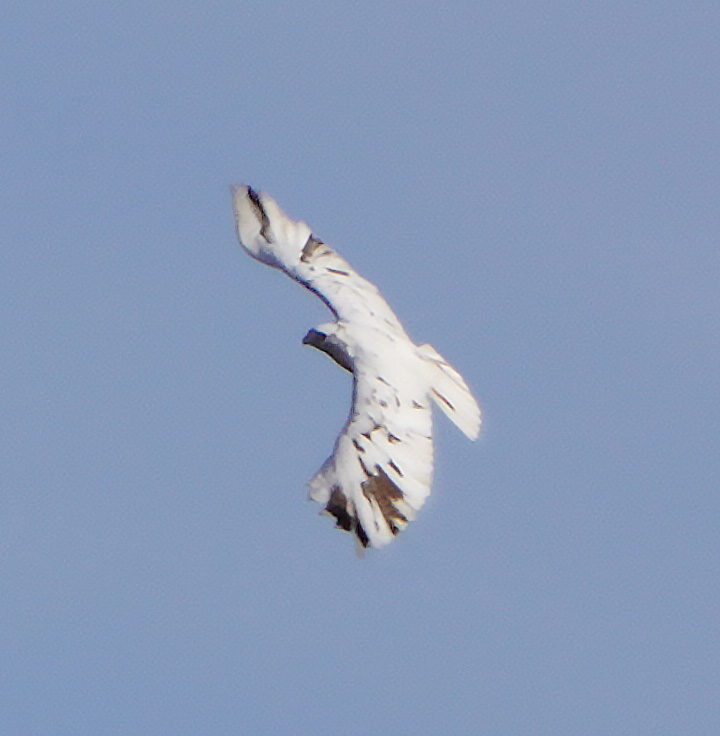
One more notable finding of the day was three leucistic Red-tailed Hawks. At least one had been spotted at the edges of fields near Powdermill for much of 2023, but on the day of the count, two different birds, with varying amounts of white, were spotted and photographed in those fields, and a third was spotted many miles to the northwest in a different sector. The word “leucistic” refers to lack of pigment, and these leucistic birds have one or, in the case of these particular hawks, many white feathers. Finding one leucistic bird is uncommon, but three relatively large birds showing this same coloration is quite rare.

Leucistic Red-tailed Hawk. Photo by Mark McConaughy.

As we wrap up the 124th Christmas Bird Count season and submit the Rector count’s data to the National Audubon Society, we thank all participants for their commitment to the birds and look forward to next year’s count!

For more information about the Christmas Bird Count and to see how the data are used, please visit: https://www.audubon.org/conservation/science/christmas-bird-count

Final 2023 Tally:

*Canada Goose – 1009

Mute Swan – 4

Tundra Swan – 1

Wood Duck – 1

American Black Duck – 13

Mallard – 74

Bufflehead – 2

Hooded Merganser – 11

Common Merganser – 3

Ruddy Duck – 6

Ring-necked Pheasant – 7

Wild Turkey – 14

Pied Billed Grebe – 6

*Black Vulture – 55

Turkey Vulture – 80

Northern Harrier – 1

Sharp-shinned Hawk – 1

Cooper’s Hawk – 2

Black Eagle – 2

Red-shouldered Hawk – 9

*Red-tailed Hawk – 66

Rough-legged Hawk – 1

Killdeer – 3

*American Woodcock – 1

Rock Pigeon – 37

Mourning Dove – 90

Eastern Screech-Owl – 14

Great Horned Owl – 1

Barred Owl – 1

Northern Saw-whet Owl – 1

Belted Kingfisher – 8

Red-headed Woodpecker – 6

*Red-bellied Woodpecker – 102

*Yellow-bellied Sapsucker – 16

Downy Woodpecker – 66

*Hairy Woodpecker – 28

Northern Flicker – 17

*Pileated Woodpecker – 38

American Kestrel – 2

Eastern Phoebe – 1

Blue Jay – 287

American Crow – 764

Common Raven – 25

Carolina Chickadee – 1

Black-capped Chickadee – 311

Tufted Titmouse – 212

Red-breasted Nuthatch – 7

White-breasted Nuthatch – 144

Brown Creeper – 8

Winter Wren – 3

*Carolina Wren – 86

Golden-crowned Kinglet – 60

Ruby-crowned Kinglet – 2

*Eastern Bluebird – 191

Hermit Thrush – 5

American Robin – 85

*Northern Mockingbird – 19

European Starling – 794

Cedar Waxwing – 45

Yellow-rumped Warbler – 7

American Tree Sparrow – 7

Field Sparrow – 5

Fox Sparrow – 1

Dark-eyed Junco – 411

White-throated Sparrow – 105

Song Sparrow – 117

Swamp Sparrow – 12

Eastern Towhee – 3

Northern Cardinal – 168

*Red-winged Blackbird – 151

Rusty Blackbird – 20

House Finch – 110

Purple Finch – 1

American Goldfinch – 90

House Sparrow – 61

Total Species: 76

Total Individuals: 6,131

*asterisk indicates high total for count

Annie Lindsay is Banding Program Manager at Powdermill Nature Reserve, Carnegie Museum of Natural History’s environmental research center.

Related Content

A Year in Review: Bird Banding 2023

What is Bird Banding?

Bird Banding with a Crew of One

Carnegie Museum of Natural History Blog Citation Information

Blog author: Lindsay, Annie
Publication date: January 24, 2024

Share this post!

  • Share on Twitter Share on Twitter
  • Share on Facebook Share on Facebook
  • Share on Pinterest Share on Pinterest
  • Share on LinkedIn Share on LinkedIn
  • Share on Reddit Share on Reddit
  • Share via Email Share via Email

Filed Under: Blog Tagged With: Annie Lindsay, Birds, Powdermill Nature Reserve, Science News

January 16, 2024 by Erin Southerland

Collected On This Day: Witch Hazel, January 1923

by Mason Heberling
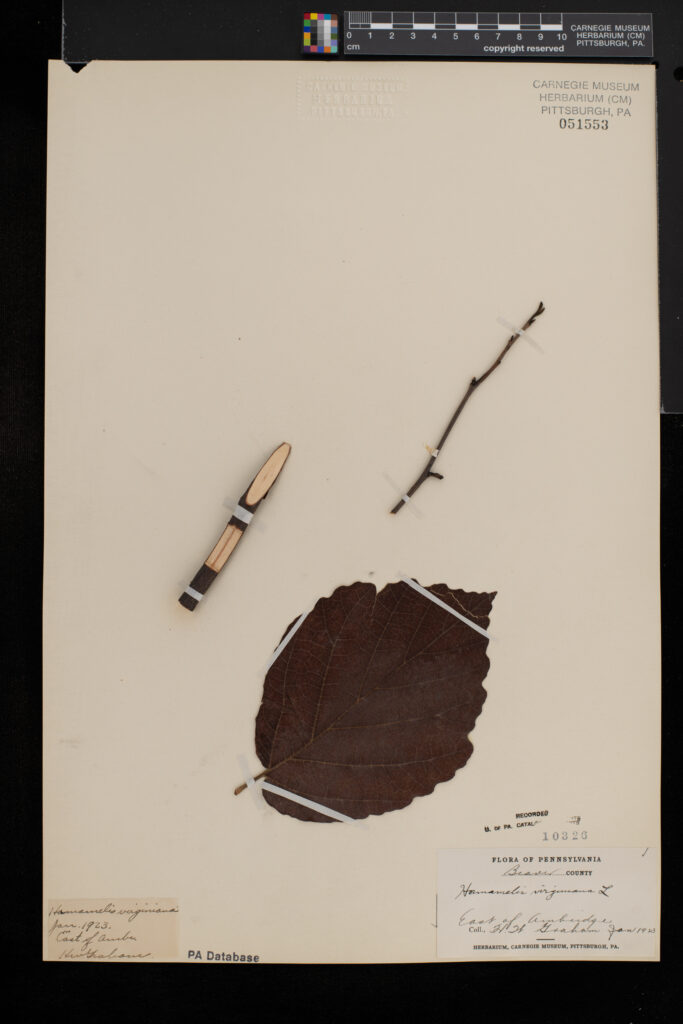
witch hazel branch, buds, and leaf on an herbarium sheet

This specimen of common witch hazel (Hamamelis virginiana) was collected in January 1923 in Beaver County, Pennsylvania “East of Ambridge” by H.W. Graham.  Herbert W. Graham (1905-2009) was an “Assistant” in Botany at the Carnegie Museum from 1925-1929 while he was a student at the University of Pittsburgh who later became an oceanographer at the Woods Hole Oceanographic Institution. During his time at the museum, he collected many specimens, often with his brother, Edward H. Graham, who was also an Assistant in Botany, later curator (1931-1937) and later, a well-known conservationist with the US Department of Agriculture.  The Graham brothers went on expeditions to the Sonoran Desert in the late 1920s, collecting specimens and information that was used to create the desert diorama that remains in the museum’s Hall of Botany today.

This specimen has a “bits and pieces” feel to it, but shows what the plant looks like in winter, with branches, buds, a leaf, and even including a nice cross section cut out of the stem. The leaf is in great shape, which makes me question whether the leaf was truly was collected in January, when the leaves are usually dry and crumbled from the wrath of winter. 

The specimen was simply collected in “January 1923” with no note on the day of year.  I feel that coming off a holiday break (what day is it?).  But more seriously, it reminds us that many specimens of the past were collected for different purposes with many of their uses today unanticipated.  For instance, collectors today would certainly record the calendar date of collection, valued just as much as information on the location it was collected, as scientists routinely use specimens to date information to understand the seasonal timing of leafing, flowering, and fruiting with changing environmental conditions over time.

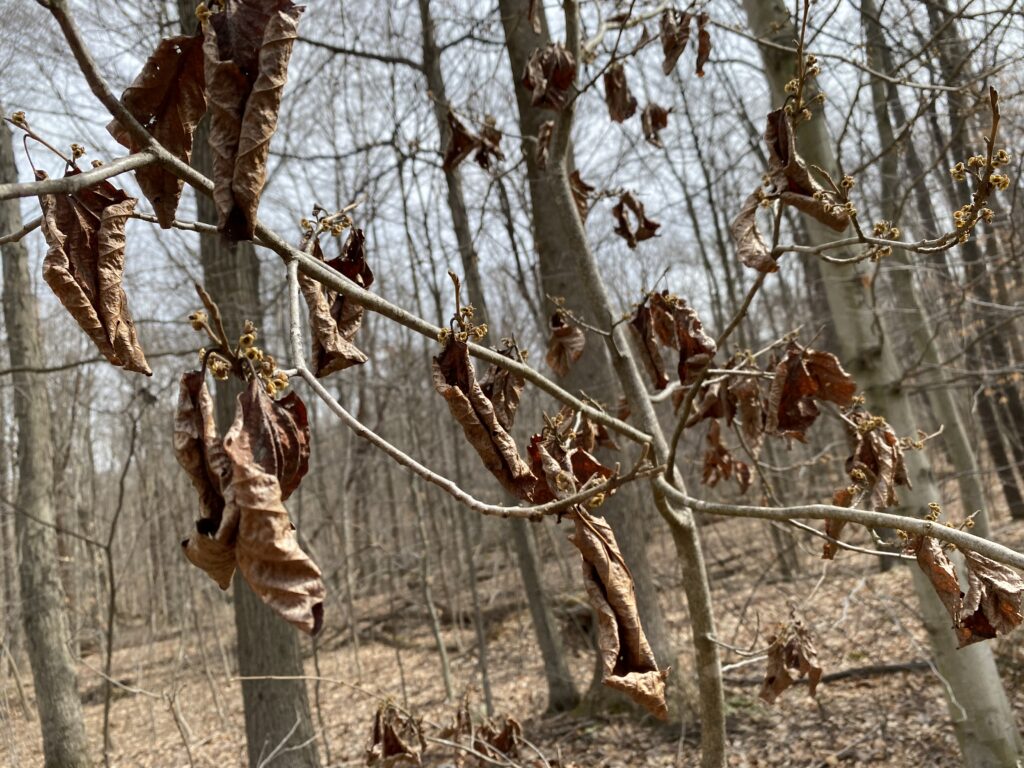
brown, dry leaves hanging from branches

The leaf is a nice touch, too.  It indicates that at least some leaves were still around in the winter of 1923, and it is quite possible they were even still connected to the stem.  Though this species is deciduous (drops its leaves seasonally), common witch hazel has been known to sometimes hang onto some dead leaves on branches through winter.  This phenomenon is known as “marcescence.”  Why this happens isn’t fully known.  Read more here.

You can find this specimen and 588 others of the species in the Carnegie Museum herbarium here.

Above: Witch hazel exhibiting marcescence, with last year’s leaves still attached in early spring (photo taken March 23 2021 at Powdermill Nature Reserve)

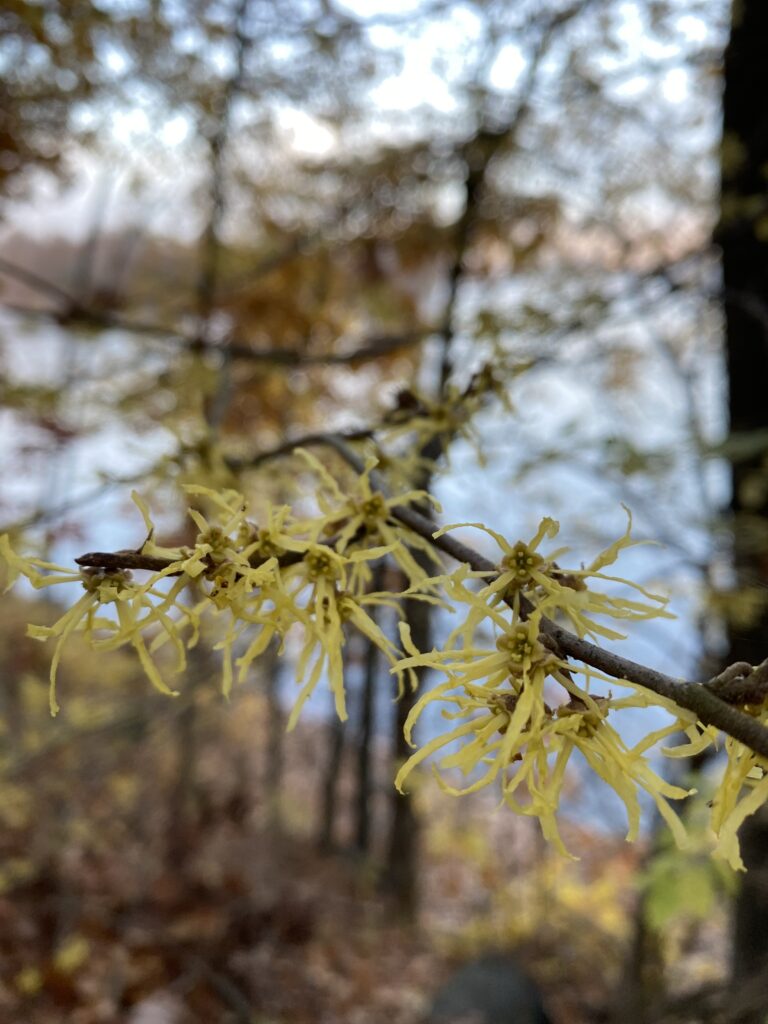
Below: Witch hazel’s magnificent autumn blooms. Unlike many woody plants in our region that bloom in spring as leaves are emerging, this species blooms in fall, as its leaves are dropping! (Photo taken October 29 2022 in New Kensington, PA.)

witch hazel blooms

Mason Heberling is Associate Curator of Botany at Carnegie Museum of Natural History.

Related Content

Witch Hazel Collected on Halloween in 1931

Collected On This Day in 1951: Bittersweet

What’s in a Name? Japanese Knotweed or Itadori

Carnegie Museum of Natural History Blog Citation Information

Blog author: Heberling, Mason
Publication date: January 16, 2024

Share this post!

  • Share on Twitter Share on Twitter
  • Share on Facebook Share on Facebook
  • Share on Pinterest Share on Pinterest
  • Share on LinkedIn Share on LinkedIn
  • Share on Reddit Share on Reddit
  • Share via Email Share via Email

Filed Under: Blog Tagged With: Botany, collected on this day, Hall of Botany, Mason Heberling, Science News

January 9, 2024 by Erin Southerland

Oysters Swim Towards a Siren Soundscape

by Sabrina Spiher Robinson

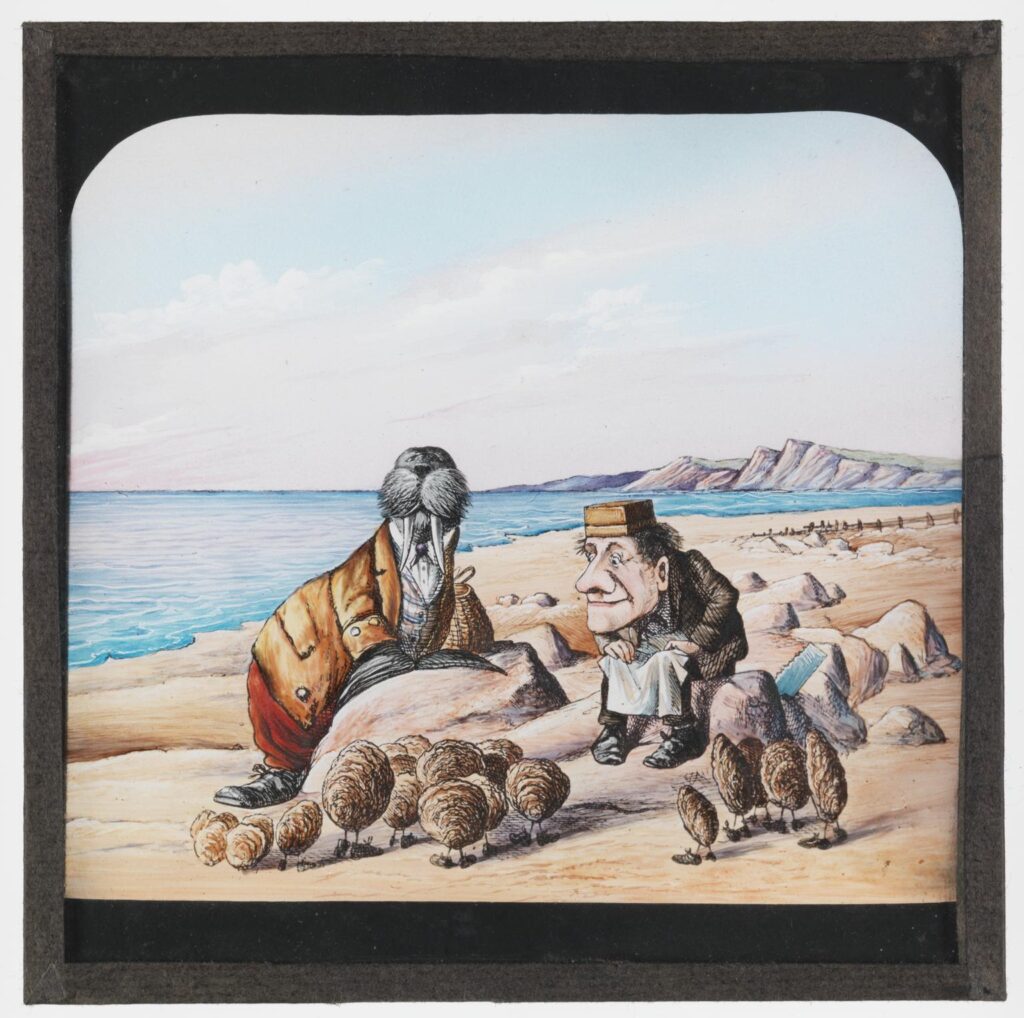
illustration of a walrus and a person on a beach looking at oysters with feet
Illustration by Sir John Tenniel. Creative Commons Attribution-NonCommercial-ShareAlike 4.0 License.¹

“’O Oysters, come and walk with us!’

The Walrus did beseech.

‘A pleasant walk, a pleasant talk,

Along the briny beach:

We cannot do with more than four,

To give a hand to each …

Four other Oysters followed them,

And yet another four;

And thick and fast they came at last,

And more, and more, and more—

All hopping through the frothy waves,

And scrambling to the shore …

‘O Oysters,’ said the Carpenter,

‘You’ve had a pleasant run!

Shall we be trotting home again?’

But answer came there none—

And this was scarcely odd, because

They’d eaten every one.”

In 1872, Lewis Carroll included the poem “The Walrus and the Carpenter” in his classic book Through the Looking Glass.  The Walrus calls out to the oysters to join him and the Carpenter on a walk along the seashore; the young oysters don’t know any better and come to join him. Eventually, all the oysters are eaten up.  But can one really sing a siren song to make an oyster come to them? An informed answer to this question requires some background knowledge information about an underappreciated form of wildlife.

oyster shells on cultch in a box
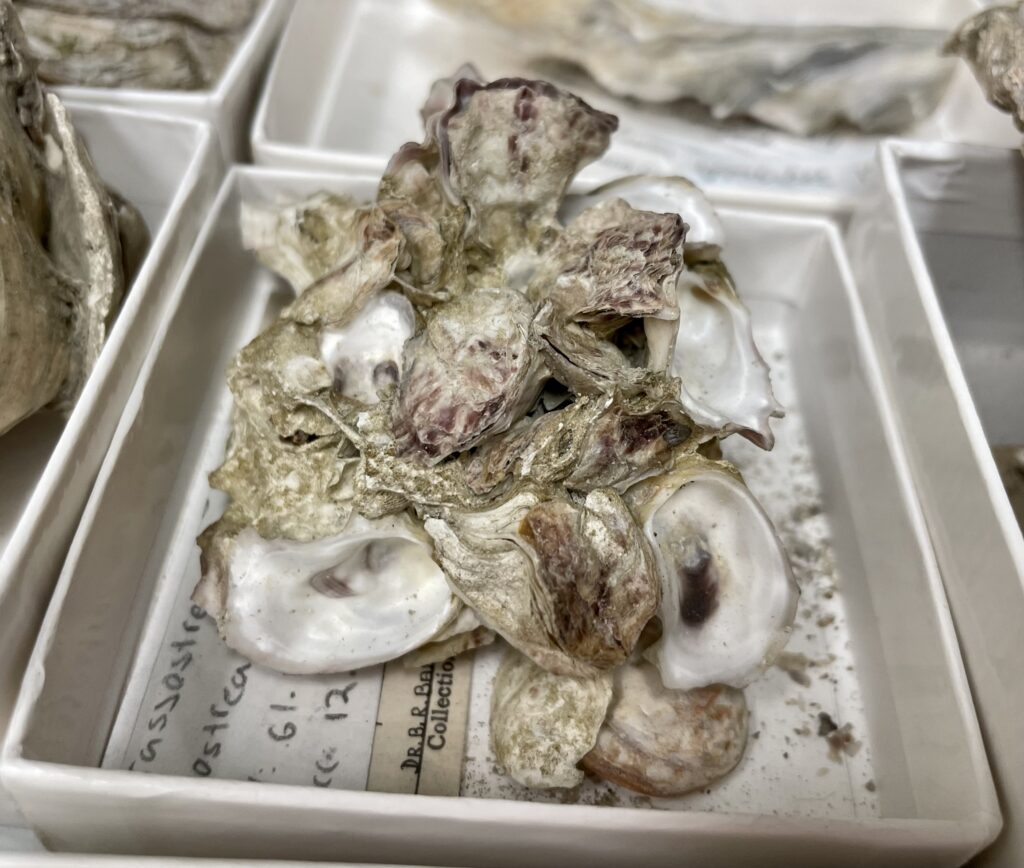
The favored subsurface described as “cultch” is depicted in this cluster of oyster shells of the species Crassostrea virginica.

Oysters live in reefs, submerged ridges or mounds of stable material, and baby oysters prefer to settle on a base — called “cultch” — of old oyster shells. Where conditions are favorable, oysters have plenty of company. When a team of researchers investigated the diversity of oyster reefs in the Gulf of Mexico, they detailed the incredible number of creatures that live on the reefs where oysters form: 115 species of fish and 41 species of crustaceans made the Gulf oyster reefs their homes, at very high densities and in communities containing up to 52 species at a time.  Other researchers have documented multiple corals, mollusks, and worms that live primarily on oyster reefs. Unfortunately, erosion from coastal development, wetland destruction, unsustainable harvesting, and pollution have decimated populations of the Atlantic coast’s native oyster, Crassostrea virginica, which is bad news for coastal marine habitats in general.²

The importance of oyster reefs as marine habitats for multiple species is only one reason to preserve and reconstruct them.  Oysters, as filter-feeding animals, provide an incredible service to the water quality of the estuaries they inhabit.  They are also, of course, an important food source along America’s east coast.

The complications of rebuilding and repopulating oyster reefs are many.  Pollution must be reduced, especially the run-off of agricultural fertilizers.  Such fertilizers “enrich” underwater environments in a process called eutrophication.

Eutrophication causes massive blooms of algae that set off a chain of events  disastrous for bodies of water and their inhabitants: the algae can release toxins on its own, but most commonly it overwhelms host ecosystems by blocking sunlight and killing all of the other plants in the water. Eventually the algae die too, and as all these dead plants decay, eaten away by multiplying bacteria that use up what little oxygen is left, dead zones form that suffocate underwater animals.  This decay also lowers the pH of the water, leading to acidification that harms and kills animals (especially mollusks, whose shells dissolve in a very acidic environment).  Additionally, if sediment erosion is not  reduced, these water-borne materials eventually bury and suffocate oysters.  

Oyster bed substrates that have been destroyed by human construction or aggressive commercial dredging can  be replaced with cultch that is attractive to baby oysters.  However, baby oysters must be recruited to the rebuilt reefs, either from the natural population of oyster larvae, or from hatchery-grown larvae reintroduced to the environment.

So, how to attract a baby oyster to your newly constructed oyster reef?  First, let’s consider the life cycle of C. virginica, and the critical importance of age range in young oyster populations.  In the first year of their adult lives, oysters are male. At certain times of the year, in response to pheromonal cues from their fellow oysters on the reef, they release clouds of billions of sperms. Older oysters on the reef, creatures transitioned into females after a year or two of life, release millions of eggs into these clouds of sperm. About two days after an egg is fertilized, the oyster larvae have become what are called veligers, and they begin to feed on particles in the water and to seek a place to call home.  During this time, they develop a foot, and once they arrive on some promising substrate, they can crawl around, looking for just the right spot.  At this point they are called spat.  Soon the spat lose their feet and cement themselves to the spot they will call home for the rest of their lives, which can be more than a dozen years in the wild.

small boxes of oyster shells
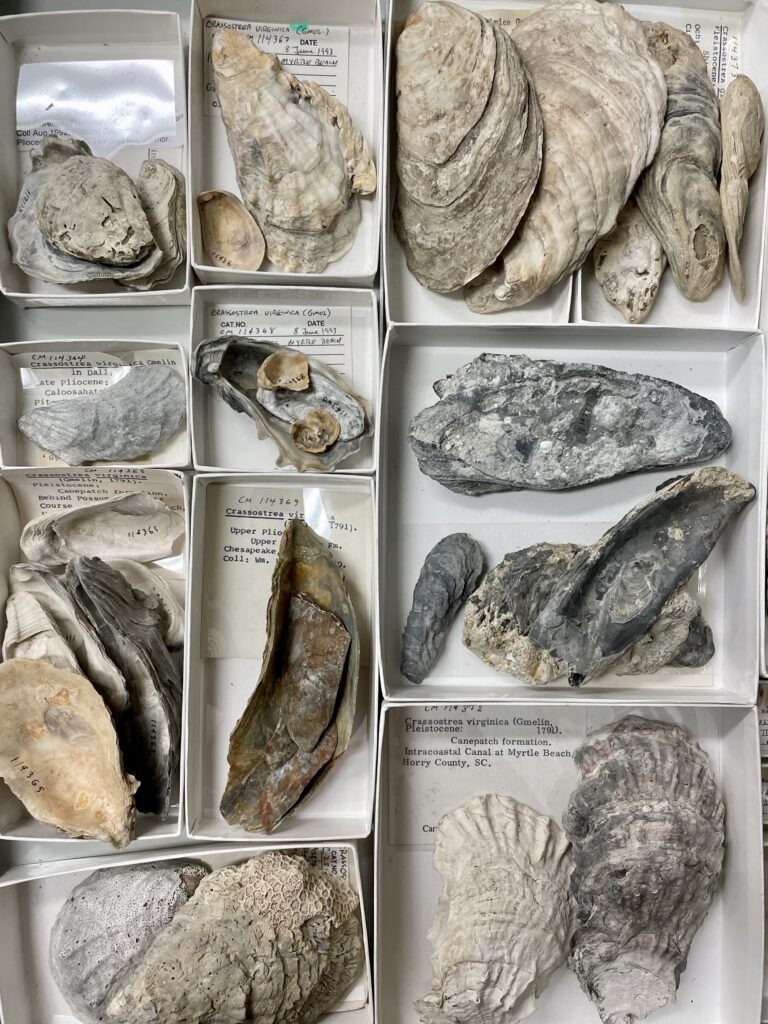
Crassostrea virginica, from the CMNH collection, multiple shells that look completely different, but represent a single species. Epicures report taste differences  according to where exactly each oyster lived.

It was long unknown how much choice an oyster veliger had in determining where it landed.  Until the 1990s scientists thought that baby oysters had very little control over their movement in the water. In 2022, Australian scientists studying the Australian flat oyster, Ostrea angasi, proved that oyster veligers could very deliberately move to get to a surface they preferred to make their permanent home on.³

How this discovery occurred is of particular interest. The Australian researchers were testing the effects of soundscapes on oyster larvae, following experiments conducted in America in Pamlico Sound in North Carolina.  Soundscapes are the collective sounds of a given environment: all the noises of human and non-human animal activity, along with environmental sounds of wind and water and precipitation.  In 2014, researchers in North Carolina were experimenting with ways to attract oyster larvae to their newly built conservation reefs. They discovered that by recording the soundscape of a healthy oyster reef and playing it in the water, they attracted a much higher number of spat on experimental tiles near the recordings.  Apparently, the baby oysters heard the sound of a healthy oyster reef and headed towards it to make their homes.⁴

How do oysters hear? Humans and other land animals hear through a system of air compression.  Sound waves compress air in certain patterns, and tiny hairs within our ears translate those compressions into electrical signals that are then sent to the brain for further interpretation as sound.  Underwater, animals hear through particle vibration: sound waves vibrate from particle to particle in the denser medium of water, where the particles are in direct contact with one another, even the water contained in the bodies of fish and invertebrates. Underwater animals have sensing structures that translate these vibrations into electrical signals that the animal then interprets in some way.⁵

Following up on the work of the North Carolina scientists, the Australian scientists confirmed in lab studies using underwater speakers in a completely currentless body of water, that oyster larvae were deliberately swimming towards the sounds of a healthy reef to settle.  When they tried this technique on human-made conservation reefs, oyster recruitment increased on the artificial cultch — an important finding, since if baby oysters don’t find the newly deployed conservation reefs quickly, the reefs become covered in algae, making it very difficult for oyster spat to attach to them.⁶

And so, recording and replaying the soundscape of a healthy oyster reef — populated by snapping shrimp, oyster toadfish, and many other creatures that call a healthy oyster reef home — can help with the recruitment of baby oysters to human-made reefs for the purposes of conserving and growing the endangered population of C. virginica.  Not only can oyster larvae “hear,” they can — and will — very deliberately swim toward the sounds of a healthy reef.  And truly, who amongst us could deny the siren song of the snapping shrimp and the oyster toadfish?

Listen:

Coastal Conservatory

Center for Marine Sciences and Technology (CMAST)

Sabrina Spiher Robinson is Collection Assistant for the Section of Mollusks at Carnegie Museum of Natural History.

Notes:

  1. Science Museum Group. Magic lantern slide depicting Alice’s Adventures in Wonderland, Walrus, Carpenter and Baby Oysters. 1951-316/11Science Museum Group Collection Online. Accessed 9 January 2024. https://collection.sciencemuseumgroup.org.uk/objects/co8362656/magic-lantern-slide-depicting-alices-adventures-in-wonderland-walrus-carpenter-and-baby-oysters-lantern-slide.
  2. La Peyre Megan K., Aguilar Marshall Danielle, Miller Lindsay S., Humphries Austin T. Oyster Reefs in Northern Gulf of Mexico Estuaries Harbor Diverse Fish and Decapod Crustacean Assemblages: A Meta-Synthesis  Frontiers in Marine Science, Vol. 6, 2019 https://www.frontiersin.org/articles/10.3389/fmars.2019.00666
  3. Williams, B. R., McAfee, D. & Connell, S. D. Oyster larvae swim along gradients of sound. Journal of Applied Ecology, Vol 59, 2002, pp. 1815–1824 https://besjournals.onlinelibrary.wiley.com/doi/full/10.1111/1365-2664.14188
  4. Ashlee Lillis, David B. Eggleston, DelWayne R. Bohnenstiehl Oyster Larvae Settle in Response to Habitat-Associated Underwater Sounds PLOS ONE 9(1). October 30, 2013 https://journals.plos.org/plosone/article?id=10.1371/journal.pone.0079337#amendment-0
  5. Nedelec, S.L., Campbell, J., Radford, A.N., Simpson, S.D. and Merchant, N.D. Particle motion: the missing link in underwater acoustic ecology. Methods Ecol Evol vol 7, 2016, pp. 836-842 https://besjournals.onlinelibrary.wiley.com/doi/full/10.1111/2041-210X.12544
  6. McAfee, D., Williams, B. R., McLeod, L., Reuter, A., Wheaton, Z., & Connell, S. D. Soundscape enrichment enhances recruitment and habitat building on new oyster reef restorations. Journal of Applied Ecology, vol. 60, 2023, pp.111–120 https://besjournals.onlinelibrary.wiley.com/doi/10.1111/1365-2664.14307

Related Content

Shark-ish Beasts Versus Cephalopods: Which Is Predator, Which Is Prey, and Is One an Artist?

Prozac and Caffeine in Our Wastewater: Effect on Freshwater Mollusks

Can Snails Feel Love?

Carnegie Museum of Natural History Blog Citation Information

Blog author: Robinson, Sabrina Spiher
Publication date: January 9, 2024

Share this post!

  • Share on Twitter Share on Twitter
  • Share on Facebook Share on Facebook
  • Share on Pinterest Share on Pinterest
  • Share on LinkedIn Share on LinkedIn
  • Share on Reddit Share on Reddit
  • Share via Email Share via Email

Filed Under: Blog Tagged With: mollusks, Sabrina Spiher Robinson, Science News, Section of Mollusks, Spotlight on Science, Spotlight on Science Mollusks, Tim Pearce

December 29, 2023 by Erin Southerland

Happy Retirement, Pat McShea!

If you’ve read our blog before today, you have almost certainly encountered the work of Museum Educator Pat McShea. Pat has written more than 125 blog posts over the past seven years and in 2020 took on the role of editor. Pat is retiring today, and we couldn’t think of a more fitting tribute than a blog post. His work has only changed our blog for the better and we are so grateful for all the time and effort he has put in over the years. 

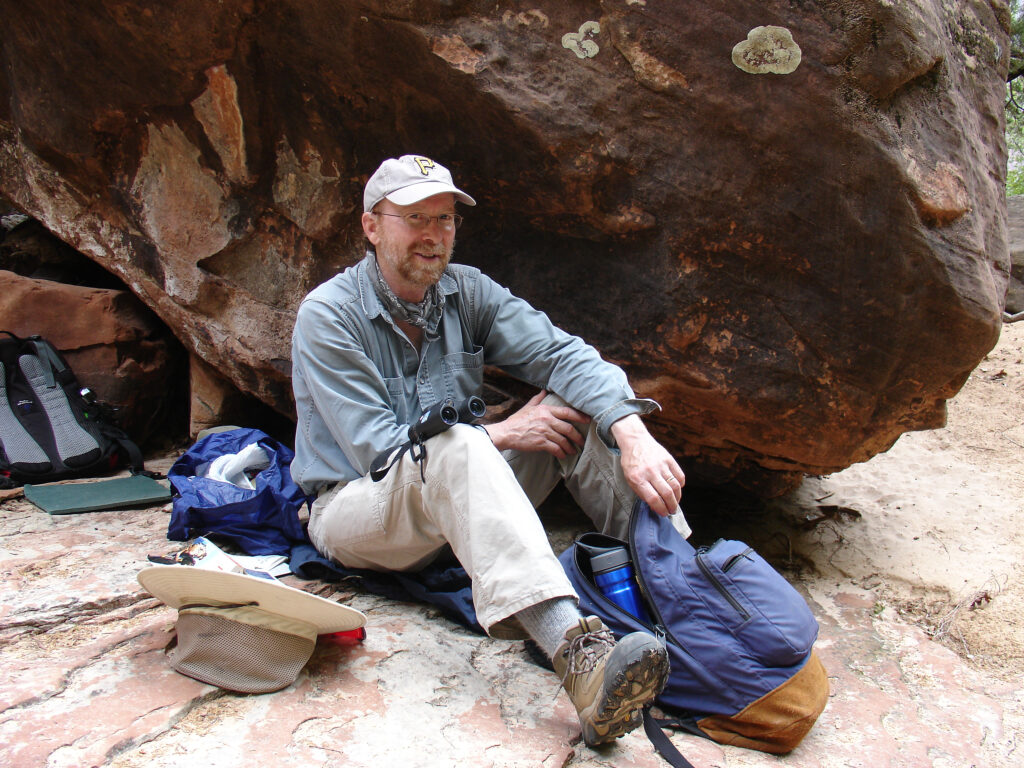
Pat McShea sitting next to a boulder with binoculars on his lap and hiking gear (backpack, hat, jacket) scattered around him.
Zion National Park, 2013.

The earliest post tagged with Pat’s name was published in February 2016 and is called Blue Fleece Jacket. It links field work to life in Pittsburgh with a piece of clothing – a blue fleece jacket. And that’s fitting because one of Pat’s great skills is connecting. Whether it’s scientific topics, people, or random ideas, if there’s a relevant connection, Pat can find it and will share it. 

But Pat has done so much more than write for and edit this blog. His primary role is as Program Officer for the Learning Collection (known for many years as the Educator Loan Collection). He was hired in 1985 as a part-time assistant for the Learning Collection and shortly thereafter as part-time gift shop staff. He took over full-time management of the Learning Collection in 1986. He has loaned items to thousands of teachers, librarians, naturalists, park rangers, artists, and home school parents over the years, and in the process has created lasting relationships while giving learners who might never make it to the museum the opportunity to engage with natural history. 

Pat and his wife Amy Henrici, Collection Manager of Vertebrate Paleontology, are retiring and the museum won’t be the same without them. They are both kind, generous with their time and knowledge, and always a joy to talk to. We will miss them!  

Memories and Stories 

Pat has made a significant impact on the museum community and beyond. When asked the best advice he can share with his education colleagues, he quoted poet and author Mary Oliver: “Pay attention.” And it’s clear from the stories collected below that when Pat is around, people pay attention. Please note, there are many, many people who could contribute here; this is a small sampling of Pat’s impact. 

“Pat has always guided students of all ages (myself included) to observe the traits and behaviors of plants and animals first; then later discover their names. In the fast-paced world of “what is this/that?” Pat shows us that if we slow down and focus our attention, we will begin to discover the amazing intricate details of our natural world and be better suited to tell stories about what we observe.” -Joe Stavish, Director of Education at Tree Pittsburgh (former senior environmental educator at Powdermill Nature Reserve) 

“I met Pat in the winter of 1984-85 [I think] through a mutual friend, relying on his outdoor expertise to buy my first cross country skis at a shop in Shadyside where he worked. I hired him in October 1985 to be my part time assistant in the Educator Loan Collection – mostly moving all the heavy cases around for me. So I was his first supervisor, but also his last(!), because he was hired full-time as head of the collection when I decided not to return from maternity leave in May 1986. 

My son Paul felt like he grew up at the museum as I worked on various freelance projects there, due largely because Pat always made time to share with him interesting info and the occasional cast-off from the collection. Coming full circle, when Paul was a high school senior, Pat took him on and mentored him for a weeks-long senior project.  

Always kind, always the educator, always radiating gentle humor – that’s Pat McShea!” – Laura Beattie, Program Specialist for The Leonard S. Mudge Environmental Education Program, 1981-1985, then Program Specialist for the Educational Loan Collection 1985-1986, freelancer for the museum from 1986-1996 

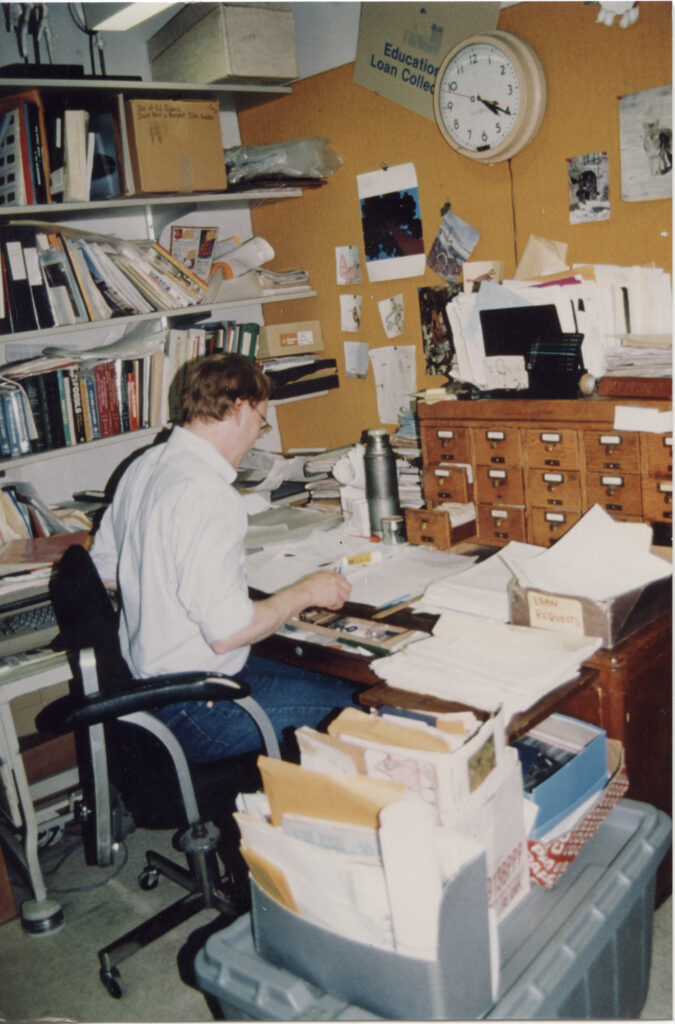
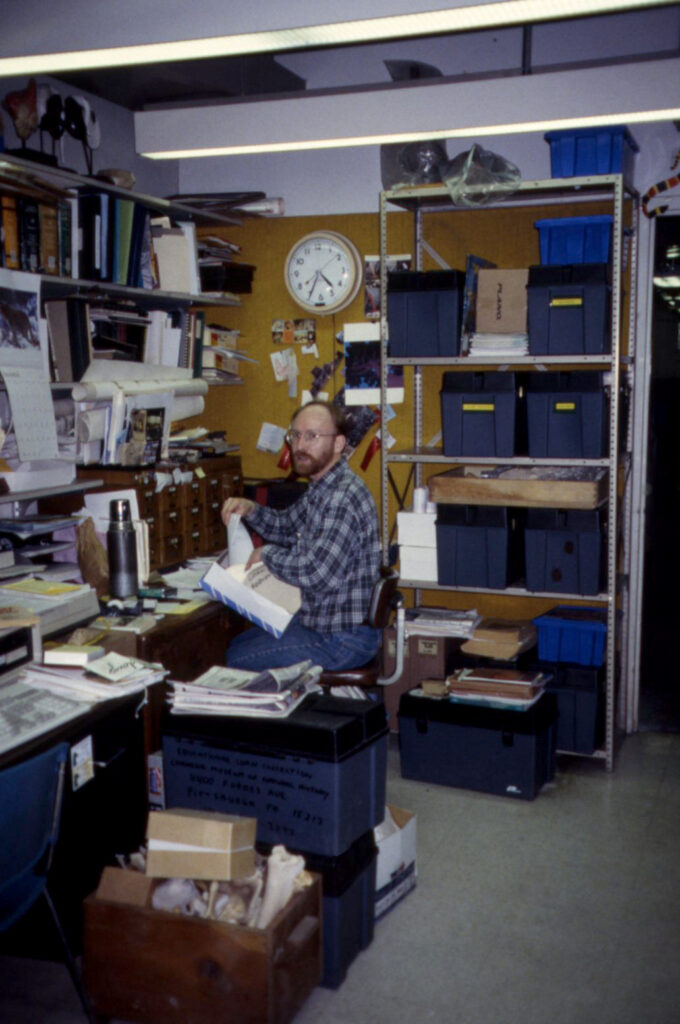
Pat McShea working at a desk
In the Learning Collection office.

“One of the most enduring lessons that Pat has shared with us is to be more curious and less afraid. This wisdom came to light secondhand from a 5-year-old summer camper who, in an end-of-camp reflection, was asked by their camp instructor what was most memorable about their time at camp. They said it was the day that Mr. Pat came to teach about bees, and explained that when he is afraid of something it makes him feel better to ask questions about it. During the camp visit, Pat spoke to a common concern that prevents many people from looking more closely at insects: fear. By making space to talk about feelings, then inviting all kinds of questions, Pat helped all of the campers learn something new. As a colleague, Pat models curiosity in the face of scary subject matter all the time. It’s been essential for the projects on climate change education that he’s worked on over the last 15 years. During the Covid-19 pandemic, this philosophy was essential. Even as we planned for his retirement, Pat has provided reassuring answers to our many questions about how to manage the Learning Collection – most importantly that the curiosity of the educators and students has always pointed the way and will continue to do so.” – Laurie Giarratani, Director of Learning and Community 

“I think ALL of the time about the lasting impact that Pat had on both young learners and adult staff when he encouraged a group of 5-year-old summer campers who were expressing some fear and anxiety about bees to lean into curiosity when they find themselves scared of something (because when you ask questions and learn more, it’s usually going to calm your fears).  That moment (maybe 5 years ago now?!) was the genesis of the ongoing summer camp mantra of “more curious = less afraid.” -Breann Thompson, Associate Director, Learning and Community Programs  

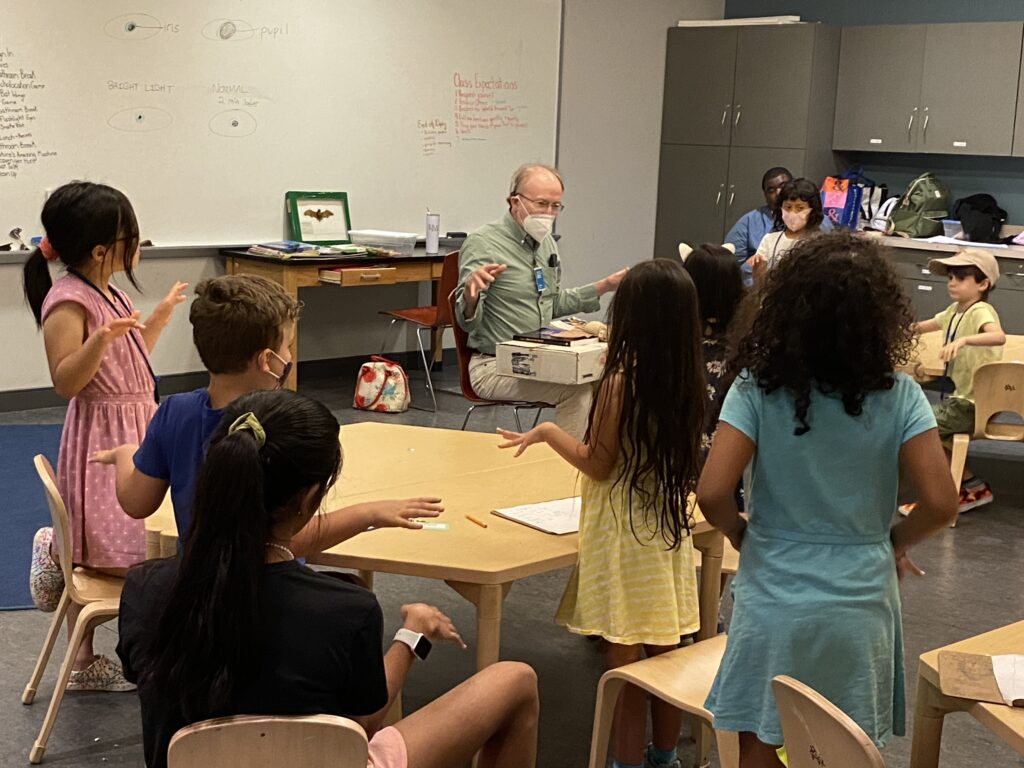
Pat McShea presenting to a group of kids in a classroom
Pat McShea teaching a group of summer campers about bats.

“One of Pat’s talents that made him so successful in his job is his ability to absorb information quickly. When I was getting my Master’s in Geology at the University of Pittsburgh, Pat would help me study for tests by quizzing me. I can still remember him asking me for the eight or so characteristics of deep-sea sediments. As I was slowly trying to come up with the list, I realized that Pat didn’t have to check my notes to see if I was correct, because he already had memorized the information ahead of me. Pat thus acquired considerable knowledge about geology while helping me study for tests.” – Amy Henrici, Collection Manager of Vertebrate Paleontology (and Pat’s wife) 

“Pat is a naturalist poet who reminds us that every hike promises revelations around every corner, as long as we’re patient and observant. After encountering Pat’s words and work, you don’t look at the world with the same eyes. In the words of Norman MacClean, it’s a world with dew still on it. 

Pat, thank you for reminding so many of us that it’s a world with dew still on it waiting for us to make our own discoveries.” – Sloan MacRae, Director of Marketing and Communications

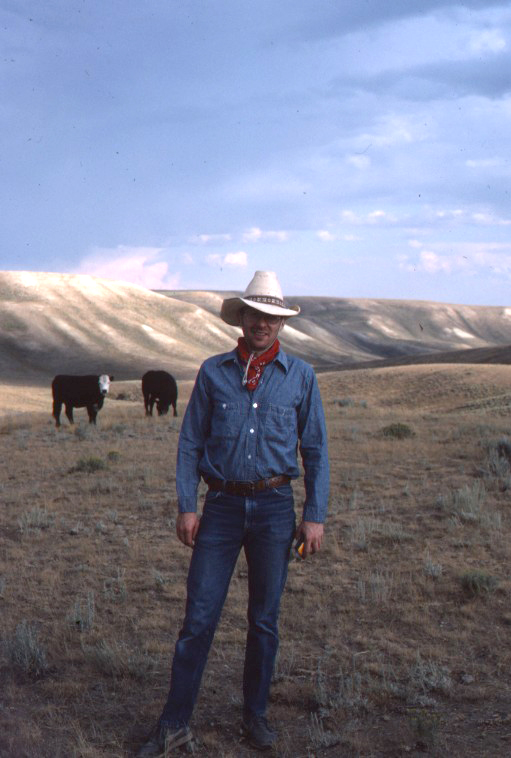
Pat McShea outdoors in a field with cows and hills in the background
Wyoming, 1982.

“It’s impossible to talk about Pat without noting his incredible generosity. He doesn’t just learn and retain information – he eagerly shares it, without fail, with friends, family, colleagues, visitors, learners, everyone. He observes, he listens, he remembers, and he follows up. When a colleague marvels over something he’s written, or remembers a special moment when Pat sought them out to share something, or receives a word of encouragement from Pat during a hard time, that’s the magic of Pat McShea. He’s the most genuine, generous person, and we are all better for working and learning alongside him.” – Jessica Romano, Museum Education Writer

“So one random week last year, Pat KEPT repeating the fact to me that the Haudenosaunee people waited until their corn plants were the size of a squirrel’s ear before planting the beans.  

Over and over and over again. It was really odd but I pushed it out of my brain.  

That was a mistake.  

When he was leading his workshop at the start of the next week, he got out a piece of corn, made a remark about how plants, animals, and natural cycles all tie together. He turns to me and goes “JOHN!  When did the Haudenosaunee plant their beans!?”   

He’s all smiles. He KNOWS I’ve got this. He’s trained me for this.  

And I completely utterly flopped. No idea. Brain blank. No lights on. The hamster is gone and all that’s left is a goldfish flopping around.  

So this madman pulls out a taxidermy of a squirrel. I don’t know where it came from, probably summoned it out of the Aether.  

He holds it up in front of me and goes “a SQUIRREL’S EAR, John!  Come on!!” and everyone starts laughing.” – John Bitsura, Offsite Program Manager 

Pat McShea at his desk
In the Learning Collection office.

“Pat’s retirement represents the loss of a significant voice for Carnegie Museum of Natural History. Contemplating the museum’s future without Pat led me to revisit some of his blogs on the web. One of my personal favorites is “A Gorilla For Our Imagination”. It relates the back story of the silverback male lowland gorilla in the Hall of African Wildlife, “George” who died of natural causes at the Pittsburgh Zoo in 1979. Pat wrote that the important role of this taxidermy ‘is as an educational tool capable of holding eye contact, and thereby encouraging contemplation. In staring contests that the glass-eyed mount never loses, the gorilla represents all its wild kind, the entire population of our planet’s largest primates, close relative of modern humans, and a group whose continued existence is increasingly threatened by illegal hunting, habitat loss, and disease.’ Pat’s insightful words speak volumes about the museum’s exhibits.” – John Wible, Curator of Mammals 

“I worked with Pat McShea in education at the Carnegie Museum of Natural History for ten years and continued to work with him for the next twenty years while using “his” amazing educational loan collection and other resources he provided in my classroom. The museum and community were lucky to have Pat in education for many years because he took a wonderful program like the loan collection and made it even better. Adjectives that describe Pat include kind, inquisitive, kind, helpful, kind, smart, kind, organized, kind, dependable, fun, and did I mention kind? If you are around Pat, it is guaranteed that you will learn something and I would say that a lot of what I know about wildlife and nature is because of Pat. Knowing him and working with him made me a better teacher. He loves the natural world and all the creatures in it and shares his knowledge in many creative ways. (He also makes the best Irish soda bread you will ever taste!)” – Linda Vitale, Natural history docent and teacher from 1983-1993, Museum on the Move volunteer until 2020 

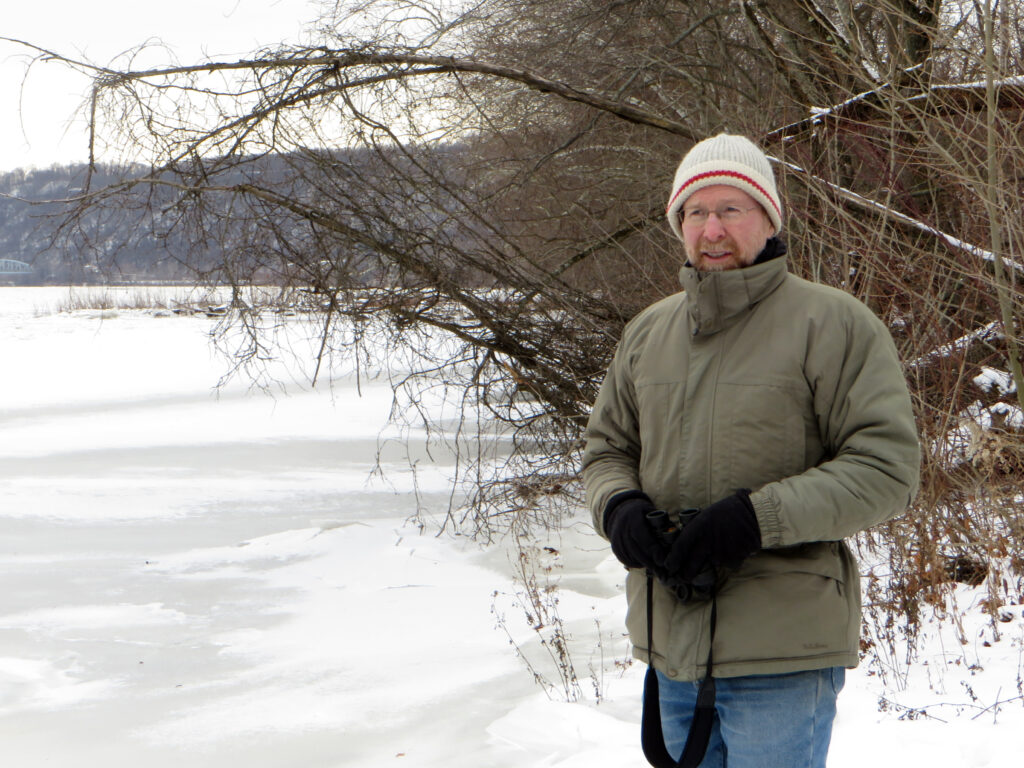
Pat McShea next to an icy river
Allegheny River, 2015.

“Pat’s wealth of knowledge has been invaluable to us as the Allegheny County Park Rangers. His dedication and passion for education shows in everything he does. From suggesting loan materials to use for a specific program to sharing educational resources and articles, Pat has made an immense impact on all of our staff members. I think it is shown best by the number of seasonal Park Rangers who move on from being Rangers but continue to use the loan collection and Pat’s expertise at other positions. It has been an honor and a privilege to be able to work with Pat.” – Elise Cupps, Education & Outreach Coordinator at Allegheny County Parks 

“Amidst the museum’s larger than life history, exhibits, collections and research, Pat’s attention has always been for the learner’s engagement with some aspect of what the climate, plants, animals, and humans might be doing in any season. For example, when working on tabletop exhibits about climate change, Pat noticed that people like to find their homes on maps. He connected that interest to a phenomenon that he and Amy were seeing on their drive to and from work, the morning exodus of crows from the city and evening return of the noisy birds in their dark flocks. He made a climate connection to the urban heat island effect that makes city roosts especially desirable. Given their daily flight patterns, numbers and vocal presence, Pat figured a small prompt “Where have you noticed crows?” might help people become curious about the connection. The regional map, combined with a heat map, crow specimen from ed loan collection and some fun stories about how crows roost and who gets the lower, poopy branches of the trees, came together as a prototype activity in Basecamp where Pat continued to observe people’s responses and chat with those who wanted to share.  

His quiet, thoughtful approach to finding openings for thinking like a naturalist, being inspired by nature around us, and drawing on museum resources, are treasured memories of my time at CMNH. An email in the morning from Pat, with a quote, article of interest, or photo causes me to pause and reflect on Pat’s awe for nature and his constant desire to understand what inspires others. Can’t wait to see how this continues in his future endeavors!” – Mary Ann Steiner, Research Associate with the Climate Rural Systems Partnership (CRSP)  

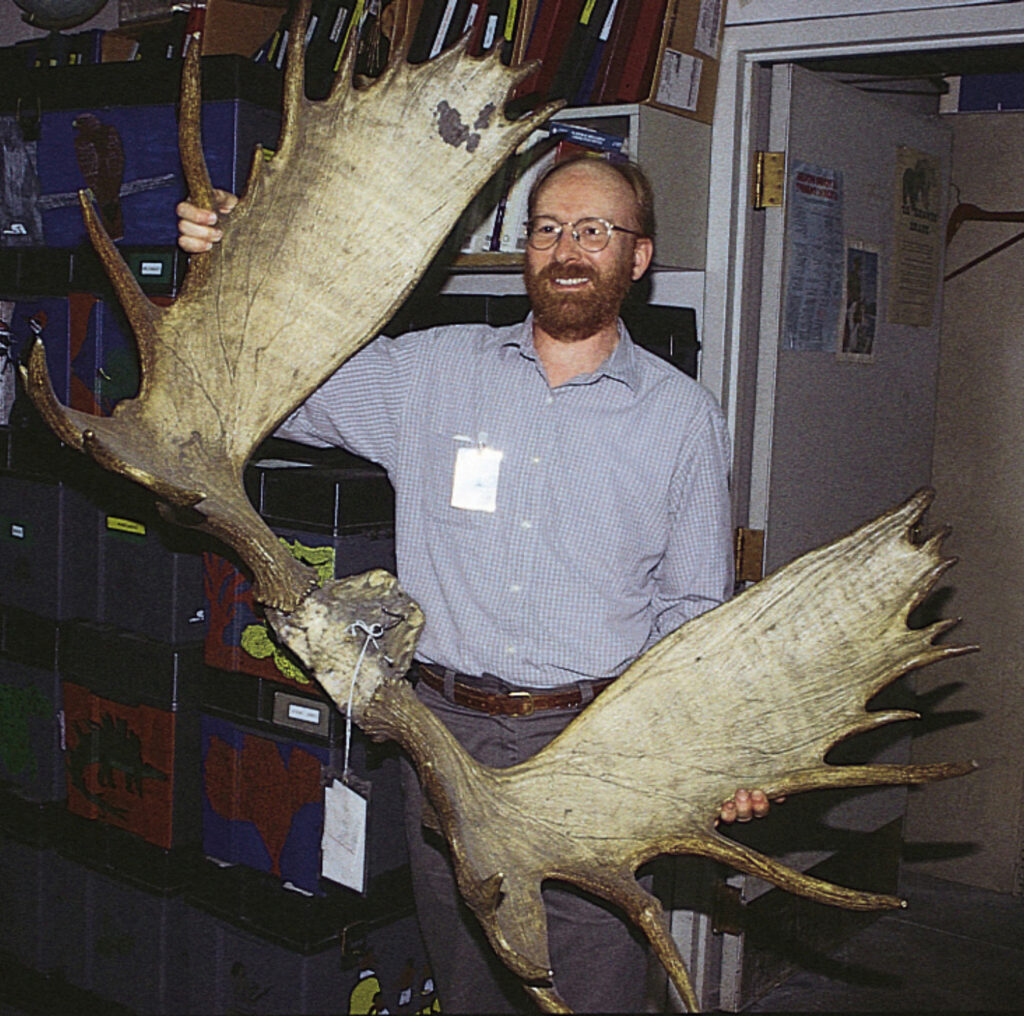
Pat McShea holding large antlers

“I was asked to share something about Pat from the time I worked with him, which was through 1999 when I left CMNH. If there were dramatic or funny stories to tell, I’ve forgotten them. This, however, attests to Pat’s character. He isn’t one to look for ways to draw attention. He’s steady, reliable, always helpful, generous in sharing his knowledge, and appreciated by educators throughout the area and staff throughout the Carnegie. This was true when I worked with Pat and I’m sure it continued. Oh yes, there was that time when I was greeted with a life-sized human skeleton model at my desk when I arrived at work on my 40th birthday. Quite a sight, courtesy of Pat!” – Judi Bobenage, former Chair of the Division of Education 

“As Pat held up the miniscule mink skull, I knew this lesson would be ‘gold’ for my students. It’s rare to find professional development in the Life Sciences that’s so engaging, informative, and relevant, and Pat’s class on identifying and studying mammal bones sparked a lesson which I still use with my middle school students every year! Though he’s leaving CMNH, Pat’s passions for all things outdoors will live on in classrooms around the Pittsburgh area and beyond. Thanks for all you’ve done, Pat. You will be missed!” – Christian Shane, North Allegheny educator 

Blog Highlights  

If you’re looking to read more of Pat’s own words, here are a few of our favorite blog posts he’s written. Happy reading!  

Learning From Misinterpretations
We Get Questions: Climate Change, Hope, and Action
Building Birding Skills
Echoes of Freedom in an Owl’s Call
Sharing a City Park With a Resident Reptile
Holiday Stowaway: Northern Saw-whet Owl

Carnegie Museum of Natural History Blog Citation Information

Blog author: Carnegie Museum of Natural History
Publication date: December 29, 2023

Share this post!

  • Share on Twitter Share on Twitter
  • Share on Facebook Share on Facebook
  • Share on Pinterest Share on Pinterest
  • Share on LinkedIn Share on LinkedIn
  • Share on Reddit Share on Reddit
  • Share via Email Share via Email

Filed Under: Blog Tagged With: Education, Pat McShea

  • « Go to Previous Page
  • Page 1
  • Interim pages omitted …
  • Page 4
  • Page 5
  • Page 6
  • Page 7
  • Page 8
  • Interim pages omitted …
  • Page 25
  • Go to Next Page »

sidebar

About

  • Mission & Commitments
  • Directors Team
  • Museum History

Get Involved

  • Volunteer
  • Membership
  • Carnegie Discoverers
  • Donate
  • Employment
  • Events

Bring a Group

  • Groups of 10 or More
  • Birthday Parties at the Museum
  • Field Trips

Powdermill

  • Powdermill Nature Reserve
  • Powdermill Field Trips
  • Powdermill Staff
  • Research at Powdermill

More Information

  • Image Permission Requests
  • Science Stories
  • Accessibility
  • Shopping Cart
  • Contact
  • Visitor Policies
Stay in the loop! Sign up for our newsletter(s).
One of the Four Carnegie Museums | © Carnegie Institute | Privacy Policy | Terms of Use | Accessibility
Rad works here logo