• Skip to primary navigation
  • Skip to main content
  • Skip to primary sidebar

Carnegie Museum of Natural History

One of the Four Carnegie Museums of Pittsburgh

  • Visit
    • Buy Tickets
    • Visitor Information
    • Exhibitions
    • Events
    • Dining at the Museum
    • Celebrate at the Museum
    • Powdermill Nature Reserve
    • Event Venue Rental
    • Gift Cards
  • Learn
    • Field Trips
    • Educator Information
    • Programs at the Museum
    • Bring the Museum to You
    • Guided Programs FAQ
    • Programs Online
    • Climate and Rural Systems Partnership
  • Research
    • Scientific Sections
    • Science Stories
    • Science Videos
    • Senior Science & Research Staff
    • Museum Library
    • Science Seminars
    • Scientific Publications
    • Specimen and Artifact Identification
  • About
    • Mission & Commitments
    • Directors Team
    • Museum History
  • Tickets
  • Give
  • Shop

Erin Southerland

April 9, 2024 by Erin Southerland

Snags, Logs, and the Importance of a Fallen Tree

by Jessica Romano

As the seasons change from winter to spring here in western Pennsylvania, a common sight on a recent walk included fallen and decomposing trees. Interesting to look at and begging to be photographed, these fallen trees also hold a very important role in the ecosystem. 
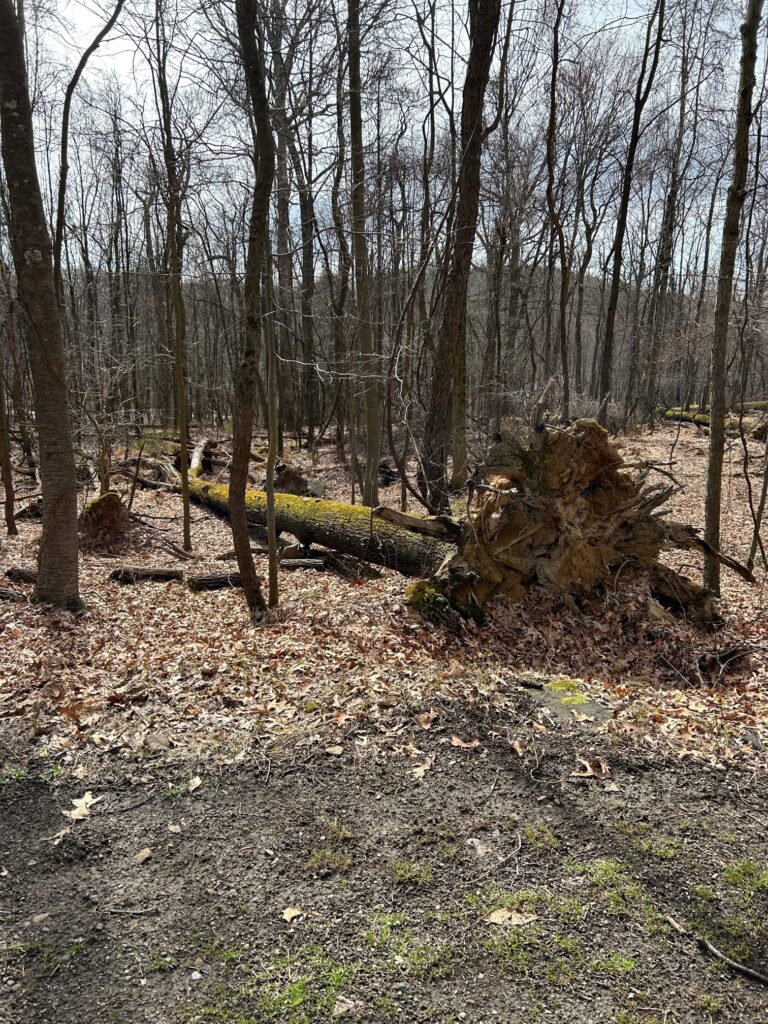
This uprooted tree shows the roots still attached, along a hiking trail in Hartwood Acres Park.

Dead and fallen trees are host to many forms of wildlife, some of which are easy to spot, like squirrels, woodpeckers, and snakes, while others may require a closer look to identify, including fungi, insects, and salamanders. These organisms use the trees for food and shelter, and as the tree decomposes further, the nutrients absorb into the soil and set up favorable conditions for new growth. This cycle is crucial to the health of forests – in fact, numerous species rely on this process to thrive. According to the National Wildlife Federation, “Dead trees provide vital habitat for more than 1,000 species of wildlife nationwide. They also count as cover and places for wildlife to raise young in the requirements for Certified Wildlife Habitat designation.” 

Dead trees are identified two ways:

Snag – a dead tree that is still standing upright while decomposing

Log – the part of a snag that has fallen or partially fallen to the ground

Snags and logs each contribute to a thriving ecosystem in different ways. Snags can have cavities that house mammals, birds, and insects, and can be used for storage or look-out points. Logs on the ground can also act as hiding spots and nests, and as they decompose they provide the nutrients that recycle back into the soil. For those curious for more details about which species in PA utilize snags and logs, Penn State Extension has a thorough list.
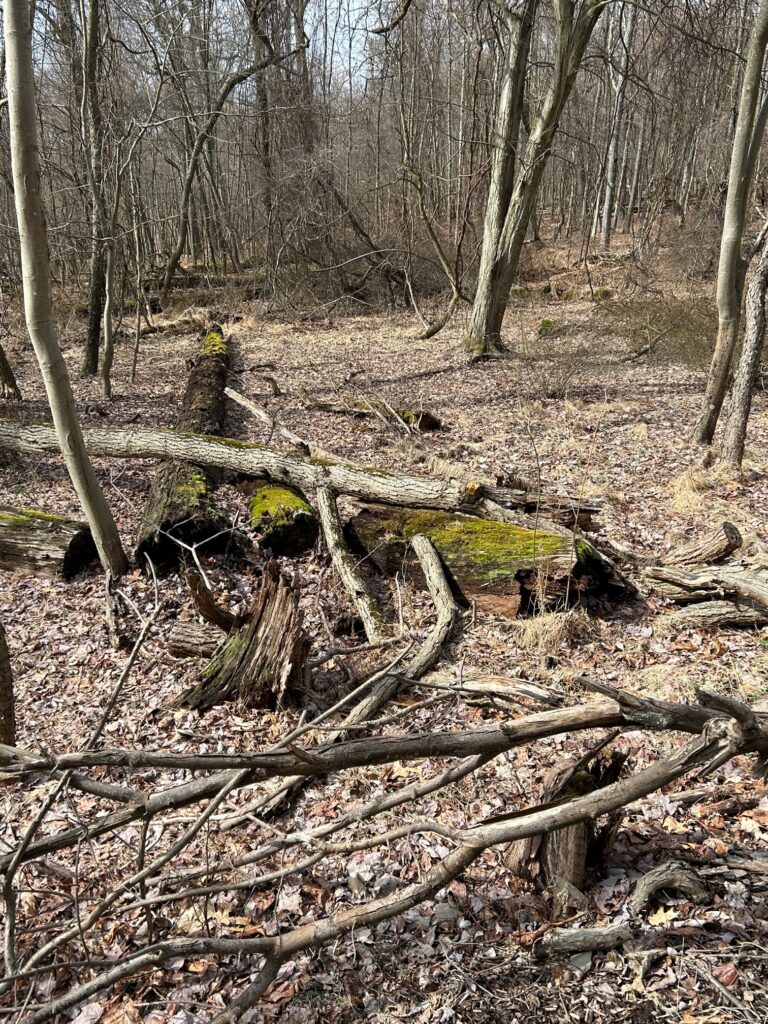
This group of logs shows varying points of decomposition and provides lots of spaces for wildlife to shelter.

The photos used here were taken at Hartwood Acres, one of the Allegheny County Parks located in Hampton Township, north of Pittsburgh. Some trees appeared to be freshly uprooted, with the circumference of the base of the tree standing several feet high, while others had clearly been decomposing for quite some time, with the trunk completely hollowed out. 
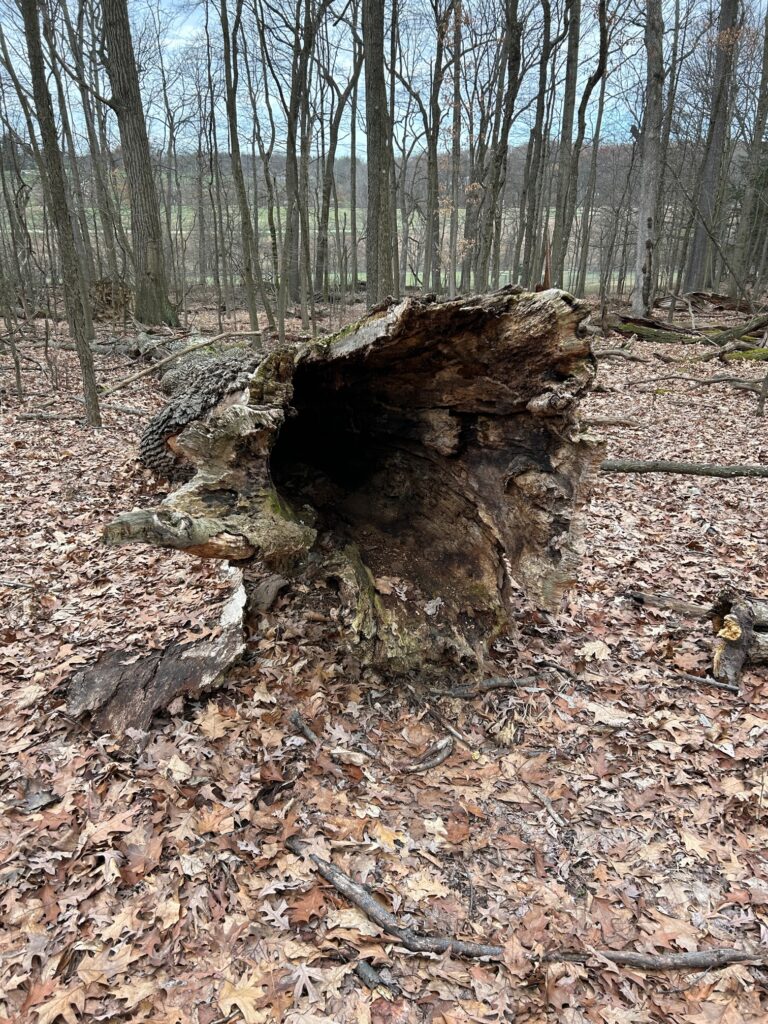
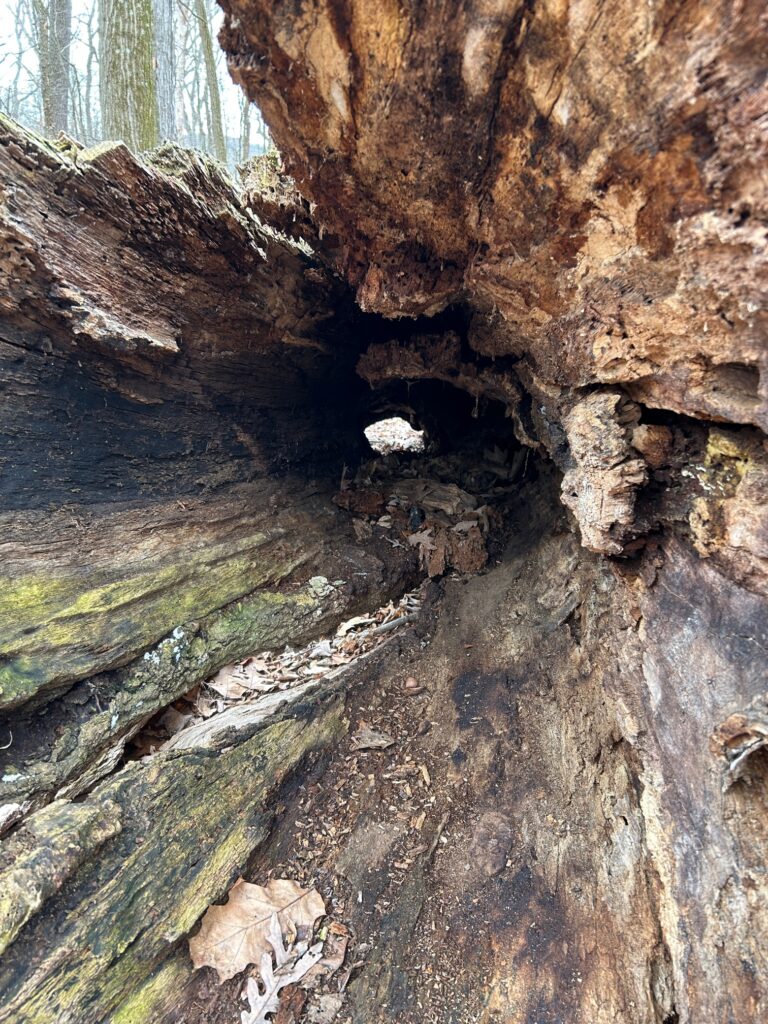
This log is almost completely hollowed out, providing shelter for various types of wildlife. 
A close-up view shows the variety of textures from varying points of decomposition.

When a tree is uprooted from some type of disturbance event like a storm, it makes space for another topographical feature, pits and mounds. A pit forms in the space where the roots and soil are pulled up. Over time, the root mass decays and falls to the ground, creating a mound on the surface. This is called a micro-topographical feature because it forms around the base of a single tree. Pit-and-mound features create new habitats for wildlife and can often be used as breeding grounds for amphibians when water collects in the pit from runoff. The amount and frequency of mounds in forests can give clues to what caused the trees to fall, and even age of the forest as mounds form over extended periods of time.  
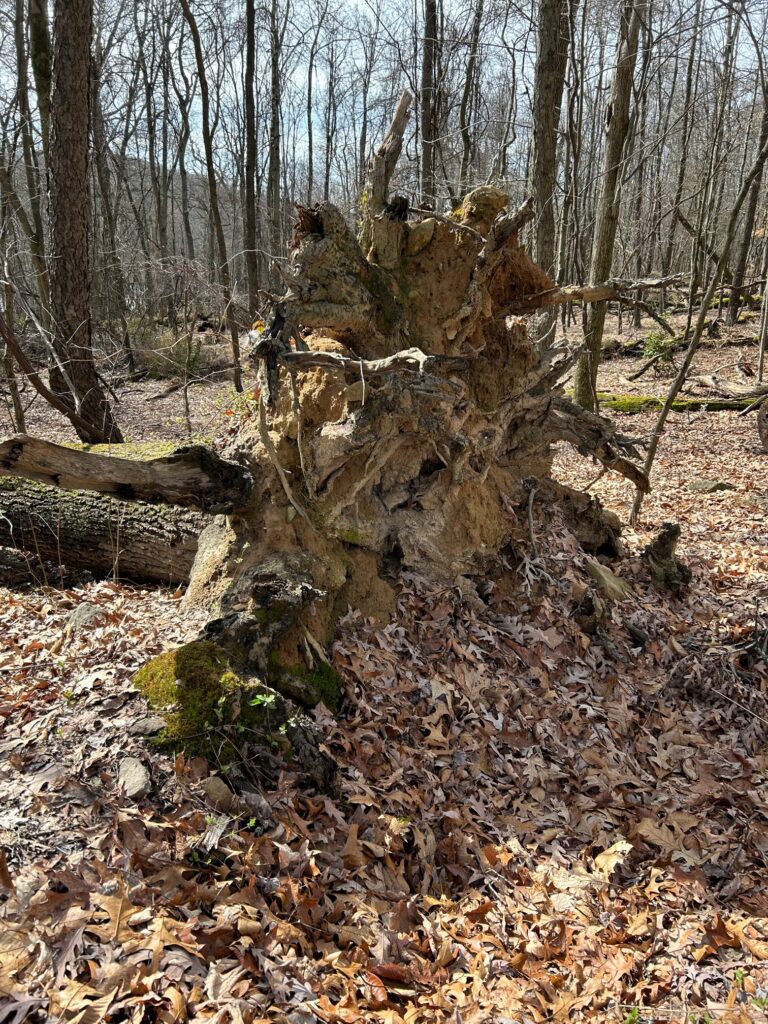
A close-up view of an uprooted tree shows the decaying roots and soil that form a pit underneath and will become a mound over time.

It’s not a coincidence that there are varying types of fallen trees in one park; forest experts monitor these fallen trees and follow guidelines for how many to leave in an area, at times clearing them to help control pests or other safety factors.

Keep in mind it can be dangerous to touch or climb on these fallen trees, especially if they appear rotted. The structure of the wood breaks down slowly but surely and the logs can be weaker than they appear. For that reason it’s better to admire the interesting sight from a distance or at least without touching it. As spring arrives and the tree canopy and forest understory fill in, a return trip will hopefully provide opportunity to spot some of the species benefitting from these fascinating snags and logs.

A perfect opportunity to search for fallen trees and the wildlife that utilizes the newly-created ecosystem is the City Nature Challenge. Using the free app iNaturalist, take and upload photos of nature from April 26 through 29, 2024 and help safely document biodiversity where you live! Learn more about the City Nature Challenge.

Jessica Romano is Museum Education Writer at Carnegie Museum of Natural History.

Sources

  1. National Wildlife Federation
  2. The Wildlife News
  3. Penn State Extension

Related Content

Using iNaturalist in the City Nature Challenge and Beyond

Teaching About Local Wildlife with the City Nature Challenge

Evidence Counts for Absent Creatures – City Nature Challenge

Carnegie Museum of Natural History Blog Citation Information

Blog author: Romano, Jessica
Publication date: April 9, 2024
Share this post!

  • Share on Twitter Share on Twitter
  • Share on Facebook Share on Facebook
  • Share on Pinterest Share on Pinterest
  • Share on LinkedIn Share on LinkedIn
  • Share on Reddit Share on Reddit
  • Share via Email Share via Email

Filed Under: Blog Tagged With: City Nature Challenge, Education, Jessica Romano

March 19, 2024 by Erin Southerland

Celebrating Women in the Natural History Art Collection

by Olivia Buehler

Within the collections of the Carnegie Museum of Natural History, one may be surprised to find more than the biological specimens, fossils, and extensive anthropological and archaeological materials that the museum is best known for. As a major scientific institution that collects and conducts research, the Carnegie Museum of Natural History also has its own “Natural History Art” Collection, formerly known as the M. Graham Netting Animal Portraiture Collection, named after the herpetologist, former CMNH director, and founder of the collection. Consisting mostly of mid-twentieth-century naturalist and scientific illustrations, this collection serves as a useful addition to the museum’s resources that complements its research activities. Naturalist and scientific illustration involves skills beyond image-making and can resemble scientific research in that it requires artists to closely observe, and often travel to, their subjects to fully understand them and render them accurately. 

Within the collection are several women artists and scientific illustrators who each contributed to the genres of naturalist and scientific illustration. In this post I will feature the artists Winifred Austen, Germaine A. Bernier-Boulanger, Florence Malewotkuk, and an artist only identified (for now) as “Deirdre E. L.,” who are all worth celebrating this Women’s History Month. Although greatly outnumbered in the collection by their male counterparts, the women in CMNH’s Natural History Art Collection, and their respective works, speak volumes. With some pieces dating to over one hundred years ago, these artworks are proof that women have always had important roles to play in art and science, and it is just the conditions of patriarchal societies that have limited them. Despite their existence as a minority in the field of naturalist and scientific illustration, and the associated income and opportunity disparities that came with that status, these women persevered to create the beautiful, informative, and humorous art below.

Winifred Austen

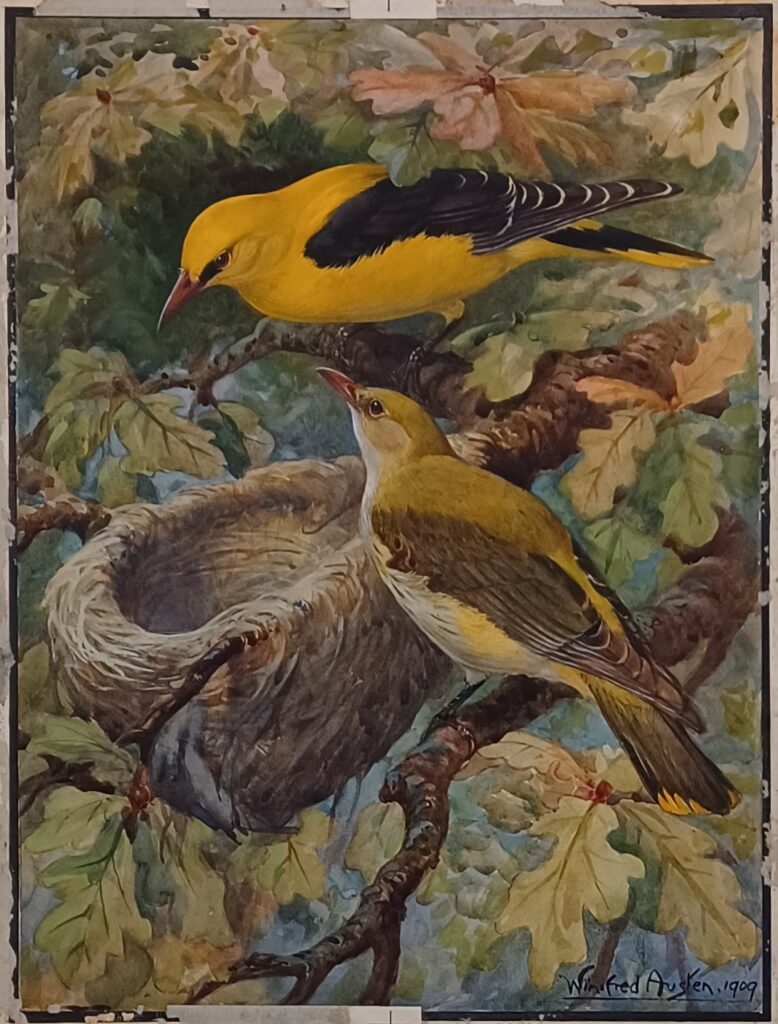
watercolor painting of two golden orioles near their nest in a tree
Winifred Austen, Golden Orioles (1909), Watercolor on board, 20 x 27 in., NHA 28.266 

One such artist is Winifred Austen, an English painter, etcher, and engraver whose work became most popular in the 1940s and 1950s with her wildlife illustrations in books and magazines. Produced as an illustration for F.B. Kirkman’s British Bird Book, Austen’s Golden Orioles (1909) is a lovely example of her expertise in wildlife painting, specifically birds. While the orioles are painted with a thoughtful hand in precise, impressive detail, their surrounding environment is rendered in a far more impressionistic style, emphasizing Austen’s utilization of her formal training in the arts, but also her choice to employ individualistic, stylistic expression and creativity. Even though these watercolors were intended to act as visual references for the texts they were accompanying, Austen still managed to contribute in a manner that was unique to her. Austen’s art can be praised for the dynamism of her subjects, and her portrayal of birds as they would appear in their natural environments, rather than in the static and perfectly poised way some other naturalist illustrators tend to favor.

Austen attended and trained formally at the London County Council School of Arts and Crafts and exhibited her work often with the Royal Society of Painter-Etchers, following a similar trajectory as many of her male contemporaries. With that being said, Austen also made incredible progress despite being a minority in her practice, for example, she was the only woman to be published in the British Bird Book.

Germaine A. Bernier-Boulanger

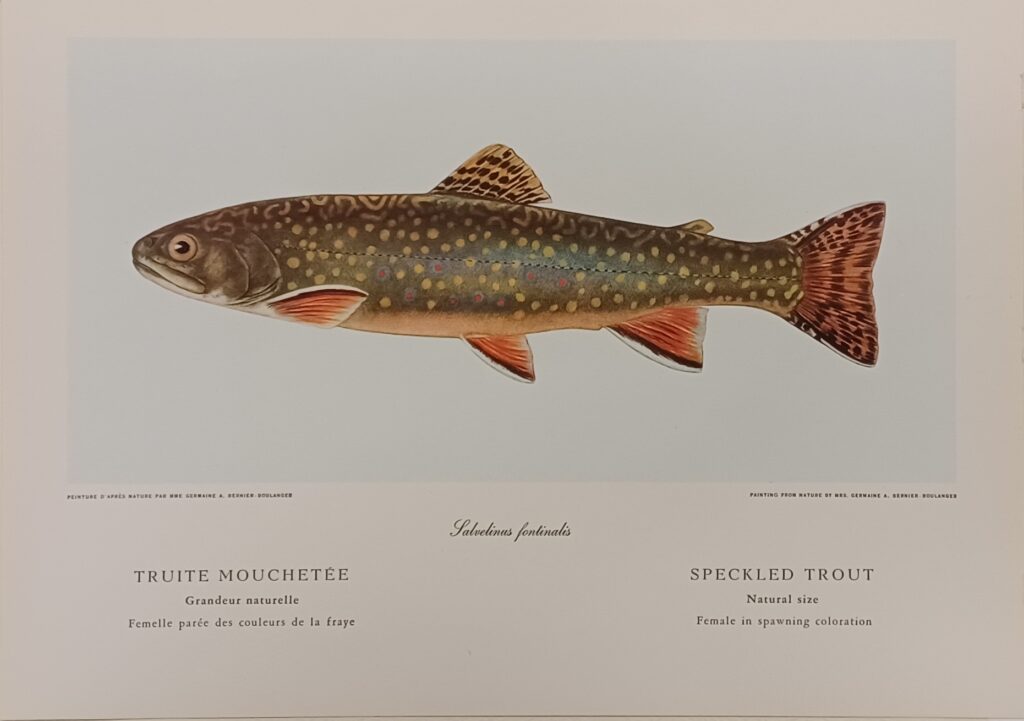
print of a speckled trout
Germaine A. Bernier-Boulanger, Salvelinus fontinalis, female (c. 1953), Print, 14.25 x 19.25 in., NHA 29.136-23 

A prime example of a woman who knew her worth as a scientist, educator, and artist, and settled for nothing less, is Germaine A. Bernier-Boulanger (1909-1989). Salvelinus fontinalis, female (c. 1953), a highly detailed, scientific illustration of a female spotted trout, is one of three prints in the collection by Bernier-Boulanger. Unlike the more painterly quality of Austen’s watercolors, Bernier-Boulanger’s work highlights the more research-intensive, “art for science’s sake” approach to wildlife illustration that contributed greatly to the discipline of non-photographic specimen documentation. Bernier-Boulanger had formally studied embryology and invertebrate zoology and didn’t become a professional illustrator until after the age of forty. Before focusing on her art, Bernier-Boulanger was employed at the Montreal Botanical Institute, and later, the University of Montreal, where she left her post as an educator after experiencing no change in her career trajectory, despite voicing her disapproval of the discrepancies in pay and career advancement between herself and her male colleagues in the natural sciences department. During Women’s History Month, it is especially important to tell the stories of women like Bernier-Boulanger, not only because of their knowledge, skill, and contributions to their respective fields, but also because they challenged long-standing discriminatory practices against women within the institutions they worked for, acting as catalysts for change.

Florence Malewotkuk

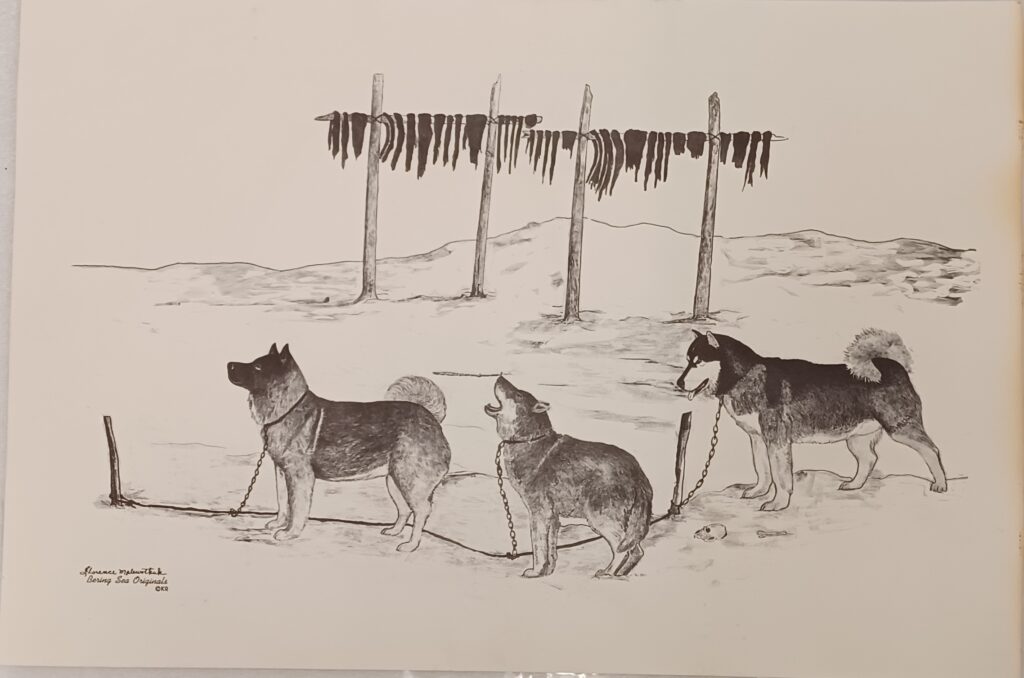
black and white drawing of three huskies
Florence Malewotkuk, Husky Dog Team (c. 1950s-60s), Print, 16 x 10.5 in., NHA 30.115-23 

Florence Malewotkuk (1906-1971) (Yup’ik) was born in a village on St. Lawrence Island on the Bering Sea, which is part of Alaska. Malewotkuk’s Husky Dog Team (circa 1950s-60s) is one of three prints by the artist in the collection by Malewotkuk, each part of a series she titled “Bering Sea Originals.” Depicting husky dogs lined up in front of drying pelts, this print, along with the others in the collection depicting walrus and polar bears, offers unembellished images of local wildlife, and the intersection with nonhuman animals and Yup’ik communities. Showing talent from an early age, Malewotkuk began working as a professional artist in her early twenties when commissioned by Otto William Geist, an archaeologist, to capture everyday scenes of Yup’ik life. Further commissions followed for Malewotkuk later in life, and today her art is housed in collections across North America. Malewotkuk’s story indicates the opportunities that art production offers to women, and the importance of having members of Indigenous groups, especially women, depict their culture from their point of view.

Deirdre E. L.

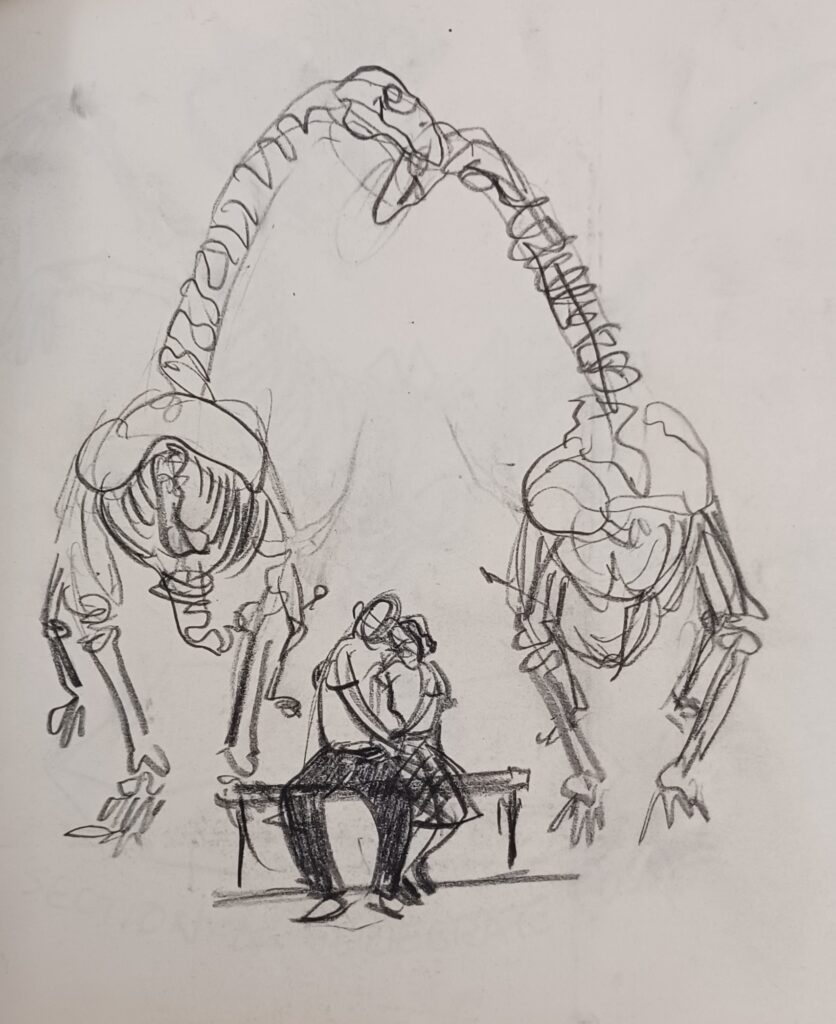
charcoal sketch of two people in front of two sauropod dinosaur fossil skeletons
Deirdre E. L., Untitled Sketch (c. 1940s), Charcoal on paper, 8.5 x 11 in.
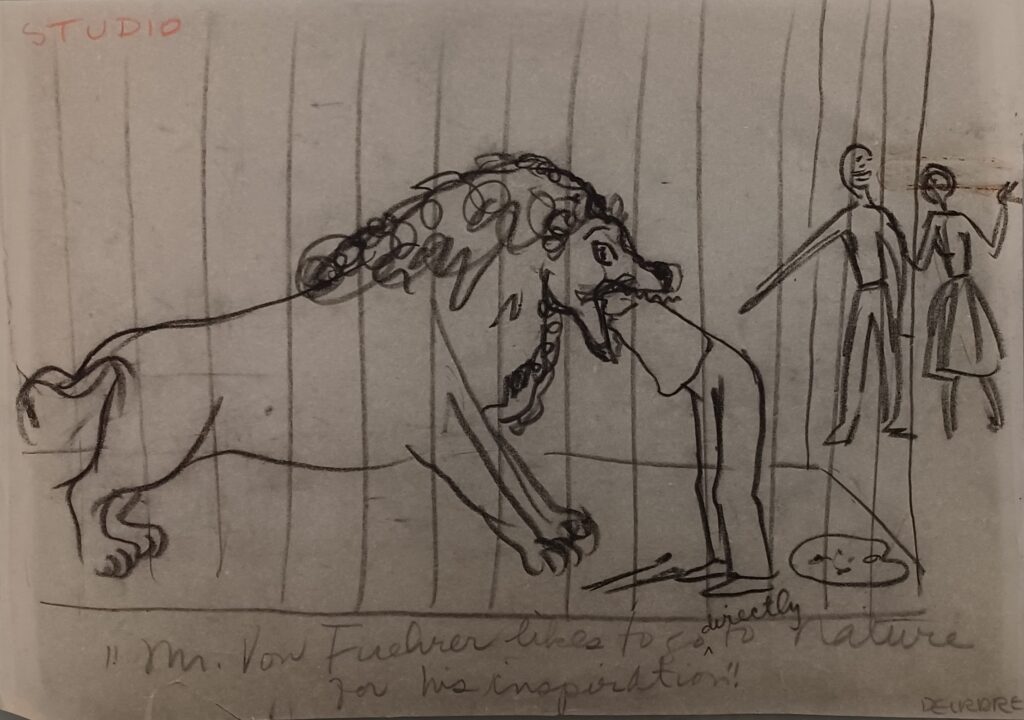
Deirdre E. L., Untitled Sketch (c. 1940s), Charcoal on parchment, 9 x 6.5 in.

Tucked away in a drawer of archival ephemera in the Natural History Art Collection is a folder of comedic cartoon illustrations by the artist Deirdre E. L. With the signature “Deirdre” at the bottom of the sketches being the only source of information available on the artist, it would seem that we must let her work speak where a biography is absent. Perhaps designed for the amusement of CMNH staff or for print in museum publications, Deirdre’s sketches combine silly captions and quirky caricatures with relevant information about the museum. Her sketch of CMNH chief staff artist Ottmar Von Fuehrer jokes about his going “directly to nature” (by sticking his head in a lion’s mouth) for inspiration, and is a fine example of this fun dichotomy. Her heart-warming sketch of a couple embracing under an equally affectionate pair of dinosaur fossils captures her sketchy, endearing drawing style. 

In this brief survey, I hope to have captured a glimpse of the talented women artists and scientific illustrators in CMNH’s Natural History Art collection. As a History of Art and Architecture and Museum Studies student at Pitt, I have been very interested in exploring the many intersections that exist between the disciplines of art and natural histories, including questions like: What distinguishes a scientific illustrator from an artist, if there is any distinction at all? How do women fit into and contribute to these respective disciplines historically? And how do studies of gender reveal vital information about science and art history? I look forward to discovering new artists as I continue to work with the Natural History Art Collection as an intern, especially women whose presence in the collection inspire me to learn more about those who challenged, and continue to challenge, societal expectations and make lasting contributions to the worlds of art and science. 

Olivia Buehler is an intern in the Section of Anthropology at Carnegie Museum of Natural History.

Related Content

How I Became an Archaeologist

Mary Anning: For the Love of the Blue Lias

Echoes of Freedom in an Owl’s Call

Carnegie Museum of Natural History Blog Citation Information

Blog author: Buehler, Olivia
Publication date: March 19, 2024

Share this post!

  • Share on Twitter Share on Twitter
  • Share on Facebook Share on Facebook
  • Share on Pinterest Share on Pinterest
  • Share on LinkedIn Share on LinkedIn
  • Share on Reddit Share on Reddit
  • Share via Email Share via Email

Filed Under: Blog Tagged With: anthropology, Olivia Buehler, Science News, Women's History Month

March 1, 2024 by Erin Southerland

When Nature Meets Art: Crinoid Fossils as Cultural Beads

by Elizabeth A. Begley and Albert D. Kollar

Did you know that invertebrate fossils make up more than 50% of the specimens on exhibit in Dinosaurs in Their Time (DITT)? It’s true! But these fossils can be easy to miss among the giant dinosaurs and vertebrate reptiles. Luckily, ongoing research on the biodiversity within our gallery spaces, from locations including England, Germany, and the United States, will help visitors better understand the importance of the Carnegie Museum of Natural History’s Invertebrate Paleontology collection research, exhibition, and education initiatives1. With few exceptions, these specimens are part of the vast Ernest de Bayet fossil collection purchased for the museum by Andrew Carnegie in 19031,2.

What are Crinoids?

Among these invertebrates are a unique group of sea bearing animals called crinoids. Crinoids are an ancient fossil group that belong to the phylum Echinodermata. Crinoids first appeared in the fossil record in the mid-Cambrian Period of the Paleozoic Era (490 – 250 million years ago) and became a significant group that formed mid-Silurian reefs in Dudley, Wales; Gotland Island, Sweden; and Milwaukee, Wisconsin. In the Mesozoic Era, crinoids formed the famous middle Triassic reefs of Germany3. Few crinoid groups live in oceans today. Examples of crinoids are on display in the museum’s Triassic Seas, Holzmaden, and Solnhofen dioramas (all locations in Germany)1. Crinoids are also called sea lilies because they look like flowers – but don’t be fooled, they’re animals! Crinoids are related to starfish, sea urchins, and brittle stars; this relationship can be noted in the crinoids five-part radial symmetry3,4. They lived on stems (or stalks) and attached to the sea floor by roots, as in the Triassic Muschelkalk Formation, but were floating animals in the Jurassic Holzmaden seas. They relied on waves and currents to bring small food particles past their petal-like arms which opened as a mode of filter-feeding micro-organic food3,4. Today, Crinoids are few in numbers living among shallow coral reefs and in the deep sea. The Bayet Collection of crinoid fossils are represented from the Silurian, Mississippian, and Triassic rock formations1.

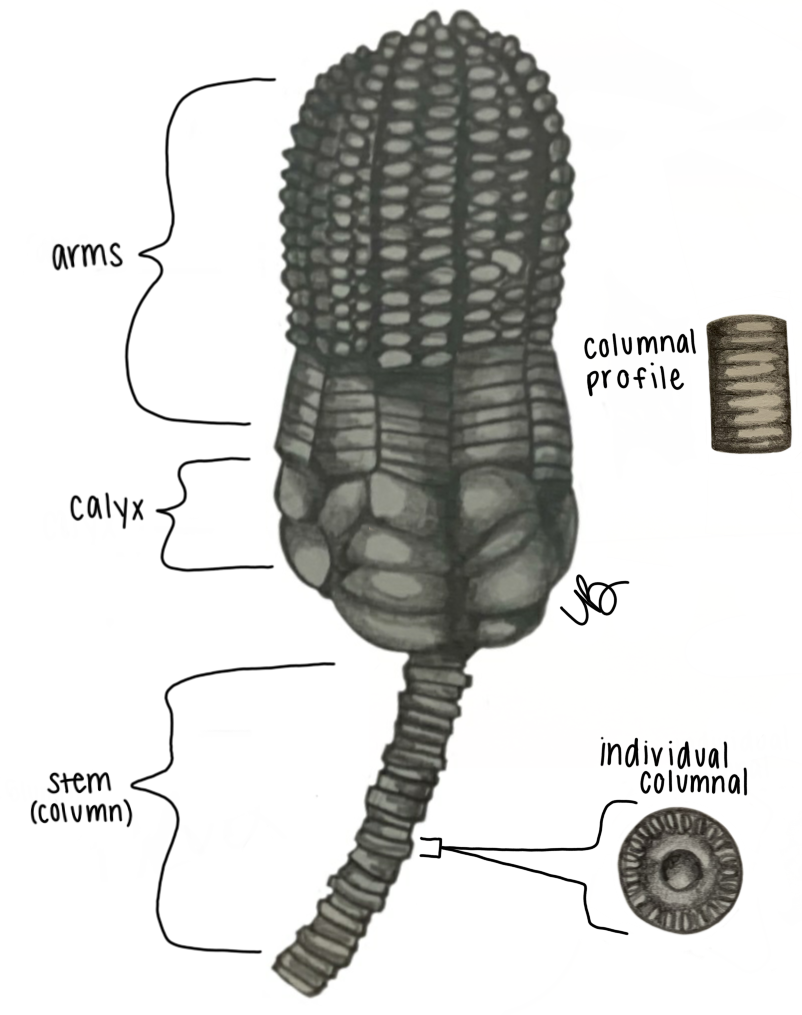
Fig. 1. In DITT, you may see crinoid fossils such as the specimen sketched above, CM29840. This crinoid’s scientific name is Encrinus liliiformis and comes from the famous middle Triassic Muschelkalk Formation in Brunswick, Germany. This specimen was collected by Dr. Fredrick Krantz within the Bayet Collection. Several parts make up the crinoid. Once dead, the crinoid’s muscles decompose resulting in the disarticulation of the arms, calyx, stem, and individual columnals4. Most crinoid fossils are found in separate parts for this reason. Artwork by Elizabeth Begley. 

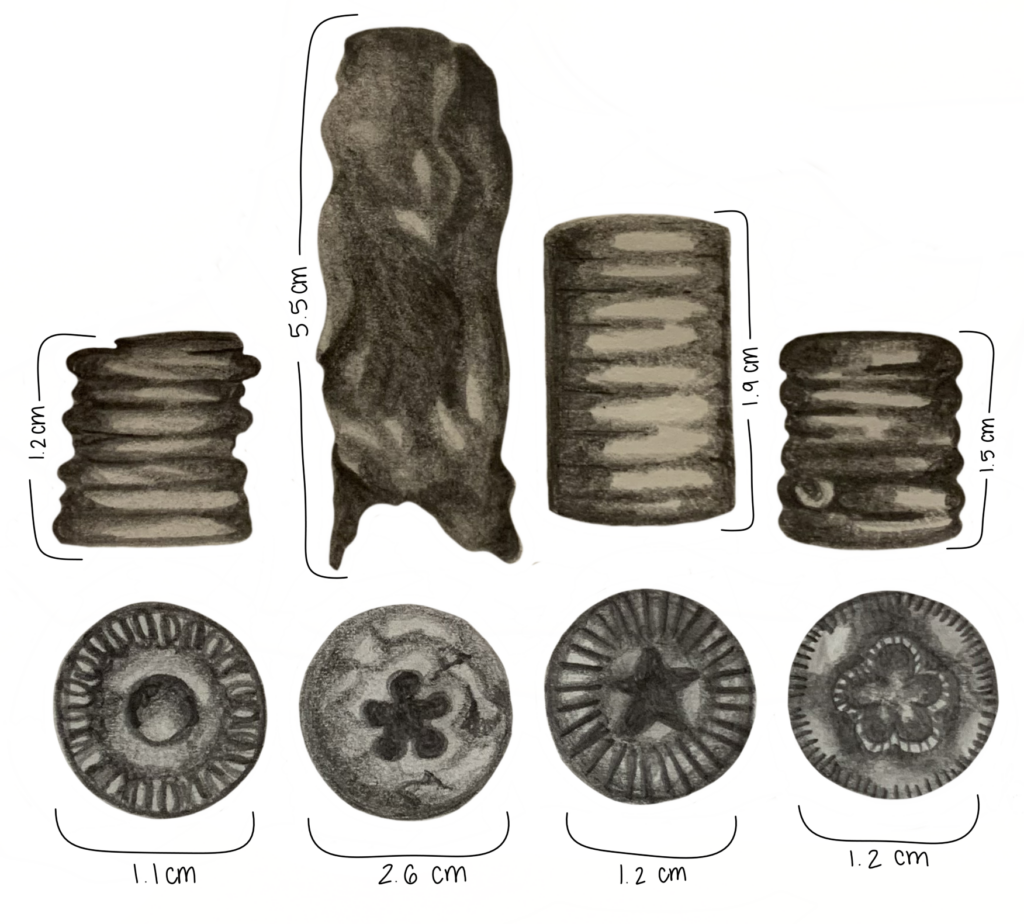
However, crinoid fossils are more than scientific material reserved for use by paleontologists alone, in fact, this invertebrate animal is unique as it gives us the opportunity to see how humans have long interacted with nature. Specifically, fossilized crinoid stems have been used in several communities and throughout history as beads. This is due to their small size, cylindrical shape, and the usual occurrence of a hole in the center (fig. 2). So, let’s explore how crinoid fossils have been used on different continents and in different eras of human history.

Fig. 2. CM63017 consists of crinoid parts from the Vanport Limestone, Lower Pennsylvanian age (~312 million years ago), Butler Co., PA. These crinoid fragments illustrate crinoid stem cross-sections and side profiles from the Invertebrate Paleontology collection. The cross-section view offers insight into the crinoid’s bead-like build. Artwork by Elizabeth Begley.

Crinoid Beads in North America

In Kentucky, amateur fossil hunters commonly refer to crinoid stem fossils as beads5 and the Illinois Archaeological Survey has reported “crinoid stems suggested to function as beads” at a historic site in Buckman Flats6. This finding joins crinoid stems already uncovered in Kickapoo territories in 2011 and 1992 as well as a 2001 discovery at a Potawatomi settlement6. To illustrate an example of historic beadwork by North American indigenous groups, Harvard’s Peabody Museum of Archaeology and Ethnology has published a photograph depicting a “string of prehistoric beads made from different sizes of fossilized crinoid stem[s]” discovered in Tennessee7.

Crinoid Beads in Asia

From the lower paleolithic period in Israel, a deposit at the archaeological site of Gesher Benot Ya’aqov revealed two “beadlike” crinoid fossils among stone artwork and polished wood artifacts. This collection is thought to hint at the group’s cognitive ability regarding the manipulation of nature for artistic and cultural purposes and has brought the hypothesis that lower paleolithic hominids collecting crinoid stems, among other marine objects, may be the origin of the modern bead shape8. The thought process behind this theory relies on our understanding that crinoids, and their fossilized stems, have existed for far longer than the modern bead has. Bednarik argues, “perhaps this is how the very concept came into being, and the humanly made disc beads were merely substitutes for the fossils that were in short supply”9.

Crinoid Beads in Europe

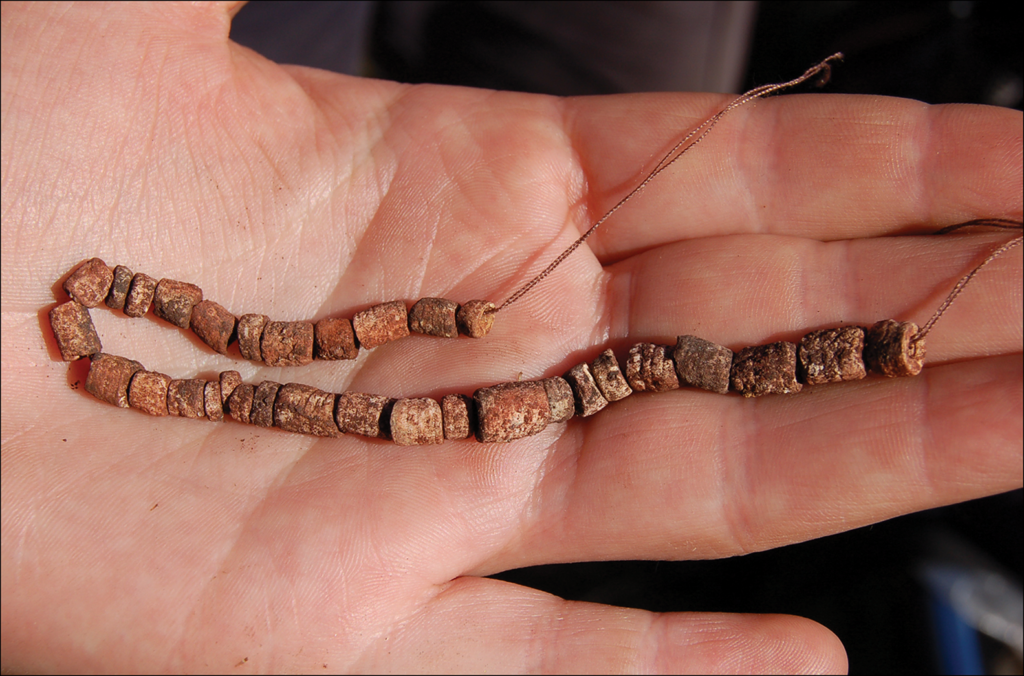
While there are several instances of crinoid stems being recognized in historic European art and culture, the cemetery at Zvejnieki in Latvia is a unique case as the stems, or “beads,” seem to be a part of funerary practice. Zvejnieki was in use during the region’s Mesolithic and Neolithic periods and rediscovered by archaeologists in the 1960s. Work at the site has continued and a re-analysis of a double burial revealed that a beaded ornament among the remains, previously believed to have been made of bird bone, is a string of fossilized crinoid stems10. This case brings us to an interesting question in assessing the use of fossils, such as crinoid stems, throughout human history, and the impact of such encounters on our current relationship with the natural world.

Fig. 3: Threaded crinoid beads. Photo credit: L. Larsson, CC BY¹⁰

So, the next time you walk through the museum, we invite you to take a closer look at the crinoids, and other invertebrate fossils on display, and imagine how else we may incorporate them in our lives!

Elizabeth A. Begley is Collection Assistant and Albert D. Kollar Collection Manger in the Section of Invertebrate Paleontology at Carnegie Museum of Natural History.

References: 

  1. Kollar, A.D., J. L. Wilson, and S.K. Mills. 2024. The Ernest de Bayet Fossil Collection at the Carnegie Museum of Natural History: A Century of Stewardship in Exhibition. Annals of Carnegie Museum.
  2. Wilson, J. L., A.D. Kollar, and S.K. Mills. 2024. Unraveling the 120 Year Mystery of Ernest Bayet and his Fossil Collection at Carnegie Museum. Annals of Carnegie Museum.
  3. Hess, H., W. I. Ausich, C. E. Brett, and M.J. Simms. 1999. Fossil Crinoids. Cambridge University Press.  
  1. Brezinski, D.K., and A.D. Kollar. 2008. Geology and Fossils of the Tri-State Region Learning/Activities/Coloring Book. PAlS Publication 8. 
  2. Kentucky Geological Survey. Identifying Unknown Fossils. https://www.uky.edu/KGS/fossils/fossilid.php
  3. Fishel, R. 2017. The Historic Indian Artifact Assemblage at Buckman Flats, Knox County, Illinois. Illinois Archaeology Vol. 29. 
  4. Peabody Museum of Archaeology and Ethnology. String of prehistoric beads made from different sizes of fossilized crinoid stem. Artstor. https://www-jstor-org.cmu.idm.oclc.org/stable/community.20420806
  5. Bednarik, R. 1994. The Pleistocene Art of Asia. Journal of World Prehistory, 8(4), 351–375. http://www.jstor.org/stable/25800655
  6. Bednarik, R. 2005 .Middle Pleistocene Beads and Symbolism. Anthropos, 100(2), 537-552. http://www.jstor.org/stable/40466555  
  7. Macāne, A. 2020. Petrified animals: Fossil beads from a Neolithic hunter-gatherer double burial at Zvejnieki in Latvia. Antiquity, 94(376), 916-931. doi:10.15184/aqy.2020.124 https://www.cambridge.org/core/journals/antiquity/article/petrified-animals-fossil-beads-from-a-neolithic-huntergatherer-double-burial-at-zvejnieki-in-latvia/A325BCCE572DA6DD3AE913E7C22C18C2

Related Content

Meet the Mysterious Mr. Ernest Bayet

Behind the Scenes with the Baron de Bayet and L.W. Stilwell Collection, Part 1: Crossing the Atlantic with a Boatload of Fossils

Bayet and Krantz: 16 Words (Part 1)

Carnegie Museum of Natural History Blog Citation Information

Blog author: Begley, Elizabeth A.; Kollar, Albert D.
Publication date: March 1, 2024

Share this post!

  • Share on Twitter Share on Twitter
  • Share on Facebook Share on Facebook
  • Share on Pinterest Share on Pinterest
  • Share on LinkedIn Share on LinkedIn
  • Share on Reddit Share on Reddit
  • Share via Email Share via Email

Filed Under: Blog Tagged With: Albert Kollar, Elizabeth Begley, invertebrate paleontology, Science News

February 29, 2024 by Erin Southerland

Scientific Names Matter in March Mammal Madness 

by Erin Southerland

March Mammal Madness (MMM) bracket advice: look up the scientific names of species on the MMM website before you make your predictions. While MMM can be silly and ridiculous, it is an educational tool and the details matter. Let’s explore why by looking at the Pitcher Plant (7) vs. Northern Short-tailed Shrew (10) match.  

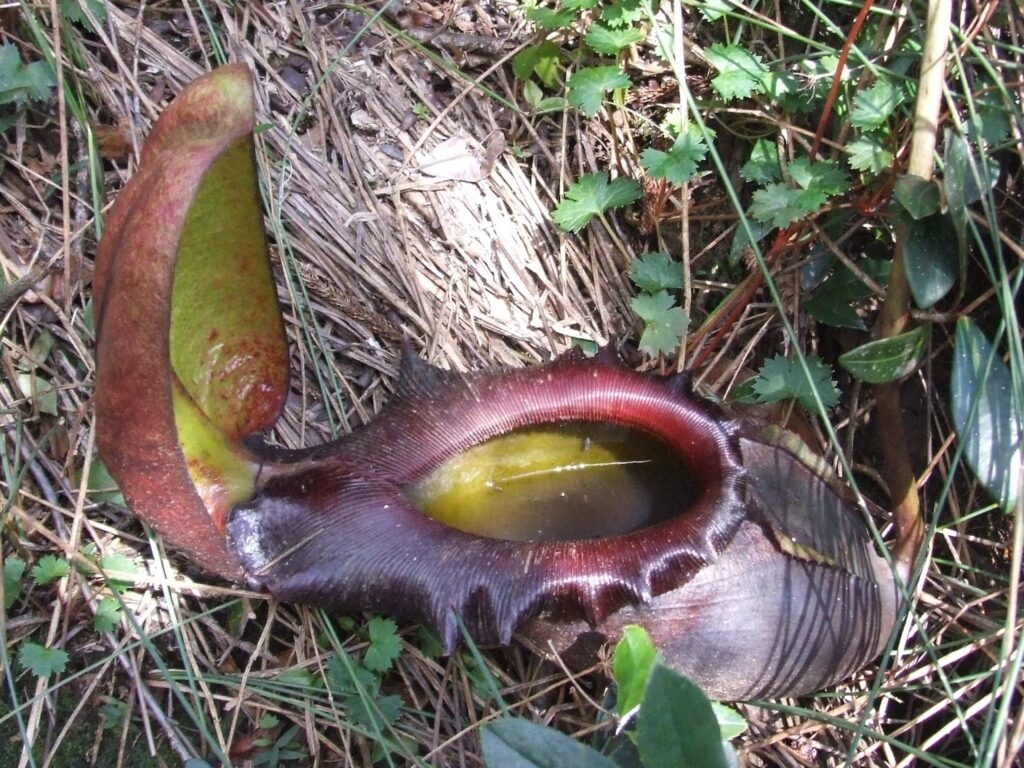
Pitcher plant isn’t a specific species of plant, rather it describes plants with a modified leaf that resembles and acts like a pitfall trap. 

Nepenthes rajah, a species of pitcher plant. © Thibaud Aronson, (CC BY-SA)

Bonnie Isaac, Collection Manager of Botany, says:

Generally, when we use the term pitcher plant, we are referring to a member of either Sarraceniaceae or Nepenthaceae. Both pitcher plant families evolved in areas where essential nutrients for plants are lacking. They needed to find a way to get their nutrients by other means. Enter carnivory.

Pitcher plants in both families primarily eat insects, but they are generalists that will catch and digest anything that comes along. However, one of these families is more likely than the other to be able to digest the Northern Short-tailed Shrew. 

Bonnie tells us:  

Sarraceniaceae are normally ground dwelling plants with trumpet-shaped leaves that are used to capture their prey. Many of these pitcher plants have hairs on the inside of the tube that point downward to keep the prey from crawling out. They may also have clear areas near the top of the tube to attract insects.  

Members of Nepenthaceae are tropical plants that frequently have a climbing stem. The modified pitcher leaves on these plants are normally of two types: one grows up in the trees that support the vine, the other grows near the ground. The trap leaves near the ground are normally larger than the aerial trap leaves and can digest larger prey. With two types of traps these plants are opportunists and ready to capture whatever may happen into the traps. 

The pitchers of Sarraceniaceae are normally not large enough to hold a Northern Short-tailed Shrew. Nepenthes on the other hand has pitchers that are large enough to hold shrews. Some Nepenthes species attract rodents by giving them a reward. The rodent in turn gives the plant nutrients either by defecating into the toilet-shaped leaf or by falling into the pitcher and being digested. Species of Nepenthes are known to trap and digest vertebrates, including rats and mice. If by chance a Northern Short-tailed Shrew happened upon a Nepenthes and fell into the trap the shrew wouldn’t stand a chance.  

Since the species of pitcher plant selected for March Mammal Madness is Nepenthes rajah, it has a chance to beat the Northern Short-tailed Shrew (Blarina brevicauda).  

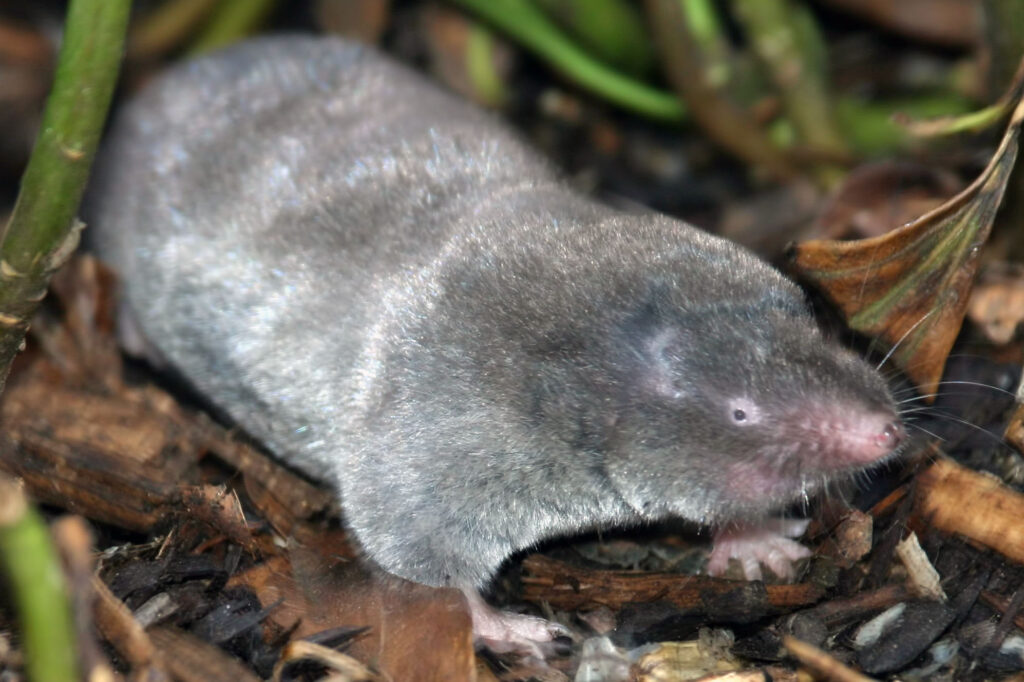
Short-tailed Shrew (Blarina brevicauda)

Sue McLaren, Collection Manager of Mammals, also notes that either competitor has a chance (it is March Mammal Madness, after all):  

When I think of the short-tailed shrew, I think of a fierce temperament when confronted by something dangerous. They are good climbers (I’ve seen them climb a tree trunk to a point at least eight feet off the ground). Even though their claws seem a little puny, they are more fossorial (adapted for digging and burrowing) than any other shrew so they can dig their way through densely compacted leaves and easily move through some types of soil (probably not heavy clay).  Finally, they have salivary glands that produce a toxin that can subdue prey that are larger than themselves – salamanders, frogs, mice, and even birds!  However, their climbing ability is probably their best defensive from inside a pitcher plant. 

Anything could happen in this sure-to-be-exciting match! But if the pitcher plant was from the family Sarraceniaceae it wouldn’t be nearly as exciting.  

Want to play March Mammal Madness?  

Get started with these links: 

Get your bracket  

Look up the Latin binomials  

Learn how to play 

Fill out your bracket by March 10, 2024 to play this year. The competition kicks off March 11 with the Wild Card: Rainbow Grasshopper (Dactylotum bicolor) vs. Sparklemuffin Peacock Spider (Maratus jactatus).

Erin Southerland is Communications and Social Media Manager at Carnegie Museum of Natural History.

Related Content

March Mammal Madness 2023: Learn and Win

March Mammal Madness and Middle School Science Class

Wolverine: Status Check for a Tournament Champion

Carnegie Museum of Natural History Blog Citation Information

Blog author: Southerland, Erin
Publication date: February 29, 2024

Share this post!

  • Share on Twitter Share on Twitter
  • Share on Facebook Share on Facebook
  • Share on Pinterest Share on Pinterest
  • Share on LinkedIn Share on LinkedIn
  • Share on Reddit Share on Reddit
  • Share via Email Share via Email

Filed Under: Blog Tagged With: Botany, Education, mammals, March Mammal Madness

February 16, 2024 by Erin Southerland

World Pangolin Day 2024 – The Mysterious Mammalian “Wishbone”

by John Wible

World Pangolin Day 2024 is on February 17, a day to raise awareness of pangolins or scaly anteaters, one of the most unique and endangered mammals on Earth. Their scales are harvested for traditional medicines that see them as cure-alls, but their scales are made of keratin like your fingernails and hair. Their scales are as medicinally effective as biting your nails.

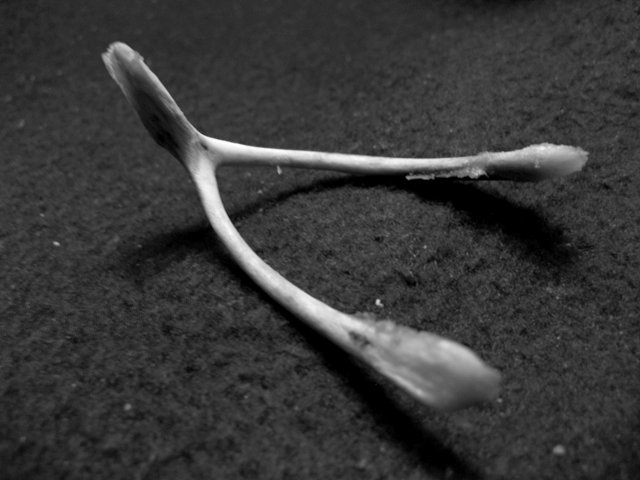
Although I will get to pangolins, I am starting with our feathered avian friends. Birds have a Y-shaped bone in their chest called a furcula (Latin for little fork). It is part of the flight apparatus and is thought to be formed by the fusion of the right and left clavicles (our collarbones). However, some researchers think it might be a different bone called the interclavicle, which in mammals is only found in monotremes, the egg-laying mammals. Some non-avian dinosaurs have a furcula, which is part of the evidence placing them on the bird family tree. The furcula is commonly called the wishbone because of the practice of making a wish on the bone! You grab one arm and someone else grabs the other; both make wishes and then pull; whoever gets the larger piece will have their wish come true.

Chicken furcula. Photo credit: Clyde Robinson/Flickr Creative Commons

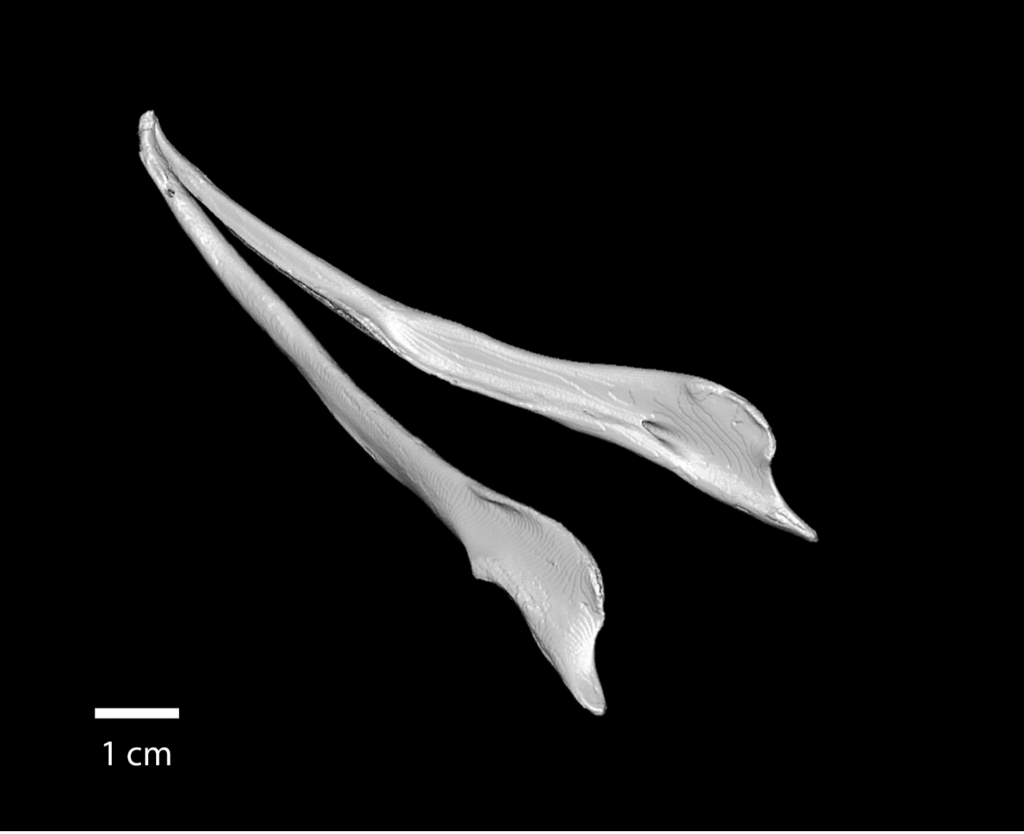
In celebration of World Pangolin Day, I want to introduce you to a mammal “wishbone.” If you search through the mammalian literature, you will not encounter a bone identified as a wishbone. Nevertheless, a small, select group of mammals have a pair of bones that looks, to me anyway, like a furcula. Here is an example.

Lower jaw of the northern tamandua, Tamandua mexicana. American Museum of Natural History 23437 made from CT scan data by Hannah Barton, University of Pittsburgh.

The lower jaw, the mandible, is made up of right and left bones called dentaries. They meet on the midline at the chin. In humans, the right and left bones are filled with teeth, fused on the midline, and don’t look like a furcula! The northern tamandua from Central America differs in that there are no teeth, the right and left bones are held together only by soft tissues, and it looks like a furcula! How does the tamandua survive without teeth? Tamanduas are social insect feeders (ants and termites) that swallow their prey whole; tamandua parents don’t have to worry about their kids chewing with their mouths open. Now, although the tamandua lower jaw looks kind of like a wishbone, when pulled apart there won’t be a winner as the split will be down the middle with the two halves the same size.

The vast majority of the 6,500 species of living mammals have teeth; some have dentaries fused like humans and some have them unfused like the tamandua. Of the 6,500 species, there are 31 that are toothless as their normal condition. These 31 fall into two camps: 15 are baleen whales, including the Earth’s largest animal, the blue whale, which are filter feeders; and 16 are social insect feeders like the tamandua. However, all 31 have a mandible that is reminiscent of an avian wishbone. The 16 social insect feeders are from three unrelated lineages that have convergently adapted to eating ants and termites. The three lineages are:

  • Spiny anteaters or echidnas (monotremes) found in Australia and New Guinea (four species).
  • True anteaters (myrmecophagids) found in South and Central America (four species including two kinds of tamandua).
  • Pangolins (pholidotans) found in Africa and Asia (eight species).

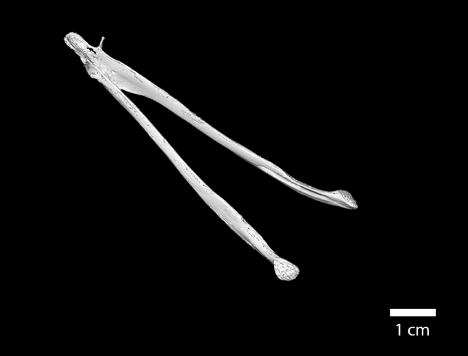
The mandibles of the #1 and #2 look like that of the northern tamandua. The left and right sides are not fused and the mandible is skinny in the front and larger in the back where it articulates with the skull. #3, the pangolins, are really different. The left and right sides are fused at the midline and the mandible is larger at the front.

Lower jaw of the Sunda pangolin, Manis javanica, United States National Museum 144418 made from CT scan data by the author.
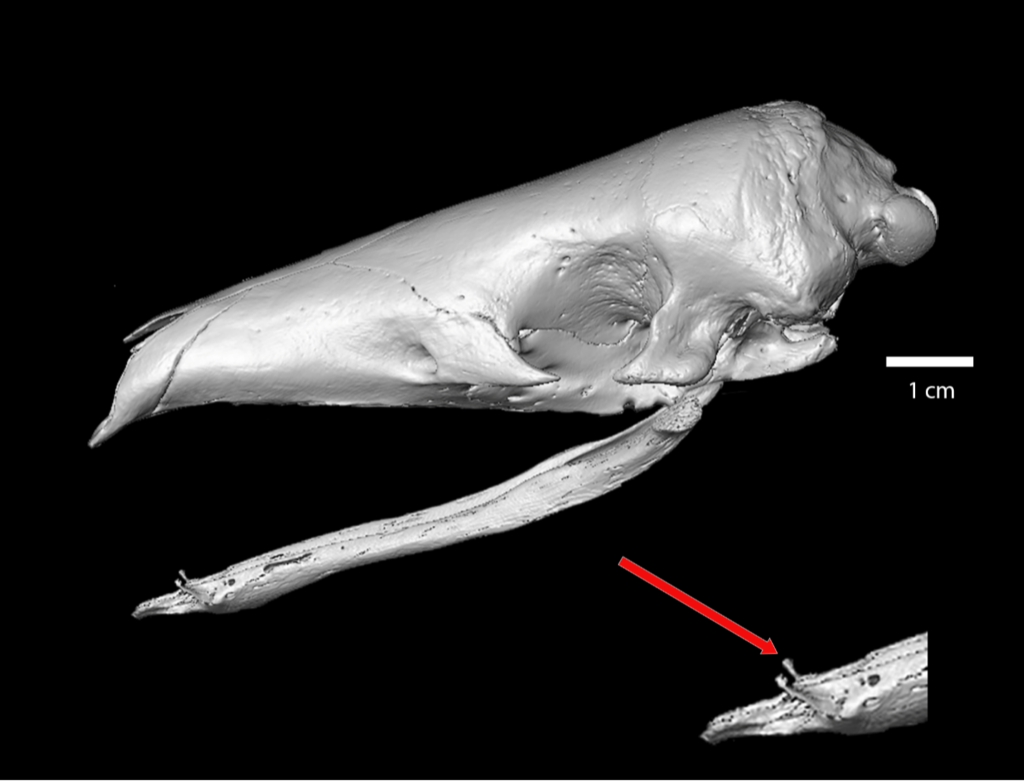
Skull of the Sunda pangolin, Manis javanica, United States National Museum 144418 made from CT scan data by the author. Red arrow points to the two bony mandibular prongs in the close-up.

The other very odd thing about the pangolin mandible is that it has a pair of bony prongs at the front that look somewhat like teeth (red arrow). Doran and Allbrook (1973: Journal of Mammalogy) dissected the pangolin tongue and reported that the lower lip was attached to these prongs, but they did not illustrate this or explain it further. Pangolins are clearly doing something different with their mandible than the tamanduas and echindas are, but what, I don’t know. Whatever it is, it has been around in pangolins for at least 35 million years! There was a pangolin that lived in the American West during the late Eocene named Patriomanis americana and it has a set of mandibular prongs just like those in the Sunda pangolin shown here. The other difference with the pangolin mandible is that when subjected to a wishbone pull, it might not break down the middle and be more like a furcula.

I have left the baleen whales until the end. Are their mandibles more like the tamandua, the pangolin, or neither?

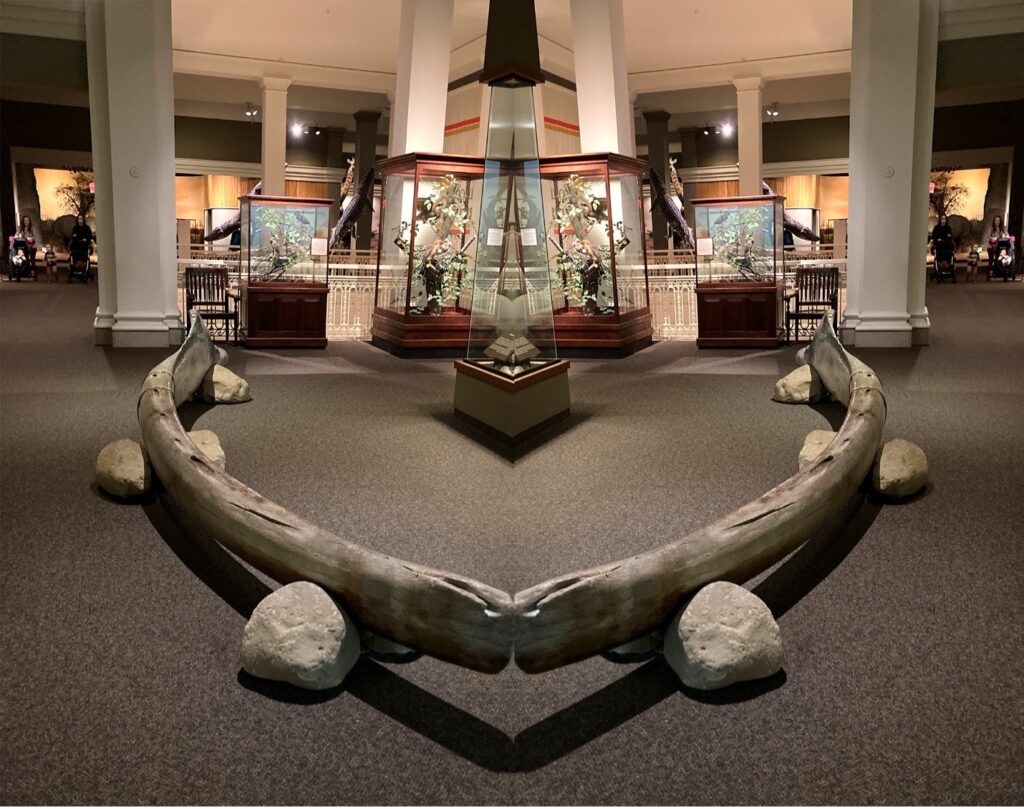
Mandible of the blue whale, Balaenoptera musculus. Only the left dentary is on display in the Hall of North American Wildlife at Carnegie Museum of Natural History. The author manipulated the photograph to create the world’s largest “wishbone.”

Baleen whales are more like the tamandua with the right and left sides unfused and the mandible larger in the back than the front. If you were able to do the wishbone pull on the blue whale, there would be no winner and someone would likely lose by throwing their back out!

John Wible is Curator of Mammals at Carnegie Museum of Natural History.

Related Content

World Pangolin Day 2023 – The Mysterious Brain Bone

World Pangolin Day 2022

E is for Echidna

Carnegie Museum of Natural History Blog Citation Information

Blog author: Wible, John
Publication date: February 16, 2024

Share this post!

  • Share on Twitter Share on Twitter
  • Share on Facebook Share on Facebook
  • Share on Pinterest Share on Pinterest
  • Share on LinkedIn Share on LinkedIn
  • Share on Reddit Share on Reddit
  • Share via Email Share via Email

Filed Under: Blog Tagged With: Hall of African Wildlife, John Wible, mammals, Science News

February 8, 2024 by Erin Southerland

A Year in Review: Bird Banding 2023

by Annie Lindsay

Nestled between the Chestnut and Laurel Ridges near the town of Rector, Pennsylvania lies Powdermill Nature Reserve, Carnegie Museum of Natural History’s environmental field research station, where ornithologists have been operating a long-term bird banding station since June 1961. In 62 years of banding birds year-round, we’ve gathered more than 830,000 banding records of nearly 200 species. Some, like the Cedar Waxwing, have tens of thousands of records in our dataset, whereas single individuals are the only representatives of other species, like Kirtland’s Warbler.

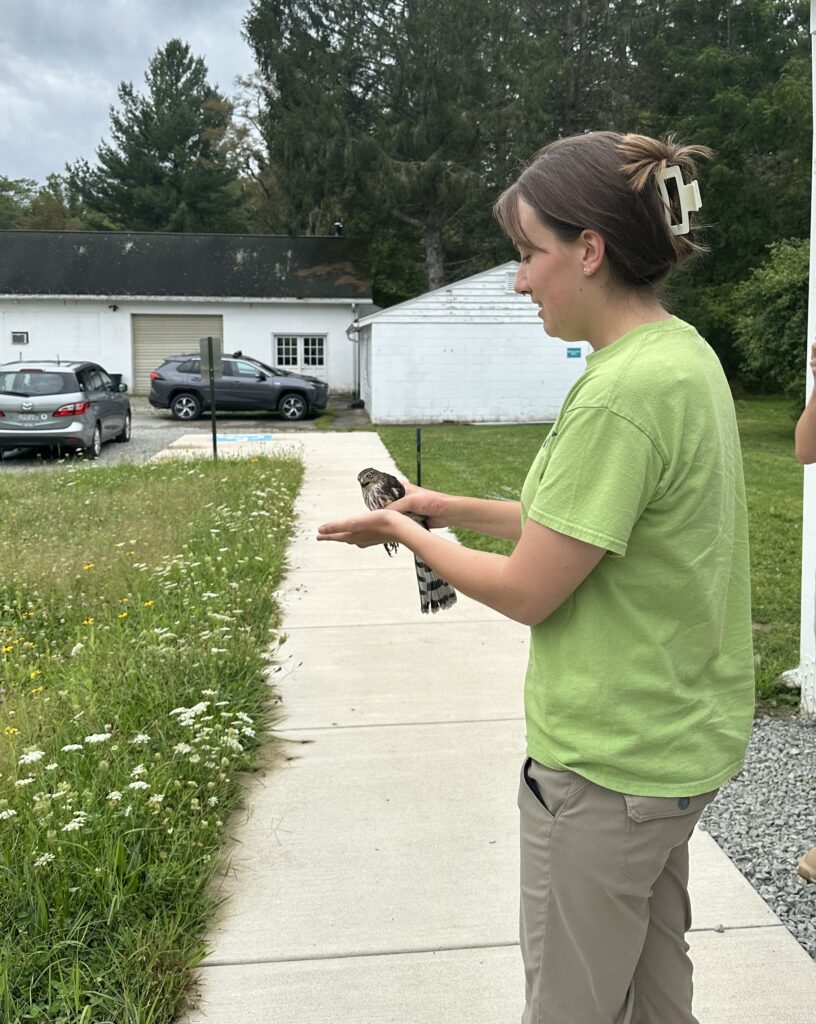
Banding Field Tech Grace Muench releasing a Sharp-shinned Hawk.
Banding Field Tech Grace Muench releasing a Sharp-shinned Hawk, one of her favorite moments from the year.

At Powdermill, we band birds all year, varying our effort seasonally, which gives us a picture of what species we expect to see at any given time of year and the relative abundance of those species. Each season brings something new. By March we are eagerly awaiting the earliest spring migrants and as spring progresses, we revel in the flood of colorful songbirds in their breeding plumage. Summer brings breeding birds and our anticipation of which individuals will return year after year. As summer fades into fall, we enjoy the subtle beauty of birds in their non-breeding plumage as they migrate south to their wintering grounds. By mid-November, almost all migrating songbirds have passed through and we are in our winter banding season, dominated by cold-hardy birds that are often recaptured between years.

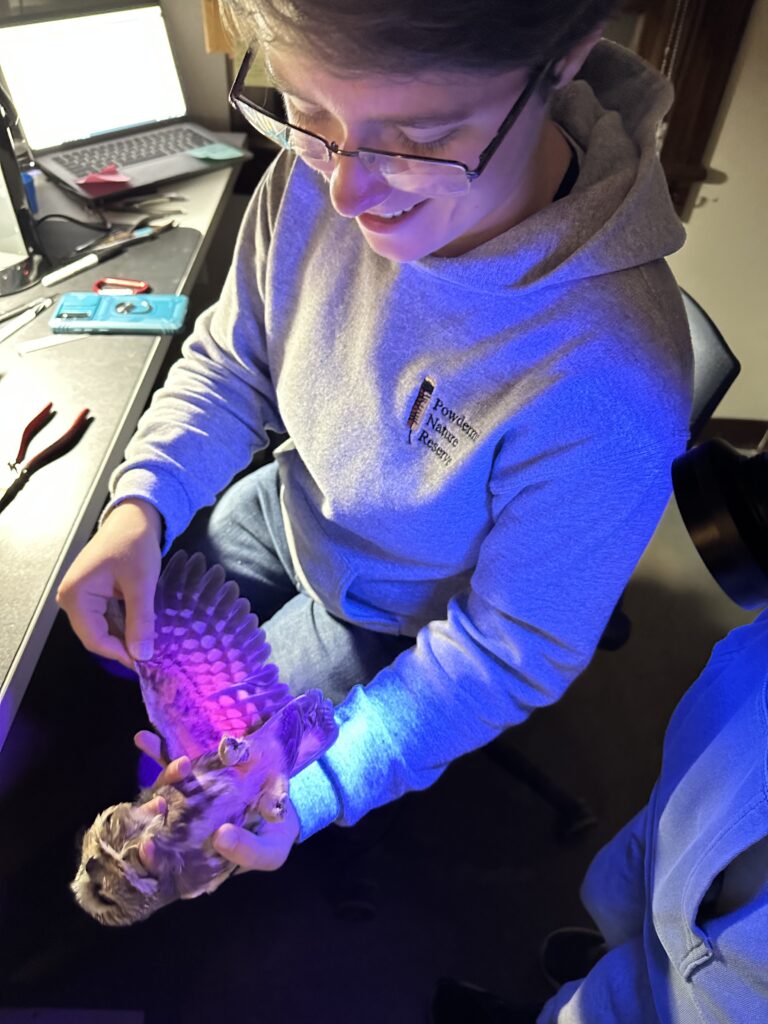
Fall Banding Field Tech Jordan Mouton using a black light to age a Northern Saw-whet Owl.
Fall Banding Field Tech Jordan Mouton using a black light to age a Northern Saw-whet Owl. Saw-whet and screech owls were the highlights of Jordan’s season.

In 2023, we banded 9,095 new birds and recaptured 5,074 individuals of 123 species (plus one hybrid). The most abundant species was Swainson’s Thrush with 631 new birds banded this year, followed by Ruby-crowned Kinglet (596), Gray Catbird (484), and Cedar Waxwing (447). The year saw slightly lower numbers than average overall, but several species had notably high captures and some even set spring or fall season records. In spring, 11 Black-billed Cuckoos edged out last year’s ten to claim that season’s record, and in the fall nine Louisiana Waterthrushes (a species that is a very early migrant and generally scarce during our fall months), 158 Ovenbirds, and two Bicknell’s Thrushes set fall high records.

We can use these numbers to compare 2023 to previous years and to totals from other banding stations, but the stories about the year’s highlights are most compelling. Each year when we analyze our data, we eagerly look for species that set new record high totals, individuals that represent early or late banding dates, or recaptures that are particularly old birds, and await reports that our banded birds have been recaptured at another station. 

This year, as in recent years, many of the species that had above average totals are species that have been increasing in southwestern Pennsylvania, which is a trend that is reflected in Christmas Bird Count data. The core of these species’ ranges has historically been a bit farther south, but they seem to have recently been expanding northward. For example, Carolina Wrens and Red-bellied Woodpeckers are year-round residents in southwestern Pennsylvania and are encountered far more often now than they were a few decades ago. Similarly, Yellow-throated Warbler is a species that tends not to breed much farther north than non-Appalachian Pennsylvania, but is a species that we’ve seen in spring attempting to establish territories and even breeding. 

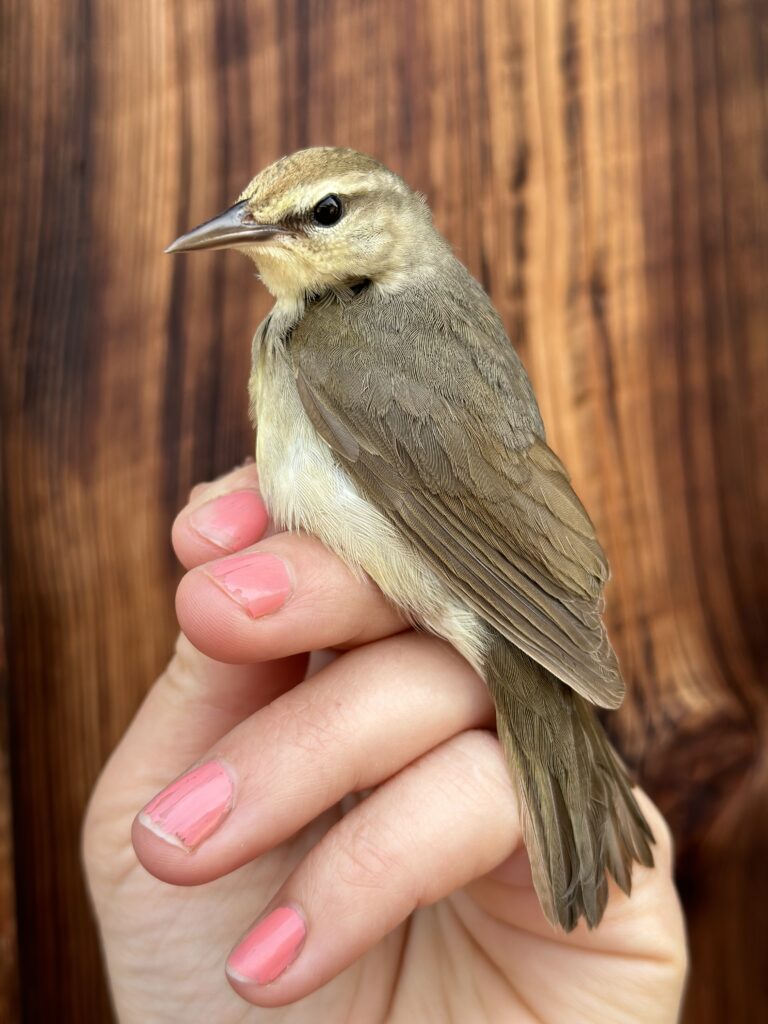
Swainson’s Warbler caught in spring 2023, the 8th of its species ever banded at Powdermill.
Swainson’s Warbler caught in spring 2023, the 8th of its species ever banded at Powdermill.

This year’s exciting captures began with a Swainson’s Warbler that was caught on May 11, only the eighth individual of that species in Powdermill’s banding dataset. Swainson’s Warblers breed significantly south of Pennsylvania in the very southern part of West Virginia, but since 2020, birders have spotted several nearby in the spring and summer and the first breeding record in the state was confirmed in summer 2023. This unexpected capture, affectionately nicknamed “Sword-billed Warbler” by the banding crew, was certainly a favorite.

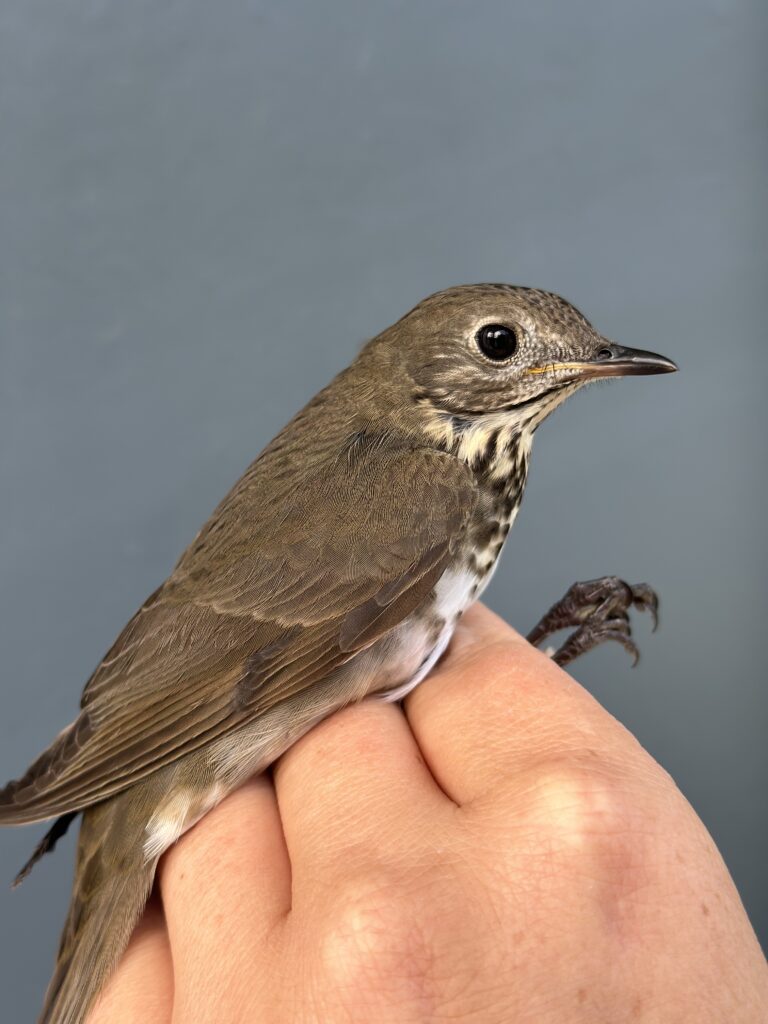
Bicknell's Thrush
The first of two Bicknell’s Thrush banded in fall 2023, a new species for Powdermill’s dataset.

This fall, something happened that is rare for a 62-year-old banding station: we added a new species to our dataset. Bicknell’s Thrush was considered a subspecies of the more common Gray-cheeked Thrush until 1995 when there was enough evidence (based on morphology, vocalizations, habitat, and migration patterns) to elevate Bicknell’s to full species status. Over the years, a few possible Bicknell’s Thrushes were banded at Powdermill, but it wasn’t until this year that two were definitively identified here, one on September 14 and one on October 8. 

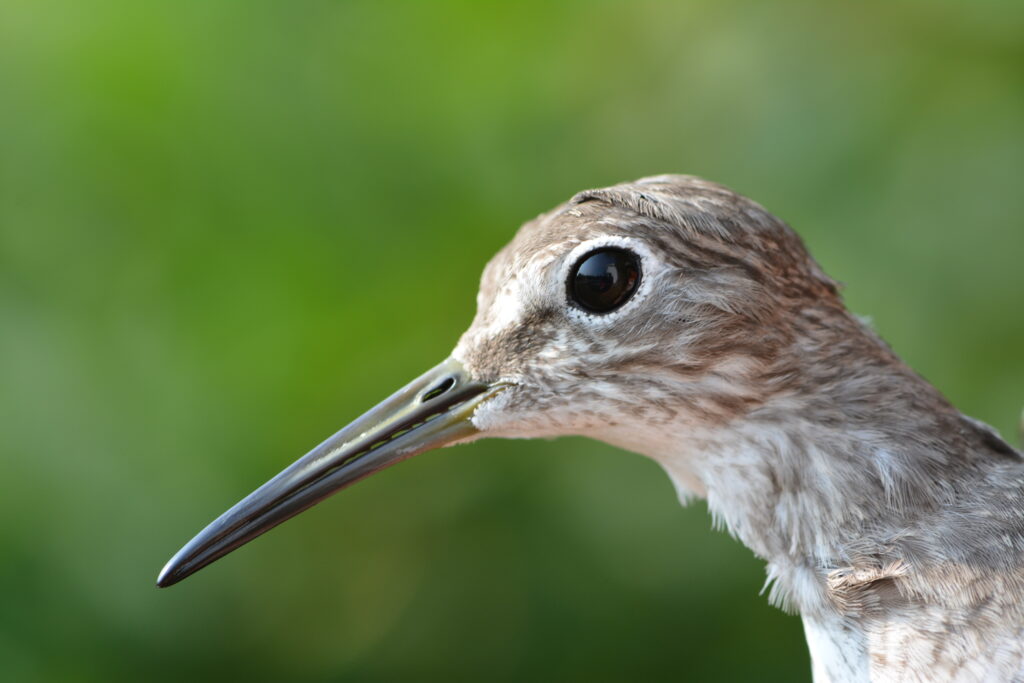
solitary sandpiper
Solitary Sandpiper, fall Banding Field Tech Lindsey Doyel’s season highlight.

One of the questions we are frequently asked is how long birds live. While it’s difficult to know how long each species lives on average, recapturing birds between seasons tells us something about how long they can live. In general, smaller birds are shorter-lived and larger birds are longer-lived. Catching a bird with a band and looking back through the data to see how long ago it was initially banded and how many times it’s been captured over the years is a highlight for the banding crew. Several notable standouts in 2023 include:

  • A Ruby-throated Hummingbird that was banded in August 2021 and aged as a bird that had hatched in a previous year was recaptured exactly two years later, making her at least three years old.

  • A Kentucky Warbler that was banded in June 2018 and aged as a bird that had hatched the previous summer was recaptured in May, making it six years old.

  • A Gray Catbird that was banded in August 2015, the summer it hatched, was recaptured this fall when it had a refeathering brood patch (the bare patch of skin on the belly that songbirds develop to help incubate eggs). This catbird was eight years old and, because female catbirds develop brood patches when they’re breeding, we were able to determine that she was breeding at Powdermill that summer.

  • Black-capped Chickadees are frequently recaptured because they’re year-round residents at Powdermill and because they tend to spend time at feeders near the banding station. Because of this, we often have their band numbers memorized and sometimes can recognize individual mannerisms. This fall, we caught one such chickadee several times; it was banded in April 2016 and aged as a bird that had hatched the previous summer, making it eight years old!
Brewster's Warbler
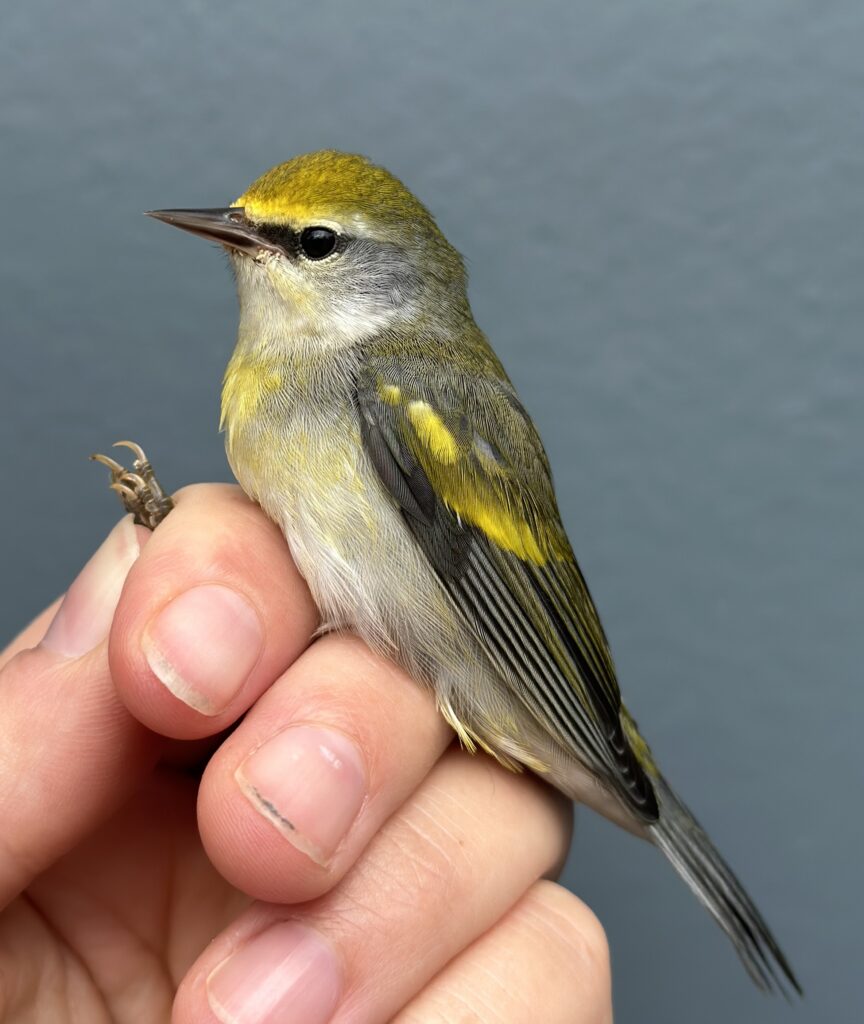
“Brewster’s” Warbler, a hybrid between Golden-winged and Blue-winged Warblers, was fall Banding Field Tech Connor O’Hea’s season highlight.

There were many more old birds captured in 2023, each one delighting the crew with its history. 

PARC is back to the winter banding schedule and we’re looking forward to what 2024 will bring us!

To learn more about bird banding, please see the post “What is bird banding?”

Annie Lindsay is the Banding Program Manager at Powdermill Nature Reserve.

Related Content

2023 Rector Christmas Bird Count Results

60 Years, One Bird at a Time

Spring Birds in Your Backyard

Carnegie Museum of Natural History Blog Citation Information

Blog author: Lindsay, Annie
Publication date: February 8, 2024

Share this post!

  • Share on Twitter Share on Twitter
  • Share on Facebook Share on Facebook
  • Share on Pinterest Share on Pinterest
  • Share on LinkedIn Share on LinkedIn
  • Share on Reddit Share on Reddit
  • Share via Email Share via Email

Filed Under: Blog Tagged With: Annie Lindsay, bird banding, Birds, parc, Powdermill Nature Reserve

  • « Go to Previous Page
  • Page 1
  • Interim pages omitted …
  • Page 3
  • Page 4
  • Page 5
  • Page 6
  • Page 7
  • Interim pages omitted …
  • Page 25
  • Go to Next Page »

sidebar

About

  • Mission & Commitments
  • Directors Team
  • Museum History

Get Involved

  • Volunteer
  • Membership
  • Carnegie Discoverers
  • Donate
  • Employment
  • Events

Bring a Group

  • Groups of 10 or More
  • Birthday Parties at the Museum
  • Field Trips

Powdermill

  • Powdermill Nature Reserve
  • Powdermill Field Trips
  • Powdermill Staff
  • Research at Powdermill

More Information

  • Image Permission Requests
  • Science Stories
  • Accessibility
  • Shopping Cart
  • Contact
  • Visitor Policies
Stay in the loop! Sign up for our newsletter(s).
One of the Four Carnegie Museums | © Carnegie Institute | Privacy Policy | Terms of Use | Accessibility
Rad works here logo