• Skip to primary navigation
  • Skip to main content
  • Skip to primary sidebar

Carnegie Museum of Natural History

One of the Four Carnegie Museums of Pittsburgh

  • Visit
    • Buy Tickets
    • Visitor Information
    • Exhibitions
    • Events
    • Dining at the Museum
    • Celebrate at the Museum
    • Powdermill Nature Reserve
    • Event Venue Rental
  • Learn
    • Field Trips
    • Educator Information
    • Programs at the Museum
    • Bring the Museum to You
    • Guided Programs FAQ
    • Programs Online
    • Climate and Rural Systems Partnership
  • Research
    • Scientific Sections
    • Science Stories
    • Science Videos
    • Senior Science & Research Staff
    • Museum Library
    • Science Seminars
    • Scientific Publications
    • Specimen and Artifact Identification
  • About
    • Mission & Commitments
    • Directors Team
    • Museum History
  • Tickets
  • Give
  • Shop

Education

August 6, 2019 by wpengine

Spiders as Interior Designers

by Megan Jones
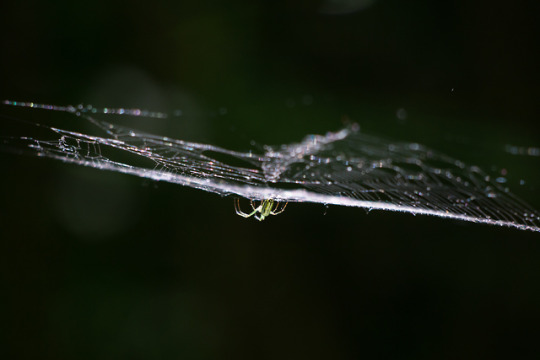
spider hanging from a spider web
A spider meticulously builds an orb web.

Did you know you can recognize a family group of spiders by the way a spider web is designed?  These web-making skills are important to a spider’s survival, and each style helps spiders catch prey in slightly different ways.

There are over 40,000 known species with different types of silk and designs. The most common four spider web designs you’ll see while exploring nature are orb webs, tangled webs, woolly webs, and sheet webs.

Silky Smooth Designs

Orb webs

Orb webs are the classic looking spider webs with a wheel-shape that allows spiders to fully enter a vertical space. Orb webs help attract prey, catching up to 250 insects per day!
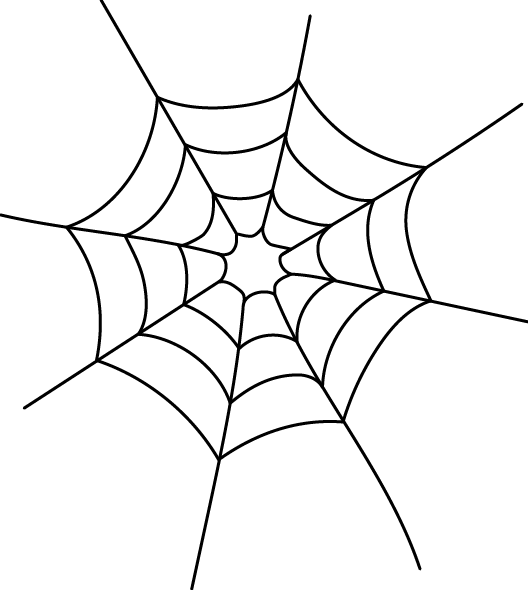
drawing of an orb web

Tangled webs

Tangled webs or cobwebs are known for their messy and shapeless design.

These are the webs you’ll see in the corner of an un-swept room. The ends of this web have sticky droplets that help catch unsuspecting prey.
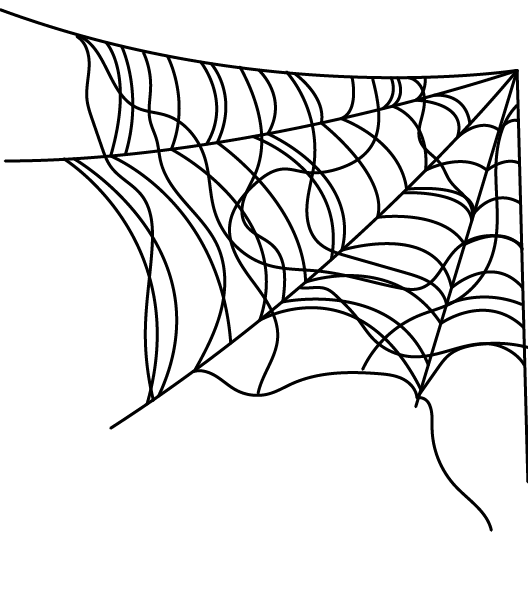
drawing of tangled web

Woolly webs

Woolly webs have a unique texture with adhesive silk. Woolly webs aren’t perfectly made but are usually built horizontally in a geometric shape.
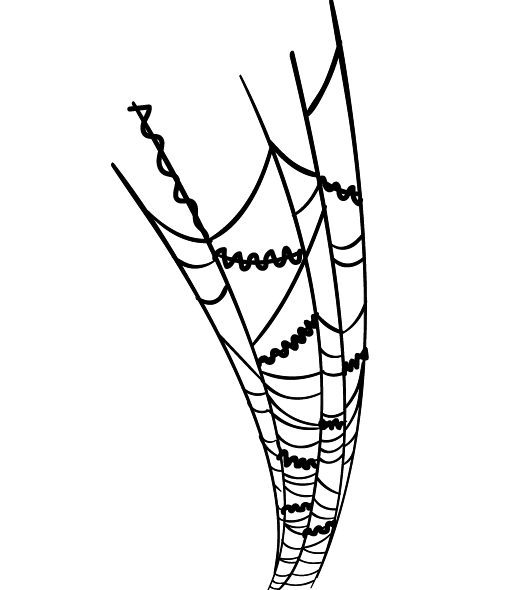
drawing of woolly web

Sheet webs

Sheet webs can be found strung across bushes acting as a maze of silk. When an insect flies into one of the silk strings, it is knocked into a net below where the spider waits for its prey.
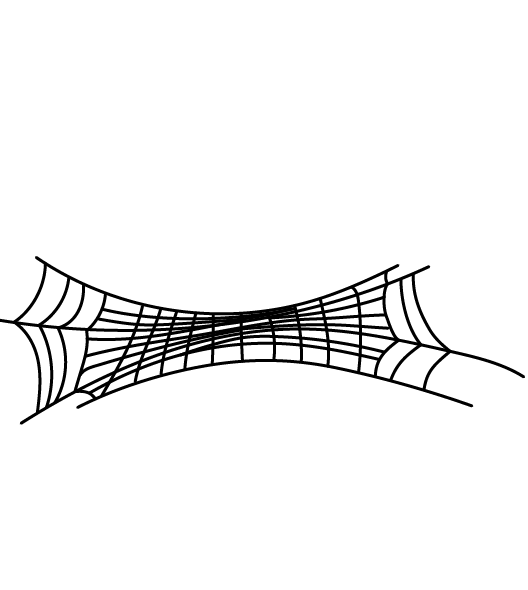
drawing of sheet web

Too Much Time On The Web

Spiders don’t just use their silk for web-building. They are known to use their silk as a trail behind them when hunting and as material for creating egg sacs. Some spiders even hang glide by sailing through the sky attached to strands of silk!

What Designs Are Around You?

Although most web designs are done with purpose, some spiders are known to actively decorate their webs. They creatively weave their webs daily. Now that you know what you’re looking for, even your backyard can be an adventure!
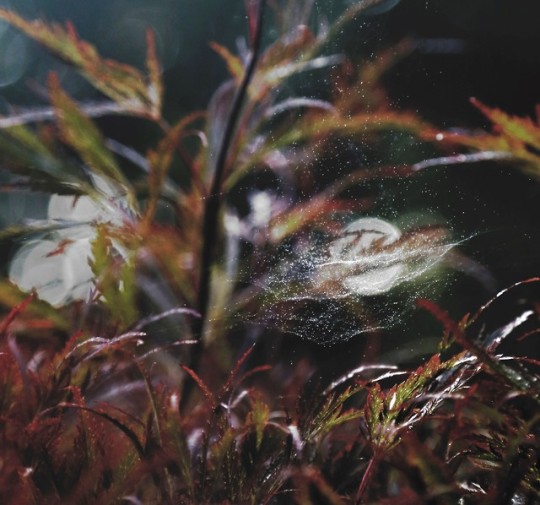
tangled spider web on a plant
A tangled web covers a plant in wait for prey to land.

Can You find all four types of webs around you? Draw a picture of each web you find!

Spider webs can be found anywhere. We recommend your backyard, the nooks and crannies of your porch, or even the corners of an undusted room in your house!

Blog post and illustrations by Megan Jones. Photos by Melissa Cagan. Museum employees are encouraged to blog about their unique experiences and knowledge gained from working at the museum.

Related Content

Spiders Catch All Sorts of Insects

Jumping Spiders

Natural History Discoveries

Carnegie Museum of Natural History Blog Citation Information

Blog author: Jones, Megan
Publication date: August 6, 2019
Share this post!

  • Share on Twitter Share on Twitter
  • Share on Facebook Share on Facebook
  • Share on Pinterest Share on Pinterest
  • Share on LinkedIn Share on LinkedIn
  • Share on Reddit Share on Reddit
  • Share via Email Share via Email

Share this post!

  • Share on Twitter Share on Twitter
  • Share on Facebook Share on Facebook
  • Share on Pinterest Share on Pinterest
  • Share on LinkedIn Share on LinkedIn
  • Share on Reddit Share on Reddit
  • Share via Email Share via Email

Filed Under: Blog Tagged With: Education, insects, Megan Jones, Melissa Cagan

June 12, 2019 by wpengine

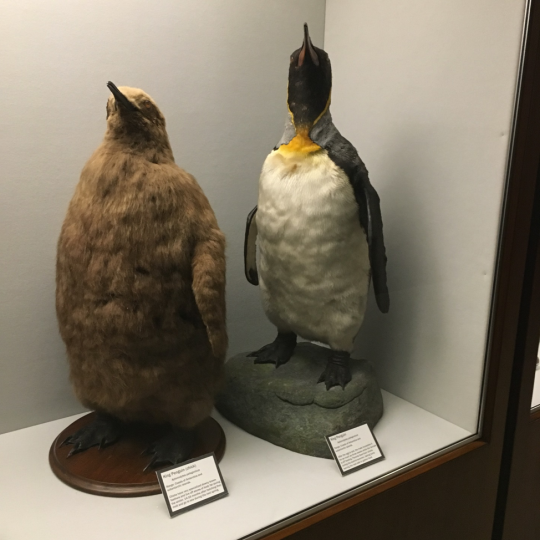
Why Do the King Penguins in Bird Hall Look so Different from Each Other?

king penguin chick and adult in Bird Hall

Visitor comments often offer insight into the effectiveness of museum displays. The most candid comments are overheard snatches of conversation, some as touching as they are humorous.

The setting: Bird Hall at Carnegie Museum of Natural History, 2:00 p.m. on a summer afternoon.

Three siblings, the oldest about nine, were studying a pair of king penguin taxidermy mounts while their mother, a few display cases away, looked at a different group of birds.

The mother walked toward her children as the nine-year-old explained the birds to his younger brother and sister, “This one is the girl penguin, and this one is the boy penguin. They really look different. The girls are brown and fuzzy, and the boys are black and white.”

The mother quickly surmised the misinterpretation and offered a gentle correction without any trace of ridicule: “The brown one’s a young bird. The label says ‘chick,’ but that doesn’t mean it’s a girl.”

Patrick McShea works in the Education and Visitor Experience department of Carnegie Museum of Natural History. Museum employees are encouraged to blog about their unique experiences and knowledge gained from working at the museum.

Filed Under: Blog Tagged With: bird hall, Birds, Education, Pat McShea, Patrick McShea

May 16, 2019 by wpengine

Learning to See, Seeing to Learn, Freshwater Insects

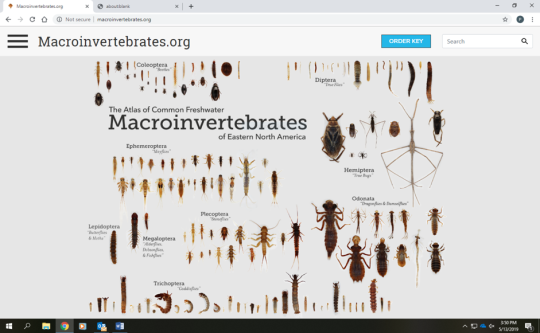
screenshot of macroinvertebrates.org

The Atlas of Common Freshwater Macroinvertebrates of Eastern North America is an online guide and accompanying set of teaching and learning resources designed to support water quality monitoring in citizen science projects and fresh water ecology education.

A suite of visual resources developed to help learners to identify fresh water insects.

For the team of entomologists, learning scientists, software engineers and designers who collaborated in the National Science Foundation-supported effort to plan, develop, test, and revise the site, six words guided the key design goals for this educational resource—Learning to See, Seeing to Learn. Team members aimed both to support the development of observational skills and provide the rich visual resources needed for observation and identification.

In freshwater environments the term macroinvertebrates refers to animals without backbones that can be seen with the naked eye. Because these insects, crustaceans, worms, and mollusks fill vital roles in aquatic food webs, their presence, absence, abundance, and diversity is key to assessing water quality in streams and freshwater bodies over time.

In early April, I spent several hours demonstrating www.macroinvertebrates.org at a table display during the Creek Connections Student Research Symposium held at the Campus Center of Allegheny College. The Meadville college has been providing opportunities for students to become stream researchers for more than 20 years, so I was confident the website would be well received by these budding young freshwater scientists.

The table displayed two iPads for visitors to explore the Macroinvertebrates.org site, a set of stream insects embedded in Lucite cubes, a traditional Riker mount of pond macros, a field microscope, and a stack of promotional postcards.

During the event I spoke with and handed-out information to approximately 100 people, a mix of middle school and high school students presenting their stream study projects, their teachers, Allegheny College students and faculty, and representatives from other organizations participating in the symposium.

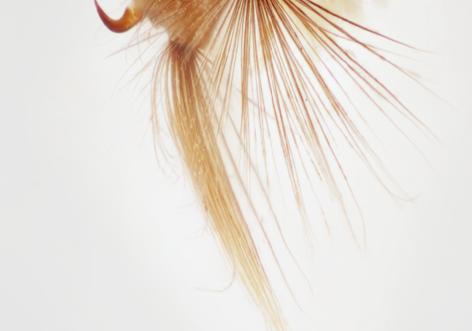
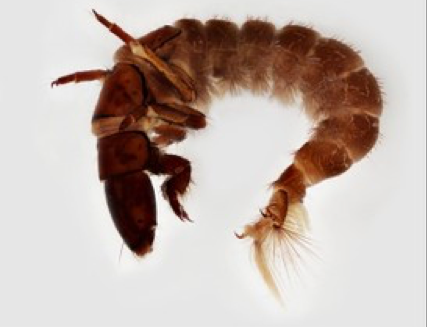
close up of caddisfly
Images showing dynamic zoomed and full-scale views of a caddisfly.

Table visitors were particularly impressed by set-ups on the paired iPads – one screen fully zoomed-in on the abstract art-like image on the “setal fan on a proleg” of a net-spinning caddisfly, the other featuring a whole-body image of the tiny beast. The companion images addressed the linked challenge of learning to see and seeing to learn.

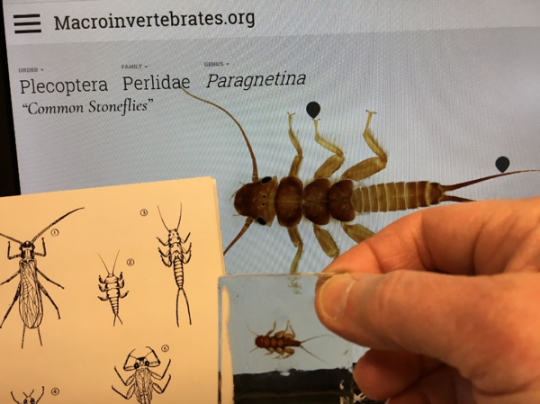
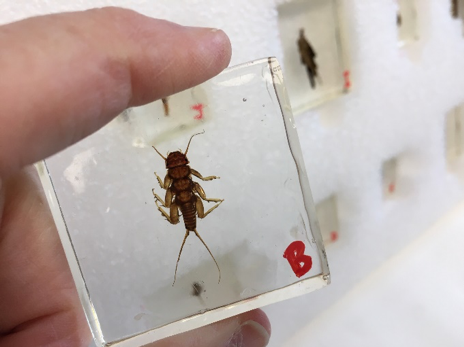
stonefly preserved in clear resin
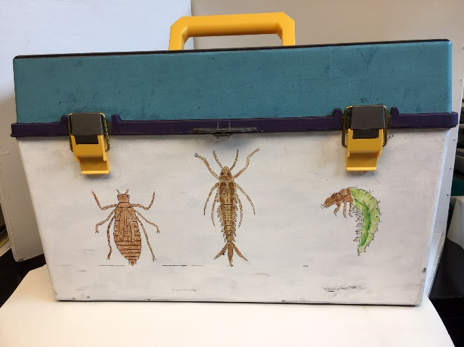
toolbox with macroinvertebrates painted on it

As teachers continue to experiment with ways for their students to use the online guide, the museum has added a set of preserved macroinvertebrates to the Educator Loan Collection. Pictured above is a stonefly embedded in a block of clear resin, and the colorfully-illustrated toolbox that contains a set of ten different specimens prepared in the same manner.

Partners involved in the development of www.macroinvertebrates.org include Carnegie Mellon University’s Human Computer Interaction Institute, University of Pittsburgh’s Learning Research & Development Center, Stroud Water Research Center, Clemson University, and Carnegie Museum of Natural History.

Patrick McShea works in the Education and Visitor Experience department of Carnegie Museum of Natural History. Museum employees are encouraged to blog about their unique experiences and knowledge gained from working at the museum.

Filed Under: Blog Tagged With: Education, Educator Loan Program, Educator Loans, Educator Resources, Invertebrate Zoology, Macroinvertebrates, Pat McShea, Patrick McShea

April 23, 2019 by wpengine

Broken Egg Evidence

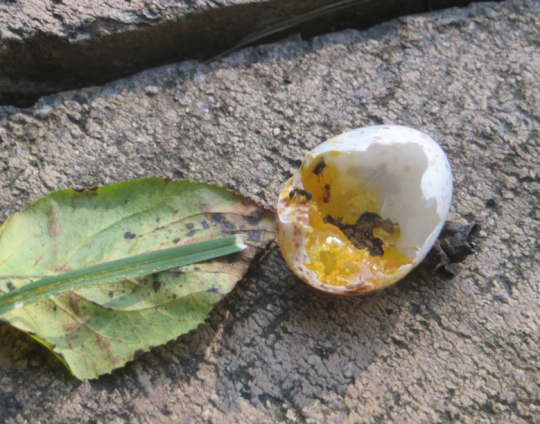
Challenges involving eggs aren’t limited to the Easter season. The pictures below are of songbird egg shells I came across in early July of 2018. Each fragment hints at a different outcome for the developing bird that once occupied the structure. My speculation about those outcomes is mainly informed by details about the places where the shells were found, critical information not captured in the photographs.

broken egg on the ground

This northern cardinal egg shell fragment rested on a brick sidewalk near a forsythia bush where a pair of the birds had been observed nesting. Blue jays frequented the area, as did eastern chipmunks. Either could have removed an egg from the nest, broken the shell, eaten much of the contents, and left drying yolk for ants to scavenge.

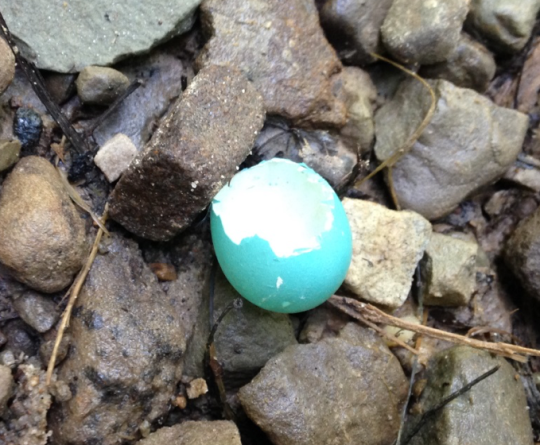
broken blue egg among rocks

It’s likely this wood thrush egg fragment was deliberately dropped by a parent bird as part of routine post-hatch nest-keeping duties. The blue shell rested on a gravel State Game Lands road inMercer County, a place that echoed with flute-like Wood Thrush song. The fragment’s spotless interior was evidence that this egg had almost certainly been opened by its occupant rather than a nest visitor.

Patrick McShea works in the Education and Visitor Experience department of Carnegie Museum of Natural History. Museum employees are encouraged to blog about their unique experiences and knowledge gained from working at the museum.

Filed Under: Blog Tagged With: Birds, Education, eggs, Pat McShea, Patrick McShea

March 29, 2019 by wpengine

Adventures with Taiji Nelson

“If you stop and look with some intention, you can find some really amazing things…”

Taiji Nelson

Frick Park has an extensive network of trails and is home to more wildlife than you might imagine.  Taiji Nelson is there to help you explore it all.

“When nature shows up for you as an educator, it’s so great…”

Taiji works for the Pittsburgh Parks Conservancy at the Frick Environmental Center as a Naturalist Educator.  What does that mean?  It means that he works with middle school and high school students to look at ecosystems in the parks and restore park health.  He shows students how parks can connect communities and introduce people to nature.

A red-belied woodpecker sips from a water droplet.

“Finding a salamander, finding a snake, finding an owl…you don’t expect to be able to see that kind of stuff in the middle of a city, in the middle of Pittsburgh, but it’s out here.”

“An interest in nature can be a really strong force to connect people.”

Taiji loves parks because he thinks they are places where groups of people can come together and be excited about being outside.

“There’s a ton of value in bringing people with different perspectives together.  Being a queer person of color, I understand the value of meeting people who think differently than you and being able to find common ground.”

“I’m the hype man for nature.”

Nature is always there for adventurers who want to see new and exciting things.  Taiji is there to guide those adventurers along.

A World of Wonder

In the parks, Taiji has seen all sorts of interesting sights. There are always birds flying from tree to tree, there are great horned owls that come out when it gets dark, and even a beaver that’s been known to frequent a stream in the park’s ravine.

Explore nature together.  Visit Nature 360 for activities and information.

Blog post by Melissa Cagan. 

Filed Under: Blog Tagged With: Education, Melissa Cagan, Nature 360, Pittsburgh, Taiji Nelson

February 7, 2019 by wpengine

Bird is the Word

bird at bird feeder

February’s here and you know what that means… it’s time for the Great Backyard Bird Count!  Since 1998, people all over the world have participated annually in the Great Backyard Bird Count to collect information on wild birds by observing areas in their own neighborhoods.  Last year people from over 100 countries participated!  The Great Backyard Bird Count gathers data to help scientists figure out what is happening to bird populations around the globe.  That means YOU can contribute to science just by taking time to look outside your windows.  Scientists can’t be everywhere, and that’s where you come in!

Birds, Birds, Everywhere

The best part about the bird count is… it’s really easy (and free) to join in!  All you need is a way to note your observations (a task perfect for your handy nature notebook), access to the internet, and your enthusiasm!  You can look at a local park, your yard, or anywhere you want to go — data from everywhere is useful!

Ready, Set, Count!

bird on a branch

Before you start looking for birds, you’ll want to set up an online account through the Great Backyard Bird Count’s website.  Once that is ready, all you have to do is spend at least 15 minutes looking outside at any time between February 15th and February 18th.  Count the number of birds and different species you see, and then submit your observations through your online account. Scientists will use the data, and you can use the information to explore what kinds of birds other people have seen nearby.

Some questions you might help scientists answer are:

-“How does weather and climate change affect bird populations?

-“How are diseases that birds can catch, like the West Nile virus, affecting birds in different areas?”

-“Are there bird species that only live in certain locations such as cities or rural areas?”

Lord of the Wings

The Christmas Bird Count, which happens at the end of December, found over 24,000 birds in Pittsburgh in 2018.  There were 71 different species represented in the total count.  Let’s see if we can find even more birds this February!  Follow this link to get ready!

Explore nature together. Visit Nature 360 for more activities and information.

Blog post written by Melissa Cagan and Rachel Carlberg.

Filed Under: Blog Tagged With: Anthropocene, bird hall, birding, Birds, Education, Melissa Cagan, Nature 360, Rachel Carlberg

  • « Go to Previous Page
  • Page 1
  • Interim pages omitted …
  • Page 12
  • Page 13
  • Page 14
  • Page 15
  • Go to Next Page »

sidebar

About

  • Mission & Commitments
  • Directors Team
  • Museum History

Get Involved

  • Volunteer
  • Membership
  • Carnegie Discoverers
  • Donate
  • Employment
  • Events

Bring a Group

  • Groups of 10 or More
  • Birthday Parties at the Museum
  • Field Trips

Powdermill

  • Powdermill Nature Reserve
  • Powdermill Field Trips
  • Powdermill Staff
  • Research at Powdermill

More Information

  • Image Permission Requests
  • Science Stories
  • Accessibility
  • Shopping Cart
  • Contact
  • Visitor Policies
One of the Four Carnegie Museums | © Carnegie Institute | Privacy Policy | Terms of Use | Accessibility
Rad works here logo