• Skip to primary navigation
  • Skip to main content
  • Skip to primary sidebar

Carnegie Museum of Natural History

One of the Four Carnegie Museums of Pittsburgh

  • Visit
    • Buy Tickets
    • Visitor Information
    • Exhibitions
    • Events
    • Dining at the Museum
    • Celebrate at the Museum
    • Powdermill Nature Reserve
    • Event Venue Rental
  • Learn
    • Field Trips
    • Educator Information
    • Programs at the Museum
    • Bring the Museum to You
    • Guided Programs FAQ
    • Programs Online
    • Climate and Rural Systems Partnership
  • Research
    • Scientific Sections
    • Science Stories
    • Science Videos
    • Senior Science & Research Staff
    • Museum Library
    • Science Seminars
    • Scientific Publications
    • Specimen and Artifact Identification
  • About
    • Mission & Commitments
    • Directors Team
    • Museum History
  • Tickets
  • Give
  • Shop

fossils

October 15, 2019 by wpengine

Carnegie Geologists Win National Award

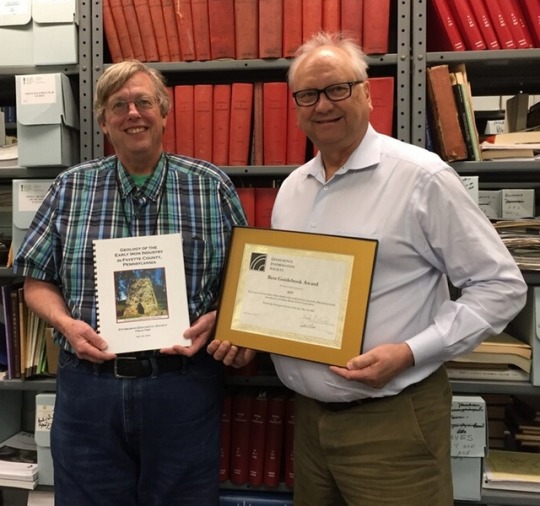
John Harper and Albert D. Kollar.

In the fall of 2018, Albert D. Kollar and John A. Harper (volunteer and research associate) of the Section of Invertebrate Paleontology in collaboration with the Pittsburgh Geological Society conducted a geology field trip titled: Geology of the Early Iron Industry in Fayette County, Pennsylvania. Back then, we had no idea this field guide would be recognized by the Geoscience Information Society with their GSIS Award 2019 for Best Guidebook (professional) at the Annual Meeting of the Geological Society of America (GSA). On September 23, 2019, Albert attended the Awards Luncheon in Phoenix, Arizona, to receive the GSIS Award.
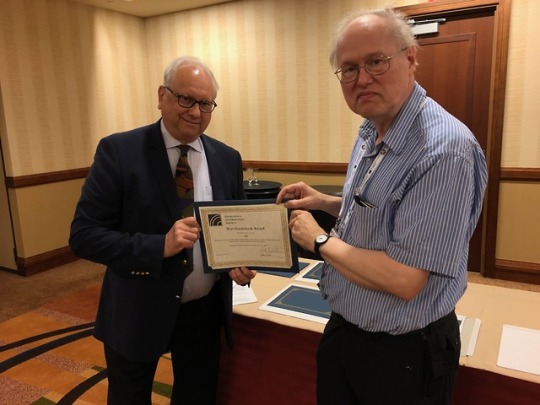
Albert D. Kollar and Michael Noga representing Geoscience Information Society.

As stated by the GSIS committee chair, “The Geology of the Early Iron Industry in Fayette County, Pennsylvania is well-written and well-illustrated, with both professional and popular sections. I can see local geology teachers taking students on these trips to show a chapter in the development of an important early ore industry in the United States. With the aid of detailed road logs guidebook users can see and learn about the geology, industrial development, history, and fossils in Fayette County. Field Trip leaders can use the guidebook to expand on several topics, depending on the interests of their trip attendees. An additional benefit of the guidebook is its free availability online, so any traveler with an interest in the area can explore on their own. The Pittsburgh Geological Society has performed a great model for other local societies that are interested in spreading the benefits of their field trips to wider audiences.”

In receiving the award, Kollar opined that the guidebook has been recognized for the diverse geology of the region and the many historical sites that can be seen and visited respectively throughout southwestern Pennsylvania. These include, the geology of Chestnut Ridge, a Mississippian-age limestone quarry with abundant fossils and Laurel Caverns, the history of oil and gas exploration, the historic Wharton Charcoal Blast Furnace, the geology of natural gas storage, the country’s First Puddling Iron Furnace, and the birth place of both coke magnate Henry Clay Frick and Old Overholt Straight Rye Whiskey, West Overton, Westmoreland County, Pennsylvania.

Another feature of the guidebook is its dedication to Dr. Norman L. Samways, retired metallurgist, geology enthusiast, and good friend who spent many years as a volunteer with the Invertebrate Paleontology Section of the Carnegie Museum of Natural History.  Sam, as we called him, passed away in February 2018.  His contribution came about when he was instrumental in the research and writing of the Geology and History of Ironmaking in Western Pennsylvania, with his co-authors John A. Harper, Albert D. Kollar, and David J. Vater, published as PAlS Publication 16, 2014. Moreover, Sam was solely responsible for a new historical marker, AMERICA’S FIRST PUDDLING FURANCE along PA 51, dedicated on September 10, 2017 by the Pennsylvania Historical & Museum Commission and the Fayette County Historical Society. David Vater contributed to the guidebook’s content by drawing a schematic diagram of a typical puddling iron furnace, which is greatly appreciated. Key fossils and iron ores of the section’s collection are referenced as well. The cataloged fossils cited in peer review journals authored by section staff and research associates includes those on the trilobites by Brezinski (1984, 2008, and 2009), Bensen (1934) and Carter, Kollar and Brezinski (2008) for brachiopods, and Rollins and Brezinski (1988) for crinoid-platyceratid (snail) co-evolution.

In recent years, the section has run highly successful regional field trips about various geology and paleontology topics based on the museum collections, collaborations with the Pittsburgh Geology Society, the Geological Society of America, Osher Institute of the University of Pittsburgh, Nine-Mile Run Watershed, Allegheny County Parks, Pittsburgh Parks Conservancy, Montour Trail, Carnegie Discovers, and the section’s own PAlS geology and fossil program. A future field trip is being planned to assess the dimension stones that built the Carnegie Museum and noted architectural building stones of Oakland.

Albert D. Kollar is the Collection Manager in the Section of Invertebrate Paleontology at Carnegie Museum of Natural History. Museum employees are encouraged to blog about their unique experiences and knowledge gained from working at the museum.
Filed Under: Blog Tagged With: Albert Kollar, Anthropocene, fossils, geology, invertebrate paleontology, western pennsylvania

August 12, 2019 by wpengine

Travels with a Sketchbook: A Natural History Artist’s Observations at the Museum

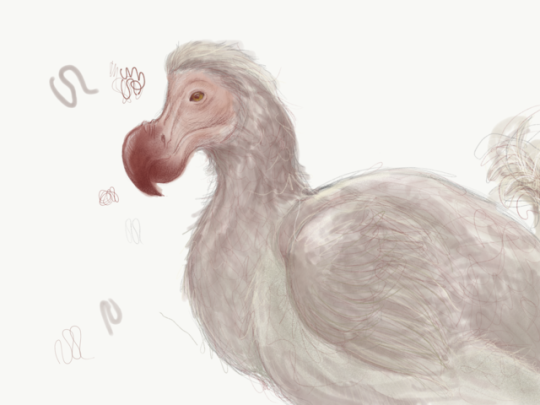
Carnegie Museum of Natural History has a large and expansive collection of artifacts, oddities, and wonders. It also has its fair share of mounted animals and skeletons on display, which makes it an ideal spot for the wandering artist. Where else can an artist study both extinct and extant species up close and in great detail? If, like me, you’re an illustrator who loves to draw animals, you could, for example, grab your sketchbook and head to the museum’s Bird Hall to get a close look at the flightless dodo (Raphus cucullatus). Driven to extinction by European colonists during the 1600s, early artists’ renderings provide some of the best evidence for the dodo’s appearance in life. Perhaps surprisingly, this bird is now known to be closely related to pigeons!

Dodo (Raphus cucullatus) in Bird Hall at Carnegie Museum of Natural History. Sketch by the author.

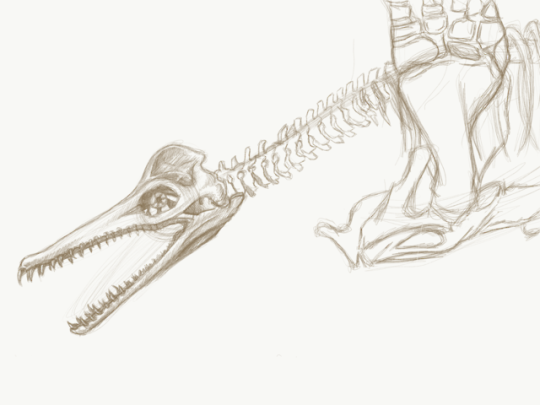
If your tastes are more prehistoric, check out the museum’s sprawling Dinosaurs in Their Time exhibition. Travel back in time to ancient seas and imagine the graceful movements of the plesiosaur Dolichorhynchops bonneri while the giant carnivorous mosasaur Tylosaurus proriger hovers ominously above you. These marine reptile groups vanished in the mass extinction that also wiped out non-avian dinosaurs roughly 66 million years ago.

Skeleton of the short-necked plesiosaur Dolichorhynchops bonneri in the Dinosaurs in Their Time exhibition at Carnegie Museum of Natural History. Sketch by the author.

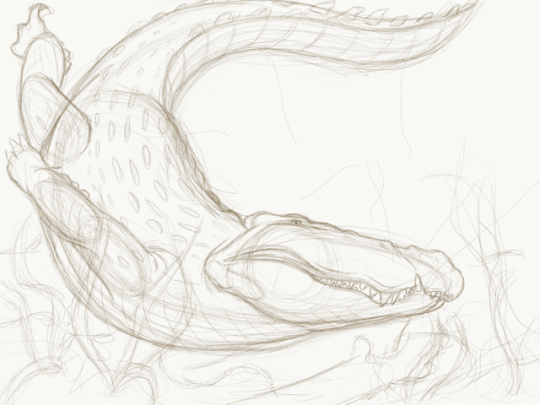
Or perhaps you’re more interested in observing and sketching modern day animals? If so, visit the Hall of North American Wildlife and Hall of African Wildlife on the museum’s second floor. Get up close and personal with the Nile crocodile (Crocodylus niloticus) trio and capture their anatomy in detail. It’s the safest way to do so – not to mention the only way to do so here in Western Pennsylvania! (Reports of alligators in our rivers notwithstanding.)

Nile crocodile (Crocodylus niloticus) in the Hall of African Wildlife at Carnegie Museum of Natural History. Sketch by the author.

So, my fellow artists and nature lovers, as I hope this post has shown, there are scores of species to inspire you here at the museum. Grab your sketchbook and come on over!

Hannah Smith is an intern working with Scientific Illustrator Andrew McAfee in the Section of Vertebrate Paleontology at Carnegie Museum of Natural History. Museum employees, interns, and volunteers are encouraged to blog about their unique experiences and knowledge gained from working at the museum.
Related Content

Celebrating Women in the Natural History Art Collection

Art and the Animal

New Vision of Old Rock Art

Carnegie Museum of Natural History Blog Citation Information

Blog author: Smith, Hannah
Publication date: August 12, 2019

Share this post!

  • Share on Twitter Share on Twitter
  • Share on Facebook Share on Facebook
  • Share on Pinterest Share on Pinterest
  • Share on LinkedIn Share on LinkedIn
  • Share on Reddit Share on Reddit
  • Share via Email Share via Email

Filed Under: Blog Tagged With: Andrew McAfee, bird hall, Birds, dinosaurs in their time, fossils, Hall of African Wildlife, Vertebrate Paleontology

April 1, 2019 by wpengine

Bayet’s Bounty: The Invertebrates That Time Forgot

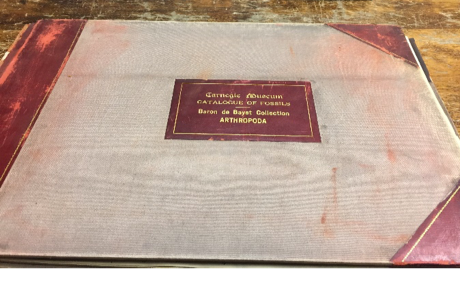
book about the baron de bayet collection
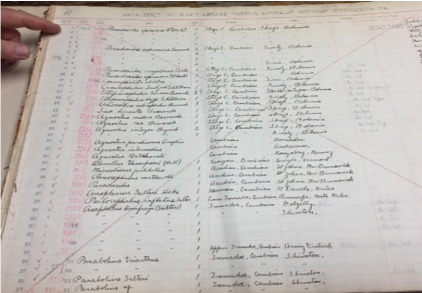
interior of book about baron de bayet collection

Albert Kollar, Collections Manager for the Carnegie Museum of Natural History Section of Invertebrate Paleontology, is on a mission to re-examine the Bayet Collection, a collection of 130,000 invertebrate and vertebrate fossils brought to the Carnegie more than 100 years ago.  Albert is re-examining the invertebrate portion of the Bayet (pronounced “Bye-aye”), which as it turns out, is 99.9% of the collection.

The story starts with a last-minute trip that began on July 8, 1903 by Carnegie Director William Holland, who had received word of a world-class fossil collection that had been put up for sale in Europe by the Baron de Bayet, secretary to the cabinet of Leopold II of Belgium.  Holland immediately booked passage to Europe on the steamer “New York” to complete the deal.  At stake were 130,000 invertebrates, combined with a small number of vertebrate fossils (several on display in the Dinosaurs in Their Time exhibition), sought by museums throughout Europe, Great Britain and the United States.  This collection became the largest addition to the department of paleontology at the Carnegie Institute, since the discovery of the dinosaur Diplodocus carnegii, at Sheep Creek, Wyoming in 1899.

Mr. Carnegie personally wrote a check for $25,000 for the project, a sum so large it exceeded the entire 1903 budget for all art and natural history acquisitions combined. Eventually, Mr. Holland negotiated a price of just under $21,000 with the Baron de Bayet for the entire collection. Another $2,300 was spent to pack, insure and transport everything back to Pittsburgh.  Twenty men and women worked for three weeks to meticulously wrap each fossil in cotton, batting, or straw and by September 1903, two hundred and fifty-nine crates arrived safely in Pittsburgh.  Storage of the crates was an issue, since the Carnegie Museum building would not be completed until 1907; so Mr. Holland rented space in a warehouse on 3rd Street in Pittsburgh for storage of 210 of the 259 crates.

This decision, however, almost destroyed the collection when a fire broke out on the upper floors of the 3rd Street warehouse.  On December 30, 1903, Mr. Holland wrote, “Yesterday brought with it a fire in which it appeared as if the Bayet collection, the acquisition of which we had so prided ourselves, was destined to go up in smoke.”  Fortunately, the Pittsburgh Fire Department contained the fire to the upper floors and the Bayet collection, stored on the lower floor, and meticulously wrapped and crated, survived with minimal damage. The crates returned to the Carnegie Institute to dry out.

In early 1904, William Holland hired Dr. Percy Raymond, a graduate of Yale University, to be the first curator of Invertebrate Paleontology.  His primary directive was to catalog and organize the Invertebrate portion of the Bayet collection. Today, over 100 years later, Albert Kollar with the help of Pitt Geology student E. Kevin Love, is undertaking a multi-year project to translate Percy Raymond’s beautifully hand-written catalogs and to migrate all 130,000 specimens into a new database.

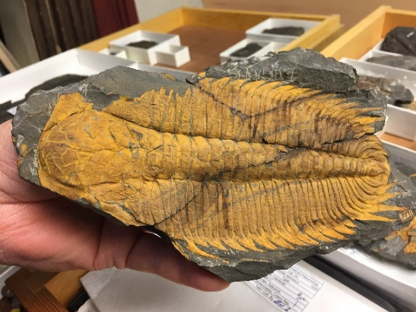
Pictured below is (BH1) the very first Bayet specimen cataloged by Percy Raymond.  BH1 is an exquisite 510-million-year-old, CM 1828 Paradoxides spinosus, a 17.17 cm or 7” long trilobite from Skreje, Bohemia – or the Czech Republic of today.

trilobite fossil

Albert’s goal in revisiting the Bayet collection is to better understand the great history of the how, why and where of fossils collected in the late 19th century, especially in Europe the birthplace of paleontology and geology.  “This project will give us insight into why certain Bayet fossils were recovered from classic European fossil localities, many of which are designated stratotype (significant geologic time reference) regions.  These fossils and localities have been used to document the validity of evolution, extinction, and the Geologic Time Scale over the last 100 years.  With an improved database, we hope to better appreciate the scientific value of the entire collection and create new statistical measures for future research and education.”

When asked if he expected any surprises as we go forward, Albert smiled, “Not until all the data has been analyzed will we have an opportunity to review the collection’s full scientific worth.”

Check back in a few months, Bayet’s invertebrates may have a few secrets yet to share.

Many thanks to Carnegie Museum Library Manager, Xianghua Sun for help researching this post.

Joann Wilson is an Interpreter in the Education department at Carnegie Museum of Natural History. Museum employees are encouraged to blog about their unique experiences and knowledge gained from working at the museum.
Filed Under: Blog Tagged With: Albert Kollar, Andrew Carnegie, fossils, geology, invertebrate paleontology, paleontology, Pittsburgh, SWK2, Trilobite, William Holland

March 19, 2019 by wpengine

March Mammal Madness Update

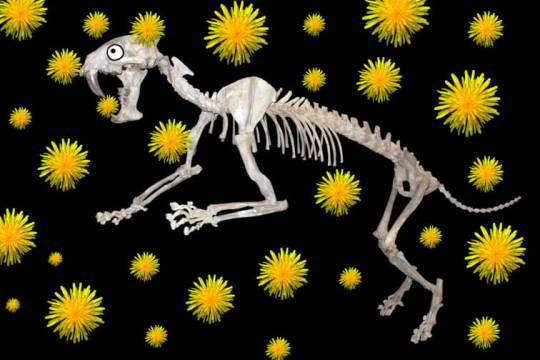
sabertooth cat fossil on black background with yellow dandelions

It’s time to break out the big cats.

Last night’s matches pitted various “cats” against each other, although some cats were only cats in name (for example, the catfish and antlion).

Our most anticipated match had a nimravid (a fossil false sabertooth cat) versus a dandelion. We weren’t sure if the nimravid would only be fossilized bones and stand little chance against the dandelion, or if the nimravid would come to life and be allergic to dandelions. So when the contest began, the nimravid was alive but it began sneezing and as a by-product bit down decapitating the fearsome dandelion. If you fancy seeing a real nimravid, there is one on display in Cenozoic Hall at the Carnegie Museum of Natural History.

For more details on this year’s tournament, click here.

Blog post courtesy of the Section of Mammals. 

Filed Under: Blog Tagged With: Age of Mammals, Cenozoic Hall, fossils, mammals, paleontology, Section of Mammals, Vertebrate Paleontology

January 17, 2019 by wpengine

Preserving Fossil Treasures: Eocene Fishes from Monte Bolca, Italy

by Linsly Church

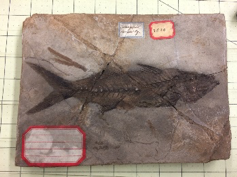
In 1903, Carnegie Museum of Natural History purchased an enormous private fossil collection from the Baron Ernest de Bayet of Brussels, Belgium. Over a 40-year period the Baron had amassed a collection comprising tens of thousands of individual fossils. At age 65 he married a much younger woman and sold the collection to fulfill her dream of having a house on the shore of Italy’s Lake Como. Within the collection are fossils from all over Europe. Fossils from Italy include the Monte Bolca fish collection, which contains about 290 beautifully-preserved specimens that date to about 50 to 49 million years ago, early in the Eocene Epoch.

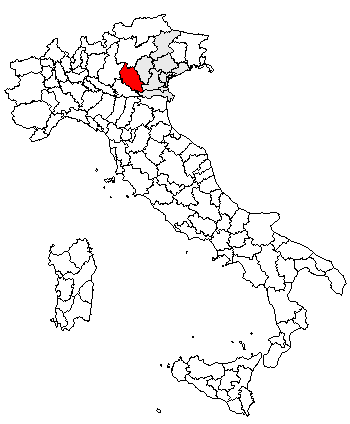
map of Italy highlighting the province of Verona
The province of Verona (in red) in Italy, where the Monte Bolca site is located.

One quarry at Monte Bolca has been owned by the same family for almost 400 years. It is known as the Pesciara, meaning the fishbowl, because many of the marine fossils found there are those of fishes. Because the preservation is so good in some layers of limestone, the site is considered a Lagerstätte. A Lagerstätte is a site that contains exquisitely-preserved fossils, typically representing a diversity of organisms. At Monte Bolca, some fishes and other creatures have preserved internal organs and even skin pigmentation, the result of an anoxic (oxygen-poor) environment that hindered decay and scavenging. The fossil site also differs from most others in that it is an underground mine with tunnels instead of a typical open quarry.

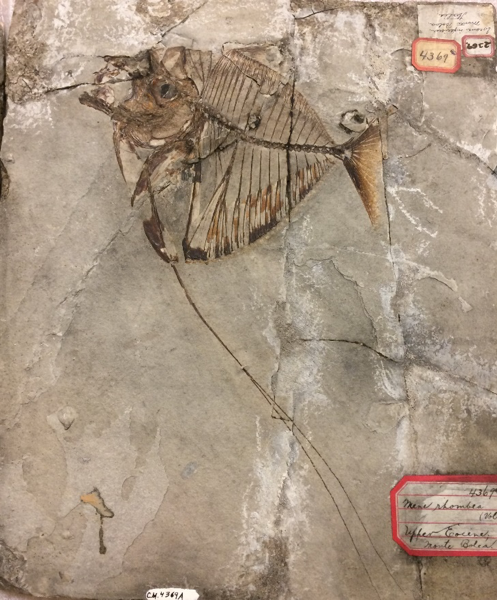
fish fossil
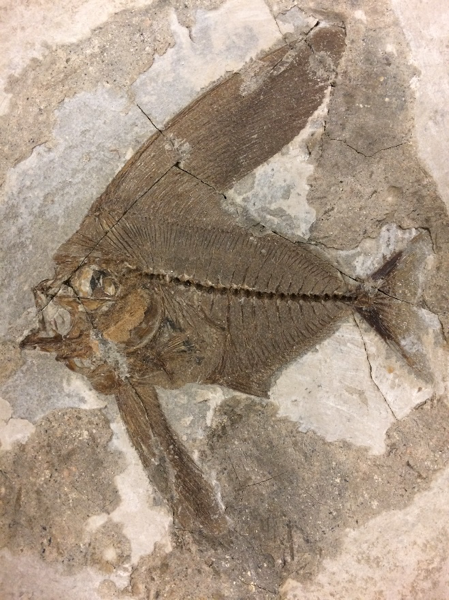
fish fossil
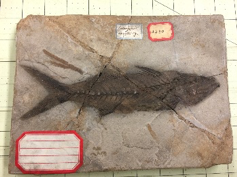
Two of Carnegie Museum of Natural History’s most spectacular ~50 million-year-old fossil fishes from Monte Bolca, Italy. Top: specimen number CM 4369, belonging to the moonfish Mene rhombea. Bottom: specimen CM 4467, belonging to the spadefish Exellia velifer. Note the dark stains in the eye sockets, which are vestiges of the original eye pigments of these ancient fishes.

Carnegie Museum of Natural History’s collection of fishes from Monte Bolca is currently undergoing conservation. In the past, the museum’s Vertebrate Paleontology collection was housed on open shelves in rooms with poor air filtration systems, resulting in soot from the local steel industry building up on the fossils. In recent years, the museum has installed an HVAC system in the Vertebrate Paleontology collection rooms, which has greatly reduced the particulates that make it into these rooms and onto the specimens. In the years since these measures were taken, we in Vertebrate Paleontology have commenced a general cleaning of our specimens, starting with our fishes from Monte Bolca.

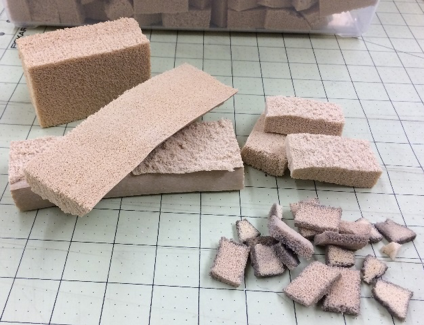
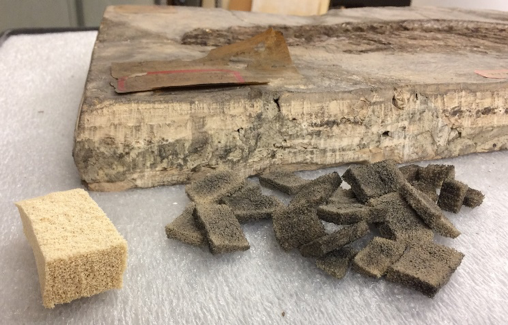
To clean the specimens, we use a soot sponge (or chemical sponge), which is also used by restoration companies to clean after fires. “Chemical sponge” is a slightly misleading name because there are no chemicals added to the sponge. It is made of vulcanized rubber and has tiny pores on its surface that collect fine soot particles without depositing chemicals on the fossil. Therefore, there is no need for water or additional solvents when using these sponges. Wet cleaning of soot can cause staining on the surface that is being cleaned so it is very important to use dry cleaning methods such as chemical sponges. In some cases, the soot on the specimens is so dense that it is obvious where cleaning has taken place.

clean soot sponges
dirty soot sponges
Before and after: clean soot sponges, prior to use (top); dirty soot sponges, after use (bottom) (with the source of the soot—a newly cleaned fossil fish from Monte Bolca—in the background).
fish fossil
fish fossil
fish fossil
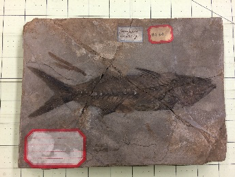
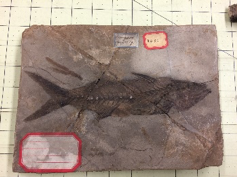
Evolution of a fish, roughly 50 million years after the fact. From top to bottom, the same fossil fish specimen from Monte Bolca (CM 4530, Carangopsis dorsalis) in four successive stages of cleaning.

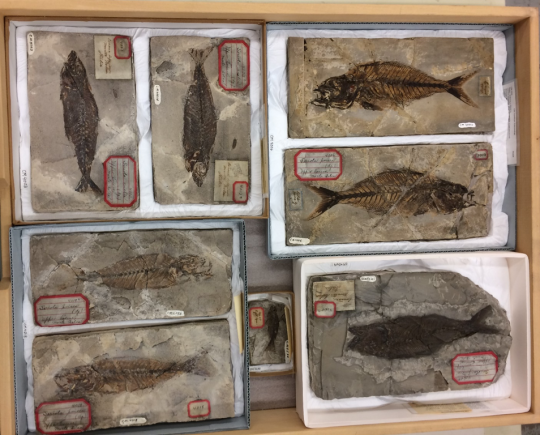
Once the specimens have been cleaned, repairs are made as needed and labels are reattached if they are delaminating from (or falling off of) the specimen. Then, storage mounts are created for specimens as needed using archival materials. These materials are made specifically to be as neutral or inert as possible so as not to give off gases that could react harmfully with the specimens. Storage mounts are important because they reduce the amount of times someone needs to touch the specimen—which, in turn, reduces breakage—and protect the specimen from vibration when the compactors in which it is housed are opened and closed. These measures will help to protect the integrity of the specimens for years to come.

A drawer full of recently-cleaned Monte Bolca fishes in their new storage mounts.

Linsly Church is the curatorial assistant for the Section of Vertebrate Paleontology at Carnegie Museum of Natural History. Museum employees are encouraged to blog about their unique experiences and knowledge gained from working at the museum.
Related Content

Early Bats: Ancient Origins of a Halloween Icon

Meet the Mysterious Mr. Ernest Bayet

Sharing Shipping Space with Amphibians and Reptiles

Carnegie Museum of Natural History Blog Citation Information

Blog author: Church, Linsly
Publication date: January 17, 2019

Share this post!

  • Share on Twitter Share on Twitter
  • Share on Facebook Share on Facebook
  • Share on Pinterest Share on Pinterest
  • Share on LinkedIn Share on LinkedIn
  • Share on Reddit Share on Reddit
  • Share via Email Share via Email

Filed Under: Blog Tagged With: fossils, Linsly Church, Vertebrate Paleontology

October 22, 2018 by wpengine

Trilobites in the Collection of the Carnegie Museum of Natural History

by Albert Kollar

trilobite

Trilobites are members of an extinct group of marine animals that lived in the ancient seas of the Paleozoic Era (542 Ma to 251 Ma) a time span of 291 million years. In comparison, dinosaurs as a group lived no more than 186 million years. Trilobites belong to the phylum Arthropoda, animals whose body plan are segmented with jointed appendages. Arthropods include many living and fossil groups that may be familiar: horseshoe crabs, eurypterids, sea spiders, scorpions, spiders, ticks, mites, barnacles, ostracods, centipedes, and millipedes. The good eating arthropods are lobsters, crabs, and even insects are a delicacy in certain societies.

The Section of Invertebrate Paleontology has a fantastic collection of trilobites. The trilobite collections are organized among the Paleozoic rocks of western Europe (i.e., Czech Republic and France), Ontario, Canada, and the United States. The collection from the United States is a reflection in part of the history of the section’s trilobite research and field collecting over 115 years. Trilobite paleontologists who helped grow the collection are Brezinski, Raymond, Taylor, Loch, and Shaw (all last names). These scientists spent years  collecting from across the United States: Missouri, Pennsylvania, New York, Maryland, Oklahoma, Arkansas, New Mexico, Illinois, Indiana, Iowa, Ohio, Texas, Minnesota, Montana, Vermont, Virginia, and West Virginia as well as collecting n Canada. Based on the discoveries, they published 35 papers citing 67 new species and 7 new genera. All specimens are housed in the section’s type trilobite collection. Among the new trilobites published, one specimen stands out Ameropiltonia lauradanae (Brezinski), 2000. Collected by Dr. David K. Brezinski, Associate Curator adjunct in the Section of Invertebrate Paleontology from the Chouteau rocks of north central Missouri. In 2004, Ameropiltonia lauradanae was selected as the section’s logo fossil.

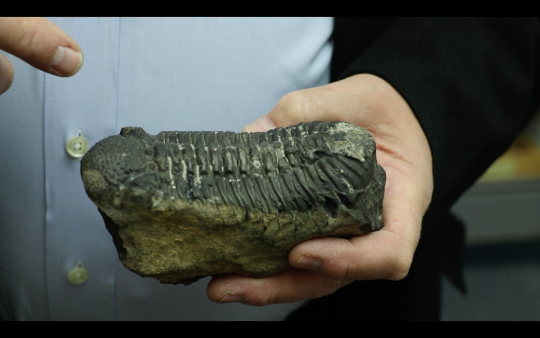
Another logo fossil is the state fossil of Pennsylvania. Probably to most Pennsylvanians, it is surprising that somehow the General Assembly of the Commonwealth of Pennsylvania would set aside state business and politics to vote and designate a trilobite (pronounced TRI-lobe-ite), Phacops rana (Green), the official state fossil in 1988. We thank the General Assembly of the Commonwealth of Pennsylvania for their vote assisting Pennsylvania’s school children’s endeavors to learn about fossils.

Phacops rana is an index fossil for the Middle Devonian (382 million years ago to 393 million years ago) age rocks of the Devonian Period. An index fossil is a designation confirmed by geologists and paleontologists that indicate rocks to be of a certain geologic age. Phacops rana is found in the Devonian rocks of Pennsylvania, New York, Ontario, Ohio, and Michigan. The section has many individual specimens of Phacops rana fossils including a few enrolled specimens and one rock slab with seven specimens.

Albert D. Kollar is collection manager in the Section of Invertebrate Paleontology at the Carnegie Museum of Natural History. Museum employees are encouraged to blog about their unique experiences and knowledge gained from working at the museum.
Filed Under: Blog Tagged With: Albert Kollar, fossils, invertebrate paleontology, Trilobite

  • « Go to Previous Page
  • Page 1
  • Page 2
  • Page 3
  • Page 4
  • Interim pages omitted …
  • Page 8
  • Go to Next Page »

sidebar

About

  • Mission & Commitments
  • Directors Team
  • Museum History

Get Involved

  • Volunteer
  • Membership
  • Carnegie Discoverers
  • Donate
  • Employment
  • Events

Bring a Group

  • Groups of 10 or More
  • Birthday Parties at the Museum
  • Field Trips

Powdermill

  • Powdermill Nature Reserve
  • Powdermill Field Trips
  • Powdermill Staff
  • Research at Powdermill

More Information

  • Image Permission Requests
  • Science Stories
  • Accessibility
  • Shopping Cart
  • Contact
  • Visitor Policies
One of the Four Carnegie Museums | © Carnegie Institute | Privacy Policy | Terms of Use | Accessibility
Rad works here logo