• Skip to primary navigation
  • Skip to main content
  • Skip to primary sidebar

Carnegie Museum of Natural History

One of the Four Carnegie Museums of Pittsburgh

  • Visit
    • Buy Tickets
    • Visitor Information
    • Exhibitions
    • Events
    • Dining at the Museum
    • Celebrate at the Museum
    • Powdermill Nature Reserve
    • Event Venue Rental
  • Learn
    • Field Trips
    • Educator Information
    • Programs at the Museum
    • Bring the Museum to You
    • Guided Programs FAQ
    • Programs Online
    • Climate and Rural Systems Partnership
  • Research
    • Scientific Sections
    • Science Stories
    • Science Videos
    • Senior Science & Research Staff
    • Museum Library
    • Science Seminars
    • Scientific Publications
    • Specimen and Artifact Identification
  • About
    • Mission & Commitments
    • Directors Team
    • Museum History
  • Tickets
  • Give
  • Shop

Invertebrate Zoology

November 7, 2018 by wpengine

Why One Bug Just Won’t Do…

by Bob Androw

When visitors tour the insect collections in the Section of Invertebrate Zoology, the conversation often turns to numbers. How many rooms house the collection? Three, all quite full. How many total drawers are in those rooms? Well, roughly 30,000, at last count. How many specimens are in those drawers? We like to quote a figure of 13 million, give or take a few (but no one has counted recently). How many staff members are there to take care of all those bugs? Well – seven on a good day – that’s just 1,857,143 specimens per staff member…

And then the big questions always hit – why do you have so many specimens? Why do you have so many of the same species?

While there are many rarities represented by one to just a few specimens, the truth is that the majority of species are represented by several to many hundreds of individuals, referred to as a ‘series.’ So how do these series end up in the collection, and what is the purpose for multiple examples of individual species?

A simple answer, but not one that explains much, is that the age of the collection alone contributes to long series, especially of common species. Since its founding in 1896, if just a single red-spotted purple butterfly (Limenitis arthemis (Drury)), were deposited each year, 122 specimens would now be present. But the series of that common species probably numbers ten times that by now. So how, and why?
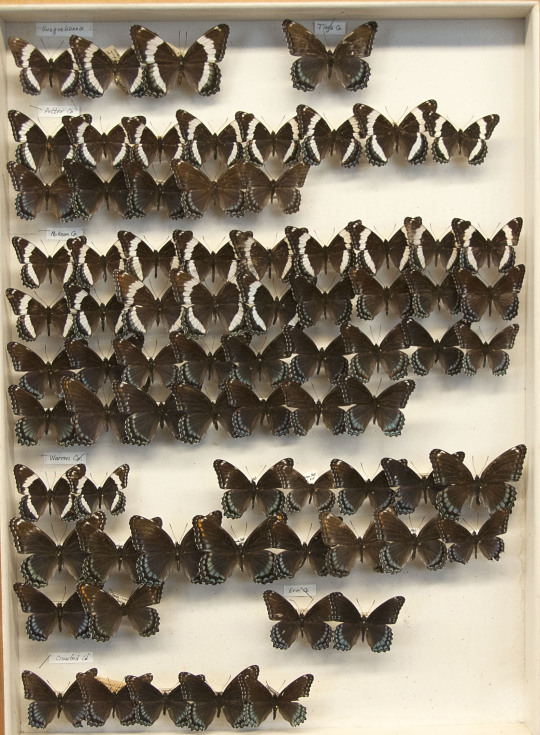
set of butterfly specimens

Over the years, museum staff have been active in traveling and collecting and were, and are, continually adding new materials to the collection. But an even greater number of specimens have come in the form of donations – entire collections, representing lifetimes of work, often come to us after their owner’s passing. These are sometimes from professional entomologists, but more often they are the legacy of non-professional, avocational collectors. These donated collections all vary drastically in their holdings, but common species are generally present, increasing the length of series of these taxa in the museum’s collection.

Back to all those red-spotted purples! Collected by a variety of people in a variety of places and times, they provide examples of the individual variation within the species, as well as critical locality and temporal documentation – or data – that help researchers understand the life history and distribution of the species. In these times of increasing global temperatures, the old data can be used as a baseline to compare against current information – does the butterfly still occur where it had in the past? Does it occur further north, now that the climes are more temperate in areas that used to be too cold? Or has it been pushed into higher elevations to evade hotter conditions in its historical habitat? By having large series, there is more data to help fill out the story of this butterfly species’ life history – past and present.

When those red-spotted purples were caught, the collectors were probably aware of what species they were – but what about species that cannot be easily identified in the field? The vast majority of insects are small to minute and cannot be identified until they are prepared and examined under a microscope. In the insect world, small size is coupled with enormous diversity. Entomologists regularly collect long series in the field to increase the odds of documenting more diversity – more specimens likely mean more species.

Not only is there a great diversity of species, but many insects exhibit variation within a species – in size, in color, and in differences between females and males. Populational differences are often evident within a species – sometimes to the extent that subspecies are described, discrete in their distribution and readily separated by physical characteristics. In the longhorned beetle Gaurotes cyanipennis (Say), individuals vary in color from blue to green to coppery to purple and all color forms can usually be found together in any given locality. But if you examine a long series of museum specimens you will notice the majority of specimens collected in the central third of Pennsylvania are all purple – rarely any other colors. The reason for this has not yet been determined, but by having long series of this common beetle, the trend can be seen, and questions can be asked.
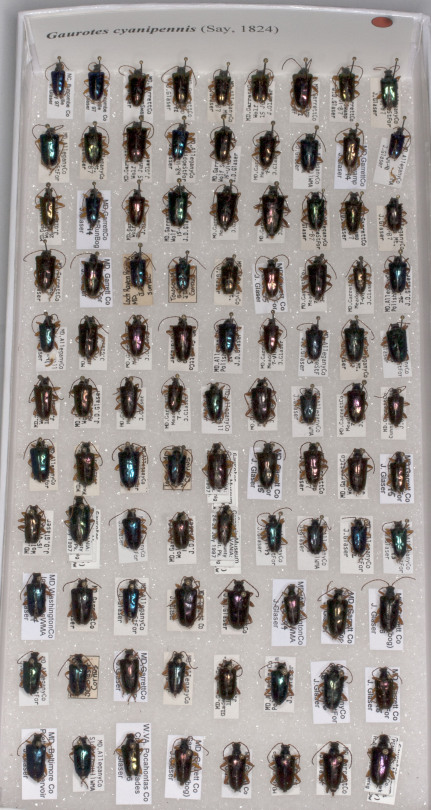
set of longhorned beetle specimens

Insects can be collected by hand, one specimen at a time, but to more fully sample the biodiversity of a habitat, various types of traps can be deployed: pitfall traps; light traps; intercept and malaise traps; baited traps; with many specially designed to capture specific taxa. Traps allow for passive collecting over time, greatly increasing the volume, and diversity, of specimens compared to what a person could capture by hand. These trap samples can provide long series of specimens, insight into the biodiversity of a habitat and good data on population sizes. Select specimens are prepared, labeled and deposited in the collection and the remainder of the trap sample is archived to be available for future research. The specimens are not unlike the scores of books on a library’s shelves, their data labels all containing a little piece of the story about a living creature’s existence, documenting its occurrence in some place, at some time, on our planet.

So, when asked “why so many?”, the answer is multi-faceted: accumulation of specimens over time, from staff activity and donations of materials; the sheer biodiversity of insects composed of thousands of species; and long series documenting variation, distribution and seasonal occurrence. And chances are, as you read this, dozens more specimens are being added to the amazing insect collection at the Carnegie Museum of Natural History.

Bob Androw is a Scientific Preparator in Invertebrate Zoology. Museum employees are encouraged to blog about their unique experiences and knowledge gained from working at the museum.
Filed Under: Blog Tagged With: biodiversity, Bob Androw, Invertebrate Zoology

October 29, 2018 by wpengine

What is a caterpillar database?

What is a caterpillar database? Curatorial Assistant in Invertebrate Zoology Catherine Giles introduces the larval collection and how it is organized. Learn how the section of Invertebrate Zoology collects and pickles specimens, then how they are stored and matched to a digital database of images and written notes.

Ask a Scientist is a video series where we ask our research staff questions about the millions of amazing objects and specimens stored in our museum collection. Tune in on YouTube, and submit your own questions via Twitter @CarnegieMNH!

Filed Under: Blog Tagged With: Ask a Scientist, caterpillars, Catherine Giles, Invertebrate Zoology

September 26, 2018 by wpengine

Kids and Caterpillars: Fostering a Child’s Interest in Nature by Rearing Lepidoptera (Moth and Butterfly) Larvae

by James W. Fetzner Jr.

We hear a soft THUMP! as another large bug hits the sheet after being drawn in to the bright mercury vapor light on this moonless night in the mountains of Montana. Upon hearing that sound, our usual questions arise … “What was that?” or “Humm…Who are you?” My 9-year-old son and I try to determine if the new arrival to the sheet is a species that is new, or one that we have already seen this evening. In this case, we note that it appears to be a new brownish moth with slivery patches on its wings, a species that is new to us and a good choice for one of our attempted rearings. We scramble to capture it in one of our empty “live jars” before it flies away, in the hopes of eventually getting some eggs.

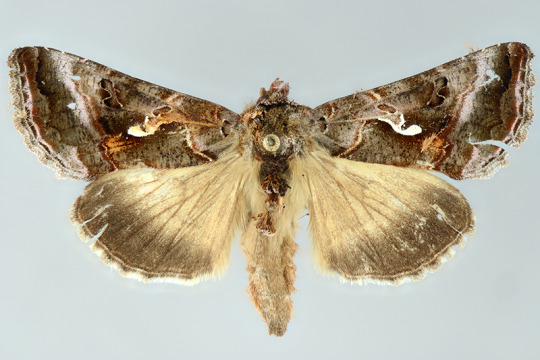
specimen of Female of Autographa pseudogamma (Grote, 1875) from Montana.
Female of Autographa pseudogamma (Grote, 1875) from Montana.

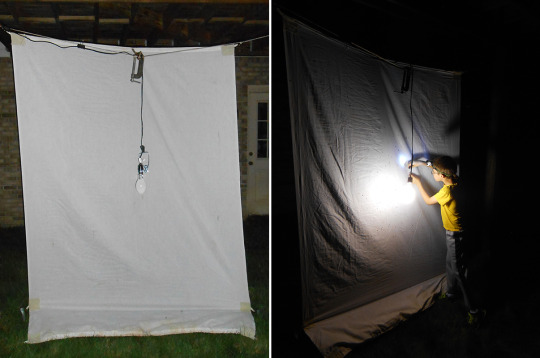
One of the easiest ways to encounter and collect insects from the wild is to erect a “bug sheet” at night and attract them en masse to your location, rather than expending a lot of effort trying to catch them individually by hand. As a scientist working in the vast insect collection at the Carnegie Museum of Natural History (CMNH), I often find myself bringing a bug sheet with me when I travel, especially when visiting family in other parts of the country. Not only does this help add specimens to our ever-expanding insect research collection, but it also serves as a fun way to experience the diversity of insects from different regions of our country. It is also an activity that kids really enjoy and engage with, and they always seem to have a great time catching interesting and colorful bugs. Even those that say they don’t like bugs seem to get caught up in the excitement when a large beetle or moth lands on the sheet.

side-by-side photos of collecting insects outside on bedsheets
Insect collecting sheet. A, the “bug sheet” setup. B, Collecting moths at the bug sheet.

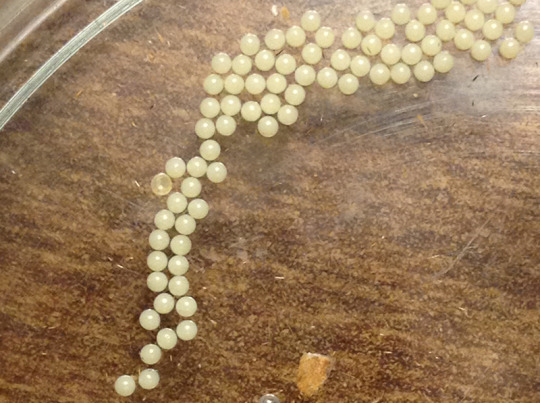
After a few hours of collecting cool bugs at the sheet the night before, my son and I wake up in the morning and check our assortment of live jars with an air of anticipation. Nothing in that one, or in that one. But wait, look at the bottom of that jar. See those little pale-yellow dots all over? Those are what we were hoping for…eggs!! Our female moth laid a bunch of eggs!  So, now the fun begins.

pale yellow eggs in the bottom of a jar
An example of pale-yellow eggs laid in the bottom of a “live jar.” Source was a female Pyrrharctia Isabella (J.E. Smith, 1797), also known as the Isabella tiger moth or banded woolly bear.

A little research in our trusty moth field guide and we determined that our bug was a species known as Autographa pseudogamma (Grote, 1875), the Delicate Silver Y moth. We also discovered that the caterpillar and host plant for this moth were unknown, (i.e., have never been described or characterized in the scientific literature). We realize that this is a great opportunity, not only to have fun rearing some caterpillars of a new species of moth that we have not encountered before, but we could also contribute to the scientific knowledge about this species by publishing a scientific paper describing the caterpillar and other aspects of its life history. A big win-win all around.

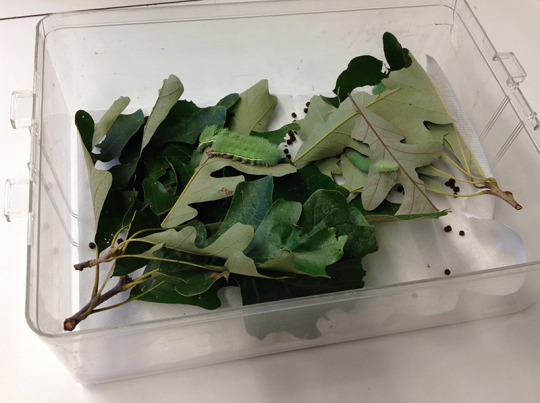
After finding out more information about this species and its close relatives, we started preparing for the eggs to hatch, which only took about seven days from the time they were laid. Once that happened, we transferred the very tiny, newly hatched caterpillars out of the live jar and into a larger plastic container with dandelion leaves from our front yard as food. They started eating and growing and my son watched them closely as they progressed through their various growth stages (instars). He had great fun watching and laughing as the 50 or so caterpillars tried to escape in all directions from the container onto our kitchen table (boy, they moved fast!) as we cleaned it out and added new food for them each day.

a typical caterpillar iso-female culture in a plastic rearing chamber with greens in it
Image showing a typical caterpillar iso-female culture in a plastic “rearing chamber” (note: the lid has been removed so the contents can be seen). The photo shows an unrelated culture of Automeris randa Druce, 1894 from Arizona.

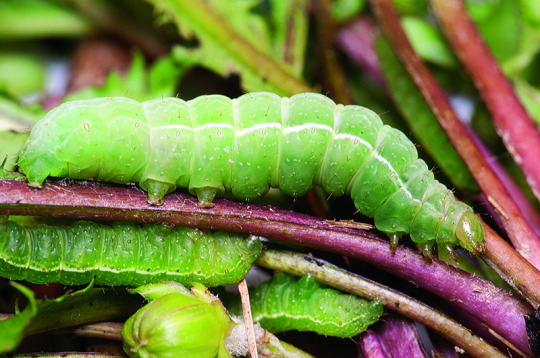
Rearing caterpillars is a lot like raising frog tadpoles. The caterpillars can be quite active, and they are constantly changing, with some species changing colors after they molt, others become hairier, and they all increase in size every time they molt to a new instar (the developmental stage in arthropods that occurs between molts). Just watching them eat or observing some of their other odd behaviors can be quite fascinating.  The caterpillars we reared were voracious eaters, eventually going through several pounds of dandelion leaves in a single day!

caterpillar (larva) of Autographa pseudogamma
The previously unknown last instar caterpillar (larva) of Autographa pseudogamma.

Many children show a keen interest in caterpillars when they are encountered outdoors. Caterpillars are often seen as cute and fuzzy, which often leads to children touching them and/or picking them up.  However, you should be cautious of this because some caterpillars, like the conspicuous and commonly encountered Hickory Tussock Moth (Lophocampa caryae Harris, 1841) caterpillar, can sometimes cause severe skin rashes, or even blindness if you get their hairs into your eyes. Several field guides to caterpillars are available, but they are not all-inclusive. This is because there are many moth species where the caterpillars are not known (as in our case), or where caterpillars have been found, but it is not known which adults they came from.

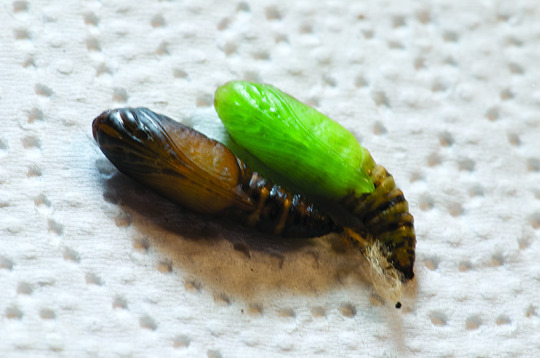
After reaching the final instar, the caterpillars move on to the next stage of their life cycle before they become adults, the pupa. During this stage, they metamorphose from a worm-like larva into a winged adult, and for A. pseudogamma, this process only took 11 days.

Pupae of Autographa pseudogamma.

We were able to witness the entire life cycle of A. pseudogamma, from an adult to an egg to a larva to a pupa and then back to an adult again, all within the span of a single month. This was a great learning experience for my son.  He was able to intimately witness first-hand the process by which insects grow and develop, which is something that few people get to see. He was also able to participate directly in the various stages of scientific discovery and, perhaps more importantly, he was able to see how a scientist would record observations and how those data are converted directly into a scientific publication. If you are interested, our study on A. pseudogamma was recently published in the Annals of Carnegie Museum. While not every caterpillar rearing will result in a published study, they are great learning experiences for young children that have an interest in nature.  Studies of caterpillars like this would also make great school science fair projects. For information on getting started, see this article on how to rear caterpillars.

The huge diversity of insects, with all their different colors, sizes, and shapes, still evokes a child-like awe in me for the natural world and this is something that I hope to pass down to my son, as well as other children that might visit the insect collection here at the natural history museum (all those budding entomologists). Remember, even something that may seem silly and inconsequential, like raising a few caterpillars at home with your child(ren), can turn into something that fosters a deeper interest in the natural world, and if you’re lucky, may even end up contributing significantly to science.

James W. Fetzner Jr., Ph.D., is assistant curator in the Section of Invertebrate Zoology at Carnegie Museum of Natural History. Museum employees are encouraged to blog about their unique experiences and knowledge gained from working at the museum.
Related Content

“Say Cheese!” – Specimen Imaging in Invertebrate Zoology

Pittsburgh’s Moths Reflect Human Impact of Industry

New Moth Species Marumba Verdeciae Named For CMNH Scientific Preparator

Carnegie Museum of Natural History Blog Citation Information

Blog author: Fetzner, James W., Jr.
Publication date: September 26, 2018

Share this post!

  • Share on Twitter Share on Twitter
  • Share on Facebook Share on Facebook
  • Share on Pinterest Share on Pinterest
  • Share on LinkedIn Share on LinkedIn
  • Share on Reddit Share on Reddit
  • Share via Email Share via Email

Share this post!

  • Share on Twitter Share on Twitter
  • Share on Facebook Share on Facebook
  • Share on Pinterest Share on Pinterest
  • Share on LinkedIn Share on LinkedIn
  • Share on Reddit Share on Reddit
  • Share via Email Share via Email

Filed Under: Blog Tagged With: Invertebrate Zoology, James Fetzner

September 6, 2018 by wpengine

Illustrating the Head of an Inchworm (caterpillar of Lepidoptera: Geometridae)

by Jane Hyland

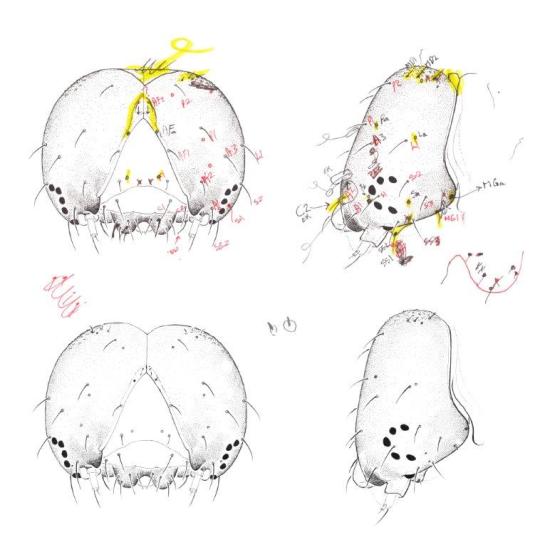
scientific illustration of an inchworm

Teamwork between scientists studying insects (entomologists) and illustrators is an important part of museum-based scientific research.  This important collaborative aspect between the scientist and the illustrator is instrumental in identifying and clarifying important characteristics of the specimen for identification purposes. Scientific illustration allows observers to see and study certain tiny features that are barely visible under the microscope, but which the scientist is familiar.

By studying and illustrating distinctive morphological features of specimens, the illustrator can choose to emphasize or ignore entirely different characters, increasing the visibility of important structures for accurate identification. For example, the placement of tiny sensory hairs (setae) on the head of this common moth caterpillar (inchworm) may be emphasized by the illustrator as important for identifying this species.

Jane Hyland is a Scientific Preparator at the Carnegie Museum of Natural History. Museum employees are encouraged to blog about their unique experiences and knowledge gained from working at the museum.
Filed Under: Blog Tagged With: bugs, Invertebrate Zoology, Lepidoptera

August 29, 2018 by wpengine

Oh MAN(tis)!

by Catherine Giles

Picture it: A crisp, early evening in late spring. The virtually cloudless sky cascades in a brilliant azure backdrop against your humble abode.

You’ve just arrived home from a long, exhausting day of work, yet your mind is still racing:

I need to remember that meeting on Tuesday, answer those important emails, what even is Windows 10?, did I put gas in the car?, what was that notification from my mother in law?

You are definitely ready to unwind and relax for the day!

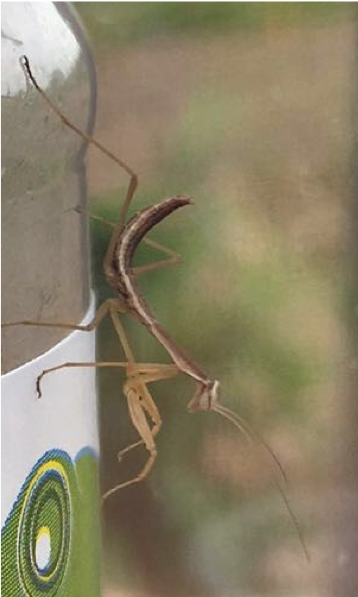
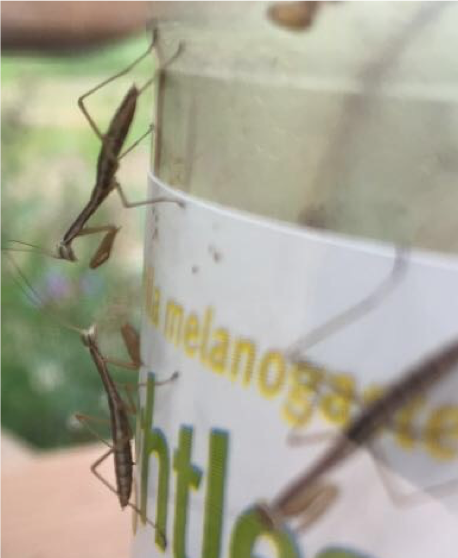
You sling your bags over a shoulder and balance your keys in one hand. You sigh wearily as you slide the key into the lock and, glancing over at the front window, notice a tiny, greenish-brown praying mantis staring back at you inquisitively, like the one pictured below.

praying mantis
A young praying mantis stalks her prey.

Huh. That’s funny.

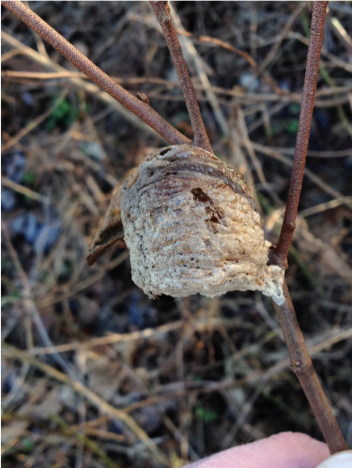
You, entomologist that you are, had found an ootheca, the foamy pouch in which mantises lay their eggs, last week, and decided to try and rear them on your own, giving them a better chance of survival for eventual release into the wild. Early this morning, you’d taken the ootheca out of a humid jar, and arranged it carefully into a brand new aerated container, mimicking seasonal outdoor changes.

ootheca
An ootheca, found outdoors. Photo credit: Jim Fetzner.

How weird that you should see a singular mantis on your window, let alone one this tiny. It probably got in through an open screen or something. You make a mental note to send your landlord a work order.

You unlock and open the door to find another tiny praying mantis on your end table. Whoa! Definitely need to check the screens.

But there’s another mantis on your ceiling. And another on the couch. Two by the sink. Three all over the Taco Bell wrappers in the trash.

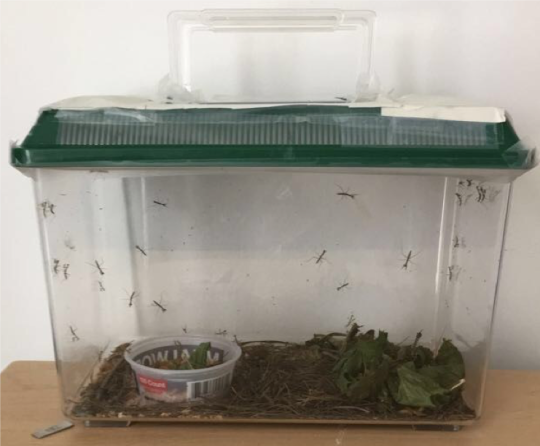
Slowly, with growing horror (and excitement!) you realize the mesh on your brand new aerated container is too large to contain minute mantises, and they’ve escaped to the refuge of your apartment.

You spend the next hour and 45 minutes frantically running around, grabbing handfuls of jumping mantises, throwing them into a (sealed) container, using a broom to pick the ones off the ceiling and praying to the old gods and the new, you can catch them all.

It’s a full-on Pokehunt, and you’re all out of potions and revives.

Nearly 200 thumb-nail sized, jumping, running, scuttling, adorable baby mantises play havoc on your heart strings (and your apartment) and you just have to take care of them. Knowing that mantises like to eat live food, and knowing they’ve gone a full day without it, you decide it’s time to get them some grub.

With all rambunctious insects fully secured, you race to Petco to grab their last container of crickets before closing, pulling Indie 500 stunts (you didn’t get gas earlier, by the way) along Route 8 to make sure your precious mantises have enough food for the day.

two praying mantises
Two praying mantises practice The Titanic for their peers.


You bought about 30 Acheta domesticus, a common house cricket, in a small container. They’re nearly three times the size of your mantises! What a hearty snack these will be. Trying to be a good mantis Momma, you empty the crickets into the enclosure.

But you’re new at this. Caterpillars you can rear easily, with the right host plant. You’ve had a dog before for goodness sake, this should be easy.

A. domesticus, though, will eat meat. Meat the approximate size and shape of a baby praying mantis.

Oh no.

You wrangle the crickets away from their mantis midnight snack and call it a day. The next day, you’ll get some flightless fruit flies and rear the mantises with less tragic incidents for several more weeks.

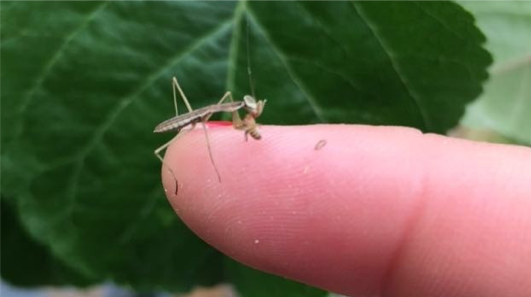
A praying mantis enjoying a refreshing flightless fruitfly.

Eventually, the spring chill warms to light summer breezes, and you’re able to release the mantises into the wilds of your home garden. All in all, you’ve learned a tremendous lesson, and earned a great campfire story, when it comes to rearing and caring for praying mantises.

mantises in their enclosure

Catherine Giles is the Curatorial Assistant of Invertebrate Zoology at the Carnegie Museum of Natural History. Museum employees are encouraged to blog about their unique experiences working at the museum. 

Filed Under: Blog Tagged With: biodiversity, bugs, ecology, entomology, Invertebrate Zoology

August 6, 2018 by wpengine

The Story of a Beetle, a Dolphin, and Some Remarkable Genitalia…

By Bob Androw

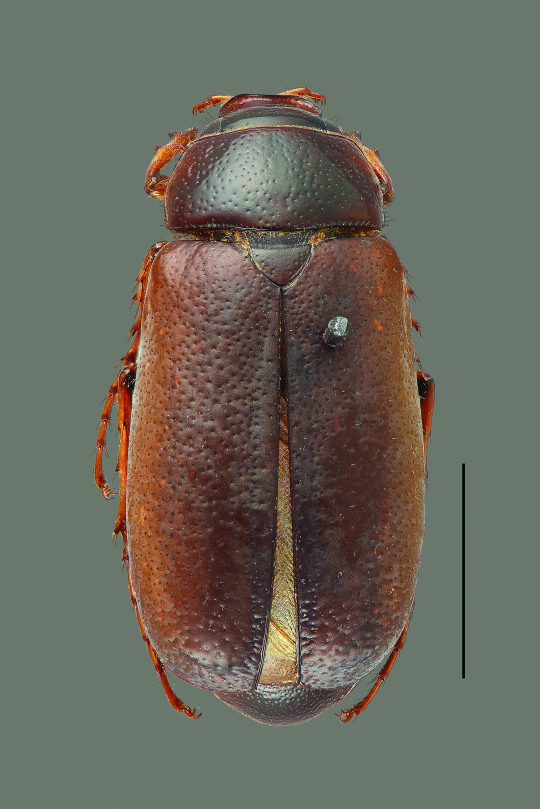
In 2014, while processing a light trap sample from the Dominican Republic, I came across a series of Phyllophaga that I could not identify. At first, this wasn’t too unusual – this one genus of scarab beetles contains over 500 named species. Upon closer examination, I was thrilled to determine that I was looking at a species new to science. I specialize in Cerambycidae, the long-horned beetles, and dabble with scarab beetles on the side – so I like to refer to Phyllophaga as one of my “mistress groups.” While I already had one species named after me, Phyllophaga androw, this would become the first new Phyllophaga I had personally discovered and would have the opportunity to describe.

When describing a new species, one of the challenges, and the joys, is choosing a name. With millions of insect species known, more than a few names are already taken. There are lots of options – naming it after one of its traits – color, size, shape; after the place it was found; after some factor of its biology; after a notable person in one’s life or after a renowned colleague; or, just maybe, after the shape of its genitalia. Hmmm… let’s clarify that…

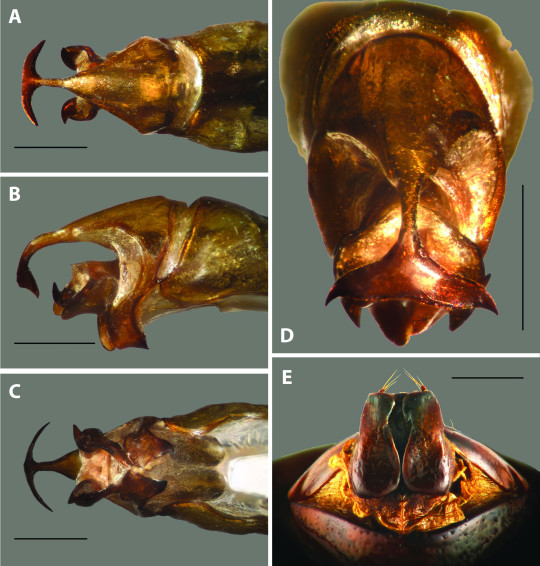
Many species of Phyllophaga are nearly inseparable by their outward appearance, but the genitalia can vary drastically between species. The male genitalia in beetles are usually strongly sclerotized, meaning that they are hard, rigid structures – hence the shape is fixed in any given species.

Phyllophaga delphinicauda, male holotype CMNH-IZ #325,315.


The new species was no exception – externally it closely resembled a number of other species but the genitalia were remarkable – having a delicate fluke-like structure arising from the upper surface. It so resembled a dolphin’s tail that the name was inevitable – Phyllophaga delphinicauda – the Phyllophaga with “the tail of a dolphin.” In 2016, I published the description in the Annals of Carnegie Museum, and, in doing so, reduced by one more the naming options available for species discovered in the future.


Phyllophaga delphinicauda, A-D, male genitalia (dorsal, lateral, ventral and posterior views, respectively). E, female genital plates.


Access the original publication for Phyllophaga delphinicauda Androw here. 

Bob Androw is a Scientific Preparator in Invertebrate Zoology. Museum employees are encouraged to blog about their unique experiences and knowledge gained from working at the museum.
Filed Under: Blog Tagged With: beetles, Bob Androw, Invertebrate Zoology

  • « Go to Previous Page
  • Page 1
  • Interim pages omitted …
  • Page 4
  • Page 5
  • Page 6
  • Page 7
  • Page 8
  • Interim pages omitted …
  • Page 10
  • Go to Next Page »

sidebar

About

  • Mission & Commitments
  • Directors Team
  • Museum History

Get Involved

  • Volunteer
  • Membership
  • Carnegie Discoverers
  • Donate
  • Employment
  • Events

Bring a Group

  • Groups of 10 or More
  • Birthday Parties at the Museum
  • Field Trips

Powdermill

  • Powdermill Nature Reserve
  • Powdermill Field Trips
  • Powdermill Staff
  • Research at Powdermill

More Information

  • Image Permission Requests
  • Science Stories
  • Accessibility
  • Shopping Cart
  • Contact
  • Visitor Policies
One of the Four Carnegie Museums | © Carnegie Institute | Privacy Policy | Terms of Use | Accessibility
Rad works here logo