• Skip to primary navigation
  • Skip to main content
  • Skip to primary sidebar

Carnegie Museum of Natural History

One of the Four Carnegie Museums of Pittsburgh

  • Visit
    • Buy Tickets
    • Visitor Information
    • Exhibitions
    • Events
    • Dining at the Museum
    • Celebrate at the Museum
    • Powdermill Nature Reserve
    • Event Venue Rental
  • Learn
    • Field Trips
    • Educator Information
    • Programs at the Museum
    • Bring the Museum to You
    • Guided Programs FAQ
    • Programs Online
    • Climate and Rural Systems Partnership
  • Research
    • Scientific Sections
    • Science Stories
    • Science Videos
    • Senior Science & Research Staff
    • Museum Library
    • Science Seminars
    • Scientific Publications
    • Specimen and Artifact Identification
  • About
    • Mission & Commitments
    • Directors Team
    • Museum History
  • Tickets
  • Give
  • Shop

paleontology

March 22, 2024 by Noelle Swart

Teen Night: The Stories We Keep

Teens (ages 13-18) are invited to Carnegie Museum of Natural History for a fun event celebrating the new exhibition, The Stories We Keep. Take the exhibit design challenge and learn what it takes to build engaging, exciting exhibitions. Check out the tools museum conservators use to preserve ancient objects, like a 4,000 year old wooden boat from Ancient Egypt. Discover the “Agents of Deterioration” that conservators dodge and deflect to keep artifacts safe, and see if you can guess the use of old-time objects. Stop by the lounge for a snack while you enjoy a night just for teens.

Whether you’ve already signed up for a free Teen Membership from Carnegie Museums of Pittsburgh, or just want to see what it’s all about – we hope you’ll stop by! Please register early to secure your free ticket; capacity is limited. Open to everyone ages 13-18.

Make your reservation today before this exciting event sells out. Free to everyone ages 13-18.

Teen Night: The Stories We Keep

Thursday, April 18, 2024, 5 p.m. to 8 p.m.

Community Access Membership is presented by

Huntington Bank

Teen Membership is generously supported by

The Grable Foundation and the Robert and Mary Weisbrod Foundation
Tagged With: archaeology, paleontology, teen night, teens

May 10, 2023 by Noelle Swart

Teen Night: Field Science

Are you interested in learning about Archaeology and Paleontology? Join us for a Teen Night all about field science! Learn the difference between these two scientific fields and see the tools scientists use on expeditions. Try your hand at being a Paleontologist as you dig for replica fossils in Bone Hunters’ Quarry. Observe replica artifacts based on real objects unearthed by Archaeologists from all over the world. Food will be available from 5-8 p.m. so grab a snack and hang out in our relaxing teens-only lounge.

Whether you’ve already signed up for a free Teen Membership from Carnegie Museums of Pittsburgh, or just want to see what it’s all about – we hope you’ll stop by! Please register early to secure your free ticket; capacity is limited. Open to everyone ages 13-18.

Make your reservation today before this exciting event sells out. Free to everyone ages 13-18.

Teen Night: Field Science

Thursday, July 13, 2023, 5 p.m. to 8 p.m.

 
Community Access Membership is presented by
Huntington Bank

Teen Membership is generously supported by The Grable Foundation

Tagged With: archaeology, paleontology, teen night, teens

August 27, 2021 by wpengine

Fossil Matrix Under the Microscope

by Pat McShea

Museum visitors who approach the broad window of PaleoLab encounter an array of large fossilized bones. If not for the pair of microscope workstations positioned against the lab’s right wall, it would be easy to misinterpret the enormous jaws, ribs, vertebrae, and limb bones as evidence of a size bias in the science of vertebrate paleontology.

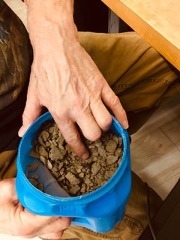
fossil matrix on a sorting tray
A scoop of fossil-bearing matrix on a sorting tray.

Small fossils have certainly made mighty contributions to our understanding of life during ancient time periods. Such fossils, which include loose teeth, small bones, and bone fragments, are the primary focus of some paleontological research. In other projects, where considerably larger fossilized creatures are the focus of study, the fossils of smaller creatures add information about species diversity, food webs, and even the climate conditions of ancient ecosystems. The sorting of fossil-bearing matrix that occurs under PaleoLab’s microscopes ensures that important discoveries will continue to occur.

The term matrix refers to the natural rock surrounding a fossil. In the case of fossil bones encased in rock, the matrix consists of the loose sediments that originally buried the bones, sediments that were later transformed into rock over long stretches of time by the pressure of other sediment layers deposited above them. When fossil-bearing rock layers erode, however, and loosened fossils are transported by water, wind, or other forces, the unconsolidated mix of surrounding materials in which the fossils eventually settle is also termed matrix.

In the field, paleontologists sometimes collect and screen loose matrix on site, using water to both separate floatable bits of plant debris and wash away soil, then sun-drying the resulting sludge for later screening. In the case of the matrix currently being sorted in PaleoLab, material eroded from a more than 50 million-year-old rock unit near Meridian, Mississippi was collected in bulk by CMNH paleontologists and brought back to Pittsburgh for washing and drying at the museum.

Container of fossil matrix with a person holding it.
Unsorted fossil-bearing matrix.

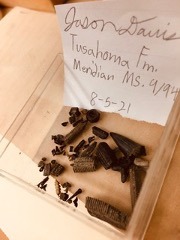
During a recent visit to PaleoLab, Scientific Preparator Dan Pickering pulled two containers from a shelf as “before” and “after” sorting examples. In the “before” container, a quart-sized plastic jug that once held ground coffee, a black, dime-sized shark tooth resting atop similar-sized irregular gray rock fragments hinted at the possible rewards for future sorting efforts. The considerably smaller and lighter “after” container bore not just an array of small marine fossils, including shark teeth and skate tooth plate fragments, but also the name and working notes of the sorter, CMNH volunteer Jason Davis.

fossils in a clear plastic container with a paper label
Fossils picked from matrix, with volunteer Jason Davis’ notes revealing that the material is from the lowermost Eocene (~55 million-year-old) Tuscahoma Formation of Mississippi.

Dan termed the recent finds typical for the current operation, but he also noted a now decades-old exciting discovery in matrix screened from a different, but adjacent Mississippi rock unit. In a scientific paper published in 1991, then-CMNH paleontologists K. Christopher Beard and Alan R. Tabrum described a tooth and jaw fragment from an early primate. The fossil was the first record of an early Eocene mammal in eastern North America, and because of its association with well-studied marine fossils, the find helped to better calibrate existing separate biochronologies of terrestrial and marine fossils.

Patrick McShea works in the Education and Visitor Experience department of Carnegie Museum of Natural History. Museum employees are encouraged to blog about their unique experiences and knowledge gained from working at the museum.

Related Content

The Bromacker Fossil Project Part III: Fossil Preparation

Pebble or Jaw?

Mesozoic Monthly: Nemicolopterus

Carnegie Museum of Natural History Blog Citation Information

Blog author: McShea, Patrick
Publication date: August 27, 2021

Share this post!

  • Share on Twitter Share on Twitter
  • Share on Facebook Share on Facebook
  • Share on Pinterest Share on Pinterest
  • Share on LinkedIn Share on LinkedIn
  • Share on Reddit Share on Reddit
  • Share via Email Share via Email

Share this post!

  • Share on Twitter Share on Twitter
  • Share on Facebook Share on Facebook
  • Share on Pinterest Share on Pinterest
  • Share on LinkedIn Share on LinkedIn
  • Share on Reddit Share on Reddit
  • Share via Email Share via Email

Filed Under: Blog Tagged With: Paleolab, paleontology, Pat McShea

August 24, 2021 by wpengine

Bringing Light to Dark Places

by Suzanne Mills

“May it be a light to you in dark places, when all other lights go out.” ― J.R.R. Tolkien, The Fellowship of the Ring

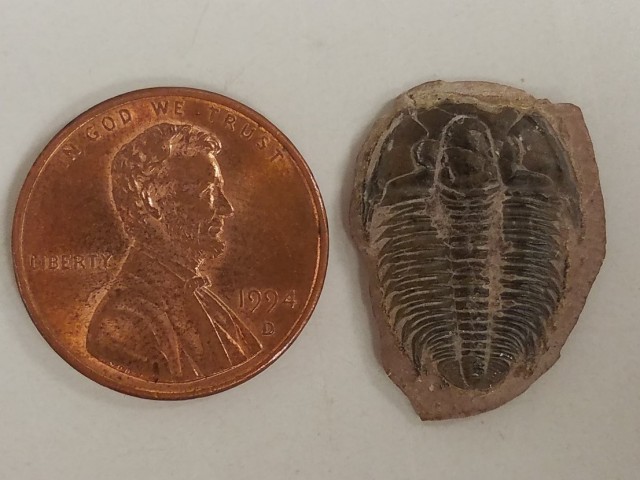
“Elrathia kingi,” the small square of paper declares. Regal yet a bit mysterious, the Latin name on the museum-issue label conjures Tolkien. From an unlidded box small enough to hold a wedding ring, I remove a chalky gray pebble. Its minute weight slides easily through my fingers; it seems as inconsequential as a penny. But it is not hard to see what gives this iota of stone its value. As if sculpted in bas-relief, a pair of tiny eyes peek out of a crescent-shaped head. Thin ridges of a segmented body, symmetrically paired about two fine center lines, taper to a tail. Each detail is delicately edged in violet. It is a fossil trilobite, an extinct relative of the horseshoe crab.

Penny next to a trilobite fossil, both are approximately the same size.
The trilobite Elrathia kingi.

But she is a humble beauty who lives a secret life. She is found behind the scenes in the Section of Invertebrate Paleontology (IP). In the fluorescent-lit museum basement, Elrathia kingi idles quietly in a long drawer with dozens of equally elegant companions. It is just one of thousands of drawers shelved in rows upon rows of gray metal cabinets. The cabinets stand silently at attention, protecting their specimens from dust, light, and heat while awaiting further orders.

More than 800,000 fossil marine organisms call the IP lab home. Collected from all over the world, they range in age from several thousand to almost a billion years old. Four thousand of these specimens have been featured in over 400 peer-reviewed publications. But others have never been studied in detail and hold valuable “dark data,”¹ ² undocumented information useful for studies about extinction³ and climate change.⁴ These data are central to the future advance of the science of paleontology and geology.⁵

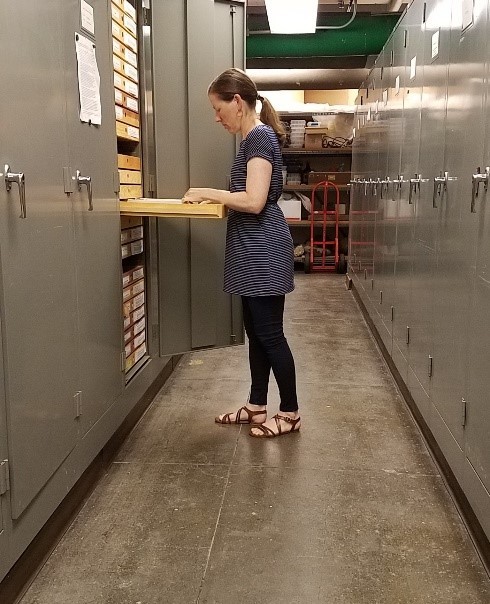
Woman looking through a drawer in a large cabinet.
Suzanne Mills working with the collections.

As a part-time Collection Assistant, I help bring this “dark data” to light. My main tools are a laptop and a microscope. When I examine a trilobite, or fossil “bug,” under the microscope, I look for characteristics that verify the biological classification, based on what is written on the fossil’s label. Further information recorded on the label about the geologic layer and location where it was found helps to validate the scientific value. I verify all this information in professional peer-reviewed publications. Finally, I enter the data I glean into a new digital database and develop charts and graphs to summarize it. This is the beginning of highlighting the IP collection’s “dark data.”

The task of bringing more than three-quarters of a million IP specimens to light is daunting. My colleagues and I bow our heads to that number and acknowledge that it is far more than a life’s work. But we persist, hoping to help the world see the value of Elrathia kingi and her ancient ocean companions, one fossil at a time.

Suzanne Mills is a Collection Assistant in the Section of Invertebrate Paleontology at Carnegie Museum of Natural History. Museum employees are encouraged to blog about their unique experiences and knowledge gained from working at the museum.

Citations:

1. California Academy of Sciences. 2018. Scientists quantify the vast and valuable finds stored on museum shelves: Quantifying “dark data” in fossil collections is a call to arms; heralds a digital revolution. ScienceDaily. https: /www.sciencedaily.com/releases/2018/09/180920102122.htm (accessed July 21, 2021)

2. Thiers, Barbara, John Bates, Andrew C, Bentley, Linda S, Ford, David Jennings, Anna K, Monfils, Jennifer M, Zaspel, James P, Collins, Manzour Hernando Hazbón, and Jyotsna L, Pandey. 2021. Implementing a Community Vision for the Future of Biodiversity Collections. BioScience, Volume 71, Issue 6, June. Pages 561–563.  https://doi.org/10.1093/biosci/biab036 (accessed July 23, 2021)

3. Casey, M. M., E. E. Saupe, and B. S. Lieberman. 2021. The effects of geographic range size and abundance on extinction during a time of “sluggish” evolution. Paleobiology, 47:54-67.

4. Lawing, A. M. 2021. The geography of phylogenetic paleoecology: integrating data and methods to better understand biotic response to climate change. Paleobiology, 47:178-197.

5. The Unique role of the Curator in Palaeontology. Special Papers in Palaeontology, 22, 7-15.

Special thanks to Albert Kollar and Joann Wilson for their insightful comments.

Related Content

Smoking Fossils

The Giant Eurypterid Trackway

Ask a Scientist: What is a trilobite?

Carnegie Museum of Natural History Blog Citation Information

Blog author: Mills, Suzanne
Publication date: August 24, 2021

Share this post!

  • Share on Twitter Share on Twitter
  • Share on Facebook Share on Facebook
  • Share on Pinterest Share on Pinterest
  • Share on LinkedIn Share on LinkedIn
  • Share on Reddit Share on Reddit
  • Share via Email Share via Email

Share this post!

  • Share on Twitter Share on Twitter
  • Share on Facebook Share on Facebook
  • Share on Pinterest Share on Pinterest
  • Share on LinkedIn Share on LinkedIn
  • Share on Reddit Share on Reddit
  • Share via Email Share via Email

Filed Under: Blog Tagged With: invertebrate paleontology, paleontology, Science News, Suzanne Mills

July 30, 2020 by wpengine

The Bromacker Fossil Project Part VIII: Martensius bromackerensis, Honoring a colleague

New to this series? Read The Bromacker Fossil Project Part I, Part II, Part III, Part IV, Part V, Part VI, and Part VII. 

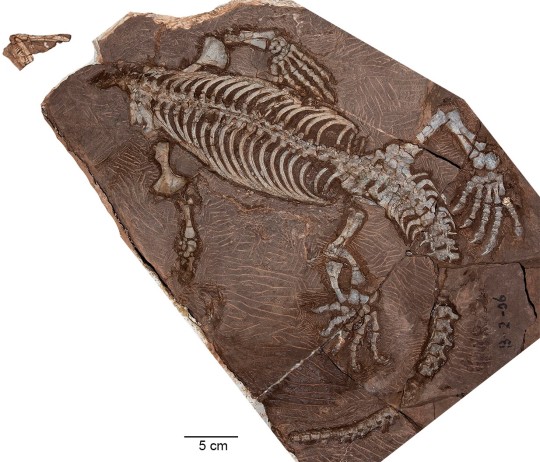
Adult, holotype specimen of Martensius bromackerensis. Image digitally assembled by the author from five photographs taken by Diane Scott (Preparator at University of Toronto Mississauga [UTM]), 2010–2013. The specimen was collected in several large blocks.

The formal publication of some of the Bromacker discoveries took more time to complete than others, and our most recently pubished fossil, Martensius bromackerensis, holds the record in that regard. Four nearly complete specimens of Martensius were collected from the Bromacker quarry between 1995–2006. The first, discovered by Thomas Martens and his father Max, came from a jumbled pocket of fossils. Unfortunately, muddy groundwater had penetrated cracks in the subsurface of this portion of the quarry and coated and eroded bone present along these cracks. Despite this damage and the lack of a skull, we could identify the specimen as a caseid synapsid (synapsids, also known as mammal-like reptiles, are a group of amniotes whose later-occurring members gave rise to mammals).

Drawing of 1995 Martensius bromackerensis specimen. Because the specimen was collected in numerous pieces of rock, with parts of some bones exposed on apposing rocks, Scientific Illustrator Kevin Dupuis (UTM) had to first draw the bones exposed on each piece and then assemble all of the drawings digitally. Dotted lines indicate bone impression in the rock. Arrows point to healing scars from two fractures in the last right rib. Additional healing scars can be seen in preceding ribs. This animal apparently survived a serious injury. Modified from Berman et al., 2020.

The next specimen was discovered in 1999 by Georg Sommers (Preparator, Museum der Natur, Gotha), who prepared the fossil. It consists of a vertebral column, ribs, some limb bones, and a few scattered skull elements. Unfortunately, a more complete skull was needed to allow for comparison to other caseids, some of which are based only on skull material. It wasn’t until the discovery of two more specimens in 2004 and 2006 by Stuart Sumida and Dave Berman, respectively, that the long sought-after skull was found. Preparation of these specimens took a long time due to their size and the considerable amount of rock covering the bones in some of the blocks. My promotion to Collection Manager in 2005 left me with considerably less time to prepare fossils. Other preparators were asked to help with the preparation at both Carnegie Museum of Natural History (CMNH, Dan Pickering and Tyler Schlotterbeck) and in Dr. Robert Reisz’s lab at the University of Toronto at Mississauga (Diane Scott and Nicola Wong Ken). Robert was originally slated to lead the study, but other commitments prevented him from working on it, so Dave took over.

Besides preparation, the scientific study and publication of the specimens required illustrations and photographs, most of which were done by Diane, Nicola, and Kevin. Andrew McAfee (Scientific Illustrator, CMNH) made skeletal and flesh reconstructions of the animal, as well as an illustration of two Martensius in their ancient habitat (see The Bromacker Fossil Project Part III for a link to this illustration). All of this effort was worth it, however, because besides adding to the diversity of the Bromacker vertebrate fauna, Martensius has an unusual life history.

Juvenile specimen of Martensius bromackerensis. Image digitally assembled by the author from two photographs (skull and body) taken by Diane Scott in 2013. The skull, shown in ventral aspect, is incomplete and eroded on its dorsal surface.

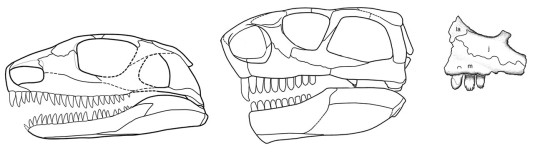
Caseid synapsids are a diverse, long-lived group known from the Late Pennsylvanian–Middle Permian epochs (~300–259 million years ago) of Europe, Russia, and the USA, and, with one exception, all are adapted to eating plants (herbivorous). The most advanced caseids (such as the enormous Cotylorhynchus romeri) have ridiculously small skulls when compared to those of carnivores, spatulate (spoon-shaped) teeth tipped with small tubercles (cuspules) for cropping vegetation, and huge, barrel-shaped ribcages to support a large gut for fermenting cellulose-rich plants. The exception is the earliest known (Late Pennsylvanian epoch, ~300 million years ago) caseid, Eocasea martini, represented by a single, incomplete juvenile specimen from Kansas. The teeth of Eocasea are small and conical, which indicate that it most likely ate insects. Because it’s skull and ribcage are of normal size, in contrast to juveniles of Martenius, Eocasea probably ate insects throughout its life.

Reconstruction of the skull of Martensius bromackerensis (left) from the Early Permian (~290 million years ago) Bromacker quarry, Germany, and the more advanced caseid Ennatosaurus tecton (skull, middle and skull fragment with cuspule-tipped teeth, right), from the Middle Permian (~263 million years ago) of Russia. Skull reconstruction of Martensius made by Diane Scott and modified from Berman et al., 2020. Ennatosaurus skull reconstruction and jaw fragment drawing modified from Maddin et al., 2008.

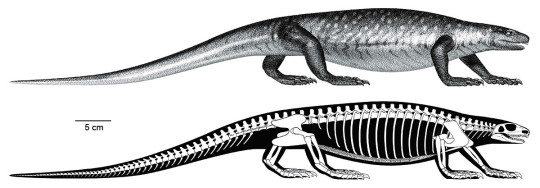
Martensius has a modestly expanded ribcage and a small skull, suggesting that it was herbivorous. Furthermore, the feet of Martensius, like those of other caseids in which the feet are known, are large, with massive, elongated, strongly recurved claws. Martensius also has a well-supported hip region that may have enabled it to rise on its hind legs to reach and tear down overhead branches to feed upon.

The upper and lower teeth of the adult Martensius differ from those of more advanced caseids in being triangular and lacking cuspules. The upper jaw teeth of the juvenile resemble those of the adult, but the lower jaw teeth are more numerous—31 in the juvenile compared to 25 in the adult—and surprisingly, they resemble those of Eocasea. Dave concluded that juveniles of Martensius had teeth adapted for eating insects, which were replaced by an adult dentition that would’ve been good for cropping plants and piercing insects. Remarkably, the juvenile Martensius apparently died while in the process of replacing its juvenile dentition with that of adults.

So why have different juvenile and adult dentitions? Modern animals that eat fibrous plant matter have micro-organisms called fermentative endosymbionts in their large guts, which break down difficult-to-digest plant matter via fermentation. It is assumed that early fossil plant-eaters with broad ribcages also had large guts housing fermentative endosymbionts. Prior to the discovery of Martensius, other scientists hypothesized that early herbivores acquired endosymbionts by eating herbivorous insects that already had these microbes in their guts. In Martensius, the introduction of endosymbionts apparently occurred during the juvenile, insectivorous stage of life, which set the stage for adults to add plants to their diet.

Flesh (top) and skeletal (bottom) reconstructions of Martensius bromackerensis. Illustrations by Andrew McAfee and modified from Berman et al., 2020.

The generic name Martensius honors Thomas Martens for his discovery of vertebrate fossils at the Bromacker quarry and his perseverance in maintaining a highly successful, long-term field operation resulting in the discovery and publication of the exceptionally preserved Bromacker fossils. Bromackerensis refers to the Bromacker quarry, the only locality from which this species is known.

Stay tuned for my next post, which will feature some terrestrial dissorophoid amphibians.

For those of you who would like to learn more about Martensius, here’s a link to the 2020 Annals of Carnegie Museum publication in which it was described.

Amy Henrici is Collection Manager in the Section of Vertebrate Paleontology at Carnegie Museum of Natural History. Museum employees are encouraged to blog about their unique experiences and knowledge gained from working at the museum.

Keep Reading

The Bromacker Fossil Project Part IX: The Dissorophoid Amphibians Tambachia, Rotaryus, and Georgenthalia, Capable Travelers

Filed Under: Blog Tagged With: Amy Henrici, dinosaurs in their time, fossils, Museum from Home, paleontology, Science News, Section of Vertebrate Paleontology, Vertebrate Paleontology

April 1, 2019 by wpengine

Bayet’s Bounty: The Invertebrates That Time Forgot

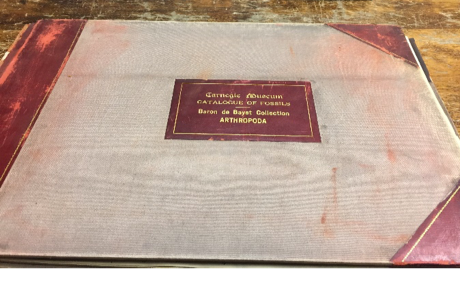
book about the baron de bayet collection
interior of book about baron de bayet collection

Albert Kollar, Collections Manager for the Carnegie Museum of Natural History Section of Invertebrate Paleontology, is on a mission to re-examine the Bayet Collection, a collection of 130,000 invertebrate and vertebrate fossils brought to the Carnegie more than 100 years ago.  Albert is re-examining the invertebrate portion of the Bayet (pronounced “Bye-aye”), which as it turns out, is 99.9% of the collection.

The story starts with a last-minute trip that began on July 8, 1903 by Carnegie Director William Holland, who had received word of a world-class fossil collection that had been put up for sale in Europe by the Baron de Bayet, secretary to the cabinet of Leopold II of Belgium.  Holland immediately booked passage to Europe on the steamer “New York” to complete the deal.  At stake were 130,000 invertebrates, combined with a small number of vertebrate fossils (several on display in the Dinosaurs in Their Time exhibition), sought by museums throughout Europe, Great Britain and the United States.  This collection became the largest addition to the department of paleontology at the Carnegie Institute, since the discovery of the dinosaur Diplodocus carnegii, at Sheep Creek, Wyoming in 1899.

Mr. Carnegie personally wrote a check for $25,000 for the project, a sum so large it exceeded the entire 1903 budget for all art and natural history acquisitions combined. Eventually, Mr. Holland negotiated a price of just under $21,000 with the Baron de Bayet for the entire collection. Another $2,300 was spent to pack, insure and transport everything back to Pittsburgh.  Twenty men and women worked for three weeks to meticulously wrap each fossil in cotton, batting, or straw and by September 1903, two hundred and fifty-nine crates arrived safely in Pittsburgh.  Storage of the crates was an issue, since the Carnegie Museum building would not be completed until 1907; so Mr. Holland rented space in a warehouse on 3rd Street in Pittsburgh for storage of 210 of the 259 crates.

This decision, however, almost destroyed the collection when a fire broke out on the upper floors of the 3rd Street warehouse.  On December 30, 1903, Mr. Holland wrote, “Yesterday brought with it a fire in which it appeared as if the Bayet collection, the acquisition of which we had so prided ourselves, was destined to go up in smoke.”  Fortunately, the Pittsburgh Fire Department contained the fire to the upper floors and the Bayet collection, stored on the lower floor, and meticulously wrapped and crated, survived with minimal damage. The crates returned to the Carnegie Institute to dry out.

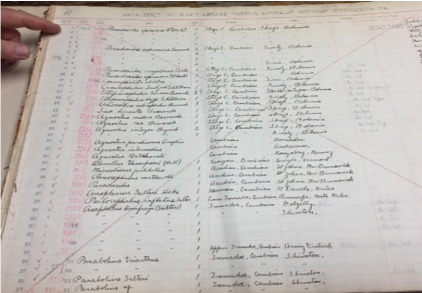
In early 1904, William Holland hired Dr. Percy Raymond, a graduate of Yale University, to be the first curator of Invertebrate Paleontology.  His primary directive was to catalog and organize the Invertebrate portion of the Bayet collection. Today, over 100 years later, Albert Kollar with the help of Pitt Geology student E. Kevin Love, is undertaking a multi-year project to translate Percy Raymond’s beautifully hand-written catalogs and to migrate all 130,000 specimens into a new database.

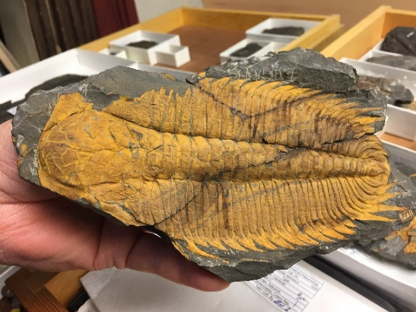
Pictured below is (BH1) the very first Bayet specimen cataloged by Percy Raymond.  BH1 is an exquisite 510-million-year-old, CM 1828 Paradoxides spinosus, a 17.17 cm or 7” long trilobite from Skreje, Bohemia – or the Czech Republic of today.

trilobite fossil

Albert’s goal in revisiting the Bayet collection is to better understand the great history of the how, why and where of fossils collected in the late 19th century, especially in Europe the birthplace of paleontology and geology.  “This project will give us insight into why certain Bayet fossils were recovered from classic European fossil localities, many of which are designated stratotype (significant geologic time reference) regions.  These fossils and localities have been used to document the validity of evolution, extinction, and the Geologic Time Scale over the last 100 years.  With an improved database, we hope to better appreciate the scientific value of the entire collection and create new statistical measures for future research and education.”

When asked if he expected any surprises as we go forward, Albert smiled, “Not until all the data has been analyzed will we have an opportunity to review the collection’s full scientific worth.”

Check back in a few months, Bayet’s invertebrates may have a few secrets yet to share.

Many thanks to Carnegie Museum Library Manager, Xianghua Sun for help researching this post.

Joann Wilson is an Interpreter in the Education department at Carnegie Museum of Natural History. Museum employees are encouraged to blog about their unique experiences and knowledge gained from working at the museum.

Filed Under: Blog Tagged With: Albert Kollar, Andrew Carnegie, fossils, geology, invertebrate paleontology, paleontology, Pittsburgh, SWK2, Trilobite, William Holland

  • « Go to Previous Page
  • Page 1
  • Page 2
  • Page 3
  • Page 4
  • Interim pages omitted …
  • Page 7
  • Go to Next Page »

sidebar

About

  • Mission & Commitments
  • Directors Team
  • Museum History

Get Involved

  • Volunteer
  • Membership
  • Carnegie Discoverers
  • Donate
  • Employment
  • Events

Bring a Group

  • Groups of 10 or More
  • Birthday Parties at the Museum
  • Field Trips

Powdermill

  • Powdermill Nature Reserve
  • Powdermill Field Trips
  • Powdermill Staff
  • Research at Powdermill

More Information

  • Image Permission Requests
  • Science Stories
  • Accessibility
  • Shopping Cart
  • Contact
  • Visitor Policies
One of the Four Carnegie Museums | © Carnegie Institute | Privacy Policy | Terms of Use | Accessibility
Rad works here logo