• Skip to primary navigation
  • Skip to main content
  • Skip to primary sidebar

Carnegie Museum of Natural History

One of the Four Carnegie Museums of Pittsburgh

  • Visit
    • Buy Tickets
    • Visitor Information
    • Exhibitions
    • Events
    • Dining at the Museum
    • Celebrate at the Museum
    • Powdermill Nature Reserve
    • Event Venue Rental
    • Gift Cards
  • Learn
    • Field Trips
    • Educator Information
    • Programs at the Museum
    • Bring the Museum to You
    • Guided Programs FAQ
    • Programs Online
    • Climate and Rural Systems Partnership
  • Research
    • Scientific Sections
    • Science Stories
    • Science Videos
    • Senior Science & Research Staff
    • Museum Library
    • Science Seminars
    • Scientific Publications
    • Specimen and Artifact Identification
  • About
    • Mission & Commitments
    • Directors Team
    • Museum History
  • Tickets
  • Give
  • Shop

Pat McShea

February 3, 2023 by Erin Southerland

Beyond the Simple Ecosystem Graphic: Teaching About Biodiversity and Pollination

by Pat McShea

You probably remember some version of this graphic: simple line drawings linked by arrows to chart energy flow through an ecosystem featuring the Sun, a patch of grass, a rabbit, and a hawk or fox. During the closing minutes of a recent day-long educator workshop about biodiversity at Carnegie Museum of Natural History, two participating middle school teachers cited the pervasive textbook illustration as an educational prop they now felt comfortable moving beyond. 

Natalie Miles and Christian Shane, science teachers at North Allegheny School District’s Ingomar Middle School, expressed confidence that the seventh graders they work with would benefit from guided firsthand explorations of more complex energy flows involving various plant and invertebrate interactions. “We already teach about pollination,” explained Christian, “and with this information we can guide students on investigations right where they live.” After endorsing Christian’s comments, Natalie added a more personal note. “You’ve kept my nerdy science self fully engaged today. Thank you.”

The core experience that so captivated the pair was a carefully prepared slide presentation by museum scientist Dr. Ainsley Seago. Because the Associate Curator of Invertebrate Zoology likened her session to a sales pitch for insects, she began with what could be termed product information specific to the museum: The CMNH collection consists of approximately 16 million pinned insect specimens, representing locations all over the world, and spanning 150 years of collecting; Moths (Lepidoptera), beetles (Coleoptera), and fleas (Siphonaptera), are collection strengths, but the wide-ranging research resource also includes many groups of non-insect invertebrates. 

The ubiquity of insects and the increasing ease and accuracy of their identification through hand-held technology such as the iNaturalist smartphone app were the next topics on Ainsley’s presentation agenda. Then her core material was setup by a reminder of two different but potentially connected circumstances: 1) Pollinators and bee declines are hot topics right now. 2)Teachers of some grades and subjects need to cover ecosystems according to the PA science standards.
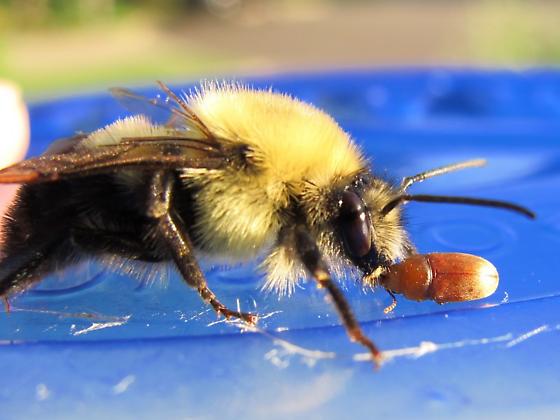
An Antherophagus species of beetle hitches a ride to its next home by attaching to a bumble bee’s tongue. Copyright © 2016 Ilona L.

What followed was refresher session on the biomechanics of pollination that moved seamlessly into enthusiastic introductions for a cast of a dozen insect and other invertebrate characters that might visit, or even inhabit, the blossom of a common wild sunflower on a late summer or early fall day. Some creatures arrived in search of pollen or nectar, others to be in the proper place to ambush and prey upon such visitors, and the most memorable, a tiny fungus beetle whose most supportive micro-habitat is the decaying detritus within bumble bee nests, to temporarily attach itself to that insect’s tongue, and hitch a ride to a new home.

Besides offering her audience alternatives to organisms favored by many textbooks, Ainsley aptly displayed what the late Dr. John Rawlins, Curator Emeritus for the museum’s Section of Invertebrate Zoology termed “bug love.” As I watched the performance from my seat as an observer in the back of the workshop classroom, I recalled something historian David McCullough wrote about Dr. Margaret B. McFarland, the University of Pittsburgh child psychologist who was a strong influencer of Fred Rogers television programs for young audiences. “What she taught, in essence, is that attitudes aren’t taught, they’re caught. If the attitude of the teacher toward the material is positive, enthusiastic, committed, and excited, the students get that.” Such transmission of attitudes also applies to older audiences.

For information about the next scheduled educator workshop, please visit our Events page. 

Related Content

Educator Spotlight: Christian Shane

Learning From Misinterpretations

Two Perspectives on Attending a Course on Moths and Butterflies in the Southwest

Carnegie Museum of Natural History Blog Citation Information

Blog author: McShea, Patrick
Publication date: February 3, 2023
Share this post!

  • Share on Twitter Share on Twitter
  • Share on Facebook Share on Facebook
  • Share on Pinterest Share on Pinterest
  • Share on LinkedIn Share on LinkedIn
  • Share on Reddit Share on Reddit
  • Share via Email Share via Email

Filed Under: Blog Tagged With: Education, Invertebrate Zoology, Pat McShea

November 22, 2022 by Erin Southerland

A Bit of Presque Isle, Erie, PA in the Hall of Botany

by Patrick McShea
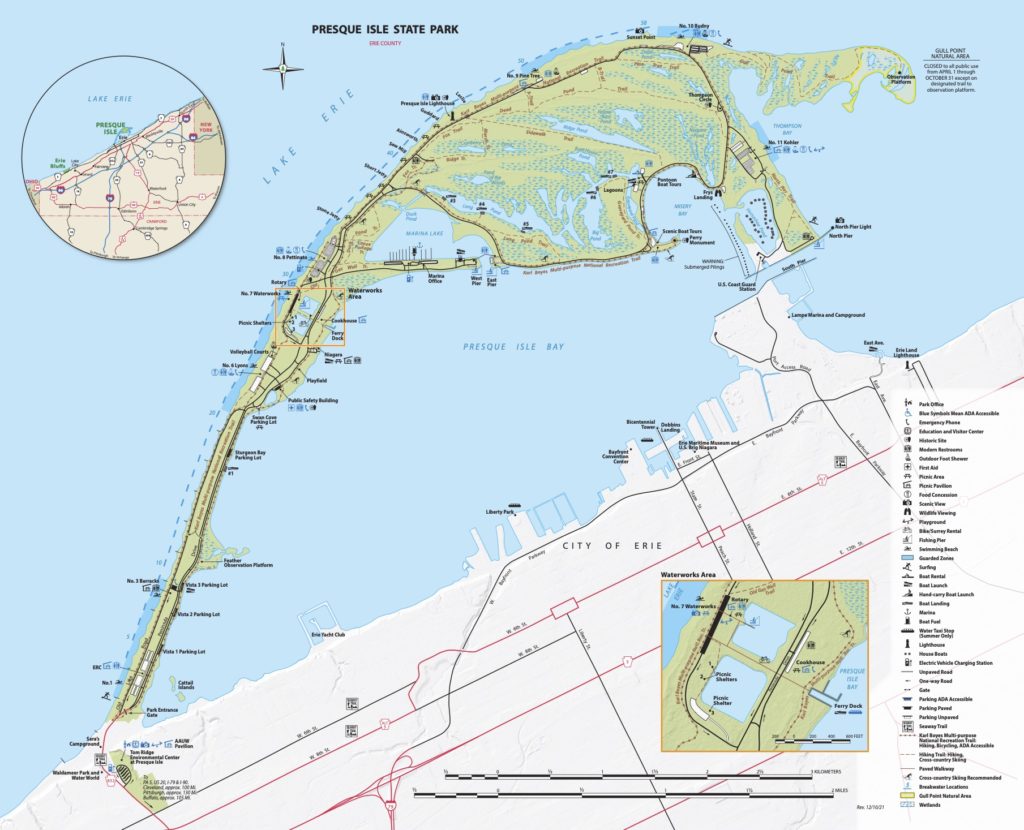
Credit: Pennsylvania State Parks

Presque Isle State Park is the most visited component of Pennsylvania’s 121 park system. In recent years, the beaches, trails, and ponds of this six-mile-long, 3,200-acre Lake Erie sand spit have drawn more than four million annual visitors. Repeat visits by local residents account for a significant portion of the seven-figure tally. The peninsula’s eastward curl into the lake creates the bay which fronts the city of Erie, and the park, which celebrated its 100th anniversary in 2021, frames northward views in many city neighborhoods.

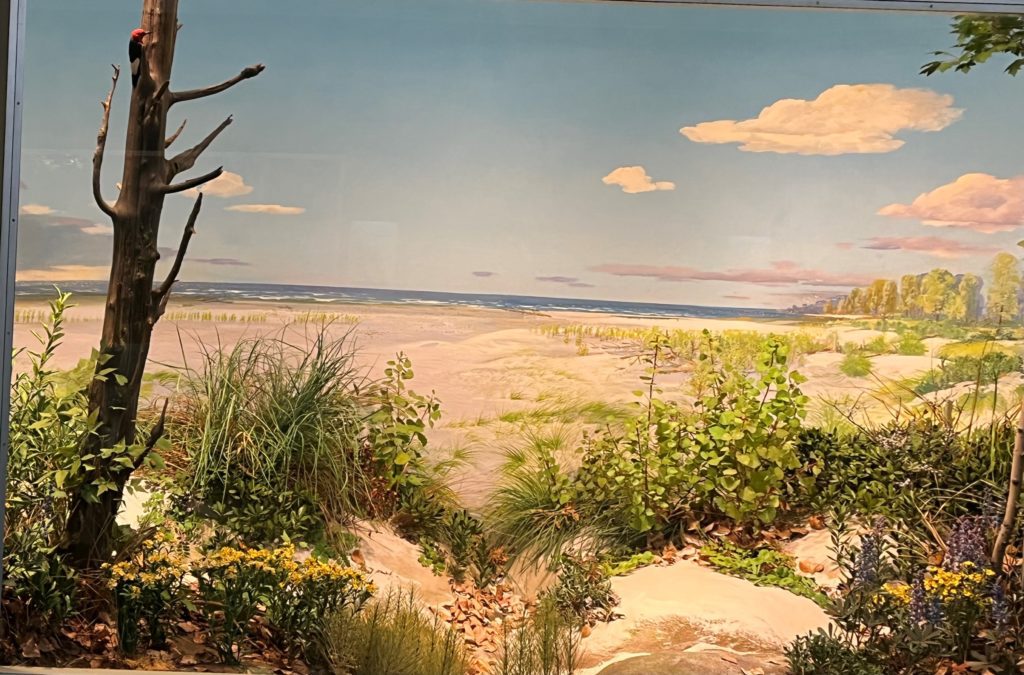
Some 120 miles south of the park, at Carnegie Museum of Natural History, visitors encounter a life-sized and un-peopled section of this unique landscape when they enter the Hall of Botany. This spacious plant-centered hall honors the vision of the museum’s first and longest-serving Curator of Botany, Otto Jennings, with eight dioramas created between the 1920s and 1970s that depict biomes with visually distinctive characteristics. The Presque Isle diorama, which opened in 1966, earns a spot among detailed three-dimensional depictions of the Sonoran Desert, Florida Everglades, and high-altitude slopes of Mount Rainier, by virtue of its representation of land continually shaped by the actions of wind, waves, and plant succession.  

As a label adjacent to the summer scene explains, Presque Isle is a place where a full cycle of plant community development can be observed in a compact space. At many park locations, a cross-peninsula transect of a few hundred yards might include the bare sand of new beach deposits, dunes stabilized by pioneering plants, marshes framed by sand ridges supporting shrubs and young trees, and patches of mature forest.

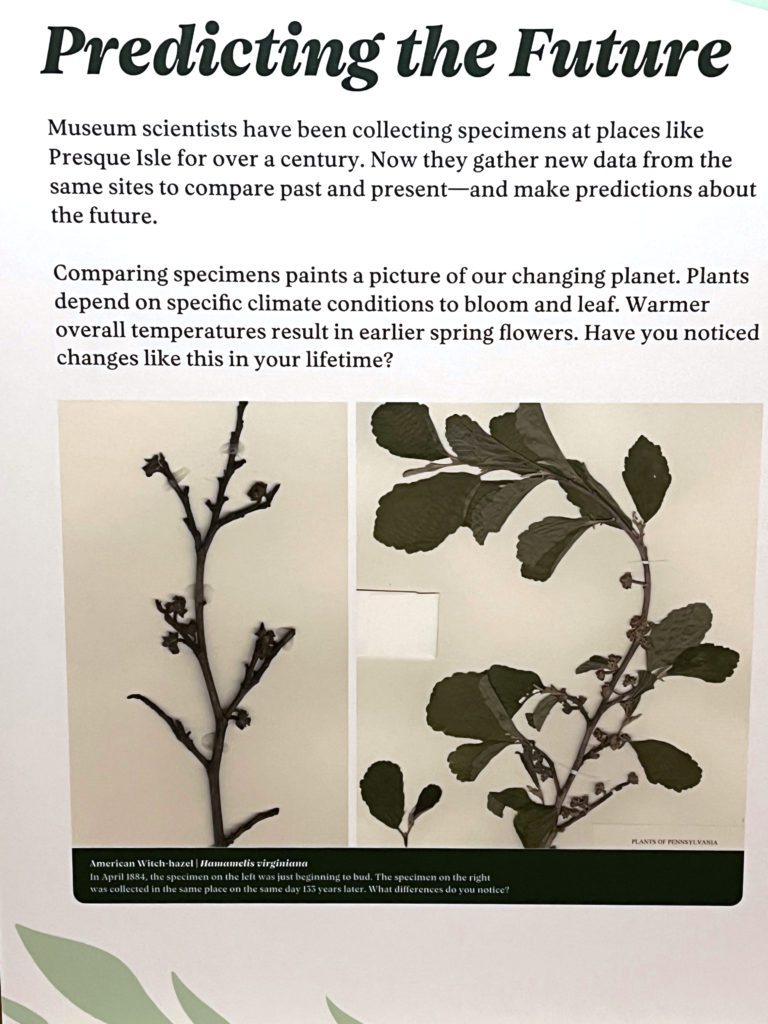
One of the diorama’s interpretive panels invites viewers to notice a half dozen featured plants and animals, while another uses two preserved specimens of witch hazel branches, collected on Presque Isle on the same date, but 133 years apart, to document dramatic changes in this common tree’s spring leaf-out date. The museum’s herbarium holds more than 3,300 Presque Isle plant specimens from ongoing collection efforts that date to 1868. These preserved plants, along with the standardized information recorded with each one, document such changes as the relatively recent abundance of non-native flora, and the decline of some rare plant populations in the wake of engineered beach stabilization efforts. 

Like all the museum’s dioramas, this window into the frozen time of a specific place lends itself to multiple interpretations by museum educators. In addition to narratives about plant succession, or the irrefutable evidence botanical records provide of a changing climate, the diorama’s recreated beach scene is a good place for students to listen to an explanation of the geology term “longshore drift,” or to consider how freshwater, even in a watershed as vast as the Great Lakes Basin, is a limited natural resource.

For some viewers, the diorama will serve as a visual prompt to visit or revisit the park and leave their own footprints on Presque Isle sands. Anyone considering a visit will find the experience enriched by making a preliminary electronic stop at the park website maintained by the Pennsylvania Department of Conservation and Natural Resources, as well a physical stop, just outside the park entrance, at interpretive exhibits in the 16-year-old Tom Ridge Environmental Center (TREC).

 On the website, among activity descriptions, park maps, recent news releases, and relevant advisories, a tab labelled “History” (under the category “Additional Information”) leads not only to a summary of the peninsula’s role in sheltering a fleet of American ships during the War of 1812 and a link to geology-focused park guide, but also to a brief account that, when repeated, serves to acknowledge how this unusual landscape was long ago utilized and cherished by Native Peoples. 

The Erie Indians lived along the southern shores of Lake Erie and were early inhabitants of the area. They hunted game from the forests, gathered plants, and fished from the waters of Lake Erie in birch-bark canoes.

According to legend, the Erie ventured far into the lake to find the place where the sun sank into the waters.

The spirits of the lake caused a great storm to arise, so the Great Spirit stretched out his left arm into the lake to protect the Erie from the storm. Where the sheltering arm of the Great Spirit had lain in the lake, a great sandbar in the shape of an arm-like peninsula was formed to act as an eternal shelter and harbor of refuge for the Great Spirit’s favorite children, the Erie.

https://www.dcnr.pa.gov/StateParks/FindAPark/PresqueIsleStatePark/Pages/History.aspx

Repeating the account in the Hall of Botany can add a new dimension to a 56-year-old diorama.

Patrick McShea works in the Education and Marketing departments at Carnegie Museum of Natural History.

Related Content

Collected On This Day in 1930: Native or Not?

Feather and Bone Connections to American History

Witch Hazel

Carnegie Museum of Natural History Blog Citation Information

Blog author: McShea, Patrick
Publication date: November 22, 2022

Share this post!

  • Share on Twitter Share on Twitter
  • Share on Facebook Share on Facebook
  • Share on Pinterest Share on Pinterest
  • Share on LinkedIn Share on LinkedIn
  • Share on Reddit Share on Reddit
  • Share via Email Share via Email

Filed Under: Blog Tagged With: Botany, Hall of Botany, Pat McShea, Science News

October 24, 2022 by Erin Southerland

Feather and Bone Connections to American History

by Patrick McShea
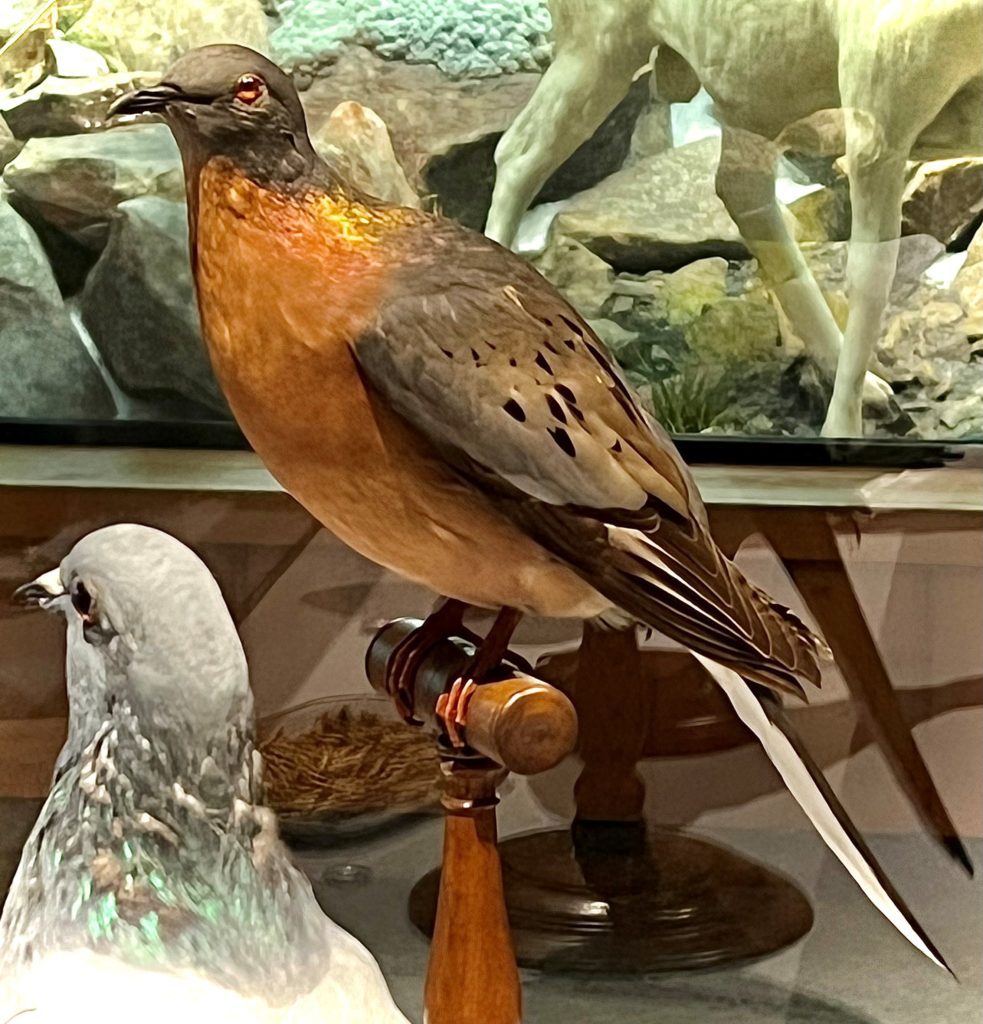
passenger pigeon taxidermy mount

Within the Hall of North American Wildlife, a Passenger Pigeon taxidermy mount stands above a handful of other objects in a display case designed to spark viewers’ thoughts about human relationships with other creatures. On a text panel outside the case an eight-word statement serves to direct such thoughts:

Directly and indirectly, people and wildlife are connected.

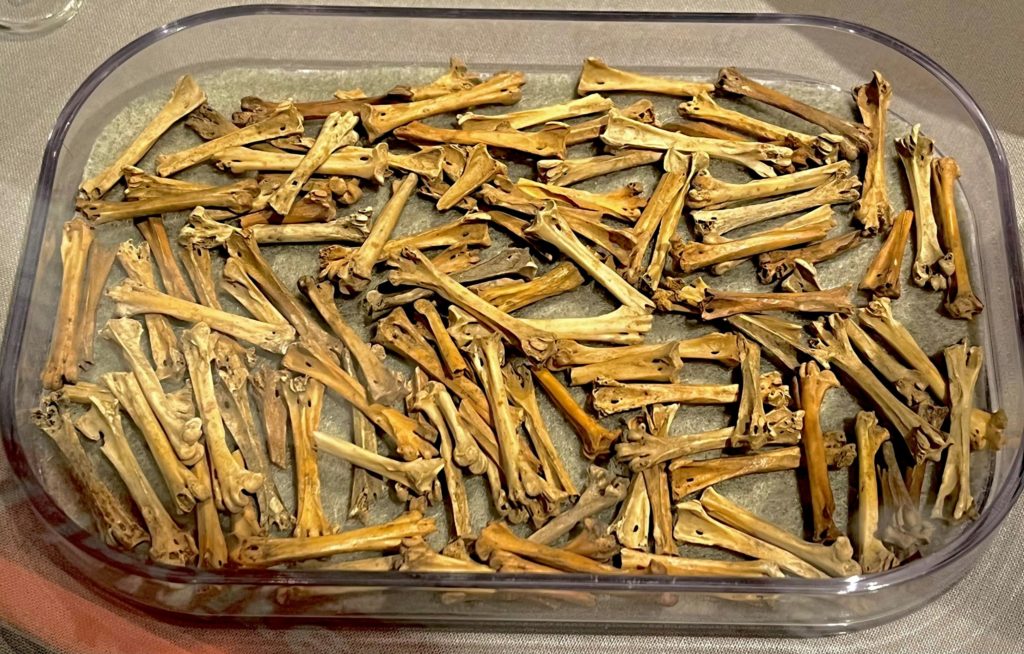
Because Passenger Pigeons have been extinct for more than a century, reflections involving this native species are necessarily historical. An adjacent tray holding dozens of Passenger Pigeon leg bones excavated from an archaeology site in Pennsylvania’s Huntingdon County provides a helpful starting point for reflective time travel.

tray filled with passenger pigeon leg bones

The concentration of bones, which date from the years 1400-1600, is evidence of a centuries-long utilization of the birds for food by the Indigenous Peoples who lived in what’s now central Pennsylvania. Passenger Pigeons were once so abundant in eastern North America that flocks darkened the skies for hours when the birds migrated to access seasonal feeding areas and nesting sites. 

Sustainable use of the birds by humans did not continue into the 19th Century. By mid-century, Passenger Pigeons became an unregulated commodity in the rapidly expanding American economy, with the country’s growing railroad network and parallel telegraph system providing unprecedented means for sharing word of flock locations, transporting hunters to those sites, and shipping harvested birds to distant markets.

A summary statement from an exhibit about Passenger Pigeon extinction at another institution, the Milwaukee Public Museum, contains a relevant insight:

 The primary factor emerged when pigeon meat was commercialized as a cheap food for slaves and the poor in the 19th century, resulting in hunting on a massive scale.

Recognizing an American slavery facet within what is commonly regarded as a natural history extinction story has never been more important. At a time when there is not consensus about how slavery should be presented as a historical topic in classrooms, the preserved remains of a once common bird have a special role to play.

In the 21st Century, museum taxidermy mounts from the 19th Century might serve as focal points for wide ranging discussions between the descendants of people who subsisted on Passenger Pigeon meat because they were enslaved, and those who could purchase little else because they were poor.

The exhibit described above is a component of We Are Nature: A New Natural History, an initiative that encourages a broader and deeper consideration of the human impact on our planet through a series of fifteen interpretive panels placed in and among existing exhibits, as well as a new interactive focal area where visitors are invited to record their thoughts, concerns, and hopes.

Patrick McShea is an Educator at Carnegie Museum of Natural History.

Related Content

Warmer Springs and Earlier Birds

Extinct Ornaments

Messages in Tardigrade Plastic Time Capsules

Carnegie Museum of Natural History Blog Citation Information

Blog author: McShea, Patrick
Publication date: October 24, 2022

Share this post!

  • Share on Twitter Share on Twitter
  • Share on Facebook Share on Facebook
  • Share on Pinterest Share on Pinterest
  • Share on LinkedIn Share on LinkedIn
  • Share on Reddit Share on Reddit
  • Share via Email Share via Email

Filed Under: Blog Tagged With: Birds, Hall of North American Wildlife, Pat McShea, We Are Nature 2

August 5, 2022 by Erin Southerland

Chimney Swift Conservation

by Patrick McShea

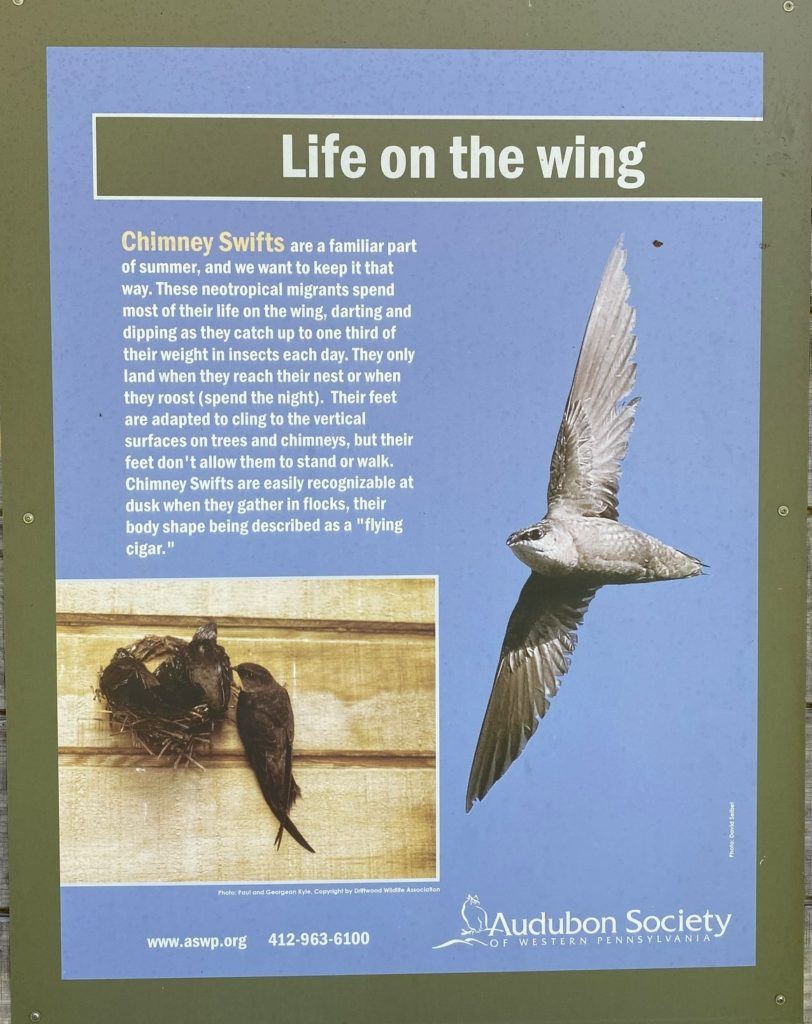
In urban, suburban, and even rural areas of southwestern Pennsylvania, the high-pitched twittering cries of circling Chimney Swifts create a soundtrack for summer days. The birds’ aerial maneuvers are a mix of rapid wing beats and dynamic glides, and much of the action relates to feeding. Chimney Swifts eat on the wing, using their unusually large mouths to capture up to 5,000 flying insects per day. (A summary of a Powdermill Aviation Research Center study of the birds’ diet preferences can be found here:  Chimney Swift Research – Powdermill Nature Reserve.)

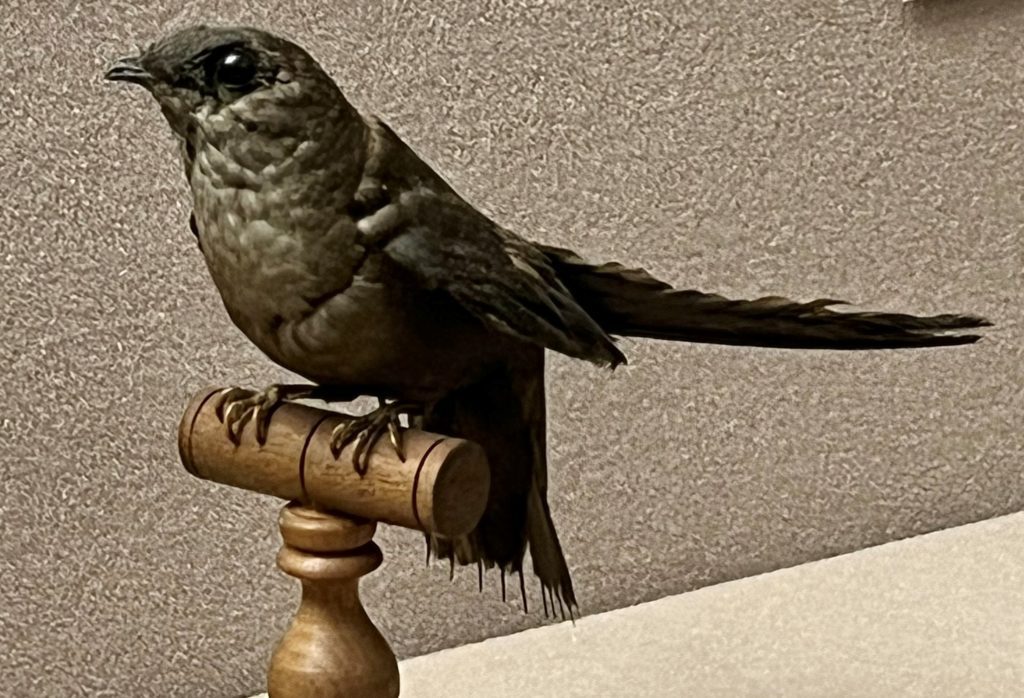
chimney swift taxidermy mount

When observed overhead, passing swifts are frequently described as resembling “flying cigars,” a visual analogy attributable to the birds’ five-inch-long, tube-shaped bodies, comparatively long, narrow wings, and muted grey-brown plumage. Our region is part of the species’ summer range, an enormous portion of eastern North America stretching from the Gulf Coast to just north of the Great Lakes. In South America, an equally large region of the upper Amazon Basin in Peru, Ecuador, and Brazil supports the population during the winter.

The architectural reference in the species’ common name alludes to commensalism involving birds and people that dates to the European settlement of eastern North America. As a biology term, commensalism denotes situations in which one species obtains benefits from another, without harming or benefiting the provider. Historic records indicate that before colonial times the species now known to science as Chaetura pelagica used hollow trees for roosting and nesting. Accounts in New England of the species nesting in chimneys date to the 1670s, and along the Atlantic coastal plain the birds’ exclusive use of chimneys for nest sites was established by 1800.

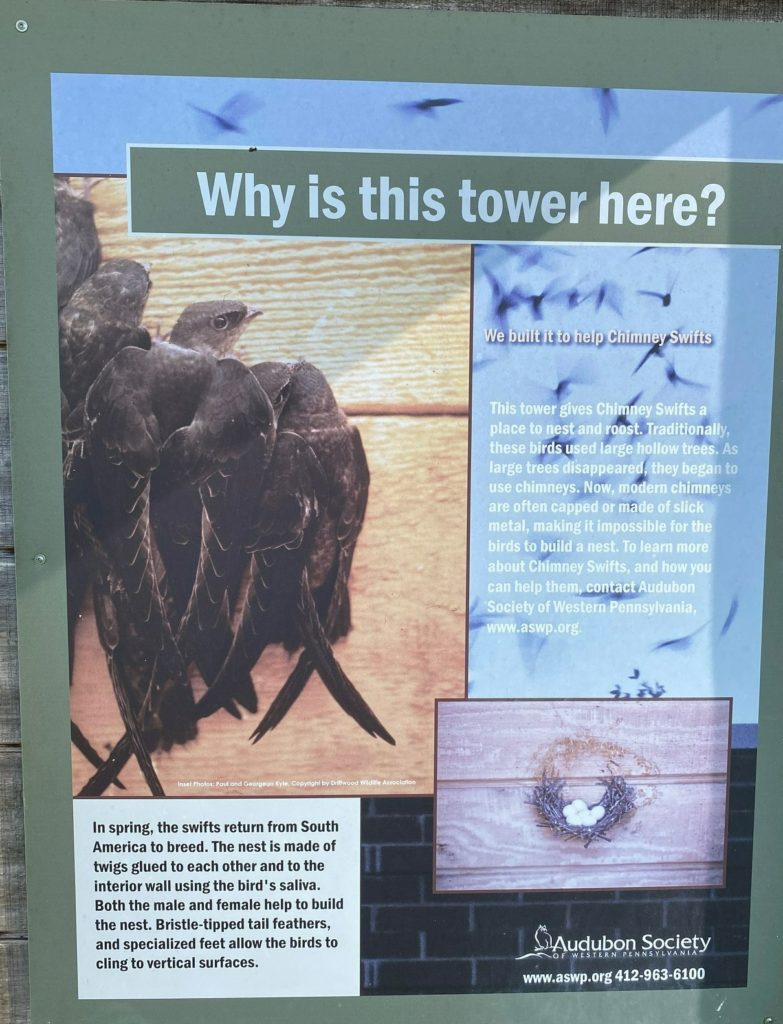
Within hollow trees and chimneys, sheltered interior walls meet the birds’ requirements for nesting and roosting. Chimney Swifts are unable to perch. Instead, they cling to vertical surfaces with their feet, and use the stiff shafts that protrude from the ends of their tail feathers as a brace. For nests, swifts collect branch-end twigs with their feet, in-flight, then use their quick-drying adhesive saliva to construct a narrow platform with the tiny sticks on an interior chimney or tree cavity wall.                                                                                                                           

In his landmark 1940 publication, Birds of Western Pennsylvania, CMNH curator W.E. Clyde Todd summarized the species’ association with chimneys as “more than accidental and connotes a remarkable adaptation to the changed conditions brought about by civilization.” In the eight decades since, changes in the built environment of modern civilization have become less welcoming to Chimney Swifts. 

The population of Chimney Swifts has declined over 70% since the 1960s. Although reductions in flying insect abundance, along with still undetermined threats during migration and on wintering grounds, appear to be critical factors in the decline, potential nest and roost sites have also decreased due to the widespread practice of capping viable chimneys and demolishing those no longer in use. 

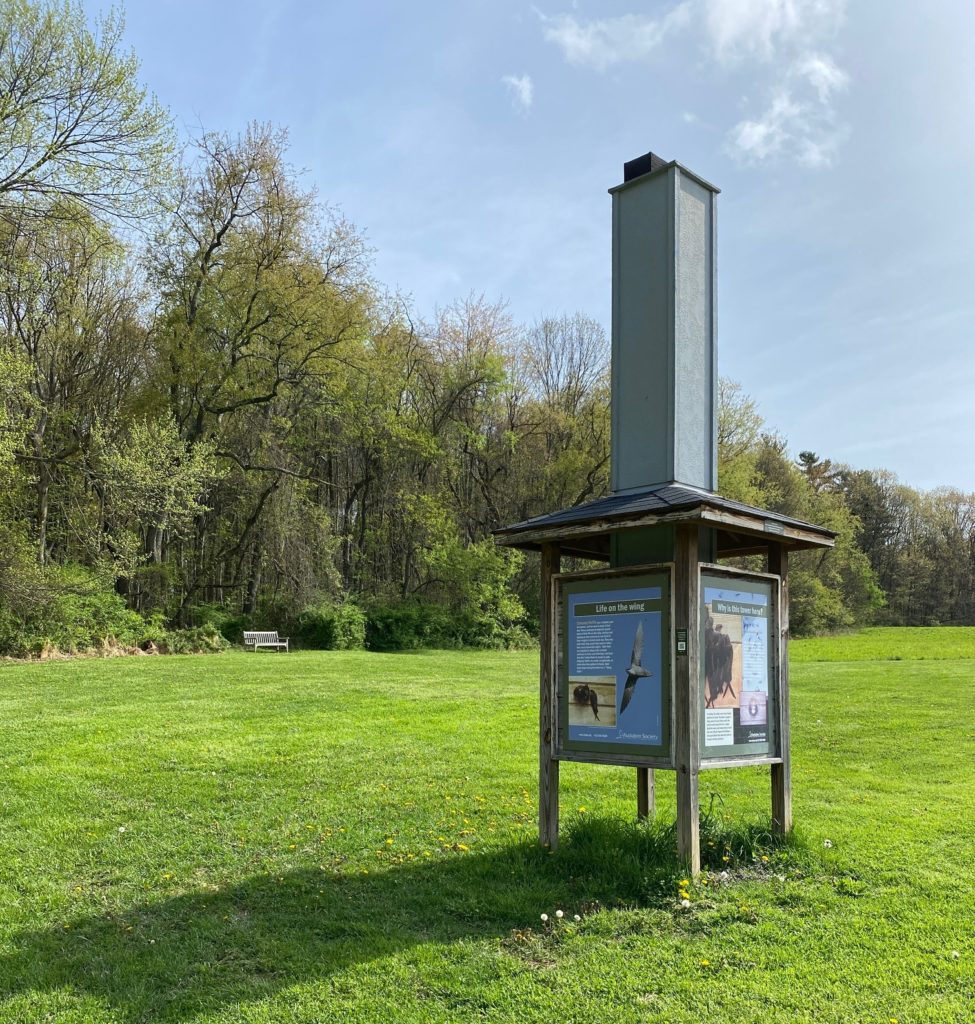
In 2013, the Audubon Society of Western Pennsylvania (ASWP) launched a regional initiative to publicize the species’ plight and address reductions in Chimney Swift nesting and roosting habitat. The 106-year-old conservation organization has since led a broad coalition of partners in an ongoing effort to construct, install, and monitor more than 150 Chimney Swift towers at appropriate locations in southwestern Pennsylvania. Although Chimney Swifts are known to fly and roost in large flocks during migration, the birds’ behaviors are far different during the breeding season. Only one pair will nest in a chimney or tower, and research indicates the same pair will return to the same nesting location in subsequent years.

chimney swift tower

The design of these sturdy towers, which mimic actual chimneys, is based upon construction plans detailed in the 2005 publication, Chimney Swift Towers: New Habitat for America’s Mysterious Birds, by Paul and Georgean Kyle. The couple are project directors of the Texas-based Driftwood Wildlife Association’s North American Chimney Swift Nest Site Research Project, an all-volunteer effort to expand public awareness about the beneficial nature and the plight of the species.

educational sign about chimney swifts
educational sign about chimney swift towers

At sites where ASWP offers regular programming, five towers were constructed of stone to enable the structures to also function as entrance signs for the facilities. In Allegheny County’s seven parks, 12-feet high kiosk-style towers constructed of lumber, shingles, and other roofing materials are now familiar landscape features. Through a partnership with Allegheny County, the Allegheny County Parks Foundation, and the Peaceable Kingdom Fund of The Pittsburgh Foundation, a total of one hundred towers, most bearing colorful informational panels, have been installed to make these public properties more welcoming to Chimney Swifts.

Observations of Chimney Swift activity near any of the towers can contribute to the ongoing evaluation of this regional conservation initiative. Allegheny County Park Rangers have been monitoring towers within the parks where they serve, and towers elsewhere are monitored by ASWP staff and volunteers, however wider public participation is welcome. For more information about Chimney Swift conservation, including a map of tower locations and an online form for reporting observations, please visit the website of the Audubon Society of Western Pennsylvania.

Patrick McShea is an Educator at Carnegie Museum of Natural History. 

Related Content

Bird Architecture on Human Infrastructure

Teaching in the Parks

Sharing a City Park With a Resident Reptile

Carnegie Museum of Natural History Blog Citation Information

Blog author: McShea, Patrick
Publication date: August 5, 2022

Share this post!

  • Share on Twitter Share on Twitter
  • Share on Facebook Share on Facebook
  • Share on Pinterest Share on Pinterest
  • Share on LinkedIn Share on LinkedIn
  • Share on Reddit Share on Reddit
  • Share via Email Share via Email

Filed Under: Blog Tagged With: Birds, climate change, Pat McShea, We Are Nature 2

May 3, 2022 by Erin Southerland

City Nature Challenge: A 2022 Reflection

by Patrick McShea

This year marked the fifth consecutive year that CMNH has sponsored the City Nature Challenge (CNC). One benefit of participation in the annual global event is a better understanding of the animals, plants, and fungi in our own neighborhoods. The submission of photo observations via the iNaturalist app, or Seek, a related app for younger audiences, can spark curiosity among students and teachers that lasts far longer than the prescribed four-day observation period.

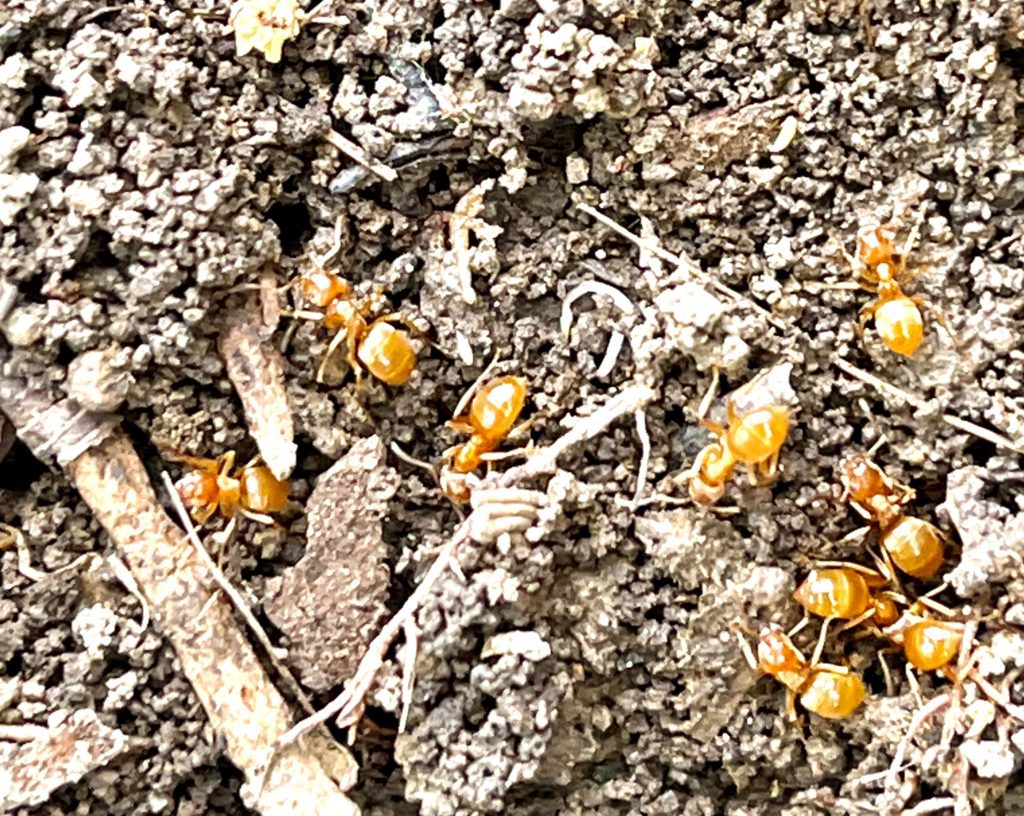
As a participant in last year’s CNC, I learned about citronella ants when iNaturalist quickly generated a tentative identification for a trio of tiny yellow creatures photographed beneath a plate-sized rock in a backyard flowerbed. A subsequent information search on the Penn State Extension website provided some fascinating information about the largely subterranean species. Citronella ants get their common name from the lemon verbena or citronella odor they emit when threatened. For food, the harmless ants rely upon honeydew secreted by root-feeding aphids. The ants’ tending of the soft-bodied aphids resembles the management of cows by dairy farmers.

Citronella ants in the dirt

This information served me well earlier this year when I was asked to speak with a dozen five- and six-year-olds in the museum’s Hall of Botany. As we sat in front of the Pennsylvania Forest diorama, I challenged the group to imagine something we couldn’t see – the tangle of tree roots beneath the display’s massive American beech. When the children’s root descriptions indicated basic understanding of the living network, I told them about root-feeding aphids and citronella ants.

During this year’s City Nature Challenge, I again documented the ants in the backyard flower bed. In appreciation for providing me with a new way to interpret a long-established museum exhibit, I replaced their sheltering rock with great care.

Related Content

Using iNaturalist in the City Nature Challenge and Beyond

The City Nature Challenge Family Experience

Expanding the Scope of Environmental Education

Carnegie Museum of Natural History Blog Citation Information

Blog author: McShea, Patrick
Publication date: May 3, 2022

Share this post!

  • Share on Twitter Share on Twitter
  • Share on Facebook Share on Facebook
  • Share on Pinterest Share on Pinterest
  • Share on LinkedIn Share on LinkedIn
  • Share on Reddit Share on Reddit
  • Share via Email Share via Email

Filed Under: Blog Tagged With: Carnegie Museum of Natural History, City Nature Challenge, Pat McShea

April 28, 2022 by Erin Southerland

Sharing a City Park With a Resident Reptile

by Patrick McShea

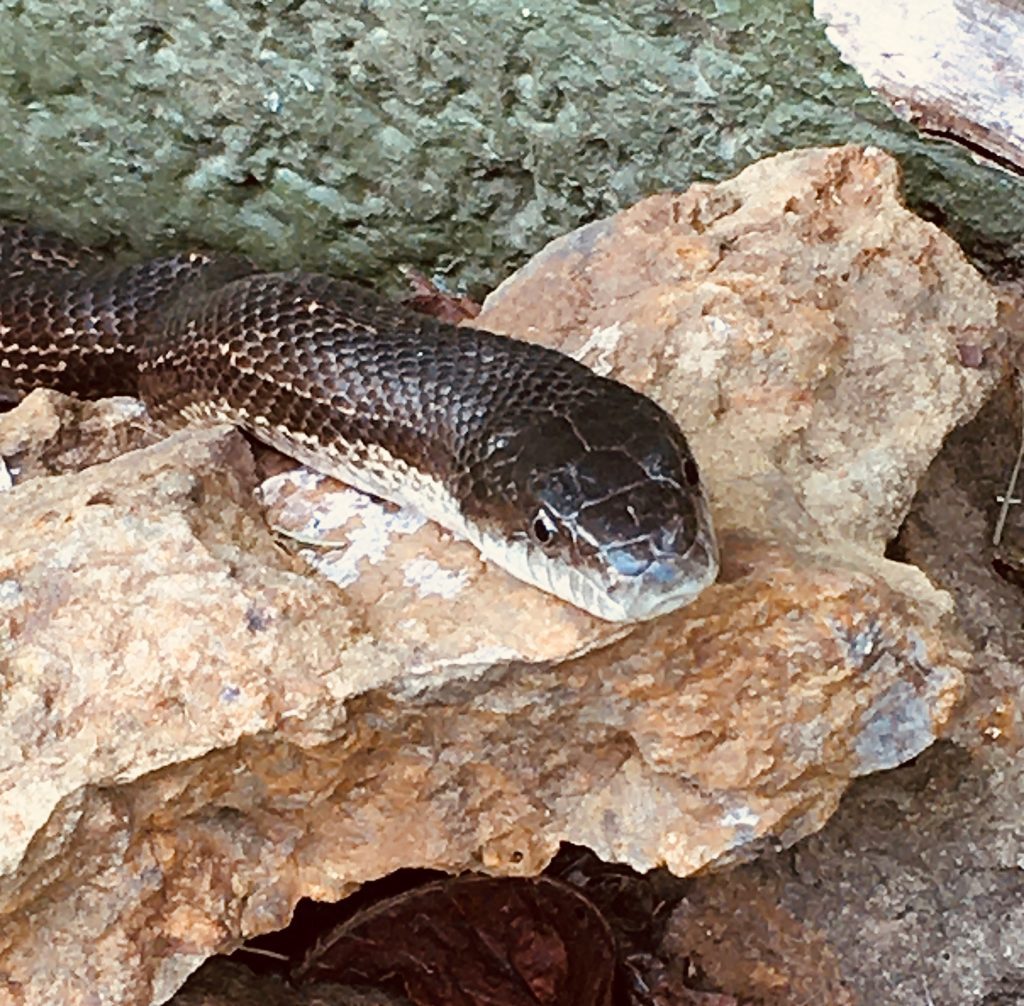
Last April, when reports of a large unidentified snake in Frick Park briefly captured the attention of Pittsburgh news media, Park Ranger Erica Heide was not alarmed. As she explained nearly a year later, “I knew it had to be a black rat snake, and I knew who to check with.” One of the city park’s longtime maintenance staff had earlier told Erica about a large snake he had encountered enough times to merit the bestowing of a name. “That’s Charlie,” he reassured her, “I get reports about him every spring.”

Early rumors, which included speculation that someone had released a large python into the park, were dispelled within hours by a widely shared photograph depicting what was clearly a black rat snake fully exposed in a still leafless trailside sapling. Erica, who has worked in her position for the City of Pittsburgh since 2017, now focuses on the benefits of the publicity. “Overall, the event had positive impact. For some weeks afterward I’d be stopped along the trails by park visitors asking how they could be sure to avoid an encounter with the snake, and by just as many others who wanted to know where they could go to see it. For both groups, and for everyone else whose interest level fell somewhere between those positions, the knowledge that this city park can support and sustain a wide variety of wildlife has certainly been a good thing.”

Black rat snake on a rock.

At Carnegie Museum of Natural History, it’s well understood that whenever snakes are the topic of a public presentation, a similar audience stratification comes into play. During such circumstances fearful and fascinated people occupy widely separated edge positions. Within the Section of Amphibians and Reptiles, Assistant Curator Jen Sheridan and Collection Manager Stevie Kennedy-Gold frequently use their positions to diminish the fear of snakes by increasing background knowledge about the creatures’ life cycles, physical adaptations, behaviors, and ecosystem roles. Stevie has recently created a full alphabet-referenced set of 26 TikTok videos that introduce viewers to preserved amphibian and reptile specimens, including many snakes, in the museum’s scientific collection. In early February Jen and Stevie welcomed NEXTPittsburgh’s Boaz Frankel on a tour of their section’s alcohol-preserved specimens for an episode of the weekly YouTube series, Yinzer Backstage Pass.

One highlight of the 30-minute program features Jen holding a large glass jar containing the preserved remains of a type of snake she has frequently encountered during fieldwork in Borneo, the venomous species known to science as Tropidolaemus subannulatus. “What’s really cool about these guys in the field is that they often will sit in the same place for days, and you can go back and take pictures of them, and I can bring students to look at them and admire their beautiful green color.”

Jen’s excitement in relating first-hand experiences as a scientist visiting an exotic environment will undoubtedly move some viewers closer to acceptance of snakes as valued biodiversity markers in a distant land. For a broader acceptance of black rat snakes as neighborhood wildlife, however, the advice Robin Wall Kimmerer, a botanist who is a member of the Citizen Potawatomi Nation, offered to museum staff earlier this month might be even more important. “Native names are important,” the author of Braiding Sweetgrass, reminded us during an informal talk that was part of her appearance as a Pittsburgh Arts and Lectures’ Ten Evenings speaker. “Their use says, ‘We’re not the first ones here.’” 

The comments prompted me to retrieve a year-old email message from Deborah Harding, the recently retired Collection Manager for the museum’s Section of Anthropology, and someone who has developed close personal and professional relations with Cherokee artists through her knowledge of traditional weaving practices. As media panic subsided when the snake in the Frick Park tree had been identified, Deb sent a one-line message that explained the creature’s predictable behavior:

The Cherokee word for blacksnake is “ulisdi” = “the one who climbs”. 

Patrick McShea is an Educator at Carnegie Museum of Natural History. Museum employees blog about their unique experiences and knowledge gained from working at the museum.

Related Content

The Enduring Appeal of Snakes

Do Snakes Believe in the Tooth Fairy?

Collected On This Day in 1906: Flowering Dogwood in Frick Park

Carnegie Museum of Natural History Blog Citation Information

Blog author: McShea, Patrick
Publication date: April 28, 2022

Share this post!

  • Share on Twitter Share on Twitter
  • Share on Facebook Share on Facebook
  • Share on Pinterest Share on Pinterest
  • Share on LinkedIn Share on LinkedIn
  • Share on Reddit Share on Reddit
  • Share via Email Share via Email

Filed Under: Blog Tagged With: amphibians and reptiles, Carnegie Museum of Natural History, Pat McShea

  • « Go to Previous Page
  • Page 1
  • Page 2
  • Page 3
  • Page 4
  • Page 5
  • Page 6
  • Interim pages omitted …
  • Page 15
  • Go to Next Page »

sidebar

About

  • Mission & Commitments
  • Directors Team
  • Museum History

Get Involved

  • Volunteer
  • Membership
  • Carnegie Discoverers
  • Donate
  • Employment
  • Events

Bring a Group

  • Groups of 10 or More
  • Birthday Parties at the Museum
  • Field Trips

Powdermill

  • Powdermill Nature Reserve
  • Powdermill Field Trips
  • Powdermill Staff
  • Research at Powdermill

More Information

  • Image Permission Requests
  • Science Stories
  • Accessibility
  • Shopping Cart
  • Contact
  • Visitor Policies
Stay in the loop! Sign up for our newsletter(s).
One of the Four Carnegie Museums | © Carnegie Institute | Privacy Policy | Terms of Use | Accessibility
Rad works here logo