• Skip to primary navigation
  • Skip to main content
  • Skip to primary sidebar

Carnegie Museum of Natural History

One of the Four Carnegie Museums of Pittsburgh

  • Visit
    • Buy Tickets
    • Visitor Information
    • Exhibitions
    • Events
    • Dining at the Museum
    • Celebrate at the Museum
    • Powdermill Nature Reserve
    • Event Venue Rental
    • Gift Cards
  • Learn
    • Field Trips
    • Educator Information
    • Programs at the Museum
    • Bring the Museum to You
    • Guided Programs FAQ
    • Programs Online
    • Climate and Rural Systems Partnership
  • Research
    • Scientific Sections
    • Science Stories
    • Science Videos
    • Senior Science & Research Staff
    • Museum Library
    • Science Seminars
    • Scientific Publications
    • Specimen and Artifact Identification
  • About
    • Mission & Commitments
    • Directors Team
    • Museum History
  • Tickets
  • Give
  • Shop

Blogs from our Scientific Researchers

Carnegie Museum of Natural History is home to active research and vast scientific collections. Our scientific researchers regularly contribute to the blog at the museum.

June 8, 2022 by Erin Southerland

Bizarre Meat-Eating Dinosaur Joins “Rogues’ Gallery” of Giant Predators from Classic Fossil Site in Egypt’s Sahara Desert

Fossil Reveals First Evidence of Abelisaurid Dinosaurs Found in Bahariya Oasis
 
Carnivorous Dinosaur Group Known for Bulldog-like Faces, Tiny Arms, and Small Teeth

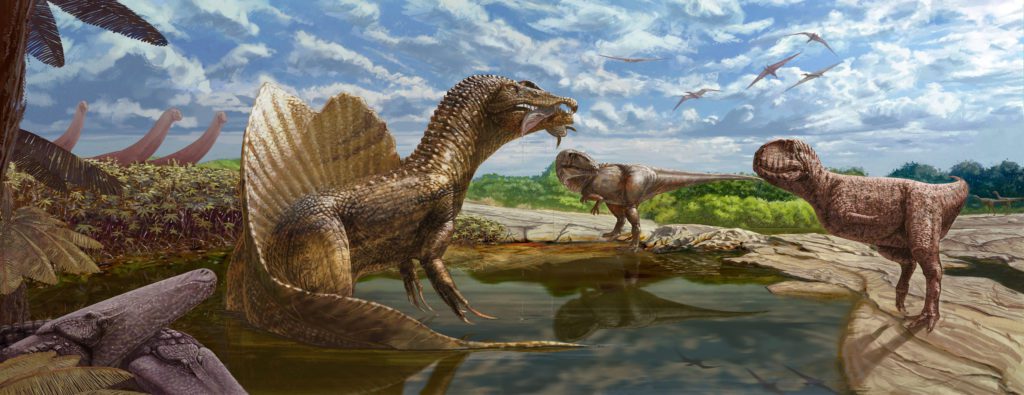
Illustration of dinosaurs in a desert oasis
Reconstruction of the ecosystem of the Bahariya Oasis in the Sahara Desert of Egypt approximately 98 million years ago, showing the diversity of large theropods (predatory dinosaurs). The newly discovered, as-yet unnamed abelisaurid (right) confronts Spinosaurus (left center, with lungfish in jaws) and Carcharodontosaurus (right center), while two individuals of the crocodilian Stomatosuchus (left) look on. In the background, a herd of the sauropod (giant, long-necked herbivorous dinosaur) Paralititan (left) warily regard these predators and two individuals of another theropod, Bahariasaurus (far right), while a flock of a still-unnamed pterosaur (flying reptile) soars above. The vegetation is dominated by the mangrove-like tree fern Weichselia. Image by Andrew McAfee, Carnegie Museum of Natural History. 

[Pittsburgh, Pennsylvania] — An Egyptian-American team of researchers has announced the discovery of a new kind of large-bodied meat-eating dinosaur, or theropod, from a celebrated fossil site in Egypt’s Sahara Desert. The fossil of a still-unnamed species provides the first known record of the abelisaurid group of theropods from the Bahariya Formation, a rock unit in the Bahariya Oasis that dates to the middle Cretaceous Era (approximately 98 million years ago). In the early 20th century, this locality famously yielded the original specimens of a host of remarkable dinosaurs—including the colossal sail-backed fish-eater Spinosaurus—which were then destroyed in World War II. Abelisaurid fossils had previously been found in Europe and in many of today’s Southern Hemisphere continents, but never before from the Bahariya Formation. The team describes the Bahariya abelisaurid discovery in a paper published today in Royal Society Open Science. 
 
The study was led by Belal Salem of the Mansoura University Vertebrate Paleontology Center (MUVP) in Mansoura, Egypt, who is also a graduate student at Ohio University and a faculty member at Benha University. The research team also included Dr. Matt Lamanna, Mary R. Dawson Associate Curator and Head of Vertebrate Paleontology and lead dinosaur specialist at Carnegie Museum of Natural History (CMNH); Dr. Patrick O’Connor, Professor of Biomedical Sciences at Ohio University; Sanaa El-Sayed, a doctoral student at the University of Michigan and the MUVP’s former vice director; Dr. Hesham Sallam, a professor at the American University in Cairo (AUC) and Mansoura University and the founding director of the MUVP; and additional colleagues from Benha University and the Egyptian Environmental Affairs Agency. CMNH Vertebrate Paleontology Scientific Illustrator Andrew McAfee produced or assisted with most of the illustrations in the paper.

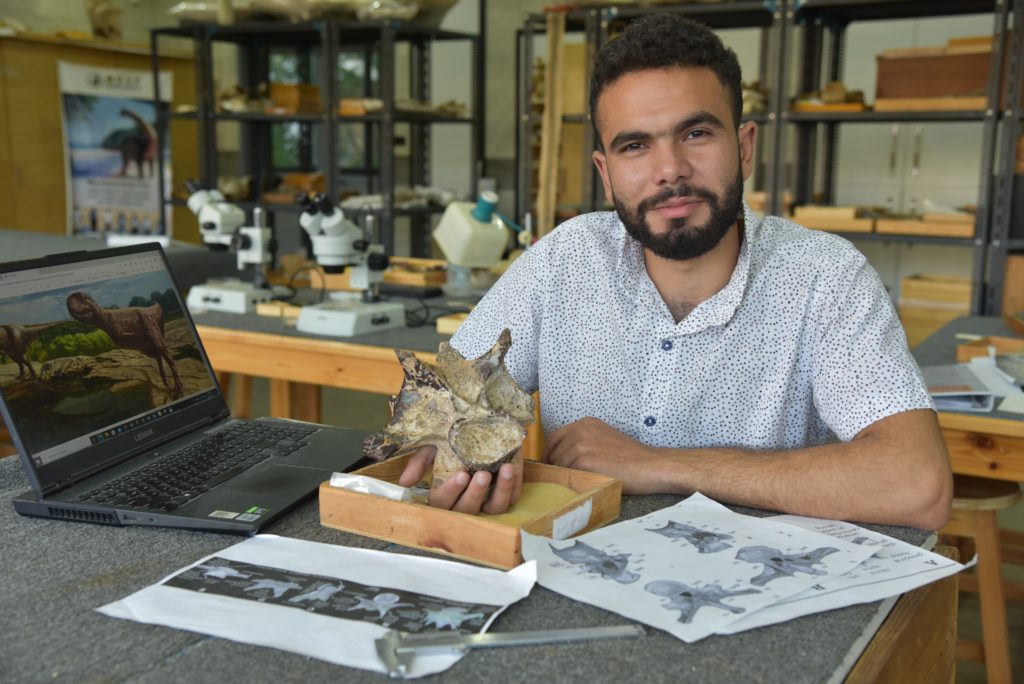
Person sitting at a desk holding a fossil
Study leader Belal Salem of the Mansoura University Vertebrate Paleontology Center (MUVP), Ohio University, and Benha University examines the roughly 98-million-year-old abelisaurid theropod neck vertebra discovered from the Bahariya Oasis that forms the basis of the new study. Photo by Hesham Sallam, American University in Cairo/MUVP. 

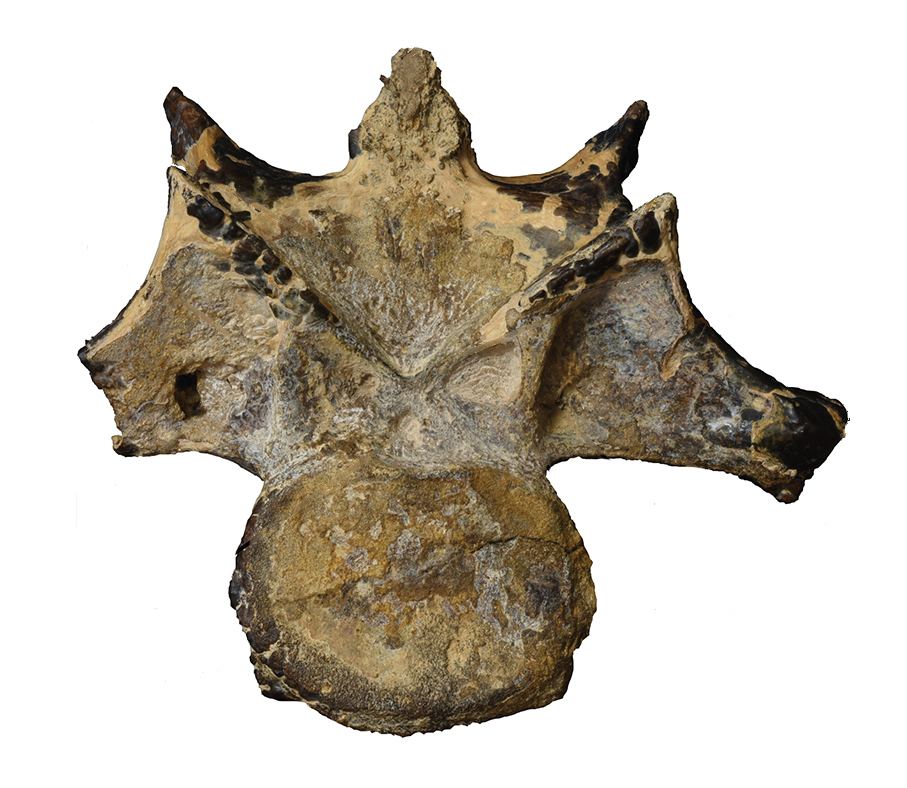
The fossil in question, a well-preserved vertebra from the base of the neck of a theropod, was recovered by a 2016 MUVP expedition to the Bahariya Oasis. The vertebra belongs to an abelisaurid, a kind of bulldog-faced, small-toothed, tiny-armed theropod that is estimated to have been roughly six meters (20 feet) in body length. Abelisaurids—most notably represented by the horned, demonic-looking Patagonian form Carnotaurus of Jurassic World and Prehistoric Planet fame—were among the most diverse and geographically widespread large predatory dinosaurs in the southern landmasses during the Cretaceous Period, the final time period of the Age of Dinosaurs. Along with Spinosaurus and two other giant theropods (Carcharodontosaurus and Bahariasaurus), the new abelisaurid fossil adds yet another species to the cadre of large predatory dinosaurs that roamed what is now the Egyptian Sahara roughly 98 million years ago. 
 
“During the mid-Cretaceous, the Bahariya Oasis would’ve been one of the most terrifying places on the planet,” says Salem. “How all these huge predators managed to coexist remains a mystery, though it’s probably related to their having eaten different things, their having adapted to hunt different prey.”

fossil vertebra
The abelisaurid neck vertebra from the Bahariya Oasis, Egypt that constitutes the first record of this dinosaur group from that classic fossil locality. The bone is shown in anterior view. Photo by Belal Salem, Mansoura University Vertebrate Paleontology Center/Ohio University/Benha University.

The new vertebra holds implications for the biodiversity of Cretaceous dinosaurs in Egypt and the entire northern region of Africa. It is the oldest known fossil of Abelisauridae from northeastern Africa, and shows that, during the mid-Cretaceous, these carnivorous dinosaurs ranged across much of the northern part of the continent, east to west from present day Egypt to Morocco, to as far south as Niger and potentially beyond. Spinosaurus and Carcharodontosaurus are also known from Niger and Morocco, and a close relative of Bahariasaurus has been found in the latter nation as well, suggesting that this fauna of large to gigantic theropods coexisted throughout much of northern Africa at this time.
 
The Site
 
The Bahariya Oasis is renowned within paleontological circles for having yielded the type specimens (the original, first-discovered, name-bearing fossils) of several extraordinary dinosaurs during the early 20th century, including, most famously, Spinosaurus. Unfortunately, all Bahariya dinosaur fossils collected prior to World War II were destroyed during an Allied bombing of Munich in 1944.
 
As a graduate student in the early 2000s, study co-author Matt Lamanna helped make the first dinosaur discoveries from the oasis since that infamous air raid, including the gargantuan sauropod (long-necked plant-eating dinosaur) Paralititan. “The Bahariya Oasis has taken on near-legendary status among paleontologists for having produced the first-known fossils of some of the world’s most amazing dinosaurs,” says Lamanna, “but for more than three quarters of a century, those fossils have existed only as pictures in old books.”

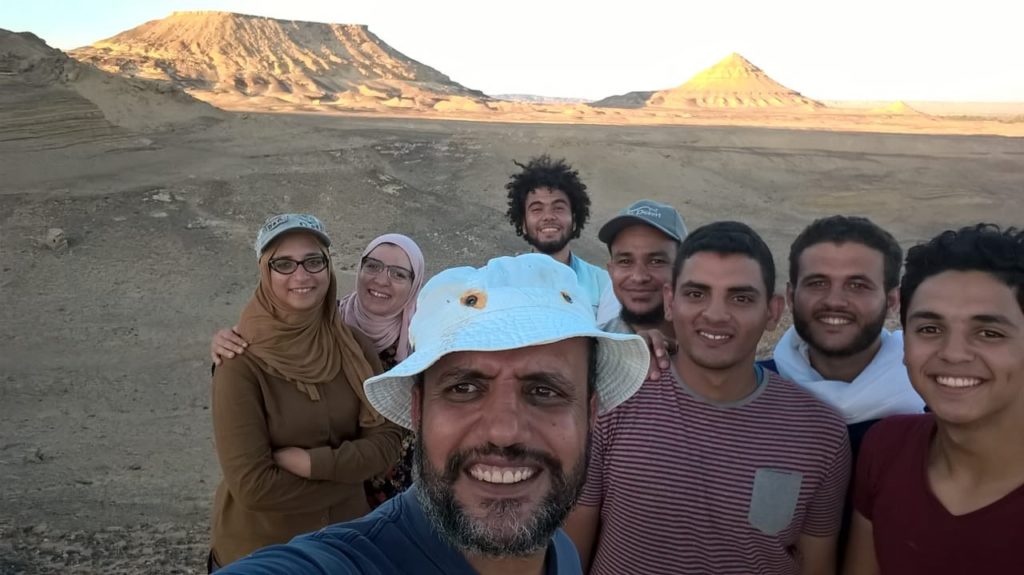
A group of people posing for a selfie in the desert
A Mansoura University Vertebrate Paleontology Center (MUVP) team exploring the Bahariya Oasis in 2018, including several authors of the new paper: Hesham Sallam (closest to camera), Sanaa El-Sayed (far left), and Belal Salem (farthest from camera). Photo by Hesham Sallam, American University in Cairo/MUVP.

Thankfully, discoveries made during recent expeditions led by researchers from AUC and MUVP—such as the new abelisaurid vertebra—are helping to restore the paleontological legacy of this classic site. These expeditions have recovered a wealth of additional fossils that the researchers plan to unveil in the near future.
 
As team member Sanaa El-Sayed, who co-led the 2016 expedition that collected the abelisaurid vertebra, explains, “this bone is just the first of many important new dinosaur fossils from the Bahariya Oasis.” 
 
The Bahariya Formation holds promise to shed further light on mid-Cretaceous African dinosaurs and the vanished ecosystems in which they once lived. Unlike more thoroughly explored rocks of the same age in Morocco that tend to yield isolated bones, the Bahariya Formation appears to preserve partial skeletons of dinosaurs and other land-living animals with a relatively high degree of frequency. The more bones that are preserved within the skeleton of a given fossil vertebrate species, the more paleontologists can generally learn about it. The propensity of the Bahariya Oasis for producing associated partial skeletons suggests that much remains to be learned from this historic locality.
 
“In terms of Egyptian dinosaurs, we’ve really just scratched the surface,” notes Hesham Sallam. “Who knows what else might be out there?”

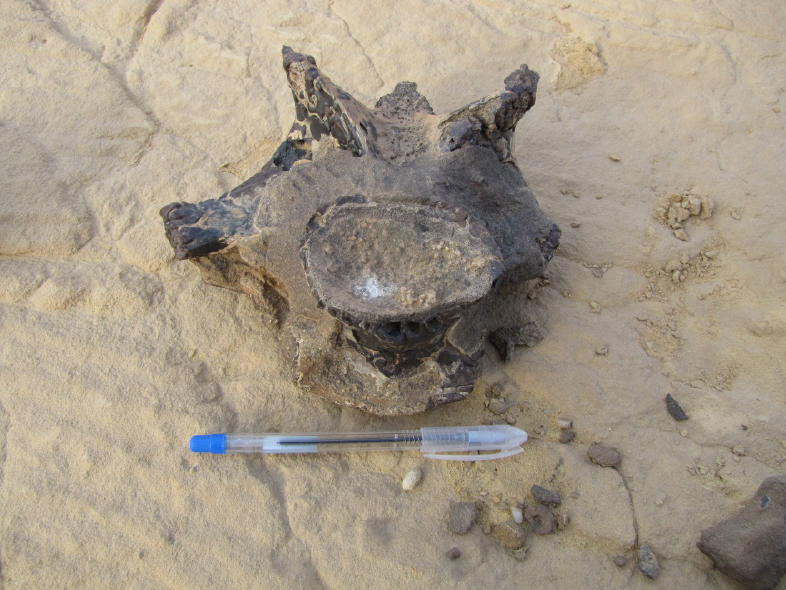
Fossil vertebra set next to a pen for scale
The abelisaurid neck vertebra, approximately 98 million years old, as it was found in the field in the Bahariya Oasis during the 2016 Mansoura University Vertebrate Paleontology Center (MUVP)/Carnegie Museum of Natural History expedition funded by the National Geographic Society. Photo by Sanaa El-Sayed, University of Michigan/MUVP.

One Fossil
 
How can the discovery of a single neck vertebra lead researchers to conclude that the fossil belongs to a member of Abelisauridae, a kind of carnivorous dinosaur that has never been found in the Bahariya Formation before? The answer is remarkably simple: it is virtually identical to the same bone in other, better-known abelisaurids such as Carnotaurus and Viavenator from Argentina and Majungasaurus from Madagascar. Additionally, Belal Salem and his collaborators conducted a computer-based evolutionary study—known as a cladistic analysis—that confirmed the placement of the species represented by the new vertebra within Abelisauridae. As co-author Patrick O’Connor, who in 2007 published an exhaustive study of the vertebral anatomy of the abelisaurid Majungasaurus, explains, “I’ve examined abelisaurid skeletons from Patagonia to Madagascar. My first glimpse of this specimen from field photos left no doubt about its identity. Abelisaurid neck bones are just so distinctive.”
 
Research on the new abelisaurid vertebra was supported by a grant to Matt Lamanna from the National Geographic Society’s Committee for Research and Exploration, grants to Hesham Sallam from Mansoura University and the American University in Cairo intramural grant program, and a grant to Patrick O’Connor from the National Science Foundation.

Filed Under: Press Release Tagged With: Matt Lamanna, Science News, Vertebrate Paleontology

June 3, 2022 by Erin Southerland

Finding Answers: From Museum to Mountains and Back Again

by Patty Dineen

The beautiful wildlife dioramas on the second floor of Carnegie Museum of Natural History have been fascinating visitors for decades. Within the Hall of North American Wildlife, most of these realistic displays feature taxidermy mounts of one or more of the continent’s large charismatic mammals, posed in recreated three-dimensional scenes of appropriate habitat that also feature smaller mammals, birds, insects, and, of course, plants. 

Typically, the dioramas don’t display a generic environment, such as say, the Arctic, the mountains, or the desert, but rather, they depict specific places in North America. The key to the “where” of each diorama is the painted background.  Most of the wildlife dioramas feature gorgeous and detailed renderings of specific locations in North America such as Kodiak Island in Alaska, the Laurel Highlands of Western Pennsylvania, or the beautiful Hayden Valley in Yellowstone National Park.

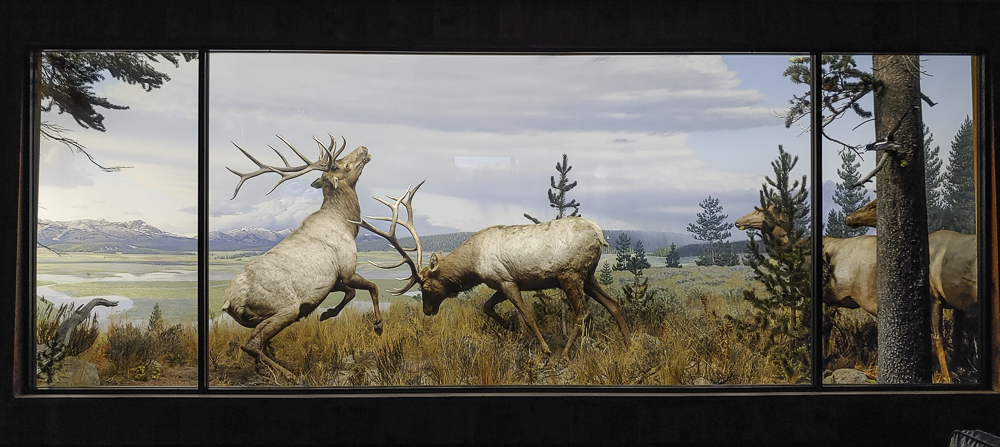
Diorama with taxidermy elk, fake trees other plants, and a mural for the background.
Elk Diorama in the Hall of North American Wildlife.

Finding the Locations That Inspired the Dioramas

Is it still possible to travel to, and view, the locations featured in these wonderful dioramas? Would those places look the same today as when they inspired artistic rendering as wildlife diorama paintings many decades ago? And first things first, how would you even go about finding the exact locations depicted in any of the dioramas? Let me tell you a brief story of a recent travel adventure that included an attempt to find the specific vantage point in Yellowstone National Park where a view of the park’s namesake river valley was long ago recreated as a painting some 1,700 miles east in Pittsburgh. The diorama in question features four American elk: two males fighting as two females watch the action from the side. The scene is a snapshot of the fall elk rut, the mating season when males compete to gather “harems” of females. 

Last fall, as some museum staff made plans for a guided visit to the park, an attempt to locate and stand in the elk diorama vantage point earned a spot on our agenda.

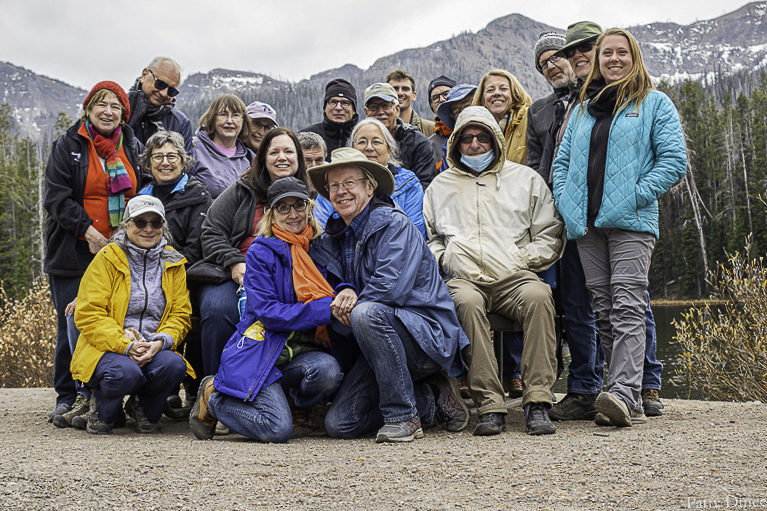
Group of people posing for a photo outdoors.

In early October 2021, our group of 21, consisting of museum staff and their travelling companions, flew from Pittsburgh to Bozeman, Montana, and then traveled south by bus through Paradise Valley to Mammoth Hot Springs in Yellowstone National Park. From this location we began three full days of guided exploration of different parts of the 3,472 square mile park, hoping that at some point we might be able to find the “Elk Diorama” location. We were armed with the Elk Diorama label copy – “…a ritualistic bout between bull elk on the edge of the Hayden Valley, overlooking the Yellowstone River, in Yellowstone National Park,” maps of the park, and photos of the museum’s Elk Diorama. When we shared our information and diorama photos with our two professional guides, one recognized the view and said she was pretty sure she knew the location.

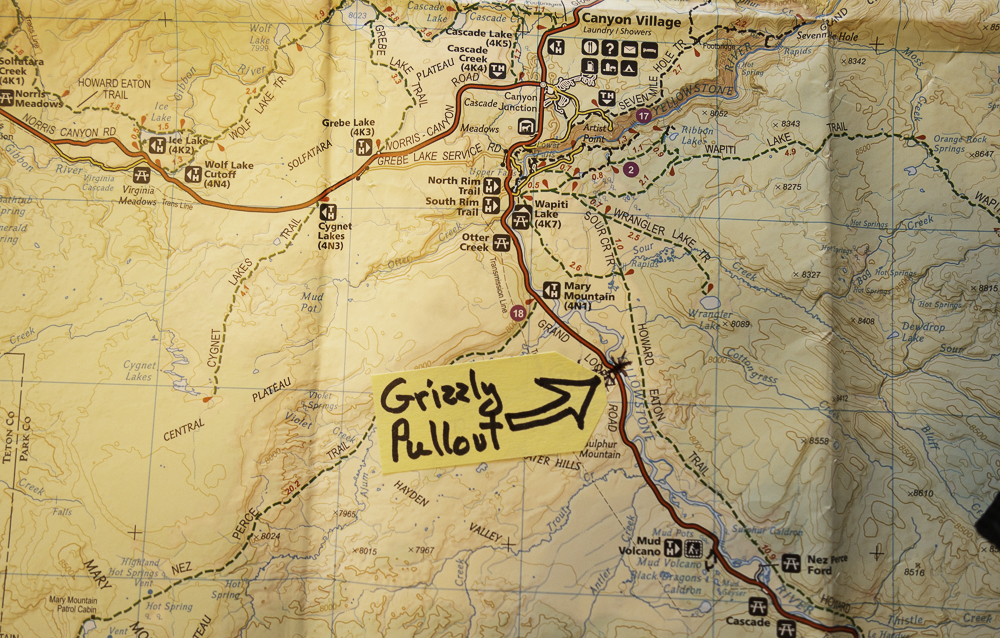
Map of Yellowstone National Park with Grizzly Pullout marked with large handwritten letters and an arrow.

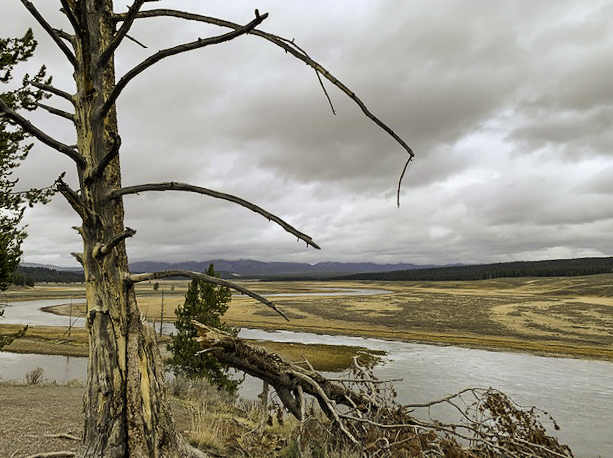
Over our three days of exploring the park we saw geysers and other geothermal features; learned about the Yellowstone National Park wolf project and watched wolves through spotting scopes; and enjoyed wildlife sightings of trumpeter swans, black and grizzly bears, elk, pronghorn, bison, ravens, and young cutthroat trout. On the third and final day, we traveled to The Grand Canyon of the Yellowstone and Yellowstone Lake, and then headed back north from Fishing Bridge and into the Hayden Valley. And there it was — not marked on my large map but referred to by our guides as “Grizzly Pullout” — a wide spot at the side of the road where a couple of cars or a small shuttle bus could pull over for a view of the Yellowstone River as it begins a graceful bend away from the Grand Loop Road. There was the distinctive (even on this heavily clouded day) profile of distant mountains to the left and middle, and a hillside sloping up and to the right in the middle distance. Group members took photos and enjoyed what seemed a familiar landscape (many thanks to Suzanne and Andy McLaren for the photos they took at Grizzly Pullout). We then headed back to Mammoth Hot Springs for one last night in the park before heading back to Pittsburgh, the museum, and our beautiful wildlife dioramas.

View from Grizzly Pullout in Yellowstone National Park: a large tree, a fallen tree, water, sand, hills, and cloudy sky.
View from Grizzly Pullout.

Patty Dineen is a Natural History Interpreter at Carnegie Museum of Natural History.

Related Content

A Deeper Look at Dioramas

Chasing Snails in the Great Smoky Mountains

Doubly Dead: Taxidermy Challenges in Museum Dioramas

Carnegie Museum of Natural History Blog Citation Information

Blog author: Dineen, Patty
Publication date: June 3, 2022

Share this post!

  • Share on Twitter Share on Twitter
  • Share on Facebook Share on Facebook
  • Share on Pinterest Share on Pinterest
  • Share on LinkedIn Share on LinkedIn
  • Share on Reddit Share on Reddit
  • Share via Email Share via Email

Filed Under: Blog Tagged With: Education, Hall of North American Wildlife, Patty Dineen, Science News

June 2, 2022 by Erin Southerland

Do Any Mammals Lay Eggs?

by Dr. John R. Wible

Scientists recognize three major types of living mammals: placentals, marsupials, and monotremes, all of which produce milk to nourish their young. Of the 6,495 mammal species recognized in 2018 (Burgin et al., Journal of Mammalogy vol. 99), 6,111 are placentals, 379 are marsupials, and 5 are monotremes. 

Placentals and marsupials are viviparous, meaning they give birth to live offspring. Marsupials, such as kangaroos, koalas, and our local Virginia opossum, give birth to very immature, embryo-like offspring that complete their development outside the womb usually attached to a nipple in a pouch. In contrast, placentals, such as dogs, cats, and humans, give birth to more developed offspring and have no pouch. Both marsupials and placentals have a placenta that nourishes the developing offspring in the womb, but this organ is more efficient in placental mammals than in marsupials. 

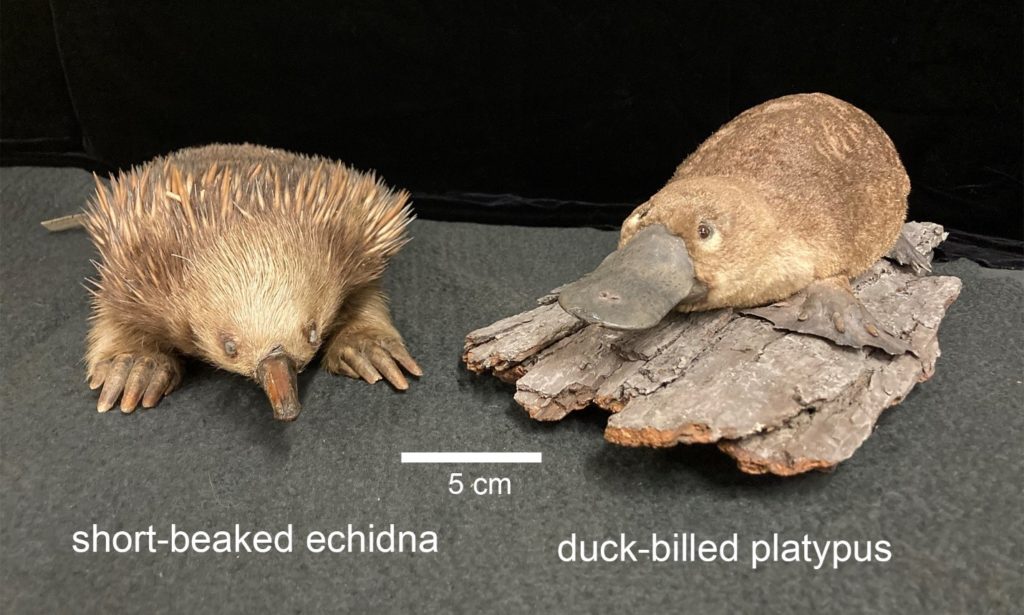
But what about monotremes? The five species of living monotremes include the duck-billed platypus found only in eastern Australia, the short-beaked echidna found in Australia and New Guinea, and the three species of the long-beaked echidna found only in New Guinea. Echidnas are also known as spiny anteaters.

echidna and platypus taxidermy mounts

In contrast to the viviparous marsupials and placentals, monotremes are oviparous, a word that means they “give birth to eggs”. Unlike the hard-shelled eggs of birds, monotreme eggs have a leathery exterior, like those of most reptiles.  The platypus has one mating season per year and produces one to three eggs with an average of two. Pregnancy lasts about 21 days and incubation of the hatched egg in a nest of wet vegetation is about 10 days. The lima bean-sized platypus newborn or puggle (or platypup to some) is embryo-like, but more advanced than a newborn joey (kangaroo). It crawls onto the mother’s belly in search of milk, which oozes from the skin surface, as monotremes don’t have nipples.

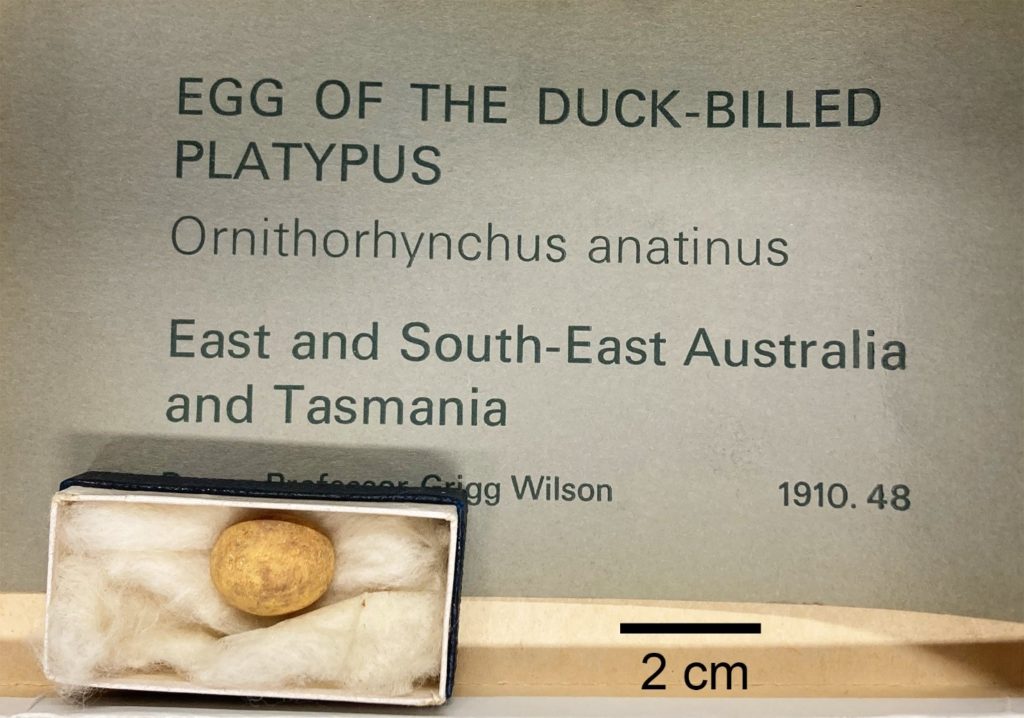
On a recent research trip to Edinburgh in the United Kingdom, I visited the mammal collection of the National Museum of Scotland. There I came across a model of the egg of a platypus, which was the inspiration for this blog. This three-quarter-inch-long egg will hatch and grow into a house cat-sized animal. Given that monotremes, most reptiles, and all birds are oviparous, the common ancestor of mammals is thought to have been an egg-layer as well. This primitive mode of birth was retained in living monotremes, but evolved into live birth in the common ancestor of placentals and marsupials.

Platypus egg in a box with a label next to it that says "Egg of the duck-billed platypus, Ornithorhynchus anatinus, East and South-East Australia and Tasmania."

John Wible is the Curator of Mammals at the Carnegie Museum of Natural History.

Related Content

E is for Echidna

Armadillos: Identical Quadruplets Every Time

Mesozoic Monthly: Volaticotherium

Carnegie Museum of Natural History Blog Citation Information

Blog author: Wible, John R.
Publication date: June 2, 2022

Share this post!

  • Share on Twitter Share on Twitter
  • Share on Facebook Share on Facebook
  • Share on Pinterest Share on Pinterest
  • Share on LinkedIn Share on LinkedIn
  • Share on Reddit Share on Reddit
  • Share via Email Share via Email

Filed Under: Blog Tagged With: John Wible, mammals, Science News

June 1, 2022 by Erin Southerland

Cryptocurrency and Its Environmental Impact

by Dr. Travis A. Olds

Since the onset of the pandemic, millions of new miners have begun working to uncover raw resources; however, these miners are not the typical rock movers at your local quarry. They are instead making cryptographic calculations that reward newly minted digital currency – cryptocurrency.

You have likely heard a great deal about cryptocurrency lately, but may not understand what it is and may be wondering how something that doesn’t exist physically could hold any value? Gold and silver, as minerals with unique physical properties, have market value beyond that of currency, but consider for a moment the $20 bill. This paper currency itself has little physical value; it costs just under 14 cents to produce it, but the value of the bill is based on the fact that millions of people use and rely on it daily. The situation is similar for cryptocurrency. High demand for use and ownership of cryptocurrency creates its value.

Some cryptocurrencies have experienced a meteoric rise, and recently, an equally dramatic fall in value. The details are complex from a technical perspective, but people find crypto attractive for several reasons: using and owning it is significantly more secure than traditional banking, there are no limits to how much can be moved, and you can move it at any time. All transactions, even those made internationally, can be completed in just seconds and with significantly lower fees than those charged by traditional banks. Additionally, new mining methods, called “proof of stake,” even allow people to invest with crypto and earn interest over time. 

Of course, there are new risks and controversies surrounding cryptocurrency that are not encountered in everyday banking and investing. Because crypto is decentralized, there is no governmental or organizational control, and this has many people questioning how to regulate and protect its use. Only a few vendors accept payments in cryptocurrency because of this. With conventional banking, every purchase, withdrawal, or deposit you make through a bank or credit union with cash or credit is tracked by an electronic ledger to verify and secure your activities. The government helps to regulate and ensure the safety of these required systems. 

Cryptocurrency, on the other hand, uses a shared and system-wide electronic ledger called the “blockchain.” All transactions made through the blockchain are tracked, verified, and securitized using rapid cryptographic calculations made via individual miners. This ongoing electronic verification process ensures the massive digital transaction ledger cannot be controlled or altered by individual users. Crypto miners contribute to the ongoing verification process by operating machines to run the necessary calculations. A fraction of a freshly minted electronic coin is awarded for the cryptography calculations one miner does to help secure a transaction, what is termed the “proof of work” consensus mechanism.

Cryptocurrency mining machine
A water-cooled computer used for mining cryptocurrency. A graphics card, the large rectangular component in the center of the image, makes the cryptographic calculations. 

Performing proof of work calculation consumes electricity. Globally, the amount of electricity used by crypto miners has increased exponentially since its inception and this has drawn controversy regarding its impact on our environment. Some large mining farms use more electricity in one day than most small cities or countries do in several; however, the total electricity used by crypto miners still makes up just a small percentage of that used by the traditional electronic banking and investing systems. In fact, traditional banking and crypto systems are both environmentally unfriendly in places that get their electricity from carbon-based power generation, such as coal, heating oil, and natural gas. In early 2022 here in Pennsylvania, 66% of our power came from carbon-based sources, with 30% from nuclear, and the remaining 3% from hydroelectric and other renewable sources. While that cocktail of energy sources makes electricity cheaper here than in most other states, it also means that Pennsylvanians indirectly emit considerably more carbon to keep their lights on. Coal, oil, and natural gas are the cheapest but also the three least efficient fuels for electricity generation and have collectively done the most harm to the environment. 

Specialized crypto mining hardware, including graphics cards and ASIC units, generates heat while performing rapid calculations, so it helps to mine in areas with cool weather. If the hardware can operate at a cooler temperature, it can perform more calculations, which is measured in hashes/second, and is used to quantify the rewards received. Many miners take advantage of the easy scalability of mining hardware, by building large farms that can contain thousands of graphics cards and make thousands of dollars per day, but that also consume enormous amounts of electricity.

The output from mining software shown in real time. Jobs (in magenta) are sent from the blockchain over the internet to your hardware to make calculations that secure transactions and mint new coins. Sometimes, your work is awarded with a share (green), which is redeemable for coins. 

Electrical inefficiency and negative environmental impact have encouraged some cryptocurrency coin developers to come up with more energy efficient algorithms for rewards, but implementation is a slow and complex process. Many miners focus on whichever cryptocurrency is most profitable on any given day, regardless of its efficiency. Many of the largest mining farms are built in areas where energy is cheapest, or where local governments provide property or other tax incentives. Typically, no consideration of environmental impact is made when establishing new farms. In contrast, small amateur and at-home miners with only a few graphics cards can mine cryptocurrency without much increase to their monthly electrical bill. It is possible to make a small profit if you live in an area with cheap electricity, or if you can offset the use with renewable energy, for example, by using solar panels. With two graphics cards, one can make up to $6 a day mining Ethereum, a currently extremely popular crypto coin. 

A screenshot with common metrics used to judge performance and profitability while mining Ethereum (ethermine.org). A high computation rate, or hashrate, given in units of Megahash/second, defines the chances for finding shares, which translate roughly to earnings based on the value of the coin that day.

The visible costs to start mining include buying the hardware, which can cost up to several thousand dollars, and paying for the electricity to power it. A mining “rig” with two graphics cards consumes 600 W, and costs $1.50 per day to mine $6 of Ethereum. Put that another way, the electricity needed to realize a $4.50 profit in one day is equivalent to leaving a 60W light bulb on continuously for 10 days. The invisible and usually overlooked cost of that profit is how roughly two-thirds of the electricity needed to profit was generated by burning fossil fuels and has indirectly but significantly contributed to climate change. 

Cryptocurrency is fraught with inefficiency, complexity, and controversy. The framework is constantly evolving and improving, and although it is far from replacing the day to day use of physical currency, many argue that digital currency is here for the long run. The development of less power-intensive mining methods and more energy efficient hardware is helping to offset the carbon footprint of crypto mining. Crypto mining will become more environmentally friendly in the future, as nuclear power and other renewables like solar and wind energy become cheaper, replacing the dirty and archaic coal and natural gas-burning power stations. 

Dr. Travis A. Olds is Assistant Curator of Minerals at Carnegie Museum of Natural History.

Related Content

Understanding Fossil Fuels Through Carnegie Museums’ Exhibits

Unidentified Gold Nugget

Sea Snails from Christmas Island (Money Cowries and Castor Bean Shells)

Carnegie Museum of Natural History Blog Citation Information

Blog author: Olds, Travis A.
Publication date: June 1, 2022

Share this post!

  • Share on Twitter Share on Twitter
  • Share on Facebook Share on Facebook
  • Share on Pinterest Share on Pinterest
  • Share on LinkedIn Share on LinkedIn
  • Share on Reddit Share on Reddit
  • Share via Email Share via Email

Filed Under: Blog Tagged With: climate change, Hillman Hall of Minerals and Gems, minerals, Science News, Travis Olds

May 4, 2022 by Erin Southerland

Exploring the Role of Leaf Litter In Our Forests

by Abby Yancy

Leaf litter is the dead plant material that has fallen from trees, shrubs, and other plants. It hangs around on the ground surface until it decomposes, with some plant species producing leaf litter that takes longer to decompose than others. You may have read about stopping the practice of raking your leaves in the fall because of the important nutrients and habitat for beloved wildlife the fallen material provides in your own backyard. The same goes for our forests, an environment where scientists have studied this critical component for many decades. 

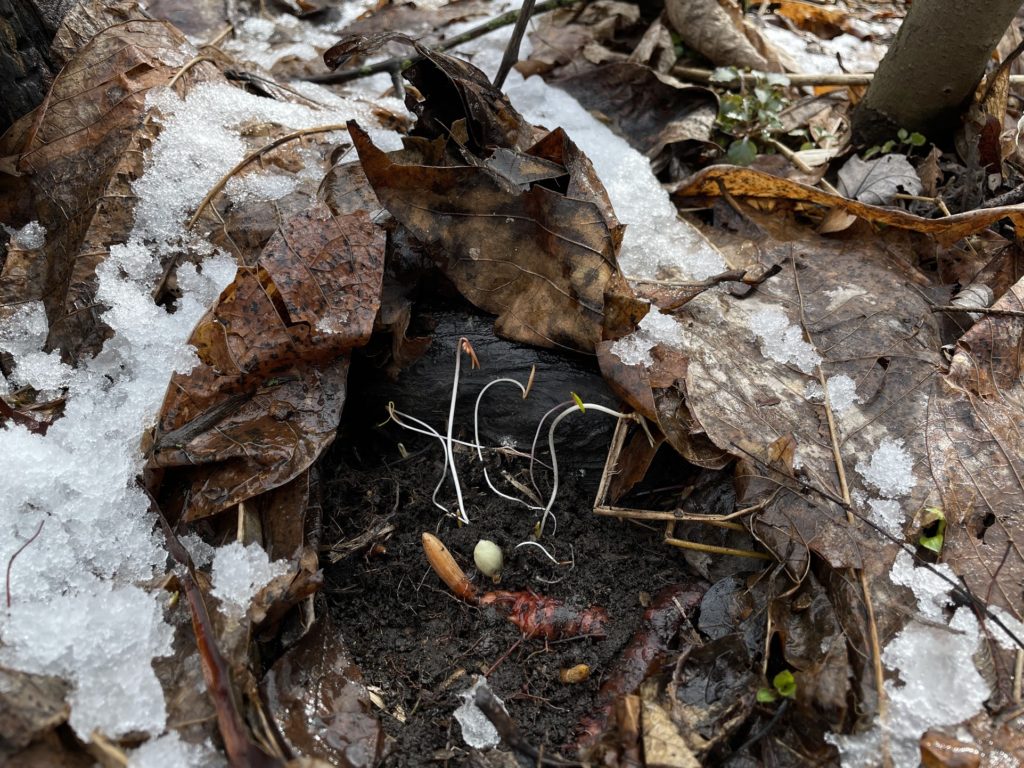
early wildflower growth under leaf litter and snow
Early growth of spring beauty (Claytonia virginica), mayapple (Podophyllum peltatum), and bloodroot (Sanguinaria canadensis) under a layer of pawpaw leaf litter on March 10, 2022. 

The leaf litter in forests acts as a protective layer for soil conditions. It creates a physical barrier between the soil surface and atmosphere that reduces soil drying, responds to atmospheric temperature fluctuations, and reduces erosion from precipitation events. Through decomposition, nutrients stored in the dead material re-enter the system and act as a natural fertilizer for plants throughout the year. The controls and nutrient cycling are especially important for forest wildflowers. 

Many forest wildflowers begin their aboveground life cycles in early spring before the trees have developed their leaves. During this time, light at the forest floor is highest, allowing wildflowers to gain high amounts of energy. However, before they emerge from below ground storage organs or germinate from seeds, the flowers are thought to rely on environmental cues to know when to begin this growth without the risk of frost damage. These environmental cues include soil temperature, which is regulated by the leaf litter layer. Despite many decades of research on the leaf litter component of forests, little is known about the influence of it on the timing of these lifecycle events (or phenology) for wildflowers. Past and ongoing research in the CMNH Section of Botany explores the changing phenology of many plants. One ongoing project is looking at the impact of early tree leaf out and the extended phenology of non-native shrubs on forest wildflower phenology and biological success. 

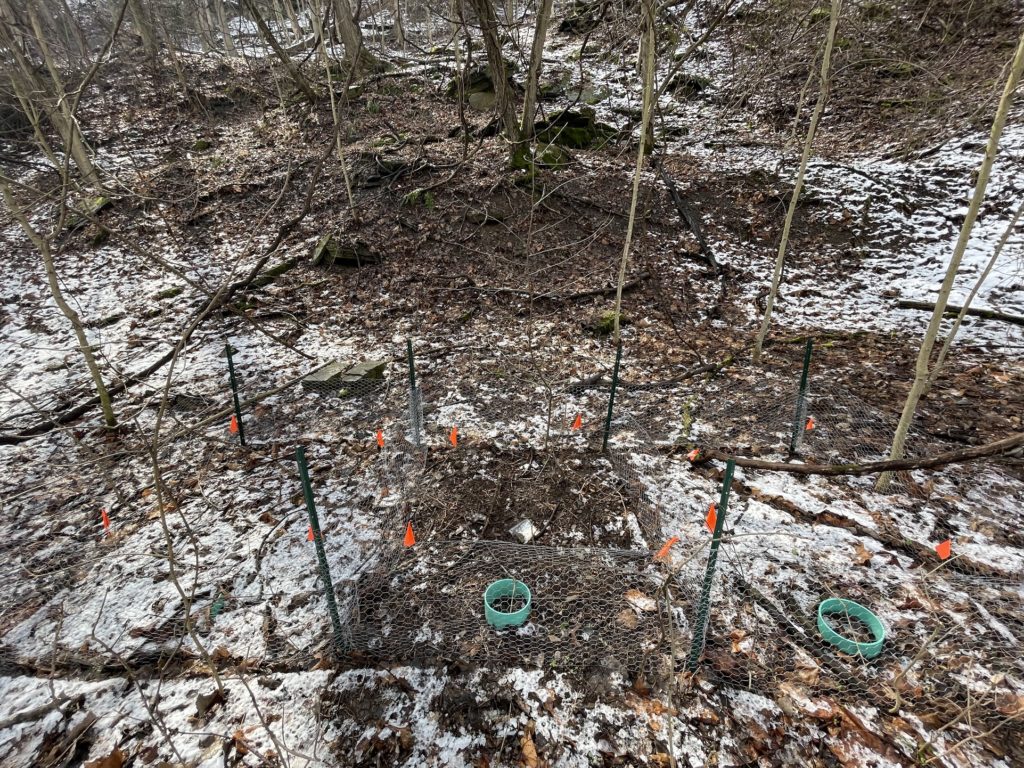
leaf litter research plots
March 10, 2022. An example of a leaf litter manipulation plot. From left to right: litter addition, litter removal, and control. 

The question of the leaf litter’s role in wildflower phenology arose after some simple, but fascinating, natural history observations early last spring—noted variations in phenology within our research site. We struggled to find some tagged individual plants, despite many of the same species being not only present in surrounding areas, but in full bloom. After moving the layer of leaf litter, we found the “missing” plants nearly a week behind in growth compared to their neighbors. These observations were more common than initially thought, and strongly related to the decomposition rate of each leaf litter species. Tree species that produced slower-decaying leaf litter delayed the phenology of plants more than those that produced faster decomposing litter. This underexplored relationship inspired one of the research projects I’m working on this year. 

My project is aimed at understanding how different amounts of leaf litter control the cues for wildflower phenology. Specifically, I want to know how leaf litter regulates the soil temperature and moisture within relatively small areas of our site and how the wildflowers respond. To test this, I have several leaf litter manipulation plots where I removed all leaf litter in some subplots and added it to another of the same size. To measure the changes related to leaf litter, I record soil temperature and moisture and wildflower phenology. 

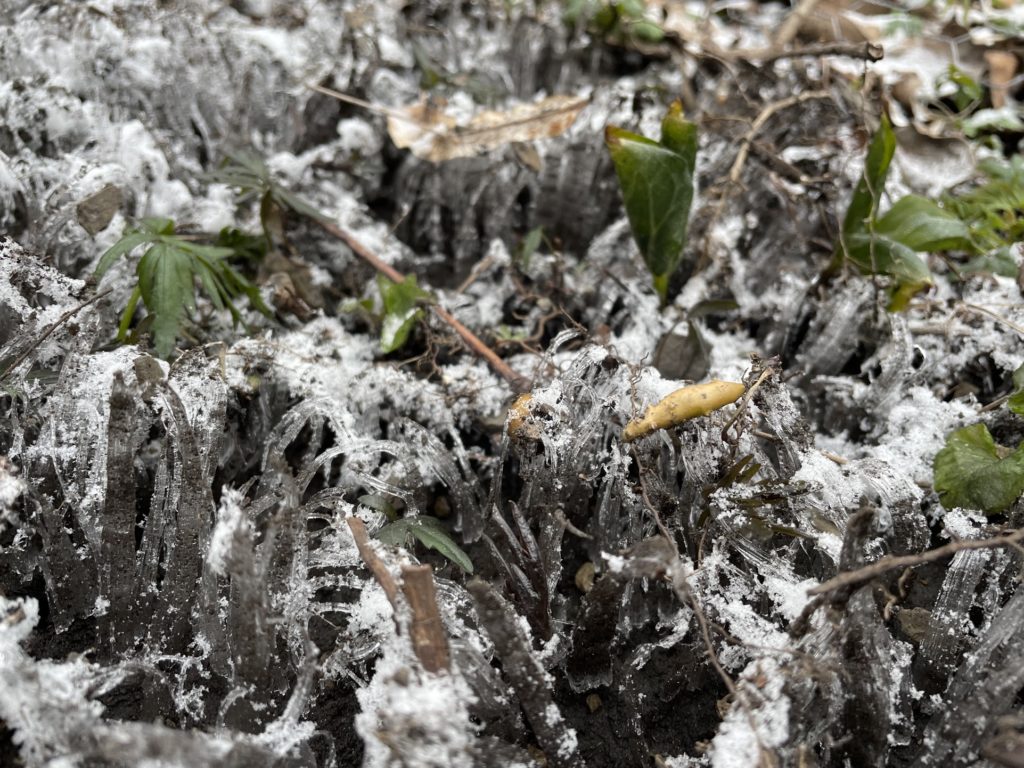
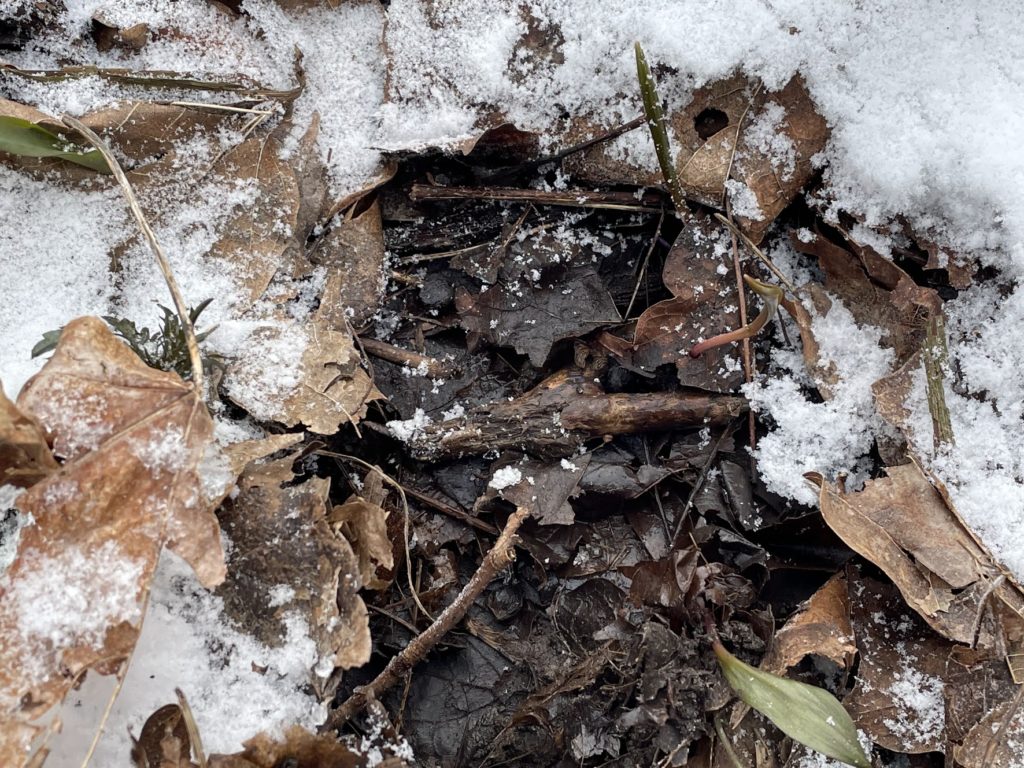
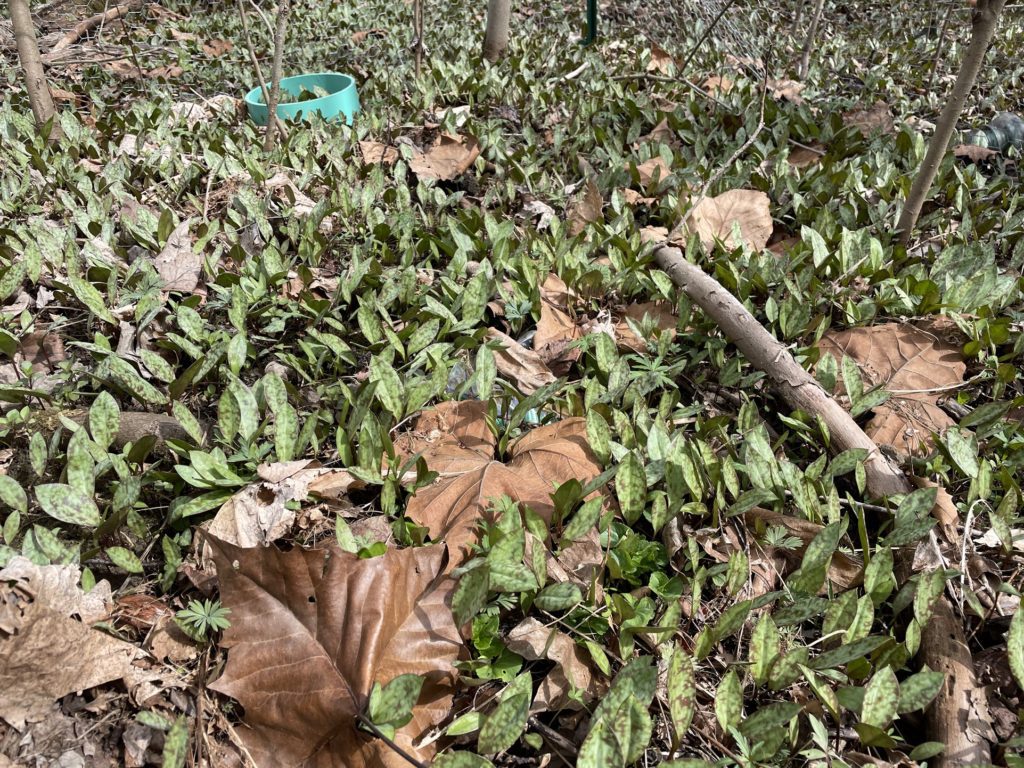
I began collecting this data in early March and have already noticed many differences. Before many of the flowers have started their aboveground lifecycles, they were already present in plots without leaf litter, but still hiding under the leaves in both the litter addition and the control plots. On a few of our random freezing days, the top layer of soil and plants were frozen in litter removal plots, while the same layer of soil was moist and visibly warmer in the litter addition plots. Additionally, one wildflower, trout lily, frequently grew around stray Sycamore leaves, which happen to be one of the slower decomposing species. 

March 28, 2022. Leaf litter removal. Top layer of soil is frozen, leaving early growth on wildflowers at risk of frost damage.
March 28, 2022 (same day and time as above picture). Leaf litter addition. After moving some leaf litter, the soil is not frozen, and wildflowers have extra protection from the freezing temperatures. 
April 1, 2022. Control plot. Trout lily growing around stray Sycamore leaves. 

The findings from this project will not only allow us to gain a better understanding of relationships among species but will also provide a basis for understanding variations in phenology within a site. 

Stay tuned for final results from this project!  

Abby Yancy is a researcher in the Section of Botany. Museum employees blog about their unique experiences and knowledge gained from working at the museum.

Related Content

Beech Drops

Collected On This Day in 1982: One Specimen Isn’t Always Enough!

What Do Botanists Do On Saturday?

Carnegie Museum of Natural History Blog Citation Information

Blog author: Yancy, Abby
Publication date: May 4, 2022

Share this post!

  • Share on Twitter Share on Twitter
  • Share on Facebook Share on Facebook
  • Share on Pinterest Share on Pinterest
  • Share on LinkedIn Share on LinkedIn
  • Share on Reddit Share on Reddit
  • Share via Email Share via Email

Filed Under: Blog Tagged With: Abby Yancy, Botany, botany hall, Carnegie Museum of Natural History, Science News

March 21, 2022 by Erin Southerland

Facing Outward, Looking Ahead: Richard Serra’s “Carnegie” As Part Of An 125 Year Legacy Of Architecture and Outdoor Sculpture

by Albert D. Kollar and Mary Wilcop

On a sunny fall weekend last November 6th and 7th, a celebration honored the 125th Anniversary (1895 – 2020) of the founding of the Carnegie Library of Pittsburgh (1895) and the Carnegie Institute Extension, now Carnegie Museums of Pittsburgh, by philanthropist Andrew Carnegie (1835 – 1919)1 (fig. 1). 

Sculpture of Andrew Carnegie in an ornate marble room.
Fig. 1: Andrew Carnegie, Music Hall Foyer

Although the event had been postponed for a year due to the COVID-19 pandemic, the 2021 “Crash the Carnegies” celebration was enjoyed by thousands of visitors. Inside the Oakland museums, families enjoyed artmaking, performance, and learning activities that paid homage to Carnegie Museums’ past 126 years. Fronting Forbes Avenue, the statues and art works that lend much to the understanding of all that’s presented inside, continued their silent vigil.

The Buildings

The long stretch of buildings along Forbes Avenue in the Oakland neighborhood of Pittsburgh is home to Carnegie Museum of Art, Carnegie Museum of Natural History, and Carnegie Music Hall. The entrance to the Carnegie Library of Pittsburgh, the furthest west section of the massive complex, faces the gateway to Schenley Park. The connected buildings that comprise this modern campus were constructed in three distinct phases (the first building in 1895, an extension in 1907, and the new Scaife wing in 1974)². A review of the history of the Carnegie Library and Institute buildings’ is available in the posts “CMP Travel Program and Section of Invertebrate Paleontology Promote the 125th Anniversary of the Carnegie Library of Pittsburgh With a Walking Tour” and “A Journey to France to Uncover the Mysteries of the Carnegie’s Grand Staircase.”

Close-up of a steel bar with the name Carnegie on it.
Fig. 2: View from inside the museum: a Carnegie Steel Company I-beam supporting the roof of the 1907 extension.

With 1895-era facades made of elegant light gray Berea sandstone mined from a  quarry in Amherst, Ohio 2, the Carnegie Library and Institute building proclaimed itself to Pittsburgh and the world at large as, in Andrew Carnegie’s own words, a “palace of culture.”3 The library was built, both financially and literally, by Carnegie Steel. Earlier, the company’s structural metal beams were used in Pittsburgh’s first skyscraper, the Carnegie Steel Building, a structure designed by Longfellow, Alden, and Harlow (Floyd 1993)5. The Carnegie Institute Extension (1907), undergirded by a steel support frame, used steel beams fabricated at the newly created United States Steel Corporation Homestead Works, formerly Carnegie Steel1 (fig 2). 

John Massey Rhind Bronze Statues

Historic black and white photo of a group of people in front of a statue of Michelangelo.
Fig. 3: Michelangelo Statue. Courtesy of Carnegie Library Archives.

With the completion of the Beaux-Arts style Carnegie Institute Extension, departments of music, art, literature, and science were established as distinct administrative divisions of Carnegie Institute and Library. These now lapsed distinctions are mirrored on the building’s exterior in the bronze sculptures collectively referred to as the Noble Quartet. Seated in classical Greek chairs made of Barre Granodiorite of Vermont2 are four male figures. The statues of Shakespeare (literature) and Bach (music) sit atop granodiorite slabs on either side of the main granodiorite staircase to the Music Hall entrance. Just east of them, at the entrance to the art and natural history museums, are seated Michelangelo representing art (fig. 3) and Galileo representing science.  

Classical style stone building on a cloudy day.
Fig. 4: Noble Quartet Muses

John Massey Rhind (1858 – 1936), a close friend of Andrew Carnegie, was commissioned by him to create these works along with four others that tower three stories above them from parapets on the edge of the building’s roof (fig. 4). Known as the Muses, these standing female figures represent allegorical spirits whose achievements equal those of their seated counterparts. The creation of eight largescale architectural figures to match the Classical style of the building was not an easy task. Statue models shaped in clay by the artist, were shipped from his New York studio to Italy to be cast in the lost-wax process, then returned for assembly and finishing6.

Sarah Scaife Gallery

In 1974, the footprint of the Oakland campus expanded once more with the opening of the Sarah Scaife Gallery. Designed by renowned New York City architect Edward Larrabee Barnes (1915-2004), with large spaces and high windows, the gallery exterior is in some ways a modern equivalent of the Beaux-Arts Carnegie Institute Extension3.

The new building was constructed in a more modernist style commensurate with the contemporary architectural styles at the time. Its interior is clad with Larvikite, a beautiful gray blue iridescent igneous rock from Larvik, Norway⁸. The exterior cladding is also Larvikite, but here the stone has a bronze iridescent color to create visual continuity between the radically different Beaux Art and modernist structures. 

By 1974, after nearly a century of atmospheric soot and pollutants from the steel mills and other modes of industrial and residential coal use, the old light gray Berea sandstone of the 1907 building darkened to a deep brown. This intended cohesion no longer exists because the sandstone underwent a major cleaning in 19899. Its original pale tone now stands in contrast to the naturally bronze-toned Larvikite. 

Richard Serra Carnegie Sculpture and COR-TEN Steel

In contrast to the bronze sculptures used in the 1907 Carnegie Extension, sculptures made of modern alloys of steel and aluminum are incorporated into the exterior plazas of the 1974 Sarah Scaife Gallery. The largest of these works is the Richard Serra Carnegie sculpture, which was installed as public art for the 1985 Carnegie International and was selected in a tie for that exhibition’s first prize10.

Richard Serra's Carnegie sculpture with the Cathedral of Learning framed in the background.
Fig. 5: Serra sculpture at CMOA

The 40-foot tower, made of four panels of 2.5-inch-thick COR-TEN steel with acute edges and corners, emerges from the Larvikite surface of the entrance plaza. The sculpture commands great sight lines with its height and profile echoing that of the nearby Cathedral of Learning, the University of Pittsburgh’s 42-story Gothic Revival, Art Deco tower (fig.5).

Steel skyscraper in downtown Pittsburgh.
Fig. 6: US Steel Tower. Image credit: Derek Jensen (Tysto).

COR-TEN is a proprietary high-strength, low-carbon steel alloy introduced by U.S. Steel Corporation in 1933. It features prominently in the company’s Pittsburgh headquarters, the U.S. Steel Tower, built in 1971 (fig. 6)¹². The name COR-TEN is an amalgam that references the product’s most notable properties, corrosion resistance and high tensile strength. The steel’s exceptional resistance to atmospheric corrosion negates the need for painting. After production, in a process that occurs over several months, a surface patina develops as the steel is exposed to wet and dry weather cycles. In many applications COR-TEN surfaces turn a reddish orange, but colors can vary from orange to brown depending, in part, on atmospheric conditions. Very fine surface oxidation layers can also build to create a rainbow-like iridescence, known as structural color – the same process that lends colorful beauty to peacock feathers and butterfly wings.

By the mid-1960s, the unique properties of COR-TEN attracted the interest of artists, especially those producing outdoor sculptures. Beverly Pepper, a sculptor known for her large-scale metal works, was introduced to COR-TEN’s properties while working at the U.S. Steel factory in Conshohocken, Pennsylvania. In 1964 she was the first sculptor to explicitly use COR-TEN as a sculptural medium11. Other artists soon followed, including Serra in the early 1970s. Although Serra was originally trained as a painter, he was already familiar with the working properties of steel. The artist’s father worked in steel mills and as a pipefitter. Later, Serra supported some of his schooling by working in steel mills14. 

By the time Serra’s design was conceived in 1985, only one company, the Lukens Steel Company, which operated the world’s widest rolling mill in the southeastern Pennsylvania town of Coatesville, could produce the large plates required for the commission. After production the plates were shipped across the state to a Pittsburgh-Des Moines Corporation plant on Neville Island, just outside Pittsburgh, for assembly.  

The Significance of Carnegie

In its sheer size and monolithic simplicity, Carnegie lends itself to many interpretations. Like the large institution it fronts, the sculpture can be experienced from walking around the outside and by standing within.

By the time of Carnegie’s installation, leaning metal plates were a feature of several of Serra’s public sculptures. For Carnegie, however, the plates were made both to lean and tilt diagonally, rather than being strictly vertical, a form Serra describes as “almost like a V or like lifting your arms up.”6 Implicitly, though perhaps unintentionally, this form and its materiality may speak to the original vision Andrew Carnegie expressed in an 1897 letter: “….not only our own country, but the civilized world will take note of the fact that our Dear Old Smoky Pittsburgh, no longer content to be celebrated only as one of the chief manufacturing centers[sic], has entered upon the path to higher things, and is before long […] also to be noted for her preeminence in the Arts and Sciences”16.

Symbolism. Alone in Carnegie

The bare steel, deliberately lacking any interior or exterior covering, stands prominently in the plaza asserting its own essentialness to the story of the museum.  

Fig. 7: View looking up from the interior of Carnegie.

To enter the sculpture’s interior from its Forbes Avenue side, visitors slide through a tapered passage between two plates. Once inside, even on the brightest summer days, several minutes are needed to adjust one’s eyes to overwhelming darkness of the interior. Following the walls upwards leads to a glowing view of the sky, blue or gray, depending upon the weather, and undoubtedly occasionally rose pink for some moments at dawn and dusk. The effect is intentionally physically and visually destabilizing (fig 7). 

Ornate stone staircase
Fig. 8. Carnegie Grand Staircase

Some visitors experience entering the tower-like structure as a representation of a steel mill’s blast furnace. In this sense, the design functions as an extension of the John White Alexander Crowning of Labor murals in the Grand Staircase, which depict workers making steel in the first floor murals and, as the smoke rises to the second floor, reveal female spirits bringing the fruits of labor to a knight in steel armor who resembles Andrew Carnegie17 (fig. 8). 

Serra often hesitated to assign a single meaning to his sculptures, preferring their interpretation remain broad and therefore boundless. Still, in an interview with Art Historian Vicky Clark during the work’s installation, the artist struggled to completely separate the sculpture from its implicit connections to the museum and Pittsburgh. “There’s something about steelworkers and the tradition of steelworkers that means that they have a basic respect for how something is built. It becomes a metaphor for what the industry of the town has produced.” 6

Sculptures and Thought in the 21st Century

While John Massey Rhind’s Noble Quartet functions mainly as an embellishment to the building, with a specific interpretation dictated by Carnegie himself, the situating of Carnegie in the plaza speaks to the extent to which the function of art and architecture, near the end of the 20th century, had fundamentally changed. Rhind’s Quartet were positioned to sit along the sides of the Carnegie Institute’s original entryways, out of the path of visitors. Carnegie, in contrast, stands imposingly in front of the Scaife extension entrance, almost requiring entering patrons and passersby to engage with it.

Sculptures of the modern era, particularly those of architectural scale, create environments for individuals to think and reflect, without necessarily a prescribed end in mind. A viewer’s interaction with an artwork like Carnegie can feel obtuse; its faceless abstraction refuses to tell us what it is or how we should feel about it. This ambiguity, for Serra, however, is essential, because it means that “the piece has the potential to engage people with various meanings they might have.”6 Like the Quartet, Carnegie, speaks to the outside world about what we might find within. That is, that art, and the museum itself, serve as a site for contemplation and reflection—and not only about art.

Albert D. Kollar is the Collection Manager in the Section of Invertebrate Paleontology at Carnegie Museum of Natural History. Mary Wilcop is Associate Objects Conservator at Carnegie Museum of Art.

References

1Kollar, A.D. 2021. The Carnegie Library of Pittsburgh (1895) and Carnegie Institute Extension (1907): The Story of the Carnegie Building Stones and Architectural Design presented for the 125th “Crash the Carnegie” Celebration held in north wing of the Carnegie Library of Pittsburgh.

2Kollar, A.D., M. Feeley, A. Joyce Jr., R. Fedosick, K. Hughes, and A. Costanzo.  2020. Carnegie Institute Extension Connemara Marble: Cross-Atlantic Connections Between Western Ireland and Gilded Age Architecture in Pittsburgh, Pennsylvania. ACM, 86: 207-253.

3Gangewere, R. 2011. Palace of Culture Andrew Carnegie’s Museum and Library of Pittsburgh. University of Pittsburgh Press, 332p. 

4Kollar, A.D. and B. Tucker. 2020. CMP Travel Program and Section of Invertebrate Paleontology promotes the 125th Anniversary of the Carnegie Library of Pittsburgh with an outdoor walking tour. https://carnegiemnh.org/125th-anniversary-carnegie-library-of-pittsburgh-outdoor-walking-tour/

5Floyd, M.H. 1994. Architecture After Richardson, Regionalism before Modernism – Longfellow, Alden, and Harlow in Boston and Pittsburgh. The University of Chicago Press, Chicago. 546 pp. 

6 Clark, V. November 1985. “Richard Serra’s Carnegie, an unpublished interview.” http://vickyaclark.com/serra_interview.html

7Gangewere, R. 1992. What the Muses Hold. Carnegie Magazine, 13-17.

8Heldal, T., and G. B. Meyer & R. Dahl. 2015. Global stone heritage: Larvikite, Norway. 21-34. Geological Society, London, Special Publication, 407. 

9Gangewere, R. 1990. Cleaning The Carnegie. Carnegie Magazine, 31 – 35. 

10CARNEGIE Fall 2021. 125 Years: A History in Objects Continues.

11 Smithsonian Archives of American Art. July 1-2, 2009. Oral history interview with Beverly Pepper. Washington, DC: Smithsonian Institution. https://www.aaa.si.edu/download_pdf_transcript/ajax?record_id=edanmdm-AAADCD_oh_283468

12Jester 1995.

12USS Cor-Ten Steel. 1980. USS Cor-Ten High Strength Low-Alloy Steel. 

13https://www.aaa.si.edu/download_pdf_transcript/ajax?record_id=edanmdm-AAADCD_oh_283468

14 https://news.artnet.com/art-world/beverly-pepper-marlborough-contemporary-1470469

15 Lidji, E. 1985. CARNEGIE, Richard Serra. Carnegie International Article.

16Wall, J. F. 1970. Andrew Carnegie. University of Pittsburgh Press. 1137p.

 17Gangewere, R. personal communication.

Related Content

Understanding Fossil Fuels Through Carnegie Museums’ Exhibits

University of Michigan Helps Solve Century Old Fossil Mystery

A Century Ago, A Donor Walked Into the Carnegie Museum

Carnegie Museum of Natural History Blog Citation Information

Blog author: Kollar, Albert D.; Wilcop, Mary
Publication date: March 24, 2022

Share this post!

  • Share on Twitter Share on Twitter
  • Share on Facebook Share on Facebook
  • Share on Pinterest Share on Pinterest
  • Share on LinkedIn Share on LinkedIn
  • Share on Reddit Share on Reddit
  • Share via Email Share via Email

Filed Under: Blog Tagged With: Albert Kollar, Science News

  • « Go to Previous Page
  • Page 1
  • Interim pages omitted …
  • Page 9
  • Page 10
  • Page 11
  • Page 12
  • Page 13
  • Interim pages omitted …
  • Page 43
  • Go to Next Page »

sidebar

About

  • Mission & Commitments
  • Directors Team
  • Museum History

Get Involved

  • Volunteer
  • Membership
  • Carnegie Discoverers
  • Donate
  • Employment
  • Events

Bring a Group

  • Groups of 10 or More
  • Birthday Parties at the Museum
  • Field Trips

Powdermill

  • Powdermill Nature Reserve
  • Powdermill Field Trips
  • Powdermill Staff
  • Research at Powdermill

More Information

  • Image Permission Requests
  • Science Stories
  • Accessibility
  • Shopping Cart
  • Contact
  • Visitor Policies
One of the Four Carnegie Museums | © Carnegie Institute | Privacy Policy | Terms of Use | Accessibility
Rad works here logo