• Skip to primary navigation
  • Skip to main content
  • Skip to primary sidebar

Carnegie Museum of Natural History

One of the Four Carnegie Museums of Pittsburgh

  • Visit
    • Buy Tickets
    • Visitor Information
    • Exhibitions
    • Events
    • Dining at the Museum
    • Celebrate at the Museum
    • Powdermill Nature Reserve
    • Event Venue Rental
  • Learn
    • Field Trips
    • Educator Information
    • Programs at the Museum
    • Bring the Museum to You
    • Guided Programs FAQ
    • Programs Online
    • Climate and Rural Systems Partnership
  • Research
    • Scientific Sections
    • Science Stories
    • Science Videos
    • Senior Science & Research Staff
    • Museum Library
    • Science Seminars
    • Scientific Publications
    • Specimen and Artifact Identification
  • About
    • Mission & Commitments
    • Directors Team
    • Museum History
  • Tickets
  • Give
  • Shop

Blogs from our Scientific Researchers

Carnegie Museum of Natural History is home to active research and vast scientific collections. Our scientific researchers regularly contribute to the blog at the museum.

October 20, 2022 by Erin Southerland

An Intern’s Experience Studying the Ecosystem at Powdermill

by Rachel Lloyd

This summer I was an intern at Powdermill Nature Reserve, Carnegie Museum of Natural History’s environmental field research station. During my time at Powdermill, I participated in a variety of projects: sampling streams for macroinvertebrates, surveying trees, installing and checking insect pitfall traps, monitoring wildlife cameras, and more. 

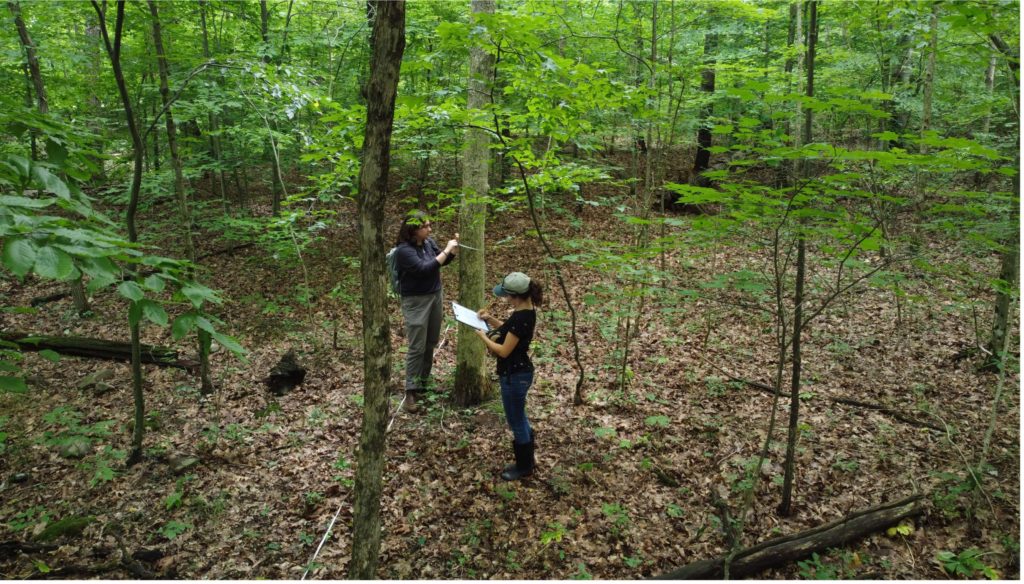
Surveying trees in the mined area. One person measures diameter at breast height (DBH) while another person records.

Most of the projects were designed to gain greater understanding of the forest ecosystem at Powdermill, specifically the area of the reserve that is home to abandoned surface coal mines. Mines that were active before the passage of the Surface Mining Control and Reclamation Act in 1977 were often completely unregulated and extremely harmful to the environment because of associated habitat destruction, and air, noise, and water pollution. The long-lasting damage to ecosystems by abandoned surface coal mines includes polluted waterways and unstable land surface gradients in the form of cliff-like highwalls created to expose coal seams.

A remediation project has been proposed at Powdermill to help restore the impacted land to what it was like before mining. Filling in the high walls to restore original surface contours, and remediating acid mine drainage in streams are two major components of any surface mine remediation project. 

Before any restoration work begins, it is important to have a baseline understanding of the ecosystem, so that there are parameters to measure change against after the completion of the project. Tree surveying, macroinvertebrate sampling, and wildlife camera monitoring all contributed to the establishment of baseline data. 

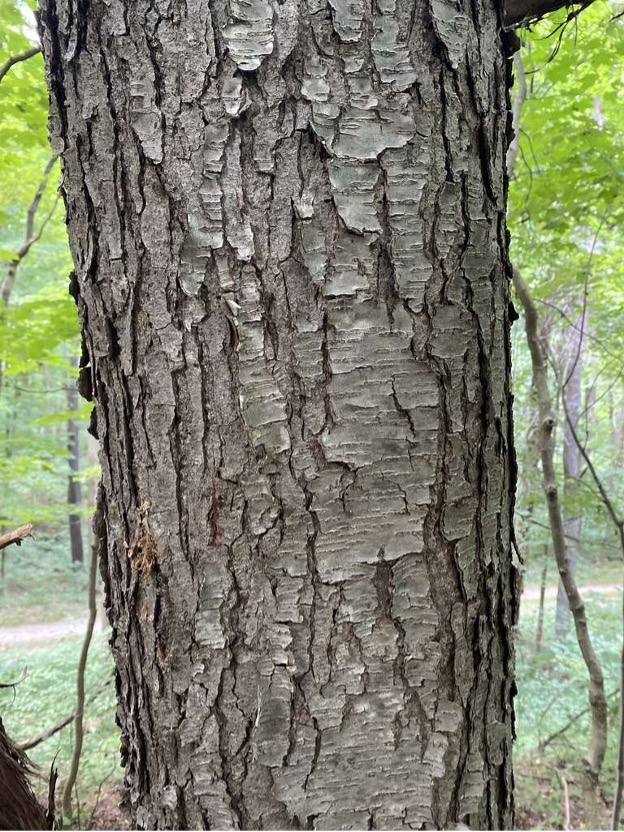
Black cherry (Prunus serotina) bark.

Forestry surveying served to document both the density and diversity of the plant species living in the study area, from overstory trees to understory shrubs. The most dominant species of overstory trees in the surveyed tract were sugar maples (Acer saccharum). In 2008, during a previous vegetation survey of the same tract, black cherry (Prunus serotina) was found to be the most abundant species. This notable change over time was expected. Black cherry trees are a pioneer species and are among the first trees to grow in a barren environment. Black cherry trees are also relatively quick to die off, and thereby create room and resources for other species. The change in the most abundant species from black cherries to sugar maples shows that the forest of the study area is changing and aging from an early to late successional forest.

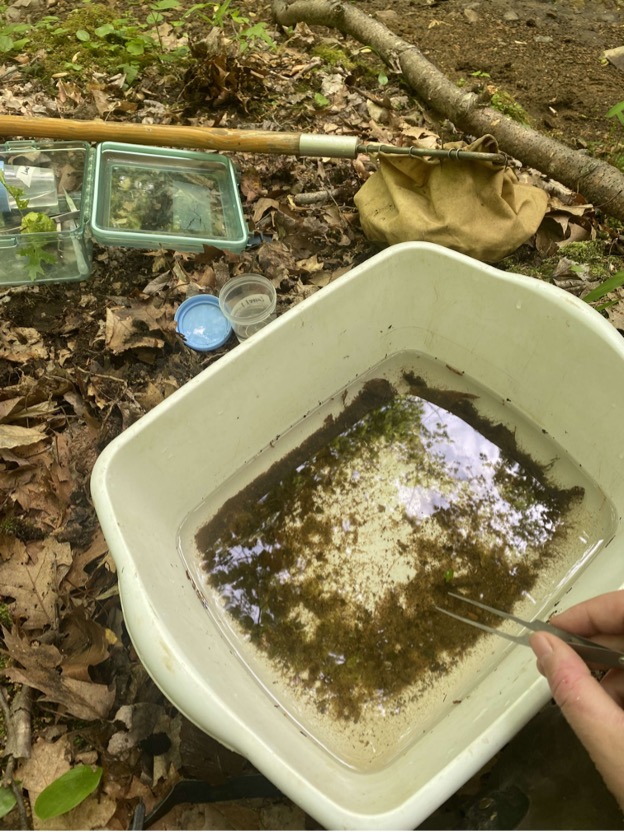
Collecting aquatic macroinvertebrates from a netted sample taken from a stream flowing through the mined area.

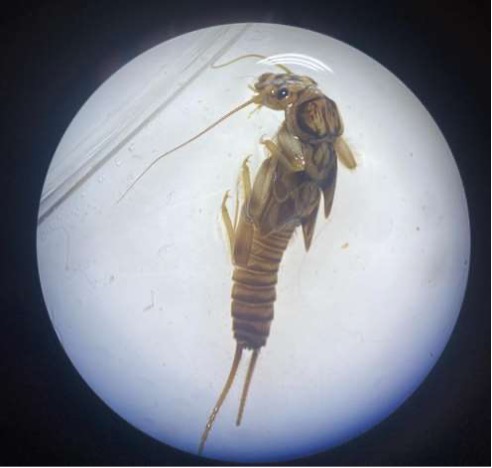
Sampling aquatic macroinvertebrates living in streams can be a great indication of the health and quality of the stream, and that of the watershed drained by the stream. In establishing baseline measurements, stream samples were taken at various locations at Powdermill near the mining sites. After collection, the samples were sorted and identified, and a water quality score was assigned to each location. Stonefly nymphs (Plecoptera) were the most dominant organisms across the whole survey. Other organisms collected included caddisfly larvae (Trichoptera), cranefly larvae (Tipulidae), fishfly larvae (Corydalidae: Chauliodinae), blackfly larvae (Simuliidae), crayfish (Decapoda), and midge larvae (Chironomidae). One important observation was the absence of mayfly nymphs (Ephemeroptera) from most of the samples. Mayflies, along with stoneflies and caddisflies, are typically found in healthy streams in Pennsylvania. The absence of any of them strongly suggests harmful anthropogenic impact, in this case acid mine run-off.

A stonefly nymph.

Camera traps were also put in place to monitor the larger wildlife activity in the area. Black bears, white-tailed deer, coyotes, and bobcats are some of the larger mammals known to use the land at Powdermill. The cameras will be kept up until the restoration project begins. After restoration, the wildlife images these cameras collect will monitor how the animals respond to the changed landscape. 

Together, the forestry surveys, stream sampling, and wildlife cameras all contribute to a comprehensive understanding of how these areas of the reserve are currently functioning as an ecosystem. The standardized procedures of each procedure will allow us to assess how the reserve changes after future restoration efforts.

For more detailed information on this project, you can check out this story map that I created as part of my internship.

Rachel Lloyd is a senior at Chatham University majoring in Environmental Science, and completed a research internship at Powdermill Nature Reserve during the summer of 2022.

Related Content

What is a Pitfall Trap?

“Moldly” Exploring Fungal Functions

An Intern’s Point of View

Carnegie Museum of Natural History Blog Citation Information

Blog author: Lloyd, Rachel
Publication date: October 20, 2022

Share this post!

  • Share on Twitter Share on Twitter
  • Share on Facebook Share on Facebook
  • Share on Pinterest Share on Pinterest
  • Share on LinkedIn Share on LinkedIn
  • Share on Reddit Share on Reddit
  • Share via Email Share via Email

Filed Under: Blog Tagged With: Botany, Powdermill Nature Reserve, Rachel Lloyd, Science News

October 7, 2022 by Erin Southerland

Celebrating Indigenous Peoples’ Day 2022

by Amy L. Covell-Murthy

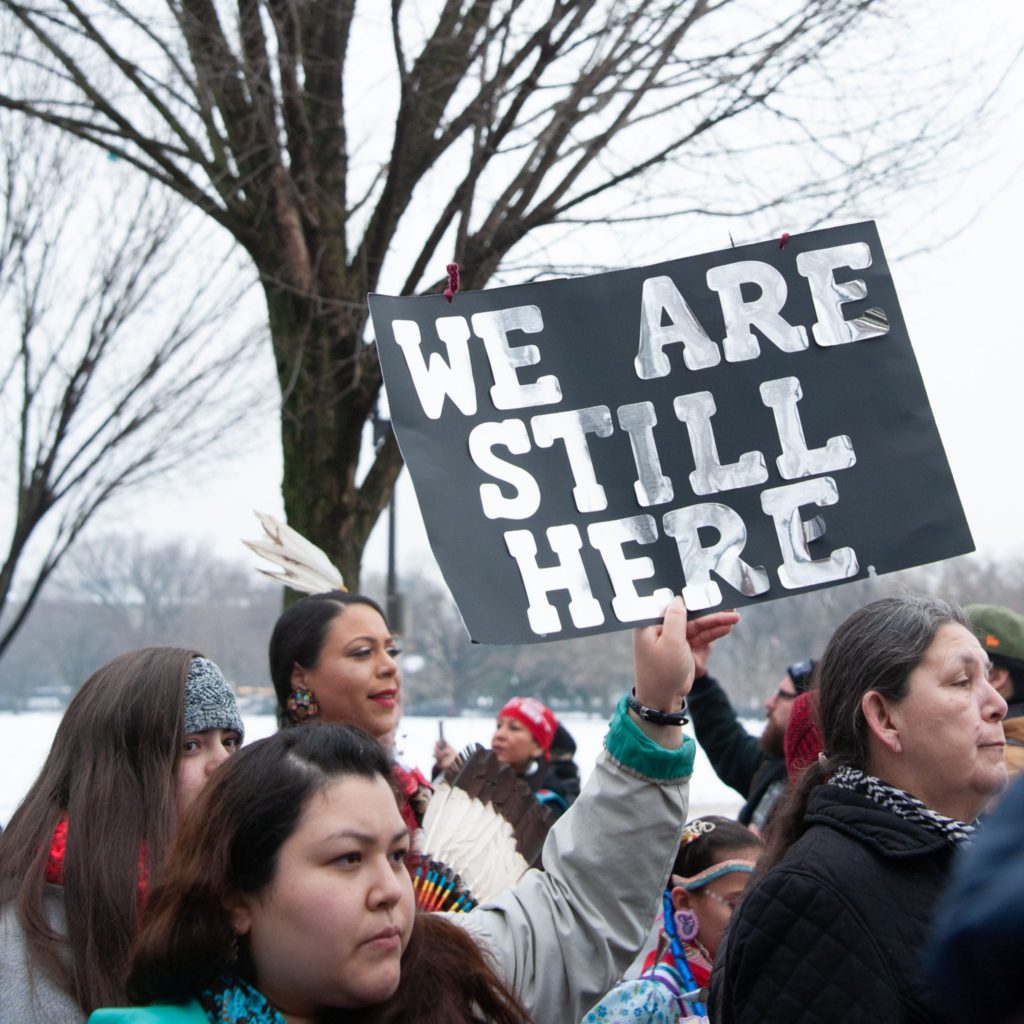
Indigenous Peoples’ Day is observed in the City of Pittsburgh concurrently with Columbus Day, and I would like to suggest some ways to observe the holiday for those who do not claim Indigenous heritage. In a state with no habitable federally recognized Indigenous land, Native people are all too often seen as existing only in the past. Although educating yourself on the Indigenous history of the region is an important part of observing the holiday, it’s also important to recognize that many First Nations people live, work, and play in the Greater Pittsburgh Area. Indigenous Peoples’ Day should not be a memorial, but a recognition of the important history and cultural heritage of those who are the past, present, and future caretakers of this land. Here are some things you can do to respectfully celebrate on October 10, 2022. 

Indigenous person holding a sign that says "We Are Still Here"

Educate Yourself

Learn about the people who have called Pittsburgh home. Many different cultural groups have occupied the Upper Ohio River Valley including but not limited to the Delaware/Lenape, the Haudenosaunee, the Shawnee, and the Wyandotte. The Osage Nation also claims origin in the Ohio River Valley, and you can learn about all these nations on their official websites. I also suggest hitting up your local library to check out books on these groups as well as the cultural traditions and ancestors who came before them. During a more distant time period, this region was home to those who are often referred to as the Adena, Hopewell, and Monongahela. But keep in mind, we have no idea what they called themselves.

Educate Yourself Some More

Learn about the history that may have been left out of your primary and secondary school curriculums. You may be unaware of the atrocities that Indigenous people faced in the State of Pennsylvania. Many First Pennsylvanians were forced from their homelands and infected with unfamiliar diseases by colonizers. Later the first assimilation school was created in Carlisle, PA. The school, which operated between 1879 and 1918, was used as a model for 24 more of these institutions whose primary goal was to force Indigenous children to abandon their Native languages and customs. In the 1960s, the building of the Kinzua Dam  on the upper Allegheny River forced Seneca Nation citizens to move into the State of New York, breaking the 1794 Treaty of Peace and Friendship. Indigenous communities thrive despite these events and institutions, but it is important to recognize and not try to hide these gruesome parts of our shared American history. You can find more information about these examples on the websites listed below.

Kinzua Dam Exhibit at Seneca-Iroquois National Museum

Smallpox information from Native American Heritage Programs

Carlisle Indian School Project

Support Local Indigenous Groups

The Council of Three Rivers American Indian Center is a regional intertribal nonprofit that promotes the socio-economic development of the Native American community and others who experience the same type of economic difficulties in the Greater Pittsburgh metropolitan area. One way to support them is to plan to attend their annual Pow Wow that is held just in Dorseyville, a suburb north of Pittsburgh, in late September. Learn more about the Center’s Early Childhood Education, Native American Elders, Veterans, and Employment programs on their website and Facebook page.

Honor the Land

Planting Native Pennsylvanian plants is a wonderful way to honor our connection to the Earth and to provide food and shelter for the diverse species who live here. You can learn about how Indigenous People use trees, ferns, flowers, vegetables, fruits, and grasses to enhance their quality of life. The Pennsylvania Department of Conservation and Natural Resources and the Audubon Society of Western Pennsylvania offer suggestions for those who are interested.

Attend an Online or In Person Event

Many cities around the United States hold events to celebrate Indigenous Peoples’ Day. A quick Google Search can point you in the right direction. I’m going to be learning about incorporating Indigenous voices into K-12 curriculum from young Indigenous activists at the Smithsonian.  You can register to tune in to the National Museum of the American Indian at 1 p.m. on October 10th to attend this free webinar titled, Youth in Action | Indigenous Peoples’ Day: Transformative Teaching / Juventud en acción | Día de los Pueblos Indígenas: Enseñanza transformativa.

Support Indigenous Artists, Authors, Film Makers, and Musicians

You have so many options! The Sundance Institute has a version of its 2022 Indigenous Short Film Tour available to stream. It’s a 93-minute program featuring 6 short films. The Carnegie Library of Pittsburgh website offers staff picks and lists of Indigenous authors. My favorite is a list of Indigenous Science Fiction from 2020 which is intended for adults, but they also have lists of Indigenous books for children and teens. The CBC  (Canadian Broadcast Corporation) released a list of Indigenous musicians to watch out for in 2022. Vogue featured 15 Indigenous Artists to watch out for from this year’s Santa Fe Indian Market. The list includes fashion designers, painters, beaded and metal jewelry designers, sculptors, and textile artists. You can also support Indigenous artists by purchasing art through the online gift shop of the Seneca Iroquois National Museum/Onöhsagwë:de’ Cultural Center.   

Help Change Derogatory Mascots and Place Names

Sign petitions, attend community forums, and advocate for the changing of harmful stereotypes and offensive signage in our community.  From the Cleveland Guardians to Hemlock Hollow Road, there are many instances of this happening around us. The National Congress of American Indians offers a State tracker of schools with offensive mascots, and Pennsylvania has 45 districts and 113 schools in need of name or mascot change. The list has gone down by 2 schools over the past year!

Also, learn about the Haudenosaunee Nationals Lacrosse Team, who hope to make it to the 2028 Olympics! Learn about how they have recently changed their own name to reflect their collective identity.  

View this post on Instagram

A post shared by World Lacrosse (@worldlacrosse)

Consider Donating Time or Resources

The Seneca Iroquois National Museum/ Onöhsagwë:de’ Cultural Center is only a few hours’ drive from Pittsburgh and occasionally may be looking for volunteers. Check their website and follow their social media accounts for more information.

If you are able, here are just a few organizations who can use your help:

Native American Agriculture Fund

NDN Collective

Association of American Indian Affairs

Advancing Indigenous People In STEM

So, join me in unlearning some Columbus Day myths and celebrating the cultural diversity of Indigenous People throughout the history of our region. Remember that the best places to start educating yourself are the local libraries and museums. Carnegie Museum of Natural History offers guided tours of our cultural halls that strengthen the messages we wish to share with the community. Visit the Alcoa Hall of American Indians to learn more about the Tlingit, Lakota, Hopi, and Haudenosaunee, and keep in mind that there are so many other Indigenous groups, traditions, nations, and organizations for you to explore on your own!

Amy L. Covell-Murthy is Archaeology Collection Manager at Carnegie Museum of Natural History.

Related Content

An Indigenous Presence: Cultural Survivance and Contemporary American Indian Art and Design

A Trip to Grave Creek Mound

Pennsylvania Archaeology and You

Carnegie Museum of Natural History Blog Citation Information

Blog author: Covell-Murthy, Amy
Publication date: October 7, 2022

Share this post!

  • Share on Twitter Share on Twitter
  • Share on Facebook Share on Facebook
  • Share on Pinterest Share on Pinterest
  • Share on LinkedIn Share on LinkedIn
  • Share on Reddit Share on Reddit
  • Share via Email Share via Email

Filed Under: Blog Tagged With: Alcoa Foundation Hall of American Indians, Amy Covell-Murthy, anthropology, Science News

September 22, 2022 by Erin Southerland

How to Hunt for Microbes

by Carla Rosenfeld

The definition of microorganism is any organism that is too small to be seen by the naked eye. They can be single-celled, like bacteria and archaea, or multi-celled, like fungi. Though they are extremely tiny as individuals, these organisms have major impacts on every one of our lives and the environment as a whole. For example, if you’ve ever eaten bread, yogurt, pickles, sauerkraut, or cheese, you have various microbes to thank for the distinctive form or flavor of those foods. But have you ever wondered how we study these tiny organisms out in the field? If they are so small, how do we find them? And once we find them, how do we collect them? 

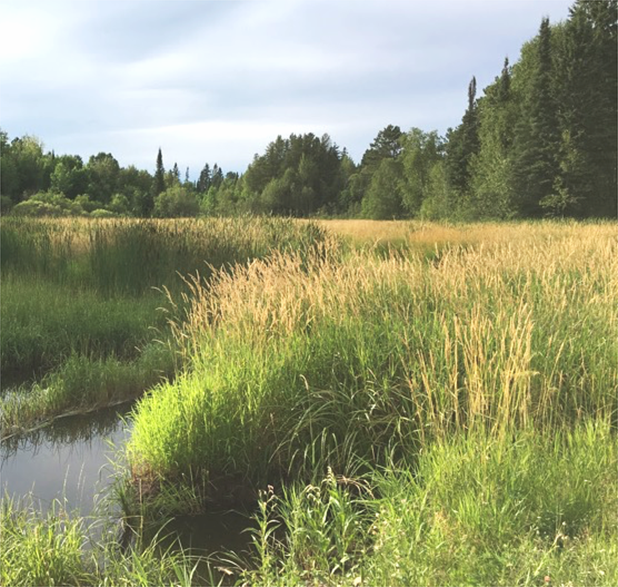
In my research, I try to understand the role microbes play in cycling various elements through the environment. Recently, I’ve been working on a project with a team of people from University of Minnesota School of Earth and Environmental Sciences and Argonne National Lab, to try to understand how microbes influence wetland sediment geochemistry. To do this, a group of us have been trekking around to different riparian wetlands from northern Minnesota to South Carolina. 

Riparian wetland in northern MN in our current studies.

To get our essential equipment to our field sites, we first pack everything we’ll need into giant coolers, and then seal the sturdy containers. If we’re flying to a distant site, we can ship the coolers to a location near our work site. If we’re driving, we just pack the coolers in a van to haul with us. The coolers are packed to the brim with our field equipment, clothing, gear (including waders and snake-proof boots), and lots of sunscreen and snacks. For work at some sites, we also take a canoe!

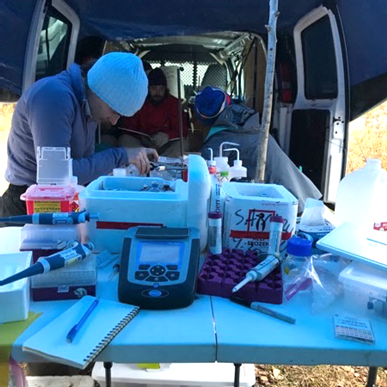
The packed coolers do double duty on our trips, because once we have emptied all our equipment out of them, we can fill them with ice to store the samples collected each day. Upon arrival at the field site, we set up a mobile lab on top of a folding table so that we can process our samples and do any time sensitive analyses. One key component of our mobile lab is a portable glove box, which is essentially a big plastic tent that we fill with nitrogen (yep, you guessed it… we also bring a tank filled with nitrogen gas!). We process our samples inside this tent so that we can cut, scrape, and separate our samples in the absence of oxygen. The controlled atmosphere within the tent is essential because the samples we collect come from underneath the water line, where little to no oxygen is present. Microbes that live below the water line have evolved different metabolic processes that don’t rely on oxygen. So, while we animals are all stuck breathing oxygen, many microbes can use different inorganic molecules like sulfate or nitrate in their respiration. The minerals that form and persist below the water line are also extremely sensitive and may start changing if we expose them to oxygen. 

Mobile lab setup for time-sensitive analyses and sediment core processing.

To collect our samples, we use a coring device…which is a fancy term for something that shoves sturdy 7 cm diameter plastic tubes down into the sediment. The tubes are approximately 60 cm-long sections of clear PVC pipe, and we push them as far down as we can. Then we pull up a sediment-filled core that ranges in length from 30-50 cm (that’s about the length of 2-6 bananas placed end to end). Once the core is removed, the clock is ticking for us to separate all our samples out and do our analyses as quickly as possible.

To buy some extra processing time, the first thing we do is dunk our entire sediment-filled PVC tube into a container of liquid nitrogen. The temperature of liquid nitrogen is -90 ˚C… which is cold enough to immediately freeze our samples on contact! We freeze our samples because it slows down or stops essentially all chemical and biological activity and preserves important molecules like DNA (deoxyribonucleic acid) and RNA (ribonucleic acid) that, once collected, can give us clues into what microbes are present in our system. Once our cores are frozen, we transfer them into our oxygen free tent, and remove the full core and separate sections of it based upon depth below the water line, sediment type, or other distinguishing features. We collect some samples to send off to labs for DNA or RNA sequencing. Other samples are collected to bring back to our labs to determine what minerals are present, and for further analysis of other chemical components present in sediment cores.

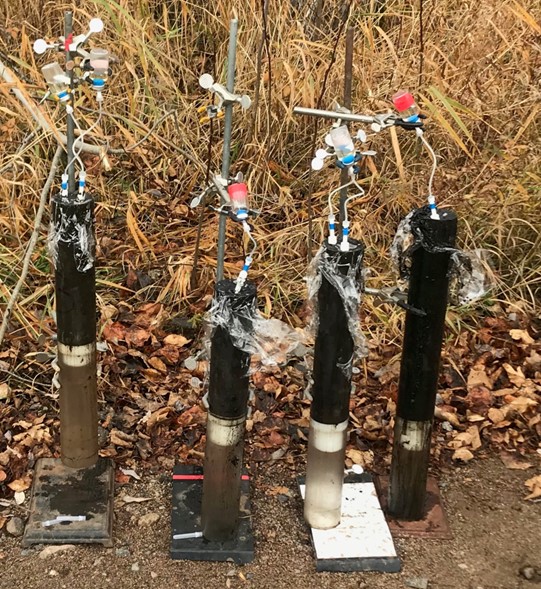
We also collect some cores that we don’t freeze so that we can collect the porewater, the liquid filling all the spaces between sediment grains, and living microbes. The chemistry of the porewater is highly related to sediment microbial activity and geochemistry of the solid sediments. To collect the waters, we stick porous tubes into the sediment cores, and connect those tubes to vials that have a vacuum inside of them, the same mechanical process used when you have your blood drawn at the doctor’s office. To collect living microbes, we take small scoops of sediment and store them in a refrigerator until we get back to the lab and can use the sediment to inoculate microbial growth media. That’s how we eventually add to our microbial culture library, a collection of living microbes with various living strategies and traits that we keep at the museum for research and to lend out to other researchers all over the world. 

Collecting sediment porewaters from cores collected from two different locations within the riparian wetland.

For a comprehensive understanding of how minerals and microbes vary within the riparian wetland, we repeat procedures of collecting and processing core samples throughout the wetland and at intervals along predetermined lines known as transects, that cross streams and intersect important hydrologic features of the ecosystem. Often, we’ll return to field sites many times over the course of a year or multiple years, so we can better investigate how the microbial activity and geochemical processes change over time with the seasons, as a result of major storm events, or with other environmental factors.   

Carla Rosenfeld is Assistant Curator of Earth Sciences at Carnegie Museum of Natural History.

Related Content

Fungi Make Minerals and Clean Polluted Water Along the Way

What Do Minerals and Drinking Water Have To Do With Each Other?

Wulfenite and Mimetite: CMNH’s Crystal Banquet

Carnegie Museum of Natural History Blog Citation Information

Blog author: Rosenfeld, Carla
Publication date: September 22, 2022

Share this post!

  • Share on Twitter Share on Twitter
  • Share on Facebook Share on Facebook
  • Share on Pinterest Share on Pinterest
  • Share on LinkedIn Share on LinkedIn
  • Share on Reddit Share on Reddit
  • Share via Email Share via Email

Filed Under: Blog Tagged With: Carla Rosenfeld, Hillman Hall of Minerals and Gems, minerals, Science News

September 13, 2022 by Erin Southerland

Two Perspectives on Attending a Course on Moths and Butterflies in the Southwest

by Kevin Keegan and Vanessa Verdecia

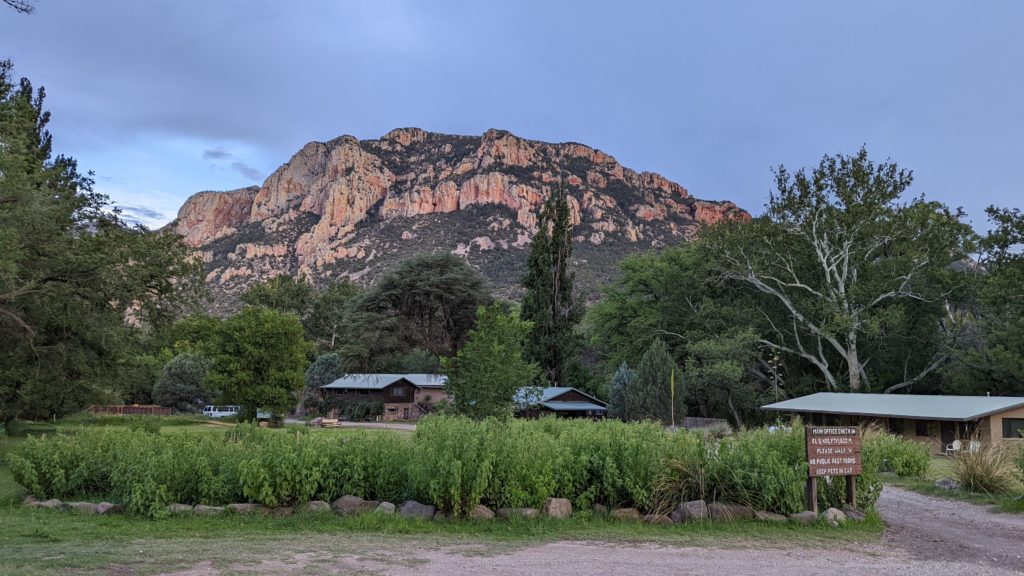
Kevin Keegan, Collection Manager of Invertebrate Zoology (IZ), and Vanessa Verdecia, Scientific Preparator for IZ, recently returned from a ten-day long crash course on moth and butterfly (Lepidoptera) taxonomy, systematics, natural history, specimen collection, and specimen preparation/curation in the beautiful Chiricahua Mountains of southeastern Arizona. The course includes both classroom time and field experiences at the American Museum of Natural History’s Southwestern Research Station.

American Museum of Natural History's Southwestern Research Station

The biological richness of the setting was ideal for learning about moths and butterflies. The Chiricahuas are one of the Sky Islands of the North American desertss, a term biologists use to describe mountains that abruptly rise high enough from the surrounding territory to support wildly different habitat on their upper flanks and summit. Because each range is surrounded by lowland desert, many mountaintop animals are isolated on what are effectively islands of high elevation.

Attending the Lepidoptera Course as an Instructor

Kevin attended the program as an instructor and gave two lectures: one on the amazing ways caterpillars deceive their predators to avoid getting eaten, and another on the taxonomy/systematics, identification, diversity, and natural history of a massive group of moths collectively called the Noctuoidea or the owlet moths(there are about 40,000 described species of owlet moths in the world). 

When he wasn’t teaching, Kevin was able to collect many species of owlet moths for study and incorporation into the CMNH IZ collection. He will soon be working with these specimens in the museum’s Molecular Lab, extracting and sequencing their DNA, and adding it to a large dataset he and other owlet moth researchers around the world have built over the last decade. With this DNA data, Kevin will be able to build evolutionary trees to determine the proper placement for these species in the tree of life, a determination that will also reveal whether any of the specimens he collected are of species new to science.

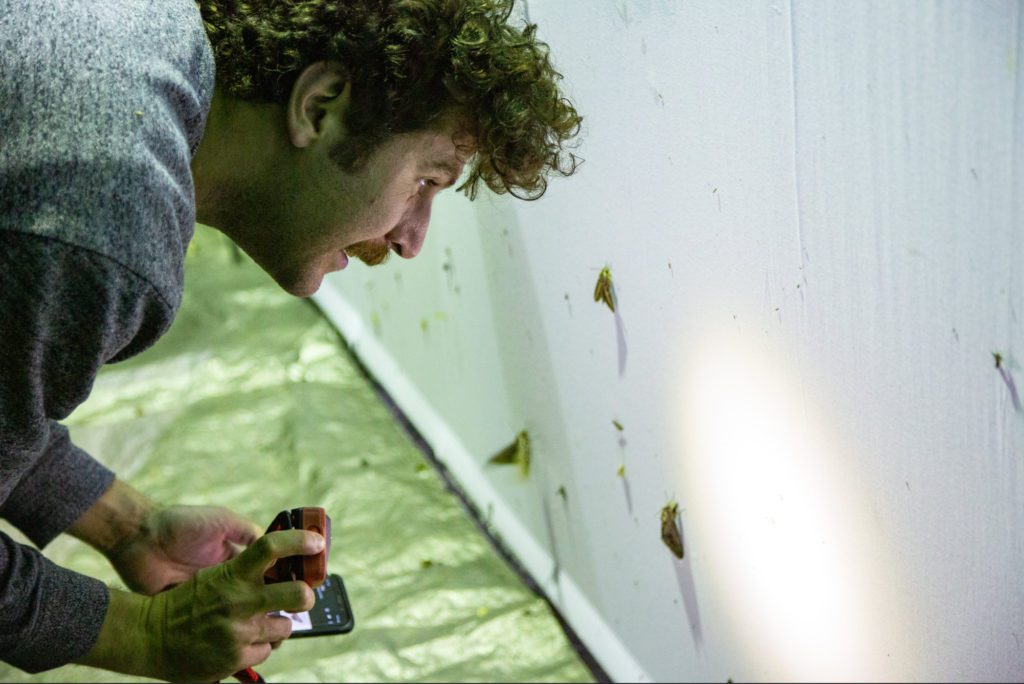
Kevin Keegan looking at moths on a light sheet. Image credit: Chris Grinter

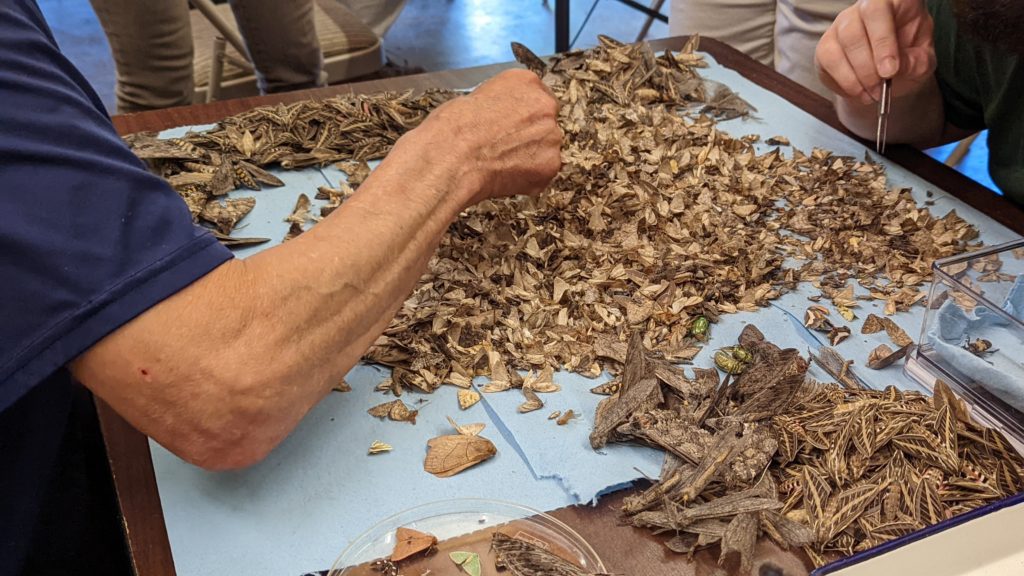
In addition to classroom time, instructors organized daytime and nighttime field experiences, including hikes to look for butterflies and caterpillars, and setting up light sheets where students could observe and collect any moths attracted to the lights. Instructors also set out traps each night to collect moths in bulk for students to identify and sort into taxonomic groups. Moths collected by these efforts were also used by students to practice preparing museum-quality specimens. 

Sorting moth specimens

Instructors and students also had plenty of time to get to know one another outside of scheduled activities. All meals were served communally in the research station dining hall, which allowed for extended conversations about moths and butterflies, biogeography, the history of lepidopterology, and numerous other topics. 

Attending the Lepidoptera Course as a Student

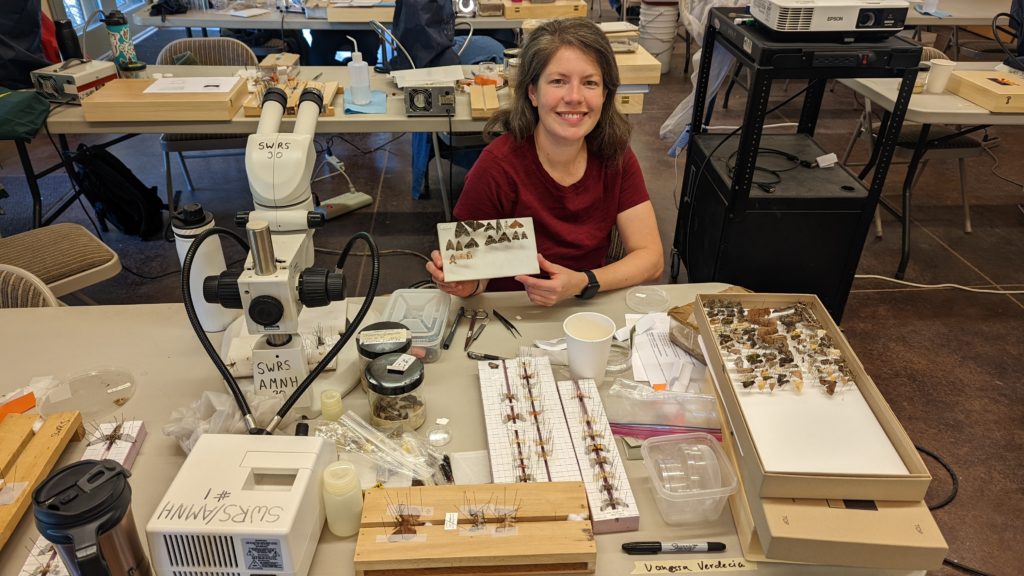
Vanessa Verdecia in the classroom. Image credit: Vicki Wolfe

Vanessa attended as a student and learned a lot even though she already has extensive field experience and training in specimen handling from her work at the museum. Vanessa found it wonderful to meet experts and professors from around the country who came together to teach the course. She also enjoyed the formal training and opportunity to learn how to identify different groups of moths by processing moth samples in the company of both experts and students.

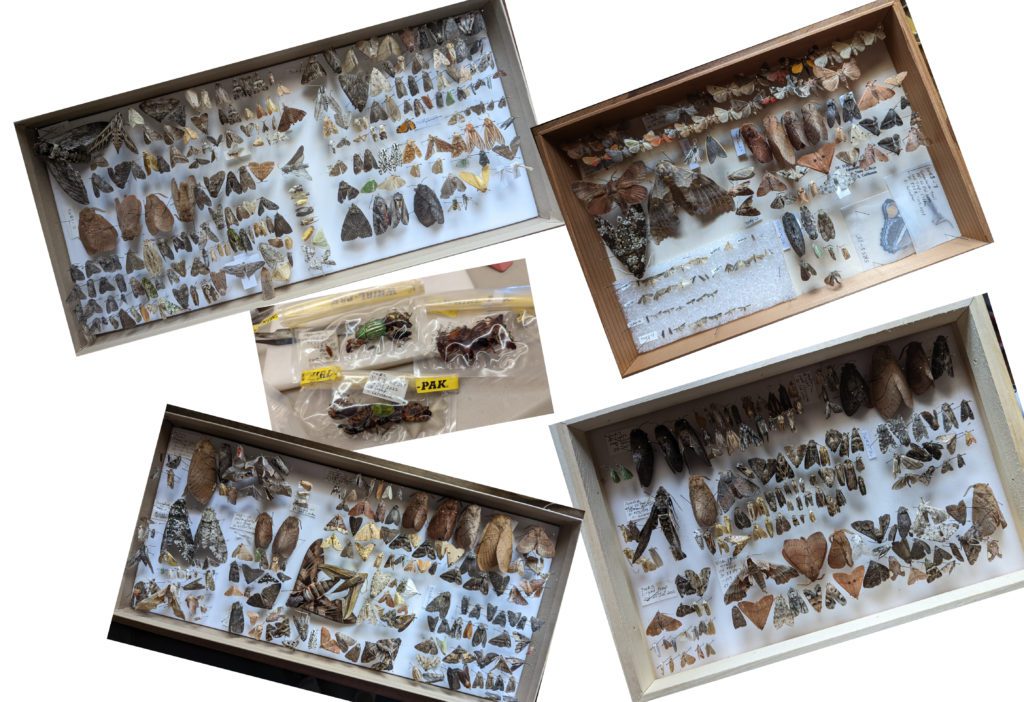
Specimens Vanessa collected for the museum. 

She brought back four boxes of moths for our IZ collection. Over the next several months she will be preparing and labeling all the specimens. Even though the course was about moths and butterflies, other groups of insects sometimes merited attention. Because the light sheets attracted many amazing beetles along with the moths, Vanessa collected two dozen small beetle specimens for the beetle experts on our staff. She also learned new techniques in spreading the wings on moths and butterflies, how to dissect specimens to be able to examine them under the microscope, and the latest information about identifying and classifying moths.

Kevin Keegan is Collection Manager and Vanessa Verdecia is Scientific Preparator for the Section of Invertebrate Zoology at Carnegie Museum of Natural History.

Related Content

Is This Butterfly Blue or Green?

Traub Flea Data Books

Working with the Type Collection

Carnegie Museum of Natural History Blog Citation Information

Blog author: Keegan, Kevin; Verdecia, Vanessa
Publication date: September 13, 2022

Share this post!

  • Share on Twitter Share on Twitter
  • Share on Facebook Share on Facebook
  • Share on Pinterest Share on Pinterest
  • Share on LinkedIn Share on LinkedIn
  • Share on Reddit Share on Reddit
  • Share via Email Share via Email

Filed Under: Blog Tagged With: Invertebrate Zoology, Kevin Keegan, Science News, Vanessa Verdecia

August 26, 2022 by Erin Southerland

Encounter With an Orb Weaver Spider: Is It Predator or Prey?

by Brady Karg

It was an early afternoon on a late spring day, and I was out trying to photograph any last stragglers for spring bird migration. The day was going well as I checked off a pair of Great Crested Flycatchers, Indigo Buntings, Black-throated Green Warblers, Black-throated Blue Warblers, Ovenbirds, a Broad-winged Hawk, and some recently fledged Barred Owls! As I was making my way back on the trail, I felt the strong pull of a spider web brush against my arm. I stopped and looked around to see a tiny spider dangling below a leaf beside me in the tangled remains of its web. As I leaned in closer, I noticed what looked to be a predator and prey encounter with the spider holding a large insect in its grasp. I soon realized the situation was something much more sinister. 

Upon closer inspection, it was apparent the bug was feasting on the spider! The mystery creature was obviously some kind of parasite, but what kind exactly? What kind of spider was being preyed upon? I then did some digging to find out more about this parasitic relationship.

In a conversation with Andrea Kautz, an entomologist at Powdermill Nature Reserve, I learned that this spider is in the subfamily Araneinae or Typical Orb weavers. After posting my observation to iNaturalist, a narrower ID was suggested, the Genus Eustala. This genus covers a large variety of orb weavers, spiders found in a wide variety of habitats including fields, forests, and marshes. The colors and patterns of these spiders vary, but the females are noted for having a distinct dorsal hump. 

So, what was eating this spider? Andrea informed me that the parasite is likely the larva of a parasitic wasp in the family Ichneumonidae. These are slender wasps, with many bearing orange and black coloration. The Ichneumonidae are known to parasitize both egg sacs and adult spiders. 

This information explained much of what I had seen. Below are two pictures I took using a digital microscope camera.

parasite on an orb weaver spider
side view of a parasite on a spider

In each you can see the larva of the parasitic wasp attached to the orb weaver spider. This situation is the result of an adult wasp in the Pimplinae subfamily laying an egg in this spider. The egg hatched, and the now much larger larva is continuing to feast on nutrients from the spider. The larva will continue to feed on the spider until it is ready to metamorphose into its pupal stage, and then into its adult form. The spider, unfortunately, will not survive this parasitic relationship. 

Our natural world is full of fascinating and unique relationships such as this wasp and spider. Always keep your eyes peeled in case you happen to stumble upon something such as this!

Brady Karg is an intern at Powdermill Nature Reserve, Carnegie Museum of Natural History’s environmental research center.

Related Content

Oh Deer, That’s A Lot of Parasites!

Natural History Discoveries

Can’t Touch This

Carnegie Museum of Natural History Blog Citation Information

Blog author: Karg, Brady
Publication date: August 26, 2022

Share this post!

  • Share on Twitter Share on Twitter
  • Share on Facebook Share on Facebook
  • Share on Pinterest Share on Pinterest
  • Share on LinkedIn Share on LinkedIn
  • Share on Reddit Share on Reddit
  • Share via Email Share via Email

Filed Under: Blog Tagged With: Brady Karg, liocf, Powdermill Nature Reserve, Science News

August 23, 2022 by Erin Southerland

GETTING FROM THE FERN HOLLOW BRIDGE TO THE FRICK FAMILY

by Lisa Miriello 
A view of Forbes Avenue bridge crossing over Fern Hollow in Frick Park, 1914. Pittsburgh City Photographer Collection, University of Pittsburgh.

After the Fern Hollow Bridge collapse on January 28, 2022, many commuters found themselves experiencing some traffic headaches as they scrambled to find different ways to and from work or school. My new route takes me past The Frick Pittsburgh, a museum complex in the Point Breeze section of Pittsburgh that includes Clayton, the former home of industrialist Henry Clay Frick.

As someone who works in the Section of Mammals, my thoughts while passing the stately grounds often turn to Frick’s son Childs (1883-1965), who grew up here exploring the woods surrounding the estate and attending Sterrett School (now Sterrett Classical Academy), less than a third of a mile away.

Photographer unknown, American, Sterrett School, c. 1900, gelatin silver printing-out paper print, H: 7 1/2 in. x W: 10 5/8 in., Carnegie Museum of Art, Pittsburgh, Second Century Acquisition Fund, 1999.34.2, Photograph © 2021 Carnegie Museum of Art, Pittsburgh.

As Childs grew older his early interest in the natural world turned to more scientific pursuits, and he embarked on a series of collecting expeditions in North America followed by visits to Africa, first in 1909 and again in 1911. But Childs wasn’t looking for “trophies.” By collecting animals at different life stages his goal was to further the knowledge of the lifestyle and habitats of these unfamiliar animals. Many of these specimens were gifted to the Carnegie Museum, and as the shipments arrived from overseas the staff taxidermists had their hands full. 

Led by brothers Remi and Joseph Santens these skilled artisans created expressive animal likenesses rather than the static displays that were seen in most museums at the time. Both Santens even visited zoos in New York and Washington, DC, to study the movements of living animals. Preserved plant life from Africa provided even more authenticity to the displays. The African Buffalo (Syncerus caffer) group was especially notable in how it was depicted. The animals appear to be spattered with mud and tramping through brush, a display then-Director W. J. Holland believed to be the first instance in which exhibition specimens had been accurately placed within their supporting environment. In the Carnegie Museum’s 1913 Annual Report he wrote that the group “may possibly provoke comment and criticism, but it is believed to be a step in the right direction, and will likely be followed by the leading taxidermists of the future.“  You can see the African Buffalo, along with other specimens collected by Frick, in the museum’s Hall of African Wildlife.

Carnegie Museum of Natural History, photo by Mindy McNaugher.

While Childs enriched the collection of the natural history museum, other family members left an impact on the city of Pittsburgh as well. His father, Henry Clay Frick (1849-1919), bequeathed 151 acres of land that would become Frick Park. Expanded by hundreds of acres over the years, it’s now the largest of the city’s parks.

Childs’ sister, Helen Clay Frick (1888-1984), was an art collector like her father and helped establish the Henry Clay Frick Fine Arts Library at the University of Pittsburgh. She later had the Frick Art Museum constructed on Clayton’s grounds to showcase her collection of art. This cultural resource opened to the public in 1970.

At the end of the day, as my car inches past the peaceful grounds of Clayton, I imagine traffic must have looked a little different over a hundred years ago when “horseless carriages,” horse-drawn vehicles, trolleys, and bicycles all shared the same road in a free-for-all. Today, with traffic signals and defined lanes, at least it’s more of an ordered chaos.

A view of a portion of Grant Boulevard populated with a mixture of automobiles, a horse with buggy, and a bicycle in the background. Grant Boulevard was renamed Bigelow Boulevard in 1916. Thomas Mellon Galey Photographs, Detre Library & Archives, Senator John Heinz History Center
Grant Boulevard | Historic Pittsburgh

Museums and parks can provide welcome relief in a chaotic world, and the Frick family’s contributions to these sanctuaries of art, science, and nature will be enjoyed for generations to come. 

Public domain image of Clayton.

Lisa Miriello is the Scientific Preparator for the Section of Mammals. 

Related Content

Finding Answers: From Museum to Mountains and Back Again

Meet the Mysterious Mr. Ernest Bayet

A Gorilla For Our Imagination

Carnegie Museum of Natural History Blog Citation Information

Blog author: Miriello, Lisa
Publication date: June 10, 2022

Share this post!

  • Share on Twitter Share on Twitter
  • Share on Facebook Share on Facebook
  • Share on Pinterest Share on Pinterest
  • Share on LinkedIn Share on LinkedIn
  • Share on Reddit Share on Reddit
  • Share via Email Share via Email

Filed Under: Blog Tagged With: Hall of African Wildlife, Lisa Miriello, mammals, Science News

  • « Go to Previous Page
  • Page 1
  • Interim pages omitted …
  • Page 7
  • Page 8
  • Page 9
  • Page 10
  • Page 11
  • Interim pages omitted …
  • Page 43
  • Go to Next Page »

sidebar

About

  • Mission & Commitments
  • Directors Team
  • Museum History

Get Involved

  • Volunteer
  • Membership
  • Carnegie Discoverers
  • Donate
  • Employment
  • Events

Bring a Group

  • Groups of 10 or More
  • Birthday Parties at the Museum
  • Field Trips

Powdermill

  • Powdermill Nature Reserve
  • Powdermill Field Trips
  • Powdermill Staff
  • Research at Powdermill

More Information

  • Image Permission Requests
  • Science Stories
  • Accessibility
  • Shopping Cart
  • Contact
  • Visitor Policies
One of the Four Carnegie Museums | © Carnegie Institute | Privacy Policy | Terms of Use | Accessibility
Rad works here logo