• Skip to primary navigation
  • Skip to main content
  • Skip to primary sidebar

Carnegie Museum of Natural History

One of the Four Carnegie Museums of Pittsburgh

  • Visit
    • Buy Tickets
    • Visitor Information
    • Exhibitions
    • Events
    • Dining at the Museum
    • Celebrate at the Museum
    • Powdermill Nature Reserve
    • Event Venue Rental
  • Learn
    • Field Trips
    • Educator Information
    • Programs at the Museum
    • Bring the Museum to You
    • Guided Programs FAQ
    • Programs Online
    • Climate and Rural Systems Partnership
  • Research
    • Scientific Sections
    • Science Stories
    • Science Videos
    • Senior Science & Research Staff
    • Museum Library
    • Science Seminars
    • Scientific Publications
    • Specimen and Artifact Identification
  • About
    • Mission & Commitments
    • Directors Team
    • Museum History
  • Tickets
  • Give
  • Shop

Blogs from our Scientific Researchers

Carnegie Museum of Natural History is home to active research and vast scientific collections. Our scientific researchers regularly contribute to the blog at the museum.

July 23, 2021 by wpengine

Eating Shipworms to Save the World

by Timothy A. Pearce

Shipworms, which bore into the wood of ships and the pilings of docks have been a menace to mariners for centuries. Recently, however, some sustainable food advocates are pointing to the disreputable creatures as a key to feeding the growing human population.

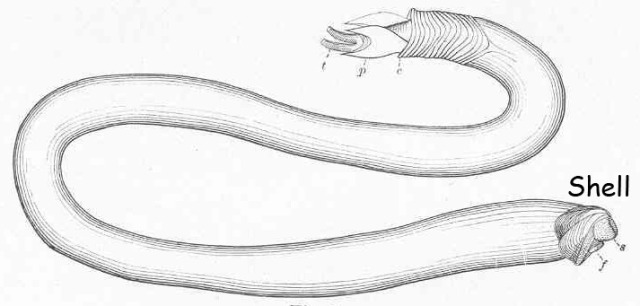
Black and white illustration of a shipworm.
Figure 1. Body of a shipworm showing the tiny shell at the lower right. Image from Wikimedia Commons taken from Goode (1884).

Surprisingly, shipworms are not worms at all, but are a type of clam in the family Teredinidae whose bivalved shells have been reduced to small rasp-like structures at one end of a worm-like body (Fig. 1). Some shipworms grow exceptionally fast, reaching 30 cm (12 inches) in six months. The small shells, which are roughly 5% of the creature’s body length, function as excavators. The shipworm uses the tiny pair to dig into wood, forming a burrow to protect its soft body, and digesting the excavated bits of wood as food. Symbiotic bacteria in the clam’s gills provide the necessary enzymes to digest the wood.

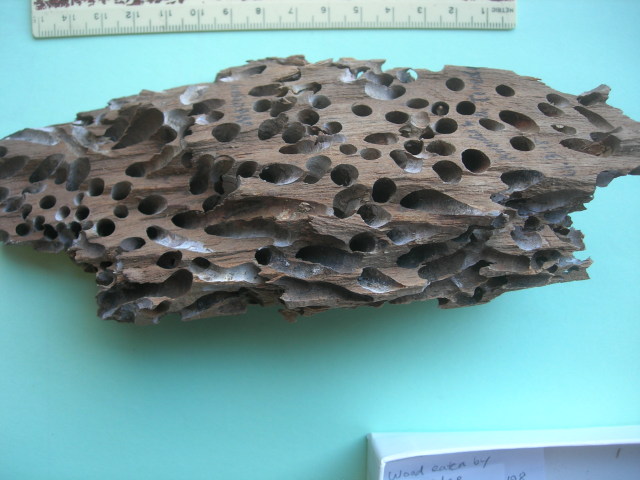
wood damaged by shipworms
Figure 2. Wood bored by the shipworm Lyrodus pedicellatus. Image by T.A. Pearce.

Sailors and stevedores (dock workers) have battled shipworms over the centuries because the holes created by the tiny mollusks weaken the wood, eventually causing ships to sink and docks to collapse (Fig. 2). Consequently, instead of causing yawns, these boring mollusks caused people to take notice. And while the shipworms’ wood-eating regime continues to plague sea-faring people who rely upon wooden vessels, other people are now taking note for a culinary reason.

From baddy to buddy, from scourge to supper, shipworms are undergoing a reputation transformation. As we look to the future, we see staring back at us both the hungry, growing human population and the threat of climate change. We understand the need to produce more food sustainably, including more protein, while reducing our greenhouse gas emissions. As an alternative to methane-belching cattle, some experts have advised eating sustainable protein sources such as insects and shipworms.

Among the advantages of shipworms as food are their exceptionally fast growth, their ability to thrive on a diet of waste wood or sustainable microalgae, and their high protein and omega-3 fatty acids content. (Willer & Aldridge 2020).

Today, shipworms are eaten primarily in parts of southeast Asia. But because they show great promise as a sustainable protein source, they are being considered for aquaculture to help feed the growing human population. In the not-so-distant future, you might be spicing up your meals by including (not so) boring clams!

Keep clam and carry on.

Timothy A. Pearce is the head of the Section of Mollusks at Carnegie Museum of Natural History. Museum employees are encouraged to blog about their unique experiences and knowledge gained from working at the museum.

Literature Cited

Goode, G.B. 1884. Fisheries and Fishery Industries of the United States: Section I, Natural History of Useful Aquatic Animals, Plates. Washington, DC: Government Printing Office.

Willer, D.F. & Aldridge, D.C. 2020. From pest to profit—the potential of shipworms for sustainable aquaculture. Frontiers in Sustainable Food Systems, 4: 575416. doi: 10.3389/fsufs.2020.575416

Related Content

Cuttlefish Pass Marshmallow Test

Vampire Squid: Cutest Dracula

Ask a Scientist: How did snails evolve from living in water to living on land?

Carnegie Museum of Natural History Blog Citation Information

Blog author: Pearce, Timothy A.
Publication date: July 23, 2021

Share this post!

  • Share on Twitter Share on Twitter
  • Share on Facebook Share on Facebook
  • Share on Pinterest Share on Pinterest
  • Share on LinkedIn Share on LinkedIn
  • Share on Reddit Share on Reddit
  • Share via Email Share via Email

Share this post!

  • Share on Twitter Share on Twitter
  • Share on Facebook Share on Facebook
  • Share on Pinterest Share on Pinterest
  • Share on LinkedIn Share on LinkedIn
  • Share on Reddit Share on Reddit
  • Share via Email Share via Email

Filed Under: Blog Tagged With: mollusks, Science News, Tim Pearce, We Are Nature 2

July 6, 2021 by wpengine

Bird Architecture on Human Infrastructure

by Patrick McShea

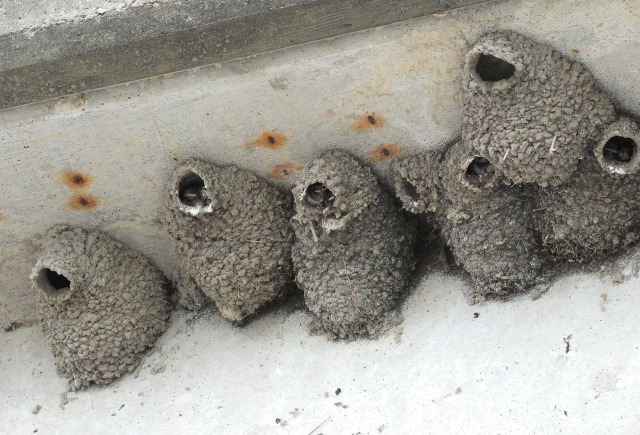
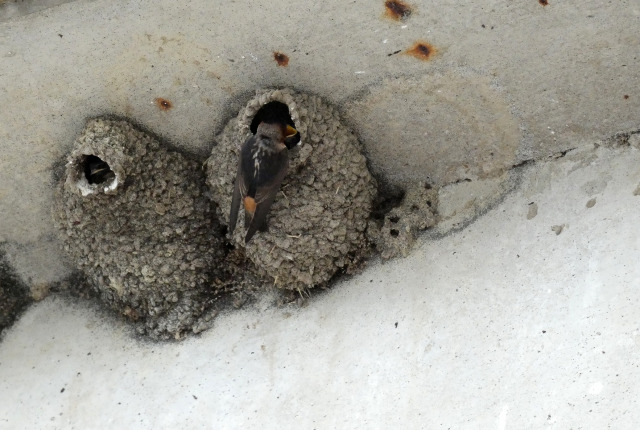
cliff swallow nests
Image credit: Amy Henrici

Cliff Swallows are potters. The gourd-shaped earthen vessels the birds construct, one tiny mouthful of mud at a time, provide shelter for their eggs and young. In Pennsylvania, and across much of the species’ current continent-wide breeding range, bridges provide favored nest sites for birds whose ancestors, until the early decades of the 1800’s, seem to have been restricted to nesting against low elevation cliffs in western mountain ranges.

The nests pictured above adhere to the concrete supports of a bridge crossing an arm of Lake Arthur in Butler County’s Moraine State Park. During field survey work leading up to the publication of the Second Atlas of Breeding Birds in Pennsylvania in 2012, bridges accounted for 44% of Cliff Swallow nest sites, barns for 33%, and churches, houses, other buildings, and dams for the balance. The species nests in colonies, and the number of nests in bridge-based colonies also far outnumbered those at other sites.

In Birds of Western Pennsylvania, a 1940 publication by W.E. Clyde Todd, then the museum’s Curator of Birds, nest descriptions are a highlight of the Cliff Swallow account.

“The type is retort-shaped, globular, with a neck springing from above and turned to open downward: a beautiful, symmetrical structure. The shape however is modified to suit the space – truncated or extended, as need requires; and where the nests are close-set, the chamber within, though pouch-like, is not truly symmetrical.”

“The nests are built of pellets of mud laid wet and retaining in the finished structure, each its smooth-rounded individuality. The walls speak of cunning and labor and of security, as does a wall of human masonry.”

cliff swallow feeding young in the nest
Image credit: Amy Henrici

On a recent early summer morning the Cliff Swallows’ incorporation of our culture’s indispensable highway architecture into their reproductive cycle made for easy and entertaining bird watching. There were hungry young in every chamber of an easily viewed eight-nest cluster. As parent birds returned regularly from insect-catching forays over the nearby lake, the entryways to the dark clay pouches were brightened by the bright yellow gaping beaks of the young.

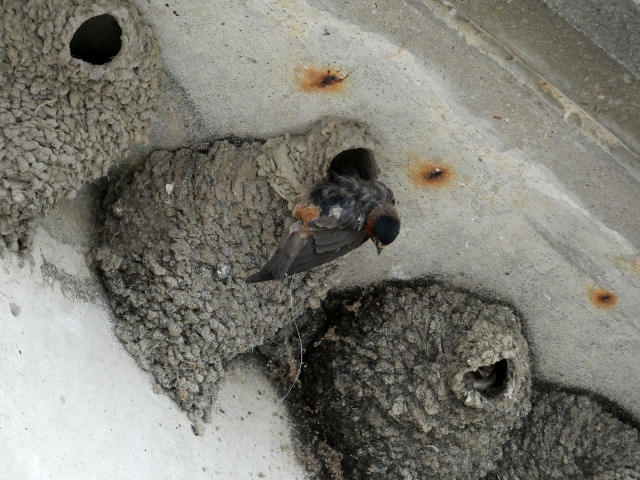
cliff swallow hanging out of nest
Image credit: Amy Henrici

Appreciation of the beneficial match between people and birds was leavened by a sight at another nest cluster on an adjacent bridge support. When a swallow perched against a nest remained still through several feeding cycles of its neighbors, an inspection with binoculars revealed a tragic circumstance. The bird appeared to have become entangled in, and eventually strangled by discarded fishing line, eight inches of which dangled from the lifeless feathered body.

Patrick McShea works in the Education and Visitor Experience department of Carnegie Museum of Natural History. Museum employees are encouraged to blog about their unique experiences and knowledge gained from working at the museum.

Reference

Second Breeding Bird Atlas of Pennsylvania – http://www.pabirdatlas.psu.edu/

Related Content

Camouflage in Your Yard?

Do Animals Use Plastic?

Raptor Watch

Carnegie Museum of Natural History Blog Citation Information

Blog author: McShea, Patrick
Publication date: July 6, 2021

Share this post!

  • Share on Twitter Share on Twitter
  • Share on Facebook Share on Facebook
  • Share on Pinterest Share on Pinterest
  • Share on LinkedIn Share on LinkedIn
  • Share on Reddit Share on Reddit
  • Share via Email Share via Email

Share this post!

  • Share on Twitter Share on Twitter
  • Share on Facebook Share on Facebook
  • Share on Pinterest Share on Pinterest
  • Share on LinkedIn Share on LinkedIn
  • Share on Reddit Share on Reddit
  • Share via Email Share via Email

Filed Under: Blog Tagged With: Birds, Educators, Pat McShea, Science News, We Are Nature 2

June 25, 2021 by wpengine

Fish and the Fourth of July?

by Patrick McShea

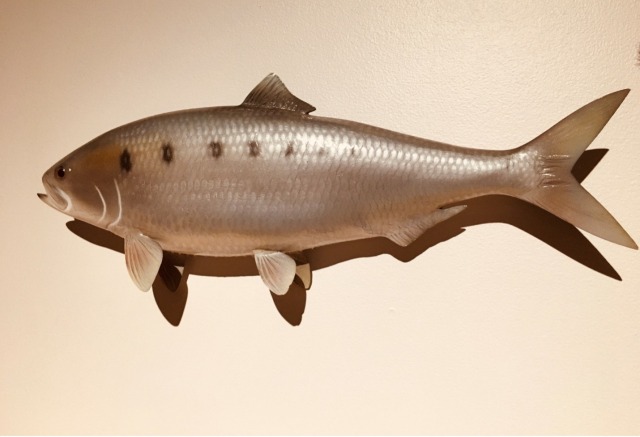
model of a shad

During the cold early months of 1778, did the outcome of the American colonies’ armed struggle for independence hinge upon a spawning run of fish up a Pennsylvania river? A 22-inch-long American shad displayed on a wall in Discovery Basecamp can serve as a focal point for consideration of this question, but many viewers will be aided by some framing background information.

In the chronology of the American Revolution, the harsh winter of 1777-1778 was notable for the British Army’s control of Philadelphia, and the encampment, some 23 miles northwest, of the opposing Continental Army, led by George Washington, at a site along the Schuylkill River known as Valley Forge.

In the more than two centuries since the United States achieved independence from Great Britain, an often repeated anecdote about the desperate conditions endured by the poorly clothed, poorly fed, and poorly sheltered soldiers at Valley Forge contends that starvation conditions were ended late in the winter by an unusually early spawning run of thousands of American shad up the Schuylkill.

American shad are an anadromous species, a term for fish that hatch in freshwater, migrate to the ocean where they spend most of their lives, and then migrate back to their natal waters to reproduce. The historic range for the species, whose Latin name, Alosa sapidissima, references its delectable flavor, encompasses western Atlantic Ocean waters bordering the east coast of Canada and the United States.

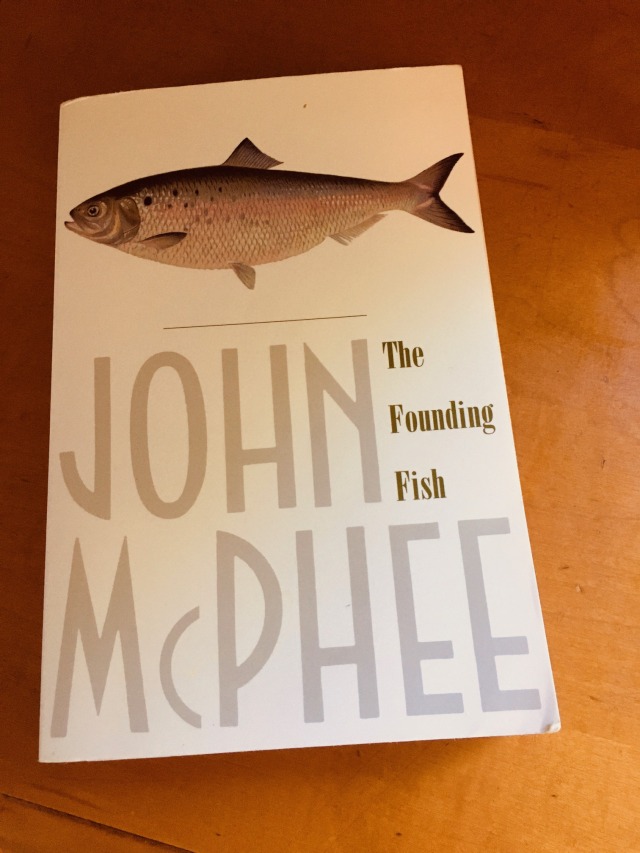
In 2002, renowned author and Princeton University professor John McPhee brought American shad to the attention of the book-reading public with the publication of The Founding Fish, a 358-page encyclopedic compilation of personal experience, firsthand reporting, historical accounts, and scientific research. (Farrar, Straus, and Giroux) The book’s title is a nod to the Valley Forge account, and in a central chapter of the same name McPhee addresses the story’s veracity by citing the research of a now retired professor of American History from Indiana University of Pennsylvania, Wayne Bodle. “When I first got in touch with Bodle, in 1998, he said that fresh shad in all likelihood were consumed by soldiers at Valley Forge in the weeks before they broke camp in June, but that the large and providently early run is a legend not supported by a single document.”

Bodle’s analysis of his research into all aspects of the Continental Army’s storied winter encampment in eastern Pennsylvania is presented in his book, The Valley Forge Winter: Civilians and Soldiers in War (The Pennsylvania University Press, 2002). Like The Founding Fish, it’s available for borrowing from Carnegie Library of Pittsburgh. If your summer reading schedule isn’t yet set, you might consider checking out either book.

Patrick McShea works in the Education and Visitor Experience department of Carnegie Museum of Natural History. Museum employees are encouraged to blog about their unique experiences and knowledge gained from working at the museum.

Related Content

Alaskan Brown Bear Spotlight

Educator Spotlight: Christian Shane

Expanding the Scope of Environmental Education

Carnegie Museum of Natural History Blog Citation Information

Blog author: McShea, Patrick
Publication date: June 25, 2021

Share this post!

  • Share on Twitter Share on Twitter
  • Share on Facebook Share on Facebook
  • Share on Pinterest Share on Pinterest
  • Share on LinkedIn Share on LinkedIn
  • Share on Reddit Share on Reddit
  • Share via Email Share via Email

Filed Under: Blog Tagged With: Education, Educators, fish, Pat McShea, Science News

June 25, 2021 by wpengine

Cuttlefish Pass Marshmallow Test

by Tim Pearce

The club for species that can pass the marshmallow test has recently gotten a new member: the cuttlefish. Cuttlefish are the first invertebrate known to show self-control.

The marshmallow test examines whether an individual has sufficient self-control to use delayed gratification. In the original marshmallow test, a child could have one marshmallow immediately, or if they were able to wait 15 minutes, they received two marshmallows. Some of the 3- to 5-year-old children waited and got the double treat, indicating that they could delay gratification for a larger reward. Other species such as chimpanzees, crows, parrots, and dogs have passed modified versions of the marshmallow test

We humans think we are special. We form clubs in which we initially believe we are the only member, but then other species creep into those clubs. In times past, humans thought they were the only members of the language club and the tool use club, but now we know many other species are in those clubs.

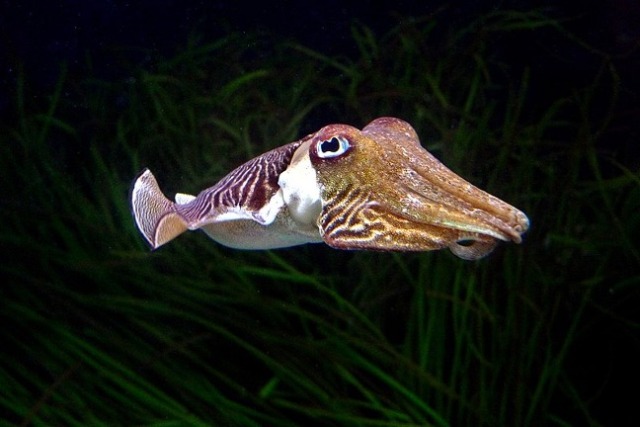
cuttlefish on dark background
Cuttlefish. Image by David Sim, from Wikimedia Commons under the Creative Commons Attribution 2.0 Generic license.

To examine whether cuttlefish could delay gratification for a better reward, researchers (Schnell et al. 2021) offered them an Asian shore crab (a less preferred food) immediately, or a grass shrimp (a more preferred food) if they were able to wait. The food was offered in two chambers with sliding doors. Before the test, cuttlefish were trained to recognize symbols on the doors that indicated if it would open immediately (a circle) or with a delay (a triangle). Most of the cuttlefish waited 50 to 130 seconds to get the more desirable grass shrimp, comparable to time delays shown by chimpanzees and crows.

Some cuttlefish appeared to move their bodies away from the immediate, less preferred reward. Similar behaviors are seen in humans and other animals (e.g., parrots close their eyes, dogs turn away) as they try to resist temptation while waiting for the better reward.

Furthermore, those cuttlefish that waited longest for their favorite foods also performed best during learning tests. Cuttlefish have good memories and can learn from past experiences.

The standard explanation for ability to use delayed gratification, is that it helps animals with long, social lives. This reasoning doesn’t apply to cuttlefish. They live just two years and are not social, so the benefits of delayed gratification to cuttlefish are less obvious. One possibility is that the evolution of self-control in cuttlefish is related to predator avoidance and camouflage; those that can stay camouflaged longer might avoid detection by predators.

Relevant joke:

What is the most affectionate fish in the ocean?

The cuttlefish!

Tim Pearce is the head of the Section of Mollusks at Carnegie Museum of Natural History. Museum employees are encouraged to blog about their unique experiences and knowledge gained from working at the museum.

Reference

Schnell, A.K., Boeckle, M., Rivera, M., Clayton, N.S. & Hanlon, R.T. 2021. Cuttlefish exert self-control in a delay of gratification task. Proceedings of the Royal Society B, Biological Sciences, 288 (1946): 20203161 doi.org/10.1098/rspb.2020.3161.

Related Content

Ask a Scientist: What is the biggest snail?

Water Bears: Why My Yard is Like the Moon

Extremely Rapid Evolution of Cone Snail Toxins

Carnegie Museum of Natural History Blog Citation Information

Blog author: Pearce, Timothy A.
Publication date: June 25, 2021

Share this post!

  • Share on Twitter Share on Twitter
  • Share on Facebook Share on Facebook
  • Share on Pinterest Share on Pinterest
  • Share on LinkedIn Share on LinkedIn
  • Share on Reddit Share on Reddit
  • Share via Email Share via Email

Share this post!

  • Share on Twitter Share on Twitter
  • Share on Facebook Share on Facebook
  • Share on Pinterest Share on Pinterest
  • Share on LinkedIn Share on LinkedIn
  • Share on Reddit Share on Reddit
  • Share via Email Share via Email

Filed Under: Blog Tagged With: mollusks, Science News, Tim Pearce

June 10, 2021 by wpengine

New Anthropocene Publication: Stemming the Tide

by Nicole Heller

Blue and white cover of a book. Title: Stemming the Tide: Global Strategies for Sustaining Cultural Heritage Through Climate Change. Edited by Rebecca Rushfield.

I am pleased to share this Smithsonian Scholarly Press publication, Stemming the Tide: Global Strategies for Sustaining Cultural Heritage Through Climate Change. The e-book, edited by Rebecca Rushfield, is available online and freely available to read and download. It is the product of an international symposium organized and hosted by the Smithsonian Institution, Washington DC, March 5 – 6, 2020. According to Amber Kerr, Chief of Conservation, Smithsonian American Art Museum “The objective of the symposium was to empower cultural heritage authorities, managers, and advocates to pursue more ambitious engagement with, and collaborative approaches to, the climate crisis,” and “250 registrants and 1,100 live web stream viewers representing 33 states and 25 countries ranging from the United Kingdom, Spain, and Greece to Canada, Mexico, and Trinidad and Tobago” took part.

I was honored to be invited to participate and frame remarks about museums and climate change. Looking back, the symposium was at the beginning of difficult times. The crisis of the coronavirus pandemic was just becoming a known reality. I recall forgoing handshakes and hugs, and instead bumping elbows, with the awesome group of global professionals assembled.

Perhaps for this reason, seeing this volume published now gives me extra pause, and feels especially symbolic of the interconnections between people and planet – past, present and future – and the risks we face in the early 21st century. As Lonnie G. Bunch III, Secretary of the Smithsonian Institution, writes in the forward “This publication invites us to put our heads together and lead the cultural heritage sector in addressing the most pressing issue of our time.”

My chapter, “Museums Facing Climate Change. All Hands On Deck: Moving Past Climate Science and Into Culture,” is about the special opportunity for museums to lead on climate change action and education in their communities, and draws on the good works started at the Carnegie Museum of Natural History with We Are Nature: Living in the Anthropocene and Climate Systems Partnerships. Other chapters explore a wide range of issues. For example, there are chapters on adapting cultural heritage sites and historic buildings to increased risks from extreme weather and sea level rise, ensuring the preservation of collections and archeological sites, supporting resilience of displaced communities, sustaining and respecting Indigenous knowledge and storytelling, as well as tools for mitigating greenhouse gases and improving sustainability practices in collections and exhibition practices.

While intended for a professional audience, I imagine this book will be relevant to anyone concerned about human-caused climate change and interested in the diverse opportunities and challenges it presents. I commend the Smithsonian Institute for leadership in organizing the symposium and publishing this valuable resource. I look forward to using it with my colleagues at the Carnegie Museums and here in Pittsburgh toward pursuing more ambitious engagement and collaborative approaches to the climate crisis.

Read Stemming the Tide: Global Strategies for Sustaining Cultural Heritage Through Climate Change free online.

Nicole Heller is Curator of Anthropocene Studies at the Carnegie Museum of Natural History. Museum employees are encouraged to blog about their unique experiences working at the museum.

Related Content

Warmer Springs and Earlier Birds

Cities Are Not Biological Deserts

Pittsburgh’s Moths Reflect Environmental Impacts of Industry

Carnegie Museum of Natural History Blog Citation Information

Blog author: Heller, Nicole
Publication date: June 10, 2021

Share this post!

  • Share on Twitter Share on Twitter
  • Share on Facebook Share on Facebook
  • Share on Pinterest Share on Pinterest
  • Share on LinkedIn Share on LinkedIn
  • Share on Reddit Share on Reddit
  • Share via Email Share via Email

Share this post!

  • Share on Twitter Share on Twitter
  • Share on Facebook Share on Facebook
  • Share on Pinterest Share on Pinterest
  • Share on LinkedIn Share on LinkedIn
  • Share on Reddit Share on Reddit
  • Share via Email Share via Email

Filed Under: Blog Tagged With: Anthropocene, Anthropocene Studies, Nicole Heller, Science News

June 9, 2021 by wpengine

Student of the World; Part 2: Stearns and Bayet

by Joann Wilson and Albert Kollar

“His [Frederick Stearns] love for that which was beautiful and useful, led him to collect a vast amount of material covering so many fields of human effort…”

Detroit Free Press, January 15, 1907

Fossils pass through many hands. Some hands hold discoveries, some buy and sell, others study and organize. Behind every fossil is a story and hopefully, for those in museum collections, a specimen label. With luck, the geology and paleontology of the label script is accurate. Beginning with the creation of the first color geological map by William Smith in 1815 and the subsequent organizing of the Geologic Time Scale in 1823, paleontologists worked to validate stratigraphy by collecting and describing new species from exposed strata in Europe and North America. It was not until the publication of Charles Darwin’s The Origin of Species in 1859 that paleontological work shifted to include studying evolution as documented by fossil evidence.

Today we understand that many hands aided fossil discovery, often in anonymity. Thanks to technology and through a focus shift to the individuals behind the specimens, we can now provide a fuller picture of the past that acknowledges the roles of collectors, dealers, indigenous cultures, women, quarry workers, and all who aided in the pursuit of fossils.

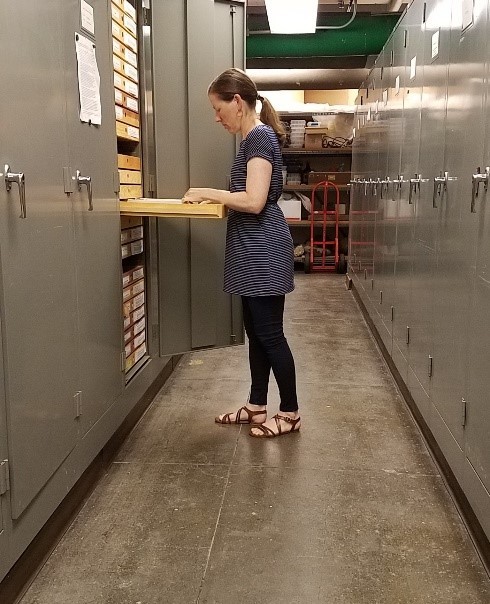
In the basement of Carnegie Museum of Natural History, behind a set of gray steel doors in the Section of Invertebrate Paleontology, is an astonishing assembly of archival documents from the Bayet Collection. Andrew Carnegie made front page news in 1903 by purchasing an estimated 130,000 fossils from Ernest Bayet of Brussels. Along with the fossils, the museum also received hundreds of documents written primarily in French, German, and Italian. Most of it has remained untranslated, until now.

Thanks to volunteer Lucien Schoenmakers of the Netherlands, details of fossil trades and purchases from over 100 years ago provide links to narratives that have yet to be told. Join us as we start the journey. Our series, which began with an examination of correspondence between fossil collector Frederick Stearns and his client, Bayet, continues here with a deeper profile of Stearns.

Sepia tone profile photo of a white man wearing a suit. Underneath the photo is his signature: Frederick Stearns.
Frederick Stearns, date unknown. Permission of the University of Michigan Stearns Collection.

Frederick Stearns of Detroit was a man not born into wealth, but with a passion for education, art, and science. His early life revolved around diligence, not fossils. Born in Lockport, New York in 1831, Stearns quit school at age 14 to find a job. Within a year, he found work as an apprentice to a pharmacist in Buffalo, New York. Of his early life, he later said, “one of my earliest memories is looking into the windows Dr. Merchant’s Gargling Oil Drug store and wondering at the mystery of the white squares of magnesia and the round balls of chalk.” Eventually, Stearns moved to another pharmacy, and became partner, but he was not convinced that Buffalo, New York was his ticket to success.

On a frosty New Year’s Day in 1855, Stearns, newly married and just 24 years of age, crossed the frozen Detroit River by foot to start anew. Of that period, he later said, “little money, fair credit, high hope.” He opened a retail pharmacy in Detroit. To reach customers, he made short trips to the surrounding area, leaving samples of his products. Over time, his business expanded to the manufacture of pharmaceuticals. In 1877, he made history by installing the first telegraph line in the city of Detroit. But despite the success, Stearns dreamed of the education lost to him when he left school at the age of 14. In 1887 at age 56, he turned the business over to his sons and he began to travel the world. Over the next twenty years, he collected many items, including fossils.

William Smith’s 1815 Color Geological Map.

Stearns pursuits led him to Africa, Europe, and Asia. In the late 1800’s, a voyage to Japan required weeks of travel as compared to a current 14-hour flight from New York to Tokyo. In the early 1890’s, Stearns travelled to Japan twice for the purpose of studying mollusks and other marine life. In a book published in 1895 titled, “Catalog of the Marine Mollusks of Japan,” Stearns credits Japanese fisherman Morita Seto for assisting in the collection of over “1000 forms of marine life.”

But Stearns interest did not stop with mollusks. He also collected fossils, art, and musical instruments. His collection of musical instruments at the Stearns Collection of Musical Instruments at the University of Michigan, in Ann Arbor Michigan, is considered one of the finest in the world.

For a short time, Stearns also collected fossils. Between 1888-1889, he wrote two letters to Ernest Bayet about a trade deal. Stearns first letter offers a clue as to how they met. Both men appear to have known fossil dealer Lucien Stilwell of Deadwood, South Dakota. The trade between Stearns and Bayet did not go smoothly, but it does have a happy ending.

Stearns was a student of the world until the very end. In 1907, just days before he was scheduled to sail for Egypt, he became ill and died. At his passing, the Detroit Free Press wrote, “A remarkable phase of Mr. Stearns’s activities as a collector was their diversity… and all of this for the simple love of learning things that he might tell them to others without price.”

Many thanks to the generous contributions of Carol Stepanchuk, Outreach and Academic Projects at the U-M Stearns Collection of Musical Instruments Lieberthal-Rogers Center for Chinese Studies and Joseph Gascho, Associate Professor at the University of Michigan School of Music and Director of the Stearns Collection of Musical Instruments. Many thanks to volunteer Lucien Schoenmakers’ ongoing effort to translate archival Bayet documents written in French and German.

Joann Wilson is an Interpreter in the Education Department at Carnegie Museum of Natural History and Albert Kollar is Collections Manager for the Section of Invertebrate Paleontology. Museum employees are encouraged to blog about their unique experiences and knowledge gained from working at the museum.

Related Content

Stearns and Bayet Part 1: The Dispute

Understanding Fossil Fuels Through Carnegie Museums Exhibits

From Collector to Director

Carnegie Museum of Natural History Blog Citation Information

Blog author: Wilson, Joann; Kollar, Albert
Publication date: June 9, 2021

Share this post!

  • Share on Twitter Share on Twitter
  • Share on Facebook Share on Facebook
  • Share on Pinterest Share on Pinterest
  • Share on LinkedIn Share on LinkedIn
  • Share on Reddit Share on Reddit
  • Share via Email Share via Email

Share this post!

  • Share on Twitter Share on Twitter
  • Share on Facebook Share on Facebook
  • Share on Pinterest Share on Pinterest
  • Share on LinkedIn Share on LinkedIn
  • Share on Reddit Share on Reddit
  • Share via Email Share via Email

Filed Under: Blog Tagged With: Albert Kollar, fossils, invertebrate paleontology, Joann Wilson, Science News

  • « Go to Previous Page
  • Page 1
  • Interim pages omitted …
  • Page 15
  • Page 16
  • Page 17
  • Page 18
  • Page 19
  • Interim pages omitted …
  • Page 43
  • Go to Next Page »

sidebar

About

  • Mission & Commitments
  • Directors Team
  • Museum History

Get Involved

  • Volunteer
  • Membership
  • Carnegie Discoverers
  • Donate
  • Employment
  • Events

Bring a Group

  • Groups of 10 or More
  • Birthday Parties at the Museum
  • Field Trips

Powdermill

  • Powdermill Nature Reserve
  • Powdermill Field Trips
  • Powdermill Staff
  • Research at Powdermill

More Information

  • Image Permission Requests
  • Science Stories
  • Accessibility
  • Shopping Cart
  • Contact
  • Visitor Policies
One of the Four Carnegie Museums | © Carnegie Institute | Privacy Policy | Terms of Use | Accessibility
Rad works here logo