• Skip to primary navigation
  • Skip to main content
  • Skip to primary sidebar

Carnegie Museum of Natural History

One of the Four Carnegie Museums of Pittsburgh

  • Visit
    • Buy Tickets
    • Visitor Information
    • Exhibitions
    • Events
    • Dining at the Museum
    • Celebrate at the Museum
    • Powdermill Nature Reserve
    • Event Venue Rental
  • Learn
    • Field Trips
    • Educator Information
    • Programs at the Museum
    • Bring the Museum to You
    • Guided Programs FAQ
    • Programs Online
    • Climate and Rural Systems Partnership
  • Research
    • Scientific Sections
    • Science Stories
    • Science Videos
    • Senior Science & Research Staff
    • Museum Library
    • Science Seminars
    • Scientific Publications
    • Specimen and Artifact Identification
  • About
    • Mission & Commitments
    • Directors Team
    • Museum History
  • Tickets
  • Give
  • Shop

Blogs from our Scientific Researchers

Carnegie Museum of Natural History is home to active research and vast scientific collections. Our scientific researchers regularly contribute to the blog at the museum.

April 29, 2020 by wpengine

Mesozoic Monthly: Sophogramma

Welcome to April! Have you seen any flowers blooming yet? Often, when we think of flowers, we also think of their pollinating buddies, the bees. However, bees are not the only pollinating insects around today, and the same was true during the Mesozoic Era (the ‘Age of Dinosaurs’). One interesting prehistoric pollinator is Sophogramma lii, a beautiful pollen-eating lacewing from the Cretaceous, the third and final time period of the Mesozoic.
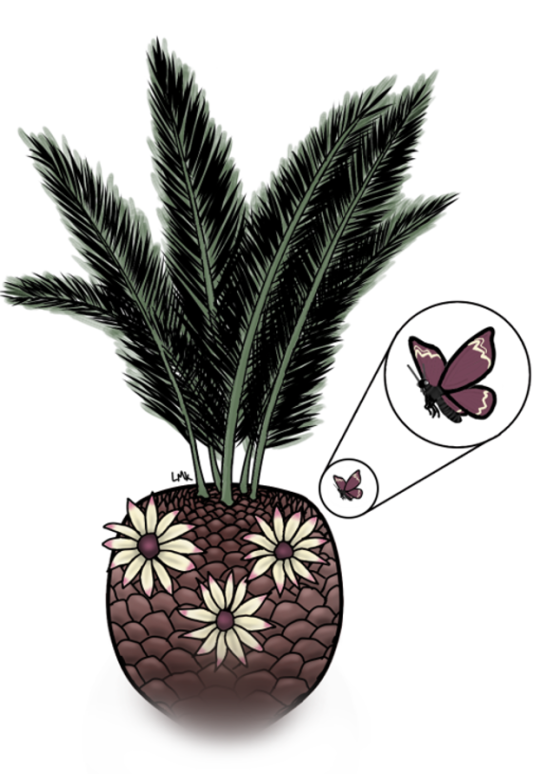
Sketch of Sophogramma lii alongside the Jurassic/Cretaceous seed plant Cycadeoidea by ginjaraptor on DeviantArt. Cycadeoidea was not a flowering plant, even though it looks like one; the flower-like structures are known as strobili and are actually types of cones!

Modern lacewings, for those who aren’t familiar, are a group of small flying insects with two pairs of wings of about equal size. They get their common name from the net-like pattern of veins on their wings. Most of today’s lacewings are predators that eat other small insects. Sophogramma, however, belongs to an extinct group of relatively large lacewings called the Kalligrammatidae, which were not predators but rather pollen eaters and juice drinkers. This group is commonly called the “butterflies of the Jurassic” due to several similarities with modern butterflies: their mouthparts formed long, tube-like siphons for drinking plant juices; their feeding habits resulted in the transference of pollen between plants; and their wings had scales and were distinctly patterned to ward off predators. Astoundingly, we know that kalligrammatids had patterned wings because these patterns are actually preserved in their fossils! Sophogramma lii had whimsical winding stripes along the edges of all four wings. Although we don’t know the exact color of the wings, we do know that these stripes were lighter in color than the rest of the wing. Other kalligrammatids had large eyespots adorning their wings, like many butterflies today.
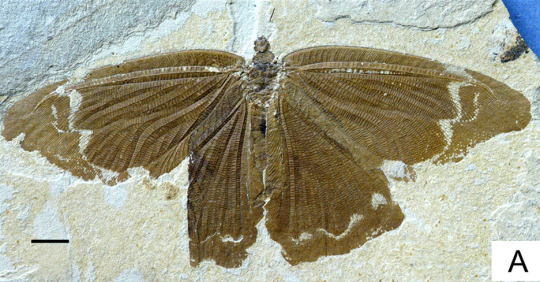
Beautifully preserved fossil of Sophogramma lii clearly showing the light-colored wavy stripes along the edges of its wings. Image from a research paper by Yang et al. (2014).

The plants that Sophogramma snacked on (and incidentally, pollinated) almost certainly lacked flowers. Flowering plants, technically called angiosperms, didn’t evolve until early in the Cretaceous, roughly 130 million years ago, but kalligrammatids had been around since at least the middle part of the preceding Jurassic Period, about 160 million years ago. So what plants were kalligrammatids eating for all that time? And why did these insects die out just as angiosperms were becoming common? Well, kalligrammatids’ host plants probably consisted of spore-bearing vascular plants such as ferns and non-flowering seed plants including conifers, cycads, ginkgos, and a variety of extinct forms. Before angiosperms burst onto the scene, these types of plants dominated land ecosystems. Despite lacking flowers, these plants would still have used spores and pollen to reproduce, providing kalligrammatids with plenty of food. Once angiosperms evolved their flowers, these plants rapidly diversified and presumably outcompeted the host plants that kalligrammatids such as Sophogramma would have relied upon.

With a wingspan of six inches (15.3 cm), Sophogramma lii was a relatively large insect. Its fossils have been found in the Yixian Formation, an Early Cretaceous-aged rock unit that crops out in northeastern China. The Yixian represents a forested environment that many dinosaurs, archaic birds, pterosaurs, and other hungry critters called home. The distinctive stripes of Sophogramma likely helped it survive attacks by drawing these predators’ attention to its relatively ‘expendable’ wingtips instead of vital parts such as the head or body. I wouldn’t personally be inclined to eat one of these ancient lacewings, but with so many of those polarizing Peeps® on the shelves at this time of year, I think some people might actually prefer a seasonal Sophogramma snack!

Lindsay Kastroll is a volunteer and paleontology student working in the Section of Vertebrate Paleontology at Carnegie Museum of Natural History. Museum staff, volunteers, and interns are encouraged to blog about their unique experiences and knowledge gained from working at the museum.
Filed Under: Blog Tagged With: Mesozoic Monthly, Museum from Home, Science News, Vertebrate Paleontology

April 29, 2020 by wpengine

Wind and Migration

Spring is just around the corner, even if it doesn’t feel like it the last few days.  In the Laurel Highlands, the trout lilies and trillium are blooming, the closed umbrella forms of May apples are poking through the leaf litter, and the migrating birds are on their way.  Some are already here.  For many birders, spring is the most exciting time of year.  We’ve waited months to see something different, all dressed up fancy and bright after growing new feathers over the winter.  We also get a chance to see some birds as they lay over, northward bound to the boreal forest or arctic tundra.   So, when will they be here?  That depends on two things: time and wind.

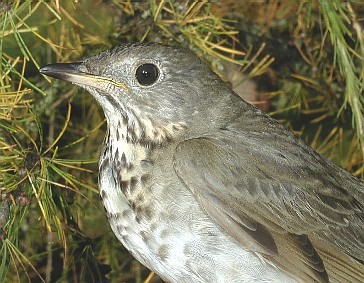
Birds want to arrive as soon as there’s food to eat so they can stake their claim on a nice plot of land to raise a family.  Since the tundra is still frozen, birds that breed there, like the Grey-cheeked Thrush, won’t be coming until around the second week of May.  Louisiana Waterthrushes on the other hand, arrived the beginning of April, as soon as insects were flying along the mountain streams they call home.  Both species know when to depart their wintering grounds based on daylength, honed over thousands of years through natural selection.

Gray-cheeked Thrush

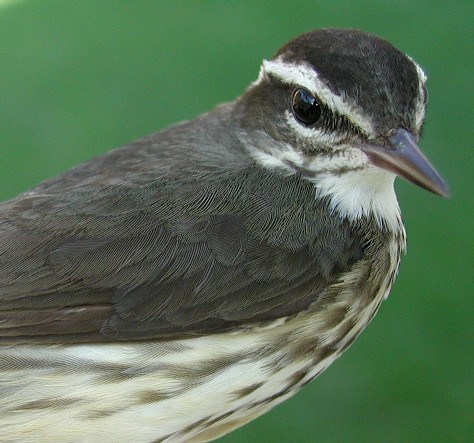
Louisiana Waterthrush

The other thing birds base their decision to leave upon is weather, specifically wind.  And it effects how many migrants might be arriving on a particular day at a particular place.  Put another way, birds’ instincts effect the range of dates they arrive, weather influences the specific dates.

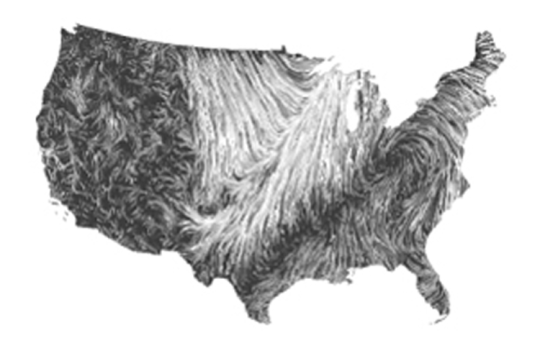
How is wind important? Hawks soar using thermals (warm air rising from heated land masses) or ridges (wind pushed up by ridges). Songbirds on the other hand, migrate at night and fly when the winds are light or are in the direction they are heading (when they literally have a tail wind). Because low pressure systems spin counter-clockwise fall migrants will move after a low front passes in the fall or before a low front arrives in the spring. We like to use Hint.fm wind maps to help predict when and where migrants can move. Besides being informative, these maps show the beautiful complexity of wind patterns.

You might now be wondering how we use these maps. Let’s use Sept 19th, 2012 as an example. At 1pm EST there are light, southerly winds along the eastern seaboard and throughout the Southeast. There are also strong southerly winds in the western part of the Midwest. If you imagine that these patterns will slowly move eastward (say half an inch by sunset) you might predict strong migration for the eastern seaboard, the southeast, and the Midwest.

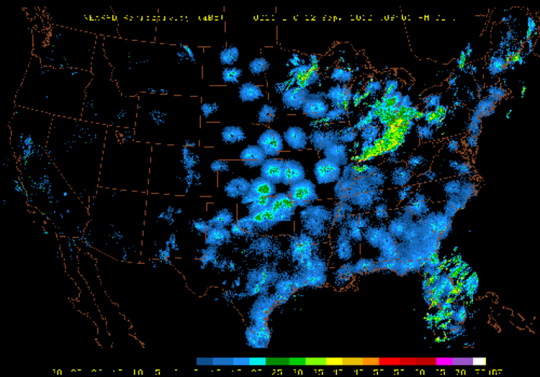
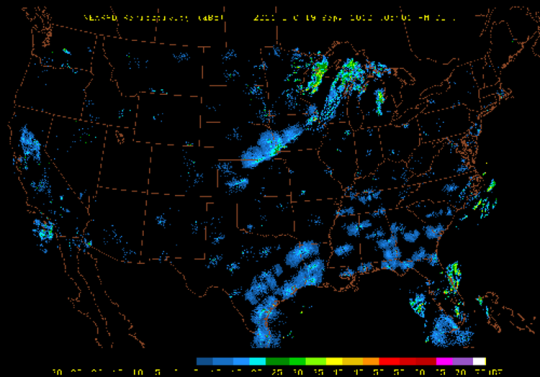
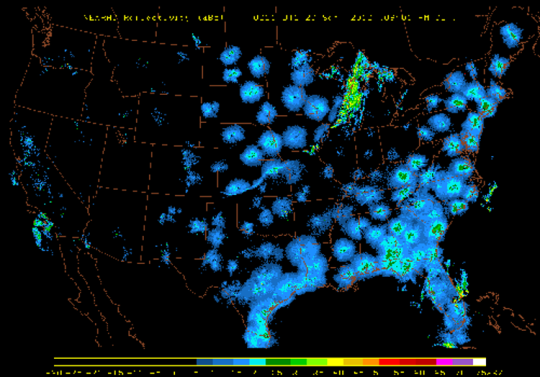
If you made such a prediction you would be right, but you don’t have to take our word for it. It turns out that birds taking off and migrating at night are picked up on radar. Here’s a radar loop from 5pm EST Sept 19th to 1:40am EST Sept 20th. At the very beginning you can see storm systems across Wisconsin and Iowa. As the frames progress you can see intense circular “clouds” appearing across the east, Southeast, and Midwest. These “clouds” are millions of birds taking off after sunset and continuing to migrate throughout the night. They’re circular because they are centered around each radar. We call these appearances “blooms” because they blossom around the radar sites.

Notice that where the storm system is and several hundred miles to the east (about an inch) there aren’t any blooms. That’s because this is the area which is experiencing strong northerly winds. Rather than fighting the headwind, birds in this area are staying put until more favorable winds come through. The winds along the gulf appear to be favorable for a trans-gulf crossing and you can see the clouds of birds take off and begin to move off the gulf coast shoreline (especially Texas). Looking at the longer loop from 3pm EST the 19th to 2pm EST the 20th you can also see birds taking off in Illinois and Iowa after the front has passed through.

What about the spring you ask?  Remember, since the low-pressure systems spin counter clockwise birds migrate ahead of a front.  A few days ago, the night of April 11th, there were southerly winds resulting in good movement northward across the southeastern U.S.  Looking ahead, the next significant warm-up with nightly, light, southerly winds won’t occur until next week, mid-week (around Tuesday April 21st). If piecing together wind patterns and radar isn’t your thing, Cornell Lab of Ornithology has you covered.  They’ve put together something they call BirdCast which puts combines weather, radar, and bird data (ebird) to forecast bird migration for the U.S.

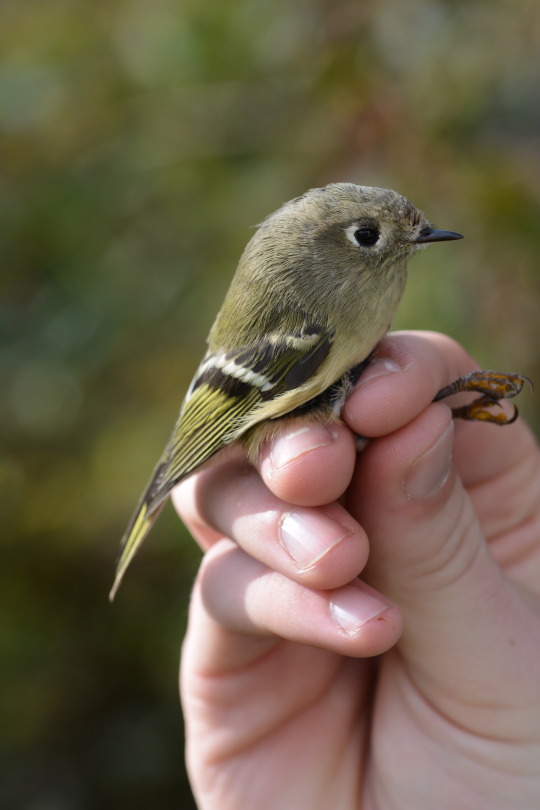
Ruby-crowned Kinglet

We may be quarantined but that doesn’t mean we have to miss the magic of migration.  As I write, there’s a ruby-crowned kinglet singing in a maple across the street.  We can bird, or learn birds, in our backyard or neighborhood.  We can bird a new local patch and contribute what we see to science by logging our sightings into ebird.com.  Over the last few years people in Pennsylvania have found some amazing birds in their own backyard.  A Black-backed Oriole from Mexico, a Painted Bunting which overshot the Carolinas by more than a few states, and even a Bahama Woodstar.  With migration, we never know exactly what we’re going to get.  To me that’s part of the magic.  That, and knowing that it’s time for them to come, carried hundreds or even thousands of miles by their wings and the wind.

Luke DeGroote is the avian research coordinator at Powdermill Nature Reserve, Carnegie Museum of Natural History’s environmental research center. Museum staff, volunteers, and interns are encouraged to blog about their unique experiences and knowledge gained from working at the museum.
Filed Under: Blog Tagged With: Birds, Luke DeGroote, Museum from Home, parc, Science News

April 29, 2020 by wpengine

A Rare New Species for Natural History: Earth System Scientists

Part of Anthropocene science is earth system science, the study of anthropogenic change of whole earth systems–the water systems, geological systems, ecosystems, and atmosphere–and their feedbacks with each other and human society. Historically earth system scientists have been a rare species at natural history museums, because they do not collect organismal specimens or valuable rocks. Instead they collect samples of air, water, microorganisms, and soil. But CMNH recognizes these scientists are key to understanding the Anthropocene and translating it to the public.

image

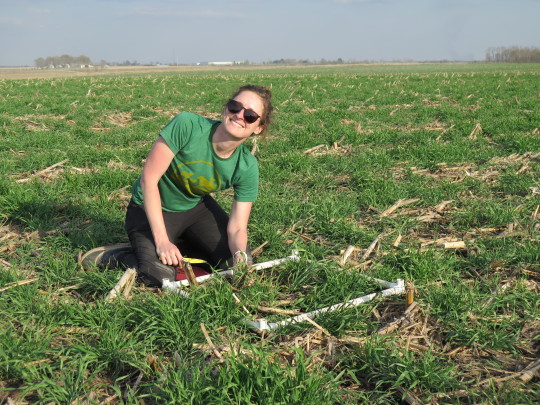
Two earth scientists have recently joined CMNH. Dr. Carla Rosenfeld will be the museum’s first curator of Earth Sciences. Rosenfeld’s work focuses on the microbial ecology of earth systems: how they naturally mediate the vast majority of water and soil chemistry and can be used to remediate pollution. For example, she is testing the potential for fungi to remove toxins from acid mine drainage. 

image

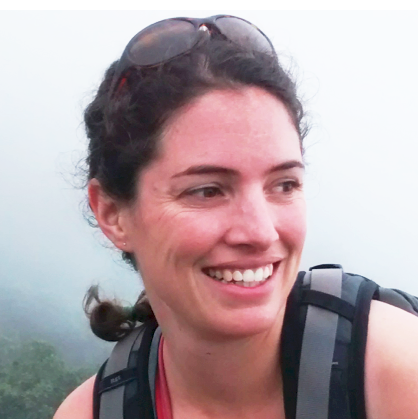
Dr. Bonnie McGill is a science communication fellow with the Climate and Rural Systems Project (CRSP) in the Anthropocene Science Section. With CRSP she is working with rural communities to explore local climate change impacts, identify the social and ecological systems involved, and design community-level actions. Much of her previous work was in the Midwest studying how soil and water conservation in corn and soybean production impacted greenhouse gas emissions and nitrate pollution of rivers.

Bonnie McGill is a Science Communication Fellow at the Carnegie Museum of Natural History. Museum employees are encouraged to blog about their unique experiences working at the museum.

Filed Under: Blog Tagged With: Anthropocene, Bonnie McGill, Carla Rosenfeld, gems and minerals, Museum from Home, Science News

April 29, 2020 by wpengine

“Say Cheese!” – Specimen Imaging in Invertebrate Zoology

“A picture tells 1,000 words.”

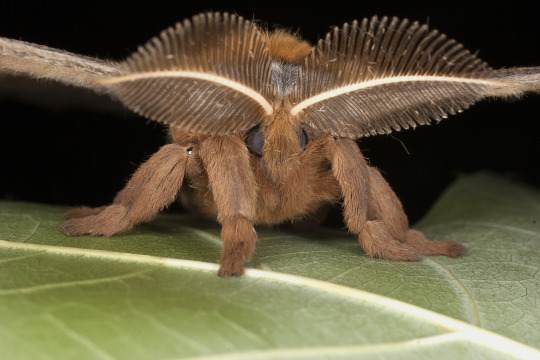
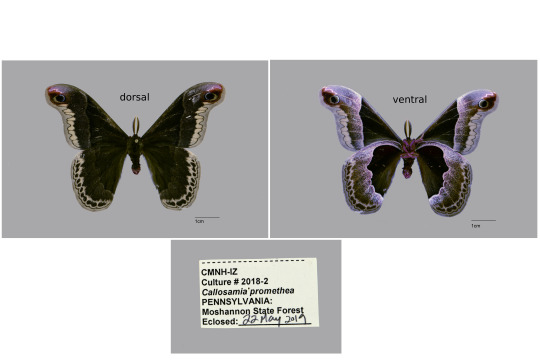
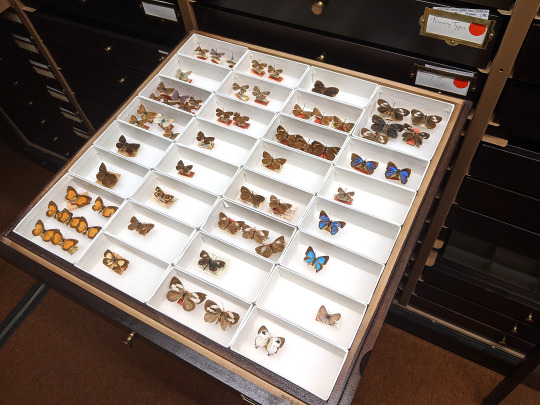
Specimen imaging is a method of documenting specimens in the Invertebrate Zoology collection for research as well as collection maintenance. Digitizing the collection allows it to be more accessible to the scientific community. Specimen-based documentation includes capturing the data from the specimen as well as images of the specimen from different angles. Images of labels serve as a primary data capture that may then be used to populate a database of specimen records.

Most of the imaging currently being done is based on requests from the entomology community needing images of specimens known to be deposited at the Carnegie. There are many historical specimens that are not otherwise imaged but are referenced in older publications. These specimens include cataloged species vouchers referred to as types, or specimens referenced in publications that are of interest to researchers studying those species.  

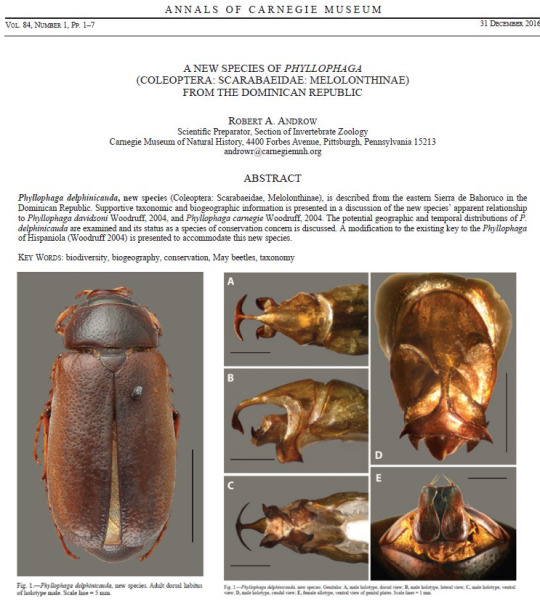
Specimen photography is also essential when discovering new species. When a paper is published describing a new species, images of the designated types are included. The type series includes the series of specimens that were examined and used to describe the new species in detail. These images should be taken with a scale line to show the size of the specimen. Images of prepared dissections are also included.

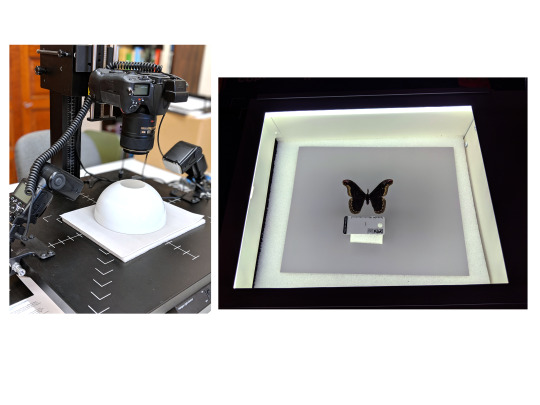
Imaging techniques include using a copy stand, flash lighting, and focus-stacking through software that produces a final high-quality image with all parts of the specimen in focus. A light box may also be used, as an alternative to flash lighting, to provide even lighting and sharp images.  

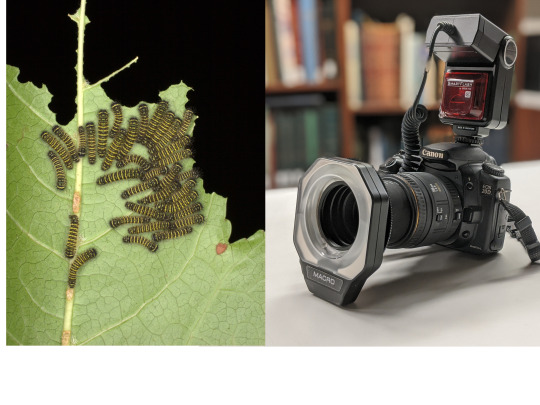
A macro ring flash helps with producing even lighting when imaging live insects that are moving or are very small and need to be really close to the lens.  

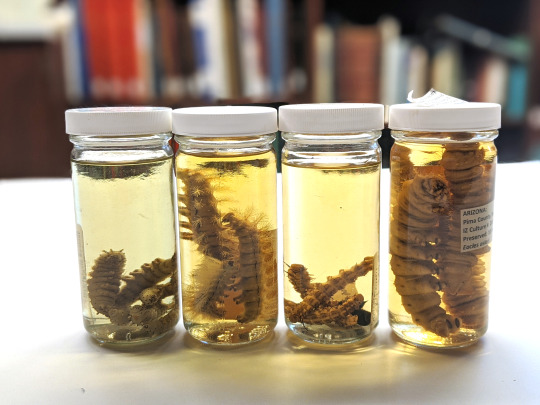
Photographing live specimens that will lose their color when preserved in alcohol, such as caterpillars, is crucial.  Larval images are a major component of the caterpillar collection and are incredibly valuable documentation of larval growth.  Raising caterpillars is a way to document the life history of different species of moths and butterflies, and their associated caterpillars.  Since the caterpillars will be stored in alcohol, the color will be lost in the preserved specimen, but these characteristics will be recorded through high-quality images.  

Several other types of equipment are used to capture images at higher magnification so that characters may be seen in greater detail.  Taking an image through a compound microscope allows one to capture an image that may be used to draw a detailed illustration. An image taken through a Scanning Electron Microscope offers even greater detail. All-together, the image collection is a major component of the archived data that contributes to the understanding of the specimens in the collection. This includes digital files and images on older slide film that still need to be scanned. The digital image collection continues to grow daily, and serves the broader entomological community that needs access to the reference specimens stored in the Invertebrate Zoology collection at the Carnegie.

Vanessa Verdecia is a collection assistant in the museum’s Invertebrate Zoology Section. Museum employees are encouraged to blog about their unique experiences and knowledge gained from working at the museum.
Filed Under: Blog Tagged With: Invertebrate Zoology, Museum from Home, Science News, Vanessa Verdecia

April 29, 2020 by wpengine

What is the Anthropocene and How Does it Relate to Earth Day?

The Anthropocene translates roughly to “human” “times” and it is the proposed current geological period that started when the activities of human beings collectively began to have big impacts on Earth system processes, so much so that it leaves a record in Earth’s geology. While it is hard to untangle when exactly the Anthropocene should start, the leading proposal is around 1950, when human population and technology really started to grow rapidly.

The first Earth Day was organized about 2 decades after the Anthropocene “officially” started. Back then the public was already seeing how much impact humans were having on the planet and they were concerned. In the 1970s, America responded and passed all of our major environmental laws, the Clean Water Act, the Clean Air Act, the Endangered Species Act. Today, 50 years later, we know a lot more about how human activities are changing the planet, including the threat of global climate change. And like those folks celebrating the first Earth Day, we again have the great opportunity to respond and protect what we love.

Stewardship in the Anthropocene

One big question with the Anthropocene is what the heck are we going to do about it? How can we respond? The concept of stewardship is helpful here. Stewardship can be defined in different ways, but generally it refers to the job of ‘caring for the land and species.’   At CMNH a number of our scientists use their research to inform how people can live and care for the land to produce things they want while taking care of nature. We want to find these beneficial land-use and stewardship practices and share them more broadly. If more people can find ways to support the human economy while also protecting the health of ecosystems, the Anthropocene may cease to be a problem.

Examples of Stewardship Research

image

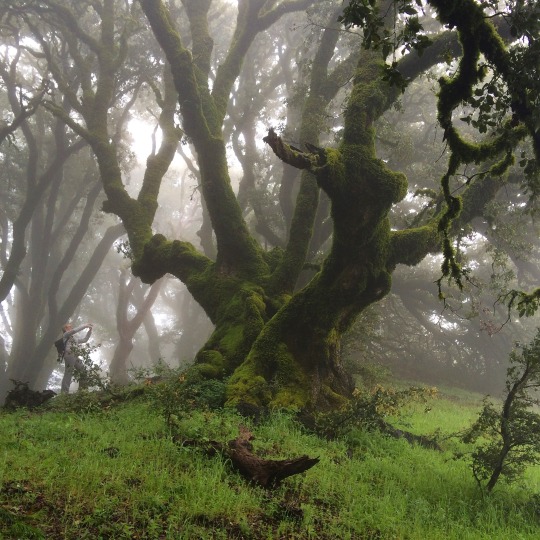
Ancient Canyon Live Oak, Santa Cruz Mountains

Curator of Anthropocene Studies, Dr. Nicole Heller conducts field work in California, where she works to adapt conservation frameworks to better include people and their positive stewardship practices in conservation decision-making. She is working with a group of scientists, farmers, foresters, conservationists, and Indigenous tribes to map and monitor all the different stewardship practices on the landscapes and understand how those practices work together to affect ecological and social health.

Curator of Amphibians and Reptiles, Dr. Jennifer Sheridan, conducts field work in Borneo, where she works with a consortium of scientists and a large palm oil producer to assess how spatial arrangement of forest and plantation can maximize biodiversity conservation. Because deforestation for oil palm plantation is the largest driver of deforestation in this biodiversity hotspot, such partnerships are critical to effective conservation.

Curator of Birds, Chase Mendenhall is a leader in establishing methods for monitoring changes in biodiversity and quantifying factors that enhance re-diversification of human-disturbed landscapes. This work has largely been conducted in Costa Rica.

image

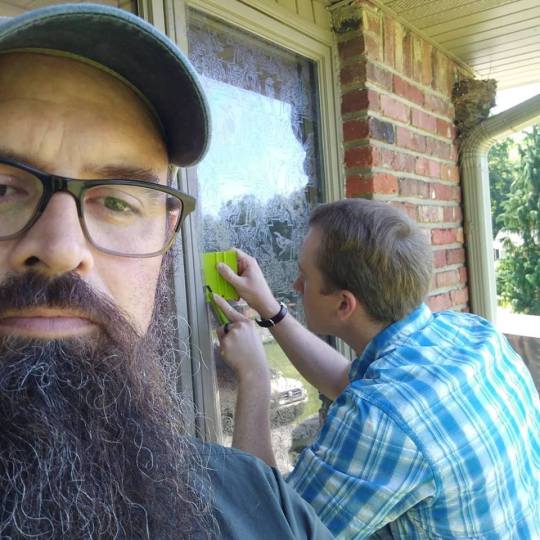
Matt Webb and Jon Rice installing decorative bird safe window film. 

Since 1961, Powdermill Avian Research Center (PARC) staff have operated one of the North America’s best bird banding programs, recording the timing of bird migration and a broad variety of life history and ecological attributes of migrating birds. PARC uses their data on birds to inform a wide variety of stewardship actions across the landscape to help birds survive. In one project, PARC works jointly with the American Bird Conservancy and select industrial partners to develop window glass that birds can see and avoid collisions.

Nicole Heller is Curator of Anthropocene Studies at the Carnegie Museum of Natural History. Museum employees are encouraged to blog about their unique experiences working at the museum.

Filed Under: Blog Tagged With: Anthropocene, Museum from Home, Science News

April 29, 2020 by wpengine

A Century Ago, a Donor Walked into the Carnegie Museum

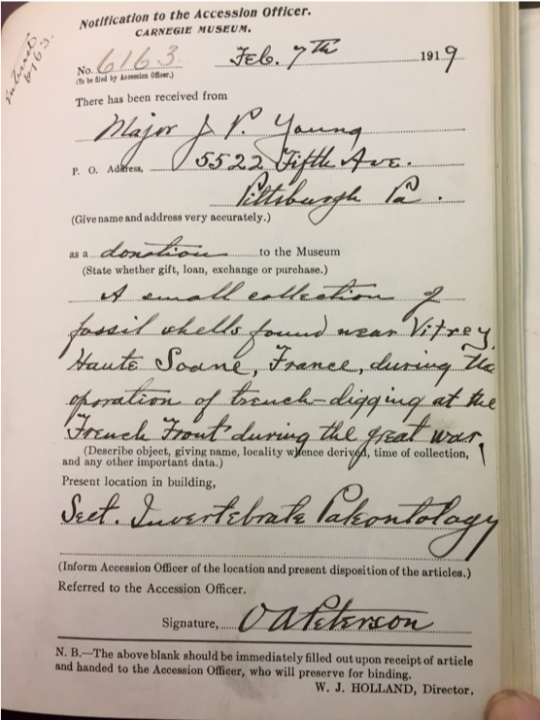
Figure 1:  Accession #6163, Donated By Major J.P. Young

What could have inspired someone to arrive at the Carnegie Institute, on a cold winter day to donate a small collection of fossils found while serving in World War I, less than a month after returning to the United States?

Albert D. Kollar, Collections Manager for the Section of Invertebrate Paleontology at the Carnegie Museum of Natural History, discovered this mystery while undertaking a multi-year project to take a fresh look at the Baron de Bayet Collection, a collection of 130,000 fossils purchased by Andrew Carnegie in 1903.   While looking at the trilobites, an extinct group of arthropods, Albert noticed a few specimens missing the characteristic “BH” letters and/or labels that typically identify the Bayet collection. After some detective work, Albert uncovered evidence of a previously unknown collection, “a small collection of fossil shells,” from France, that had been donated by a “Major J.P. Young” in 1919. (Figure 1).

Major Young, born in 1873 in Middletown, Ohio, developed a love of collecting early in life, spotting artifacts from indigenous cultures of North America, while working as a surveyor, for the Pennsylvania Railroad. His connection to Pittsburgh was further strengthened by his marriage to Margaret Young Oliver, daughter of George T. Oliver, industrialist and United States Senator from Pennsylvania. After World War I, John and Margaret settled in Ithaca, New York, where John was affiliated with his alma mater, Cornell University, for the remainder of his life.  From 1925-1935, he painstakingly illustrated eight volumes of diatoms, single celled algae with sharp exterior coatings made of silica. Many of these illustrations were published by Dr. Mathew Hohn in 1951. During World War II, John Young volunteered as a “dollar a year man;” so that a Cornell staff member could serve in the war effort. After the war, he returned to his fascination with indigenous artifacts when he reorganized the Seneca and Cayuga collections of the DeWitt Museum in Ithaca, New York. But his longest tenure of service involved the Cornell Paleontological Research Institution (PRI), which he joined in 1934. He served as president from 1941-43 and remained active until his death in 1957. Fellow members of the PRI described him as “scholarly and pleasant” in a memorandum published after his passing.

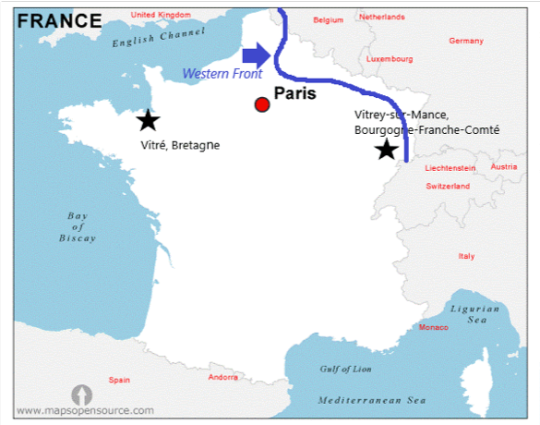
Which brings us back to those fossils. In 1917, at age 44, John Paul Young joined the United States Army, and was tapped to lead the 5th Trench Mortar Battalion, a unit of 600 soldiers. Sometime between September and November of 1918, while managing his soldiers’ cold, thirst, hunger, and conditions such as “trench foot,” a complication from extreme wetness and cold that could turn a soldier’s foot into a gangrenous mass, Major Young  uncovered the trilobite fossils during the excavation of trenches under his command. The construction of a World War I trench is shown in real time in the first 17 minutes of the movie, 1917.   After this blog’s original release, Albert watched 1917 on the big screen in January 2020 to gain an appreciation of the difficulty in trench construction shoring the walls with wood, tin, and wire while a battle takes place.  To Albert’s amazement the process of digging a 7-foot-deep trench to the top of the parapet out of brown mud and brown colored rock, closely matches the Major’s accession description (Fig. 1) and fossil colors (Fig. 4). The Major noticed fossiliferous rocks at the bottom of a trench along the Western Front in Vitrey-sur-Mance, France (Figure 2). Intrigued to find fossils in a trench, the Major collected and then later donated them to the Carnegie Institute in 1919.

Figure 2: French Locations of Carnegie Trilobites

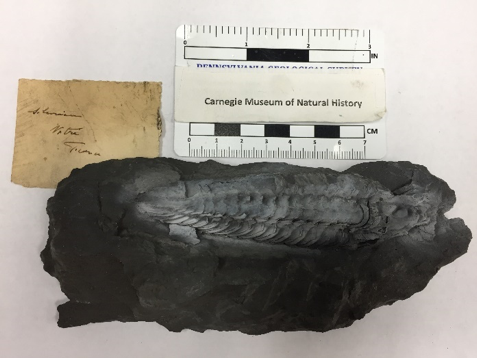
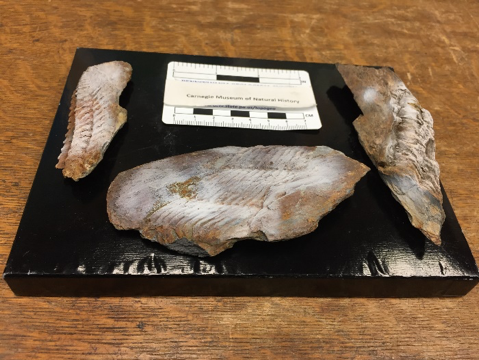
This fall, Albert travelled to Paris to visit the Muséum national d’Histoire naturelle in Paris seeking to uncover this 100-year-old French trilobite mystery. Albert met with Dr. Sylvain Charbonnier, Collections Manager of Invertebrate Paleontology at the Muséum to discuss this puzzle. Albert’s query is to verify the genus, species, age, and stratigraphic locality of these trilobites. At this point, his preliminary research indicates that the Bayet trilobites are distorted and preserved in a black siltstone rock, that Albert recently coated with a white salt to enhance the fossil detail (Figure 3). In contrast, the three trilobites without labels possibly attributed to Major Young (see Figure 4) are also distorted; but preserved in a brown iron color siltstone. The iron oxide coating gives them a reddish appearance. They too are coated with a whitish salt to enhance detail.

Figure 3: Sample of a Bayet Trilobite from Vitré

Figure 4: Trilobites From Major Young Donation

An established paleontological collecting method, crucial to the identification of specimens, is to know the exact placement of the fossil to the stratigraphic locality (rock layer) which can support a known geologic age verified in the Geologic Time Scale. If someone makes a collection, such as the Baron de Bayet, and a paper label is preserved (Figure 3) then, Albert must confirm through paleontology literature and the geologic map of France, all known stratigraphic localities in the region for evidence of similar trilobites. For example, the Vitré label in Figure 3, establishes the location for this trilobite as Bretagne in the northwest of France. To ascertain the proper locality of the Major’s donation (Figure 4), we assume at this point, that it is from Vitrey-sur-Mance in the northeast of France; but further research is planned to resolve the exact location of the of the trenches that the Major occupied in World War I.

Following the advice of Dr. Charbonnier, Albert will proceed to digitize all 50 plus trilobites and send these images and other documentation to the Paris Muséum for further review. While we await the results, the fact that the fossils are sparking a new vein of research is probably exactly what the Major had hoped for all along.

Joann Wilson is the Interpreter for the Department of Education and Volunteer for the Section of Invertebrate Paleontology at CMNH and Albert Kollar is the Collections Manager for the Section of Invertebrate Paleontology. Museum staff, volunteers, and interns are encouraged to blog about their unique experiences and knowledge gained from working at the museum.
Many thanks to the fabulous Carnegie Library of Pittsburgh staff, with special acknowledgment to Carnegie Museum Library Managers, Xianghua Sun and Marilyn Cocchiola Holt, and Carnegie Reference Librarians Joanne Dunmyre and Leigh Anne Focareta. Special thank you to Peter Corina at the Kroch Library, Division of Rare and Manuscript Collections at Cornell University.    

Filed Under: Blog Tagged With: invertebrate paleontology, Museum from Home, Science News

  • « Go to Previous Page
  • Page 1
  • Interim pages omitted …
  • Page 37
  • Page 38
  • Page 39
  • Page 40
  • Page 41
  • Interim pages omitted …
  • Page 43
  • Go to Next Page »

sidebar

About

  • Mission & Commitments
  • Directors Team
  • Museum History

Get Involved

  • Volunteer
  • Membership
  • Carnegie Discoverers
  • Donate
  • Employment
  • Events

Bring a Group

  • Groups of 10 or More
  • Birthday Parties at the Museum
  • Field Trips

Powdermill

  • Powdermill Nature Reserve
  • Powdermill Field Trips
  • Powdermill Staff
  • Research at Powdermill

More Information

  • Image Permission Requests
  • Science Stories
  • Accessibility
  • Shopping Cart
  • Contact
  • Visitor Policies
One of the Four Carnegie Museums | © Carnegie Institute | Privacy Policy | Terms of Use | Accessibility
Rad works here logo