• Skip to primary navigation
  • Skip to main content
  • Skip to primary sidebar

Carnegie Museum of Natural History

One of the Four Carnegie Museums of Pittsburgh

  • Visit
    • Buy Tickets
    • Visitor Information
    • Exhibitions
    • Events
    • Dining at the Museum
    • Celebrate at the Museum
    • Powdermill Nature Reserve
    • Event Venue Rental
    • Gift Cards
  • Learn
    • Field Trips
    • Educator Information
    • Programs at the Museum
    • Bring the Museum to You
    • Guided Programs FAQ
    • Programs Online
    • Climate and Rural Systems Partnership
  • Research
    • Scientific Sections
    • Science Stories
    • Science Videos
    • Senior Science & Research Staff
    • Museum Library
    • Science Seminars
    • Scientific Publications
    • Specimen and Artifact Identification
  • About
    • Mission & Commitments
    • Directors Team
    • Museum History
  • Tickets
  • Give
  • Shop

Blogs from our Scientific Researchers

Carnegie Museum of Natural History is home to active research and vast scientific collections. Our scientific researchers regularly contribute to the blog at the museum.

January 31, 2023 by Erin Southerland

Groundhog Day 2023

by John Wible

January 21, 2023 was Squirrel Appreciation Day! With Groundhog Day, which commemorates our most famous squirrel, Punxsutawney Phil, right around the corner, I thought it appropriate to celebrate squirrels with this blog.

Rodents are the most diverse lineage of living mammals with more than 2,500 species, which represents nearly 40% of the species diversity of living mammals. Squirrels (Sciuridae) are one of 36 families of living rodents. There are nearly 300 species of squirrels found in the Americas, Eurasia, and Africa; a few squirrels have been introduced into Australia by humans. Broadly speaking, there are three main types of squirrels: tree, ground, and flying. Tree and ground are descriptive of their main habitats; flying squirrels also inhabit trees but are so called because of their unique locomotory pattern, which actually isn’t flying but gliding! Regarding their evolutionary relationships, all flying squirrels are more closely related to each other than to other squirrels, supporting a single origin of gliding in their common ancestor. The tree and ground squirrels do not show the same pattern; all ground squirrels are not each other’s closest relatives and the same is true of all tree squirrels. The fossil record (see text below) supports tree life as the earliest squirrel habitat, with multiple episodes of ground invasion from the trees.

In Pennsylvania, we are fortunate to have seven native species of squirrels (two ground, three tree, and two flying). You can learn more about Pennsylvania mammals at our website: https://mammals.carnegiemnh.org/pa-mammals/

Allegheny County has six of the seven PA squirrel species: the two ground squirrels (the Eastern chipmunk, Tamias striatus, and the groundhog, Marmota monax); the three tree squirrels (the gray squirrel, Sciurus carolinensis, the fox squirrel, Sciurus niger, and the red squirrel, Tamiasciurus hudsonicus); and one of the two flying squirrels (the Southern flying squirrel, Glaucomys volans). Depending on where you are in Allegheny County, you may see all six squirrels, although the Southern flying squirrel is likely the most elusive because of its nocturnal (nighttime) activities.

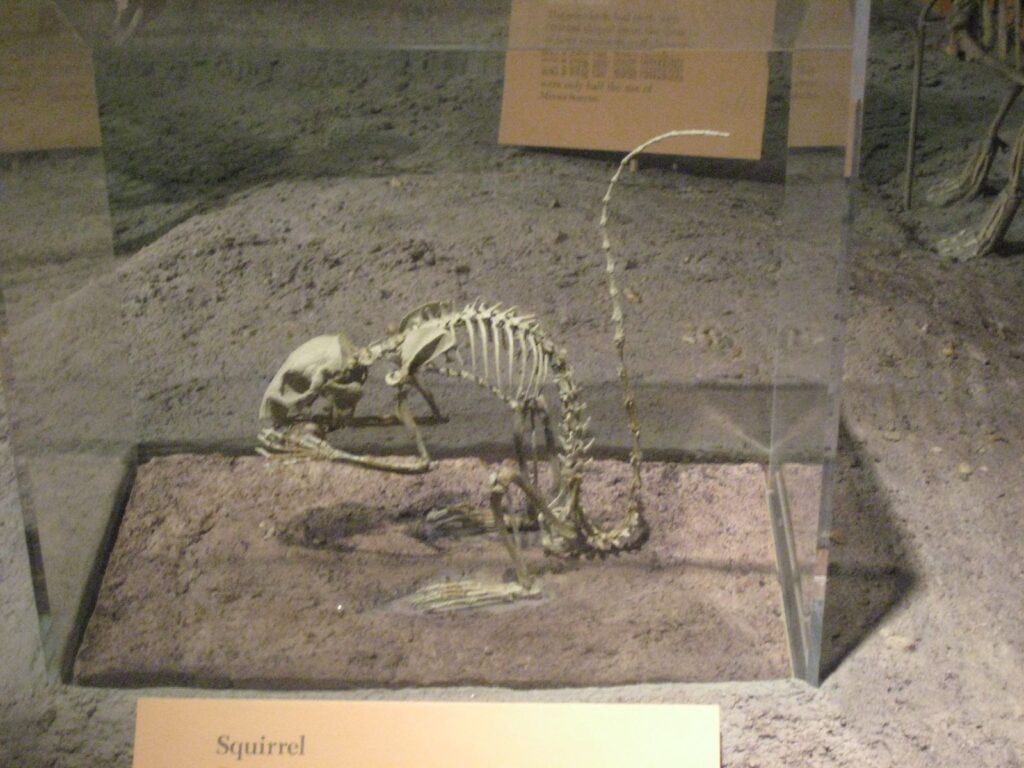
Squirrels have a long evolutionary history. The oldest fossils identifiable as squirrels first appeared around 34 million years ago in western North America, all showing adaptations to tree life. One of these, Protosciurus, is on display at the Smithsonian in Washington, D.C. (see below). Its skeleton is remarkably like those of living gray squirrels, both in size and morphology. Given that this remarkable similarity occurred over 30 million years of geological time, scientists consider our gray squirrel and tree-adapted relatives to be living fossils, that is, not dramatically changed compared to their very ancient relatives.

Reconstruction of the skeleton of Protosciurus on display at the Smithsonian’s National Museum of Natural History in Washington, D.C. Image credit: Claire H. from New York City, USA, CC BY-SA 2.0 https://creativecommons.org/licenses/by-sa/2.0, via Wikimedia Commons

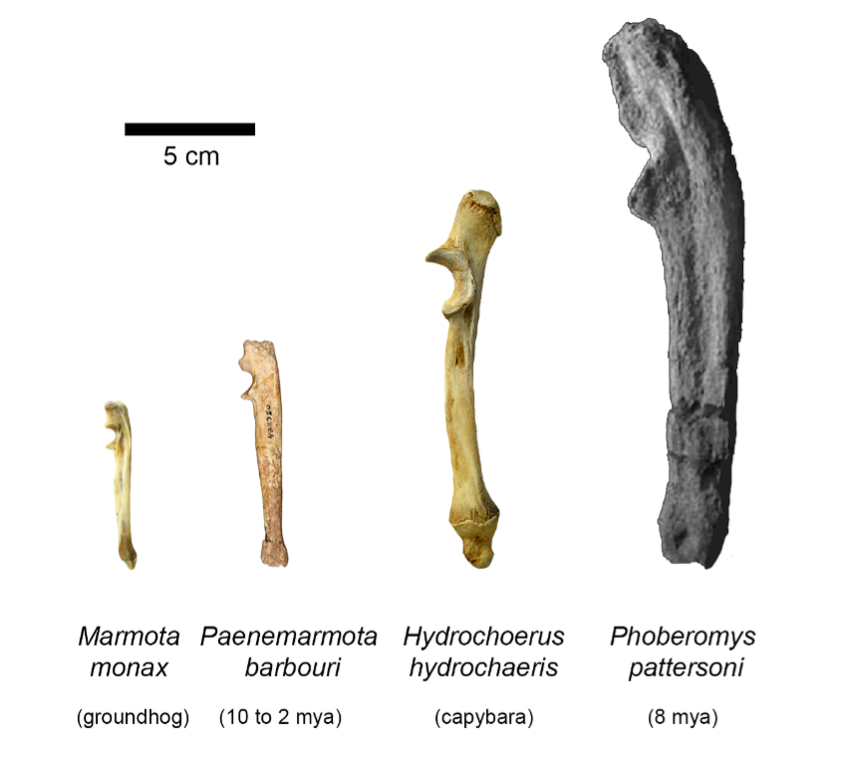
Most rodents are small mammals; think mice and their relatives. Punxsutawney Phil is the second largest living squirrel; his cousin, the hoary marmot, Marmota caligata, from the Pacific Northwest is slightly larger, with adult males typically over 20 pounds. There was a larger ground squirrel that lived in western North America between 10 and two million years ago, Paenemarmota, a Latin name that translates to “almost a marmot.” Some of my colleagues have called it the “giant marmot,” which should be taken with a gigantic grain of salt! Below is an image of four ulnae, one of the two bones in the forearm. On the left is the living groundhog and next to it is the “giant marmot.” Anatomically, the bones are nearly identical, with one a little larger than the other. Weight estimates for the “giant marmot” are around 35 pounds. Yes, that is big for a squirrel, but not compared to some truly giant rodents. Next to the “giant marmot” is the ulna of the largest living rodent, the semiaquatic Central and South American capybara, Hydrochoerus, which translates to “water pig.” Capybaras, which can grow to nearly 150 pounds, are related to guinea pigs! But wait, there is more. Capybaras pale in comparison to the largest rodent that ever lived. The 8-million-year-old Proberomys from Venezuela was estimated to be the size of a large African antelope at 300 to 550 pounds. Yikes, now that is a giant guinea pig.

Ulna (forearm bone) of select living and extinct rodents.

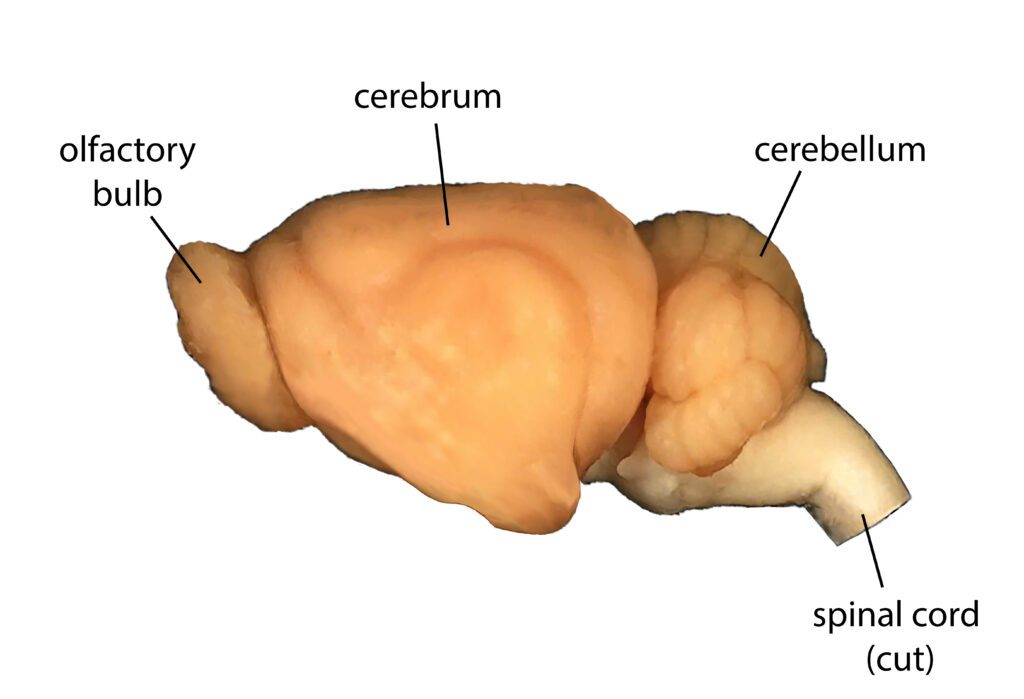
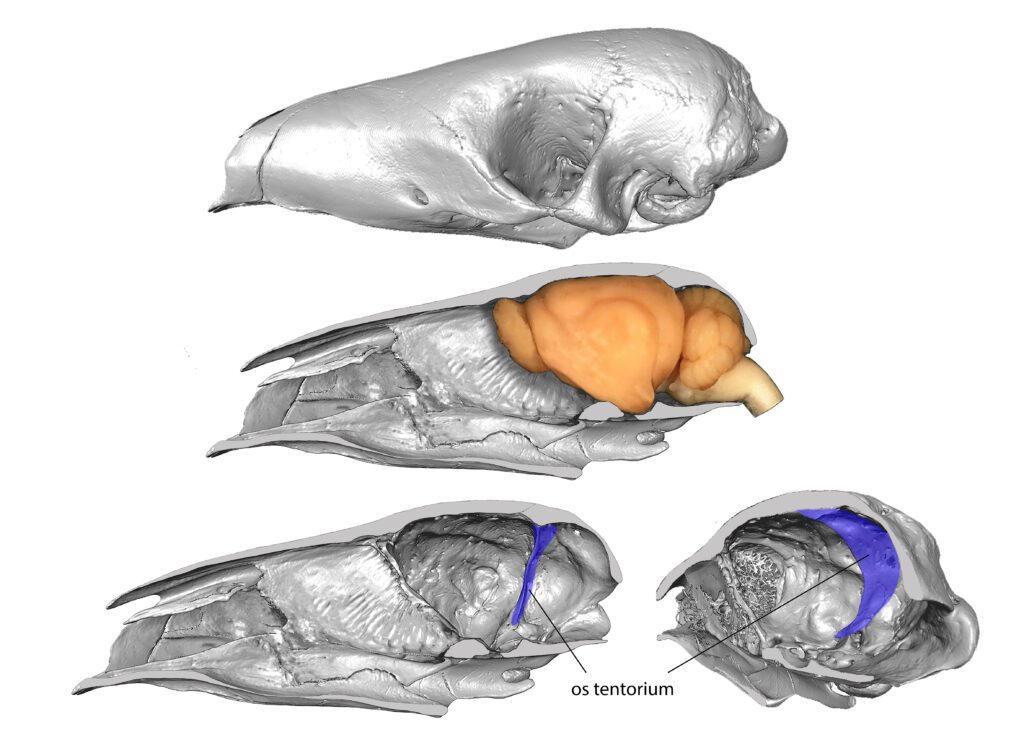
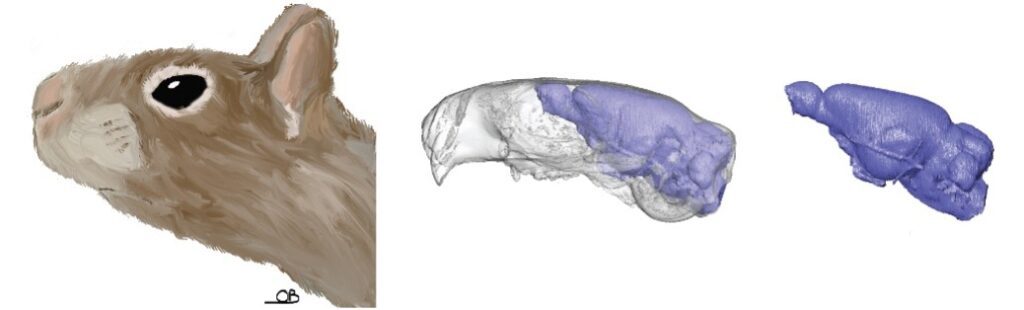
Recently, one of my colleagues, Ornella Bertrand from the Universitat Autònoma de Barcelona, Spain, and coauthors have studied the evolution of the brain in squirrels. From CT scans of fossil skulls (see images below), they were able to recreate various parameters of the brain, including the relationship between brain size and body size. They found that squirrels living in trees had larger brains to their body size than other squirrels, that life in the complex arboreal environment was a driver of brain evolution in squirrels. The result of this evolutionary story for us may be that we will always be hard pressed to build a bird feeder that those big-brained tree squirrels can’t get into!

Images courtesy of Ornella Bertrand. Middle, skull taken from CT scans of the 32-million-year-old fossil squirrel Cedromus wilsoni from Wyoming with the blue indicating the reconstructed brain, shown separately to the right; left is Ornella’s reconstruction of the animal’s head. For 3D models made by Ornella Bertrand and more, see https://ornellabertrand.wordpress.com/3d-models/

John Wible, PhD, is the curator of the Section of Mammals at Carnegie Museum of Natural History.

Related Content

Groundhog as Archaeologist

Groundhog Architecture

Groundhog with a Malocclusion

Carnegie Museum of Natural History Blog Citation Information

Blog author: Wible, John
Publication date: January 31, 2023

Share this post!

  • Share on Twitter Share on Twitter
  • Share on Facebook Share on Facebook
  • Share on Pinterest Share on Pinterest
  • Share on LinkedIn Share on LinkedIn
  • Share on Reddit Share on Reddit
  • Share via Email Share via Email

Filed Under: Blog Tagged With: Hall of North American Wildlife, John Wible, mammals, Science News

January 6, 2023 by Erin Southerland

2022 Rector Christmas Bird Count Results

by Annie Lindsay
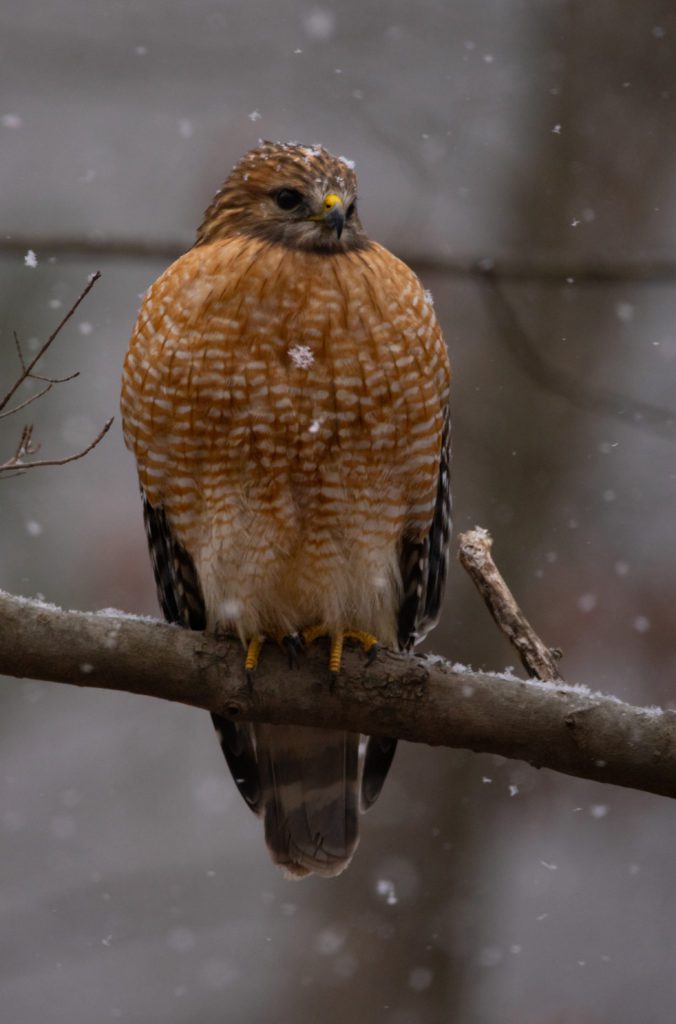
Red-shouldered Hawk. Image credit: Brady Karg

On the morning of December 17, 2022, 41 birders assembled at Powdermill Avian Research Center to receive the maps and datasheets for the sectors they’d be visiting for the annual Rector Christmas Bird Count (CBC). During the CBC, participants identify and tally every bird they see or hear within a pre-established 15-mile-diameter circle on a selected day between December 14 and January 5. The Rector count was established in 1974, but the history of the CBC extends back to 1900, when a small group listed birds in 25 count circles on Christmas Day. Now sponsored by the National Audubon Society, the CBC has expanded to include nearly 3,000 circles throughout the Western Hemisphere. The CBC welcomes birders of all skill levels and is one of the largest and longest-term community science projects. 

The Rector count’s center point is just northwest of Powdermill Nature Reserve, and encompasses a variety of habitats including the ridge-top forests of Chestnut Ridge, Laurel Summit State Park, Laurel Mountain State Park, and Forbes State Forest, the mountain stream valleys and hillsides of Linn Run State Park and Powdermill Nature Reserve, two lakes that often attract migrating or overwintering waterfowl, and rolling farmland interspersed with small towns. This habitat variety means that species diversity can be quite high, and since 1974, birders have tallied 131 species in the Rector circle. 

Last year, warm weather extended far into the fall, and the Rector count recorded high totals of many species that we would normally expect to spend the winter a bit further south. This year, however, the fall weather was more typical of southwestern Pennsylvania, and temperatures on the day of the count hovered around freezing as large, fluffy snowflakes fell throughout the morning. The day began early as a few ambitious birders searched for owls before dawn, finding eight Eastern Screech Owls. By dawn, all participants headed to their sectors to count diurnal birds, while an additional eight birders counted what they saw and heard in their yards and visiting their feeders. As dusk fell, CBC participants met at Powdermill for a tally dinner, an evening of camaraderie and sharing stories from the day. Although the species total was only 59, which is slightly below average, individual numbers for each of these species were typical. A few, including Wild Turkey, Bald Eagle, Red-shouldered Hawk, Winter Wren, and Eastern Bluebird even saw new high-count records. 

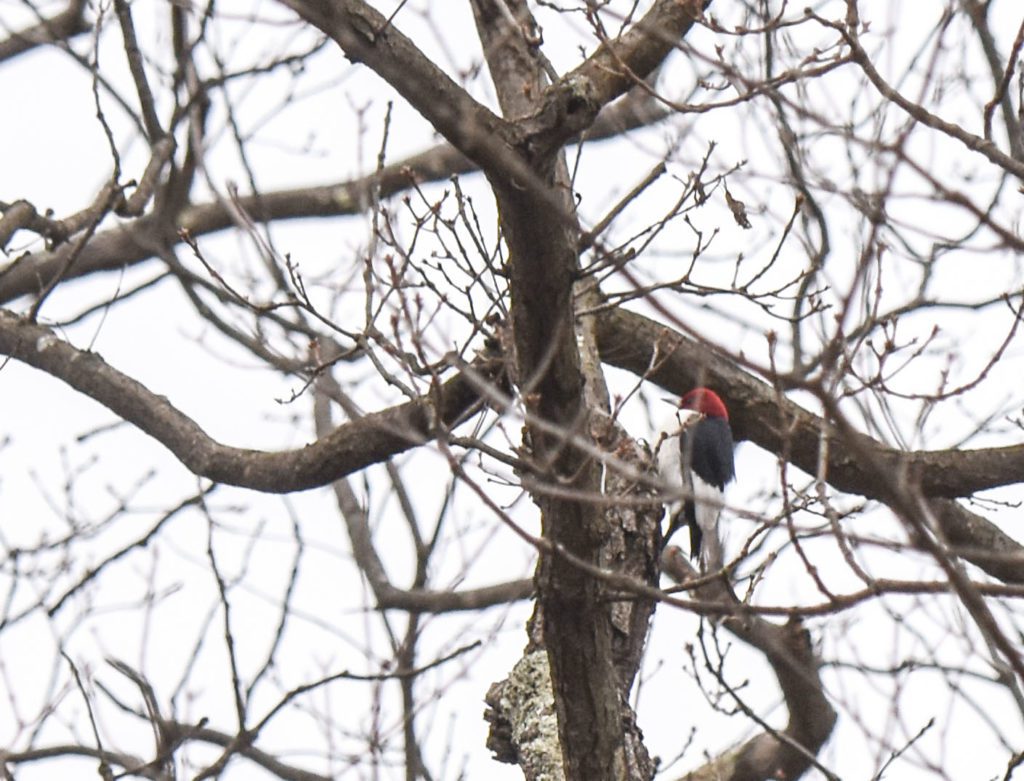
Red-headed Woodpecker. Image credit: Tom Kuehl

For the fifth year in a row, participants found Red-headed Woodpeckers during the count. This species is difficult to find in southwestern Pennsylvania, and the Rector count circle is one of the only reliable places to encounter them. A favorite of birders, this bold, color-block-patterned woodpecker always delights those lucky enough to spot one.

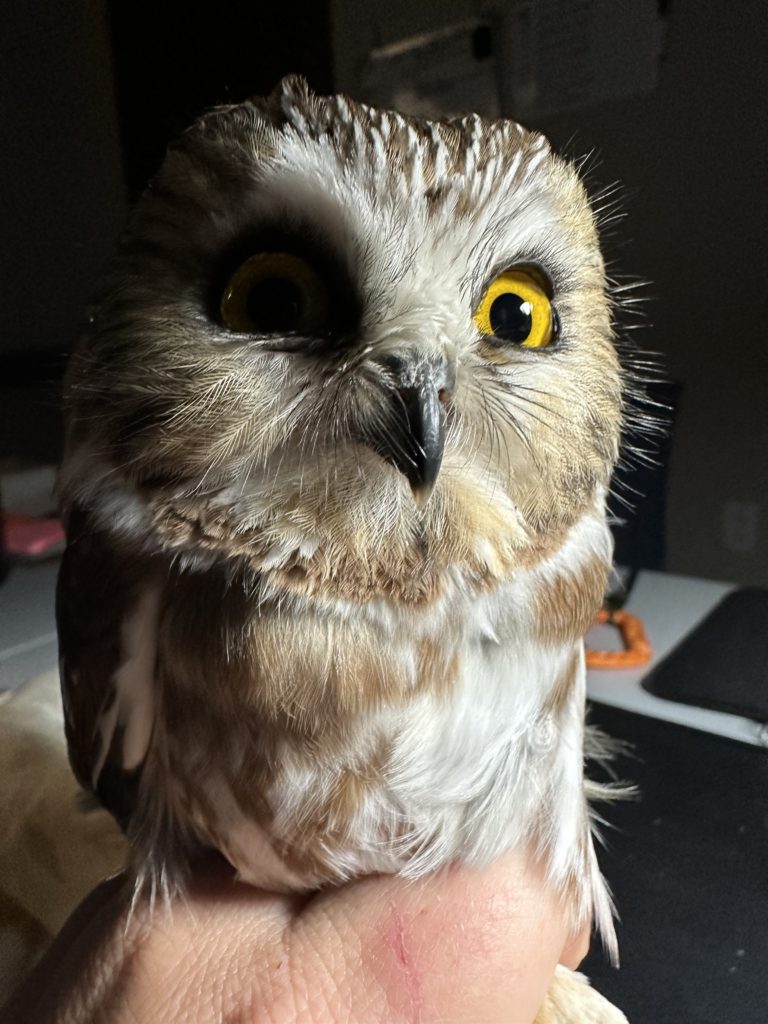
Northern Saw-whet Owl

One of the most exciting sightings of this year’s count, and the last bird encountered for the day, was a Northern Saw-whet Owl spotted near Powdermill’s nature center just as the tally dinner ended. Northern Saw-whet Owls are found in southwestern Pennsylvania primarily during fall migration, but some overwinter here, and there is evidence that a few pairs may breed locally. Saw-whets are small and do not vocalize as readily as most of the other owls, which make them difficult to find. This fall, Powdermill’s ornithologists caught and banded 99 of these tiny owls, nearly a high fall record! As the 2022 Christmas Bird Count season wraps up, we’re already looking forward to 2023. Thank you to all participants for spending the day searching every corner of the count circle looking for birds, and to all landowners for granting participants access to their properties for a much more thorough and complete count.

Related Content

2021 Rector Christmas Bird Count Results

Milestones at Powdermill’s Banding Lab

Holiday Stowaway: Northern Saw-whet Owl

Carnegie Museum of Natural History Blog Citation Information

Blog author: Lindsay, Annie
Publication date: January 6, 2023

Share this post!

  • Share on Twitter Share on Twitter
  • Share on Facebook Share on Facebook
  • Share on Pinterest Share on Pinterest
  • Share on LinkedIn Share on LinkedIn
  • Share on Reddit Share on Reddit
  • Share via Email Share via Email

Filed Under: Blog Tagged With: Annie Lindsay, Birds, Powdermill, Science News

December 7, 2022 by Kathleen

A New Building at Powdermill

by Luke DeGroote

On a crisp fall morning, 30 minutes before the sun rises, the bird banding crew at Powdermill Avian Research Center (PARC) are hard at work setting up the mist nets for a typical day. As the dewdrops fall from the nets and the birds call, everything seems as normal as it has since 1961, but something is different. For the first time, the birds will be processed in a new location. PARC has finally established a new home.

On September 30, 2022, we celebrated the Grand Opening of the Richard P. Mellon Avian Research Center. This new facility is a great leap ahead for PARC that will allow us to continue conducting our avian research as we have since 1961, while also providing new opportunities for outreach, additional research projects, and more efficient data collection. A 60-second video tour provides visual orientation to the facility.

View this post on Instagram

A post shared by Powdermill Nature Reserve (@powdermillnaturereserve1956)

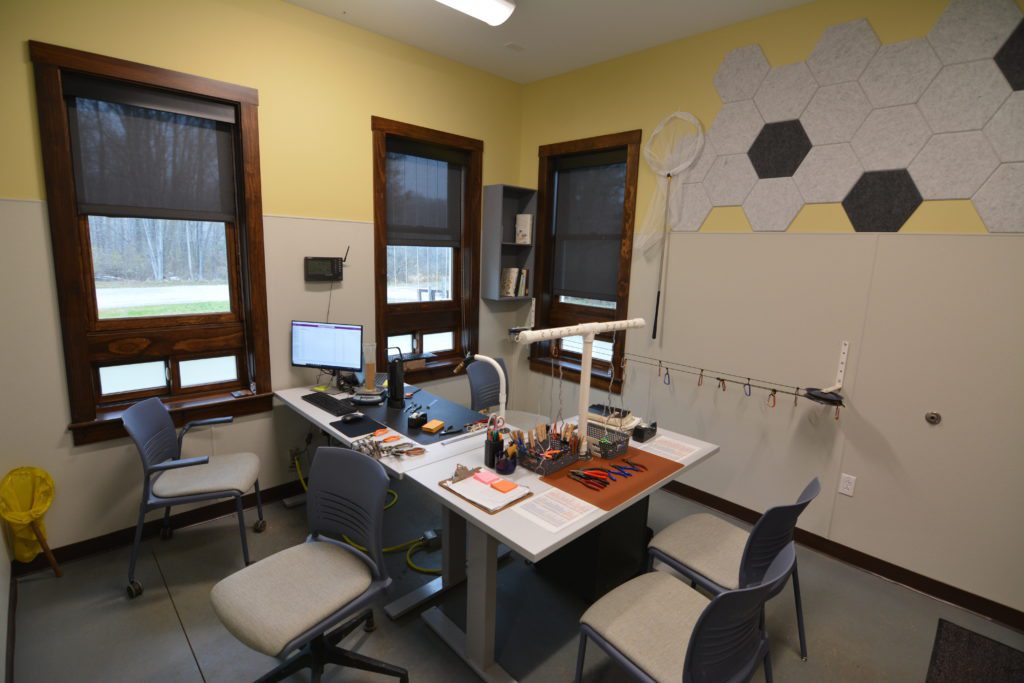
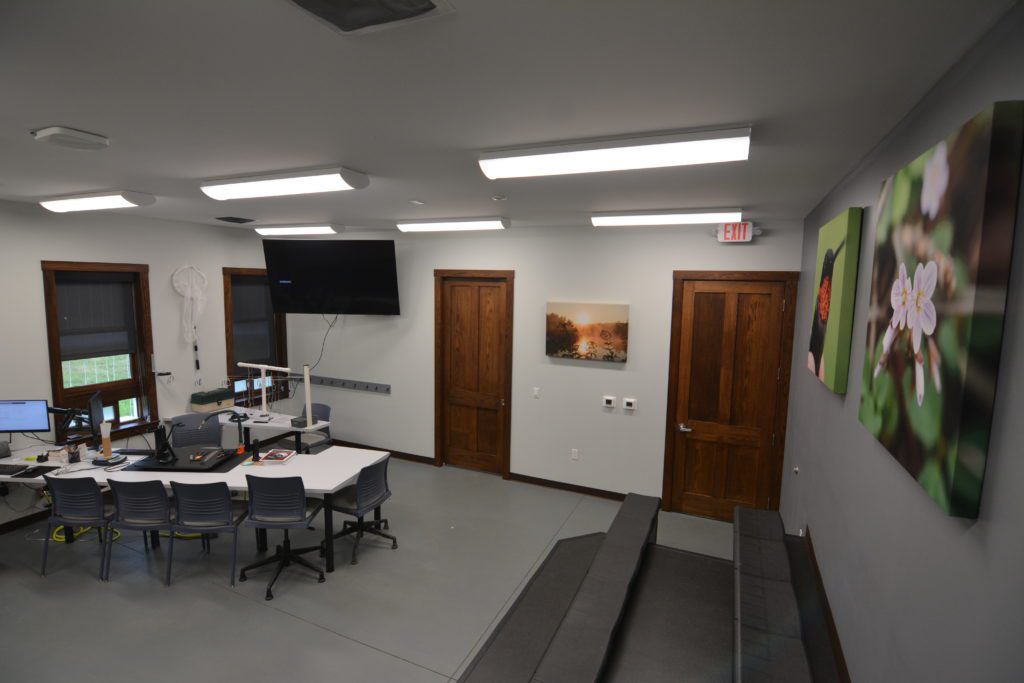
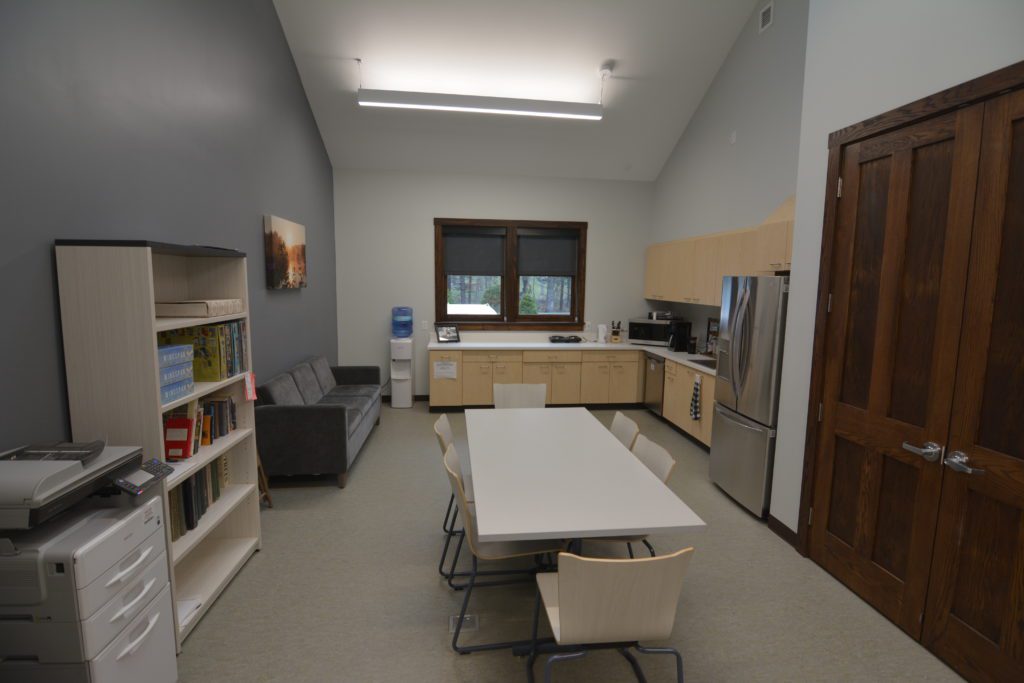
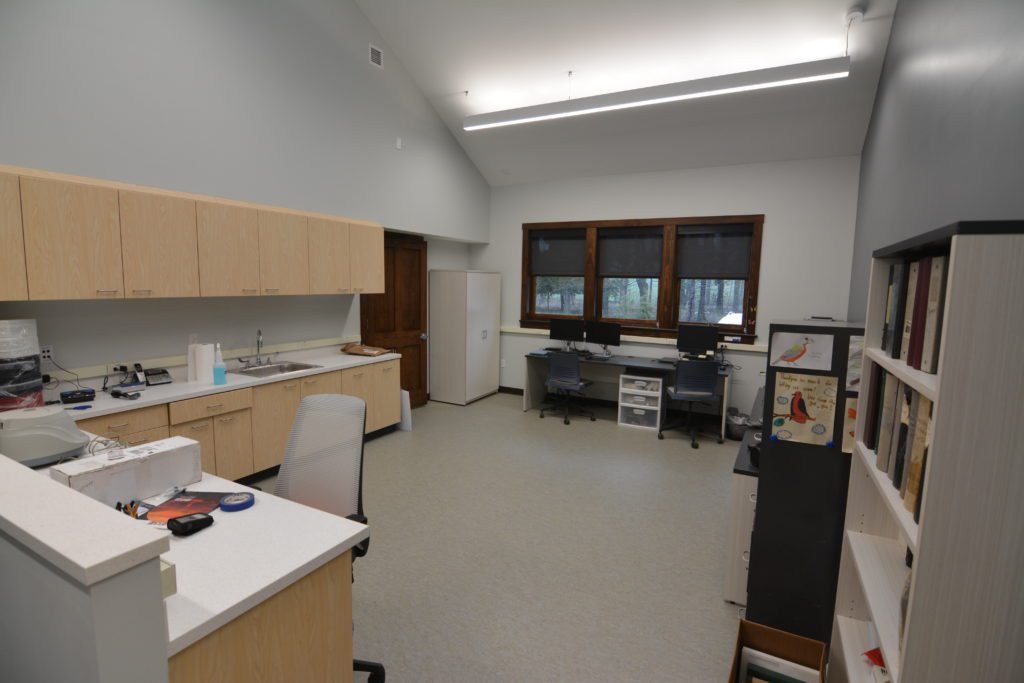
So, what’s inside? The new building consists of a bird holding room, research lab, seminar space, kitchen/lounge, offices, a multi-use lab space, and an observation deck.

Bird Holding Room: This space is used by the bird banding techs. It allows easy access to the bird bags, radios, and carabiners, and has spaces for the birds to await their turn to be processed in the lab. The addition of this room frees up lab space and prevents the processor, recorder, and bird banders from being interrupted while collecting data.

room with an l-shaped desk with bird banding equipment on it

Research Lab: This room mirrors the original setup in the old building. Birds are banded and processed here on a day-to-day basis. PARC’s bird banders have captured and processed over 800,000 birds with many more to come in the lab’s future.

Seminar Space: This classroom space will now allow large groups to visit us for field trips, open houses, and guided tours. This space has a similar setup to the research lab with the addition of lecture-style seating and a video screen that allow groups to see bird banding up close and learn about PARC’s many avian research projects.

Kitchen/Lounge: This is a much-needed space where we can fuel up on coffee for our early mornings or late nights, or where workshop participants can take a snack break. It’s also a fantastic place to play our favorite board game (Wingspan, of course).

Lab: This multi-use space has proved to be a great addition for PARC staff and collaborators. There are desks and computers for the Avian Outreach Tech, Flight Tunnel Tech, and visiting researchers. The space is also utilized for data proofing and ongoing research projects.

Although the move from the original building was bittersweet, we are so thrilled to continue conducting avian research from this new space. Thank you so much to everyone who helped this new building come to life. The opportunities with this new building are endless.

Luke DeGroote is Avian Research Coordinator at Powdermill Nature Reserve, the museum’s environmental research center.

Related Content

An Intern’s Experience Studying the Ecosystem at Powdermill

Chimney Swift Conservation

Encounter With an Orb Weaver Spider: Is It Predator or Prey?

Carnegie Museum of Natural History Blog Citation Information

Blog author: DeGroote, Luke
Publication date: December 1, 2022

Share this post!

  • Share on Twitter Share on Twitter
  • Share on Facebook Share on Facebook
  • Share on Pinterest Share on Pinterest
  • Share on LinkedIn Share on LinkedIn
  • Share on Reddit Share on Reddit
  • Share via Email Share via Email

Filed Under: Blog Tagged With: Luke DeGroote, Powdermill Nature Reserve, Science News

November 22, 2022 by Erin Southerland

A Bit of Presque Isle, Erie, PA in the Hall of Botany

by Patrick McShea
Credit: Pennsylvania State Parks

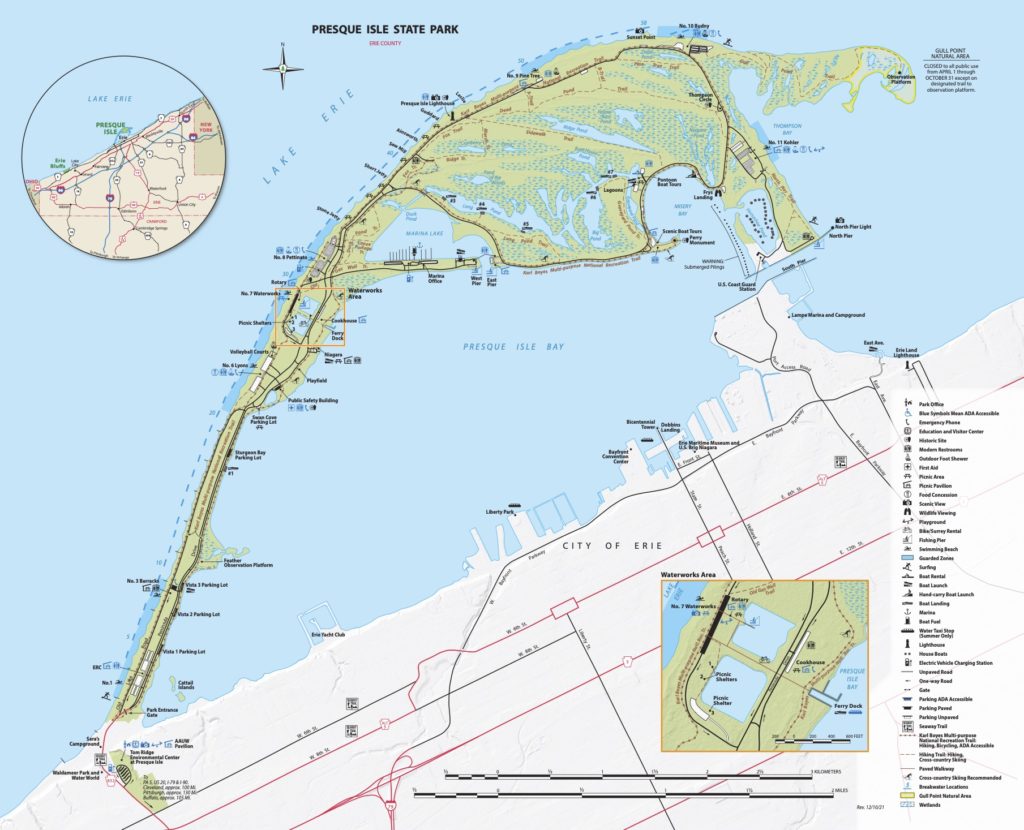
Presque Isle State Park is the most visited component of Pennsylvania’s 121 park system. In recent years, the beaches, trails, and ponds of this six-mile-long, 3,200-acre Lake Erie sand spit have drawn more than four million annual visitors. Repeat visits by local residents account for a significant portion of the seven-figure tally. The peninsula’s eastward curl into the lake creates the bay which fronts the city of Erie, and the park, which celebrated its 100th anniversary in 2021, frames northward views in many city neighborhoods.

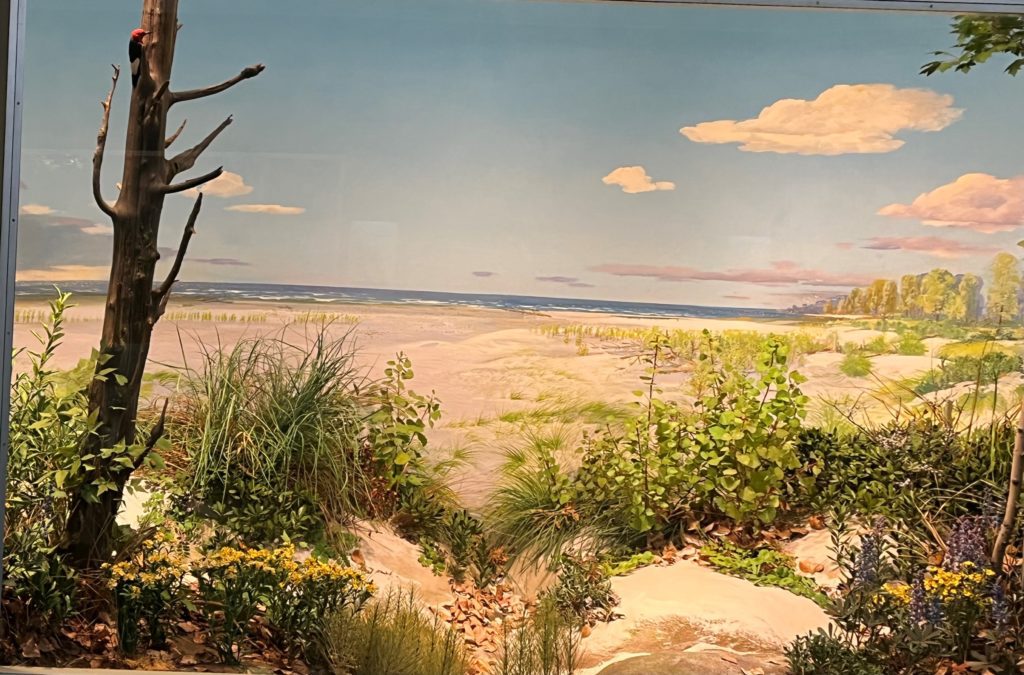
Some 120 miles south of the park, at Carnegie Museum of Natural History, visitors encounter a life-sized and un-peopled section of this unique landscape when they enter the Hall of Botany. This spacious plant-centered hall honors the vision of the museum’s first and longest-serving Curator of Botany, Otto Jennings, with eight dioramas created between the 1920s and 1970s that depict biomes with visually distinctive characteristics. The Presque Isle diorama, which opened in 1966, earns a spot among detailed three-dimensional depictions of the Sonoran Desert, Florida Everglades, and high-altitude slopes of Mount Rainier, by virtue of its representation of land continually shaped by the actions of wind, waves, and plant succession.  

As a label adjacent to the summer scene explains, Presque Isle is a place where a full cycle of plant community development can be observed in a compact space. At many park locations, a cross-peninsula transect of a few hundred yards might include the bare sand of new beach deposits, dunes stabilized by pioneering plants, marshes framed by sand ridges supporting shrubs and young trees, and patches of mature forest.

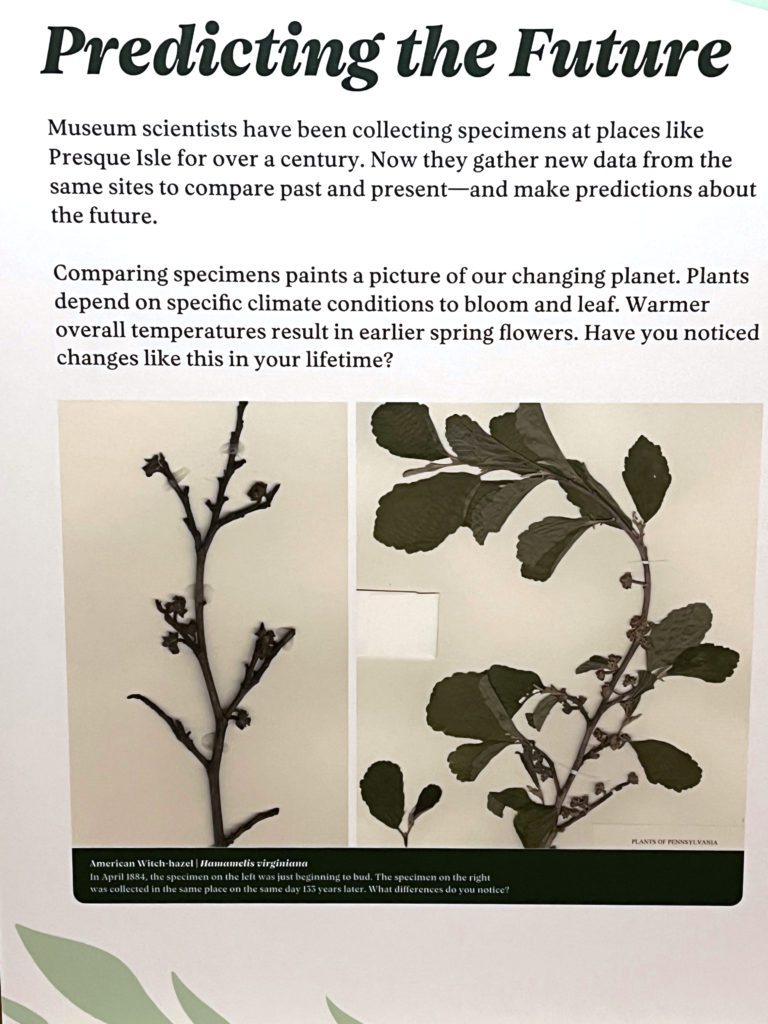
One of the diorama’s interpretive panels invites viewers to notice a half dozen featured plants and animals, while another uses two preserved specimens of witch hazel branches, collected on Presque Isle on the same date, but 133 years apart, to document dramatic changes in this common tree’s spring leaf-out date. The museum’s herbarium holds more than 3,300 Presque Isle plant specimens from ongoing collection efforts that date to 1868. These preserved plants, along with the standardized information recorded with each one, document such changes as the relatively recent abundance of non-native flora, and the decline of some rare plant populations in the wake of engineered beach stabilization efforts. 

Like all the museum’s dioramas, this window into the frozen time of a specific place lends itself to multiple interpretations by museum educators. In addition to narratives about plant succession, or the irrefutable evidence botanical records provide of a changing climate, the diorama’s recreated beach scene is a good place for students to listen to an explanation of the geology term “longshore drift,” or to consider how freshwater, even in a watershed as vast as the Great Lakes Basin, is a limited natural resource.

For some viewers, the diorama will serve as a visual prompt to visit or revisit the park and leave their own footprints on Presque Isle sands. Anyone considering a visit will find the experience enriched by making a preliminary electronic stop at the park website maintained by the Pennsylvania Department of Conservation and Natural Resources, as well a physical stop, just outside the park entrance, at interpretive exhibits in the 16-year-old Tom Ridge Environmental Center (TREC).

 On the website, among activity descriptions, park maps, recent news releases, and relevant advisories, a tab labelled “History” (under the category “Additional Information”) leads not only to a summary of the peninsula’s role in sheltering a fleet of American ships during the War of 1812 and a link to geology-focused park guide, but also to a brief account that, when repeated, serves to acknowledge how this unusual landscape was long ago utilized and cherished by Native Peoples. 

The Erie Indians lived along the southern shores of Lake Erie and were early inhabitants of the area. They hunted game from the forests, gathered plants, and fished from the waters of Lake Erie in birch-bark canoes.

According to legend, the Erie ventured far into the lake to find the place where the sun sank into the waters.

The spirits of the lake caused a great storm to arise, so the Great Spirit stretched out his left arm into the lake to protect the Erie from the storm. Where the sheltering arm of the Great Spirit had lain in the lake, a great sandbar in the shape of an arm-like peninsula was formed to act as an eternal shelter and harbor of refuge for the Great Spirit’s favorite children, the Erie.

https://www.dcnr.pa.gov/StateParks/FindAPark/PresqueIsleStatePark/Pages/History.aspx

Repeating the account in the Hall of Botany can add a new dimension to a 56-year-old diorama.

Patrick McShea works in the Education and Marketing departments at Carnegie Museum of Natural History.

Related Content

Collected On This Day in 1930: Native or Not?

Feather and Bone Connections to American History

Witch Hazel

Carnegie Museum of Natural History Blog Citation Information

Blog author: McShea, Patrick
Publication date: November 22, 2022

Share this post!

  • Share on Twitter Share on Twitter
  • Share on Facebook Share on Facebook
  • Share on Pinterest Share on Pinterest
  • Share on LinkedIn Share on LinkedIn
  • Share on Reddit Share on Reddit
  • Share via Email Share via Email

Filed Under: Blog Tagged With: Botany, Hall of Botany, Pat McShea, Science News

November 21, 2022 by Erin Southerland

What Does Pittsburgh Have in Common with Mount Vesuvius?

by Debra Wilson

In the mid 18th century, it was popular amongst the wealthy elite of Europe to take a “Grand Tour” of cities like Paris, Rome, Venice, Florence, and Naples. During these tours they traveled with a tutor and would learn about the culture, languages, geography, art, and architecture of the cities. A must-see when passing through Naples was the volcano, Mount Vesuvius, probably because of the fascination of the famous 79 A.D. eruption that destroyed the cities of Pompeii and Herculaneum.

Back then, to reach the top of Vesuvius one had to climb on foot, ride on horseback, or be carried by sedan-chair. And just like modern day travelers, they liked to take home souvenirs. What better souvenir of making it to the summit of a volcano could there be than a piece of lava? And not just any piece, but one that would commemorate your adventure. Thus, the creation of the lava medallion.

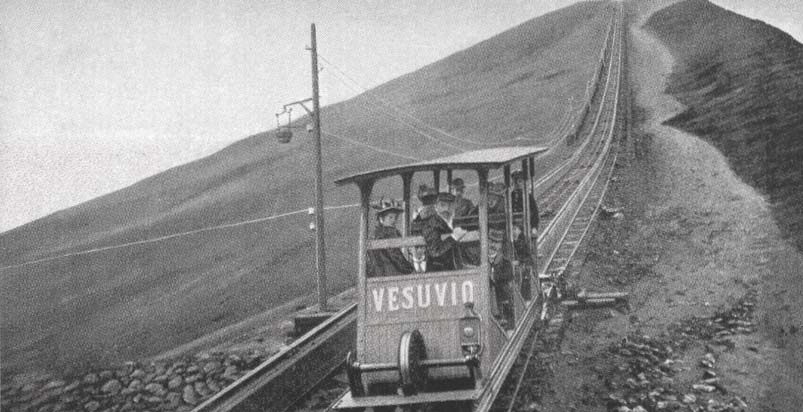
To make a medallion, some brave soul would retrieve molten lava on a stick, which was then molded, stamped out with engraved steel plates, cooled in a bucket of water, and then sold to the tourists. To increase the tourist trade and make it easier and more comfortable for tourists to visit the summit of Mount Vesuvius, it was determined that a funicular should be built on the 4,190-foot-high volcano. So, what’s a funicular you say? It’s a cable railroad designed to transport people and cargo up and down steep slopes. The ascending and descending cars are counterbalanced, meaning both cars are permanently connected to the opposite ends of the same cable, known as a haul rope. This haul rope runs through a system of pulleys at the upper end of the line. The first funicular on Mount Vesuvius opened on June 6, 1880 and ran, with some interruptions, until it was destroyed by the March 1944 Vesuvius eruption. The two cable cars were named “Etna” and “Vesuvio.”

Black and white image of a funicular car named Etna.
Stereokarte: Knackstedt & NätherScan: Claus-Peter Enders im Team mit Bernd Schwabe im Wikipedia-Büro HannoverCropp: Pechristener, Public domain, via Wikimedia Commons
Black and white image of a funicular car named Vesuvio.
Unknown author, Public domain, via Wikimedia Commons

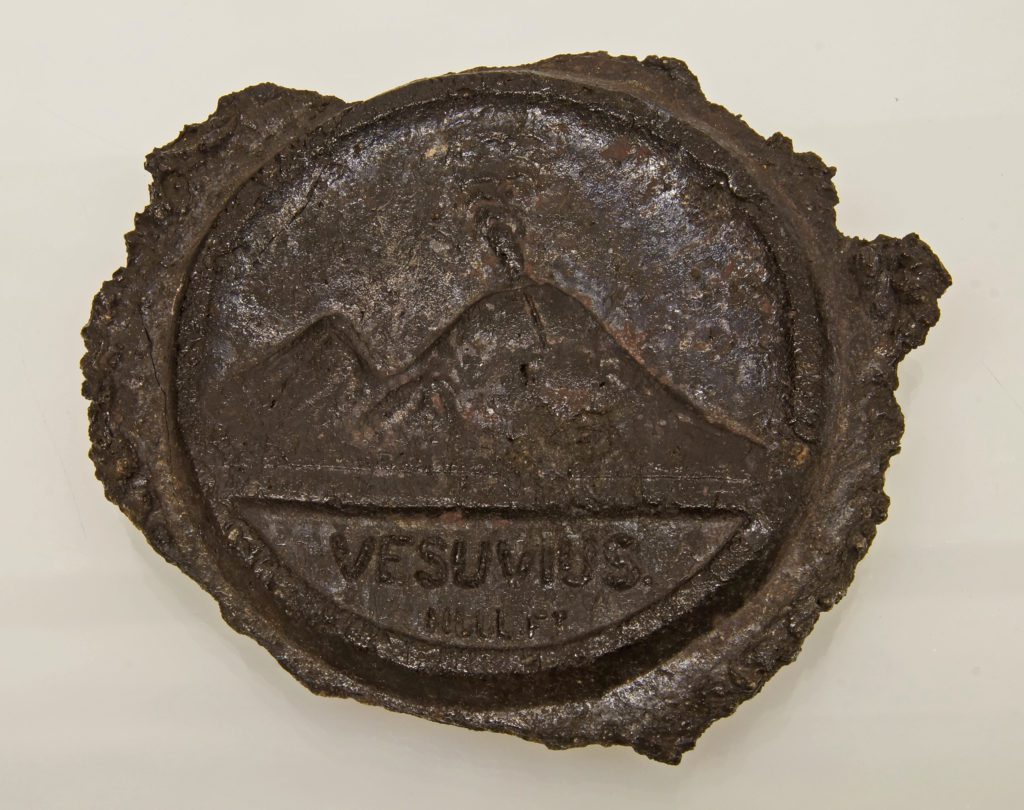
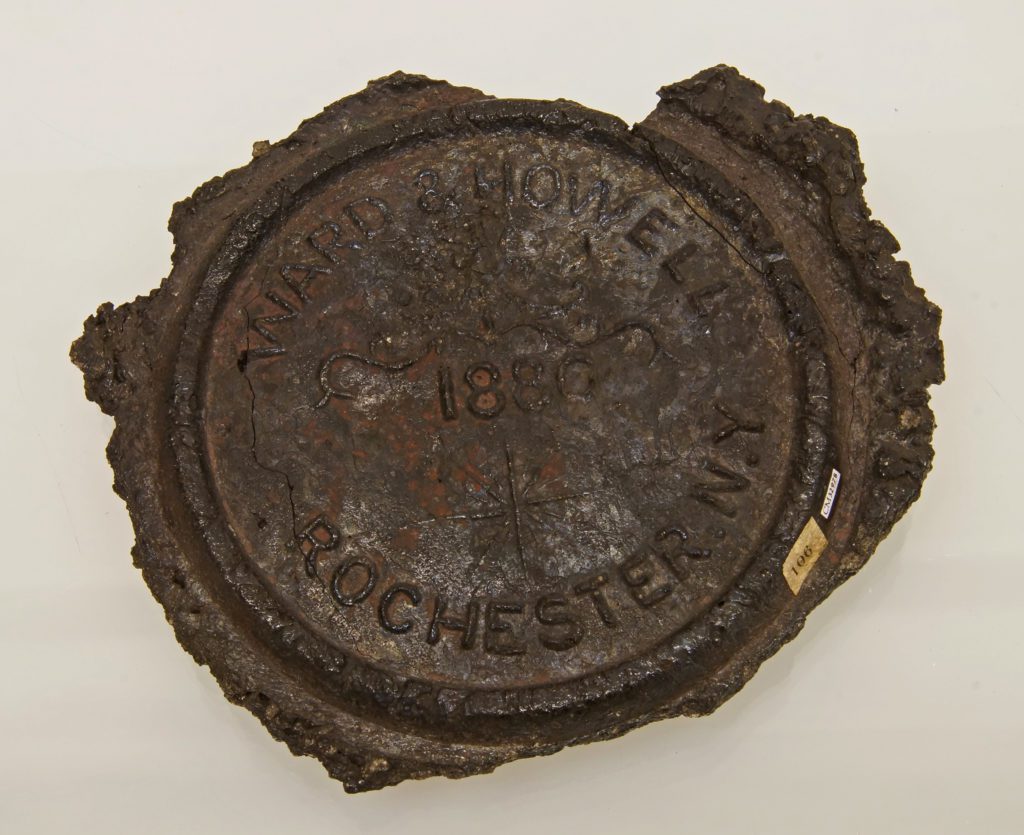
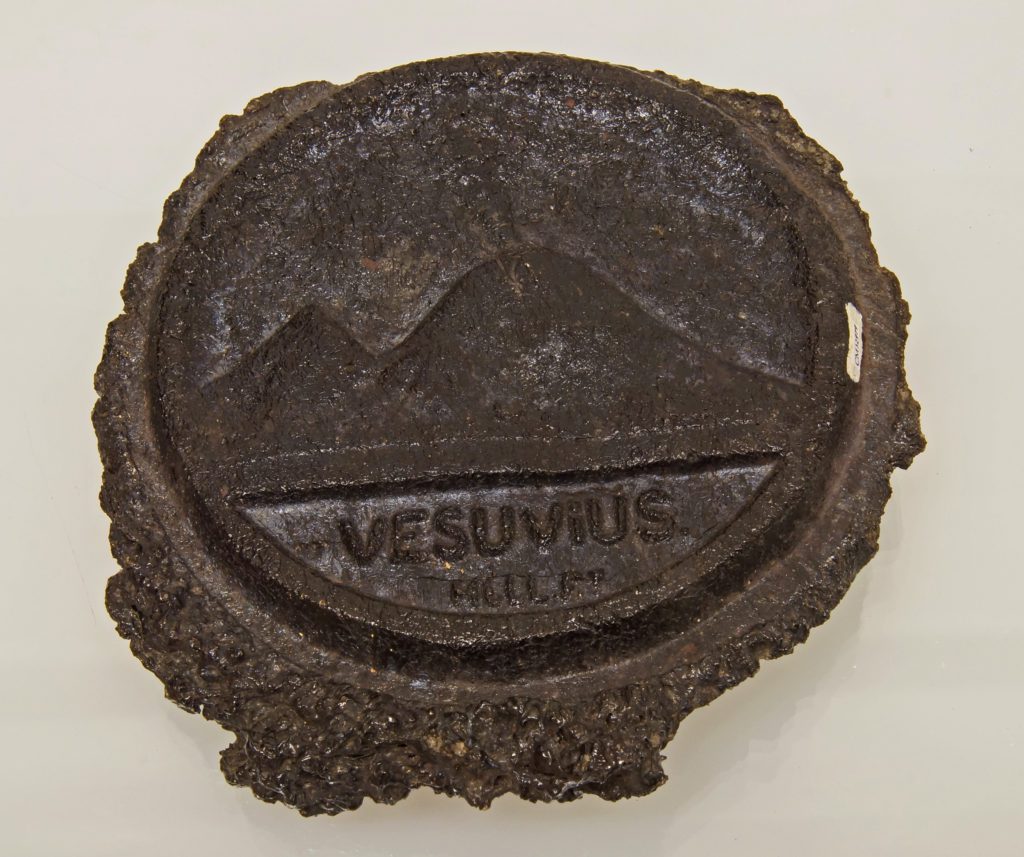
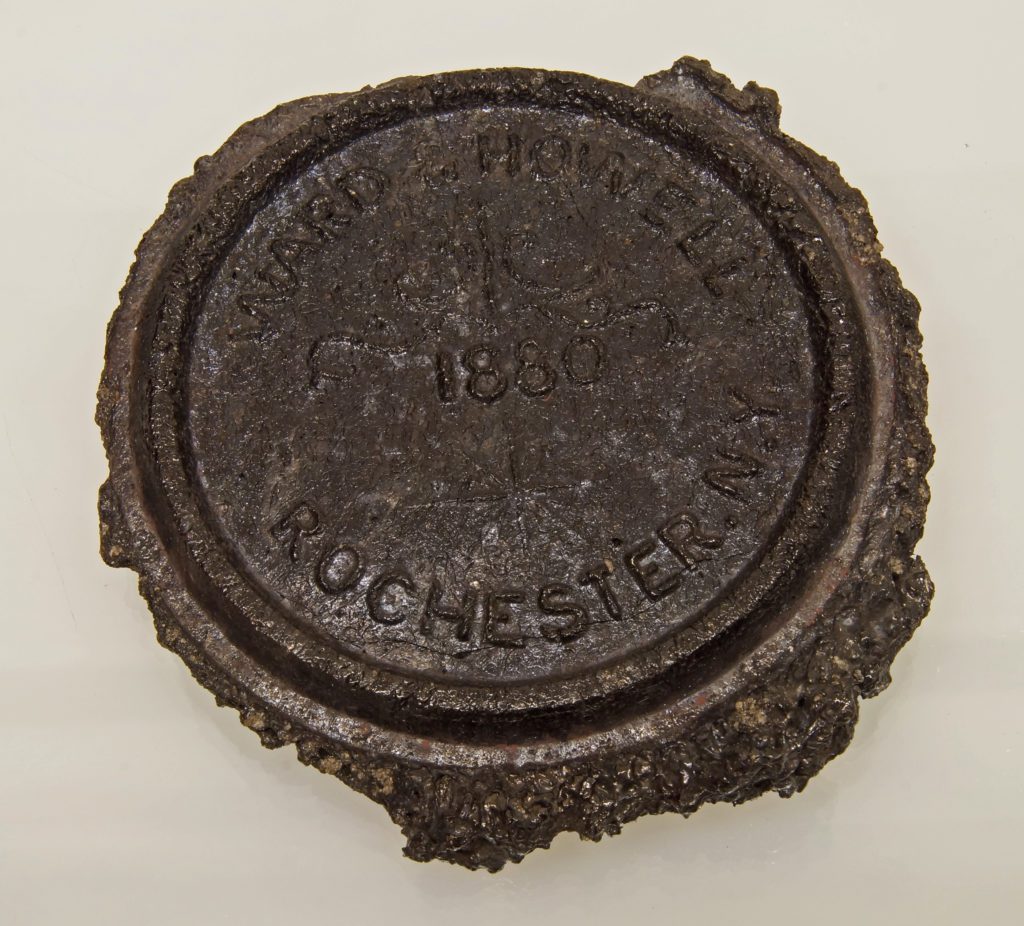
To commemorate the opening, some very special lava medallions were made. Our collection contains two such medallions among the roughly 30,000 specimens not on public view in the museum. These lava medallions were produced by Ward & Howell, the company that sold minerals for Ward’s Natural Science Establishment of Rochester, New York from 1875 to 1891. Each medallion has Mount Vesuvius stamped on the front, and the year 1880 on the back along with Ward & Howell Rochester, N.Y. If you look closely, you can make out the funicular rails on Vesuvius. Notice that no two medallions are alike, depending on how the lava squeezed out between the steel plates.

Mount Vesuvius lava medallion
CM32978 lava medallion, 18.3 x 14.4 x 2.6 cm   
Mount Vesuvius laval medallion
Back of the medallion
CM32979 lava medallion, 16.1 x 14.6 x 3.2 cm
Back of the medallion.

There was something else very special created to commemorate the 1880 opening of the funicular. The famous song “Funiculi, Funiculà” (which means funicular up, funicular down) was written by composer Luigi Denza, with lyrics by Peppino Turco. The Neapolitan tune is about a young man who compares his love for his sweetheart to a volcano and invites her to ride up to the summit on the funicular. As the funicular rises up, so does his courage to ask for her hand in marriage. The song became so popular that by 1881 the sheet music had sold one million copies. If you are unfamiliar with the tune listen to one or both of these:

For those of you who love the popular Girls Und Panzer anime series, which depicts competition between girls’ high schools practicing tank warfare as a sport, you might recognize this tune as one of the theme songs for the Sensha-dō  team of Anzio High School (an Italian-style private academy from Aichi Prefecture in Japan) commanded by “Duce” Anchovy. Here is a video of the Girls Und Panzer version of “Funiculi, Funiculà” with lyrics shown in both the original language and English:

So, what is the Pittsburgh connection?

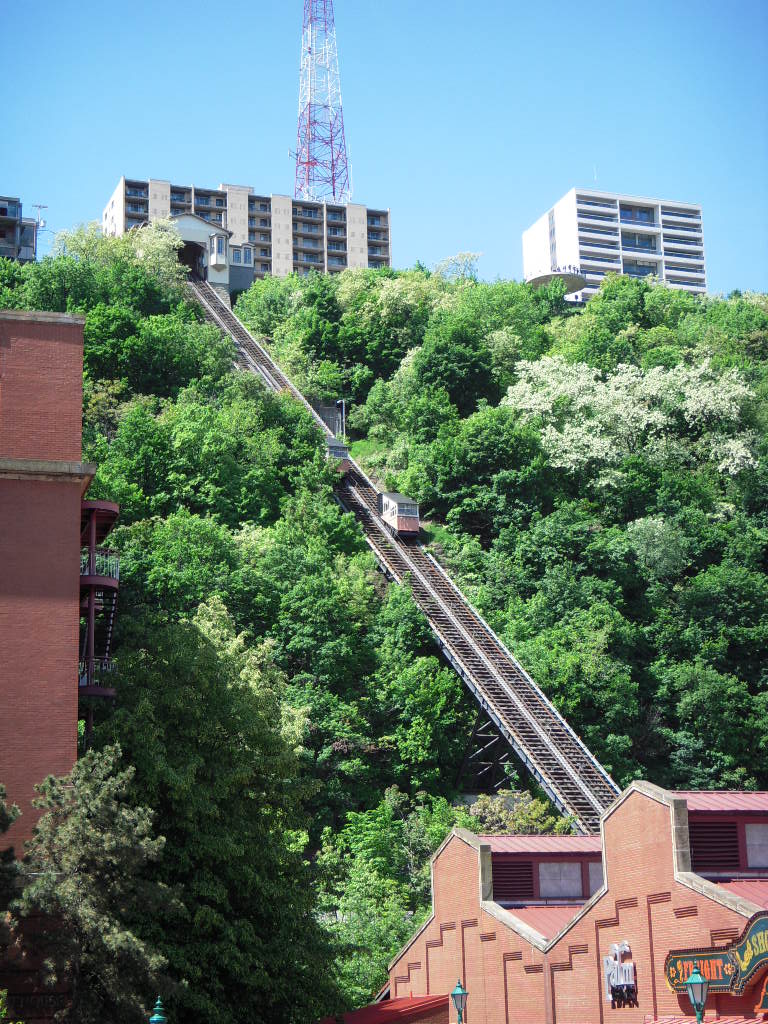
Now you know what a funicular is, but did you know that Pittsburgh has two funiculars? It’s not surprising since here in Pittsburgh we have just a few steep slopes around! We refer to these funiculars as inclines, and at one time there were 17 of them operating on the hilly topography carved by the Monongahela and Allegheny rivers. They were originally built to transport cargo up and down Mount Washington. Then with the influx of workers during the expansion of the coal and steel industries, more inclines were built to transport the employees of the mills and factories to their places of residence up on Mount Washington and other hilltop neighborhoods. Most of these inclines closed as more roads were built and the use of automobiles increased. The two inclines that are still in operation today were both in service on Mount Washington even before the funicular on Mount Vesuvius opened in 1880. The Monongahela Incline opened on May 27, 1870 and is the oldest continually operating funicular in the United States. The Duquesne Incline opened on May 17, 1877. Of course, you can’t get a lava medallion as a souvenir, but the next time you ride up and down one of our inclines, how about breaking out in a song, you know the one I mean…”Funiculi, Funiculà!”

Monongahela Incline. Image credit: pennsyloco, CC BY 3.0, via Wikimedia Commons
Duquesne Incline. Image credit: Bohemian Baltimore, CC BY-SA 4.0, via Wikimedia Commons

Debra Wilson is the Collection Manager for the Section of Minerals at Carnegie Museum of Natural History.

Related Content

Beauty From the Ashes

Manhattan Project Glass

Born to the Purple

Carnegie Museum of Natural History Blog Citation Information

Blog author: Wilson, Debra
Publication date: November 21, 2022

Share this post!

  • Share on Twitter Share on Twitter
  • Share on Facebook Share on Facebook
  • Share on Pinterest Share on Pinterest
  • Share on LinkedIn Share on LinkedIn
  • Share on Reddit Share on Reddit
  • Share via Email Share via Email

Filed Under: Blog Tagged With: Debra Wilson, minerals, minerals and earth sciences, minerals and gems, Science News

November 17, 2022 by Erin Southerland

Shark-ish Beasts Versus Cephalopods: Which is Predator, Which is Prey, and is One an Artist?

by Sabrina S. Robinson and Timothy A. Pearce

We’ve all heard the legend of the sperm whale and the giant squid, locked in epic battles in the waters of the deep, like that imagined in Jules Verne’s 20,000 Leagues Under the Sea (and yes, sperm whales do love to eat giant squids). If one substituted a shark for the whale, most of us would think the squid — or its relation, the octopus — wouldn’t have much chance. But that assumption might be wrong…and in fact, evidence from nearly one hundred million years ago hints at surprising mortal interactions between shark-like vertebrates and cephalopods.

Octopuses vs. Sharks

In 2000, with some trepidation, a Giant Pacific Octopus was placed in a large tank with sharks at the Seattle Aquarium. At the time, some aquarium staff wondered whether  the octopus would be attacked by the sharks. It turned out that the trepidation was justified, but for precisely opposite reasons: sharks started disappearing (and perhaps the octopus began to look too self-satisfied). Several years later a video, which subsequently went viral, was filmed  at the aquarium showing an octopus attacking and eating a dogfish shark. As in many videos produced for nature documentaries, the creatures were subject to human interference (not to ruin nature documentaries for you); divers directed dogfish toward the octopus. Despite this meddling, the fact remains: sharks, beware.

Credit: A sperm whale attacks a giant squid. Colour line block after A. Twidle. Wellcome Collection. Public Domain Mark

Ammonites vs. Mosasaurs

Ammonites and ammonoids were ancient cephalopods that became extinct at the end of the Cretaceous. Fossilized ammonite shells have been found with indentations that some paleontologists interpret as bite marks from mosasaurs. (An alternate explanation is that the mosasaur bites were holes made by limpets, marine gastropods, some species of which scrape holes into calcium carbonate surfaces, such as other shells [Seilacher 1998], although some paleontologists continue to defend the mosasaur bite hypothesis [Tsujita & Westermann 2001]. Mosasaurs were part of a group of extinct ocean-going reptiles, having the body form and presumably the behaviors of sharks. In other words, this mollusk vs. shark(ish) conflict might be a blood feud going back 90 million years or more.

So, let’s say that it was mosasaurs (and not nibbling limpets) snacking on the ammonites, and that all of this adds up to a pattern, leaving the question: do the mollusks or the sharks and shark-like reptiles have the intellectual advantage in the fight? Modern squids and octopuses, collectively classified as coleoids, are famous for their intelligence and quick wit. It’s difficult to know whether ammonites shared this cleverness — coleoids and ammonites descend from a common ancestor known as a bactritid, and we don’t know how intelligent this ancestral creature was. The modern chambered nautilus, resembling ammonites though not closely related to them, does not seem to be very smart (but it does have a remarkable memory). 

Squids vs. Ichthyosaurs

Here is additional possible evidence of ancient intelligence shaping the feud between mollusks and shark-like reptiles. Fossils of shell-less cephalopods are rare, but the creatures’ presence in the fossil record is sometimes detectable through their preserved bird-like beaks and gladii (singular is gladius), a hard pen-shaped internal structure of squid. The beak remains of a large fossil squid with a body length estimated to be at least 10 meters were found in Nevada near multiple ichthyosaur vertebrae arranged in an unusual pattern. This peculiar circumstance, which had been seen elsewhere in the fossil record, led at least one paleontologist to speculate that the bones had been deliberately arranged by a large squid (who presumably killed the vertebrate), perhaps as a self-portrait! Ichthyosaurs, like mosasaurs, are shark-like in body plan and (presumably) behavior.

Of course, this is a highly controversial idea — but creatures making art on the seabed has at least some precedent. In 2011, Matsura Keiichi solved a mystery in the sands of the sea floor around the Ryukyu Islands, a chain of Japanese islands on the boundary between the East China Sea and the Philippine Sea. Complex and beautiful circular patterns had been found by divers in these underwater sands for years. It was finally discovered that the white spotted pufferfish (Torquigener albomaculosus), was making these works of art as a courtship display, carefully constructing and maintaining them, until a female, enticed by their sculpture, spawned in the center of the circle, leaving the artistic male to care for the eggs. (See a video of one adorable little guy making his art on PBS.) So underwater art is a known explanation for strange seabed arrangements.

We’re reminded of the Arnold Schwarzenegger movie Predator, in which the Predator’s trophies from its kills were spinal columns. Could this ancient kraken have been the original Predator, collecting its victims’ spinal columns? Constructing displays with them to attract mates??

Which reminds us of a joke. Tim’s friend called him on the phone to say he was changing his name to Spinal Column. Tim asked, “Umm, can I call you Back?”

Sabrina Robinson is a volunteer in the Section of Mollusks. Tim Pearce is Curator of Collection in the Section of Mollusks.

Related Content

How to Talk with an Extra-Terrestrial Alien? Practice with an Octopus

Prozac and Caffeine in Our Wastewater: Effect on Freshwater Mollusks

Oysters Swim Towards a Siren Soundscape

Carnegie Museum of Natural History Blog Citation Information

Blog author: Pearce, Timothy A.; Robinson, Sabrina S.
Publication date: November 17, 2022

Share this post!

  • Share on Twitter Share on Twitter
  • Share on Facebook Share on Facebook
  • Share on Pinterest Share on Pinterest
  • Share on LinkedIn Share on LinkedIn
  • Share on Reddit Share on Reddit
  • Share via Email Share via Email

Filed Under: Blog Tagged With: mollusks, Science News, Tim Pearce

  • « Go to Previous Page
  • Page 1
  • Interim pages omitted …
  • Page 6
  • Page 7
  • Page 8
  • Page 9
  • Page 10
  • Interim pages omitted …
  • Page 43
  • Go to Next Page »

sidebar

About

  • Mission & Commitments
  • Directors Team
  • Museum History

Get Involved

  • Volunteer
  • Membership
  • Carnegie Discoverers
  • Donate
  • Employment
  • Events

Bring a Group

  • Groups of 10 or More
  • Birthday Parties at the Museum
  • Field Trips

Powdermill

  • Powdermill Nature Reserve
  • Powdermill Field Trips
  • Powdermill Staff
  • Research at Powdermill

More Information

  • Image Permission Requests
  • Science Stories
  • Accessibility
  • Shopping Cart
  • Contact
  • Visitor Policies
One of the Four Carnegie Museums | © Carnegie Institute | Privacy Policy | Terms of Use | Accessibility
Rad works here logo