• Skip to primary navigation
  • Skip to main content
  • Skip to primary sidebar

Carnegie Museum of Natural History

One of the Four Carnegie Museums of Pittsburgh

  • Visit
    • Buy Tickets
    • Visitor Information
    • Exhibitions
    • Events
    • Dining at the Museum
    • Celebrate at the Museum
    • Powdermill Nature Reserve
    • Event Venue Rental
  • Learn
    • Field Trips
    • Educator Information
    • Programs at the Museum
    • Bring the Museum to You
    • Guided Programs FAQ
    • Programs Online
    • Climate and Rural Systems Partnership
  • Research
    • Scientific Sections
    • Science Stories
    • Science Videos
    • Senior Science & Research Staff
    • Museum Library
    • Science Seminars
    • Scientific Publications
    • Specimen and Artifact Identification
  • About
    • Mission & Commitments
    • Directors Team
    • Museum History
  • Tickets
  • Give
  • Shop

Section of Vertebrate Paleontology

November 4, 2020 by wpengine

The Bromacker Fossil Project Part XI: Dimetrodon teutonis, an apex predator

New to this series? Read The Bromacker Fossil Project Part I, Part II, Part III, Part IV, Part V, Part VI, Part VII, Part VIII, Part IX, and Part X. 

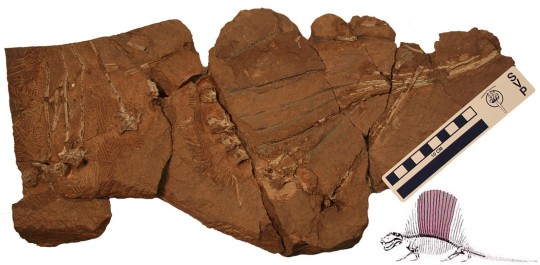
Holotype specimen of Dimetrodon teutonis, which consists of a partial vertebral column. The preserved portion of this vertebral column is highlighted in the reconstruction of Dimetrodon (lower right). Photograph by the author, 2007. Dimetrodon reconstruction modified from Romer and Price, 1940.

Specimens of two top predators have been discovered at the Bromacker quarry. Like Martensius, both are basal members of the group Synapsida, the later members of which gave rise to mammals. You might be familiar with one of them – Dimetrodon, a synapsid sometimes incorrectly portrayed with dinosaurs, which carried a tall sail on its back that was supported by bony spines. The other is a new genus and species that will be presented in my next post.

The fossil pictured above, the first-discovered specimen of Dimetrodon from the Bromacker quarry, may not look like much, but it was the first record of Dimetrodon outside of North America. The circumstances under which it was found were very different from the discovery of other fossils from the Bromacker quarry. Before Dave Berman and I arrived for the 1999 field season, Thomas Martens noticed that someone, possibly a fossil poacher, had been in the quarry overnight and knocked some rocks off the quarry lip. The rocks apparently broke upon hitting the ground, which exposed some bones. Thomas carefully picked them up and took them to his lab at the Museum der Natur, Gotha (MNG). When Dave and I met Thomas at the quarry on our first day of the field season, Thomas mentioned the find and told us that he thought the bones were ribs. We didn’t think much of it, other than horror at learning a fossil poacher might have visited the quarry overnight, one of our worst fears.

As planned, Dave and I spent the last day of the field season in the museum collections, and when Thomas let us in that morning, he reminded us to look at the potential ribs and told us where they were. Shortly after we began examining them, Dave and I simultaneously realized that the “ribs” were actually spines of Dimetrodon. We couldn’t believe our eyes, because of all the Early Permian fossils known from North America, Dimetrodon was Thomas’ favorite. Indeed, he’d used an image of it on signs at the Bromacker and included a model of Dimetrodon in a diorama, once on display in the MNG, that showed models of Bromacker animals in their environment. Thomas jumped for joy later that day when we gave him the news.

So how did Dave and I so quickly realize that the “ribs” were spines of Dimetrodon? Besides Dimetrodon, some other basal synapsids had sails, the function of which remains unknown, though scientists have speculated they could’ve been used for display or regulating body temperature. The spines (known as neural spines) supporting the sails vary in shape and length, with those of Dimetrodon and its herbivorous relative Edaphosaurus being tall and narrow, and those of another relative, the carnivorous Sphenacodon, being shorter and blade-like. Neural spines of Dimetrodon are easy to distinguish, because in addition to being long they bear fore and aft grooves, which create a dumbbell-shaped cross-sectional outline, and they lack the ‘crossbars’ that occur on the long neural spines of Edaphosaurus. When Dave and I saw the fore and aft grooves, the dumbbell-shaped cross-sectional outline of some broken spine ends, and an absence of crossbars, we knew that the “ribs” were indeed spines of Dimetrodon.
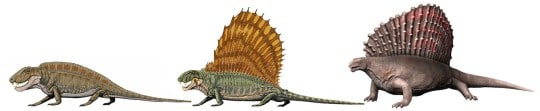
Flesh reconstructions of Sphenacodon sp. (left), Dimetrodon grandis (middle), and Edaphosaurus pogonias (right) to show the differences between their sails. Note that Dimetrodon and Sphenacodon are more closely related to one another than they are to Edaphosaurus, despite their different sail shapes. Reconstructions of Sphenacodon and Dimetrodon by Dmitry Bogdanov and that of Edaphosaurus by Nobu Tamura, all from Wikimedia Commons.

The Bromacker Dimetrodon is considerably smaller than other known species of the genus, and this is one character among other more detailed anatomical features that distinguishes it. For the new species name, Dave selected the Latin “teutonis,” which means an individual of a German tribe, in reference to the geographic origin of the holotype specimen.
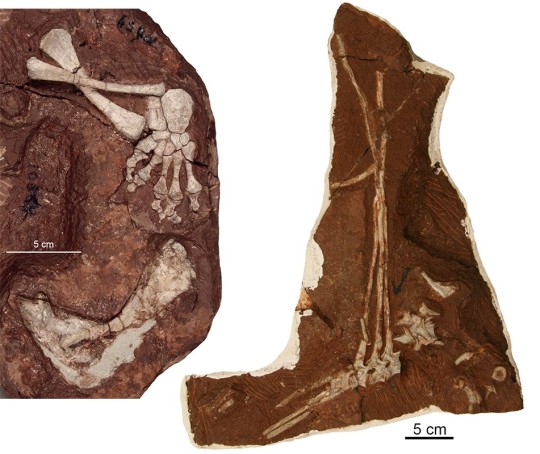
Two additional specimens of Dimetrodon teutonis. Left, hindleg and shoulder girdle bone (fused scapulocoracoid) and right, several vertebrae bearing complete to nearly complete neural spines of an individual that was larger and presumably more mature than the holotype. Photographs by the author, 2007.

Dave was able to use a mathematical equation involving measurements of the vertebrae to estimate the holotype’s weight as a living animal at 31 pounds. In contrast, other known Dimetrodon species have estimated weights of about 81–550 pounds. We later discovered additional partial specimens of Dimetrodon at the Bromacker quarry, and Dave estimated the weight of the largest specimen with vertebrae at 53 pounds, still considerably less than that of what had previously been the smallest species, D. natalis from Texas. Dimetrodon is otherwise known from numerous species from the American mid-continent and southwest that generally got larger through time.
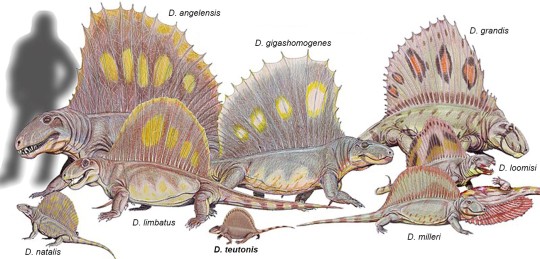
Reconstructions of various species of Dimetrodon drawn to scale. The diminutive D. teutonis is at bottom center and D. natalis, no longer the smallest species, is at bottom left. Illustration adapted from Dmitry Bogdanov via Wikimedia Commons.

All Dimetrodon species have teeth adapted for meat-eating in being teardrop-shaped with sharp edges for slashing flesh. By size and jaw position these sharp teeth are divided into precanines, canines, and postcanines of varying numbers. Unlike D. teutonis, some species even had fine serrations on their tooth edges. The only known upper jaw bone of Dimetrodon teutonis clearly has two canines, but one is missing and represented by a large gap in the tooth row that would have accommodated this tooth. The second canine is represented only by its broad base, but it too must have been large. Although it was a small animal, the teeth of D. teutonis indicate that it was a meat-eater and as such would have preyed on other vertebrates from the Bromacker, many of which were even smaller.
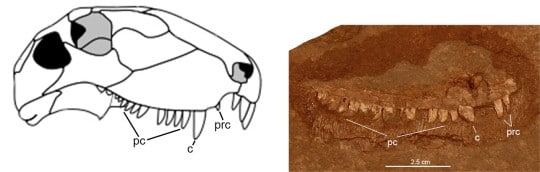
Diagrammatic drawing of the skull of Dimetrodon (left) and photograph of the maxilla or upper jaw bone (right) of D.teutonis. Abbreviations: c, canine; pc, postcanine; prc, precanine. Photographs by the author, 2007. Drawing of skull from Wikimedia Commons.

Stay tuned for my next post, which will be about the second-known apex carnivore from the Bromacker. In the meantime, here are links to scientific papers on Dimetrodon teutonis:

https://www.researchgate.net/publication/325670232_A_new_species_of_Dimetrodon_Synapsida_Sphenacodontidae_from_the_Lower_Permian_of_Germany_records_first_occurrence_of_genus_outside_of_North_America

https://www.researchgate.net/publication/288544821_New_materials_of_Dimetrodon_teutonis_Synapsida_Sphenacodontidae_from_the_Lower_Permian_of_Germany

Amy Henrici is Collection Manager in the Section of Vertebrate Paleontology at Carnegie Museum of Natural History. Museum employees are encouraged to blog about their unique experiences and knowledge gained from working at the museum.

Keep Reading

The Bromacker Fossil Project Part XII: Tambacarnifex unguifalcatus, the Tambach Executioner 
Filed Under: Blog Tagged With: Amy Henrici, Museum from Home, Science News, Section of Vertebrate Paleontology, The Bromacker Fossil Project, Vertebrate Paleontology

October 29, 2020 by wpengine

Mesozoic Monthly: Gargoyleosaurus

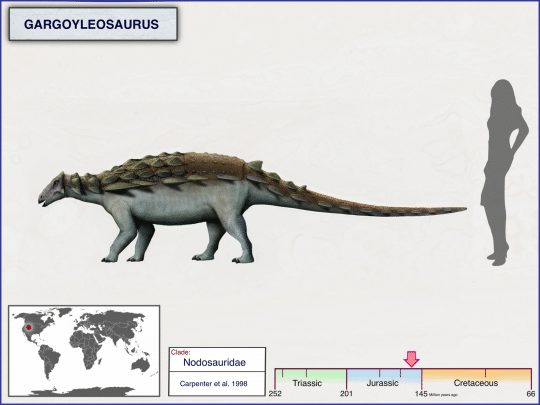
Do you know what you’re going to dress up as for Halloween? This year, I’ll be going to work dressed as Velma Dinkley from Scooby-Doo. For the October edition of Mesozoic Monthly, I’ll be ‘unmasking’ a dinosaur with a monstrous name: Gargoyleosaurus parkpinorum, an armored dinosaur from the Jurassic Period!

image
Handy infographic of the ankylosaur Gargoyleosaurus parkpinorum showing its appearance, size, geographic and temporal occurrence, and more. Art by cisiopurple on DeviantArt, used with permission.

Gargoyleosaurus belongs to my favorite group of dinosaurs: the ankylosaurs! The group Ankylosauria is comprised of many big-bodied herbivores covered in osteoderms, which are pieces of bone embedded in the skin that act like armor. Their osteoderms came in many shapes and sizes, from tiny ossicles that protected their bellies, to large, fused pieces of bone that formed club-like structures on their tails. In most cases you can easily distinguish between the two major groups of ankylosaurs based on their style of osteoderms (though there are other features that distinguish them as well). Ankylosaurids are famous for their tail clubs: the last vertebrae in their tail overlap to form a rigid ‘handle’ that ends with a mass of fused osteoderms akin to a club. Nodosaurids, their sister group, sported massive osteoderm spikes on their shoulders instead of clubs on their tails. Some paleontologists distinguish a third group of ankylosaurs, called polacanthids, which have a rectangular ‘pelvic shield’ made of fused osteoderms that rests over the hips. There’s a lot of overlap between ‘nodosaurid’ and ‘polacanthid’ characteristics, though, so ankylosaurs with pelvic shields are typically grouped in with the nodosaurids instead of being recognized as their own group.

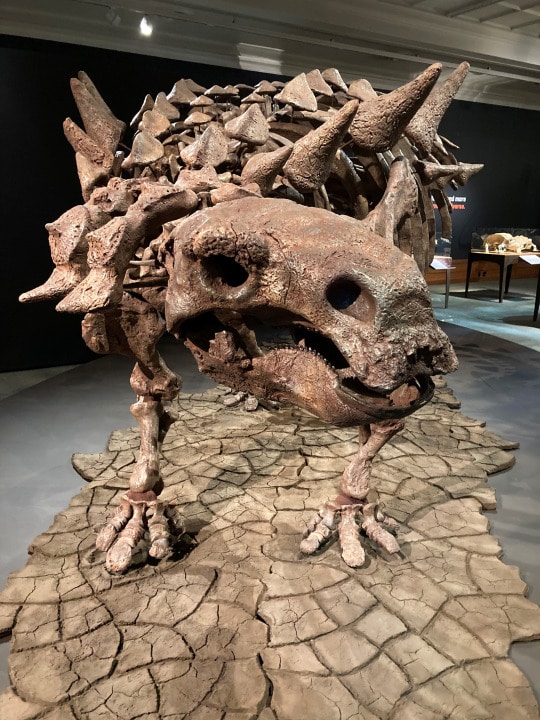
Conveniently, the Dinosaur Armor temporary exhibition at Carnegie Museum of Natural History features representatives of all three (or both, depending on your taxonomic preference!) ankylosaur subgroups: the ankylosaurid Akainacephalus, the nodosaurid Peloroplites, and the polacanthid (= nodosaurid?) Gastonia.

image
The imposing nodosaurid ankylosaur Peloroplites as seen in CMNH’s Dinosaur Armor exhibition. Check out those giant, spike-shaped shoulder osteoderms, a nodosaurid hallmark. Photo by Matt Lamanna.

There’s been some debate over where to place Gargoyleosaurus on the ankylosaur family tree because it displays a range of features from both major groups. It has pointy, horn-like osteoderms on the back of its head, which is a feature of ankylosaurids, but its skeleton lacks evidence of a tail club or other ankylosaurid characteristics. It also has a long snout, shoulder spines, and a pelvic shield, all features of nodosaurid (or polacanthid) ankylosaurs. The best explanation for the mix of features seen in Gargoyleosaurus is that it was one of the most basal nodosaurids, meaning it was one of the earliest nodosaurids to evolve and is therefore located at the base of the group’s evolutionary tree. If Gargoyleosaurus was a basal nodosaurid, that would explain why it still had features similar to those of ankylosaurids: because it had only recently evolved from the common ancestor of ankylosaurids and nodosaurids, not enough time had elapsed for features of that common ancestor (such as ankylosaurid-like skull osteoderms) to be removed by natural selection. This would be in keeping with the status of Gargoyleosaurus as one of the geologically oldest ankylosaurs of any kind discovered to date.

image
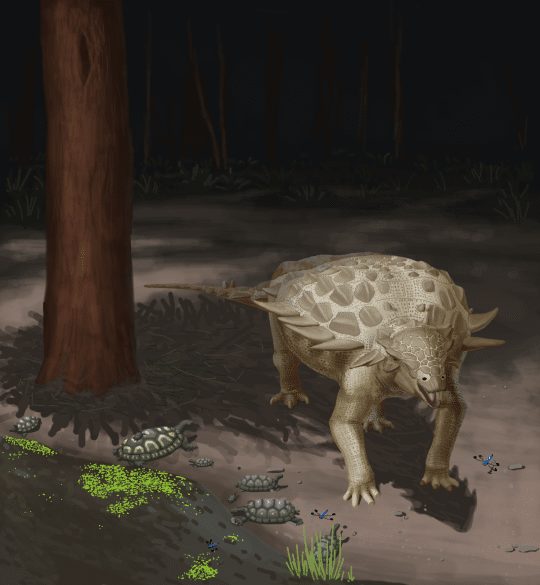
Albany County, Wyoming, ca. 150,000,000 B.P.: a solitary Gargoyleosaurus enjoys a shady spot by a stream in its Morrison Formation ecosystem. Art by Batavotyrannus on DeviantArt, used with permission.

No matter which ankylosaur subgroup Gargoyleosaurus belongs to, everyone can agree that it was a well-armored tank. Armor is a very useful defense against predators, since it generally covers the most vulnerable places on the body, such as the neck. Gargoyleosaurus lived in what is now the Morrison Formation, a famous set of rocks in the western US made of sediment deposited during the late Jurassic Period (the second of three periods in the Mesozoic Era, or Age of Dinosaurs). Most of the Jurassic dinosaurs on display at CMNH come from the Morrison Formation, such as our beloved long-necked sauropod Diplodocus, the even more massive sauropod Apatosaurus, and the forever popular Stegosaurus. But the Morrison ecosystem was home to a horde of formidable carnivores too—Allosaurus, Ceratosaurus, and Torvosaurus among them—so the armor of Gargoyleosaurus undoubtedly came in very handy. Contrary to what certain “Jurassic” franchises would lead you to believe, though, Tyrannosaurus rex did not live during the Jurassic Period, and so it never interacted with Gargoyleosaurus or any other members of the Morrison dinosaur community. That said, if trick-or-treating had been a possibility in the Jurassic, I’d imagine those inflatable T. rex Halloween costumes might have been very popular. Who doesn’t love those silly costumes?!

Lindsay Kastroll is a volunteer and paleontology student working in the Section of Vertebrate Paleontology at Carnegie Museum of Natural History. Museum staff, volunteers, and interns are encouraged to blog about their unique experiences and knowledge gained from working at the museum.

Related Content

Mesozoic Monthly: Protostega

Armored Advantage

Ask a Scientist: What is still unknown about “the chicken from Hell”?

Filed Under: Blog Tagged With: dinofest, dinosaurs in their time, Lindsay Kastroll, Science News, Section of Vertebrate Paleontology, Vertebrate Paleontology

September 18, 2020 by wpengine

In the Field: Following the Work of a Paleontologist

Introduction by Jessica Sperdute

Edited by Matt Lamanna

With 22 million specimens housed at Carnegie Museum of Natural History (CMNH) and nearly 10,000 on display at any given time, chances are you’ve seen a dinosaur or two during your museum visits. But have you ever wondered how those dinosaurs get to the museum after they’re found? Or how we know where to dig for them in the first place?

What is a Fossil?

Fossils are the remains of animals, plants, and other ancient life that have been preserved in rock layers, or sediment. Fossils can include things such as leaves, skin, feathers, hair, footprints, and, most commonly, hard material such as wood, shells, teeth, and bones. Even poop can be fossilized! Many kinds of fossils are rare, and studying them can help us understand how the world looked tens of thousands or even millions of years before our time. Scientists who study fossils are known as paleontologists.

Looking at the Layers

Paleontologists use many tools to help them find fossils, but the key to knowing where fossils may be hidden underground lies with rocks—massive layers of rocks, called strata, are piled onto one another over time. These layers of different rocks can tell us not only what type of rock the layer is made of, but also approximately how old the layer is. The study of rock layers is called stratigraphy, and paleontologists use it to find potential fossil beds. For instance, if a paleontologist is looking specifically for fossils of dinosaurs, they would use stratigraphy to locate exposed layers of sedimentary rocks that formed at the time when dinosaurs lived and died—the Mesozoic Era. Once rocks from the Mesozoic Era are found in a location, the paleontologist goes to that location to hunt for fossils.

Big Prospects

Finding the right type of strata is only half the work of finding fossils; once paleontologists arrive at the field site, they need to physically walk around and search for clues that fossils may be around or underneath them. This is called prospecting, and the best place to prospect is usually at the base of a hill. Wind and rain will erode or gradually wear away rocks, allowing some fossils to break loose from higher sediments and roll downhill. If a fossil fragment is found, the team can then search the area to see if there may be other, more complete fossils—oftentimes higher up the hill and still embedded in rock.

Once prospecting has yielded an area where a fossil is likely to buried, the team can begin to block out the site and start digging. They use a wide variety of tools—even household items like paintbrushes, shovels, and hammers—to uncover fossils without damaging them. Records are taken of this step-by-step process to ensure all the data, from the precise location of the dig site, to the type of fossils found and their spatial relationships to one another, and even the measurements of the quarry, is kept for further study.

Safety First

The team has found a fossil, dug it up, and recorded the data. Now what? Once a fossil has been carefully excavated, it needs to be protected. Most fossils are delicate, so to transport them, especially larger ones, paleontologists use a method called plaster jacketing to protect them. First, they wrap the fossil in soft material such as paper towels, toilet paper, or aluminum foil to cover it. Then they wrap the covered fossil in strips of burlap that have been soaked in liquid plaster. This method is like using a cast on broken bones. After the plaster hardens, it acts as a shield. When the fossil has been safely transported and is ready to be studied or put on display at a place like Carnegie Museum, the paleontologist can gently cut away the plaster without damaging the fossil inside.

Paleontologist Photos

Dr. Matt Lamanna, Mary R. Dawson Associate Curator of Vertebrate Paleontology here at CMNH, has shared some of his favorite photos of his work at previous fossil dig sites. Look at the photos—do you recognize some of the locations, the tools that Dr. Lamanna is using, or the fossils that he’s digging up?

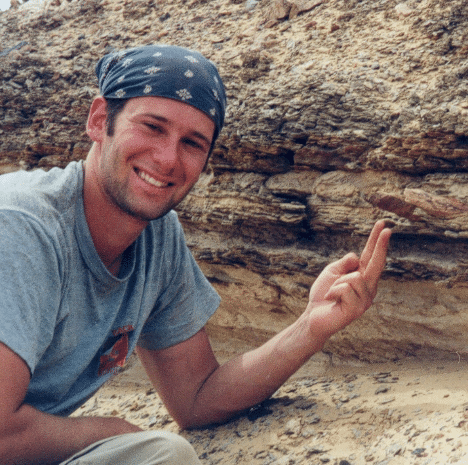
Here, Carnegie Museum of Natural History Mary R. Dawson Associate Curator of Vertebrate Paleontology Dr. Matt Lamanna is pointing at two ribs of a small—possibly baby—sauropod (long-necked plant-eating dinosaur) projecting from a rock face in the Bahariya Oasis of Egypt in 2001. He’d found this small sauropod only minutes before this photo was taken. Sometimes prospecting yields great finds! Credit: Mandi Lyon.
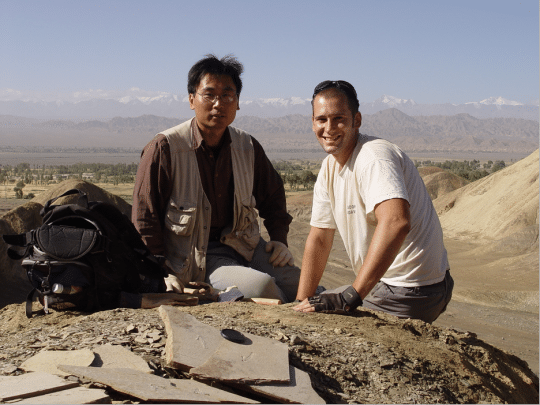
Dr. Matt Lamanna (right) on an expedition that found dozens of roughly 120-million-year-old fossil bird skeletons, mostly belonging to the species Gansus yumenensis, in the Changma Basin of Gansu Province, China in 2004. Lamanna is with collaborator Hailu You. Credit: Ken Lacovara.
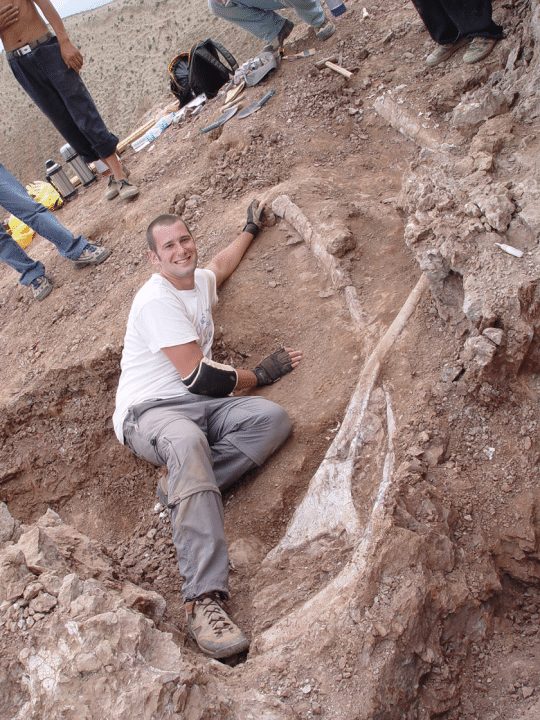
In this photo, also taken in 2004 in Gansu Province, China, Dr. Lamanna poses next to the ribs of a giant sauropod—these ribs were just part of the massive skeleton that was discovered. Credit: Hailu You.
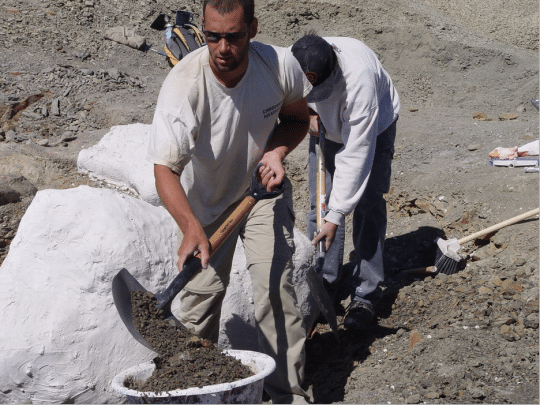
Dr. Lamanna on the expedition that found the new and gigantic titanosaur (a type of sauropod, again, a long-necked plant-eating dinosaur) Dreadnoughtus schrani in Santa Cruz Province, Argentina in 2005. Lamanna is shoveling loose rock out of the Dreadnoughtus quarry. Credit: Ken Lacovara.
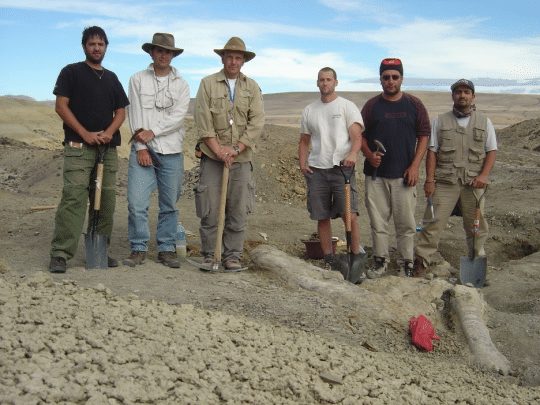
Members of the expedition from Drexel University, the Universidad Nacional de la Patagonia San Juan Bosco, and CMNH that found the giant titanosaur Dreadnoughtus in Santa Cruz Province, Argentina in 2005 (left to right: Lucio Ibiricu, Chris Coughenour, Ken Lacovara, Matt Lamanna, Marcelo Luna, and Gabriel Casal). The huge femur (thigh bone) and tibia (shin bone) of Dreadnoughtus are visible in the foreground. Credit: Matt Lamanna.
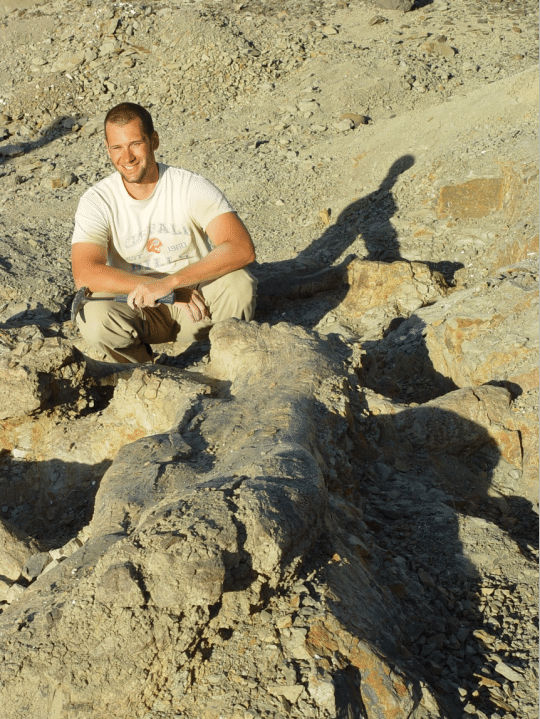
Dr. Lamanna on the expedition that found the titanosaur Dreadnoughtus in Santa Cruz Province, Argentina in 2005. He’s sitting behind the 1.91 m (6 ft 3 in) femur, or thigh bone, of Dreadnoughtus not long after its discovery. Credit: Chris Coughenour.
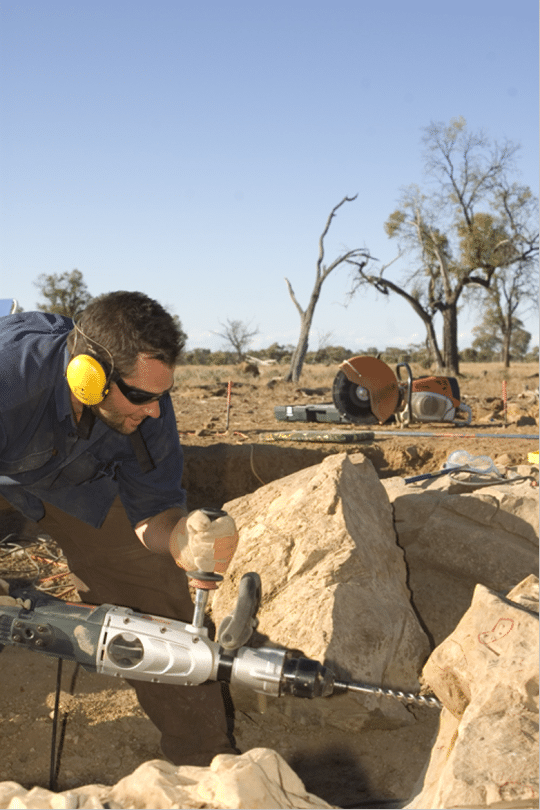
Here, Dr. Lamanna is using a rock drill (one of his very favorite field tools!) to help collect the skeleton of a new armored dinosaur in Queensland, Australia in 2008. Credit: Steve Salisbury.
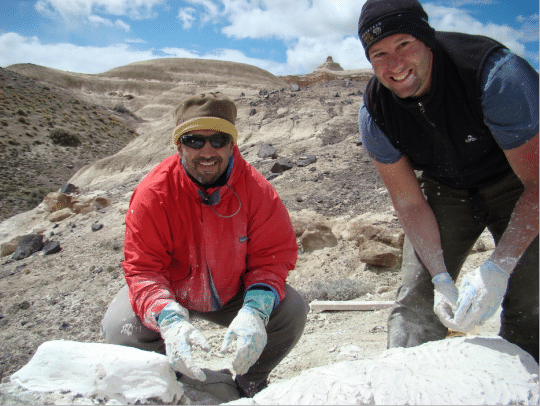
Dr. Lamanna (right) with collaborator Gabriel Casal making a plaster-and-burlap jacket to protect bones of the titanosaur Sarmientosaurus musacchioi in Chubut Province, Argentina in 2008. Credit: Mandi Lyon.
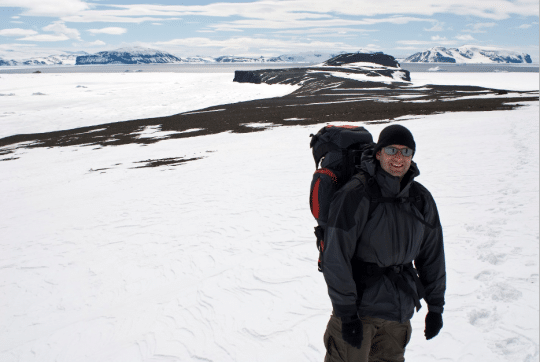
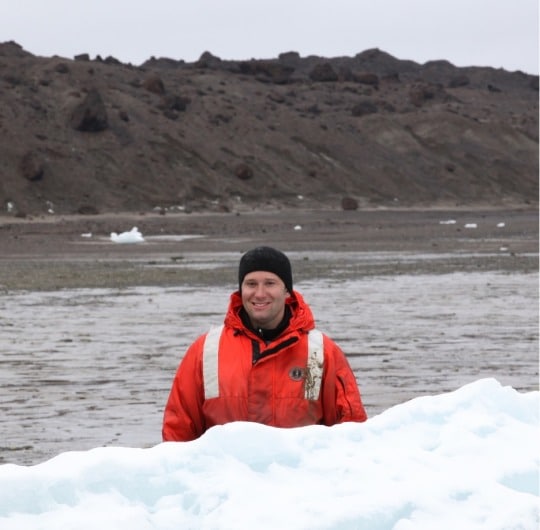
Lamanna on the day he found the only known fossil of the new, ~90-million-year-old crab Hadrocarcinus tectilacus on James Ross Island, Antarctica in 2009. Credit: Patrick O’Connor.
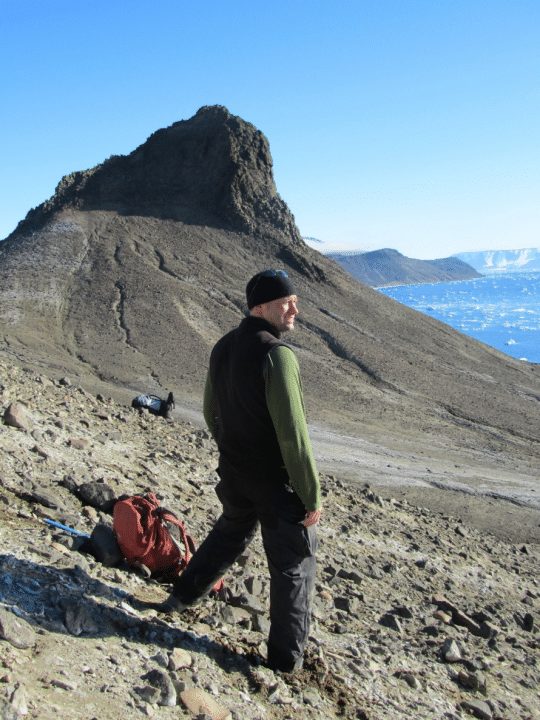
Here’s another photo of Lamanna on James Ross Island of Antarctica, this time in 2011. The team found tooth and bone fragments of the theropod—meat-eating dinosaur—Imperobator antarcticus at this site. Credit: Meng Jin.
During the 2011 Antarctic expedition, Lamanna and his fellow paleontologists also found lots of fossils on nearby Vega Island, especially those of approximately 70-million-year-old birds. Credit: Meng Jin.
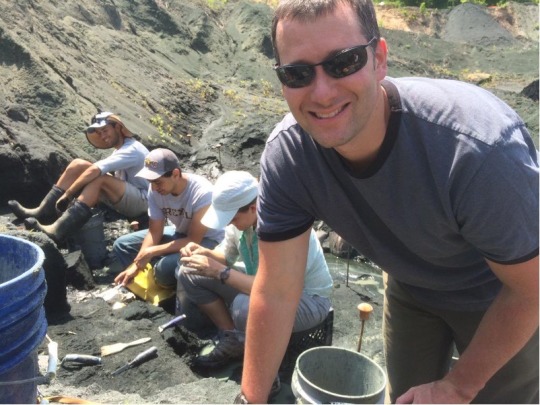
In this photo from 2015, Lamanna is shown collecting fossils in a New Jersey quarry with a research team from Drexel University, who were uncovering marine creatures from the very end of the Mesozoic Era. Credit: Ken Lacovara.

Jessica Sperdute is a Gallery Presenter II Floor Captain and Lead Animal Husbandry Specialist in CMNH’s Lifelong Learning Department. Museum staff, volunteers, and interns are encouraged to blog about their unique experiences and knowledge gained from working at the museum.

Related Content

The Strange Saga of Spinosaurus, the Semiaquatic Dinosaurian Superpredator

Dippy in Star Wars?

Ah, Snap! Dino Named for Marvel’s Thanos

Filed Under: Blog Tagged With: dinofest, dinosaurs in their time, Matt Lamanna, Scientist Takeover, Section of Vertebrate Paleontology, Super Science Days

September 14, 2020 by wpengine

The Strange Saga of Spinosaurus, the Semiaquatic Dinosaurian Superpredator

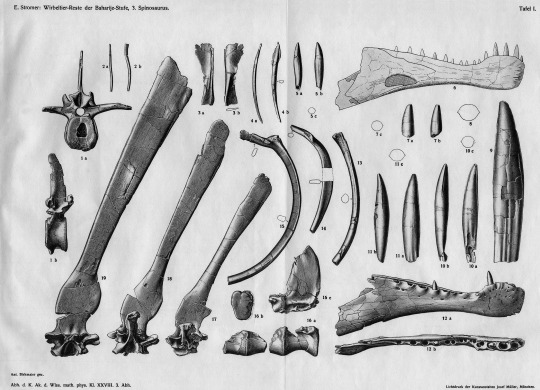
I’ve been captivated by dinosaurs for as long as I can remember. My parents tell me that I told them that I wanted to be a paleontologist as early as age four. Naturally, then, I had lots and lots of books about dinosaurs when I was a boy growing up during the 1980s. One of the dinosaurs that always fascinated me the most was Spinosaurus aegyptiacus. Found in 1912 in the Bahariya Oasis of the Western Desert of Egypt (could anyplace sound more exotic to a small-town kid from upstate New York?!), Spinosaurus was originally known from a highly incomplete but also very large and extremely distinctive partial skeleton found in a middle Cretaceous-aged (roughly 95-million-year-old) rock layer in the oasis. Among the few skeletal elements known were part of a strangely shaped (for a dinosaur) lower jaw, some crocodile-like teeth, and most strikingly, several back vertebrae that each sported tall spines, some of them measuring nearly six feet. These spines clearly impressed Ernst Stromer von Reichenbach, the German paleontologist who studied the skeleton and gave the animal its name in a 1915 publication. Tragically, however, that original Spinosaurus skeleton—and all of Stromer’s other dinosaur fossils from Egypt—were destroyed during the Second World War, more specifically in a British Royal Air Force bombing of Munich on April 24, 1944. The story of Stromer’s lost dinosaurs found its way into many a children’s book, including several that I read cover-to-cover. As such, the tale took on near-legendary status for me, and, I’m sure, many other young dinosaur enthusiasts around the world. Here was an absolutely extraordinary dinosaur from a faraway land, similar in size to the gargantuan Tyrannosaurus rex, but clearly very different from all other predatory dinosaurs known at the time – and it was represented only by a few teeth and bones that had been blasted into oblivion decades ago and so now existed only as pictures in books.

A scan of my photocopy of plate I of Ernst Stromer’s original 1915 publication on Spinosaurus aegyptiacus, showing some of the teeth and bones preserved in the holotype (= name-bearing) partial skeleton, discovered in 1912 in Egypt’s Bahariya Oasis. Check out the long spines on the back vertebrae at lower left!
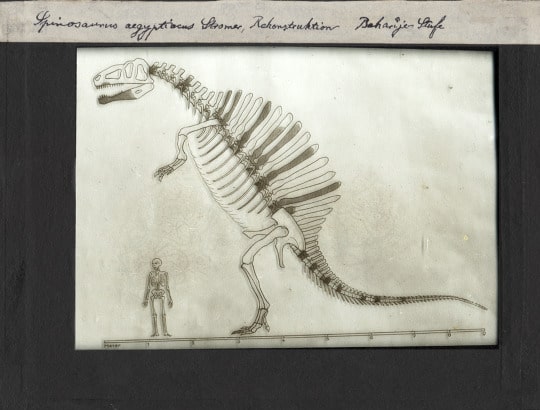
Stromer’s conception of Spinosaurus, as depicted in a 1936 publication and on a glass slide of his that colleagues of mine scanned during our visit to the Paläontologisches Museum München in Munich, Germany in 2001. Stromer knew this animal was big, as evidenced by the human skeleton he included for scale. Interestingly, too, he reconstructed Spinosaurus with unusual proportions for a carnivorous dinosaur, such as an abnormally elongate torso and short hind limbs. We’ll come back to those odd proportions a little later…

When I arrived in graduate school at the University of Pennsylvania in 1997, one of the first things I did was make a lengthy list of all the paleontological sites I was interested in exploring, ranked by their potential (in my mind, at least) to produce scientifically significant finds. The Bahariya Oasis and the search for a ‘replacement Spinosaurus’ quickly rose to the top of the list. Amazingly, no one had ever found—or at least officially reported—new dinosaur fossils in the oasis in the more than half-century since Stromer’s beasts were obliterated during that fateful airstrike. A need to keep this post to a reasonable length prevents me from describing the stars that had to align to make this happen, but in January 2000 I found myself in the Bahariya Oasis—one of the places I’d dreamed about going since I was a small child—as part of the first significant ‘dinosaur hunt’ to take place at the site since the early 20th century. It was bittersweet, though, in the sense that we never really found that ‘replacement Spinosaurus’ I’d fantasized about – all we ever discovered of that creature were a few isolated, fragmentary teeth and bones (and, in a very different location, a couple previously unpublished photos of the original skeleton in a Munich archive). We did find and dig up a gigantic new species of long-necked, plant-eating sauropod dinosaur, Paralititan stromeri, a creature that to this day is one of the largest land animals of any kind that’s ever been found, anywhere – but that’s another story for another time.

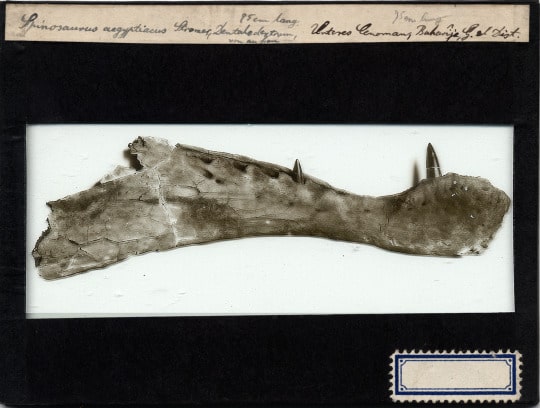
One of the rare contributions that I personally have made to scientific knowledge of Spinosaurus: a glass slide showing the only known photo of the right dentary (tooth-bearing lower jaw bone) of the original, name-bearing partial skeleton from Egypt. Like all of Stromer’s Egyptian dinosaur material, this specimen (including this bone) was destroyed in a British air raid on Munich during World War II. Several colleagues and I ‘rediscovered’ this photo—which nobody apparently knew existed—in an archive at the Paläontologisches Museum München in 2001. We published it and one other previously unknown photo of the Spinosaurus type specimen in a 2006 paper in the Journal of Paleontology.
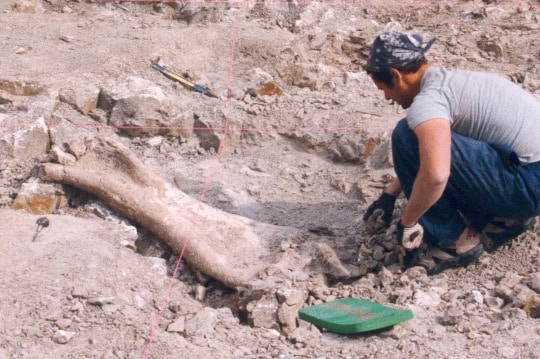
A much younger yours truly digging up the incomplete left humerus (upper arm bone) of the gigantic sauropod (long-necked herbivorous dinosaur) Paralititan stromeri in the Bahariya Oasis of Egypt, February 2000. Paralititan is one of the largest dinosaurs ever discovered – a nice ‘consolation prize’ given that we didn’t find much of Spinosaurus during our expeditions to Bahariya. (A cast replica of the complete right humerus of Paralititan is on display in PaleoLab at Carnegie Museum of Natural History.) Credit: Josh Smith.

Back to the matter at hand, meaning Spinosaurus. Fast-forward to 2011. I had the honor of serving as the external thesis examiner for Nizar Ibrahim, a promising doctoral student at University College Dublin in Ireland. I’d known Nizar for years, ever since he reached out to me by email while an undergraduate at the University of Bristol, England, to discuss our mutual interests in African Cretaceous dinosaurs. Nizar’s Ph.D. thesis was on dinosaurs and other middle Cretaceous-aged vertebrates from the celebrated Kem Kem beds of southeastern Morocco, a set of rocks that had yielded a fossil fauna very similar to, though seemingly more diverse than, that of the Bahariya Oasis. Among the many finds that Nizar documented in his colossal thesis were intriguing new remains of Spinosaurus. I went to Dublin to participate in his successful thesis defense, and afterward, he and I hit up some of the city’s finest public houses to celebrate (no surprise for those who know me). Over a pitcher of yummy Irish stout, he told me an exciting story – he and his team had lately discovered not just isolated bones of Spinosaurus in Morocco, but parts of a probable new skeleton. If so, this find would be the first skeleton since Stromer, and moreover would be exceedingly important given how little was known about Spinosaurus, even as recently as the early 2010s. The more parts we paleontologists have of a given fossil animal, the more we can generally learn about it, so the prospect of a new and relatively complete Spinosaurus skeleton—in other words, many bones belonging to a single individual dinosaur—was thrilling to say the least.

Again I’ll skip details for brevity’s sake, but fast-forward once again, to 2014. I was contacted by an editor of Science—one of the foremost scientific journals in the world—to peer-review a paper that had been submitted by (you guessed it!) Nizar and a long list of collaborators describing that new skeleton of Spinosaurus that he’d told me about over beers in Ireland three years before. Nizar and team had revisited the quarry and it had panned out in a big way. From this one, single individual Spinosaurus—again, the first associated skeleton of this dinosaur to have been found in roughly a century—they had bones from the skull, backbone (including a few of those famously long-spined vertebrae!), forelimb, pelvis, and hind limb. More importantly, these ‘new’ bones revealed that Spinosaurus was even more bizarre than anyone imagined! We already knew, from Stromer’s specimen and other, isolated finds made through the years, that the shapes of the skull and back were really weird for a predatory dinosaur. Now, the new skeleton showed that the bones were remarkably dense, the hind legs were oddly short, and the hind feet may have been webbed! All of this led Nizar and colleagues to propose that Spinosaurus may have been semiaquatic; in other words, that its lifestyle was much more comparable to that of a modern-day alligator or crocodile than it was to a more ‘typical’ land-living predatory dinosaur such as T. rex. Other evidence for an affinity to watery habitats had been found in Spinosaurus and closely related dinosaurs (known, perhaps unsurprisingly, as spinosaurids) before, but this was, in my mind, the most convincing case yet made that these animals spent significant amounts of their time at least partly submerged in lakes and rivers. The paper was published in Science a few months later, accompanied by a cover story in National Geographic magazine and a special on the venerable PBS TV series NOVA. Almost exactly one hundred years after it had been named, Spinosaurus had become a celebrity.

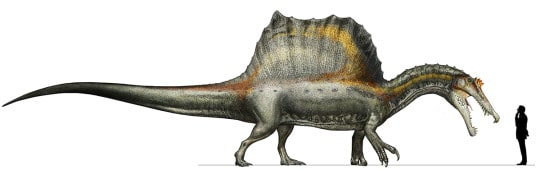
Nizar Ibrahim and colleagues’ initial conception of Spinosaurus aegyptiacus in the flesh, released to coincide with the publication of their Science paper in 2014. Two aspects stand out: as Stromer already knew (see his skeletal reconstruction above), the animal is enormous, but it was more oddly proportioned than even he had imagined. Note also the ‘regular-looking’ (for a dinosaur) tail, and read on. Credit: Davide Bonadonna.
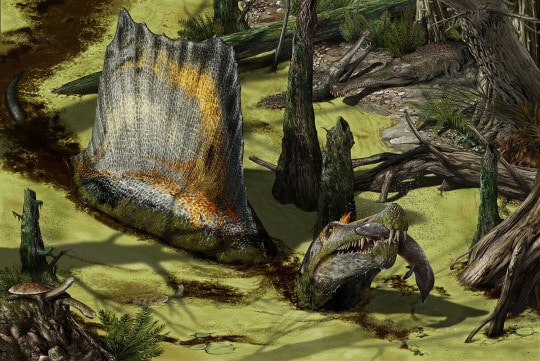
Semiaquatic Spinosaurus chowing down on a tasty lungfish in what is now northern Africa some 95 million years ago. Italian paleoartist Davide Bonadonna has produced some of the most beautiful and accurate modern depictions of this extraordinary dinosaur, and I’m grateful to him for letting me reproduce his art here.

But the story didn’t end there. Some prominent paleontologists criticized Nizar and colleagues’ semiaquatic interpretation of Spinosaurus. These opinions weren’t a final judgment. Instead, this is just how science works: we scientists propose ideas, or hypotheses—in this case, that Spinosaurus lived and behaved more like a crocodile than your garden-variety carnivorous dinosaur—and then test these hypotheses by reevaluating the existing evidence and/or bringing new information to light. If a hypothesis repeatedly stands up to testing, then it gradually gets incorporated into the body of knowledge. Other paleontologists presented evidence that they claimed refuted the semiaquatic hypothesis, but Nizar and team eventually countered with new data of their own. In late 2019, another prominent scientific journal—this time it was Nature—came calling, asking me to review a second paper by Nizar et al. on Spinosaurus. What, I thought, could these researchers have to say about this dinosaur that they hadn’t already said before? Well, as it turns out, Nizar and colleagues had kept digging at their Spinosaurus skeleton site, and incredibly, they’d continued to find important new bones belonging to the same specimen. Among these post-2014 finds was the almost complete tail. When I saw what it looked like (via an illustration in their paper), I literally laughed out loud with surprise and delight. Somehow, the shape of the Spinosaurus tail Nizar’s team had discovered—the first even reasonably complete tail of this dinosaur to have ever been unearthed—was simultaneously both unexpected and predictable. It looked really dissimilar from the tails of other predatory dinosaurs, but it was nearly exactly like what one might expect for a dinosaur that used its tail to propel itself through water. In other words, the tall, fin-like tail of Spinosaurus looked more like that of a supersized alligator or newt than that of T. rex.

Nizar and team’s Nature paper on their Spinosaurus tail was published this past April 29. Is it the last word on this dinosaur and its mode of life? Most certainly not, but the evidence is now stronger than ever—in my opinion, very strong—that Spinosaurus spent more time in the water than any other non-avian (= non-bird) dinosaur that we currently know about.

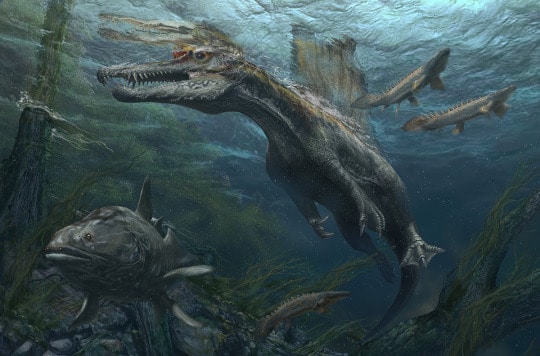
The modern view of Spinosaurus, not as a ‘regular’ predatory dinosaur, but rather as a specialized semiaquatic hunter that spent much of its life in the water. Self-serving side note: the three smaller, spiky-looking fish are Bawitius bartheli, a polypterid (an archaic, still-extant group of thick-scaled ray-finned fishes) that several colleagues and I named in 2012 from fossils found in the Bahariya Oasis. The larger fish at lower left is the giant coelacanth Axelrodichthys (sometimes called Mawsonia) libyca. Credit: Davide Bonadonna.
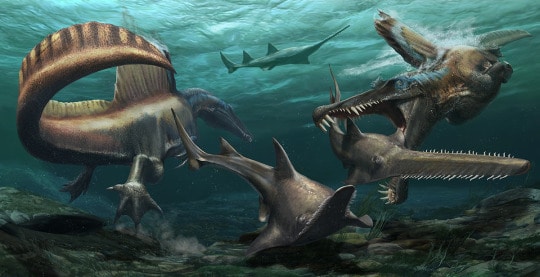
Two Spinosaurus invite the sawfish Onchopristis numidus to lunch in what’s now northern Africa some 95 million years ago. Look at those fin-like Spinosaurus tails! Credit: Davide Bonadonna/National Geographic.

Nizar (who’s a Research Associate here at Carnegie Museum of Natural History), myself, and our many colleagues and collaborators are continuing to study the mysterious dinosaurs and other fossil vertebrates from the middle and Late Cretaceous of northern Africa. Indeed, Nizar and I have several collaborative papers in the works right now, and I’m also working with an amazing team of paleontologists at Mansoura University on multiple new Egyptian fossil finds. It’s a good bet that African Cretaceous dinosaurs even stranger than Spinosaurus are still out there, waiting to be discovered!

Further reading/watching:

Nothdurft, W. E., with J. B. Smith, M. C. Lamanna, K. J. Lacovara, J. C. Poole, and J. R. Smith. 2002. The Lost Dinosaurs of Egypt. Random House, New York, 256 pp.

Smith, J. B., M. C. Lamanna, H. Mayr, and K. J. Lacovara. 2006. New information regarding the holotype of Spinosaurus aegyptiacus Stromer, 1915. Journal of Paleontology 80:400–406.

Ibrahim, N., P. C. Sereno, C. Dal Sasso, S. Maganuco, M. Fabbri, D. M. Martill, S. Zouhri, N. Myhrvold, and D. A. Iurino. 2014. Semiaquatic adaptations in a giant predatory dinosaur. Science 345:1613–1616.

Bigger Than T. rex (NOVA documentary): https://www.pbs.org/wgbh/nova/video/bigger-than-t-rex/

Henderson, D. M. 2018. A buoyancy, balance and stability challenge to the hypothesis of a semi-aquatic Spinosaurus Stromer, 1915 (Dinosauria: Theropoda). PeerJ 6:e5409.

Ibrahim, N., S. Maganuco, C. Dal Sasso, M. Fabbri, M. Auditore, G. Bindellini, D. M. Martill, S. Zouhri, D. A. Mattarelli, D. M. Unwin, J. Wiemann, D. Bonadonna, A. Amane, J. Jakubczak, U. Joger, G. V. Lauder, and S.E. Pierce. 2020. Tail-propelled aquatic locomotion in a theropod dinosaur. Nature 581:67–70.

Matt Lamanna is Mary R. Dawson Associate Curator and Head of the Section of Vertebrate Paleontology at Carnegie Museum of Natural History. Museum staff, volunteers, and interns are encouraged to blog about their unique experiences and knowledge gained from working at the museum.

Related Content

Mesozoic Monthly: Gryposaurus

Behind the Scenes of Dinosaur Armor

Egypt and the Nile

Filed Under: Blog Tagged With: dinofest, dinosaurs in their time, Matt Lamanna, Museum from Home, Science News, Section of Vertebrate Paleontology

August 24, 2020 by wpengine

Mesozoic Monthly: Gryposaurus

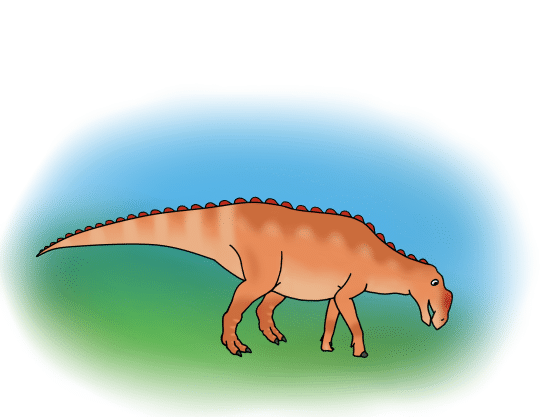
The Late Cretaceous-aged (~75 million-year-old) large-nosed North American hadrosaur (aka duck-billed dinosaur) Gryposaurus by ginjaraptor on DeviantArt.

Anyone who frequents the Pittsburgh area is familiar with ‘Pittsburghese,’ the regional dialect given full voice in what was once voted America’s ugliest accent (a fact that does not diminish our pride for it). One of my personal favorite Pittsburghese words is “nebby,” which translates to “nosy” for any non-local readers. “Nebby” can be used in a variety of contexts: the distant relative asking prying questions about your love life at Thanksgiving dinner is nebby, the pet cat trying to crawl under the bathroom door to see what you’re doing is nebby, and even the statue of Carnegie Museum of Natural History mascot Dippy the Diplodocus, silently judging your driving on Forbes Avenue, is nebby. We can assume other dinosaurs were nebby too, since so many had huge noses to stick into things. One of the biggest noses in the fossil record belongs to Gryposaurus notabilis, the star of this edition of Mesozoic Monthly.

Gryposaurus belongs to a group of dinosaurs called hadrosaurs, which are commonly referred to as duck-billed dinosaurs. Hadrosaurs were herbivores that got their nickname from the flat, toothless, somewhat duck-like beaks at the tips of their jaws. These beaks were used to bite through tough vegetation so that it could be ground up by the numerous teeth embedded in the rear half of the jaws. There are two main groups of hadrosaurs, both of which are featured in CMNH’s Dinosaurs in Their Time exhibition. Probably the more famous group is the Lambeosaurinae, known for their distinctive head crests that housed extra-long nasal passages. Virtually everyone can recognize the incredible backward-curving crest of Parasaurolophus (featured multiple times in the Jurassic Park franchise), and visitors to CMNH will also know the helmet-like crest of Corythosaurus. The second group is the Saurolophinae (traditionally known as the Hadrosaurinae), which typically lack bony crests. You can find a simulated carcass of the saurolophine Edmontosaurus (lovingly known to those of us in CMNH’s Section of Vertebrate Paleontology as “Dead Ed”) between the two imposing Tyrannosaurus skeletons in Dinosaurs in Their Time.

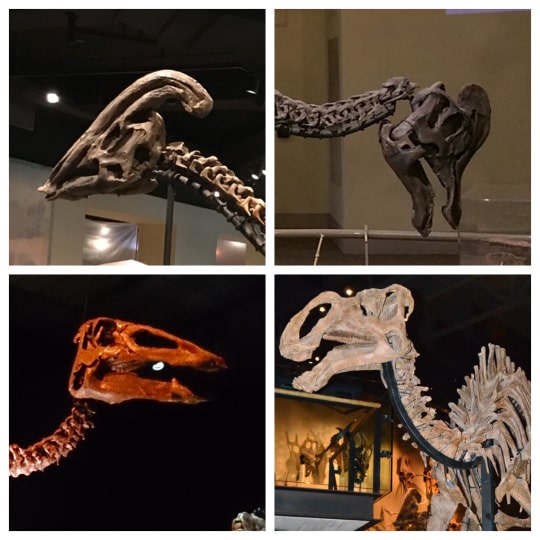
A gallery of hadrosaur heads. Top left: the lambeosaurine Parasaurolophus at the Field Museum of Natural History in Chicago (photo by the author). Top right: the lambeosaurine Corythosaurus at Carnegie Museum of Natural History (photo from Wikimedia Commons). Bottom left: the saurolophine Edmontosaurus at the Houston Museum of Natural Science (photo from Wikimedia Commons). Bottom right: the saurolophine Gryposaurus at the Natural History Museum of Utah in Salt Lake City (photo from Wikimedia Commons).

As a crestless hadrosaur, Gryposaurus was a saurolophine. Despite its lack of crest, its skull still had pizzazz: its nasal bone arched dramatically, giving the impression of a ‘Roman nose’ (which is very noticeable if you compare the skulls of Edmontosaurus and Gryposaurus in the image above). The name Gryposaurus notabilis means “notable hooked-nose lizard” in homage to this feature. G. notabilis is the type species of Gryposaurus; type species are typically the first ones to be named in a genus, and therefore become the reference to which all new specimens that may belong to that genus are compared. The other species (such as G. monumentensis, shown in the photo montage above) are similar enough to the type species that they can be referred to the genus Gryposaurus, but they differ in too many ways to be assigned to G. notabilis itself.

Occasionally, paleontologists will revisit a fossil species or genus and decide that it is either too similar to another to justify its own name or that certain specimens are too different to be grouped under the same name. Kritosaurus, another saurolophine with a ‘Roman nose,’ has fallen victim to both of these circumstances. It was originally considered its own genus, but was subsequently revisited by paleontologists who decided that it was so similar to Gryposaurus that the two genera were lumped together under the name Gryposaurus (when combining taxonomic groups, the first name that was published is the one that gets used). However, later paleontologists reviewed the evidence again and split a single species of Kritosaurus back out of Gryposaurus. The famous sauropod (giant long-necked herbivorous dinosaur) Brontosaurus underwent a similar series of changes over the years: originally, it and Apatosaurus were considered different animals, but after a review they were lumped together under Apatosaurus. Recently, the two were split apart again and the name Brontosaurus was revived (to the delight of fans of that name around the world).

It is not uncommon in paleontology for species to be lumped or split based on new or revisited evidence. When you consider that the decision to name new fossil species is often based on fragmentary, highly incomplete skeletons, you can see why it might be difficult to get things right the first time! These changes sometimes give people the impression that paleontologists “can’t make up their minds” or “contradict themselves,” but we must remember two things. First, that science is meant to change based on new evidence. Second, there have been thousands of paleontologists over the course of history, and every one of them is an individual person who can draw their own conclusions based on the same evidence. Although the resulting changes can disappoint fans of a specific animal or hypothesis, revision is normal and beneficial for the field as a whole. Scientists are supposed to be nebby – it’s how we make new discoveries!

Lindsay Kastroll is a volunteer and paleontology student working in the Section of Vertebrate Paleontology at Carnegie Museum of Natural History. Museum staff, volunteers, and interns are encouraged to blog about their unique experiences and knowledge gained from working at the museum.

Related Content

Mesozoic Monthly: Aspidorhynchus

Ah, Snap! Dino Named for Marvel’s Thanos

Jurassic Days: Specimen Scavenger Hunt

Filed Under: Blog Tagged With: dinosaurs in their time, Educator Resources, Lindsay Kastroll, Mesozoic Monthly, Museum from Home, Science News, Section of Vertebrate Paleontology

August 21, 2020 by wpengine

The Bromacker Fossil Project Part IX: The Dissorophoid Amphibians Tambachia, Rotaryus, and Georgenthalia, Capable Travelers

New to this series? Read The Bromacker Fossil Project Part I, Part II, Part III, Part IV, Part V, Part VI, Part VII, and Part VIII.

The Dissorophoidea are a group of ancient amphibians that were common about 290 million years ago, when the animals fossilized in the Bromacker quarry were alive. The group consists of small to medium-sized water- and land-dwelling vertebrates (animals with backbones) that ate invertebrates (e.g., dragonflies, cockroaches, and millipedes) and vertebrates smaller than themselves. Most scientists agree that modern amphibians (frogs, salamanders, and the reclusive, worm-like, subterreanean caecilians) had their origins among the dissorophoids. Three disssorophoid species are currently known from the Bromacker quarry, and at least one and possibly two more are yet to be described. Two of the described species, Tambachia trogallas and Rotaryus gothae, are members of the dissorophoid subgroup Trematopidae, and the other, Georgenthalia clavinasica, is a member of the subgroup Amphibamiformes. All of them inhabited the terrestrial realm and most likely only returned to water to breed.

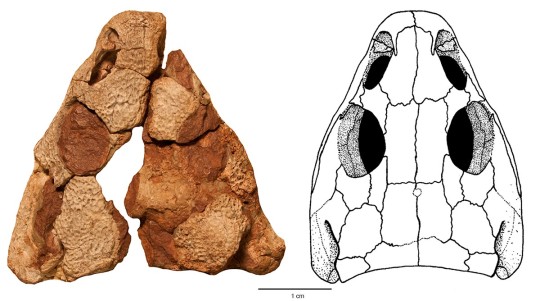
Photograph (left) and reconstruction (right) of the skull of the holotype and only known specimen of Tambachia trogallas in dorsal (= top) view. Photograph by the author (2013) and reconstruction by Stuart Sumida, modified from Sumida et al. (1998).

The first trematopid discovered in the Bromacker quarry was found by Thomas Martens in 1980, and it is represented by a poorly preserved skull and skeleton. Stuart Sumida, as lead author of the scientific paper presenting it, coined the name Tambachia trogallas. Tambachia refers to the Tambach Formation, the rock unit preserving the Bromacker fossils, which in turn is named after the nearby village of Tambach, which is now merged with the adjacent town Dietharz to become Tambach-Dietharz. “Trogallas” is from the Greek “trogo,” meaning munch or nibble, and “allas,” meaning sausage, in reference to all of the bratwurst consumed during Bromacker field seasons by the authors of the Tambachia publication (Stuart, Dave Berman, and Thomas). The state where the the quarry is located, Thuringia, is famous for its bratwurst and rightly so. A hot bratwurst for lunch was always welcomed when we experienced what Thomas called “Scandanavian summers,” which were cold and rainy. The then-Bürgermeister (mayor) of Tambach-Dietharz, who also was a butcher, was so thrilled by the name that he hosted an annual bratwurst lunch featuring brats that he’d made. This tradition was carried on by subsequent Bürgermeisters, though they had to buy the featured main course.

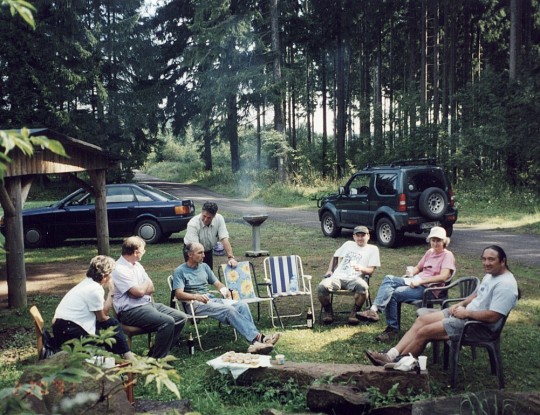
Bratwurst lunch in the Thuringian Forest close to the Bromacker quarry. Seated are (from left to right) unknown, Rainer Samietz (then Director of the Museum der Natur Gotha, now retired), Thomas Martens, Johannes Müller (then field assistant and now Professor at Museum für Naturkunde, Berlin), the author, and Stuart Sumida. The Bürgermeister is standing behind Thomas. His bratwurst grill, which he transported in his SUV, is between the vehicles. Photo by Dave Berman (2002).
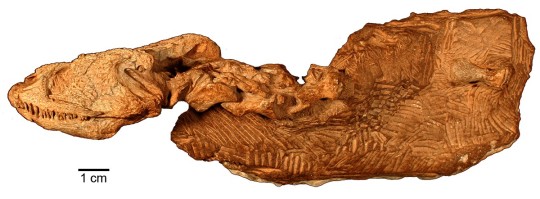
Skull and partial skeleton of Rotaryus gothae in left lateral (= side) view. Photograph by the author, 2008.

When Rotaryus gothae was found in 1998, only part of the skull was exposed, so we took out a large block expecting a complete skeleton to be preserved, as typically occurs at the Bromacker. Once I began preparing the specimen, however, I was extremely disappointed to find that only a small portion of the body of the animal was present. At least we had the skull, the most scientifically important part of the skeleton. Dave led the scientific study of Rotaryus, and he named it in honor of the Gotha Rotary Club, an organization that generously provided financial support for Bromacker fieldwork. Dave sent the head of the Gotha Rotary Club three choices for the fossil’s name, and the members voted on which one to use.

At the time that Tambachia and Rotaryus were named and described in scientific publications in 1998 and 2011, respectively, trematopids were known only from the USA. Their presence at the Bromacker added to the growing list of animals previously thought to only inhabit North America, such as Diadectes and Seymouria. In hindsight, it is not surprising that trematopids also had a more cosmopolitan distribution, because although they are amphibians, their skeletons were strong enough to support their body out of water and withstand the effects of gravity, thus enabling them to disperse to far corners of the world (though hypotheses of such dispersal assume that no physical or climatic barriers prevented movement).

I was the lucky person who discovered, in 2002, the amphibamiform Georgenthalia clavinasica. I recall lifting up a block of rock that I had loosened with a hammer and chisel and seeing two ghostly eye openings staring back at me. The rest of the skeleton was preserved with the skull, but unfortunately all bone beyond the skull was extremely eroded from groundwater and had the consistency of mashed potatoes.

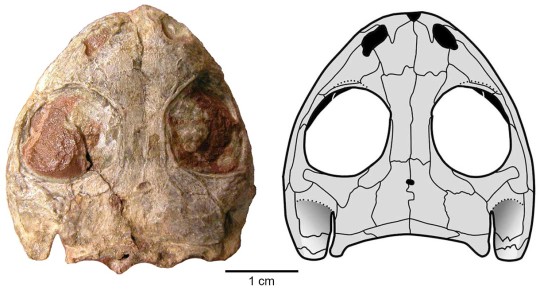
Photograph (left) and reconstruction (right) of the skull of Georgenthalia clavinasica in dorsal (= top) view. Both by Jason Anderson, 2007.

After Tambachia was named, the Bürgermeister of the nearby village of Georgenthal, whose boundaries included the Bromacker quarry, approached Dave about naming a fossil after his village. Dave then asked Jason Anderson, a colleague from the University of Calgary and the project’s lead researcher, to name it Georgenthalia. Jason created clavinasica from the Latin “clavis” for key, and “nasica” for nostril, in reference to the fossil’s keyhole-shaped nostril, a unique feature that differentiates Georgenthalia from all other amphibamiforms.

Jason, as lead author of a 2008 scientific publication, concluded that the relationship of Georgenthalia to other amphibamiforms was uncertain. Computer algorithms are used to analyze relationships of organisms by tabulating the proportion of unique characteristics shared between the members of the group under study. A group of organisms that share unique characters is called a clade, and members of a clade are considered to be more closely related to each other than they are to members of other clades. These relationships are depicted in a diagram of relatedness called a cladogram.

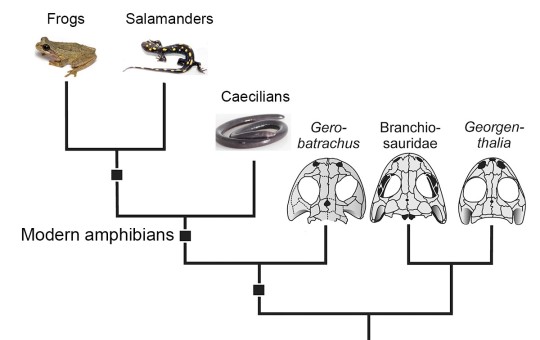
A 2019 study by dissorophoid expert Rainer Schoch (Curator, Naturkunde Museum Stuttgart) that investigated the ancestry of modern amphibians revealed Georganthalia as a member of a clade that also includes modern amphibians (see figure below). The fossil Gerobatrachus, however, is more closely related to modern amphibians than it is to the clade consisting of Georgenthalia and Branchiosauridae (a group of aquatic amphibamiforms). This indicates that although Georgenthalia (along with Branchiosauridae) is in the clade containing modern amphibians, it is not directly ancestral to them.

Cladogram showing the relationship of Georgenthalia (far right) to modern amphibians. Cladogram modified from Schoch (2019); images of modern amphibians from Wikimedia Commons.

Stay tuned for my next post, which will feature yet another terrestrial amphibian, a fossil from a locality in Tambach-Dietharz.

If you would like to learn more about Tambachia, Rotaryus, or Georgenthalia, please follow the links below.

Tambachia

Rotaryus

Georgenthalia

Amy Henrici is Collection Manager in the Section of Vertebrate Paleontology at Carnegie Museum of Natural History. Museum employees are encouraged to blog about their unique experiences and knowledge gained from working at the museum.

Keep Reading

The Bromacker Fossil Project Part X: Tambaroter carrolli, an Amphibian with a Wedge-Shaped Head 

Filed Under: Blog Tagged With: Amy Henrici, Museum from Home, Science News, Section of Vertebrate Paleontology, The Bromacker Fossil Project, Vertebrate Paleontology

  • Page 1
  • Page 2
  • Go to Next Page »

sidebar

About

  • Mission & Commitments
  • Directors Team
  • Museum History

Get Involved

  • Volunteer
  • Membership
  • Carnegie Discoverers
  • Donate
  • Employment
  • Events

Bring a Group

  • Groups of 10 or More
  • Birthday Parties at the Museum
  • Field Trips

Powdermill

  • Powdermill Nature Reserve
  • Powdermill Field Trips
  • Powdermill Staff
  • Research at Powdermill

More Information

  • Image Permission Requests
  • Science Stories
  • Accessibility
  • Shopping Cart
  • Contact
  • Visitor Policies
One of the Four Carnegie Museums | © Carnegie Institute | Privacy Policy | Terms of Use | Accessibility
Rad works here logo