• Skip to primary navigation
  • Skip to main content
  • Skip to primary sidebar

Carnegie Museum of Natural History

One of the Four Carnegie Museums of Pittsburgh

  • Visit
    • Buy Tickets
    • Visitor Information
    • Exhibitions
    • Events
    • Dining at the Museum
    • Celebrate at the Museum
    • Powdermill Nature Reserve
    • Event Venue Rental
  • Learn
    • Field Trips
    • Educator Information
    • Programs at the Museum
    • Bring the Museum to You
    • Guided Programs FAQ
    • Programs Online
    • Climate and Rural Systems Partnership
  • Research
    • Scientific Sections
    • Science Stories
    • Science Videos
    • Senior Science & Research Staff
    • Museum Library
    • Science Seminars
    • Scientific Publications
    • Specimen and Artifact Identification
  • About
    • Mission & Commitments
    • Directors Team
    • Museum History
  • Tickets
  • Give
  • Shop

City Nature Challenge

April 7, 2021 by wpengine

Cities are Not Biological Deserts

by Nicole Heller

Cities are increasingly important in organizing the experience of people and their interactions with nature. In 1950 there were 2.5 billion people on Earth and 30% lived in cities. Today, there are 7.5 billion people and 55% live in cities. By 2050, there will be an estimated 9.5 billion and 68% will live in cities.

Generally, cities are not good places for other critters to live. The abundance of pavement, buildings, traffic, pollution, pesticides, herbicides, and other hazards make cities really hard places for plants and animals to survive and breed. From a conservation science perspective, cities have long been considered dead spaces, or biological deserts. But more recently researchers are paying more attention to nature in cities. One reason for their interest involves people’s need for nature. Study after study confirms the basic biophilia hypothesis, that people want to associate with nature; they are happier and healthier when they are near plants and animals in their daily lives.

Berlin is recognized as a city that works for people and biodiversity due to its high percentage of green space, variety of habitats, and thoughtful regional planning. Photo by Filipe Varela on Unsplash.

Cities have also drawn the attention of researchers because of some really exciting things are happening within their limits, such as growing populations of peregrine falcons , sightings of rare birds using cities parks during annual migrations, and even discoveries of new species not previously known to science. While cities are overall negative for biodiversity, recent research findings raise important questions: Can human cities be good for non-humans too? Can urban wildlife include a broader spectrum of creatures beyond the common city-adapted species like European sparrows, pigeons, and black rats? What about species special or unique to the regions in which cities are located? How can we make cities work for biodiversity?

A few years ago I posed these questions along with colleagues from the Resilient Landscape program at the San Francisco Estuary Institute. We wanted to learn if there were general lessons that could be distilled from recent and ongoing research projects about what kinds of species can benefit from cities and if so how might city planners utilize this information to prioritize actions that would help cities contribute positively to the resilience of regional biodiversity, or at least do more to diminish the negative impacts.

Earlier this year, some of our findings were published open source in the journal Bioscience, The Biological Deserts Fallacy: Cities in Their Landscapes Contribute More than We Think to Regional Biodiversity, by Erica N Spotswood, Erin E Beller, Robin Grossinger, J Letitia Grenier, Nicole E Heller, Myla F J Aronson.

The study, which includes citations from dozens of regional research projects around the world, identifies five pathways by which cities can help regional biodiversity. “Cities can benefit some species by releasing them from threats in the larger landscape, increasing regional habitat heterogeneity, acting as migratory stopovers, enhancing regional genetic diversity and providing selective forces for species to adapt to future conditions under climate change (e.g., a phenomenon we are calling preadapting species to climate change), and enabling and bolstering public engage­ment and stewardship.”

Each of these pathways is described in greater detail in the study. Four categories of species commonly utilize urban habitat, with varying degrees of success, and the study explores examples of how specific species in specific places demonstrate these five pathways.
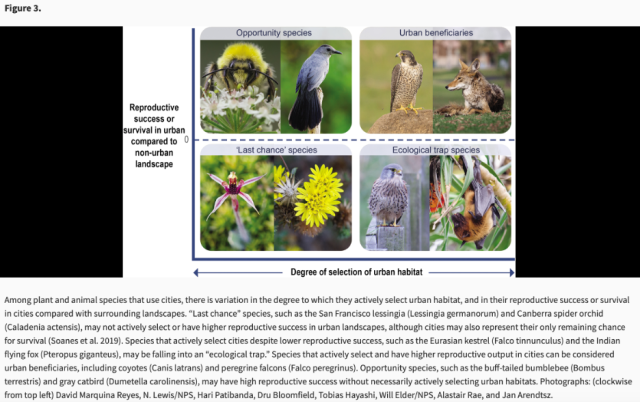
screen grab of a figure from a paper with birds and flowers

Overall, the role of cities in supporting landscape-scale biodiversity is an understudied area of research. As cities continue to grow in number and size, human populations rise, and climate change continues, paying attention to the experience of other critters, and how we can make space for them to survive and thrive in anthropogenic habitats, will be more important than ever. This research identifies opportunities to reconcile cities with biodiversity. Opportunities exist to learn more about the unique resources that cities can provide, which specific types of species can take advantage of these resources, and how this information can be incorporated into city plans for parks and green spaces. The San Francisco Estuary Institute has begun this applied work in their report Making Nature’s City, which presents a science-based framework for increasing biodiversity in cities.

What excites me are possibilities if we really try. For the most part cities have been developed with little or no concern for biodiversity. Often people think that humans and nature just can’t coexist. What if city planners and conservation professionals start applying these lessons from ecology more broadly and work together with citizens to deliberately steward biodiversity in cities? How abundant and rich with diverse life could cities become? How happy would that make humans? I wonder. And I am hopeful.

If you are interested in urban nature, you can help to measure its diversity by participating in the museum’s upcoming City Nature Challenge. You never know what you may find in our city. Our combined observations, coupled with the museum’s collections and records, will provide important benchmarks to help track how local species are doing as the region keeps growing and changing in the 21st century.

Full Article Citation

The Biological Deserts Fallacy: Cities in Their Landscapes Contribute More than We Think to Regional Biodiversity By ERICA N. SPOTSWOOD , ERIN E. BELLER, ROBIN GROSSINGER, J. LETITIA GRENIER, NICOLE E. HELLER, AND MYLA F. J. ARONSON BioScience, Volume 71, Issue 2, February 2021, Pages 148–160, https://doi.org/10.1093/biosci/biaa155

Nicole Heller is Curator of Anthropocene Studies at the Carnegie Museum of Natural History. Museum employees are encouraged to blog about their unique experiences working at the museum.

Related Content

Teaching About Local Wildlife with the City Nature Challenge

Air Quality and Urban Gardening

Introducing the Anthropocene Living Room

Carnegie Museum of Natural History Blog Citation Information

Blog author: Heller, Nicole
Publication date: April 7, 2021
Share this post!

  • Share on Twitter Share on Twitter
  • Share on Facebook Share on Facebook
  • Share on Pinterest Share on Pinterest
  • Share on LinkedIn Share on LinkedIn
  • Share on Reddit Share on Reddit
  • Share via Email Share via Email

Share this post!

  • Share on Twitter Share on Twitter
  • Share on Facebook Share on Facebook
  • Share on Pinterest Share on Pinterest
  • Share on LinkedIn Share on LinkedIn
  • Share on Reddit Share on Reddit
  • Share via Email Share via Email

Filed Under: Blog Tagged With: Anthropocene, City Nature Challenge, Nicole Heller, Science News, We Are Nature 2

April 7, 2021 by wpengine

Teaching About Local Wildlife with the City Nature Challenge

by Patrick McShea

Join the Challenge April 25-28, 2025

The sixth-grade student took the time to study a taxidermy mount from multiple angles before she approached with a question. “Is that Raticate?” she asked, pointing back at the lifelike preserved muskrat that had drawn her across the school cafeteria to the table promoting museum resources.

Raticate, she explained to my quizzical look, is a Pokémon creature. When she held up her phone, I conceded a striking resemblance between the cartoon-like beast filling the small screen and the sleek-furred stuffed rodent a few feet away. I then explained how the preserved muskrat represents a very real and relatively common mammal, one that in some seasons might be observable in the cattail-edged margins of Schenley Park’s Panther Hollow Lake, a location within a mile of where we stood.

The event, 14 months ago, was an evening meeting of a parent’s council at Pittsburgh Science and Technology Academy. Although I spoke with dozens of parents during my two-hour visit, the information exchange with the student remains a clear memory because it reinforced a research paper I read days earlier.

A study published in 2002 found primary school students in the United Kingdom knew far more about Pokémon creatures than they knew about local wildlife. (Why conservationists should heed Pokémon. Balmford A, Clegg L, Coulson T, Taylor, Science 29 Mar 2002) If the study’s findings remain valid nearly twenty years later, museum strategies to counter them have become more innovative, collaborative, and purposeful. The primary example of these ongoing efforts is an upcoming event known as the City Nature Challenge.

What is the City Nature Challenge?

The City Nature Challenge (CNC), coming up April 25–28, 2025, is an international effort for people to document plants and wildlife in metropolitan areas across the globe. (The Pittsburgh Region’s six county territory for the CNC includes Allegheny, Armstrong, Beaver, Butler, Westmoreland, and Washington Counties.) The event is a bioblitz-style competition with cities competing on several measurable fronts, including the number of participants, the sum total of recorded observations, and the total number of identified species. The technology enabling broad participation and accurate data compilation in this vast observational effort is the free app, iNaturalist, utilized through the same common device by which I first glimpsed Raticate, a smartphone.

iNaturalist and City Nature Challenge History

iNaturalist, originally developed as the Master’s Final Project of Nathan Agrin, Jessica Kline, and Ken-ichi Ueda at University of California at Berkeley’s School of information, is now a joint initiative of the California Academy of Sciences and the National Geographic Society. As the initiative’s website explains, “iNaturalist is an online social network of people sharing biodiversity information to help each other learn about nature.”

The City Nature Challenge also has California roots, beginning in 2016 as a Los Angeles versus San Francisco contest by citizen science staff at the Natural History Museum of Los Angeles County and California Academy of Sciences. These two institutions continue to as the principal organizers for the global effort, and in 2021, more than 400 cities across the globe are expected to participate in the competition.

2021 marked the fourth consecutive year for Carnegie Museum of Natural History to serve as one of CNC’s city organizer agencies. Partner organizers for 2021 were the Pittsburgh Parks Conservancy and the Pennsylvania Alliance of Environmental Educators. An online workshop for teachers and other educators to promote student participation in early March helped groups get an early start and a regularly updated web page contains current information about the event.

How to Participate in City Nature Challenge

If spending some time later this spring documenting the plants, animals, and fungi sounds interesting, please visit our City Nature Challenge page to learn how you can participate with the museum in the Pittsburgh region. We offer resources for educators, groups, and individuals interested in the annual bioblitz.

After the April 25–28 documentation phase, comes a vital second phase to the CNC that you might be able to support: identification of the photographed species. The identifications will be crowd-sourced through the online community April 29–May 1 still using the iNaturalist app. 

Patrick McShea works in the Education and Visitor Experience department of Carnegie Museum of Natural History. Museum employees are encouraged to blog about their unique experiences and knowledge gained from working at the museum.

Related Content

Spring Birds in Your Backyard

Collected on This Day in 1998: Common Chickweed

Joining the iNaturalist Team!

Carnegie Museum of Natural History Blog Citation Information

Blog author: McShea, Patrick
Publication date: April 7, 2021
Share this post!

  • Share on Twitter Share on Twitter
  • Share on Facebook Share on Facebook
  • Share on Pinterest Share on Pinterest
  • Share on LinkedIn Share on LinkedIn
  • Share on Reddit Share on Reddit
  • Share via Email Share via Email

Filed Under: Blog Tagged With: City Nature Challenge, Education, Educator Resources, Pat McShea, Patrick McShea

March 24, 2021 by wpengine

Spring Birds in Your Backyard

by Annie Lindsay

On spring mornings that I’m not banding birds, I like to sit on my back porch with my binoculars, watching for movement at the edge of the woods behind my house, keeping my ears tuned in to songs and short, usually high-pitched, chip and contact notes. On mornings following a night of heavy migration, small flocks of mixed species often move through the trees, feeding on insects as they refuel for the next stage of migration. These flocks often have warblers, thrushes, tanagers, grosbeaks, or sparrows foraging in their own niches: warblers tend to be in mid- to high-canopy, whereas thrushes stay low and sparrows are often on the ground.

Occasionally, I’ll stand outside in a quiet, dark spot just before dawn and listen for the soft, high-pitched flight calls of migrants settling into habitat after a night of flying. I’m an avid birder: I love to see both new and familiar birds, and watch the species that use my yard and favorite birding patches.

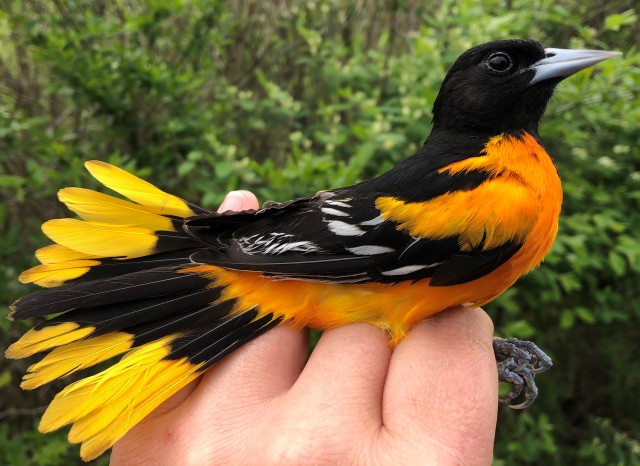
Baltimore Orioles arrive in southwest PA by mid-to late-April. Providing fresh orange halves on spikes can bring them to your feeders from spring through fall migration.

Last year, many people discovered birding. We spent much of the spring working from home, perhaps gazing out of our windows at our bird feeders or backyard plants, and for the first time noticed birds that we didn’t know existed or didn’t realize visited our yards. The opportunity to learn about the diversity of birds in our area and develop a passion for watching them was a bright spot (both literally and metaphorically!) in an otherwise difficult year. The seasons progressed, and now we once again eagerly anticipate the arrival of beautiful and colorful migratory songbirds. Let’s explore common spring backyard birds in southwest Pennsylvania and how to attract and find them!

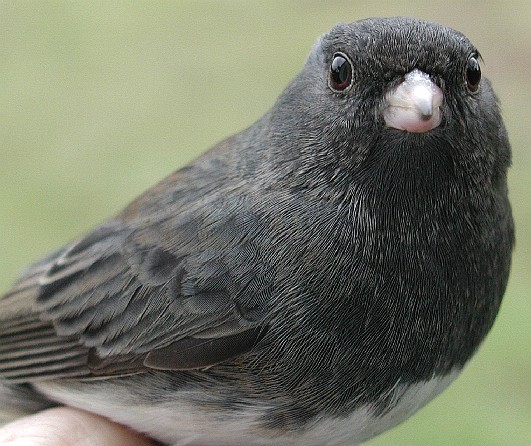
Dark-eyed Juncos are a species we usually associate with winter in southwest PA. They start singing in March, then do an elevational migration up the nearby mountains.

Each year, as the temperature warms, migratory birds move through our area in search of their breeding grounds. Although arrival timing is a bit variable between years due to annual variation in weather patterns, there is a predictable progression of species, so we know what to expect next relative to what we’ve already seen. The first, and often most conspicuous, to arrive are Red-winged Blackbirds and Common Grackles, usually in late February. They are followed by “peenting” American Woodcocks in early March, Eastern Phoebes in mid-March, and kinglets peaking in late-March. Keep your eyes to the sky any time you’re outdoors during these early spring weeks to watch for migrating waterfowl and raptors.

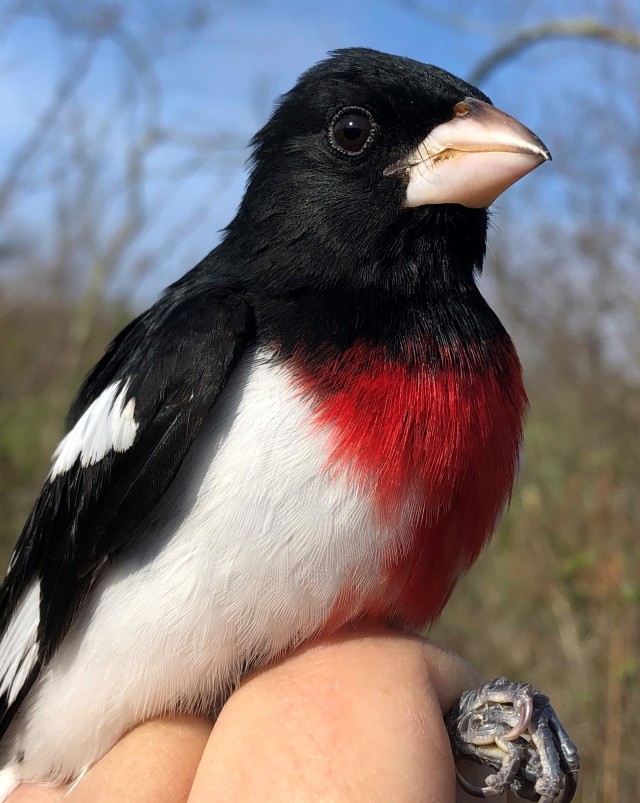
Rose-breasted Grosbeaks readily visit feeders with black oil sunflower seeds or safflower seeds usually in early- to mid-May before moving off into the forest to set up breeding territories.

By April, more songbirds, including vireos, swallows, early warblers, Blue-gray Gnatcatcher (a tiny bird with a wheezy song), House Wren, and the fan favorite, Gray Catbird make their way through our region, many remaining here to set up their breeding territories. In May, the migration floodgates open and some of the most brilliantly plumaged birds we’ve ever seen, like Baltimore Oriole, Rose-breasted Grosbeak, Ruby-throated Hummingbird, Scarlet Tanager, Indigo Bunting, and several warblers, may visit our yards and feeders, along with the less flashy, but equally beautiful, sparrows and thrushes.

Orioles readily come to feeders with orange halves, especially during migration, and seed-eating species like grosbeaks, buntings, and sparrows often visit feeders with sunflower or other seeds (or, in the case of many sparrows, clean up seeds on the ground under feeders!). Hummingbirds come to feeders with nectar (four parts water to one part white sugar, please avoid using food dyes or commercial nectar that has been dyed red). Most of these species are insectivorous, especially during spring migration, and are often observed picking things like caterpillars, midges, and spiders from foliage.

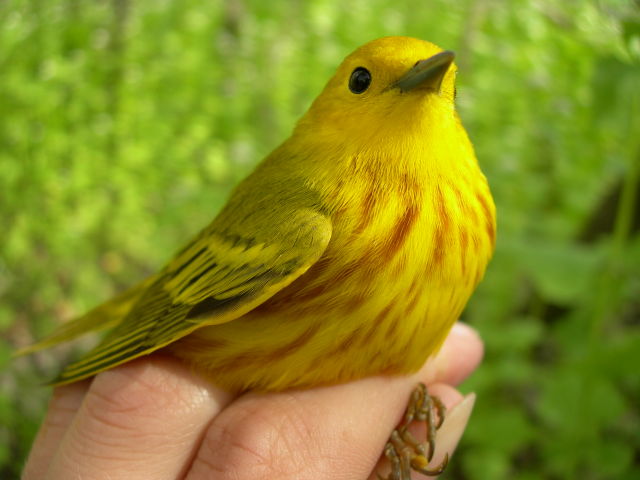
Yellow Warblers are often recognized by their signature “sweet sweet I’m so sweet!” song. You may see them flitting through small woody plants like dogwoods as they forage for caterpillars.

In addition to the migratory species that we see and hear in the spring, many birds that are year-round residents also frequent our yards. Black-capped and Carolina Chickadees, Tufted Titmice, White-breasted Nuthatches, Carolina Wrens, five species of woodpeckers (Downy, Hairy, Red-bellied, Pileated, and Northern Flicker, plus two more if we’re lucky – Red-headed Woodpecker and Yellow-bellied Sapsucker), and the colorful American Goldfinch, Northern Cardinal, and Eastern Bluebird mix with migratory birds. Most of these species visit bird feeders filled with sunflower or safflower seeds (chickadees, titmice, cardinals, nuthatches, woodpeckers), suet (woodpeckers, wrens), nyjer seed (finches), and mealworms (bluebirds, titmice, chickadees).

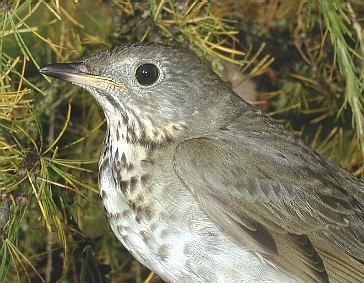
Gray-cheeked Thrushes are cryptic and secretive, but can be found skulking on the forest floor in mid- to late-May before they continue northward migration. They have a beautiful, flutey song and a distinctive call note.

One of the best ways to attract birds to your yard is planting native trees, shrubs, wildflowers, and other plants. Native plants are hosts for a high diversity of insects, especially during their larval stages, and provide nutritious seeds and fruit, all of which are important food resources for birds. These plants are also valuable as cover for safety and nest sites. Although often overlooked, a source of clean, fresh water, as simple as a bird bath or as complex as a pond with a bubbler or waterfall, can make your yard especially attractive to birds. And one of the easiest and most popular ways to attract birds for close viewing is providing bird food in clean, safe feeders. I recommend visiting your local bird feeding specialty store.

You may see all of the birds mentioned in this blog in your yard, but this is a non-exhaustive list and you may even see something unexpected. Visiting a local birding hotspot with complex and diverse habitats is certainly worth the effort as well. Birding these spots several times throughout the season will reward you with an impressive list and will boost your knowledge of natural history. The combination of a good pair of binoculars and a field guide with identification tips, range maps, and text about habitat is one of the best ways to maximize your birding, whether at home or in the field.

Please visit CMNH’s blog page to find bird ID tips and field guide recommendations.

The Audubon Society put together a great guide to the best binoculars at various price ranges.

You can put your bird observation skills to good use (or further develop those skills) by participating this spring in a broad survey of local wildlife and plants called the City Nature Challenge. The observation portion of this event is April 30 – May 3.

Annie Lindsay is the Bird Banding Program Manager at Carnegie Museum of Natural History’s Powdermill Nature Reserve. Museum employees are encouraged to blog about their unique experiences and knowledge gained from working at the museum.

Related Content

The Christmas Bird Count During an Irruption Year

Wind and Migration

Bird Banding with a Crew of One

Carnegie Museum of Natural History Blog Citation Information

Blog author: Lindsay, Annie
Publication date: March 24, 2021

Share this post!

  • Share on Twitter Share on Twitter
  • Share on Facebook Share on Facebook
  • Share on Pinterest Share on Pinterest
  • Share on LinkedIn Share on LinkedIn
  • Share on Reddit Share on Reddit
  • Share via Email Share via Email

Share this post!

  • Share on Twitter Share on Twitter
  • Share on Facebook Share on Facebook
  • Share on Pinterest Share on Pinterest
  • Share on LinkedIn Share on LinkedIn
  • Share on Reddit Share on Reddit
  • Share via Email Share via Email

Filed Under: Blog Tagged With: Annie Lindsay, Birds, City Nature Challenge, Powdermill Nature Reserve, Science News

March 8, 2021 by wpengine

Collected on this Day in 1998

Spring is springing as we speak.

In the city and beyond.

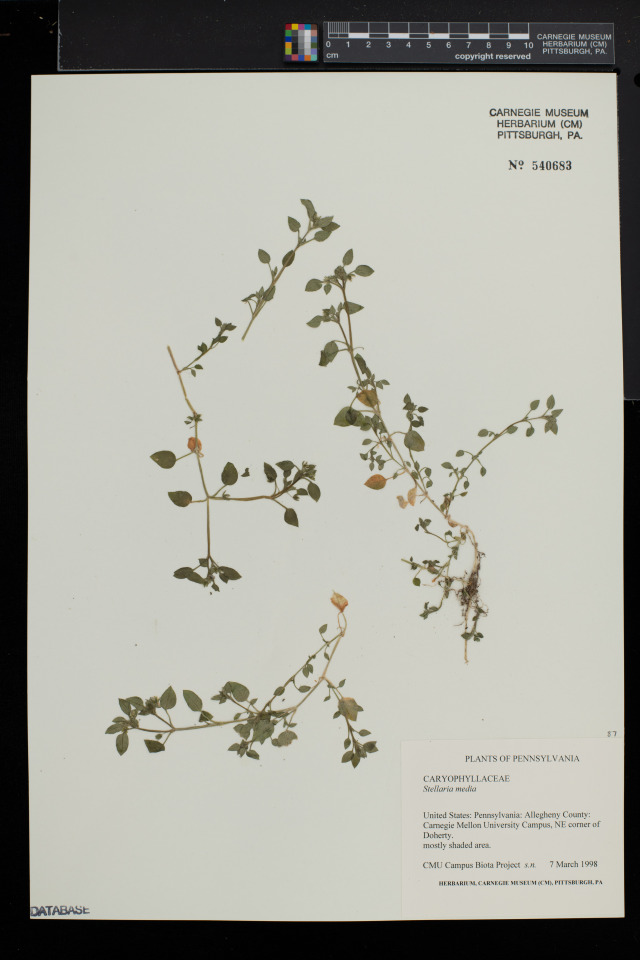
dried common chickweed specimen on herbarium sheet

This specimen of common chickweed (Stellaria media) was collected on the campus of Carnegie Mellon University, in Pittsburgh, in a “mostly shady area.” Though small, if you look closely you’ll encounter a charismatic tiny flower. Common chickweed is a familiar plant across the world, found in every continent (except perhaps Antarctica?). Like many cosmopolitan lawn weeds, it is native to “Eurasia.” The plant’s exact native range is unclear, but it is considered not native to North America.

In Pennsylvania, common chickweed can be found in habitat ranging from urban lawns to forests. In some locations dense growth of the plant can form a mat along the ground. Common chickweed can be found just about year-round when snow isn’t on the ground, and like dandelion, the plant flowers throughout the year.

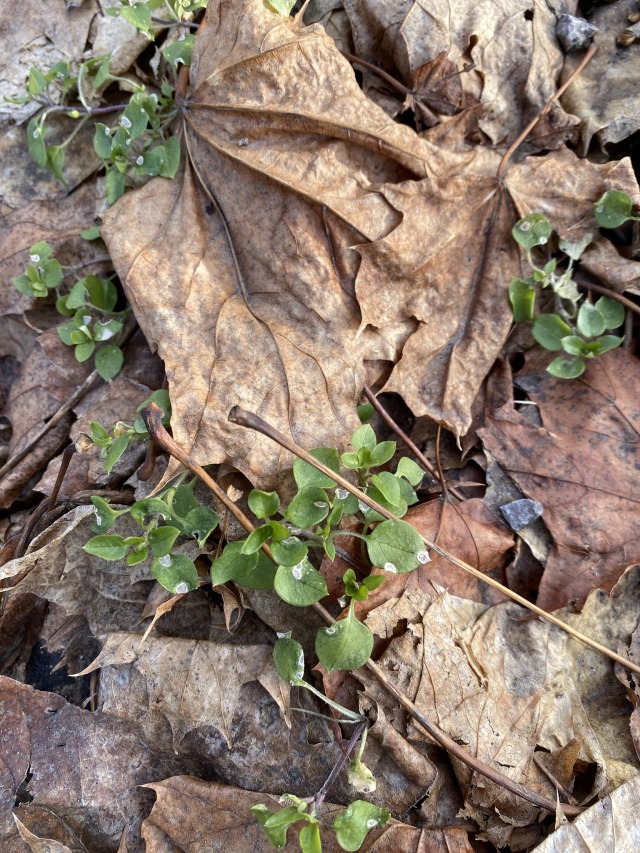
Stellaria media on January 30 in southwest Pennsylvania.

The tiny flowers now are also sending a signal – spring is on the way. For some plants, such as skunk cabbage and red maple, spring has already sprung.

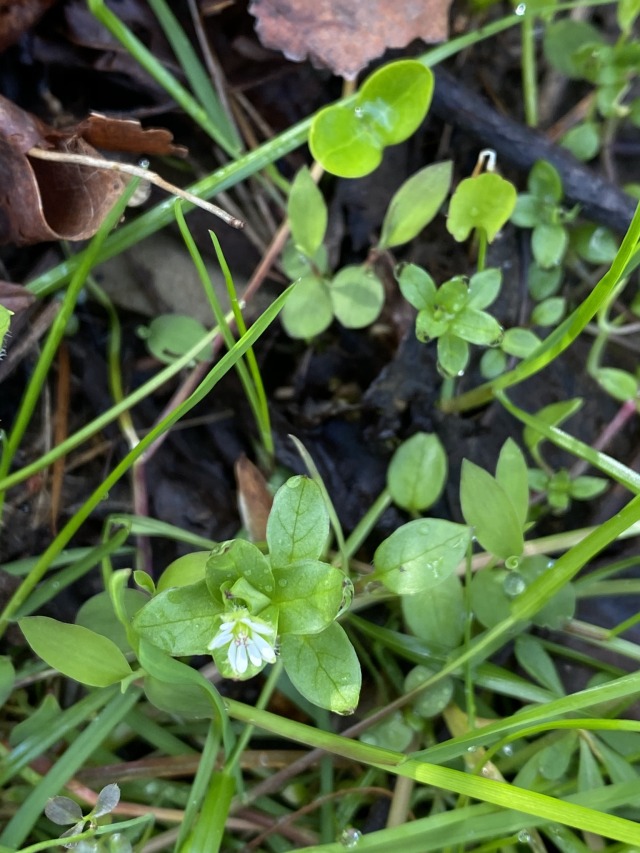
Stellaria media on April 24 in southwest Pennsylvania.

This species is a good one to look out for during the upcoming City Nature Challenge!

Find this specimen and more here.

Check back for more! Botanists at the Carnegie Museum of Natural History share digital specimens from the herbarium on dates they were collected. They are in the midst of a three-year project to digitize nearly 190,000 plant specimens collected in the region, making images and other data publicly available online. This effort is part of the Mid-Atlantic Megalopolis Project (mamdigitization.org), a network of thirteen herbaria spanning the densely populated urban corridor from Washington, D.C. to New York City to achieve a greater understanding of our urban areas, including the unique industrial and environmental history of the greater Pittsburgh region. This project is made possible by the National Science Foundation under grant no. 1801022.

Mason Heberling is Assistant Curator of Botany at Carnegie Museum of Natural History. Museum employees are encouraged to blog about their unique experiences and knowledge gained from working at the museum.

Related Content

Collected On This Day in 1949: Honeysuckle

Collected On This Day in 1940: Plants with bladders?

Looking for Bugs in Your Yard! 

Share this post! 

  • Share on Twitter Share on Twitter
  • Share on Facebook Share on Facebook
  • Share on Pinterest Share on Pinterest
  • Share on LinkedIn Share on LinkedIn
  • Share on Reddit Share on Reddit
  • Share via Email Share via Email

Carnegie Museum of Natural History Blog Citation Information

Blog author: Heberling, Mason
Publication date: March 8, 2021

Share this post!

  • Share on Twitter Share on Twitter
  • Share on Facebook Share on Facebook
  • Share on Pinterest Share on Pinterest
  • Share on LinkedIn Share on LinkedIn
  • Share on Reddit Share on Reddit
  • Share via Email Share via Email

Filed Under: Blog Tagged With: Botany, City Nature Challenge, collected on this day, Mason Heberling, Science News

May 19, 2020 by wpengine

Joining the iNaturalist Team!

Carnegie Museum of Natural History has promoted participation in the Pittsburgh City Nature Challenge for the past three years. Because I live outside the six-county “Challenge” region, I decided to help the best way I know how, by participating, as time permits, in the identification phase of the iNaturalist-based project.

Although publicity about the City Nature Challenge tends to focus on the value of participants documenting the diversity of life around them by taking pictures and submitting them via the iNaturalist app, the proper identification of submitted images is critically important.

My normal carpool commute time to the museum is usually a little over an hour. So, I decided that what would normally be my commute time to work would become my iNaturalist identification time. This process proved to be enlightening in several ways.  First was the digital proof that a lot of people in the Pittsburgh region are interested in the outdoors. That is a good thing! Second, was the ample evidence that people of all ages got involved in a project that can potentially help me and other scientists track what is going on in the outdoors. Also, a good thing. Submitted images can help us track phenology, the timing of recurring events such as plant blooming or fruiting.

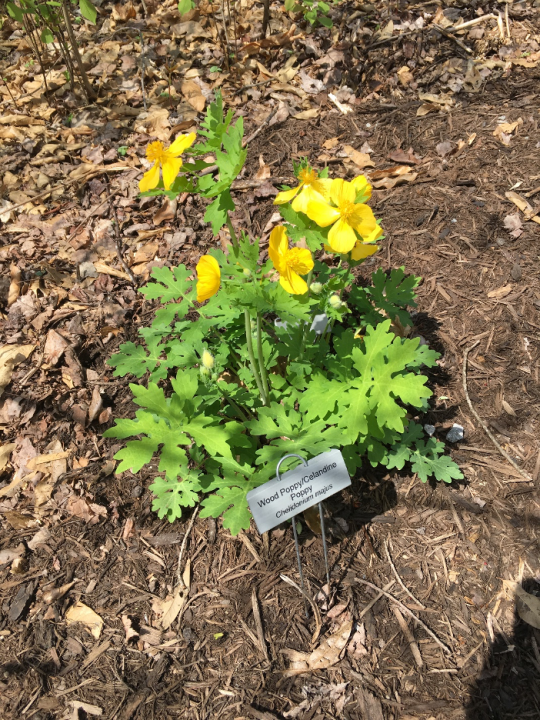
Photo of Stylophorum diphyllum mislabeled as Chelidonium majus in a native plant garden. Credit: BL Isaac

We can also use iNaturalist records for distribution studies. For instance, there is a “native” plant known as the woods-poppy (Stylophorum diphyllum) that we don’t have any records of from natural populations in the Commonwealth of Pennsylvania. There are nine documented Pennsylvania specimens in herbaria that I am aware of. Only one of those is older than I am.  The locality data on it is very vague and suspect as to whether it is really from Pennsylvania. (“Probably near Zelienople” is a far from precise location.) The other eight specimens are all known to be from cultivated populations. These specimens are from only three counties. State botanists have been discussing and debating this plant for several decades. It is native in Ohio and west, but is it native in Pennsylvania? There are now nearly 300 observations of woods-poppy (Stylophorum diphyllum) from across Pennsylvania on iNaturalist.

What is going on here? Have botanists just been overlooking this thing for decades?  Is it escaping from cultivated populations?  I know that it is being sold in native plant nurseries, so are folks just buying it and planting it out and about?  I do know that we need to get out and get some of these populations documented. Maybe by visiting some of the sites we can postulate why this plant that wasn’t seen in Pennsylvania for centuries is now popping up everywhere.

I have also learned that there is plenty of room for educating people on the importance of knowing how to identify plants.  It is almost scary the number of people (it doesn’t take many) who have trouble identifying poison ivy. There are also plenty of problems with identifying common backyard plants.  I have been active the last few years with plant identification workshops, and there is certainly a need for more of these. I’ll continue to learn as I continue to help identifying plants for the City Nature Challenge while I “commute” to work. I’m eager to see what other mysteries may pop up that pique my curiosity about the world around us.

Bonnie Isaac is the Collection Manager in the Section of Botany. Museum staff, volunteers, and interns are encouraged to blog about their unique experiences and knowledge gained from working at the museum.

Related Content

City Nature Challenge

City Nature Challenge Recap

The City Nature Challenge Family Experience

Carnegie Museum of Natural History Blog Citation Information

Blog author: Isaac, Bonnie
Publication date: May 19, 2020

Share this post!

  • Share on Twitter Share on Twitter
  • Share on Facebook Share on Facebook
  • Share on Pinterest Share on Pinterest
  • Share on LinkedIn Share on LinkedIn
  • Share on Reddit Share on Reddit
  • Share via Email Share via Email

Share this post!

  • Share on Twitter Share on Twitter
  • Share on Facebook Share on Facebook
  • Share on Pinterest Share on Pinterest
  • Share on LinkedIn Share on LinkedIn
  • Share on Reddit Share on Reddit
  • Share via Email Share via Email

Filed Under: Blog Tagged With: Bonnie Isaac, botany hall, City Nature Challenge, iNaturalist, Section of Botany

May 8, 2020 by wpengine

City Nature Challenge Recap

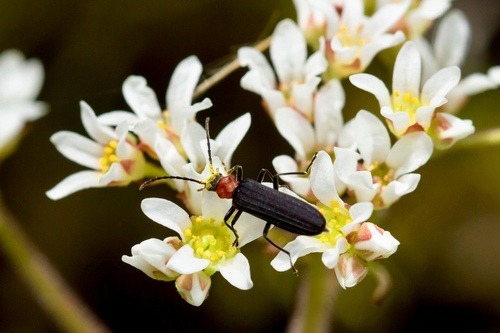
photo of black and red bug on white flowers

With the COVID-19 pandemic hitting, the entire world had to adapt how we participated in this year’s City Nature Challenge. This year we focused on a global collaboration instead of a competition, and physical distancing over public events. We are amazed at the creativity and resilience that we saw – and 2020’s City Nature Challenge results show just how important it was both globally and in the Pittsburgh region.

City Nature Challenge Results

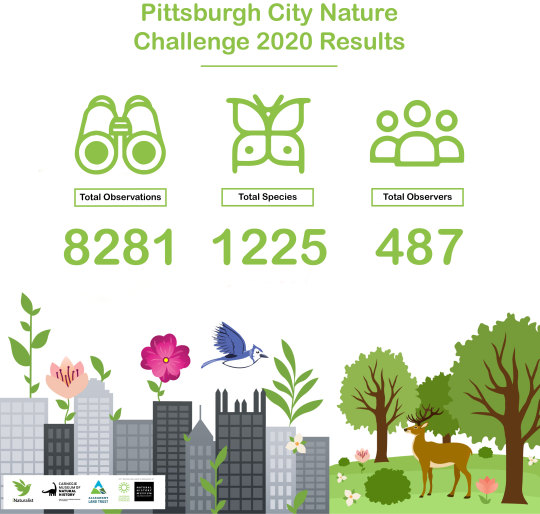
graphic of Pittsburgh City Nature Challenge 2020 Results: 8281 total observation, 1225 total species, and 487 total observers

This year, over 40,000 people around the world came together virtually to participate in the City Nature Challenge.  Collectively we shared over 800,000 observations of nature near our homes, and documented 135,435 different species of fungi, plants, and animals. Want to see what was found in any of the more than 200 cities that participated? You can explore at this link.

Pittsburgh’s numbers are incredible too. At the end of the challenge, the Pittsburgh region ended up having 487 observers, 8,281 observations, and 1,225 different species. We almost doubled the number of observers from last year!

The identification phase was a success as well with 419 users helping identify 13,446 different observations. You can explore all the Pittsburgh Region’s observations from this year at this link.

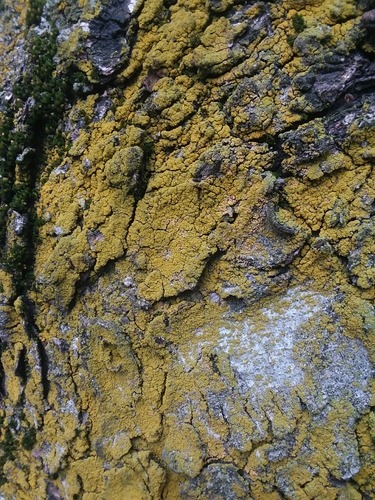
photo of candle flame lichen
Pete Peng has 1,310 observations and these Candleflame Lichens are beautiful.

Don’t Stop Observing!

We can’t put into words how thankful we are for everyone’s resilience and hard work. The results from this year’s City Nature Challenge prove that even though we have to distance from each other right now, we can still come together to accomplish something awesome.

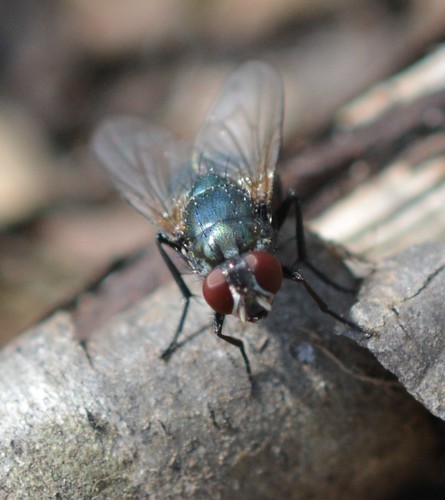
closeup photo of a fly
Check out this observation of a fly from Julia Schwierking!

The City Nature Challenge may be over, but the observations don’t have to end here. Nature is around you 24/7 and waiting to be observed. You can use the iNaturalist app anytime to share what you find!

We’d love to see your observations. Email them to nature360@carnegiemnh.org or tag us on social media @CarnegieMNH.

Get more nature activity ideas from Nature Lab!

Filed Under: Blog Tagged With: City Nature Challenge, Education, Educators, Museum from Home, Nature 360, Nature Lab

  • « Go to Previous Page
  • Page 1
  • Page 2
  • Page 3
  • Page 4
  • Page 5
  • Page 6
  • Go to Next Page »

sidebar

About

  • Mission & Commitments
  • Directors Team
  • Museum History

Get Involved

  • Volunteer
  • Membership
  • Carnegie Discoverers
  • Donate
  • Employment
  • Events

Bring a Group

  • Groups of 10 or More
  • Birthday Parties at the Museum
  • Field Trips

Powdermill

  • Powdermill Nature Reserve
  • Powdermill Field Trips
  • Powdermill Staff
  • Research at Powdermill

More Information

  • Image Permission Requests
  • Science Stories
  • Accessibility
  • Shopping Cart
  • Contact
  • Visitor Policies
One of the Four Carnegie Museums | © Carnegie Institute | Privacy Policy | Terms of Use | Accessibility
Rad works here logo