• Skip to primary navigation
  • Skip to main content
  • Skip to primary sidebar

Carnegie Museum of Natural History

One of the Four Carnegie Museums of Pittsburgh

  • Visit
    • Buy Tickets
    • Visitor Information
    • Exhibitions
    • Events
    • Dining at the Museum
    • Celebrate at the Museum
    • Powdermill Nature Reserve
    • Event Venue Rental
    • Gift Cards
  • Learn
    • Field Trips
    • Educator Information
    • Programs at the Museum
    • Bring the Museum to You
    • Guided Programs FAQ
    • Programs Online
    • Climate and Rural Systems Partnership
  • Research
    • Scientific Sections
    • Science Stories
    • Science Videos
    • Senior Science & Research Staff
    • Museum Library
    • Science Seminars
    • Scientific Publications
    • Specimen and Artifact Identification
  • About
    • Mission & Commitments
    • Directors Team
    • Museum History
  • Tickets
  • Give
  • Shop

Enjoy the Museum from Home via our Blog

Can't make it to the museum in person? We've done our best to help cultivate resources for you to enjoy from home. Activities for the whole family, different ways to experience our exhibitions and more are included in these blogs.

September 14, 2020 by wpengine

The Strange Saga of Spinosaurus, the Semiaquatic Dinosaurian Superpredator

I’ve been captivated by dinosaurs for as long as I can remember. My parents tell me that I told them that I wanted to be a paleontologist as early as age four. Naturally, then, I had lots and lots of books about dinosaurs when I was a boy growing up during the 1980s. One of the dinosaurs that always fascinated me the most was Spinosaurus aegyptiacus. Found in 1912 in the Bahariya Oasis of the Western Desert of Egypt (could anyplace sound more exotic to a small-town kid from upstate New York?!), Spinosaurus was originally known from a highly incomplete but also very large and extremely distinctive partial skeleton found in a middle Cretaceous-aged (roughly 95-million-year-old) rock layer in the oasis. Among the few skeletal elements known were part of a strangely shaped (for a dinosaur) lower jaw, some crocodile-like teeth, and most strikingly, several back vertebrae that each sported tall spines, some of them measuring nearly six feet. These spines clearly impressed Ernst Stromer von Reichenbach, the German paleontologist who studied the skeleton and gave the animal its name in a 1915 publication. Tragically, however, that original Spinosaurus skeleton—and all of Stromer’s other dinosaur fossils from Egypt—were destroyed during the Second World War, more specifically in a British Royal Air Force bombing of Munich on April 24, 1944. The story of Stromer’s lost dinosaurs found its way into many a children’s book, including several that I read cover-to-cover. As such, the tale took on near-legendary status for me, and, I’m sure, many other young dinosaur enthusiasts around the world. Here was an absolutely extraordinary dinosaur from a faraway land, similar in size to the gargantuan Tyrannosaurus rex, but clearly very different from all other predatory dinosaurs known at the time – and it was represented only by a few teeth and bones that had been blasted into oblivion decades ago and so now existed only as pictures in books.
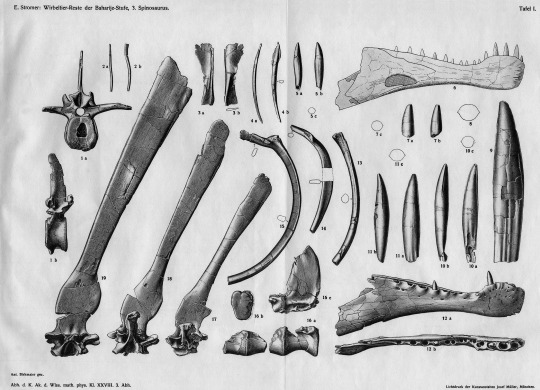
A scan of my photocopy of plate I of Ernst Stromer’s original 1915 publication on Spinosaurus aegyptiacus, showing some of the teeth and bones preserved in the holotype (= name-bearing) partial skeleton, discovered in 1912 in Egypt’s Bahariya Oasis. Check out the long spines on the back vertebrae at lower left!

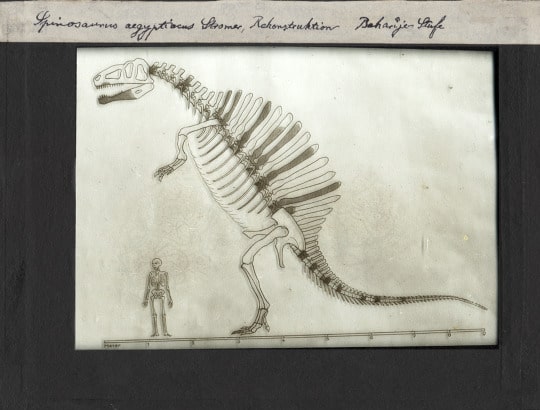
Stromer’s conception of Spinosaurus, as depicted in a 1936 publication and on a glass slide of his that colleagues of mine scanned during our visit to the Paläontologisches Museum München in Munich, Germany in 2001. Stromer knew this animal was big, as evidenced by the human skeleton he included for scale. Interestingly, too, he reconstructed Spinosaurus with unusual proportions for a carnivorous dinosaur, such as an abnormally elongate torso and short hind limbs. We’ll come back to those odd proportions a little later…

When I arrived in graduate school at the University of Pennsylvania in 1997, one of the first things I did was make a lengthy list of all the paleontological sites I was interested in exploring, ranked by their potential (in my mind, at least) to produce scientifically significant finds. The Bahariya Oasis and the search for a ‘replacement Spinosaurus’ quickly rose to the top of the list. Amazingly, no one had ever found—or at least officially reported—new dinosaur fossils in the oasis in the more than half-century since Stromer’s beasts were obliterated during that fateful airstrike. A need to keep this post to a reasonable length prevents me from describing the stars that had to align to make this happen, but in January 2000 I found myself in the Bahariya Oasis—one of the places I’d dreamed about going since I was a small child—as part of the first significant ‘dinosaur hunt’ to take place at the site since the early 20th century. It was bittersweet, though, in the sense that we never really found that ‘replacement Spinosaurus’ I’d fantasized about – all we ever discovered of that creature were a few isolated, fragmentary teeth and bones (and, in a very different location, a couple previously unpublished photos of the original skeleton in a Munich archive). We did find and dig up a gigantic new species of long-necked, plant-eating sauropod dinosaur, Paralititan stromeri, a creature that to this day is one of the largest land animals of any kind that’s ever been found, anywhere – but that’s another story for another time.
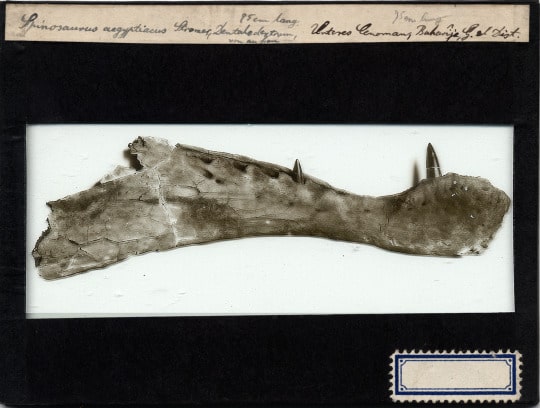
One of the rare contributions that I personally have made to scientific knowledge of Spinosaurus: a glass slide showing the only known photo of the right dentary (tooth-bearing lower jaw bone) of the original, name-bearing partial skeleton from Egypt. Like all of Stromer’s Egyptian dinosaur material, this specimen (including this bone) was destroyed in a British air raid on Munich during World War II. Several colleagues and I ‘rediscovered’ this photo—which nobody apparently knew existed—in an archive at the Paläontologisches Museum München in 2001. We published it and one other previously unknown photo of the Spinosaurus type specimen in a 2006 paper in the Journal of Paleontology.

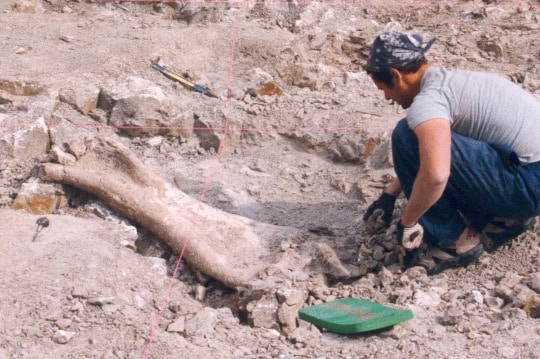
A much younger yours truly digging up the incomplete left humerus (upper arm bone) of the gigantic sauropod (long-necked herbivorous dinosaur) Paralititan stromeri in the Bahariya Oasis of Egypt, February 2000. Paralititan is one of the largest dinosaurs ever discovered – a nice ‘consolation prize’ given that we didn’t find much of Spinosaurus during our expeditions to Bahariya. (A cast replica of the complete right humerus of Paralititan is on display in PaleoLab at Carnegie Museum of Natural History.) Credit: Josh Smith.

Back to the matter at hand, meaning Spinosaurus. Fast-forward to 2011. I had the honor of serving as the external thesis examiner for Nizar Ibrahim, a promising doctoral student at University College Dublin in Ireland. I’d known Nizar for years, ever since he reached out to me by email while an undergraduate at the University of Bristol, England, to discuss our mutual interests in African Cretaceous dinosaurs. Nizar’s Ph.D. thesis was on dinosaurs and other middle Cretaceous-aged vertebrates from the celebrated Kem Kem beds of southeastern Morocco, a set of rocks that had yielded a fossil fauna very similar to, though seemingly more diverse than, that of the Bahariya Oasis. Among the many finds that Nizar documented in his colossal thesis were intriguing new remains of Spinosaurus. I went to Dublin to participate in his successful thesis defense, and afterward, he and I hit up some of the city’s finest public houses to celebrate (no surprise for those who know me). Over a pitcher of yummy Irish stout, he told me an exciting story – he and his team had lately discovered not just isolated bones of Spinosaurus in Morocco, but parts of a probable new skeleton. If so, this find would be the first skeleton since Stromer, and moreover would be exceedingly important given how little was known about Spinosaurus, even as recently as the early 2010s. The more parts we paleontologists have of a given fossil animal, the more we can generally learn about it, so the prospect of a new and relatively complete Spinosaurus skeleton—in other words, many bones belonging to a single individual dinosaur—was thrilling to say the least.

Again I’ll skip details for brevity’s sake, but fast-forward once again, to 2014. I was contacted by an editor of Science—one of the foremost scientific journals in the world—to peer-review a paper that had been submitted by (you guessed it!) Nizar and a long list of collaborators describing that new skeleton of Spinosaurus that he’d told me about over beers in Ireland three years before. Nizar and team had revisited the quarry and it had panned out in a big way. From this one, single individual Spinosaurus—again, the first associated skeleton of this dinosaur to have been found in roughly a century—they had bones from the skull, backbone (including a few of those famously long-spined vertebrae!), forelimb, pelvis, and hind limb. More importantly, these ‘new’ bones revealed that Spinosaurus was even more bizarre than anyone imagined! We already knew, from Stromer’s specimen and other, isolated finds made through the years, that the shapes of the skull and back were really weird for a predatory dinosaur. Now, the new skeleton showed that the bones were remarkably dense, the hind legs were oddly short, and the hind feet may have been webbed! All of this led Nizar and colleagues to propose that Spinosaurus may have been semiaquatic; in other words, that its lifestyle was much more comparable to that of a modern-day alligator or crocodile than it was to a more ‘typical’ land-living predatory dinosaur such as T. rex. Other evidence for an affinity to watery habitats had been found in Spinosaurus and closely related dinosaurs (known, perhaps unsurprisingly, as spinosaurids) before, but this was, in my mind, the most convincing case yet made that these animals spent significant amounts of their time at least partly submerged in lakes and rivers. The paper was published in Science a few months later, accompanied by a cover story in National Geographic magazine and a special on the venerable PBS TV series NOVA. Almost exactly one hundred years after it had been named, Spinosaurus had become a celebrity.
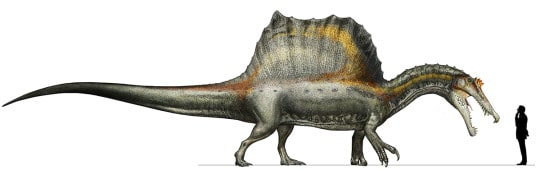
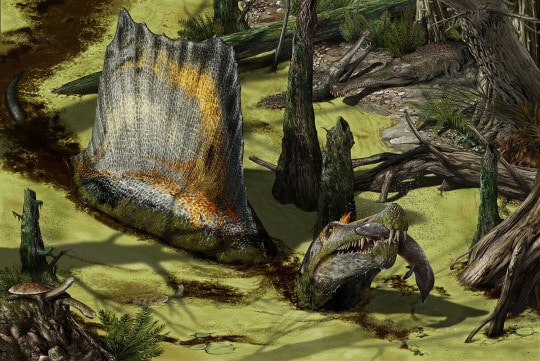
Nizar Ibrahim and colleagues’ initial conception of Spinosaurus aegyptiacus in the flesh, released to coincide with the publication of their Science paper in 2014. Two aspects stand out: as Stromer already knew (see his skeletal reconstruction above), the animal is enormous, but it was more oddly proportioned than even he had imagined. Note also the ‘regular-looking’ (for a dinosaur) tail, and read on. Credit: Davide Bonadonna.

Semiaquatic Spinosaurus chowing down on a tasty lungfish in what is now northern Africa some 95 million years ago. Italian paleoartist Davide Bonadonna has produced some of the most beautiful and accurate modern depictions of this extraordinary dinosaur, and I’m grateful to him for letting me reproduce his art here.

But the story didn’t end there. Some prominent paleontologists criticized Nizar and colleagues’ semiaquatic interpretation of Spinosaurus. These opinions weren’t a final judgment. Instead, this is just how science works: we scientists propose ideas, or hypotheses—in this case, that Spinosaurus lived and behaved more like a crocodile than your garden-variety carnivorous dinosaur—and then test these hypotheses by reevaluating the existing evidence and/or bringing new information to light. If a hypothesis repeatedly stands up to testing, then it gradually gets incorporated into the body of knowledge. Other paleontologists presented evidence that they claimed refuted the semiaquatic hypothesis, but Nizar and team eventually countered with new data of their own. In late 2019, another prominent scientific journal—this time it was Nature—came calling, asking me to review a second paper by Nizar et al. on Spinosaurus. What, I thought, could these researchers have to say about this dinosaur that they hadn’t already said before? Well, as it turns out, Nizar and colleagues had kept digging at their Spinosaurus skeleton site, and incredibly, they’d continued to find important new bones belonging to the same specimen. Among these post-2014 finds was the almost complete tail. When I saw what it looked like (via an illustration in their paper), I literally laughed out loud with surprise and delight. Somehow, the shape of the Spinosaurus tail Nizar’s team had discovered—the first even reasonably complete tail of this dinosaur to have ever been unearthed—was simultaneously both unexpected and predictable. It looked really dissimilar from the tails of other predatory dinosaurs, but it was nearly exactly like what one might expect for a dinosaur that used its tail to propel itself through water. In other words, the tall, fin-like tail of Spinosaurus looked more like that of a supersized alligator or newt than that of T. rex.

Nizar and team’s Nature paper on their Spinosaurus tail was published this past April 29. Is it the last word on this dinosaur and its mode of life? Most certainly not, but the evidence is now stronger than ever—in my opinion, very strong—that Spinosaurus spent more time in the water than any other non-avian (= non-bird) dinosaur that we currently know about.
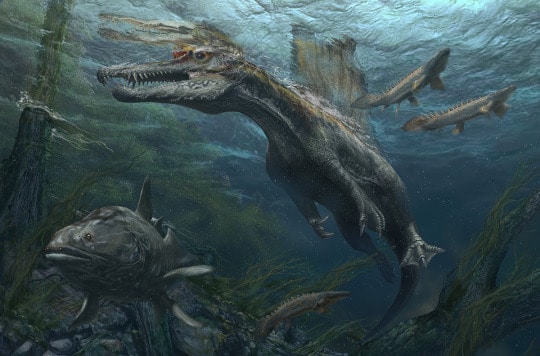
The modern view of Spinosaurus, not as a ‘regular’ predatory dinosaur, but rather as a specialized semiaquatic hunter that spent much of its life in the water. Self-serving side note: the three smaller, spiky-looking fish are Bawitius bartheli, a polypterid (an archaic, still-extant group of thick-scaled ray-finned fishes) that several colleagues and I named in 2012 from fossils found in the Bahariya Oasis. The larger fish at lower left is the giant coelacanth Axelrodichthys (sometimes called Mawsonia) libyca. Credit: Davide Bonadonna.

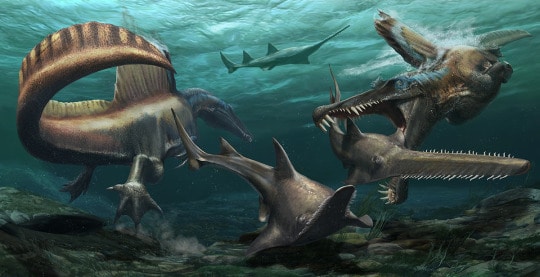
Two Spinosaurus invite the sawfish Onchopristis numidus to lunch in what’s now northern Africa some 95 million years ago. Look at those fin-like Spinosaurus tails! Credit: Davide Bonadonna/National Geographic.

Nizar (who’s a Research Associate here at Carnegie Museum of Natural History), myself, and our many colleagues and collaborators are continuing to study the mysterious dinosaurs and other fossil vertebrates from the middle and Late Cretaceous of northern Africa. Indeed, Nizar and I have several collaborative papers in the works right now, and I’m also working with an amazing team of paleontologists at Mansoura University on multiple new Egyptian fossil finds. It’s a good bet that African Cretaceous dinosaurs even stranger than Spinosaurus are still out there, waiting to be discovered!

Further reading/watching:

Nothdurft, W. E., with J. B. Smith, M. C. Lamanna, K. J. Lacovara, J. C. Poole, and J. R. Smith. 2002. The Lost Dinosaurs of Egypt. Random House, New York, 256 pp.

Smith, J. B., M. C. Lamanna, H. Mayr, and K. J. Lacovara. 2006. New information regarding the holotype of Spinosaurus aegyptiacus Stromer, 1915. Journal of Paleontology 80:400–406.

Ibrahim, N., P. C. Sereno, C. Dal Sasso, S. Maganuco, M. Fabbri, D. M. Martill, S. Zouhri, N. Myhrvold, and D. A. Iurino. 2014. Semiaquatic adaptations in a giant predatory dinosaur. Science 345:1613–1616.

Bigger Than T. rex (NOVA documentary): https://www.pbs.org/wgbh/nova/video/bigger-than-t-rex/

Henderson, D. M. 2018. A buoyancy, balance and stability challenge to the hypothesis of a semi-aquatic Spinosaurus Stromer, 1915 (Dinosauria: Theropoda). PeerJ 6:e5409.

Ibrahim, N., S. Maganuco, C. Dal Sasso, M. Fabbri, M. Auditore, G. Bindellini, D. M. Martill, S. Zouhri, D. A. Mattarelli, D. M. Unwin, J. Wiemann, D. Bonadonna, A. Amane, J. Jakubczak, U. Joger, G. V. Lauder, and S.E. Pierce. 2020. Tail-propelled aquatic locomotion in a theropod dinosaur. Nature 581:67–70.

Matt Lamanna is Mary R. Dawson Associate Curator and Head of the Section of Vertebrate Paleontology at Carnegie Museum of Natural History. Museum staff, volunteers, and interns are encouraged to blog about their unique experiences and knowledge gained from working at the museum.
Related Content

Mesozoic Monthly: Gryposaurus

Behind the Scenes of Dinosaur Armor

Egypt and the Nile

Filed Under: Blog Tagged With: dinofest, dinosaurs in their time, Matt Lamanna, Museum from Home, Science News, Section of Vertebrate Paleontology

September 14, 2020 by wpengine

Egypt and the Nile

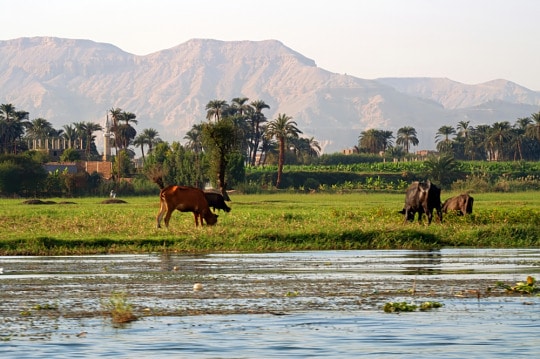
Over the course of some five millennia the ancient Egyptians developed a distinctive material culture shaped in large part by their local geography, natural resources, and relationship with the Nile River. In the 5th Century BCE, the Greek historian Herodotus noted that “any sensible person” could see that Lower Egypt was a “gift of the river” (Herodotus, 2.5). While his comments were limited to the areas in the north and in the Delta, they really ring true for all the Nile River Valley. Every aspect of life in Egypt depended on the river – the Nile provided food and resources, land for agriculture, a means of travel, and was critical in the transportation of materials for building projects and other large-scale endeavors. It was a critical lifeline that literally brought life to the desert.

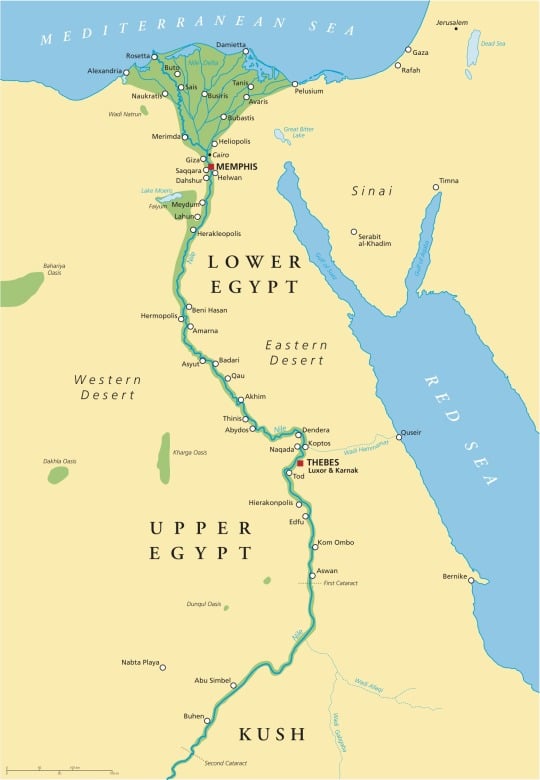
Map of Ancient Egypt (www.shutterstock.com 211163719)

The modern name of the Nile River comes from the Greek Nelios, but the Egyptians called it Iteru or “River.” The Nile is the longest river in the world, measuring some 6,825 km. The Nile River System has three main branches – the White Nile, the Blue Nile, and the Atbara river. The White Nile, the river’s headwaters, flows from Lake Victoria and Lake Albert. The Blue Nile brings about the inundation or annual flood and provides most of the river’s water and silt. The Atbara river has less of an impact, as it flows only occasionally.

In the south, the Nile has a series of six main cataracts, which begin at the site of Aswan. A cataract is a shallow stretch of turbulent waters formed where flowing waters encounter resistant rock layers. In the case of the Nile cataracts, large outcroppings of granite make the flow of the river unpredictable and much more difficult to traverse by boat. The cataract system created a natural boundary at Aswan, separating Egypt from its southern neighbor, Nubia.

Ancient Egypt was located in Northeastern Africa and had four clear geographic zones: the Delta, the Western Desert, the Eastern Desert, and the Nile Valley. Each of these zones had its own natural environment and its own role within the Egyptian State. Cities could only flourish in the Nile Delta, the Nile Valley, or desert oases, where people had access to water, land, and key resources. The ancient Egyptians, who were always keen observers of nature, often associated the Nile Valley with life and abundance and the neighboring deserts with death and chaos.

Kemet or, “black land,” denotes the rich, fertile land of the Nile Valley, while Deshret, or “red land,” refers to the hot, dry desert. The contrast between the red land and the black land was not just visible or geographic, it effected the Egyptians’ everyday lives. The dry climate of the desert, for example, made it an ideal location for cemeteries. There, the annual Nile flood would not disturb people’s graves and the dry climate acted to preserve tombs and their contents. Good preservation and the fact that most people do not live in the desert, are the main reasons that so much of what archaeologists and anthropologists study comes from a funerary context.

View with the Nile River Valley in the foreground and the desert cliffs in the background. (www.shutterstock.com 1082850872)

The landscapes of Upper and Lower Egypt also differ. The Egyptian word Tawy, means “Two Lands” – this refers to the two main regions of ancient Egypt, Upper and Lower Egypt. Lower Egypt is in the north and contains the Nile Delta, while Upper Egypt contains areas to the South. These two designations may seem counterintuitive to their physical locations, but they reflect the flow of the Nile River, from South to North.

The expansive floodplain of the Nile Delta and the very narrow band of fertile land present in the Nile Valley led to different ways of life. In the Nile Delta for example, the Egyptians constructed their towns and cemeteries on turtlebacks; natural highpoints in the landscape that became islands during the inundation. In addition, the location of the Delta along the Mediterranean and at the entry point into the Levant made it an important area for trade and international contacts. The Delta was a very multi-cultural region throughout Egyptian history.

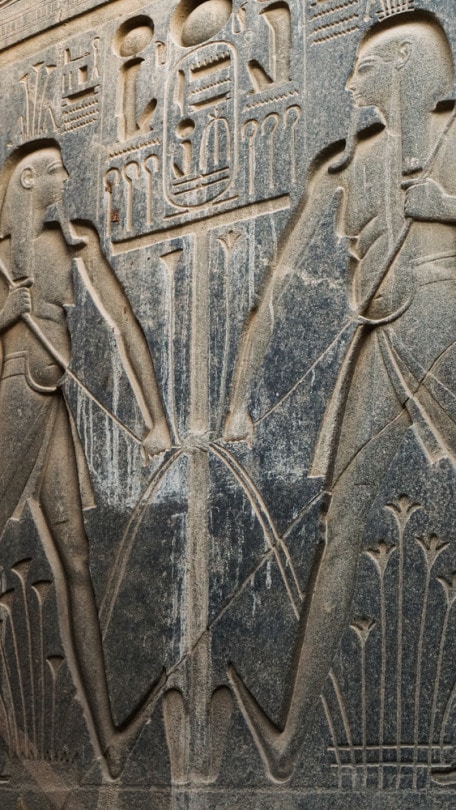
Ancient Egyptian Sema-Tawy – represents the eternal unification of Upper and Lower Egypt (www.shutterstock.com 1778750570).

The Egyptians thought of the king as the unifier of the “Two Lands.” One of the king’s primary roles was to keep Upper and Lower Egypt united; the Egyptians expressed this visually using something we call the sema-tawy motif. Here you can see two Nile gods symbolically uniting the lands of Upper and Lower Egypt – each depicted in the form of their characteristic plant, the papyrus for Lower Egypt and the lotus for Upper.

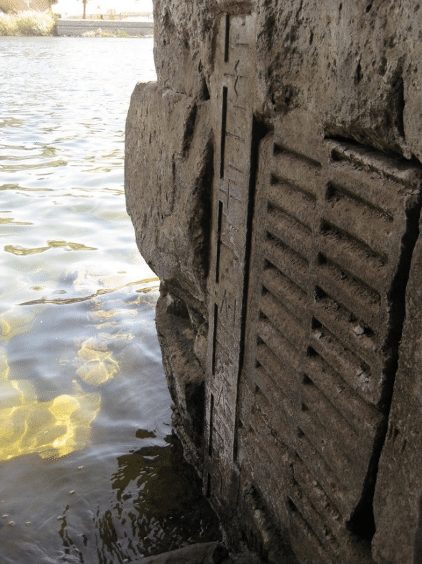
The Egyptians constructed their calendar around the yearly cycle of the Nile. It included three main seasons: Akhet, the period of the Nile’s inundation, Peret, the growing season, and Shemu, harvest season. The Egyptians made Nilometers to measure and track the height of the annual inundation – they used the recorded readings from these Nilometers much like more contemporary farmers would use almanacs. One particularly well-preserved example is located on Elephantine Island at Aswan.

The close connection between the Egyptians the Nile River led them to identify a number of Egyptian gods with aspects of the river, its annual flood, and the fertility and abundance associated with them. Hapi, for example, is the incarnation of the life force that the Nile provides; he also symbolizes the annual inundation of the Nile. His round belly and folds of skin represent abundance. Osiris, who is most often recognized in his role associated with the afterlife, is fundamentally a god of regeneration and rebirth. Artists often depicted him with black skin, linking him to the fertility of the Nile River and its lifegiving silt. The broader natural world was a further source of inspiration for Egyptian religion.

Elephantine Nilometer (Image by author)

The Nile was also an important highway, it was the easiest way to travel and played an essential role in mining expeditions, trade, architectural projects, and general travel. The Egyptians were expert boat builders; images of boats are some of the earliest designs that appear on Egyptian Predynastic Vessels dating to ca. 3500-3300 B.C.E. River access decreased the time and number of individuals needed for the transportation of large objects, like stones, obelisks, and architectural elements. Boats were also common in the funerary religion as well – as a part of the funeral itself and for the afterlife.

Although I’ve only been able to touch on a few key elements here, the natural environment of Egypt and the Nile River impacted every aspect of life in ancient Egypt. The river’s floodplain, water, and silt provided the foundation for civilization and served as a source of inspiration for the people who inhabited northeastern Africa during this pivotal period in history.

Lisa Saladino Haney is Postdoctoral Assistant Curator of Egypt on the Nile at Carnegie Museum of Natural History. Museum employees are encouraged to blog about their unique experiences and knowledge gained from working at the museum.
Related Content

Ancient Egypt Through Its Pottery

Where the Heck Did That Come From?

Snails in the Desert

Carnegie Museum of Natural History Blog Citation Information

Blog author: Haney, Lisa
Publication date: September 14, 2020

Share this post!

  • Share on Twitter Share on Twitter
  • Share on Facebook Share on Facebook
  • Share on Pinterest Share on Pinterest
  • Share on LinkedIn Share on LinkedIn
  • Share on Reddit Share on Reddit
  • Share via Email Share via Email

Filed Under: Blog Tagged With: ancient egypt, Egypt on the Nile, Lisa Haney, Museum from Home, Science News, Walton Hall of Ancient Egypt, We Are Nature 2

September 10, 2020 by wpengine

Feeding the Monster in the Sewer

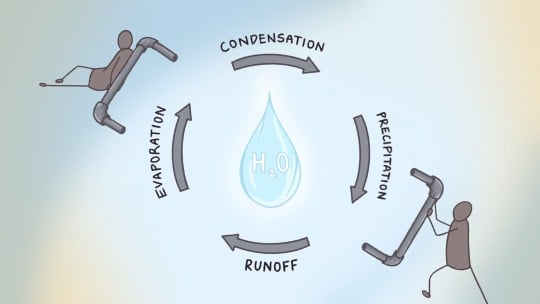
Water is a resource that I often take for granted. I take daily showers, wash my dishes, and do my laundry without a second thought to the amount or quality of water that is used. I only experience small aspects of the natural water cycle on a daily basis, from a bit of condensation on a cold glass of water to the sporadic downfall of rain that occurs in Pittsburgh. The water cycle that I’ve learned about in school can be boiled down to: precipitation, surface runoff, infiltration, evaporation, and condensation; but how do I, as a human being, fit into all of this? What is the human water cycle and how have parts of the water cycle changed within the Anthropocene?

drawing of the city water cycle from waste water to drinking water

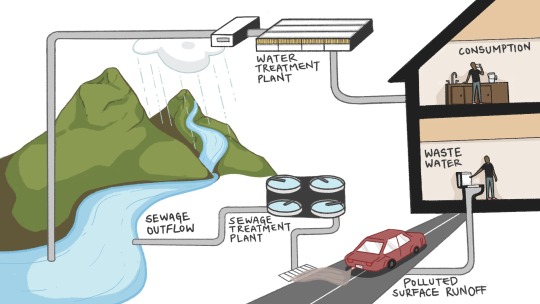
As intrigued as I was, I didn’t know enough about my own impact on the water cycle, so I took a deeper dive into learning about what was actually happening to the water that I used. In order to explore the concept of the human water cycle I needed to start by looking at infrastructure. In the case of water infrastructure, outside of irrigation, the water purification systems and sewage systems are some of the most impactful additions human beings have included into the planet’s water cycle. These infrastructural systems span thousands and thousands of miles underground, connecting houses, neighborhoods, and cities. And yet, at least for me, there was a vast mental disconnect between the water that flows underneath us and the water that we consume. I wasn’t sure how to visualize something that was happening underground, hidden away from sight. That’s when I learned about fatbergs.

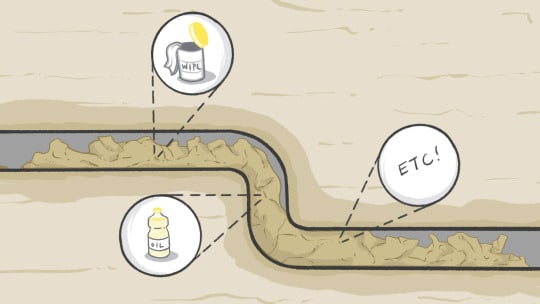
In 2017 an 820 foot long mass weighing 130 metric tons was discovered in the sewers of Whitechapel in London, England. The same type of mass, weighing 42 metric tons was found in Melbourne, Australia during the outbreak of the COVID-19 virus, most likely due to the flushing of “toilet paper substitutes” (i.e. paper towels, sanitary products, facial tissues). These masses are called fatbergs and can be found in most major cities, especially those with older sewage systems like Pittsburgh. A fatberg is a solidified mass of fat, formed overtime in sewers, that sticks to the build-up of un-flushable sewage. Fatbergs cost hundreds of thousands of dollars to remove, and also reduce river and stream water quality by making sewer overflows more likely. In the Pittsburgh Area, whenever the combined storm and sanitary sewer system is overloaded, excess flow is dumped directly into the rivers.

drawing of a pipe with a fatberg forming in it

Fatbergs are a human phenomenon that directly impacts both us and the greater environment. The sewer overflows that they cause impact both the built and natural environment, introducing pollutants such as human waste from our toilets and fats from our kitchen sinks into the living domain. But as harmful as they are, they can be easily prevented.

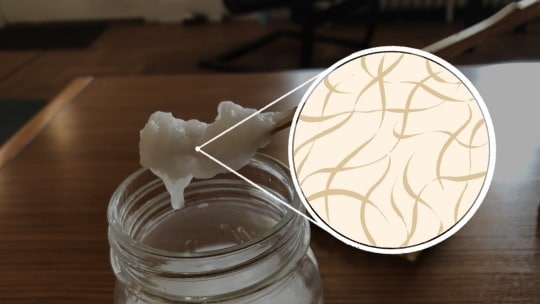
How, you ask? The solution is simple… don’t flush down anything other than toilet paper and bodily waste. But why? What makes toilet paper any different from other paper-like materials? The answer lies in the unique quality of the material that toilet paper is made up of. Unlike paper towels that use long fiber pulps, which improves the strength and absorptivity of the material, and facial tissues that contain additives that hold the fibers together, toilet paper is made using approximately 70% hardwood pulps with short fibers and 30% softwood pulps with longer fibers. Due to the hardwood pulps, once the toilet paper makes contact with water, the short fibers, which also help keep the toilet paper soft to touch, are able to untangle and fall away into smaller fragments, eventually dissolving into tiny bundles of short fiber that can easily flow through the sewage system.

jar, wet paper, and a drawing of paper fibers

Objects like ‘flushable wipes’, unlike toilet paper, take hours to days to break down. This means that just because we are able to flush something down, doesn’t necessarily make it safe for sewer and septic systems. If you want to try an experiment to explore this concept, try putting ‘flushable’ wipes and toilet paper into two separate containers of water. See for yourself what happens.

Fatbergs are all the more relevant to us during the times of the pandemic, especially in the United States. As people stay home, more objects that aren’t healthy for the sewage system are being flushed. Think about the times you flushed anything other than toilet paper. Are you feeding a potential fatberg in your neighborhood?

Daniel Noh is an intern for the Center for Anthropocene Studies, Carnegie Museum of Natural History. Museum employees are encouraged to blog about their unique experiences and knowledge gained from working at the museum.
Related Content

From the Allegheny to Our Kitchen Sinks

We Are Nature: Living in the Anthropocene (Video)

I Love this Interspecies Friendship!

Filed Under: Blog Tagged With: Anthropocene, Anthropocene Living Room, Anthropocene Section, Anthropocene Studies, Daniel Noh, Museum from Home, Science News

September 9, 2020 by wpengine

Snails in the Desert

Land snails are leaky bags of water that survive on dry land. Snails lose water through evaporation, and because mucus is more than 90% water, they must expend water just to move, gliding on their silvery slime trails. Most land snails occur in moist environments where they can readily replenish lost water. But some snails live in the desert or other arid areas! How is that even possible?

Several strategies help snails survive in arid situations. For example, some close their aperture with a door or with a mucus sheet, some have small apertures or modify their growth direction to make better seals, some have mucus that inhibits evaporation, and some manage moisture loss by choice of microhabitats.

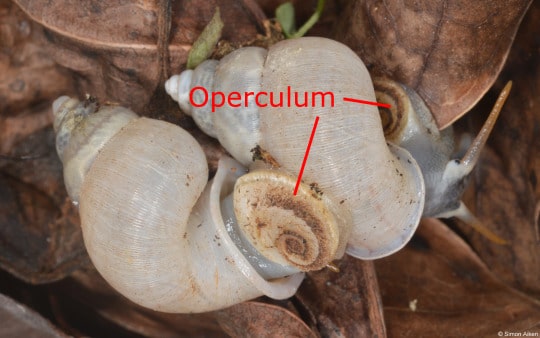
Fig. 1. Two Clydonopoma poloense snails from Dominican Republic showing their opercula. (Photo by S.P. Aiken with permission.)

An operculum, or door, closes the shell in some land snails (Fig. 1), although most land snails lack one. The operculum is attached to the rear of the snail’s tail; when the snail pulls into its shell, the tail withdraws last and positions the operculum to make a tight seal. In addition to protecting the snail from water loss, it also protects from predators.

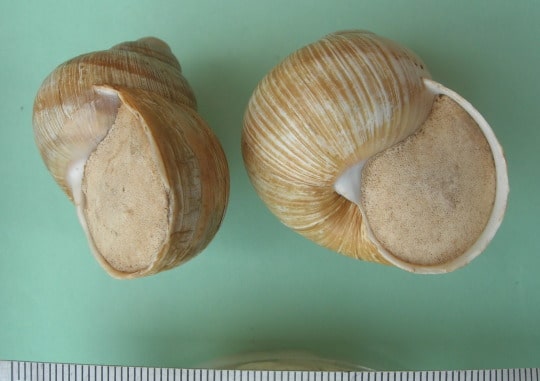
Fig. 2. Two Helix pomatia edible snails from Russia (CM154077) with apertures closed by an opaque epiphragm. (Photo by T.A. Pearce.)

Snails that don’t have an operculum can cover the aperture with a mucus sheet called an epiphragm. In most snails, the epiphragm is thin and clear, but in some species, the epiphragm can be thick and opaque (Fig. 2). During dry periods, snails can form an epiphragm over the aperture or they can make a tight mucus seal between the aperture edges and substrates such as a rock or plant. The seal helps to retard evaporative water loss. Some snails in the desert remain sealed under a rock for years before a rainstorm wakes them.

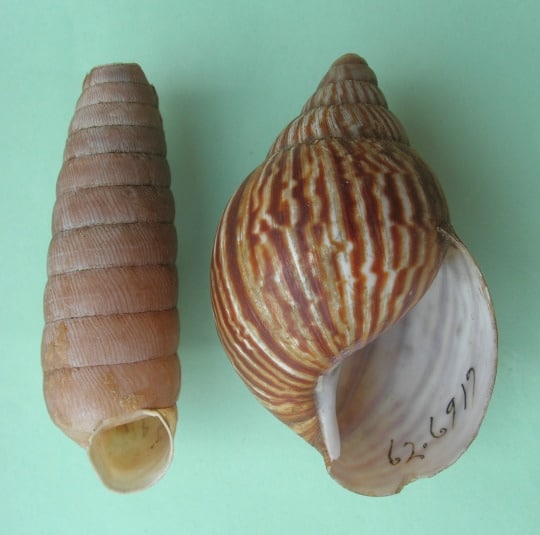
Fig. 3. Coelocentrum gigas from Guatemala CM62.8574 (left); Achatina zebra from Africa CM62.6917 (right). Land snails in drier areas tend to have relatively smaller apertures like the shell on the left. Shells pictured are 8 and 8.5 cm tall, respectively. (Photo by T.A. Pearce.)

Snails of arid areas usually have a relatively small aperture (Fig. 3). The smaller surface-area-to-volume ratio reduces moisture loss through evaporation. Just like you would lose less heat (on a cold day) with your parka zipped up and your hood cinched around your face, the snail loses less water with less of its skin exposed, as in the case of a smaller aperture.

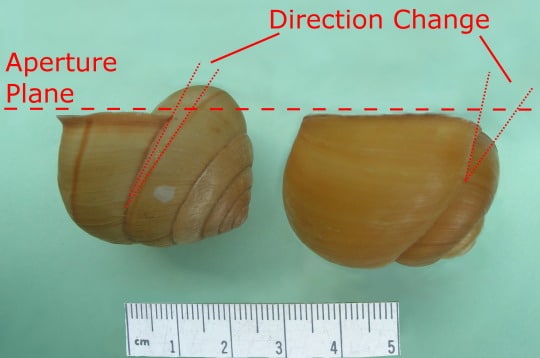
Fig. 4. Ganesella fusca (left) from Japan (CM106167) and Zachrysia guanensis (right) from Cuba (CM152889). Land snails in drier areas tend to have greater change in direction of growth when reaching full size, allowing the plane of the aperture to make a closer seal with flat surfaces. (Photo by T.A. Pearce.)

As growing snails approach their final size, many dip the direction of shell growth toward the shell base (Fig. 4). This results in the plane of the aperture making a tighter seal on a flat surface. Snails of arid areas tend to have shells that make tighter seals on flat surfaces than snails of moister areas.

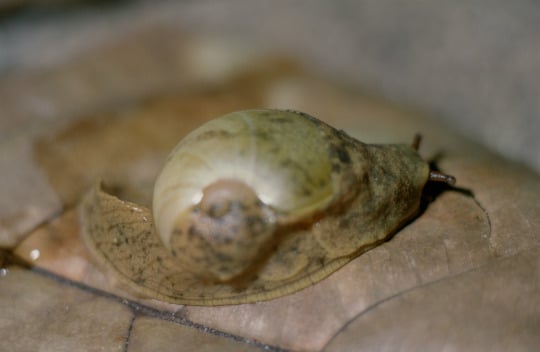
Fig. 5. Urocyclid semi-slug from a dry area in N Kenya. (Photo by T.A. Pearce.)

The mucus of some species retards evaporation. Snails produce different kinds of mucus, for example, the mucus they glide upon to move, sticky or distasteful mucus when irritated, and mucus on their skin that can retard evaporation. One day when I was traveling in northern Kenya during the dry season after at least 6 months without rain, I was surprised to find a semi-slug (a gastropod whose shell is too small to fit the entire body) resting among some dry leaves and soil (Fig 5). It must have had special mucus covering the body that retarded water loss, allowing this species to survive many months of aridity.

Finally, snails influence their moisture loss by choosing their microhabitats. Some snails burrow underground during hot, dry weather to escape the heat. Other snails crawl under moist logs or descend deep into rock piles to avoid the harshest weather.

Why would snails even choose to live in the desert? I’m not sure anyone knows the answer for sure. My guess is that snails might live in a desert because it allows them to escape predators or competitors who can’t or don’t want to live there.

How do they do it? Snails survive in the desert by leaking water a bit more slowly than snails in moist areas.

Timothy A. Pearce, PhD, is the head of the mollusks section at Carnegie Museum of Natural History. Museum employees are encouraged to blog about their unique experiences and knowledge gained from working at the museum.
Related Content

Ask a Scientist: What is the biggest snail?

The Tell-Snail Heart

Happy Ctenophore Day!

Filed Under: Blog Tagged With: Museum from Home, Science News, Section of Mollusks, Tim Pearce

September 9, 2020 by wpengine

From the Allegheny to our Kitchen Sinks

There are more than 326 million trillion gallons of water on our planet. Our bodies are made up of around 60% water. Even the air that we breathe has water vapors in it. Water is everywhere, but the water we can use is limited. According to the National Groundwater Association, the Earth is made up of about 71% water. Out of that, 99.7% is trapped in oceans, icecaps, soil, and the atmosphere. That leaves us with around 0.3% of the Earth’s water to use and drink. The same water that all living and nonliving things have used again and again since water has been on the planet.

drawing of people drinking water

Every morning I go downstairs to the kitchen and pour myself a glass of cold water from a water filter. Without a second thought, I drink the water because I consider this water to be safe. After all, the porous, activated carbon filters absorb various chemicals, including chlorine, lead, and mercury, which ‘purifies’ the water. Furthermore, I don’t have to worry about what could be in the water, because I know that the water is thoroughly cleaned before it enters the house. But how is it cleaned? Where does this water come from and what does it go through in order to splash into my kitchen sink?

Let’s start with a broader concept: rivers. Most major cities can be found along rivers: Paris along the Seine River, London along the River Thames, Seoul along the Han River, and New York along the Hudson River. This is no surprise, as communities need fresh, drinking water as an essential part of building a city. Pittsburgh is no different. In fact, in Pittsburgh, two rivers, the Monongahela and the Allegheny form a third, the Ohio, which on its passage through Pennsylvania, West Virginia, Ohio, Kentucky, Indiana, and Illinois, is the primary water source for over five million people. Within the city, the Allegheny River provides us, the people of Pittsburgh, with fresh water that we use on a daily basis.

illustration of the water cycle: condensation, precipitation, runoff, evaporation

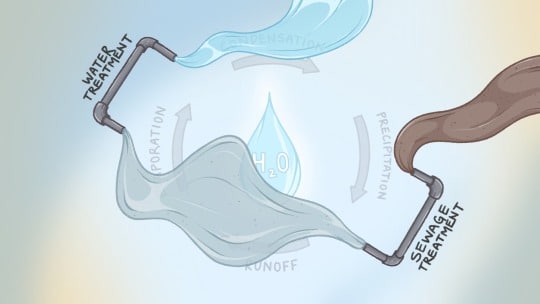
If my water comes from the Allegheny River, what’s the difference between drinking tap water and river water? That’s where the Pittsburgh Water and Sewer Authority, or the PWSA, enters the picture. PWSA is the organization in charge of providing quality water throughout the city of Pittsburgh. The organization’s drinking water system “contains approximately 965 miles of water lines, five reservoirs, and 11 tanks with a water storage capacity of 455 million gallons” (pgh2o.com). And their process for making clean water looks like this. First, the collected river water is coagulated using ferric chloride, potassium permanganate, carbon, and catatonic polymer, which react to the polluting particles in the water, causing them to stick and clump together. The water is then taken through the filtration process, where it flows through pulverized anthracite coal and sand to remove any of the remaining particles. Afterwards, the water is disinfected with sodium hypochlorite, a type of chlorine compound that is used to remove microbial particles. Lastly, once the water has been completely purified, fluoride, the processed form of a naturally occurring mineral, is added back into the water as recommended by the Center for Disease Control to prevent tooth decay.

image of sewage treatment and water treatment over water cycle

As complex as this purification process is, it isn’t perfect. The quality of the water that we receive is affected by what we put into it and there are countless compounds that cannot be completely filtered out by the processes used in water treatment plants. For example, trace amounts of dioxane, a likely human carcinogen from plastic manufacturing runoff, can be found in Pittsburgh’s own water system. Moreover, as of 2019, the PWSA has introduced orthophosphate in order to reduce lead levels, originating from the city’s ancient water pipes, in our tap water. In the end, all the water treatment plants can do is clean the water, test for contaminants, and research new ways to produce and deliver as clean a product as possible. The rest is up to us, the community. It’s up to us to be cautious of how we treat water by watching what we flush, preventing littering, or even reducing plastic use to reduce both microplastics and plastic production.

Water treatment is a growing process; new methods to remove previously unfilterable chemicals are constantly being discovered. With this in mind, think about your relationship with water. How do you treat it? What kind of objects do you flush down the toilet? What are your direct and indirect interactions with our water system? All of our actions matter. Because what we put into the river, will eventually come back to us.

Daniel Noh is an intern for the Center for Anthropocene Studies, Carnegie Museum of Natural History. Museum employees are encouraged to blog about their unique experiences and knowledge gained from working at the museum.
Resources

https://blogs.scientificamerican.com/guest-blog/the-purest-of-them-all/

https://www.portpitt.com/pages/monongahela-river

https://www.wpxi.com/news/what-you-need-to-know-about-pittsburghs-three-rivers/739536503/

http://www.orsanco.org/river-facts/

https://coolcosmos.ipac.caltech.edu/ask/67-How-much-water-does-Earth-have-#:~:text=There%20are%20more%20than%20326,in%20ice%20caps%20and%20glaciers

Related Content

The Inequity of Summer Heat

Hip and “Trashy” Ice Cream

Finding Nature in Your Local Streams

Filed Under: Blog Tagged With: Anthropocene, Anthropocene Living Room, Anthropocene Section, Anthropocene Studies, Daniel Noh, Museum from Home, Science News

September 3, 2020 by wpengine

The circle of life… and invasion

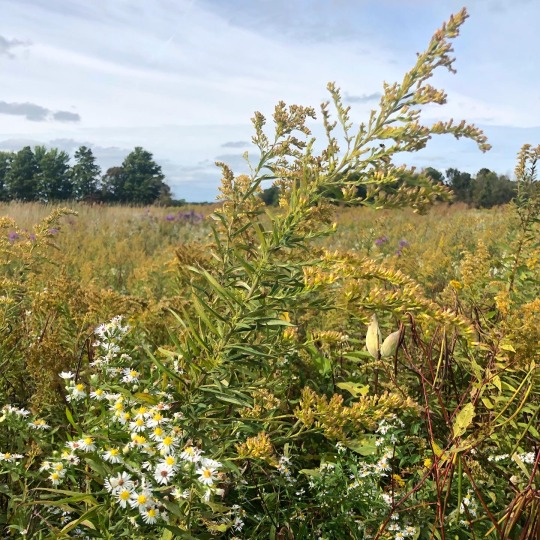
field with wild flowers

If you have a garden in Pittsburgh, chances are that it has been invaded by nonnative plants. Nonnative plants are species that have been introduced by humans to a location outside their native range. Typically this means that humans have carried a species across oceans or mountains or very long distances that the species would be unlikely to travel on its own.  This includes dandelions (Taraxacum officinale), English ivy (Hedera helix), garlic mustard (Alliaria petiolata), Japanese knotweed (Fallopia japonica), and thousands more. In many cases, nonnative, invasive species hurt our efforts to protect and restore natural areas by displacing native plants from their environment and reducing the healthy functioning of ecosystems.

As an invasion ecologist at the University of Pittsburgh, I aim to identify the traits that make nonnative plants unique from native plants and investigate how these traits influence a nonnative species’ ability to invade and persist within ecosystems. I’ve become fascinated by one plant trait in particular: phenology, or the timing of a plant’s life cycle events, like flowering in the spring or leaves changing color in the fall. Phenology is critical to the survival and reproduction of all organisms. Plants, for example, need to be able to germinate at the exact right time in the spring; early enough to maximize their growth potential, but late enough that they avoid damaging winter frosts. Plants must also flower and set fruit at a time when their chances of reproduction are highest, such as when pollinators are the most active, or when seeds are most easily dispersed. The timing of phenology also impacts a plant’s ability to compete with other species. An older, mature plant is likely to be a better competitor than a newly germinated seedling. As a result, most species have evolved to become sensitive to a wide array of environmental factors, including temperature and precipitation, which signal the “ideal” time to enter into a new stage of the life cycle.

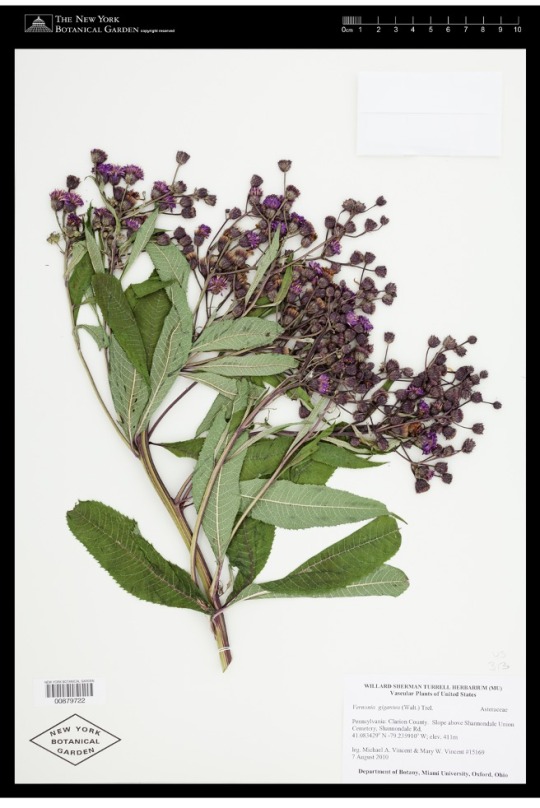
dried plant specimen with purple flowers
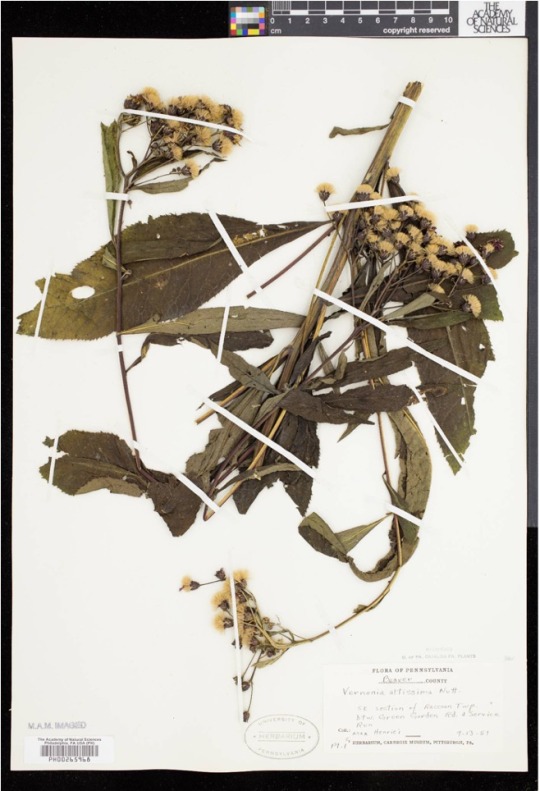
dried plant specimen with yellow flowers

In a recently published study, I partnered with Dr. Mason Heberling and Bonnie Isaac at the Carnegie Museum of Natural History to explore how phenology differs between native and nonnative plant species. Plant specimens from the museum’s herbarium provide us with valuable snapshots of phenology from more than the past 120 years. By looking at a specimen’s collection date and identifying reproductive structures on the specimen (did the plant have open flowers or fruits?), we can determine the annual timing of life cycle events for a species and compare it with other species throughout time.

First, our research team asked: are there differences in the timing of reproduction between native and nonnative plant species? We referenced nearly a thousand herbarium specimens that were collected in old-field ecosystems (i.e. abandoned agricultural fields) since 1900. We found that nonnative plants reproduce substantially earlier than native plants in old-field ecosystems. Specifically, nonnative plants flowered 50 days earlier, and set fruit 17 days earlier, on average, than native plant species. When considering that the growing season in western Pennsylvania only lasts for 121-180 days in total, this is a very large difference in the activity periods of these species! We predict that the early reproduction of nonnative plants may actually help them to survive in invaded ecosystems, and my current research is experimentally testing some of these ideas at the Unviersity of Pittsburgh field station. I hypothesize that nonnative plants are accessing important resources, like soil nutrients and light, by growing and reproducing earlier than native plants.

We also found that all old-field species, regardless of origin, are flowering approximately 10 days earlier, and fruiting 13 days earlier today than they were at the beginning of the 20th century. What is causing plant species to shift their phenology over time? This is likely a response in-part to climate change, which has caused warmer and wetter springs in Pennsylvania

Next, we asked: are there differences in the sensitivity of native and nonnative phenology to climate signals? Sensitivity is defined as the number of days a plant will shift the timing of reproduction in response to a change in the environment. For example, a species with “high” sensitivity to temperature might flower several days earlier than normal in response to a particularly warm spring. By contrast, a species with “no” sensitivity to temperature will flower at the same time every year, regardless of temperature. To answer this question, we paired plant specimens from the CMNH herbarium with historic climate records that date back to 1900. This source tells us the temperature and precipitation conditions for each month and year that a specimen was collected. Our study found that native and nonnative species are not sensitive to the same types of climate signals. When looking across a range of temperature and precipitation signals, the timing of reproduction in native plants often would shift by a different number of days than in nonnative plants. This information may be important in helping scientists to understand how plant phenology will respond to future climate change: Will native and nonnative species respond similarly, as seen in the past, or will their responses begin to diverge?

Herbarium collections such as those found at the Carnegie Museum of Natural History provide invaluable insight into the traits of species throughout history. We hope that, through the continued exploration of these data sources, scientists will continue to uncover new findings about the relationship between invasion, plant phenology, and climate.

Rachel Anne Reeb is a PhD candidate at the University of Pittsburgh. 

Related Content

Protecting Plant Specimens from Decomposing

Collected September 20, 1952: Virginia stickseed

Ask a Scientist: How do you find rare plants?

Filed Under: Blog Tagged With: Botany, Hall of Botany, Museum from Home, Rachel Anne Reeb, Section of Botany

  • « Go to Previous Page
  • Page 1
  • Interim pages omitted …
  • Page 8
  • Page 9
  • Page 10
  • Page 11
  • Page 12
  • Interim pages omitted …
  • Page 26
  • Go to Next Page »

sidebar

About

  • Mission & Commitments
  • Directors Team
  • Museum History

Get Involved

  • Volunteer
  • Membership
  • Carnegie Discoverers
  • Donate
  • Employment
  • Events

Bring a Group

  • Groups of 10 or More
  • Birthday Parties at the Museum
  • Field Trips

Powdermill

  • Powdermill Nature Reserve
  • Powdermill Field Trips
  • Powdermill Staff
  • Research at Powdermill

More Information

  • Image Permission Requests
  • Science Stories
  • Accessibility
  • Shopping Cart
  • Contact
  • Visitor Policies
Stay in the loop! Sign up for our newsletter(s).
One of the Four Carnegie Museums | © Carnegie Institute | Privacy Policy | Terms of Use | Accessibility
Rad works here logo