• Skip to primary navigation
  • Skip to main content
  • Skip to primary sidebar

Carnegie Museum of Natural History

One of the Four Carnegie Museums of Pittsburgh

  • Visit
    • Buy Tickets
    • Visitor Information
    • Exhibitions
    • Events
    • Dining at the Museum
    • Celebrate at the Museum
    • Powdermill Nature Reserve
    • Event Venue Rental
    • Gift Cards
  • Learn
    • Field Trips
    • Educator Information
    • Programs at the Museum
    • Bring the Museum to You
    • Guided Programs FAQ
    • Programs Online
    • Climate and Rural Systems Partnership
  • Research
    • Scientific Sections
    • Science Stories
    • Science Videos
    • Senior Science & Research Staff
    • Museum Library
    • Science Seminars
    • Scientific Publications
    • Specimen and Artifact Identification
  • About
    • Mission & Commitments
    • Directors Team
    • Museum History
  • Tickets
  • Give
  • Shop

Enjoy the Museum from Home via our Blog

Can't make it to the museum in person? We've done our best to help cultivate resources for you to enjoy from home. Activities for the whole family, different ways to experience our exhibitions and more are included in these blogs.

October 1, 2020 by wpengine

The Bromacker Fossil Project Part X: Tambaroter carrolli, an amphibian with a wedge-shaped head

New to this series? Read The Bromacker Fossil Project Part I, Part II, Part III, Part IV, Part V, Part VI, Part VII, Part VIII, and Part IX. 

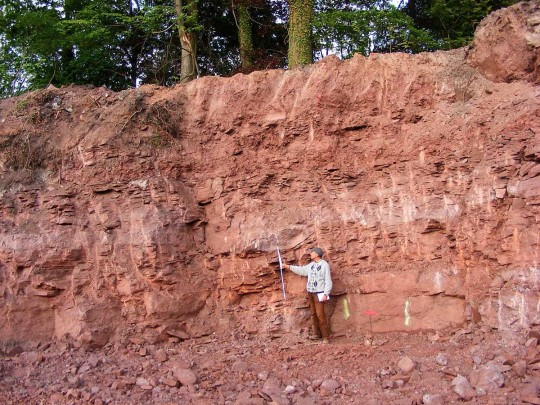
Thomas Martens at the construction site for a new store in Tambach-Dietharz where he found fossils by checking loose pieces of rock on the excavation floor. Photo by Stephanie Martens, 2008.

Paleontologist Thomas Martens has an amazing ability to find fossils. After he discovered the first vertebrate fossils at the Bromacker site in an abandoned commercial quarry in 1974, he and his father Max found additional fossils in the bottom of a deep pit they’d dug with hand tools, an excavation that Dave Berman, Stuart Sumida, and I fondly dubbed the “elevator shaft.” Years later, Thomas used funding from the German federal government to drill rock cores in the field surrounding the Bromacker quarry to help understand the geology of the fossil deposit. Amazingly, at one of the spots Thomas had selected, the drill core penetrated a skeleton of Diadectes absitus. So, it wasn’t surprising that in 2008 Thomas found a skull and partial skeleton of D. absitus and a small skull of a fossil animal new to science at a construction site for a new store in the nearby village of Tambach-Dietharz.

Dave Berman (left) and Stuart Sumida (right) pose with a shopping cart in front of the Netto Discount Store, which was built in the excavation site where Tambaroter was found. Rocks of the Tambach Formation can be seen behind the retaining wall. Photo by the author, 2008.

It makes sense, however, that vertebrate fossils were found close to the Bromacker quarry. Fossils from the Bromacker were preserved in the Tambach Formation, a 200–400-foot-thick unit of sediments that were deposited in the small intermontane Tambach Basin about 290—283 million years ago during the Early Permian Epoch. The Tambach Basin covered an area of about 155 square miles and was internally drained; that is, there were no rivers or streams flowing into and out of the basin. During periods of extremely heavy rain, water and mud would flow down the basin sides in what are called sheet floods and pool in the basin center, which is where the present day Bromacker quarry and Tambach-Dietharz are thought to be located. Any animals killed during these events would be carried by the sheet floods to the basin center where they’d have been quickly and deeply buried in mud settling out of the ponded water and later become fossilized. It is assumed that animals captured by the sheet flood events inhabited the Tambach Basin, because carcasses couldn’t have been carried into the basin by rivers and streams.
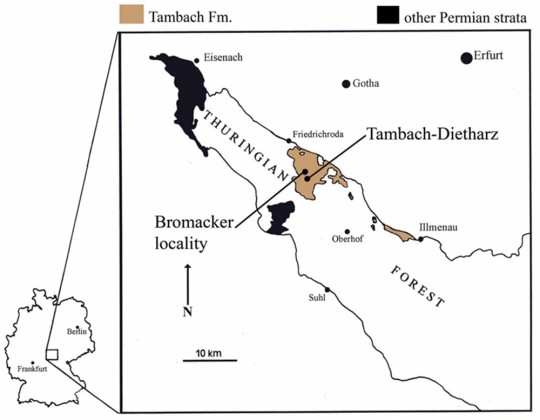
Map of Germany with inset showing the Bromacker locality and the nearby town of Tambach-Dietharz. Although the Tambach Basin in which the Tambach Formation was deposited covers about 155 square miles, outcrops of the Tambach Formation today occur in an area of only about 31 square miles.

While preparing Bromacker fossils, I’d typically read literature related to the fossil I was working on, write notes on what I thought were important features in the fossil, and give my notes to the person leading the project. When Dave was the lead, we’d typically have lots of discussion about certain features preserved in the animal, conversations that often directed the course of preparation. This time, in addition to preparing the new find, I was designated as the lead author for the publication that would name and describe it.
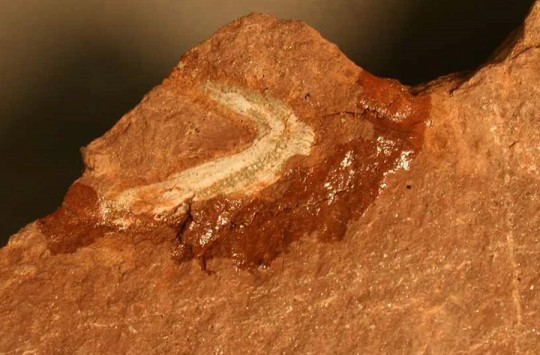
View of the underside of the skull of Tambaroter carrolli before preparation. The shiny area surrounding the skull is glue, which I applied to a crack to stabilize the specimen before preparation could begin. I had to free the skull from the surrounding rock before exposing as much of it as possible through preparation. Photo by the author, 2008.

Tambaroter is a member of the Microsauria, a diverse group of small amphibians that were once thought to be reptiles, a hypothesis that some paleontologists are currently revisiting. Microsaurs inhabited a variety of habitats and exhibited a range of body forms. Some were highly terrestrial with limb proportions similar to those of lizards, whereas others were aquatic and had elongated bodies and reduced girdles and limbs. Still others were adapted for burrowing or rooting through leaf litter. Tambaroter belongs to this latter-most group, which is named Recumbirostra for their recurved snout, in which the front of the mouth is overhung by the snout.
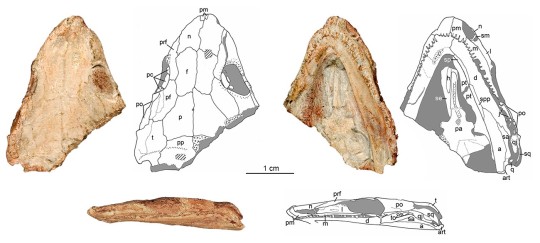
Photographs and line drawings of the skull of Tambaroter carrolli in (clockwise from upper left) dorsal (top), ventral (underside), and left lateral (side) views. Photographs by the author, 2008 and drawings by the author and modified from Henrici et al., 2011.

Tambaroter is member of the recumbirostran subgroup Ostodolepidae. I coined the name Tambaroter, which is derived from “Tamb,” for the Tambach Formation, and the Greek “aroter,” meaning plowman, in reference to the snout shape. Two previously named ostodolepids, Micraroter and Nannaroter, have the “aroter, suffix in their name, so usage of the “aroter” suffix was a continuation of this. The species name, carrolli, honors microsaur expert Robert Carroll (then Curator Emeritus at the Redpath Museum, McGill University, Montreal, Canada).

Skulls of representative ostodolepid microsaurs from geologically oldest (left) to youngest (right). A reconstruction drawing of the skull of Tambaroter was used instead of a photograph for comparison because the original fossil skull is extremely flattened (see previous image). Photographs, except for that of Nannaroter, by the author, 2009. The photograph of Nannaroter was modified from Anderson et al., 2009. Tambaroter skull reconstruction by the author and modified from Henrici et al., 2011. Scale bar of the tiny Nannaroter and other ostodolepids equals 1 cm.

When Tambaroter was published on in 2011, it was the first ostodolepid to be found outside of the USA (the others are from Oklahoma and Texas) and is the oldest one known. Other, possible ostodolepids have since been described from the American Midwest and Germany. All ostodolepids have a wedge-shaped skull and recumbent snout, which is accentuated in Pelodosotis. Based on these features, scientists think that ostodolepids burrowed or searched for worms and other prey in leaf litter. Remarkably, the skull of the tiny Nannaroter is so strongly built that it could have withstood burrowing headfirst into the ground by using its shovel-like snout to loosen dirt and its broad, flat head to push soil against the burrow ceiling. Because the sutures between individual skull bones in the Tambaroter type specimen are not tightly fused together, we think it belonged to a juvenile, so we don’t know if the adult skull would’ve been as strongly built as that of Nannaroter.
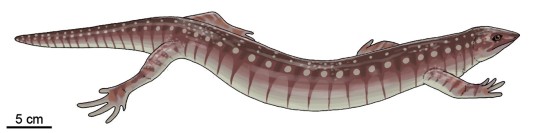
Life drawing of the ostodolepid microsaur Pelodosotis elongatum, which is known by a nearly complete specimen. Tambaroter probably had a similar body shape, though its skull would not have been as strongly wedge-shaped. Drawing modified by Carnegie Museum of Natural History Scientific Illustrator Andrew McAfee from outline drawing in Carroll and Gaskill (1978).

Stay tuned for my next post, which will feature one of the Bromacker’s top carnivores. To learn more about Tambaroter, read the publication that described the animal here.

Amy Henrici is Collection Manager in the Section of Vertebrate Paleontology at Carnegie Museum of Natural History. Museum employees are encouraged to blog about their unique experiences and knowledge gained from working at the museum.

Keep Reading

The Bromacker Fossil Project Part XI: Dimetrodon teutonis, an apex predator
Filed Under: Blog Tagged With: Amy Henrici, Museum from Home, Science News, The Bromacker Fossil Project, Vertebrate Paleontology

September 29, 2020 by wpengine

Collected on this Day in 1967: Fall blooms rival those of spring

photo of aster flowers with white petals

In the northeastern United States, we often think of spring as a time for wildflowers.  But the fall is, too.  

It is easy to be distracted by the beautiful fall foliage, when our landscape turns brilliant shades of red, orange, and yellow.  But when many plants are shutting down for the winter, others are just kicking into gear.

Many wildflower species bloom well into fall, both in open areas and in the forest understory.  One group of plants are the fall blooming “asters.”  In same plant family as sunflowers and dandelions (Asteraceae), Aster was once a very large plant genus in our native North American flora (somewhere along the lines of >175 species!), but as we learned more about the evolutionary relationships of these plants, they have since been split into multiple genera (plural of genus). In fact, there is only one “true” Aster in Pennsylvania, Tatarian aster (Aster tataricus), which is actually not even native to Pennsylvania!  Regardless of the scientific name, these plants are commonly referred to as asters.  And they put on quite an autumn show in Pennsylvania.

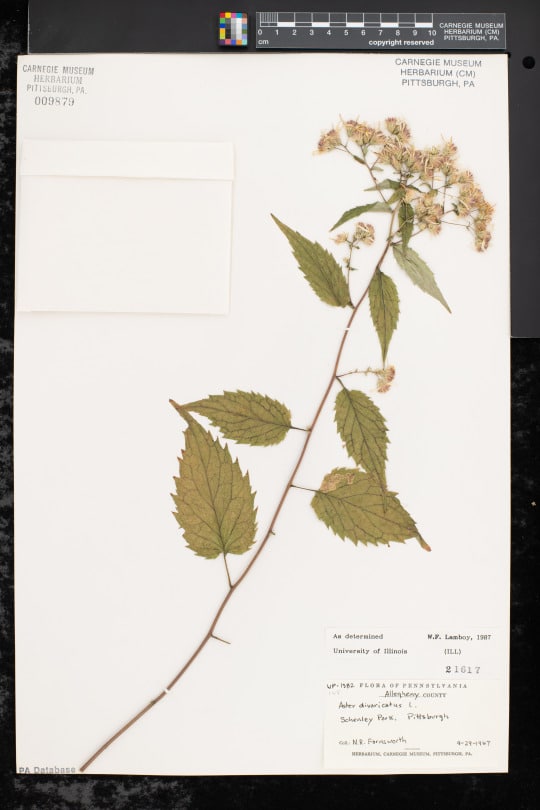
dried specimen of aster flower from Carnegie Museum of Natural History herbarium

Perhaps one of the most common woodland asters in Pennsylvania is white wood aster (Eurybia divaricata, formerly known as Aster divaricatus).  This specimen was collected September 29, 1967 by N.R. Farnsworth in Pittsburgh’s Schenley Park.  This species can still be found in Schenley Park, and many parks, woodlands, and wooded roadsides across Eastern North America.

Fall foliage is beautiful in Pennsylvania.  But don’t forget to look down at the flowers, too!

Find this white wood aster specimen here: https://midatlanticherbaria.org/portal/collections/individual/index.php?occid=11826562

Check back for more! Botanists at the Carnegie Museum of Natural History share digital specimens from the herbarium on dates they were collected. They are in the midst of a three-year project to digitize nearly 190,000 plant specimens collected in the region, making images and other data publicly available online. This effort is part of the Mid-Atlantic Megalopolis Project (mamdigitization.org), a network of thirteen herbaria spanning the densely populated urban corridor from Washington, D.C. to New York City to achieve a greater understanding of our urban areas, including the unique industrial and environmental history of the greater Pittsburgh region. This project is made possible by the National Science Foundation under grant no. 1801022.

Mason Heberling is Assistant Curator of Botany at Carnegie Museum of Natural History. Museum employees are encouraged to blog about their unique experiences and knowledge gained from working at the museum.

Related Content

Collected on This Day in 1944: Squarrose Goldenrod

Dandelion and Goldenrod Coloring Pages

Herbarium Specimens Hold More Information Than We Realize

Filed Under: Blog Tagged With: Botany, collected on this day, Hall of Botany, Mason Heberling, Museum from Home, Science News, Section of Botany

September 25, 2020 by wpengine

From Collector to Director

image
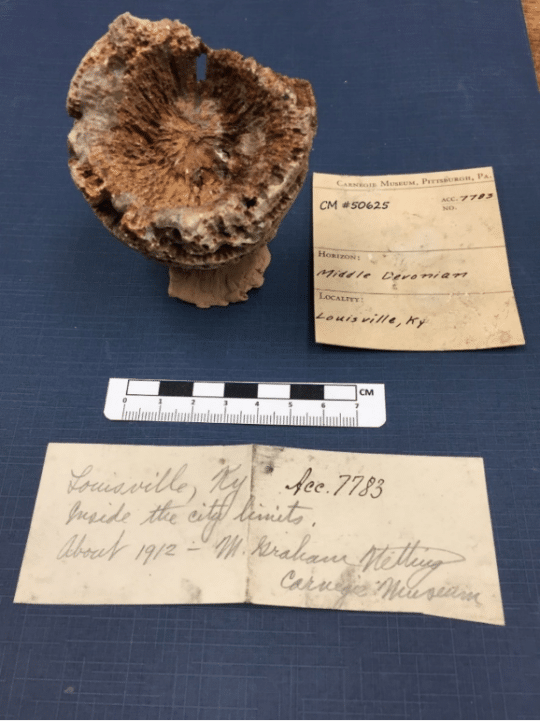
Figure 1: CM 50625 – Rugosa Coral. Collected by M. Graham Netting in 1912.   Coral body shape has a radial symmetry.

In 1912, eight-year-old M. Graham Netting unearthed 13 coral fossils within the city limits of Louisville, Kentucky.  Later, as a 22-year-old Pitt student, he donated them to the Carnegie Museum of Natural History (Figure 1).   When the Great Depression cut short his graduate studies at the University of Michigan in 1929, he returned to the museum as Assistant Curator of Herpetology, and worked his way up to Curator in 1932.   In 1954, six months before turning 50, he was appointed Director of the Carnegie Museum of Natural History.   Along the way, the Wilkinsburg native left an astonishing legacy that includes a steady growth in scientific collections, numerous wildlife dioramas in the Halls of Wildlife, and a mid-Appalachian field research station, Powdermill Nature Reserve.  Upon his retirement in 1975, the Post-Gazette noted, “Long before it was “in,” Netting saw pollution of the air and water ravaging the land.”

Albert Kollar, Collection Manager of the of Section of Invertebrate Paleontology, re-discovered young Graham Netting’s horn corals while working on a multiyear review of the Bayet Collection.  Netting’s label note did not provide any evidence for the stratigraphic unit that he collected from, but more on that later.

image
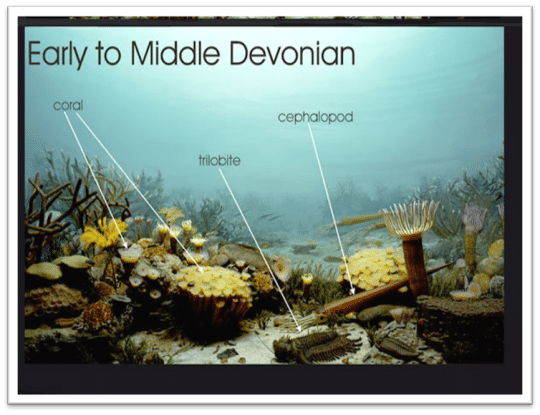
Figure 2: Carnegie Museum of Natural History exhibit reconstruction of an Early to Middle Devonian reef, 375 – 390 MYA.  The reef shows Rugosa and Tabulate corals, a spiny trilobite about 18 inches in length and several straight cephalopods.   Coral tentacles (shown in white) are illustrated in feeding mode.  Both Rugosa and Tabulate corals went extinct at the end of the Permian Period.

Rugose corals are often called horn corals because many species have a horn shape.  Horn corals attach to the sea floor by way of a sticky tentacle that protrudes from the base or curved end of the animal.  Other invertebrate animals, such as brachiopods, attached in this position are described as sessile.  The coral animal or “polyp” built its skeleton from calcium carbonate, a mineral formed from Bicarbonate and Calcium ions in seawater.  The polyp tentacles or feeding polyp extend out from the top of the basic body for feeding (Figure 2).  When the animal died, its soft tissues would have decayed and left behind the external hard mineral skeleton that fossilized.

Netting’s Louisville coral specimens are fossilized in a different way than similar corals from the nearby Falls of the Ohio middle Devonian fossil beds.  His corals are lighter and fragile to the touch, conditions which gave Albert reason to compare Netting’s fossils to similar invertebrate paleontology corals from strata within the Louisville area.  Sometime during or after burial, these horn coral skeletons were replaced by silica or quartz, a process known as silicification. The mineral silica can saturate a column of seawater when the seabed is overwhelmed with a large population of sponges.  Sponge skeletons are composed of silica and when they die silica is added to a column or more of seawater.  Volcanic eruptions eject silica into the atmosphere that eventually settles into the sea.  Again potentially adding higher amounts of silica.  Whatever the cause, Albert believes Netting’s corals were collected from the fossiliferous Middle Devonian age Jeffersonville Limestone, where the “lower foot of a “conglomerate” of reworked silicified Louisville Limestone” of Upper Silurian age is known to occur with silicified coral fossils (Conkin and Conkin, 1972).

Horn and Tabulate corals thrived in shallow seas forming diversified ecological reefs from about the late Silurian Period to the beginning of the Late Devonian epoch. During the Middle Devonian epoch roughly 400 Ma to 390 Ma years ago, reefs formed in central New York, southern Ontario, central Ohio, central Iowa, western Alberta, Canada, western Australia, and in Eifel, Germany.

image
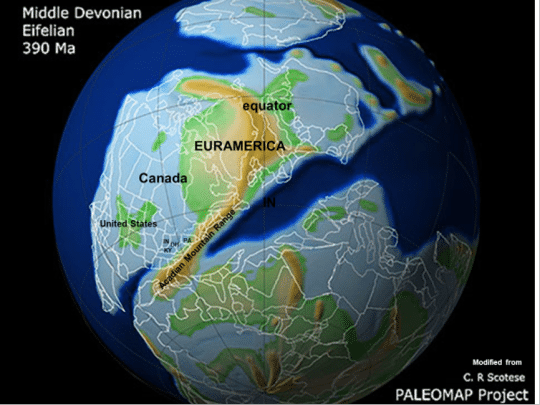
Figure 3:  Paleogeographic Map of the Middle Devonian Period – Kentucky is well south of the equator.

Louisville, during the Devonian Period, was centered in the southern hemisphere about 40 degrees south of the equator. Because of plate tectonics, the coral beds of Louisville would travel 5,500 miles over the next 390 million years to their present-day location of 38 degrees north (Figure 3). Today, fossil outcrops in the city limits of Louisville are difficult to find.

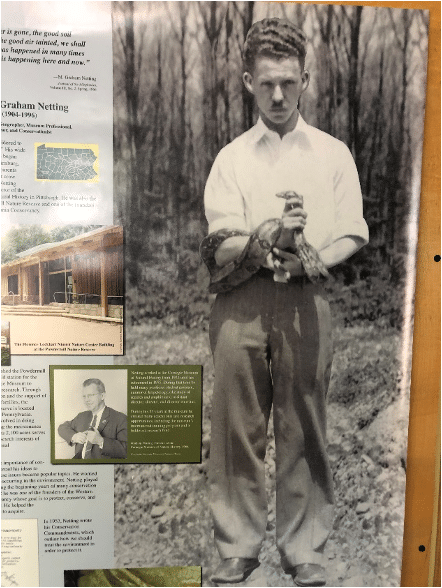
Figure 4: Graham Netting in his twenties.

When Netting retired as Director of Carnegie Museum of Natural History, he moved to a modest house next to Powdermill Nature Reserve.   A seat was saved for him each Sunday at the reserve’s weekly nature talk.  In 1996, he passed away.  Steve Rogers, Collections Manager for the Section of Birds, recalls sipping fresh lemonade on Netting’s back porch in 1981.   According to Rogers, Netting was reflective and humble.   The fossil collector who became a museum director had a habit of rubbing his chin while listening to someone speak.   When asked about his legacy, Rogers replied, “He was more instrumental in forming Powdermill than anyone.  He had an amazing ability to be a part of a team that got things done.”

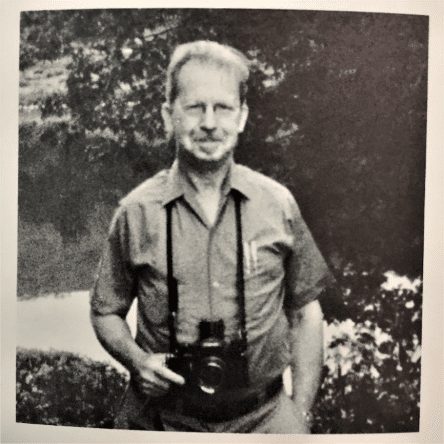
Figure 5: Graham Netting at Retirement in 1975.

As Netting prepared to step down as director in 1975, he said, “These great collections are a natural resource to answer questions about the life of the world.” On a recent day, I saw two children jumping up and down in front of the Glacier Bear diorama in Hall of North American Wildlife on a family visit to the museum.   When one of the children asked, “what’s a diorama?” I thought about Graham Netting, smiled, and encouraged their engagement with the life of the world.

Many thanks to Xianghua Sun, Carnegie Museum Library Manager, Marie Corrado, Carnegie Museum Library Clerk, Stephen Rogers, Collections Manager for the Section of Birds, and John Wenzel, Director of Powdermill Nature Reserve for help researching this post.  

Joann Wilson is an Interpreter in the Education Department at Carnegie Museum of Natural History and Albert Kollar is Collections Manager for the Section of Invertebrate Paleontology. Museum employees are encouraged to blog about their unique experiences and knowledge gained from working at the museum.

Related Content

CMP Travel Program and Section of Invertebrate Paleontology Promote the 125th Anniversary of Carnegie Library of Pittsburgh with an Outdoor Walking Tour

Hidden Treasure of Pittsburgh Found

Harriet Tubman Was a Naturalist

Filed Under: Blog Tagged With: Albert Kollar, Graham Netting, invertebrate paleontology, Joann L. Wilson, Museum from Home, Powdermill Nature Reserve, Science News

September 25, 2020 by wpengine

Mesozoic Monthly: Champsosaurus

Good news everyone: it’s September! We’ve made it to month nine of 12! Sometimes it feels like this year will never end. I take comfort in the idea that if life can survive the traumatic Cretaceous-Paleogene (K-Pg) extinction that killed the non-avian dinosaurs, I can make it through 2020. One of the survival champs of the K-Pg extinction was Champsosaurus, a superficially crocodile-like reptile belonging to the extinct group Choristodera.

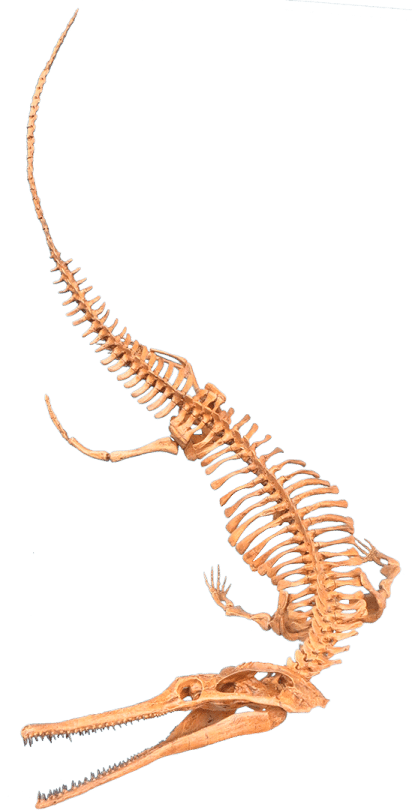
The skeleton of Champsosaurus laramiensis looks superficially like that of a crocodilian, but this is the result of convergent evolution. Choristoderes (like Champsosaurus) and crocodilians lived contemporaneously for at least 150 million years, until the choristoderes said “after a while, crocodile!” and went extinct. Photo by Triebold Paleontology, Inc., used with permission.

The class Reptilia encompasses an incredible variety of animals: lizards, snakes, turtles, crocodilians, pterosaurs, dinosaurs, and even birds are just a few of its members. In addition to the familiar reptiles that live today, many other reptile groups thrived for millions of years before eventually going extinct. It’s easy to think of dinosaurs like Tyrannosaurus or Triceratops when we talk about extinct reptile groups, but in reality, many extinct groups of animals with no living relatives escape the public eye. Choristodera, an order within the class Reptilia, is one of these groups. Choristoderes were semi-aquatic or aquatic carnivorous reptiles that evolved during the Mesozoic Era (the Age of Dinosaurs) and died out in the Cenozoic Era (the Age of Mammals). Just because they went extinct does not mean they were unsuccessful; the group survived for at least 150 million years! Like many animals, a rapidly shifting environment was probably the source of their demise. Until that point, choristodere evolution was able to ‘keep up’ with the changing times, including the monumental global changes that came with the K-Pg extinction. The combination of a massive asteroid impact in what’s now Mexico, extensive volcanic activity in India, and worldwide climatic shifts resulted in the extinction of over 75% of all species. Research on choristodere teeth suggests that they beat the odds by adapting to new prey.

When you think of an aquatic carnivorous reptile, you probably think of a crocodilian – and that’d be right! The crocodilian body plan is a very successful build for hunting prey in the water. As another aquatic carnivorous reptile, Champsosaurus evolved similar traits. This is an example of convergent evolution, in which unrelated species develop similar characteristics to deal with comparable circumstances. (You can read about more examples of convergent evolution in the January edition of Mesozoic Monthly about the sauropodomorph dinosaur Ledumahadi.) Some of the shared features between Champsosaurus and crocodilians include long, muscular jaws for catching fish, eyes at the top of the head for peering out of the water, and a flattened tail that was paddled side-to-side for propulsion. Of course, Champsosaurus and the rest of the choristoderes had many features that set them apart as well. Unlike crocodilians, which have bony armor called osteoderms embedded in their skin, choristoderes just had skin covered with tiny scales. In addition, crocodilians have nostrils on top of their snouts so that they can breathe while lurking beneath the surface of the water; choristodere nostrils were at the end of their snouts, so that they could stick the tip of their nose out of the water like a snorkel and breathe from down below.

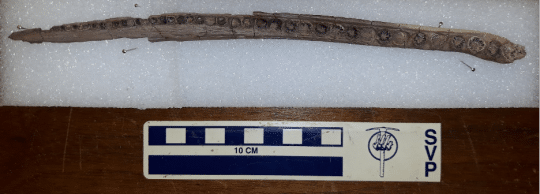
A right dentary (tooth-bearing lower jaw bone) of Champsosaurus sp. from the Upper Cretaceous of Wyoming in Carnegie Museum of Natural History’s Vertebrate Paleontology collection (specimen number CM 96509). The bone is facing upwards, so you’re looking down on the teeth. Check out the dark ‘stripes’ on the enamel of each tooth. These unusual enamel striations are a hallmark of neochoristoderes, the particular choristodere subgroup to which Champsosaurus belongs. Photo by Joe Sawchak.

The traits we see in the skeleton of Champsosaurus help paleontologists paint a picture of its behavior. Instead of lurking at the surface of the water, Champsosaurus would wait on the bottom of a shallow lake or stream for prey to come close, lifting the tip of its snout out of the water to breathe. When a tasty fish approached, it would spring off the bottom with its powerful legs and snatch it with its toothy jaws. Despite having strong legs, Champsosaurus was not adapted to a terrestrial lifestyle. In fact, adult males may not have been able to leave the water at all! Fossils attributed to females have more robust hips and hind limbs, allowing them to crawl onto land to lay eggs. According to this hypothesis, the less-robust males would have been restricted to an aquatic-only lifestyle.

Some of the freshwater environments that Champsosaurus inhabited were relatively cold, but that wasn’t a big deal; choristoderes may have been able to regulate their body temperature (a talent known as endothermy or ‘warm-bloodedness’). Crocodilians, by contrast, live in warm, tropical habitats because they are not capable of regulating their body temperature and rely on the sun to warm their bodies (aka ectothermy or ‘cold-bloodedness’). This would explain why choristoderes were able to live further north than crocodilians. However, it seems that crocodilians had the right idea; temperatures around the tropics change less during cooling and warming periods than those at higher latitudes. So, when the current Antarctic ice sheets began to form and the planet started cooling, the temperate choristoderes had to deal with more environmental change than the tropical crocodilians, and finally went extinct. I think the moral of the story is, we would all be handling 2020 better if we lived in the tropics!

Lindsay Kastroll is a volunteer and paleontology student working in the Section of Vertebrate Paleontology at Carnegie Museum of Natural History. Museum staff, volunteers, and interns are encouraged to blog about their unique experiences and knowledge gained from working at the museum.

Related Content

In the Field: Following the Work of a Paleontologist

Jurassic Days: Camptosaurus

Behind the Scenes of Dinosaur Armor

Filed Under: Blog Tagged With: dinosaurs in their time, Lindsay Kastroll, Mesozoic Monthly, Museum from Home, Science News, Vertebrate Paleontology

September 18, 2020 by wpengine

Western Bird, Eastern Waters

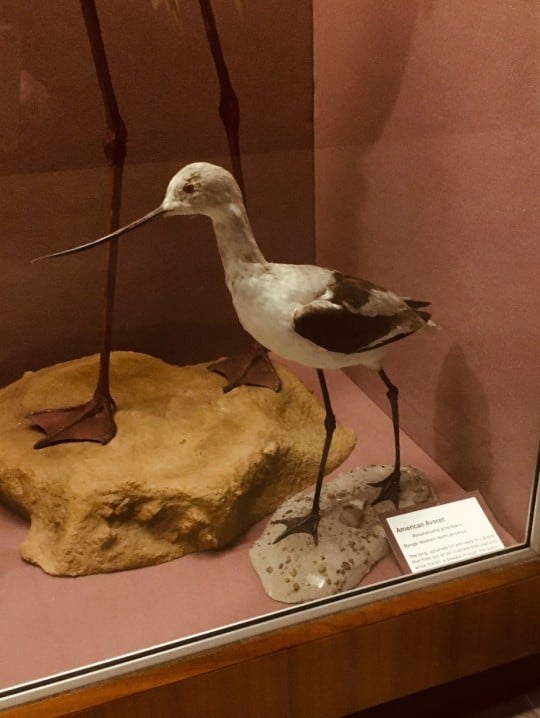
avocet taxidermy mount

If you enter Bird Hall from the Grand Staircase Balcony, the first taxidermy mount you’ll encounter is an American Avocet, an elegant species commonly associated with the shallow margins of western lakes. The life-like preserved remains of the 20-inch high, long-legged, and long-billed bird occupy the lower-right position within a display case visually dominated by a flamingo. “Adaptations for Feeding” is the comparative theme for the display’s six preserved birds, a select group the Avocet earned membership among by virtue of its long, reed-thin, and slightly up-turned bill.

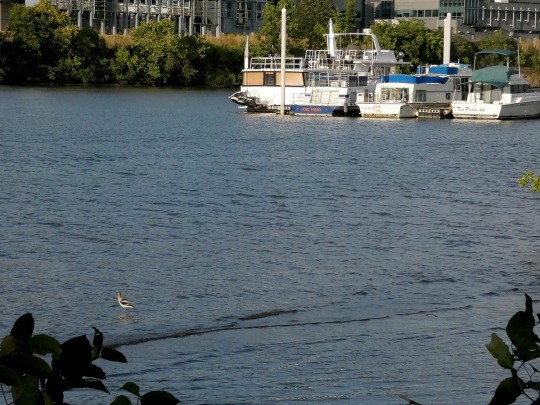
The species, known to science as Recurvirostra Americana, feeds by swinging its bill scythe-like through the water to capture small invertebrates. Remarkably, on a recent evening, I was able to observe an Avocet demonstrate the technique in waters less than three miles from the museum.

American Avocet (lower left) downstream from boats moored at the South Side Marina. Credit: Amy Henrici.

On July 24, a local birder used an online forum to share a lunchtime sighting of an avocet in the shallow waters of Monongahela River near the Birmingham Bridge. The report enabled other birders to make quick plans for riverside visits, and by 7:00 p.m. I was among a handful of binocular-bearing observers who watched the bird for 30 minutes from a South Side path before it flew upstream and out of sight.

American Avocet in Monongahela waters. Credit: Amy Henrici.

In the following days I tried to retroactively enrich the firsthand observation. I read the American Avocet account on the Cornell Lab of Ornithology’s informative All About Birds website, re-read relevant passages in The Wind Birds, author Peter Matthiessen’s 1967 tribute to the diverse tribe of species collectively termed “shore birds,” and finally, made a narrowly-focused visit to Bird Hall.

Kneeling on the marble floor in front of the avocet, I was able to inspect a key physical feature that days earlier had been concealed by murky Monongahela waters – the species’ fully webbed feet. Studying anatomical details on taxidermy mounts can enhance field observations of wildlife. This statement can be something of a mantra for natural history museum educators.

Patrick McShea works in the Education and Visitor Experience department of Carnegie Museum of Natural History. Museum employees are encouraged to blog about their unique experiences and knowledge gained from working at the museum.

Related Content

Canada Goose

Teaching in a Changed World

Live Animal Encounter Practice with Mango the Sun Conure

Filed Under: Blog Tagged With: Education, Educators, Hall of Birds, Museum from Home, Pat McShea, Patrick McShea

September 17, 2020 by wpengine

When Perspective Meets Research

Note: This piece uses both person-first and identity-first language, based on how the persons referenced choose to discuss their neurodiversity. In unsure situations, the author has defaulted to person-first language.

Science is an ever-evolving thing. As we learn more, do more, and see more, science changes and grows as well. Certainly, there are a plethora of things that contribute to the ability to do better and more efficient research; when asked, people may answer with better tools, new technology, or even funding. However, the researchers themselves play a crucial role in the evolution of science. With new researchers, of course, comes a much-needed addition to scientific study: diversity.

Laurent Mottron, a psychiatrist who specializes in cognitive neuroscience research in autism at the University of Montreal, knows exactly how important neurodiversity is to research as a whole. One of his most prolific partnerships is with Michelle Dawson, an openly autistic researcher. In his publication, “The Power of Autism,” Mottron makes a point to highlight the fact that “… autistic behaviors, although atypical, are still adaptive.” Because of this, he says that neurotypical researchers can unfortunately display a negative bias even as they seek to research neurodiversity. His partnership with Dawson, with whom he has co-authored over 13 works, has served to solidify the idea that neurodiverse perspectives are not just helpful— they are a necessity.

Mottron also points out that the diagnostic criteria of many conditions, like autism, rely on negative aspects, rather than positive ones. This underscores something that many neurodivergent researchers already know: studies on neurodivergency also have a tendency to pin their focus on its negative manifestations. Without the perspective of neurodivergent researchers, the trend towards exclusive study of negative traits can contribute, however unwittingly, to stigma. Jac den Houting, a research associate in the Department of Educational Studies at Macquarie University, echoes the this sentiment in an interview for the article “Meet the Scientists Redefining Autism Research,” saying “[t]here’s a lot of research coming out that unfortunately doesn’t take into account the fact that autistic people are going to read what you’re writing.” Reading research that is informed by stigma can contribute to a snowball effect; if new research is based on the research that came before it, it can be difficult for stigma to be broken— and as a result, a feeling of being “othered,” or an outcast, in academic environments can persist.

As neurodiverse voices contribute more and more to their fields, however, stigma has begun to show a slow, yet promising, fade. Monique Botha, a researcher with autism who studies stigma and discrimination against autistic people and is an associate lecturer at the University of Surrey, shared her perspective: “For every high-quality piece of work an autistic researcher puts out on autism, the more the autistic perspective will be valued or recognized.”

The perspective of neurodiverse individuals is a necessity in fields other than psychology.  Temple Grandin, a faculty member with Animal Sciences at Colorado State University, has extensively documented her personal experience with autism. Grandin credits her ability to empathize with livestock to her neurodivergency, which has in turn led her to creating more humane methods of treating them. With over 60 published works and numerous appearances in other media (including multiple TV appearances, films, interviews, and even a song named after her), Grandin is among the most famous researchers of animal sciences.

Her prominence is a clear indicator of the benefit of neurodiverse perspectives in science. Within the realm of research on neurodivergence, researchers whose own experience mirrors elements of their research often provide insight which benefits neurodiverse individuals as a whole. Neurodiversity is also linked to higher levels of creativity in many publications, pointing towards unique research and research methods that could further shape and advance numerous different fields to amazing heights.

Works Cited/Additional Reading:

Grandin, T. (n.d.). Temple Grandin: Inside ASD. Retrieved from https://www.autism.org/temple-grandin-inside-asd/

Mottron, L. (2011). The power of autism. Nature, (479), 33-35.

Nuwer, R. (2020). Meet the Autistic Scientists Redefining Autism Research. The Scientist.

Emma McGeary is a Gallery Presenter and Natural History Interpreter in Carnegie Museum of Natural History’s LifeLong Learning Department. Museum staff, volunteers, and interns are encouraged to blog about their unique experiences and knowledge gained from working at the museum.

This post is part of Super Science Days: Scientist Takeover! 

Filed Under: Blog Tagged With: Emma McGeary, Museum from Home, Scientist Takeover, Super Science Days

  • « Go to Previous Page
  • Page 1
  • Interim pages omitted …
  • Page 7
  • Page 8
  • Page 9
  • Page 10
  • Page 11
  • Interim pages omitted …
  • Page 26
  • Go to Next Page »

sidebar

About

  • Mission & Commitments
  • Directors Team
  • Museum History

Get Involved

  • Volunteer
  • Membership
  • Carnegie Discoverers
  • Donate
  • Employment
  • Events

Bring a Group

  • Groups of 10 or More
  • Birthday Parties at the Museum
  • Field Trips

Powdermill

  • Powdermill Nature Reserve
  • Powdermill Field Trips
  • Powdermill Staff
  • Research at Powdermill

More Information

  • Image Permission Requests
  • Science Stories
  • Accessibility
  • Shopping Cart
  • Contact
  • Visitor Policies
Stay in the loop! Sign up for our newsletter(s).
One of the Four Carnegie Museums | © Carnegie Institute | Privacy Policy | Terms of Use | Accessibility
Rad works here logo