• Skip to primary navigation
  • Skip to main content
  • Skip to primary sidebar

Carnegie Museum of Natural History

One of the Four Carnegie Museums of Pittsburgh

  • Visit
    • Buy Tickets
    • Visitor Information
    • Exhibitions
    • Events
    • Dining at the Museum
    • Celebrate at the Museum
    • Powdermill Nature Reserve
    • Event Venue Rental
    • Gift Cards
  • Learn
    • Field Trips
    • Educator Information
    • Programs at the Museum
    • Bring the Museum to You
    • Guided Programs FAQ
    • Programs Online
    • Climate and Rural Systems Partnership
  • Research
    • Scientific Sections
    • Science Stories
    • Science Videos
    • Senior Science & Research Staff
    • Museum Library
    • Science Seminars
    • Scientific Publications
    • Specimen and Artifact Identification
  • About
    • Mission & Commitments
    • Directors Team
    • Museum History
  • Tickets
  • Give
  • Shop

Blogs from our Scientific Researchers

Carnegie Museum of Natural History is home to active research and vast scientific collections. Our scientific researchers regularly contribute to the blog at the museum.

April 14, 2021 by wpengine

Who is the bigger fool – the fool or the fool that falls for it?

by Stevie Kennedy-Gold

The start of April only means one thing – pranks galore thanks to April Fools Day! Ok, ok, I realize that’s not necessarily true as April also marks that spring has sprung, many small critters are emerging from their hibernations, and we celebrate, among other things, Earth Day and Arbor Day. But we can all agree that April usually starts with a load of laughs, some fibs, and some fools. In the animal kingdom, however, fooling isn’t regulated to one day. In fact, many amphibians and reptiles rely on their ability to fool both predators and prey to survive.

Masters of Disguise
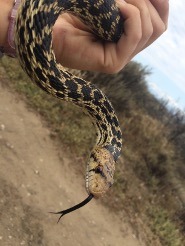
Fig. 1: Because of the large blotches on their backs, people often confuse the nonvenomous gopher snakes with venomous rattlesnakes. Gopher snakes play into this confusion, however, by imitating rattlesnake behaviors.

One of the oldest tricks in the book when it comes to fooling another is to transform to look like someone, or something, else. Although herpetofauna lack access to theatrical wardrobes teeming with makeup and outfits, they evolved behaviors and physical attributes that allow them to imitate other things. The gopher snake (Pituophis catenifer, Fig. 1), for instance, is a totally harmless colubrid species found across the western and middle United States and into Canada. They are beautiful animals, having splotches of gold, reddish-brown, and black along their bodies, and, due to these colorations, are often mistaken for rattlesnakes. What’s more, when spooked, gopher snakes tend to flatten their heads, coil into a strike position, and quickly sway their tails to and fro, a rattlesnake imitation that includes a realistic sound component when it occurs in dry grass. Most snakes are solitary animals and prefer to avoid conflict and avoid expending energy in get-away attempts, so scaring away potential predators through imitation is preferred over fighting and biting. Often times, this imitation works, and potential predators leave the gopher snake alone.
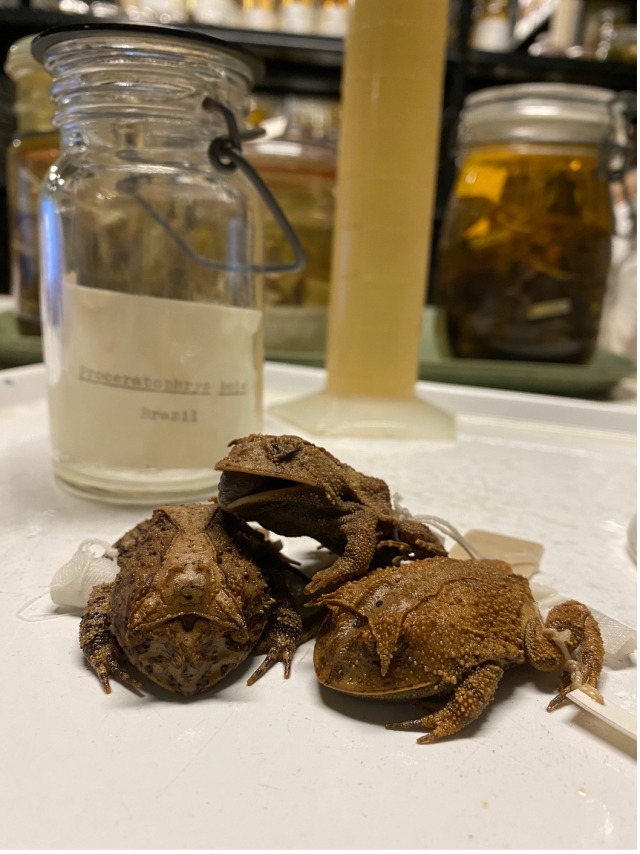
three horned frog specimens on a white tray with glass jars in the background
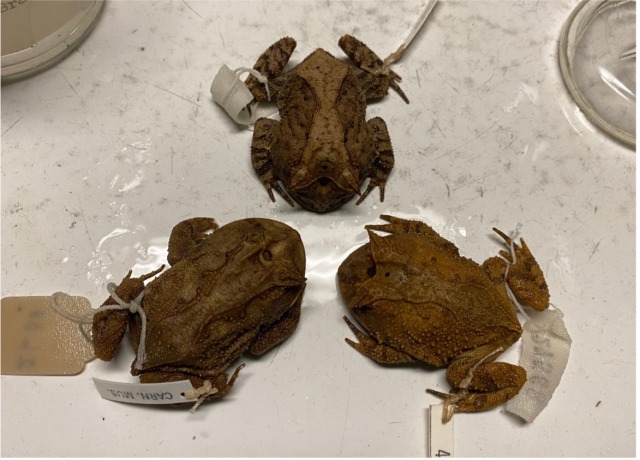
Fig. 2: Smooth horned frog (Proceratophrys boiei) specimens in the collection. Although the points above their eyes have been distorted due to preservation, it is clear to see how these frogs used their coloration, patterning, and morphological features to blend into leaf litter on the forest floor.

Predictably, snakes are not the only masters of disguise. Many frog species have unique morphological features that allow them to resemble other items in nature. The dark brown coloration and the points above the eyes of the smooth horned frog (Proceratophrys boiei) give it the appearance of a leaf (Fig. 2), allowing it to blend seamlessly into the forest floor and enabling it to both evade predators and ambush prey. Similarly, the entirely aquatic Suriname toad (Pipa pipa) looks like a dead leaf in the water due to its brown coloration and flattened body. Unless you’re an omnivore that prefers dead, low-nutrition leaves, the imitation tactics of these frogs improves their chances of survival and fools any prey items not clever enough to see past their disguises.

Deceptive Practices

Not all imitations are meant to help an animal blend in. Sometimes, imitations serve “nefarious” intents. Although not apparent to an outside observer, alligator snapping turtles (Macrochelys temminckii) have a sneaky tactic to lure prey directly into their mouth. The tongues of these turtles evolved a vestigial piece of flesh, called a lingual lure, to protrude from the tip. Alligator snapping turtles will sit on the bottom of lakes and rivers and open their powerful jaws to reveal this pink bit of flesh. They then move the lingual lure around to make it look like a tasty worm, fooling unsuspecting fish right into their giant maws.

Spider-tailed horned vipers (Pseudocerastes urarachnoides), a species endemic to Iran, employ a similar tactic, albeit far more noticeably to the casual observer. Admittedly, the common name of this animal gives away the punch line, but, nonetheless, this species of viper evolved to have a unique tail. Much like how a rattlesnakes’ rattle is made of modified scales, the spider-tailed horned viper’s tail scales evolved so that the last few scales bulge out into a small bubble and the scales leading up to that bulge are heavily keeled, or ridged. While keeled scales are common in most species in the Viperidae family, the keeling on these tail scales is extremely exaggerated, making the scales look like long spikes, or even legs. When you combine the long, keeled scales with the large, posterior bulge, the tail of a spider-tailed horned viper actually looks like a spider! With the snakes speckled coloration allowing it to blend into surrounding rocks and a solid tail wiggle performance, the snake’s tail looks like a tasty spider lunch to unsuspecting birds… which then become lunch for the snake. Imitation is the best form of flattery… or maybe a reliable way to fill your belly!

Now You See Me, Now You Don’t

Whereas some reptiles and amphibians are the masters of disguise, allowing them to hide from predators or to lure unsuspecting prey, other herps use subtler bodily alterations to fool potential prey, predators, and even conspecifics (animals of the same species). Take, for example, color changes. Chameleons often come to mind at any mention of lizard color changes, but it is actually a misconception that chameleons perfectly blend into their surroundings, mimicking every leaf and twig in the background. In truth, chameleons and many other lizard species change colors to improve thermoregulation and to communicate with conspecifics – males signaling to females that they’re ready to mate, or relying on darker colors to demonstrate aggression. There are, however, some species of frogs that do lighten or darken their hue to blend into their surroundings. The gray treefrog (Hyla versicolor) is present across most of the eastern and middle United States and, as its name implies, is an arboreal species. Because it spends its time among green leaves and gray-brown tree trunks and branches, the gray treefrog has evolved the ability to change its body coloration so it can blend in perfectly with the substrate upon which it perches. If it is on a bright green leaf, the frog will shift to a green hue. Upon landing on a mossy rock or a lichen-crusted tree trunk, the frog will change to a more gray, blotched hue instead. One second, you can see the animal perfectly and, in the next, it has completely melted away into its surroundings.

Leaving Something Behind

Other herpetofauna use more exuberant tactics to evade capture. Unlike the camouflage-wielding gray treefrog, many lizard and salamander species will self-autotomize their tails to avoid being eaten. In these instances, the herp has already been seen (or, worse, caught by a herpetologist!) and needs a quick getaway. Running away without a distraction means that the predator will likely give chase and possibly capture the lizard or salamander. However, by self-autotomizing – or breaking off – their tails, these animals increase their chances of escaping. This drastic tactic is effective because the tail continues to wriggle around and move once detached from the animals’ body, making it a tasty and easy to grab meal! Many predators become distracted by the tail, leaving the lizard or salamander free to make its escape. Interestingly, this behavior is not strictly regulated to predator attacks. I witnessed a prolonged aggressive battle between two male western fence lizards (Sceloporus occidentalis), where one male lost his tail and, instead of leaving it to writhe on the ground and eventually decompose, the lizard (attempted) to make a hasty, grapple-filled retreat from the other male, all while holding his detached tail in his mouth! Although this seems morbid, it’s actually quite clever – tails require a lot of energy and resources to make, but then the appendage stores energy in the form of meat and fat. This male fence lizard was likely keeping hold of his old tail so that he could later consume it and regain those resources. And, don’t worry, most salamander and lizard species can regrow their autotomized tails (Fig. 3), an ability that many herpetologists take advantage of when we need tissue for genetic studies.
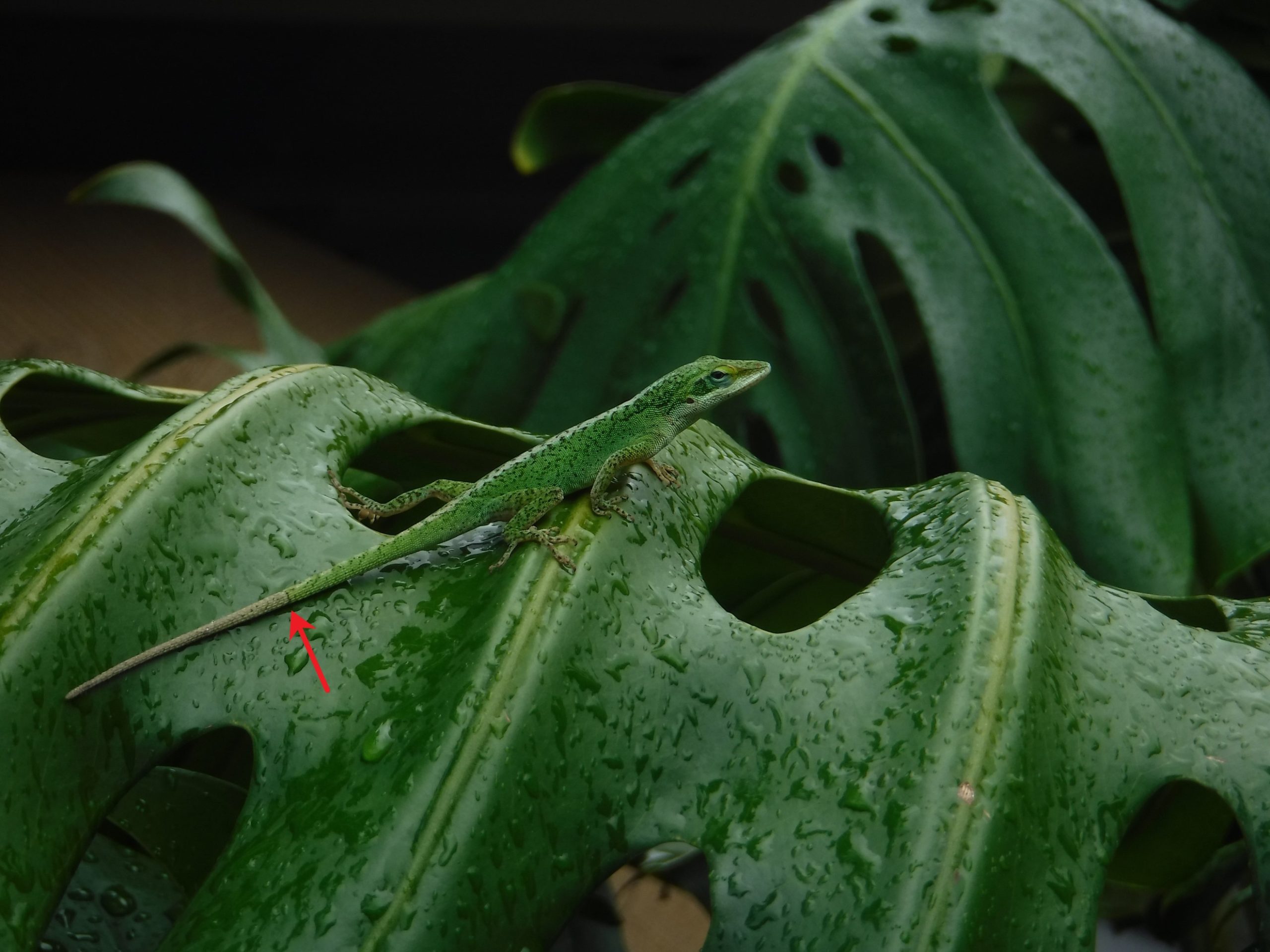
Fig. 3: Example of tail loss and regrowth in a female Anolis carolinensis (green anole). The red arrows points at the old break point, and you can see how the tail color differs in the new growth.

The list of herpetofaunal imitators and imposters, pranksters and fibbers goes on and on. Although these disguises and imitations aren’t meant to make other animals giggle and laugh as our April Fool’s Day pranks often do, these tactics allow these reptiles and animals to live another day, evade unwanted attention, or snag a tasty meal. But, at the end of the day, it really does beg the question… who is the bigger fool – the fool or the fool that falls for it?

Stevie Kennedy-Gold is the collection manager for the Section of Amphibians and Reptiles at Carnegie Museum of Natural History. Museum employees are encouraged to blog about their unique experiences and knowledge gained from working at the museum.

Related Content

Ask a Scientist: What is an Alcohol House?

Evidence Counts for Absent Creatures – City Nature Challenge

Introducing Matt Brandley, the Herpetology Collection’s New Science Communicator and Research Associate

Carnegie Museum of Natural History Blog Citation Information

Blog author: Kennedy-Gold, Stevie
Publication date: April 14, 2021
Share this post!

  • Share on Twitter Share on Twitter
  • Share on Facebook Share on Facebook
  • Share on Pinterest Share on Pinterest
  • Share on LinkedIn Share on LinkedIn
  • Share on Reddit Share on Reddit
  • Share via Email Share via Email

Share this post!

  • Share on Twitter Share on Twitter
  • Share on Facebook Share on Facebook
  • Share on Pinterest Share on Pinterest
  • Share on LinkedIn Share on LinkedIn
  • Share on Reddit Share on Reddit
  • Share via Email Share via Email

Filed Under: Blog Tagged With: amphibians and reptiles, Science News, Stevie Kennedy-Gold

April 7, 2021 by wpengine

Cities are Not Biological Deserts

by Nicole Heller

Cities are increasingly important in organizing the experience of people and their interactions with nature. In 1950 there were 2.5 billion people on Earth and 30% lived in cities. Today, there are 7.5 billion people and 55% live in cities. By 2050, there will be an estimated 9.5 billion and 68% will live in cities.

Generally, cities are not good places for other critters to live. The abundance of pavement, buildings, traffic, pollution, pesticides, herbicides, and other hazards make cities really hard places for plants and animals to survive and breed. From a conservation science perspective, cities have long been considered dead spaces, or biological deserts. But more recently researchers are paying more attention to nature in cities. One reason for their interest involves people’s need for nature. Study after study confirms the basic biophilia hypothesis, that people want to associate with nature; they are happier and healthier when they are near plants and animals in their daily lives.

Berlin is recognized as a city that works for people and biodiversity due to its high percentage of green space, variety of habitats, and thoughtful regional planning. Photo by Filipe Varela on Unsplash.

Cities have also drawn the attention of researchers because of some really exciting things are happening within their limits, such as growing populations of peregrine falcons , sightings of rare birds using cities parks during annual migrations, and even discoveries of new species not previously known to science. While cities are overall negative for biodiversity, recent research findings raise important questions: Can human cities be good for non-humans too? Can urban wildlife include a broader spectrum of creatures beyond the common city-adapted species like European sparrows, pigeons, and black rats? What about species special or unique to the regions in which cities are located? How can we make cities work for biodiversity?

A few years ago I posed these questions along with colleagues from the Resilient Landscape program at the San Francisco Estuary Institute. We wanted to learn if there were general lessons that could be distilled from recent and ongoing research projects about what kinds of species can benefit from cities and if so how might city planners utilize this information to prioritize actions that would help cities contribute positively to the resilience of regional biodiversity, or at least do more to diminish the negative impacts.

Earlier this year, some of our findings were published open source in the journal Bioscience, The Biological Deserts Fallacy: Cities in Their Landscapes Contribute More than We Think to Regional Biodiversity, byErica N Spotswood, Erin E Beller, Robin Grossinger, J Letitia Grenier, Nicole E Heller, Myla F J Aronson.

The study, which includes citations from dozens of regional research projects around the world, identifies five pathways by which cities can help regional biodiversity. “Cities can benefit some species by releasing them from threats in the larger landscape, increasing regional habitat heterogeneity, acting as migratory stopovers, enhancing regional genetic diversity and providing selective forces for species to adapt to future conditions under climate change (e.g., a phenomenon we are calling preadapting species to climate change), and enabling and bolstering public engage­ment and stewardship.”

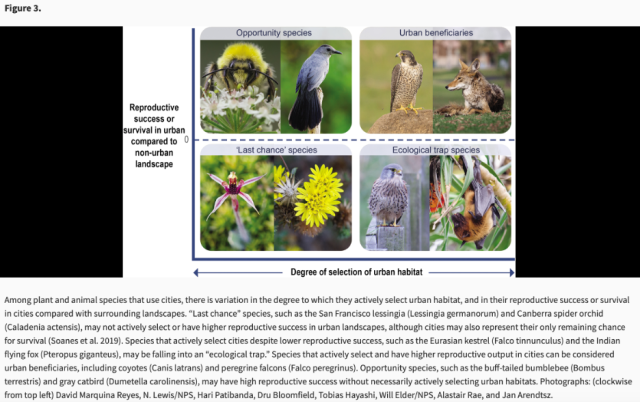
Each of these pathways is described in greater detail in the study. Four categories of species commonly utilize urban habitat, with varying degrees of success, and the study explores examples of how specific species in specific places demonstrate these five pathways.

screen grab of a figure from a paper with birds and flowers

Overall, the role of cities in supporting landscape-scale biodiversity is an understudied area of research. As cities continue to grow in number and size, human populations rise, and climate change continues, paying attention to the experience of other critters, and how we can make space for them to survive and thrive in anthropogenic habitats, will be more important than ever. This research identifies opportunities to reconcile cities with biodiversity. Opportunities exist to learn more about the unique resources that cities can provide, which specific types of species can take advantage of these resources, and how this information can be incorporated into city plans for parks and green spaces. The San Francisco Estuary Institute has begun this applied work in their report Making Nature’s City, which presents a science-based framework for increasing biodiversity in cities.

What excites me are possibilities if we really try. For the most part cities have been developed with little or no concern for biodiversity. Often people think that humans and nature just can’t coexist. What if city planners and conservation professionals start applying these lessons from ecology more broadly and work together with citizens to deliberately steward biodiversity in cities? How abundant and rich with diverse life could cities become? How happy would that make humans? I wonder. And I am hopeful.

If you are interested in urban nature, you can help to measure its diversity by participating in the museum’s upcoming City Nature Challenge. You never know what you may find in our city. Our combined observations, coupled with the museum’s collections and records, will provide important benchmarks to help track how local species are doing as the region keeps growing and changing in the 21st century.

Full Article Citation

The Biological Deserts Fallacy: Cities in Their Landscapes Contribute More than We Think to Regional Biodiversity By ERICA N. SPOTSWOOD , ERIN E. BELLER, ROBIN GROSSINGER, J. LETITIA GRENIER, NICOLE E. HELLER, AND MYLA F. J. ARONSON BioScience, Volume 71, Issue 2, February 2021, Pages 148–160, https://doi.org/10.1093/biosci/biaa155

Nicole Heller is Curator of Anthropocene Studies at the Carnegie Museum of Natural History. Museum employees are encouraged to blog about their unique experiences working at the museum.

Related Content

Teaching About Local Wildlife with the City Nature Challenge

Air Quality and Urban Gardening

Introducing the Anthropocene Living Room

Carnegie Museum of Natural History Blog Citation Information

Blog author: Heller, Nicole
Publication date: April 7, 2021

Share this post!

  • Share on Twitter Share on Twitter
  • Share on Facebook Share on Facebook
  • Share on Pinterest Share on Pinterest
  • Share on LinkedIn Share on LinkedIn
  • Share on Reddit Share on Reddit
  • Share via Email Share via Email

Share this post!

  • Share on Twitter Share on Twitter
  • Share on Facebook Share on Facebook
  • Share on Pinterest Share on Pinterest
  • Share on LinkedIn Share on LinkedIn
  • Share on Reddit Share on Reddit
  • Share via Email Share via Email

Filed Under: Blog Tagged With: Anthropocene, City Nature Challenge, Nicole Heller, Science News, We Are Nature 2

April 2, 2021 by wpengine

A Little Harbinger of Spring…

by Bob Androw

As I begin to write this, it’s early March, the sun is shining, the temperature outside is climbing over 50°F and I’m starting to think… “I need to go look for some deer poop!”

As an entomologist, I’ve developed a mental calendar not based on seasons or months… but rather on what species of insects are likely to be out and about on any given day of the year. Once summer arrives, the specificity disappears and it just becomes a question of whether it’s a “good bug day” or not – based entirely on the weather and my chances of prying myself out of the museum (or the house, in these new times) to go somewhere and chase them.

During autumn, the onset of wet weather and cooling temperatures gradually reduces the number of active insects. Like most organisms, I tend to head for shelter from the outside environment, settling indoors to wait out the winter. Of course, winter is time for “bug work” as well – but rather than hunting living specimens, time is dedicated to catching up on the lab work set aside during ‘collecting’ season. This entails pinning and labeling specimens collected earlier in the year, performing identifications, data-basing specimen records, and working on manuscripts.

But then there’s spring – that pivotal period that influences one to keep checking the weather forecast, hoping for warming days. This seemingly never-arriving season focuses one’s attention on how fast the last snow is melting off. It’s a time that has me searching for signs of plant shoots breaking the soil surface and tree buds exhibiting tiny slivers of green to announce the upcoming burst of foliage.

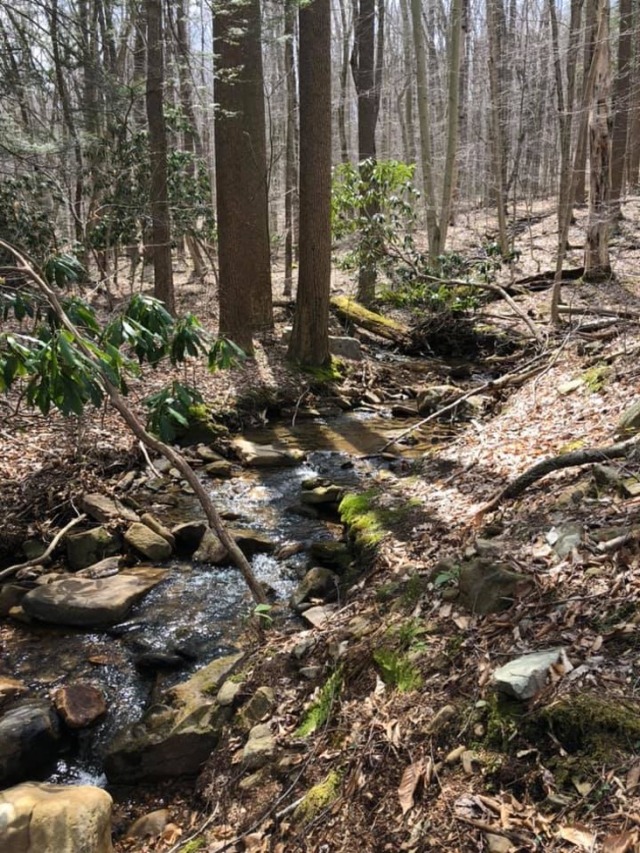
Hardwood forest habitat in late winter at Powdermill Nature Reserve in the Laurel Highlands of Pennsylvania. Image courtesy of the Powdermill Nature Reserve Facebook page.

Once these signs converge to indicate spring is just around the corner – it’s time to test the theory that winter is finally ending by – you got it! – going to look for deer poop!

Now, don’t get me wrong – deer regularly poop all year round – which is good for them – but during the first warm days of spring – or more accurately the warmest days of late winter – a little beetle becomes active and begins its own search for deer dung.

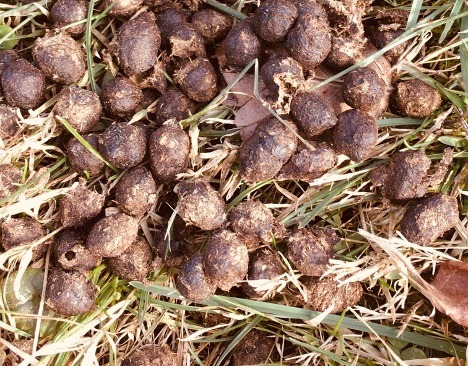
A typical pile of deer dung. The pellet in the lower left corner shows a hole created by a feeding beetle.

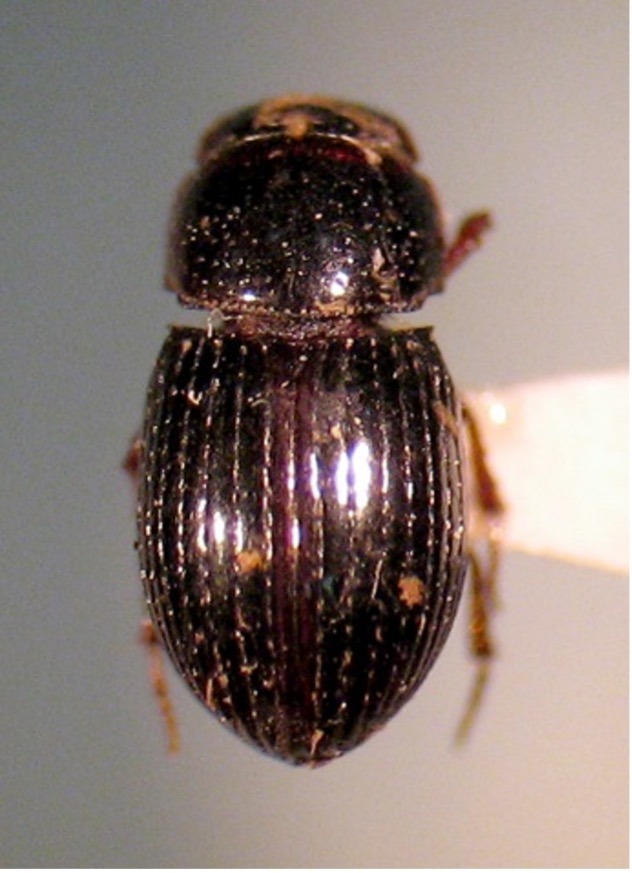
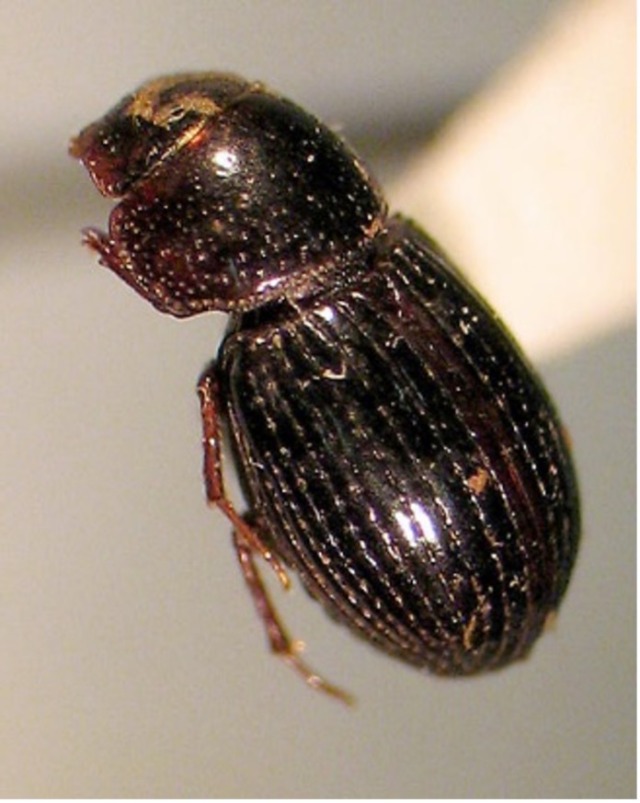
The species Dialytellus tragicus (Schmidt, 1916) is a mere 3mm in length and one of only two species in the genus Dialytellus. My favorite location to search for it is the museum’s field research station, Powdermill Nature Reserve, in the Laurel Highlands. Dialytellus tragicus is found in forested areas of the northeastern United States, but is sporadic in distribution and never seems to be overly common. The other species in the genus, Dialytellus dialytoides (Fall, 1907), is more widely distributed in the eastern states, much more common, and is taken frequently in pitfall traps. The genus Dialytellus is a member of the large subfamily Aphodiinae in the large family Scarabaeidae, the scarab beetles.

The Aphodiinae is a diverse group of small to tiny beetles, with over 400 species occurring in the United States and Canada. Nearly all of them are specialists on animal dung for feeding as adults and for provisioning their larvae with food. Many are considered ‘generalists’ which means they will utilize whatever dung they find – from cattle, horses, deer, pigs, dogs, and even humans (Oh, there are some stories to tell there…). Some species dig tunnels in the soil under dung and create brood chambers where they lay eggs on dung brought down from the source on the ground surface, but most lay eggs directly in the dung and the larvae develop within.

A fair number of aphodiine species are ‘specialists’, utilizing dung from only certain species of animals. In the Great Plains region of the U.S., the group reaches its greatest diversity of species for North America, with most species being obligate associates with prairie dogs, living in the burrows and feeding in the dung ‘middens’ that the resident prairie dogs create. In the Pacific Northwest, aphodiines are often associated with the burrows of marmots. In the Southeast, many species are associated only with pocket gophers, while a few have evolved to live only in the nests of squirrels, or packrats, feeding on decaying nest materials. Some of these specialized beetles have even evolved to live in ant nests, feeding on plant detritus in the ants’ garbage heaps.

beetle specimen
Dialytellus tragicus (Schmidt, 1916). Specimen data: PENNSYLVANIA: Westmoreland County, Powdermill Nature Reserve, 15 March 2003, in deer dung, R. Androw, coll. Image from BugGuide.net, courtesy of Blaine Mathison, Salt Lake City, Utah.

Dialytellus tragicus is able to pull me out of the house and into the woods in late winter on an annual search first for piles of deer dung, and then if lucky, beetles. The beetles can be found inside the deer dung pellet, which means the search entails splitting dung pellets to find the precious one with a beetle inside. Thankfully, deer dung is dry and hard and has little odor, so the process is less offensive than it sounds. Still, I would guess that laying on one’s side in the leaves, splitting pellets with a forceps as if they were little coconuts with prizes inside, isn’t a common way to celebrate the onset of Spring – no Facebook group for us folks!

Most specimens that I have collected have been found during the middle two weeks of March, always on days where the temperatures have been over 50°F for at least the preceding three days. It takes a few days of warmer weather to get the beetles up and moving. I’ve learned that searching for them later in the year – say mid-April – never produces specimens of D. tragicus, but instead produces numerous specimens of another aphodiine, the extremely abundant generalist, Oscarinus rusicola (Melsheimer, 1845). Circumstantial evidence would suggest that as D. tragicus evolved alongside O. rusicola in eastern forests of North America it shifted its period of activity to earlier in the season to avoid competition for resources with the more abundant O. rusicola.

By the end of February of any normal year, the urge to get out of the house and into the woods starts to become irresistible, but the insects are more patient – waiting for the perfect number of degree-days to become active. Knowing this little beetle is out there early – and is not necessarily easy to find – provides the perfect impetus to shake off the winter dust and go out to look for it. In a year like the one we’ve all suffered through, this little beetle is even more appreciated as an excuse to rouse and get moving again.

Bob Androw is a Collection Manager for Invertebrate Zoology. Museum employees are encouraged to blog about their unique experiences and knowledge gained from working at the museum.

Related Content

So, Just What is a Wheel Bug?

Do No Harm: Dealing with Spotted Lanternflies

The BSF – Leveraging Our Collections and Expertise to Help Fight Invasive Species

Carnegie Museum of Natural History Blog Citation Information

Blog author: Androw, Bob
Publication date: April 2, 2021

Share this post!

  • Share on Twitter Share on Twitter
  • Share on Facebook Share on Facebook
  • Share on Pinterest Share on Pinterest
  • Share on LinkedIn Share on LinkedIn
  • Share on Reddit Share on Reddit
  • Share via Email Share via Email

Filed Under: Blog Tagged With: Bob Androw, Invertebrate Zoology, Science News

March 31, 2021 by wpengine

MESOZOIC MONTHLY: Volaticotherium

by Lindsay Kastroll

Once again, spring has sprung. Prepare to see the gorgeous forests of Pennsylvania launch back into action. I, for one, can’t wait to get outside and explore as the weather continues to improve. I was recently reminded of the fact that Pennsylvania is home to two species of flying squirrels, and I am definitely adding them to my list of things to see. But of course, this is Mesozoic Monthly, so flying squirrels can’t be the stars of this article. Instead, the superficially flying squirrel-like “ancient gliding beast” Volaticotherium antiquum is stealing the spotlight!

Although Volaticotherium was about the size of a modern flying squirrel at 5–6 inches (13–15 cm) long, it belonged to a group of early mammals called eutriconodonts that includes some of the largest mammals that lived alongside non-avian dinosaurs. “Eutriconodont” means “true three-coned tooth,” in reference to the three longitudinally aligned cusps on their molars. Although not all mammals today have three-cusped molars, the ancestors of modern mammals did. Does this mean that modern mammals evolved from a eutriconodont? The answer is no, though they did evolve from a mammal with eutriconodont-like teeth.

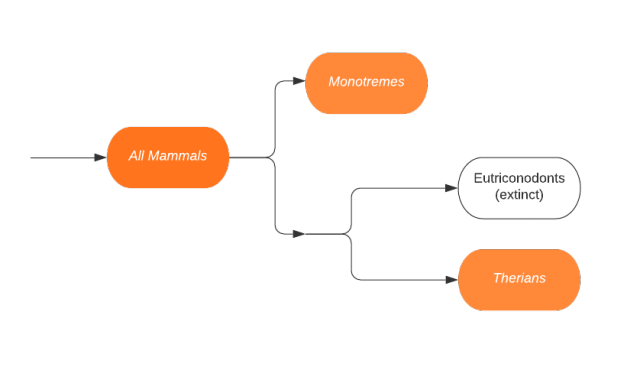
We can split modern mammals into two main groups: the monotremes, which are egg-laying mammals like the platypus, and the therians, which include both marsupial and placental mammals (like kangaroos or humans, respectively). The ancestors of monotremes diverged (meaning, formed their own ‘branch’ of the evolutionary tree) before eutriconodonts and therians evolved. Eutriconodonts and therians share a different, more recent, and as-yet unknown common ancestor. Monotremes, therians, and eutriconodonts actually lived alongside one another for over one hundred million years before eutriconodonts became extinct near the end of the Cretaceous Period (the third and final division in the Mesozoic Era, or ‘Age of Dinosaurs’).


This flowchart represents a simplified phylogeny (aka, evolutionary tree) of the relationships discussed in the previous paragraph. A lot of ‘branches’ and intermediate steps are missing from this phylogeny to make it easier to follow.

The canines and molars of eutriconodonts were pointy, suggesting that these mammals were carnivores or insectivores. Volaticotherium is no exception, which makes it particularly unique, as most other gliding mammals are herbivores! Because it was so small, Volaticotherium was probably an insectivore, but a larger cousin, Jugulator, could probably eat small vertebrates. As an arboreal glider, Volaticotherium could soar from tree to tree to catch insects in midair. Instead of wings, it had a patagium, a broad flap of skin that stretched between the fore- and hind limbs, creating enough surface area to achieve gliding descents. The various limb adaptations necessary to make Volaticotherium an efficient glider also made it poor at maneuvering on the ground. It can be hard to understand why an animal would evolve features that would hinder its terrestrial movement, and multiple hypotheses have been put forth to try to explain this. Most of these focus on the benefits of leaping out of trees to escape predators or to quickly traverse territory between arboreal food sources, scenarios based on herbivorous mammals. Because Volaticotherium was a gliding predator, perhaps gliding conferred other advantages to this eutriconodont.

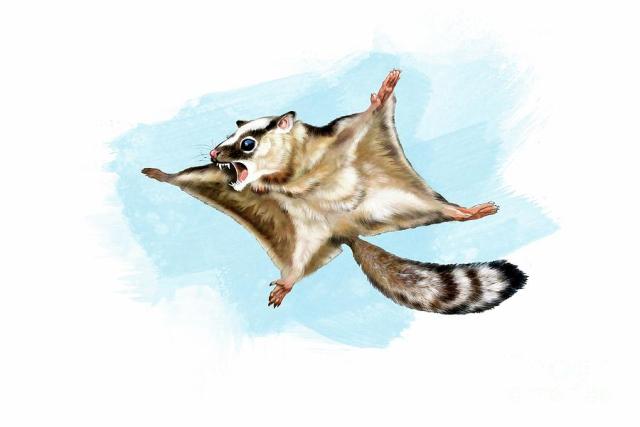
Restoration of Volaticotherium in mid-glide by Jose Antonio Peñas, used with permission. Take note of those sharp canine teeth, useful for catching tasty insects! You can find more of Peñas’ art on their DeviantArt, ArtStation, or YouTube.

The fossilized remains of Volaticotherium were found in a layer of rock called the Daohugou Bed in China. This deposit consists of lakebed sediment and volcanic ash compacted into solid rock over millions of years as more heavy sediment was deposited on top of it. There is a debate about how old the Daohugou Bed is, but most estimates place it near the middle or end of the Jurassic Period (the middle period of the Mesozoic). Getting the timing right is important. Because Volaticotherium is among the oldest known gliding mammals, its discovery pushes the origin of mammalian gliding back as much as 70 million years earlier than previously thought!

A variety of factors have led geologists to struggle in determining the age of the Daohugou Bed. In an ideal geologic record, rock layers would be perfectly horizontal, creating a continuous stack with the oldest layers on the bottom and the newest layers on top. However, this is rarely the case. Sediment may be eroded before new layers are deposited, creating a gap of time without record in that sequence of rocks. This phenomenon, where two rock layers do not represent a continuous progression of time and have a gap of data missing between them, is called an unconformity. Other issues with dating rock layers involve the squeezing, stretching, folding, melting, and chemical alteration of rock layers when they’re subjected to geologic processes. These forces can result in old rock layers being placed on top of younger ones, making it hard to determine the actual sequential order of the rocks. Changes can also occur within the minerals that compose the rocks, making radiometric dating much more difficult.

The Daohugou Bed has an unconformity above and below it, and it has been folded, which makes attributing an exact age to it that much harder. When you go out hiking in the beautiful spring weather on the horizon, take a moment to look at the rock outcrops you pass and think about what those layers might have experienced on their journey to where they are today. And if you continue your hike after sunset, be sure to keep your eyes peeled. If you’re lucky, you might just catch a glimpse of a flying squirrel gliding through the forest!

Lindsay Kastroll is a volunteer and paleontology student working in the Section of Vertebrate Paleontology at Carnegie Museum of Natural History. Museum staff, volunteers, and interns are encouraged to blog about their unique experiences and knowledge gained from working at the museum.

Related Content

Mesozoic Monthly: Nasutoceratops

Researchers Announce Surprising Clue in the Evolution of the Mammalian Middle Ear

Ah, Snap! Dino Named for Marvel’s Thanos

Carnegie Museum of Natural History Blog Citation Information

Blog author: Kastroll, Lindsay
Publication date: March 31, 2021

Share this post!

  • Share on Twitter Share on Twitter
  • Share on Facebook Share on Facebook
  • Share on Pinterest Share on Pinterest
  • Share on LinkedIn Share on LinkedIn
  • Share on Reddit Share on Reddit
  • Share via Email Share via Email

Share this post!

  • Share on Twitter Share on Twitter
  • Share on Facebook Share on Facebook
  • Share on Pinterest Share on Pinterest
  • Share on LinkedIn Share on LinkedIn
  • Share on Reddit Share on Reddit
  • Share via Email Share via Email

Filed Under: Blog Tagged With: dinosaurs in their time, Lindsay Kastroll, Science News, Vertebrate Paleontology

March 24, 2021 by wpengine

Spring Birds in Your Backyard

by Annie Lindsay

On spring mornings that I’m not banding birds, I like to sit on my back porch with my binoculars, watching for movement at the edge of the woods behind my house, keeping my ears tuned in to songs and short, usually high-pitched, chip and contact notes. On mornings following a night of heavy migration, small flocks of mixed species often move through the trees, feeding on insects as they refuel for the next stage of migration. These flocks often have warblers, thrushes, tanagers, grosbeaks, or sparrows foraging in their own niches: warblers tend to be in mid- to high-canopy, whereas thrushes stay low and sparrows are often on the ground.

Occasionally, I’ll stand outside in a quiet, dark spot just before dawn and listen for the soft, high-pitched flight calls of migrants settling into habitat after a night of flying. I’m an avid birder: I love to see both new and familiar birds, and watch the species that use my yard and favorite birding patches.

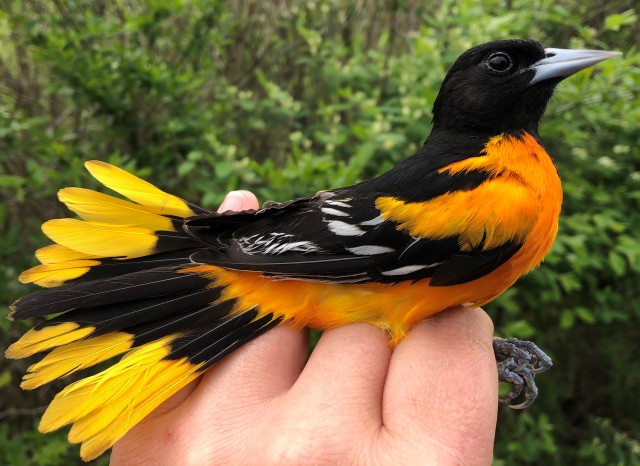
Baltimore Orioles arrive in southwest PA by mid-to late-April. Providing fresh orange halves on spikes can bring them to your feeders from spring through fall migration.

Last year, many people discovered birding. We spent much of the spring working from home, perhaps gazing out of our windows at our bird feeders or backyard plants, and for the first time noticed birds that we didn’t know existed or didn’t realize visited our yards. The opportunity to learn about the diversity of birds in our area and develop a passion for watching them was a bright spot (both literally and metaphorically!) in an otherwise difficult year. The seasons progressed, and now we once again eagerly anticipate the arrival of beautiful and colorful migratory songbirds. Let’s explore common spring backyard birds in southwest Pennsylvania and how to attract and find them!

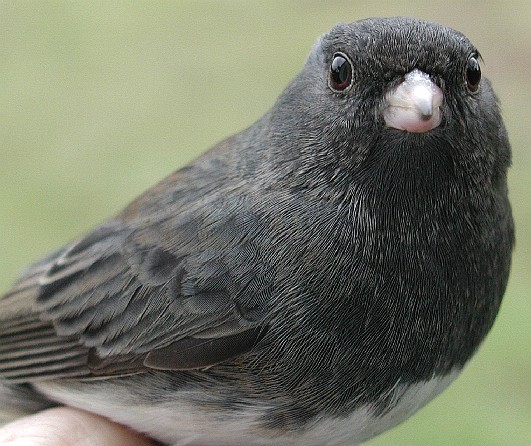
Dark-eyed Juncos are a species we usually associate with winter in southwest PA. They start singing in March, then do an elevational migration up the nearby mountains.

Each year, as the temperature warms, migratory birds move through our area in search of their breeding grounds. Although arrival timing is a bit variable between years due to annual variation in weather patterns, there is a predictable progression of species, so we know what to expect next relative to what we’ve already seen. The first, and often most conspicuous, to arrive are Red-winged Blackbirds and Common Grackles, usually in late February. They are followed by “peenting” American Woodcocks in early March, Eastern Phoebes in mid-March, and kinglets peaking in late-March. Keep your eyes to the sky any time you’re outdoors during these early spring weeks to watch for migrating waterfowl and raptors.

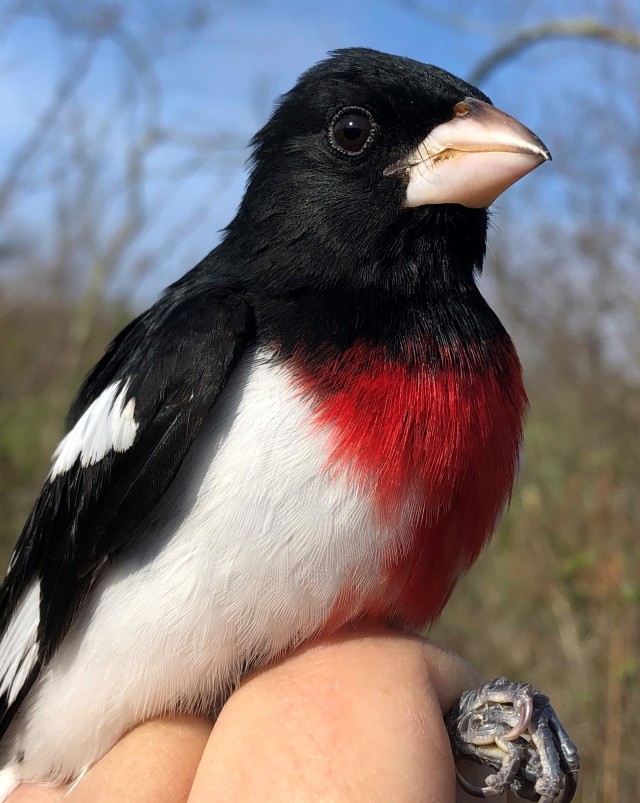
Rose-breasted Grosbeaks readily visit feeders with black oil sunflower seeds or safflower seeds usually in early- to mid-May before moving off into the forest to set up breeding territories.

By April, more songbirds, including vireos, swallows, early warblers, Blue-gray Gnatcatcher (a tiny bird with a wheezy song), House Wren, and the fan favorite, Gray Catbird make their way through our region, many remaining here to set up their breeding territories. In May, the migration floodgates open and some of the most brilliantly plumaged birds we’ve ever seen, like Baltimore Oriole, Rose-breasted Grosbeak, Ruby-throated Hummingbird, Scarlet Tanager, Indigo Bunting, and several warblers, may visit our yards and feeders, along with the less flashy, but equally beautiful, sparrows and thrushes.

Orioles readily come to feeders with orange halves, especially during migration, and seed-eating species like grosbeaks, buntings, and sparrows often visit feeders with sunflower or other seeds (or, in the case of many sparrows, clean up seeds on the ground under feeders!). Hummingbirds come to feeders with nectar (four parts water to one part white sugar, please avoid using food dyes or commercial nectar that has been dyed red). Most of these species are insectivorous, especially during spring migration, and are often observed picking things like caterpillars, midges, and spiders from foliage.

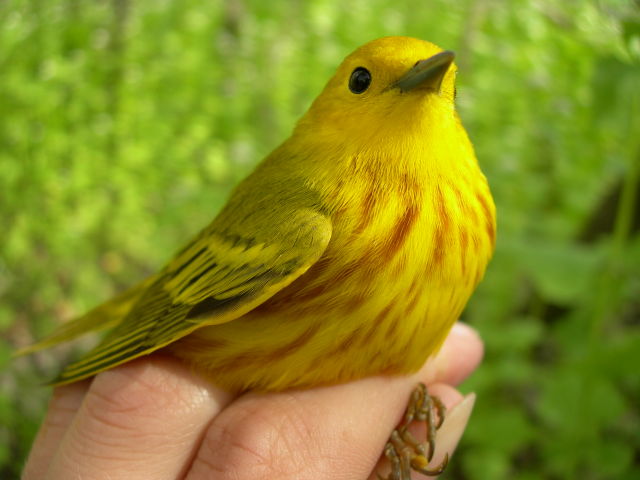
Yellow Warblers are often recognized by their signature “sweet sweet I’m so sweet!” song. You may see them flitting through small woody plants like dogwoods as they forage for caterpillars.

In addition to the migratory species that we see and hear in the spring, many birds that are year-round residents also frequent our yards. Black-capped and Carolina Chickadees, Tufted Titmice, White-breasted Nuthatches, Carolina Wrens, five species of woodpeckers (Downy, Hairy, Red-bellied, Pileated, and Northern Flicker, plus two more if we’re lucky – Red-headed Woodpecker and Yellow-bellied Sapsucker), and the colorful American Goldfinch, Northern Cardinal, and Eastern Bluebird mix with migratory birds. Most of these species visit bird feeders filled with sunflower or safflower seeds (chickadees, titmice, cardinals, nuthatches, woodpeckers), suet (woodpeckers, wrens), nyjer seed (finches), and mealworms (bluebirds, titmice, chickadees).

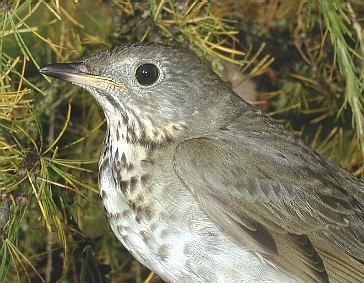
Gray-cheeked Thrushes are cryptic and secretive, but can be found skulking on the forest floor in mid- to late-May before they continue northward migration. They have a beautiful, flutey song and a distinctive call note.

One of the best ways to attract birds to your yard is planting native trees, shrubs, wildflowers, and other plants. Native plants are hosts for a high diversity of insects, especially during their larval stages, and provide nutritious seeds and fruit, all of which are important food resources for birds. These plants are also valuable as cover for safety and nest sites. Although often overlooked, a source of clean, fresh water, as simple as a bird bath or as complex as a pond with a bubbler or waterfall, can make your yard especially attractive to birds. And one of the easiest and most popular ways to attract birds for close viewing is providing bird food in clean, safe feeders. I recommend visiting your local bird feeding specialty store.

You may see all of the birds mentioned in this blog in your yard, but this is a non-exhaustive list and you may even see something unexpected. Visiting a local birding hotspot with complex and diverse habitats is certainly worth the effort as well. Birding these spots several times throughout the season will reward you with an impressive list and will boost your knowledge of natural history. The combination of a good pair of binoculars and a field guide with identification tips, range maps, and text about habitat is one of the best ways to maximize your birding, whether at home or in the field.

Please visit CMNH’s blog page to find bird ID tips and field guide recommendations.

The Audubon Society put together a great guide to the best binoculars at various price ranges.

You can put your bird observation skills to good use (or further develop those skills) by participating this spring in a broad survey of local wildlife and plants called the City Nature Challenge. The observation portion of this event is April 30 – May 3.

Annie Lindsay is the Bird Banding Program Manager at Carnegie Museum of Natural History’s Powdermill Nature Reserve. Museum employees are encouraged to blog about their unique experiences and knowledge gained from working at the museum.

Related Content

The Christmas Bird Count During an Irruption Year

Wind and Migration

Bird Banding with a Crew of One

Carnegie Museum of Natural History Blog Citation Information

Blog author: Lindsay, Annie
Publication date: March 24, 2021

Share this post!

  • Share on Twitter Share on Twitter
  • Share on Facebook Share on Facebook
  • Share on Pinterest Share on Pinterest
  • Share on LinkedIn Share on LinkedIn
  • Share on Reddit Share on Reddit
  • Share via Email Share via Email

Share this post!

  • Share on Twitter Share on Twitter
  • Share on Facebook Share on Facebook
  • Share on Pinterest Share on Pinterest
  • Share on LinkedIn Share on LinkedIn
  • Share on Reddit Share on Reddit
  • Share via Email Share via Email

Filed Under: Blog Tagged With: Annie Lindsay, Birds, City Nature Challenge, Powdermill Nature Reserve, Science News

March 15, 2021 by wpengine

Collected on this Day in 1957

Spring at Powdermill.

An early bloomer.

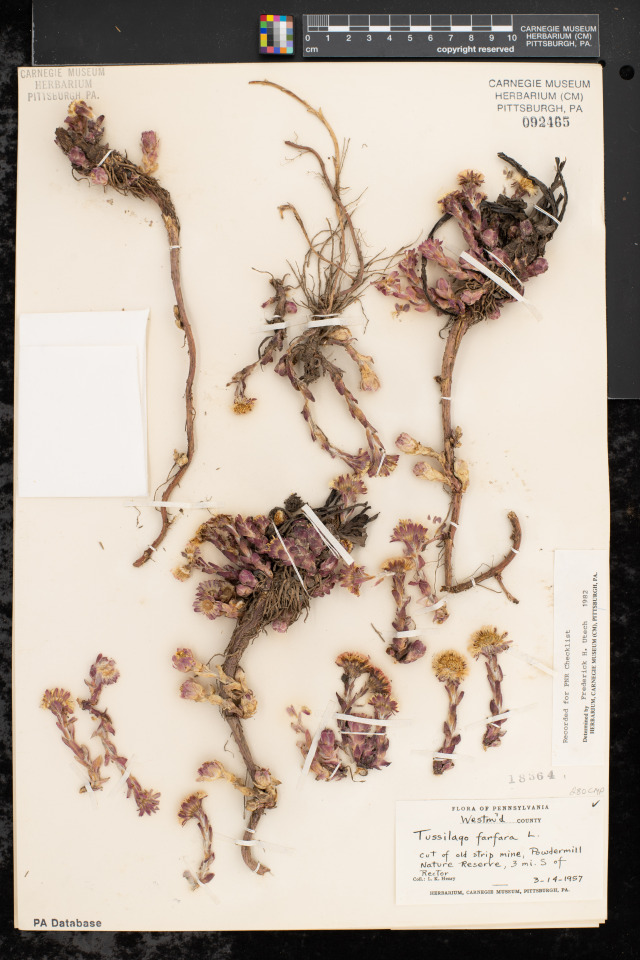
dried specimen of coltsfoot on an herbarium sheet

This specimen of coltsfoot (Tussilago farfara) was collected at Powdermill Nature Reserve, the field station of Carnegie Museum of Natural History in 1957, just one year after the facility was established. It was collected by Leroy Henry, a Curator of Botany at the museum from 1937 until 1972 (though he was also affiliated with the museum before and after this period). Henry is an important collector for our region, with >36,000 specimens in the Carnegie Museum herbarium.

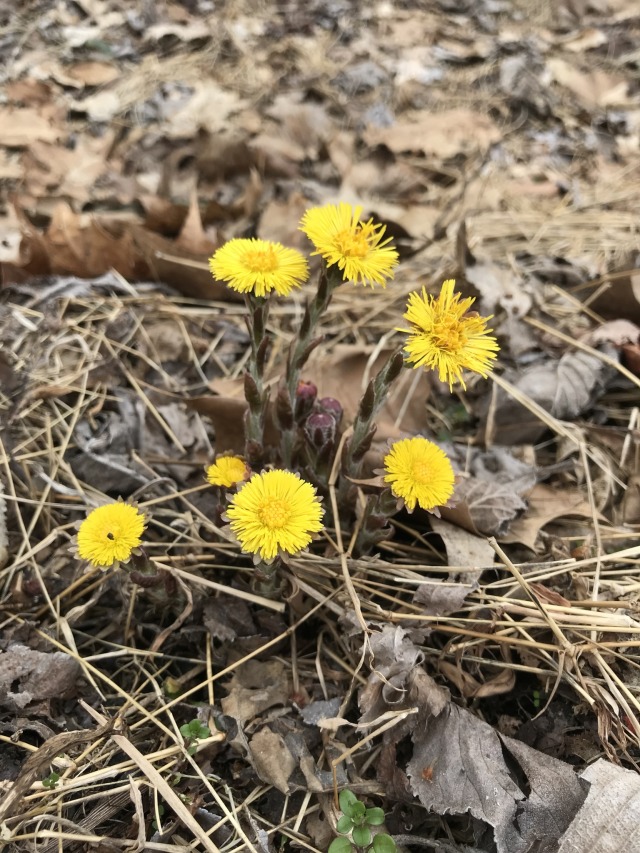
coltsfoot flowering in spring

At first look, the plant may be confused with your common dandelion. It has definite similarities, as it is in the same plant family, Asteraceae, and bears yellow flowers. But, as you’ll notice from the specimen – flowering coltsfoot doesn’t have leaves!

Coltsfoot, which is native to Europe, was introduced to Pennsylvania, and is quite unique in our state’s flora. The plant blooms very early in the spring, with dandelion-like flowers frequently poking through the soil of otherwise barren slopes. The leaves soon follow, and they are shaped like – well – a colt’s foot! Quite different than the familiar serrated edge shape of dandelion leaves.

Coltsfoot’s early appearance also makes it a great species to track changes in bloom time using herbarium specimens. The species was among the first to be used in a pioneering study published in 2006 using herbarium specimens by Claud Lavoie and Daniel Lachance. In Southern Quebec, they found coltsfoot bloomed 15-31 days earlier in recent decades, compared to pre-1950. Earlier blooming was strongly linked to climate change in the region. The plants also showed a clear signal of flowering earlier in the city (due to a phenomenon known as urban heat island effect).

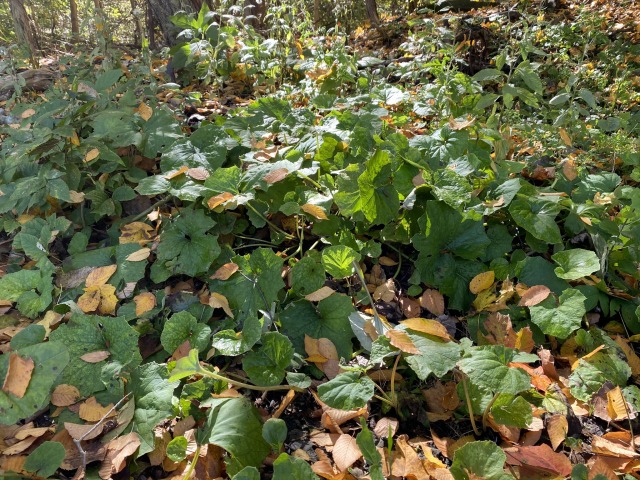
coltsfoot leaves in the fall

We have plenty of spring ephemerals that bloom early, but unlike these plants, coltsfoot doesn’t die off by summer. The plant keeps its leaves well after it blooms, into late fall.

This strategy is interesting, and I can’t think of many plants in our flora with similar growth patterns. Is the plant on to something?

Keep an eye out for coltsfoot, especially along wooded roadsides. Once you see a big bloom, check the same site later in the year. The leaves can grow to a surprisingly large size.

Find this specimen and more here.

Check back for more! Botanists at the Carnegie Museum of Natural History share digital specimens from the herbarium on dates they were collected. They are in the midst of a three-year project to digitize nearly 190,000 plant specimens collected in the region, making images and other data publicly available online. This effort is part of the Mid-Atlantic Megalopolis Project (mamdigitization.org), a network of thirteen herbaria spanning the densely populated urban corridor from Washington, D.C. to New York City to achieve a greater understanding of our urban areas, including the unique industrial and environmental history of the greater Pittsburgh region. This project is made possible by the National Science Foundation under grant no. 1801022.

Mason Heberling is Assistant Curator of Botany at Carnegie Museum of Natural History. Museum employees are encouraged to blog about their unique experiences and knowledge gained from working at the museum.

Related Content

Collected on this Day in 1998: Common chickweed

Spring is in the Air, Botanists are in the Field

Ask a Scientist: What is biogeochemistry? 

Carnegie Museum of Natural History Blog Citation Information

Blog author: Heberling, Mason
Publication date: March 14, 2021

Share this post!

  • Share on Twitter Share on Twitter
  • Share on Facebook Share on Facebook
  • Share on Pinterest Share on Pinterest
  • Share on LinkedIn Share on LinkedIn
  • Share on Reddit Share on Reddit
  • Share via Email Share via Email

Share this post!

  • Share on Twitter Share on Twitter
  • Share on Facebook Share on Facebook
  • Share on Pinterest Share on Pinterest
  • Share on LinkedIn Share on LinkedIn
  • Share on Reddit Share on Reddit
  • Share via Email Share via Email

Filed Under: Blog Tagged With: Botany, collected on this day, Mason Heberling, Science News

  • « Go to Previous Page
  • Page 1
  • Interim pages omitted …
  • Page 18
  • Page 19
  • Page 20
  • Page 21
  • Page 22
  • Interim pages omitted …
  • Page 43
  • Go to Next Page »

sidebar

About

  • Mission & Commitments
  • Directors Team
  • Museum History

Get Involved

  • Volunteer
  • Membership
  • Carnegie Discoverers
  • Donate
  • Employment
  • Events

Bring a Group

  • Groups of 10 or More
  • Birthday Parties at the Museum
  • Field Trips

Powdermill

  • Powdermill Nature Reserve
  • Powdermill Field Trips
  • Powdermill Staff
  • Research at Powdermill

More Information

  • Image Permission Requests
  • Science Stories
  • Accessibility
  • Shopping Cart
  • Contact
  • Visitor Policies
Stay in the loop! Sign up for our newsletter(s).
One of the Four Carnegie Museums | © Carnegie Institute | Privacy Policy | Terms of Use | Accessibility
Rad works here logo