• Skip to primary navigation
  • Skip to main content
  • Skip to primary sidebar

Carnegie Museum of Natural History

One of the Four Carnegie Museums of Pittsburgh

  • Visit
    • Buy Tickets
    • Visitor Information
    • Exhibitions
    • Events
    • Dining at the Museum
    • Celebrate at the Museum
    • Powdermill Nature Reserve
    • Event Venue Rental
  • Learn
    • Field Trips
    • Educator Information
    • Programs at the Museum
    • Bring the Museum to You
    • Guided Programs FAQ
    • Programs Online
    • Climate and Rural Systems Partnership
  • Research
    • Scientific Sections
    • Science Stories
    • Science Videos
    • Senior Science & Research Staff
    • Museum Library
    • Science Seminars
    • Scientific Publications
    • Specimen and Artifact Identification
  • About
    • Mission & Commitments
    • Directors Team
    • Museum History
  • Tickets
  • Give
  • Shop

Vertebrate Paleontology

March 31, 2020 by wpengine

Mesozoic Monthly: Nemicolopterus

Welcome back to Mesozoic Monthly! Spring has sprung, and you know what that means: baby animals are coming! It only makes sense that the star of this month’s post should be as small and cute as chicks or puppies. With a wingspan of less than 10 inches (25 centimeters), Nemicolopterus crypticus is one of the tiniest known pterosaurs – about the size of an American Robin!
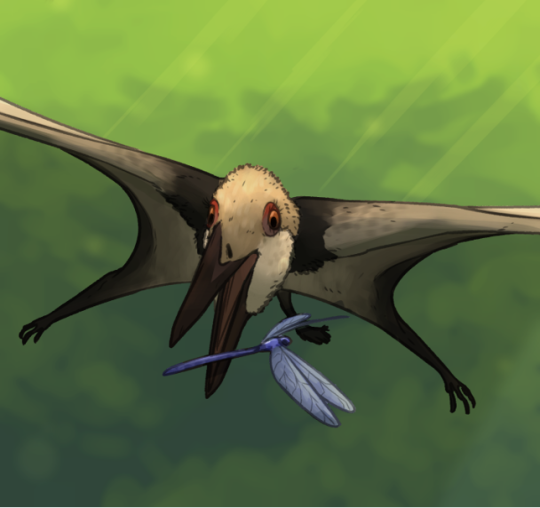
Life reconstruction of the adorable little pterosaur (flying reptile) Nemicolopterus crypticus by paleoartist Connor Ashbridge, used with permission. You can find Connor’s other work on Instagram @pantydraco.

Nemicolopterus is a pterosaur, a kind of prehistoric animal that is commonly called a “pterodactyl” or “flying dinosaur.” However, pterosaurs are not dinosaurs! Dinosaurs are all animals within a specific group of reptiles known as the Dinosauria. Pterosaurs comprise a separate group of reptiles that were specialized for flight, called the Pterosauria. These flying reptiles are extraordinary; they not only represent the earliest-known flying vertebrates (animals with backbones), but they also achieved flight in a different manner than did modern flying vertebrates (birds and bats)! Over half the length of a pterosaur’s wing was made up by a single super-long finger (specifically, the fourth finger, aka the ‘ring finger’ of a human) that anchored a broad skin membrane. It might seem like it’d be impossible to fly on just one finger, but many pterosaurs managed to grow to gargantuan sizes. Cousins of Nemicolopterus known as azhdarchids (one of which, Quetzalcoatlus, soars above T. rex in Carnegie Museum of Natural History’s Dinosaurs in Their Time exhibition) could reach estimated wingspans of 39 feet (12 meters). That’s as big as a small airplane!

Tiny, fuzzy, and adorable, Nemicolopterus would have looked a lot like a baby bird if you could take a trip back to the Cretaceous and see this pterosaur in the wild. In fact, the only specimen we have of Nemicolopterus may have been a baby! It’s often difficult to tell just based on its fossilized skeleton whether a prehistoric animal was fully mature or still in the process of growing and changing when it died. One way of telling if a fossil reflects an adult is whether certain bones have completely fused together (the technical term is coossified). You may know that humans have more separate bones as babies than we do as adults; this is because, as a person grows, certain bones like the ones that make up your skull fuse together along lines called sutures. Many baby bones also tend to be soft and flexible because they start out as cartilage, which is replaced by solid bone over time through a process called ossification. Several important bones in the Nemicolopterus fossil are ossified, so we can be sure that it was not a hatchling. However, since paleontologists agree that this specimen was still young when it died, and also that baby pterosaurs were precocial (i.e., able to effectively move about and find food on their own shortly after hatching), there’s still a significant chance that the Nemicolopterus fossil represents a young life stage of another, larger pterosaur.

There’s a good candidate for which pterosaur might be the adult form of Nemicolopterus, if indeed the only known fossil is just a baby of another species: Sinopterus is a tapejarid pterosaur that lived at the same time and place as the little fellow. Tapejarids are unique because they were likely arboreal and had beaks that appear useful for eating plants or fruit. Nemicolopterus crypticus was named the “hidden flying forest dweller” as an homage to the forested wetlands in which it lived roughly 120 million years ago, in what is now Liaoning Province in northeastern China. It spent its time in the trees, attempting to avoid predatory dinosaurs such as the famously bird-like dromaeosaurid Microraptor or the distant T. rex relative Sinotyrannus.

Lindsay Kastroll is a volunteer and paleontology student working in the Section of Vertebrate Paleontology at Carnegie Museum of Natural History. Museum staff, volunteers, and interns are encouraged to blog about their unique experiences and knowledge gained from working at the museum.
Filed Under: Blog Tagged With: Museum from Home, Science News, Vertebrate Paleontology

February 27, 2020 by wpengine

Mesozoic Monthly: Thrinaxodon

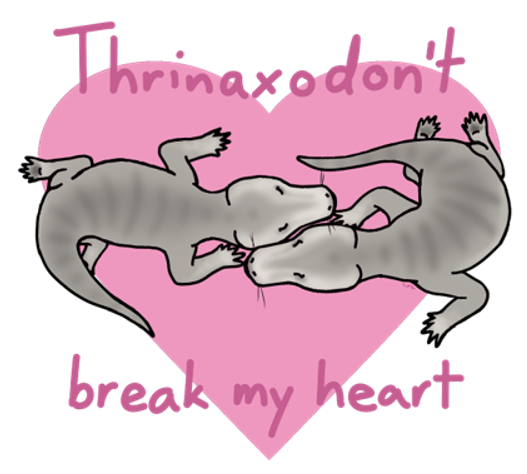
Happy Valentine’s Day from two cuddly Thrinaxodon, a close relative of mammals from the early days of the Age of Dinosaurs. The pose of the two Thrinaxodon is based on a real fossil. Art by ginjaraptor on DeviantArt.

Ah, February. It’s a time when love is on our minds, whether we are sharing our love with a romantic partner or with friends and family. For this edition of Mesozoic Monthly, prepare to fall in love with the adorable Thrinaxodon liorhinus, a little mammal relative that appreciated a good cuddle!

The Mesozoic Era (after which this blog series is named) is often known as the Age of Dinosaurs. After dinosaurs (except their descendants, birds), pterosaurs, and many other large reptiles became extinct at the end of the Cretaceous Period, a new era began: the Cenozoic Era, also known as the Age of Mammals. While mammals certainly became more prominent in ecosystems around the planet during the Cenozoic, mammals actually evolved during the Mesozoic alongside the dinosaurs. Mammals are the only survivors of a group of animals called cynodonts, which were warm-blooded (endothermic) creatures with specialized teeth and simplified lower jaws. Paleontologists are not yet sure if early cynodonts had evolved fur, one of the hallmark traits of mammals, but it is quite possible that critters such as Thrinaxodon had furry little bodies! Small pits that dot the snout of this cynodont suggest that it sported sensitive whiskers, which supports the hypothesis that it had a form of hair.

Whiskers are very sensitive to touch, making them useful for navigating the dark burrows that Thrinaxodonlived in. Many specimens have been found fossilized in their burrows as they slept, sometimes even in groups! A remarkably cute fossil preserves two juveniles curled around each other with their heads pressed close together in an eternal cuddle. It’s easy to imagine this as a case of young star-crossed lovers who died together, but it is just as likely that these two individuals were siblings sharing the same small burrow. Due to the number of fossils of mixed-aged groups of adults with younger individuals, paleontologists believe that Thrinaxodon parents provided some form of childcare before their offspring grew up and ‘flew the nest.’ Regardless of whether Thrinaxodon experienced romantic or familial love, it certainly gives us warm-and-fuzzy feelings today!

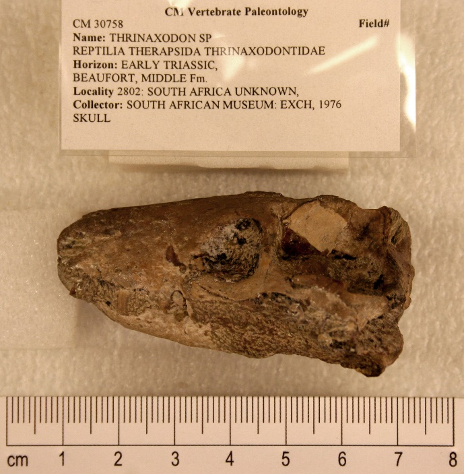
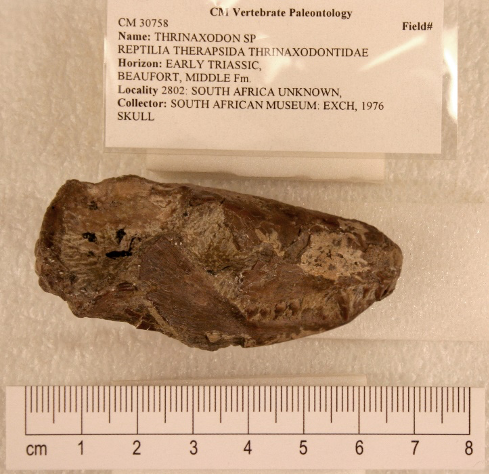
Carnegie Museum of Natural History has a couple Thrinaxodon fossils that we got from the South African Museum in the 1970s. Here’s one of them—our nice skull CM 30758—viewed from the left and right sides. Photos by Andrew McAfee.

Other Thrinaxodon weren’t the only animals that visited their cozy burrows. One noteworthy fossil shows a Thrinaxodon sharing its home with a small amphibian called Broomistega, which apparently took shelter in the burrow after being injured by a larger carnivore. Although Thrinaxodon was itself a carnivore, the bite marks on the Broomistega do not match up with the jaws of its roommate. Instead, Thrinaxodon probably ate little reptiles or other small vertebrates that roamed the Early Triassic of South Africa. Some of its above-ground neighbors included the large, predacious reptile Proterosuchus and the odd-looking dicynodont (distant mammal relative) Lystrosaurus. Fortunately or unfortunately, dinosaurs did not evolve until at least a few million years after Thrinaxodon became extinct. A prehistoric animal’s relationship with dinosaurs is not what makes it endearing, of course; Thrinaxodon is proof of that, since it has managed to steal our hearts all on its own!

Lindsay Kastroll is a volunteer and paleontology student working in the Section of Vertebrate Paleontology at Carnegie Museum of Natural History. Museum staff, volunteers, and interns are encouraged to blog about their unique experiences and knowledge gained from working at the museum.
Filed Under: Blog Tagged With: Vertebrate Paleontology

February 10, 2020 by wpengine

MESOZOIC MONTHLY: LEDUMAHADI

January brings with it a new year and a new installment of Mesozoic Monthly! At the start of a new decade, perhaps the perfect prehistoric creature to honor this month is the dinosaur Ledumahadi mafube, the “giant thunderclap at dawn.”

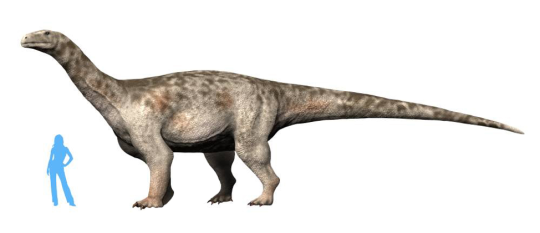
Ledumahadi was an early sauropodomorph, a group of herbivorous dinosaurs that ultimately produced the famous sauropods. Sauropods such as Brachiosaurus or Diplodocus are popular dinosaurs because of their often monstrous sizes, long necks, and lengthy, sometimes whip-like tails. One of the traits that paleontologists believe helped sauropods get so big was their pillar-like legs. Their legs were straight, like stilts, and heavily constructed so that they could support the weight of the animal. Modern elephants also have columnar legs, similar to those of sauropods, because this style of limb is so efficient for big animals. Non-sauropod sauropodomorphs tended to be smaller than their sauropod cousins, and could walk on either two legs or four. Quadrupedal early sauropodomorphs such as Ledumahadi did not have the columnar legs of sauropods, but instead walked with their forelimbs partially bent.

Life reconstruction of Ledumahadi by Nobu Tamura with a human silhouette for scale. This was a big beast! Note how, unlike its sauropod kin, this early sauropodomorph walked with its forelimbs flexed at the elbow. Read the 2018 scientific paper that described it (for free) here.

The largest known dinosaur of its kind, Ledumahadi weighed over 13 tons (12 metric tons), and reconstructions estimate that it grew over 30 feet (9 meters) long! This size is noteworthy, because it shows that it was possible for sauropodomorphs to reach gigantic sizes without columnar legs. This demonstrates that terrestrial animals can get big due to a variety of adaptations. In this case, the tremendous size of both sauropods and Ledumahadi is an example of convergent evolution, a process in which unrelated animals can evolve similar features. One classic example of convergent evolution is wings. Birds, bats, and pterosaurs are unrelated, yet all evolved similar structures that increase surface area for flying. But they all did it in different ways: birds have feathers anchored to the forearm and a fused hand, bats have skin stretched across five fingers, and pterosaurs had skin stretched along one long finger. Although we may not definitively know how Ledumahadi achieved its status as a “great thunderclap,” we do know that it did so along a different evolutionary pathway than its sauropod relatives.

The name Ledumahadi mafube means “great thunderclap at dawn,” referring to the massive size of the animal and its early place in the rock record. Unlike many dinosaur names, it is not derived from Latin or Greek; instead, it is from Southern Sotho, one of the languages spoken in South Africa, where the creature’s fossils were discovered.

Not many well-known animals lived in the Early Jurassic of southern Africa alongside Ledumahadi; the most famous dinosaurs are other sauropodomorphs such as Massospondylus, the small bipedal herbivores Heterodontosaurus and Lesothosaurus, and the small carnivore Coelophysis (formerly called Syntarsus) rhodesiensis. They all lived in an arid floodplain that was crisscrossed by meandering streams. Every so often, after a long period of stability, these water channels would flood, depositing new soil and nutrients and rejuvenating the ecosystem. A great deal of plant growth occurs after floodplains drain, reflecting a cycle of renewal that is familiar to us during each and every new year.

Lindsay Kastroll is a volunteer and paleontology student working in the Section of Vertebrate Paleontology at Carnegie Museum of Natural History. Museum staff, volunteers, and interns are encouraged to blog about their unique experiences and knowledge gained from working at the museum.
Filed Under: Blog Tagged With: Lindsay Kastroll, Science News, Vertebrate Paleontology

August 12, 2019 by wpengine

Travels with a Sketchbook: A Natural History Artist’s Observations at the Museum

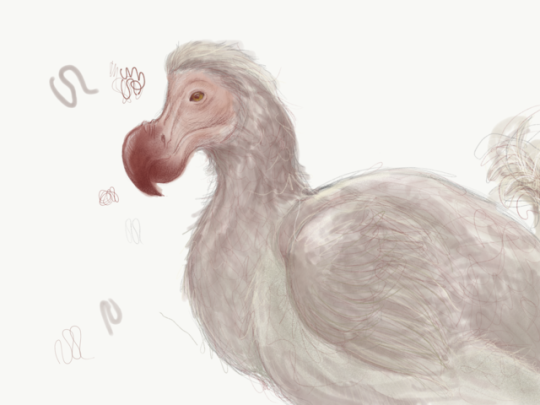
Carnegie Museum of Natural History has a large and expansive collection of artifacts, oddities, and wonders. It also has its fair share of mounted animals and skeletons on display, which makes it an ideal spot for the wandering artist. Where else can an artist study both extinct and extant species up close and in great detail? If, like me, you’re an illustrator who loves to draw animals, you could, for example, grab your sketchbook and head to the museum’s Bird Hall to get a close look at the flightless dodo (Raphus cucullatus). Driven to extinction by European colonists during the 1600s, early artists’ renderings provide some of the best evidence for the dodo’s appearance in life. Perhaps surprisingly, this bird is now known to be closely related to pigeons!

Dodo (Raphus cucullatus) in Bird Hall at Carnegie Museum of Natural History. Sketch by the author.

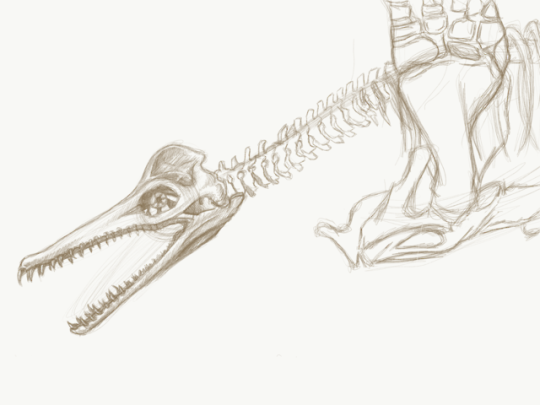
If your tastes are more prehistoric, check out the museum’s sprawling Dinosaurs in Their Time exhibition. Travel back in time to ancient seas and imagine the graceful movements of the plesiosaur Dolichorhynchops bonneri while the giant carnivorous mosasaur Tylosaurus proriger hovers ominously above you. These marine reptile groups vanished in the mass extinction that also wiped out non-avian dinosaurs roughly 66 million years ago.

Skeleton of the short-necked plesiosaur Dolichorhynchops bonneri in the Dinosaurs in Their Time exhibition at Carnegie Museum of Natural History. Sketch by the author.

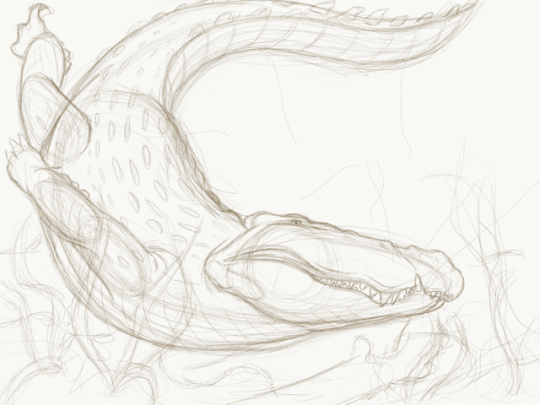
Or perhaps you’re more interested in observing and sketching modern day animals? If so, visit the Hall of North American Wildlife and Hall of African Wildlife on the museum’s second floor. Get up close and personal with the Nile crocodile (Crocodylus niloticus) trio and capture their anatomy in detail. It’s the safest way to do so – not to mention the only way to do so here in Western Pennsylvania! (Reports of alligators in our rivers notwithstanding.)

Nile crocodile (Crocodylus niloticus) in the Hall of African Wildlife at Carnegie Museum of Natural History. Sketch by the author.

So, my fellow artists and nature lovers, as I hope this post has shown, there are scores of species to inspire you here at the museum. Grab your sketchbook and come on over!

Hannah Smith is an intern working with Scientific Illustrator Andrew McAfee in the Section of Vertebrate Paleontology at Carnegie Museum of Natural History. Museum employees, interns, and volunteers are encouraged to blog about their unique experiences and knowledge gained from working at the museum.
Related Content

Celebrating Women in the Natural History Art Collection

Art and the Animal

New Vision of Old Rock Art

Carnegie Museum of Natural History Blog Citation Information

Blog author: Smith, Hannah
Publication date: August 12, 2019

Share this post!

  • Share on Twitter Share on Twitter
  • Share on Facebook Share on Facebook
  • Share on Pinterest Share on Pinterest
  • Share on LinkedIn Share on LinkedIn
  • Share on Reddit Share on Reddit
  • Share via Email Share via Email

Filed Under: Blog Tagged With: Andrew McAfee, bird hall, Birds, dinosaurs in their time, fossils, Hall of African Wildlife, Vertebrate Paleontology

March 19, 2019 by wpengine

March Mammal Madness Update

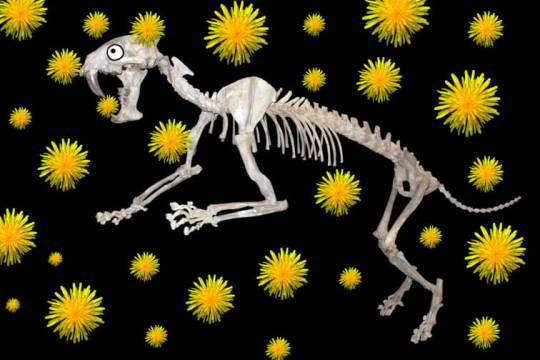
sabertooth cat fossil on black background with yellow dandelions

It’s time to break out the big cats.

Last night’s matches pitted various “cats” against each other, although some cats were only cats in name (for example, the catfish and antlion).

Our most anticipated match had a nimravid (a fossil false sabertooth cat) versus a dandelion. We weren’t sure if the nimravid would only be fossilized bones and stand little chance against the dandelion, or if the nimravid would come to life and be allergic to dandelions. So when the contest began, the nimravid was alive but it began sneezing and as a by-product bit down decapitating the fearsome dandelion. If you fancy seeing a real nimravid, there is one on display in Cenozoic Hall at the Carnegie Museum of Natural History.

For more details on this year’s tournament, click here.

Blog post courtesy of the Section of Mammals. 

Filed Under: Blog Tagged With: Age of Mammals, Cenozoic Hall, fossils, mammals, paleontology, Section of Mammals, Vertebrate Paleontology

January 17, 2019 by wpengine

Preserving Fossil Treasures: Eocene Fishes from Monte Bolca, Italy

by Linsly Church

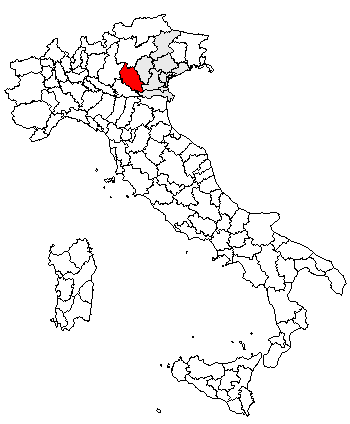
In 1903, Carnegie Museum of Natural History purchased an enormous private fossil collection from the Baron Ernest de Bayet of Brussels, Belgium. Over a 40-year period the Baron had amassed a collection comprising tens of thousands of individual fossils. At age 65 he married a much younger woman and sold the collection to fulfill her dream of having a house on the shore of Italy’s Lake Como. Within the collection are fossils from all over Europe. Fossils from Italy include the Monte Bolca fish collection, which contains about 290 beautifully-preserved specimens that date to about 50 to 49 million years ago, early in the Eocene Epoch.

map of Italy highlighting the province of Verona
The province of Verona (in red) in Italy, where the Monte Bolca site is located.

One quarry at Monte Bolca has been owned by the same family for almost 400 years. It is known as the Pesciara, meaning the fishbowl, because many of the marine fossils found there are those of fishes. Because the preservation is so good in some layers of limestone, the site is considered a Lagerstätte. A Lagerstätte is a site that contains exquisitely-preserved fossils, typically representing a diversity of organisms. At Monte Bolca, some fishes and other creatures have preserved internal organs and even skin pigmentation, the result of an anoxic (oxygen-poor) environment that hindered decay and scavenging. The fossil site also differs from most others in that it is an underground mine with tunnels instead of a typical open quarry.

fish fossil
fish fossil
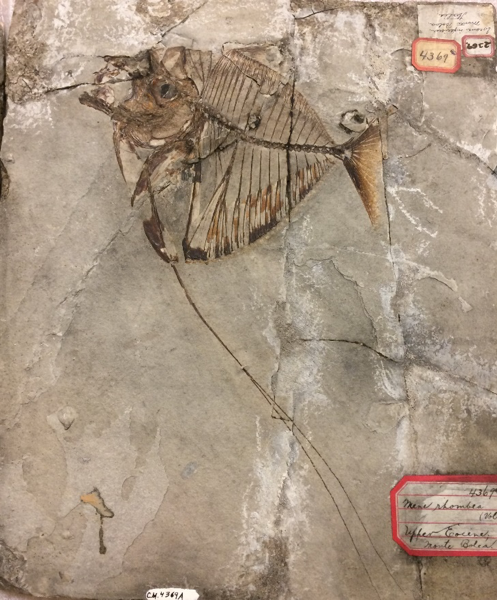
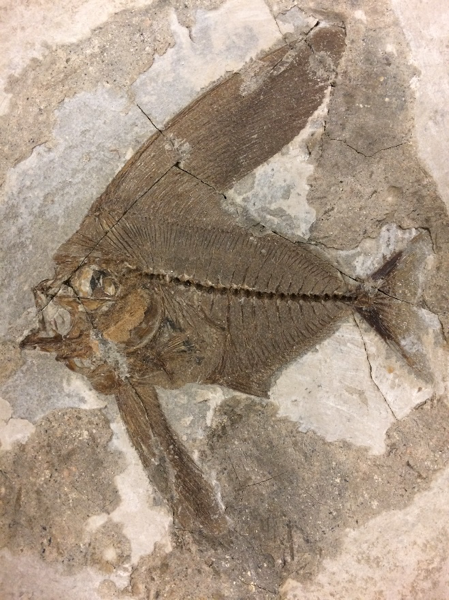
Two of Carnegie Museum of Natural History’s most spectacular ~50 million-year-old fossil fishes from Monte Bolca, Italy. Top: specimen number CM 4369, belonging to the moonfish Mene rhombea. Bottom: specimen CM 4467, belonging to the spadefish Exellia velifer. Note the dark stains in the eye sockets, which are vestiges of the original eye pigments of these ancient fishes.

Carnegie Museum of Natural History’s collection of fishes from Monte Bolca is currently undergoing conservation. In the past, the museum’s Vertebrate Paleontology collection was housed on open shelves in rooms with poor air filtration systems, resulting in soot from the local steel industry building up on the fossils. In recent years, the museum has installed an HVAC system in the Vertebrate Paleontology collection rooms, which has greatly reduced the particulates that make it into these rooms and onto the specimens. In the years since these measures were taken, we in Vertebrate Paleontology have commenced a general cleaning of our specimens, starting with our fishes from Monte Bolca.

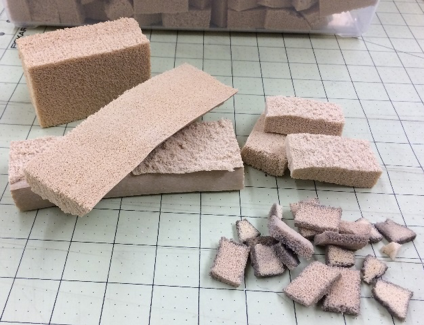
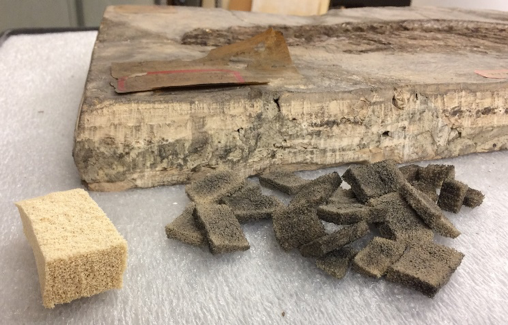
To clean the specimens, we use a soot sponge (or chemical sponge), which is also used by restoration companies to clean after fires. “Chemical sponge” is a slightly misleading name because there are no chemicals added to the sponge. It is made of vulcanized rubber and has tiny pores on its surface that collect fine soot particles without depositing chemicals on the fossil. Therefore, there is no need for water or additional solvents when using these sponges. Wet cleaning of soot can cause staining on the surface that is being cleaned so it is very important to use dry cleaning methods such as chemical sponges. In some cases, the soot on the specimens is so dense that it is obvious where cleaning has taken place.

clean soot sponges
dirty soot sponges
Before and after: clean soot sponges, prior to use (top); dirty soot sponges, after use (bottom) (with the source of the soot—a newly cleaned fossil fish from Monte Bolca—in the background).
fish fossil
fish fossil
fish fossil
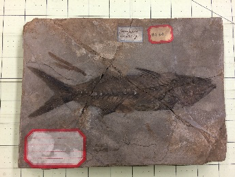
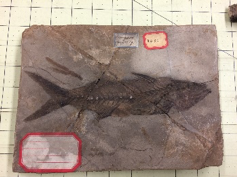
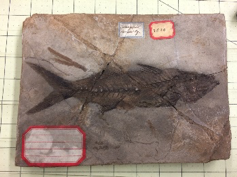
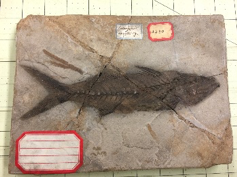
Evolution of a fish, roughly 50 million years after the fact. From top to bottom, the same fossil fish specimen from Monte Bolca (CM 4530, Carangopsis dorsalis) in four successive stages of cleaning.

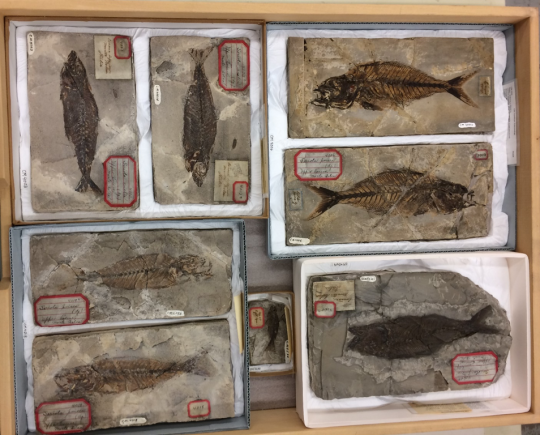
Once the specimens have been cleaned, repairs are made as needed and labels are reattached if they are delaminating from (or falling off of) the specimen. Then, storage mounts are created for specimens as needed using archival materials. These materials are made specifically to be as neutral or inert as possible so as not to give off gases that could react harmfully with the specimens. Storage mounts are important because they reduce the amount of times someone needs to touch the specimen—which, in turn, reduces breakage—and protect the specimen from vibration when the compactors in which it is housed are opened and closed. These measures will help to protect the integrity of the specimens for years to come.

A drawer full of recently-cleaned Monte Bolca fishes in their new storage mounts.

Linsly Church is the curatorial assistant for the Section of Vertebrate Paleontology at Carnegie Museum of Natural History. Museum employees are encouraged to blog about their unique experiences and knowledge gained from working at the museum.
Related Content

Early Bats: Ancient Origins of a Halloween Icon

Meet the Mysterious Mr. Ernest Bayet

Sharing Shipping Space with Amphibians and Reptiles

Carnegie Museum of Natural History Blog Citation Information

Blog author: Church, Linsly
Publication date: January 17, 2019

Share this post!

  • Share on Twitter Share on Twitter
  • Share on Facebook Share on Facebook
  • Share on Pinterest Share on Pinterest
  • Share on LinkedIn Share on LinkedIn
  • Share on Reddit Share on Reddit
  • Share via Email Share via Email

Filed Under: Blog Tagged With: fossils, Linsly Church, Vertebrate Paleontology

  • « Go to Previous Page
  • Page 1
  • Interim pages omitted …
  • Page 4
  • Page 5
  • Page 6
  • Page 7
  • Page 8
  • Interim pages omitted …
  • Page 10
  • Go to Next Page »

sidebar

About

  • Mission & Commitments
  • Directors Team
  • Museum History

Get Involved

  • Volunteer
  • Membership
  • Carnegie Discoverers
  • Donate
  • Employment
  • Events

Bring a Group

  • Groups of 10 or More
  • Birthday Parties at the Museum
  • Field Trips

Powdermill

  • Powdermill Nature Reserve
  • Powdermill Field Trips
  • Powdermill Staff
  • Research at Powdermill

More Information

  • Image Permission Requests
  • Science Stories
  • Accessibility
  • Shopping Cart
  • Contact
  • Visitor Policies
One of the Four Carnegie Museums | © Carnegie Institute | Privacy Policy | Terms of Use | Accessibility
Rad works here logo