• Skip to primary navigation
  • Skip to main content
  • Skip to primary sidebar

Carnegie Museum of Natural History

One of the Four Carnegie Museums of Pittsburgh

  • Visit
    • Buy Tickets
    • Visitor Information
    • Exhibitions
    • Events
    • Dining at the Museum
    • Celebrate at the Museum
    • Powdermill Nature Reserve
    • Event Venue Rental
    • Gift Cards
  • Learn
    • Field Trips
    • Educator Information
    • Programs at the Museum
    • Bring the Museum to You
    • Guided Programs FAQ
    • Programs Online
    • Climate and Rural Systems Partnership
  • Research
    • Scientific Sections
    • Science Stories
    • Science Videos
    • Senior Science & Research Staff
    • Museum Library
    • Science Seminars
    • Scientific Publications
    • Specimen and Artifact Identification
  • About
    • Mission & Commitments
    • Directors Team
    • Museum History
  • Tickets
  • Give
  • Shop

Erin Southerland

July 7, 2023 by Erin Southerland

Ruffed Grouse or Scarlet Tanager: Debating the Pennsylvania State Bird

by Pat McShea

Should a wildlife species representing a state reflect the creature’s abundance within the designated boundaries? Where state birds are concerned, the topic is now wide open for discussion because of an enlightening article in the spring issue of Living Bird, the quarterly publication of the Cornell Lab of Ornithology. 

In “What if the State Birds Were Determined by Data?” authors Matt Smith, an applications programmer for the Lab’s Macaulay Library, and Marc Devokaitis, associate editor for Living Bird, make a strong case for the “thought experiment” of revising such symbols. They trace the current arrangement to a campaign by the General Federation of Women’s Clubs in the 1920s that eventually resulted in a designated “bird of honor” for all 50 states, the District of Columbia, and the 13 provinces and territories of Canada.

Chief among the current system’s deficiencies are birds earning honors for multiple states. The Northern Cardinal, for example, holds the revered position in seven states, creating a red bird belt stretching westward from North Carolina and Virginia across West Virginia, Ohio, Kentucky, Indiana, and Illinois.

As remedy, Smith and Devokaitis suggest a more scientific selection process based upon millions of community science observation records in eBird, the vast and easily accessible electronic archive of bird sightings managed by Cornell Lab of Ornithology. Examination of this enormous data set, when paired with analysis of satellite-generated land-cover maps, reveals how the biogeographical conditions in many states favor the well-being of particular species. Selecting such species for recognition not only produces unique state bird designations, but also directs public attention to the ecosystem that supports the honored birds.

Here in Pennsylvania, where the Ruffed Grouse has reigned as our state bird since 1931, such data driven recommendations might seem unnecessary. No other state so honors the Ruffed Grouse, and the species’ collective value to Pennsylvania residents includes the gamebird’s historic importance as a food source and its current role as the focus of much upland sport hunting. 
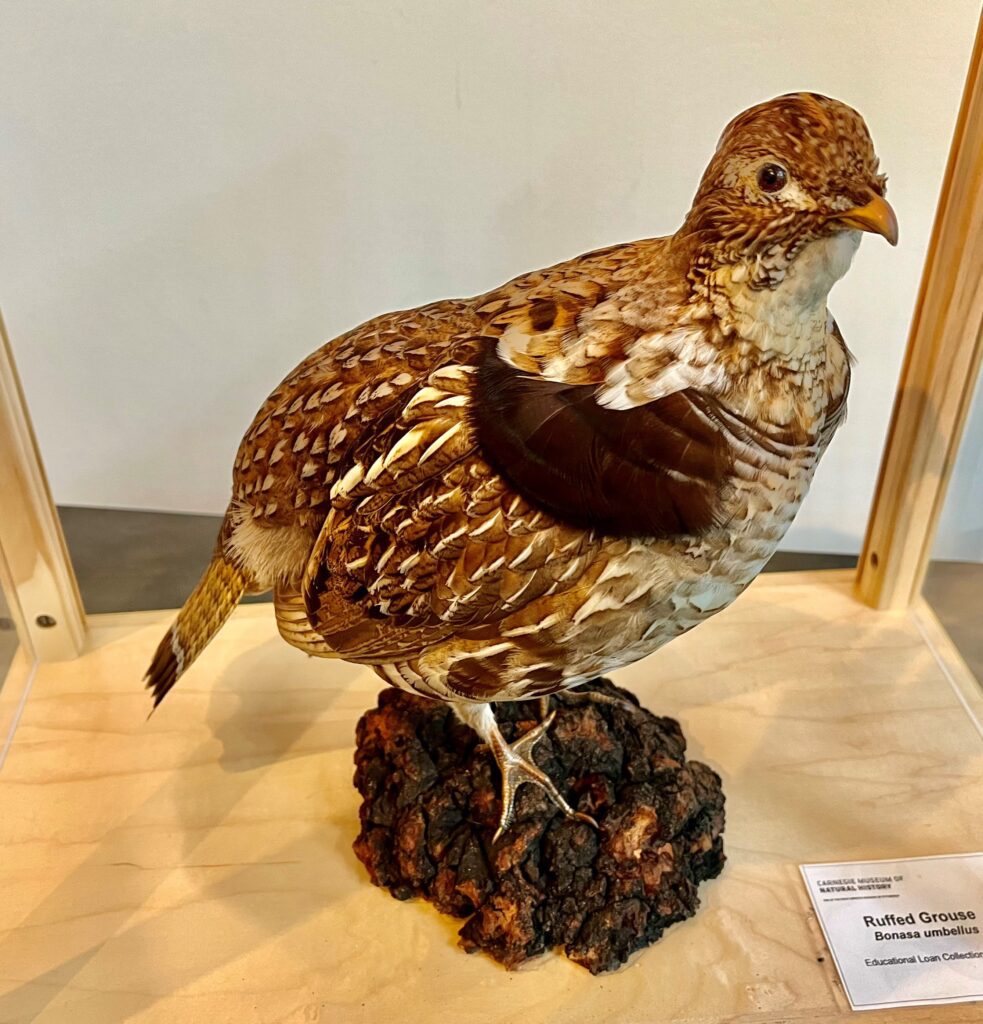
ruffed grouse taxidermy mount
Ruffed Grouse taxidermy mount.

In a challenge to this status quo, documented observations and land cover conditions point to a smaller and brighter bird for state honors, the Scarlet Tanager. Pennsylvania, according to the reasoning behind the nomination, supports a greater breeding population of these songbirds than any other state. 
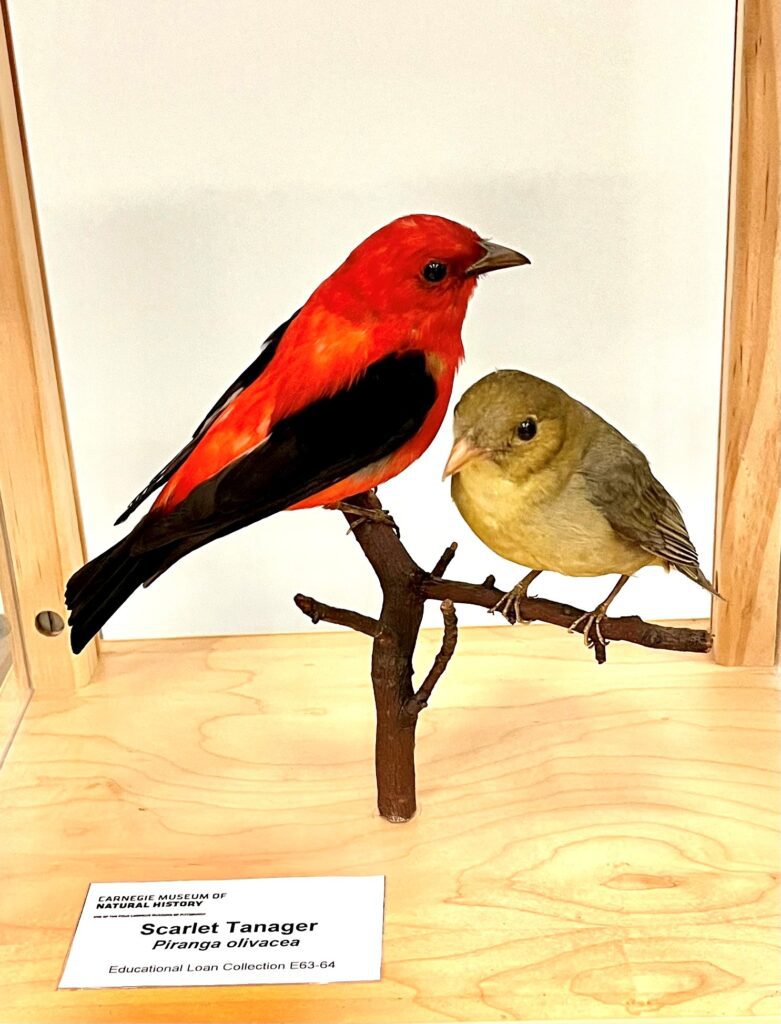
taxidermy mount of two scarlet tanagers
Pair of Scarlet Tanagers.

The species, whose descriptive name is an apt description of the male bird in breeding plumage, could certainly attract advocates. In All About Birds, the Cornell Lab of Ornithology’s encyclopedic online reference, the nominee’s description begins with its pure visual appeal: Male Scarlet Tanagers are among the most blindingly gorgeous birds in an eastern forest in summer, with blood-red bodies set off by jet-black wings and tail. Viewing expectations are quickly tempered by subsequent sentences, which, after noting the dark-winged female’s otherwise yellowish-green plumage, and the species overall preference for high tree canopies, recommends using the birds’ distinctive call as an aid to visually locate them. 

Whenever circumstances make it possible for such advice to be followed, there is great potential for the development of more ardent Scarlet Tanager fans. Gabi Hughes, Environmental Educator for the Audubon Society of Western Pennsylvania, recalls a spring when a male Scarlet Tanager would reliably sing from the woods just beyond the suburban Pittsburgh middle school campus where she was leading bird-focused activities with seventh grade students. By her estimate, over the course of multiple small group hikes, at least 80 seventh grade students saw and heard the bird, a creature introduced to them as a spring and summer resident of their neighborhood who had recently returned from wintering grounds as distant as Bolivia.

For Ruffed Grouse fans, declining populations, a trend attributable to reductions in the mixed forest stage habitat across Pennsylvania, as well as the species’ susceptibility to West Nile Virus, might be of far greater concern than a revision of symbolic honor. As a fallback position, Ruffed Grouse backers might even cite the specific wording of the relevant 1931 statute, making their case that “state game bird” should be regarded differently than “state bird.”

Pat McShea is an Educator at Carnegie Museum of Natural History.

Related Content

Building Birding Skills

Bird Architecture on Human Infrastructure

Why Do the King Penguins in Bird Hall Look So Different from Each Other?

Carnegie Museum of Natural History Blog Citation Information

Blog author: McShea, Patrick
Publication date: July 7, 2023
Share this post!

  • Share on Twitter Share on Twitter
  • Share on Facebook Share on Facebook
  • Share on Pinterest Share on Pinterest
  • Share on LinkedIn Share on LinkedIn
  • Share on Reddit Share on Reddit
  • Share via Email Share via Email

Filed Under: Blog Tagged With: Birds, Pat McShea, Science News

June 23, 2023 by Erin Southerland

From Collections User To Collections Manager

Introducing Mariana Marques, the New Collection Manager for the Section of Amphibians and Reptiles

by Mariana Marques
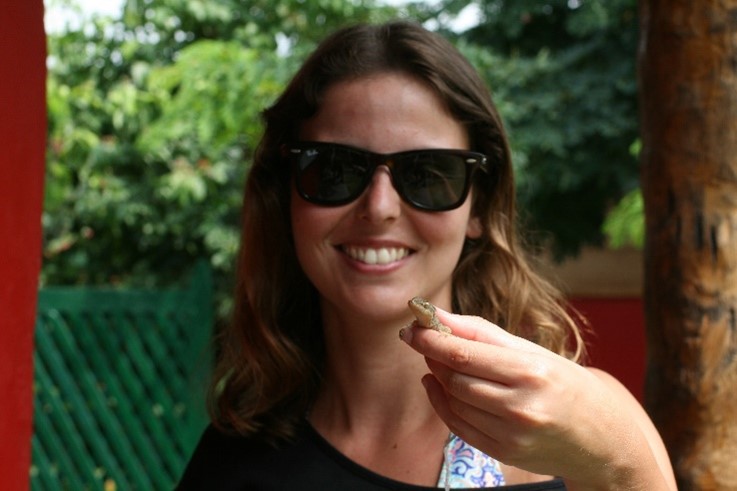
With a Hemidactylus greefii – São Tomé giant gecko, São Tomé island.

I’m not sure when I first entered in a natural history museum, but I know that these establishments have always been my favorite places to visit. I did my bachelor’s degree in biology in the University of Évora, a small and picturesque town in southern Portugal surrounded by one of the most biodiverse habitats of the Iberian Peninsula, the unique savanna-like ecosystem known as the “montado.” In the intervals between classes, I loved to go look for the critters that surrounded the university field station where most of my classes were held. I was lucky enough to be in one of the places with the highest diversity of amphibians and reptiles in the country, and in a natural and unspoiled area which meant that I could easily see good numbers of these animals. Being able to handle and study these animals in the field woke up my passion for herpetology, and I decided that I wanted to become a herpetologist.

I started to collaborate on projects in herpetology, and I was lucky enough to visit the outstanding collections of the Natural History Museum of Paris while I was an undergraduate. Most of the projects I was participating in had a strong taxonomic focus, and therefore specimens were the basis of my research. I had become specialized in measuring snout-vent length, counting scales, and describing the coloration of preserved lizards, frogs, and snakes from across the world. With these, I started to better understand the importance of historical labels, catalog numbers, old publications citing these specimens, and modern databases. 

My path turned to Africa during master’s thesis work as I started working with the poorly known fauna of two Portuguese-speaking countries on the continent: Angola, in southwestern Africa, and São Tomé & Príncipe, an island nation in the Gulf of Guinea. For this work, I learned another new skill: specimen collecting. As an apprentice naturalist, I learned where to find species of interest, how to collect them safely, and how to prepare and fix them to become museum specimens. These new experiences gave me an increased appreciation of our collections and their importance. As an MSc and PhD student, I described species new to science, and catalogued and mapped herp diversity to support their conservation. 

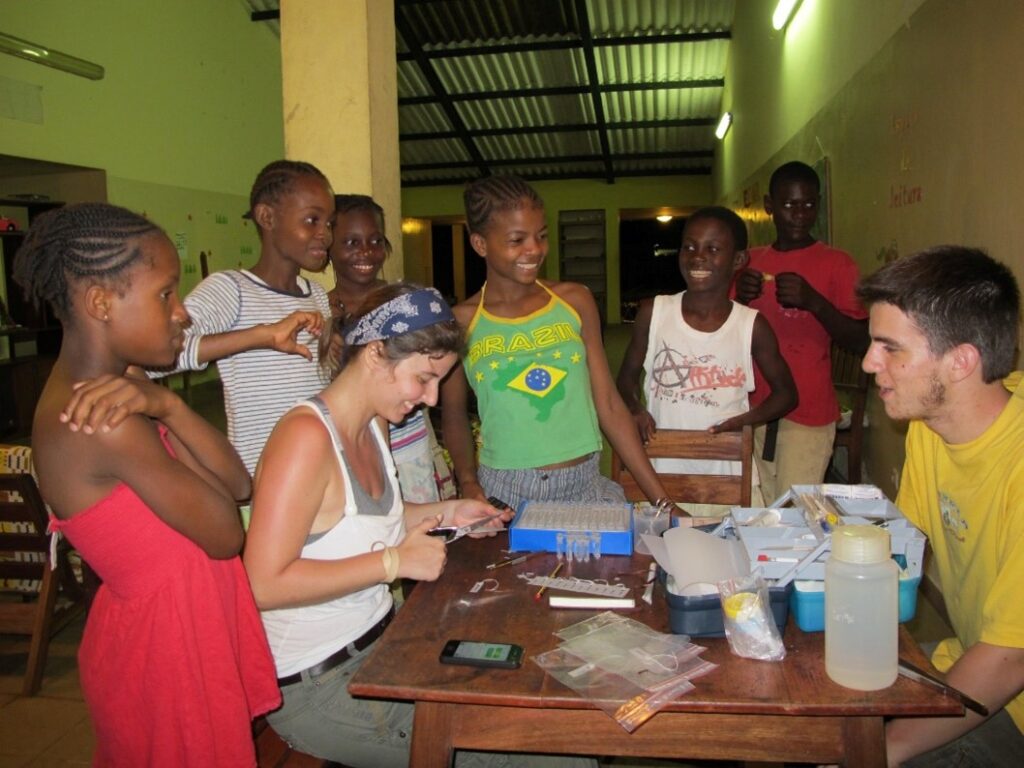
Preparing specimens field tags in the company of the young future naturalists at Príncipe island.
Photo by: Luis M.P. Ceríaco, 2015.

Although I’ve visited many collections in Europe, Africa, and the US (including CMNH!), I was mostly based in Portugal. The Portuguese collections had suffered considerable neglect which made most of them almost unusable. However, taxonomists need collections, so together with colleagues, I embarked on the mission of rescuing those collections to make them accessible and usable for researchers. Through this process I learned how a collection should be housed, and best practices for collection management and care. I became a collections manager!

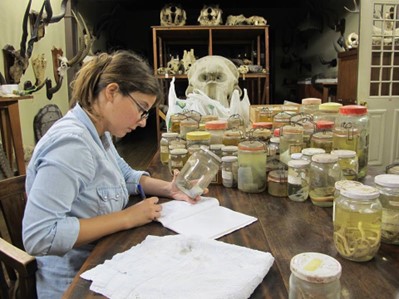
Starting from scratch. Listing all herpetological material at Instituto de Investigação Científica Tropical, Lisboa, Portugal. Photo by: Luis M.P. Ceríaco, 2014.

Currently, while I still love to do research, participate in fieldwork, and describe new species, I love to be taking care of specimens in old jars, making them accessible to researchers and to the public, telling stories about them, and ensuring they are preserved for generations to come. Natural history collections, such as the one we have at Carnegie Museum of Natural History, are fundamental tools for science and conservation, and new promising technologies are showing us that their potential is far beyond my traditional snout-vent length measuring and scale counting.

Becoming the Collection Manager of the Section of Amphibians and Reptiles of Carnegie Museum of Natural History is both a challenge and an honor. And what I find more curious about it, is that in 2018, when I visited the museum and used its collections for my own research, I remember saying to myself: this is a city where I could see myself living!

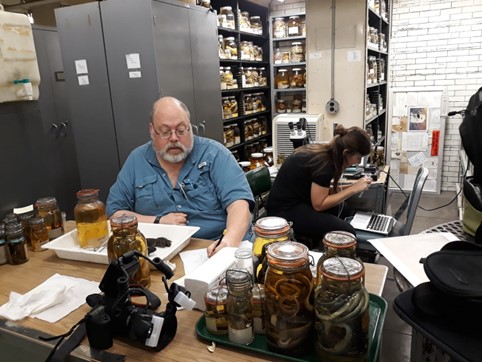
At Carnegie Museum of Natural History, Section of Amphibians and Reptiles in 2018, studying the Angolan material from Pulitzer Expedition, with Aaron Bauer and Luis Ceríaco. Photo by: Luis M.P. Ceríaco, 2018.

Mariana Marques is Collection Manager of Amphibians and Reptiles at Carnegie Museum of Natural History.

Related Content

A Deep Look Inside Reptiles and Amphibians

Sharing a City Park with a Resident Reptile

Is This What They Call Overkill? Toxin and Venom in the Herp World

Carnegie Museum of Natural History Blog Citation Information

Blog author: Marques, Mariana
Publication date: June 23, 2023

Share this post!

  • Share on Twitter Share on Twitter
  • Share on Facebook Share on Facebook
  • Share on Pinterest Share on Pinterest
  • Share on LinkedIn Share on LinkedIn
  • Share on Reddit Share on Reddit
  • Share via Email Share via Email

Filed Under: Blog Tagged With: amphibians and reptiles, herpetology, Mariana Marques, Science News, SWK2

June 15, 2023 by Erin Southerland

Wolverine: Status Check For a Tournament Champion

by Pat McShea
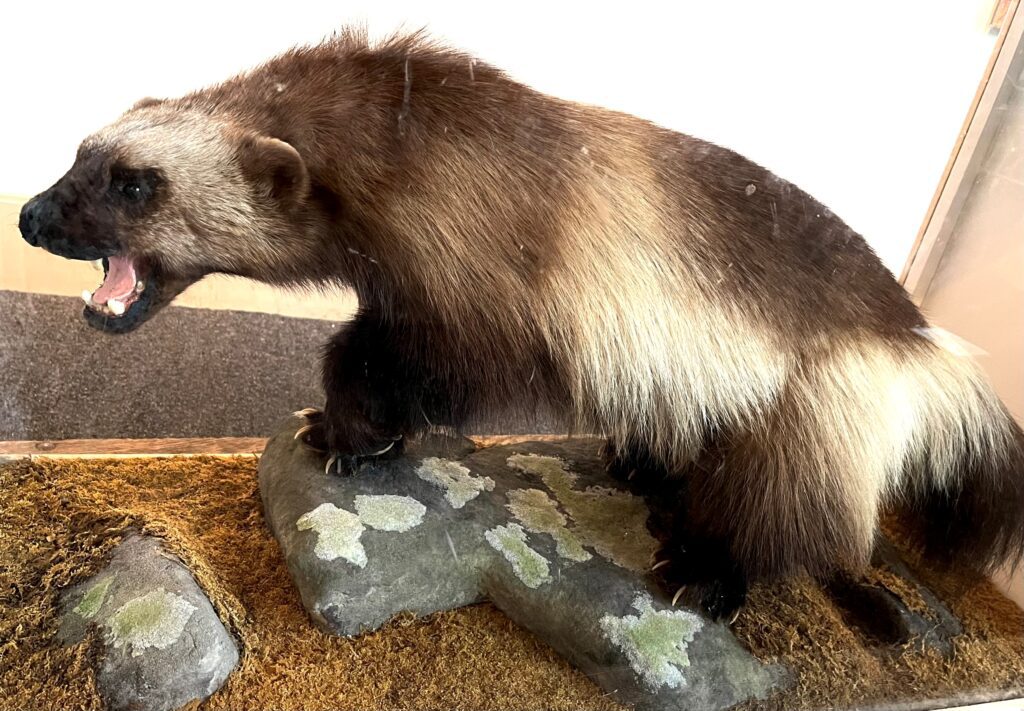
A wolverine taxidermy mount is a popular display in Discovery Basecamp.

Technology has revolutionized the work of wildlife biologists, but among those who study wolverines, long waits for field-collected information about these large members of the weasel family still occur. Because wolverines are known to patrol enormous home ranges, Cory Mosby, Furbearer Staff Biologist with Idaho’s Department of Fish and Game, relies upon strategically placed camera traps as effective monitoring tools. As he explained in a recent Zoom interview from his office in Boise, deep snow at high elevations can delay the retrieval of video and photographic evidence for months. “There’s a few places we placed cameras for over-the-winter wolverine studies where we weren’t able to retrieve the devices until July.”

Our discussion of wolverine research occurred just after the species received accolades as the 2023 champion of March Mammal Madness (MMM), the wide-reaching, ten-year-old educational project that masquerades as a tournament mimicking competition, but is in no way affiliated with, the NCAA college basketball tournament. The online event, founded and directed by Professor Katie Hinde of Arizona State University, challenges participants to predict outcomes for a widely branched bracket’s worth of hypothetical combative wildlife encounters. Reference material links on the MMM website encourage fans to make informed decisions, and as the tournament’s hypothetical encounters unfold, additional information about the combatants is shared via timely narrative reports. 

This year, any MMM fan who tracked the wolverine’s six victory championship campaign undoubtedly learned lots of information about this carnivore with solitary ways, a bone-crushing bite, and a fierceness sufficient to intimidate even bears and wolves.

On Zoom, much of Mosby’s information sharing focused on historic wolverine distribution. He explained how, by the 1930s, a species once found across much of the American West and even in sections of several Great Lakes states, was largely extirpated in the lower 48 states by predator control programs, landscape alteration, and unregulated hunting and trapping. However, during the nearly eight decades since, changes in public policies and attitudes eventually created conditions that enabled animals from western Canada to naturally re-colonize portions of four states – north-central Washington, northern and central Idaho, western Montana, and northwestern Wyoming.

In 2010, a proposed listing of these animals under the Federal Endangered Species Act prompted the establishment of the Western States Wolverine Conservation Project, a multi-year investigation in which essential early work, beginning in 2016, involved establishing baseline information about the numbers and movements of the animals under study. 

Cory Mosby placing a camera trap as part of wolverine monitoring effort in Idaho’s Centennial Mountains.

When presented with the question, “What do you wish the public knew about wolverines?” Mosby had a ready answer. “This might not align with popular opinion, but I wish more people realized that, as a species, at the moment, wolverines are quite secure. In Idaho today, wolverines occupy all available habitat. The population in the western U.S., the animals I’ve helped study, are on this continent, a southerly extension of a species found around the globe at northerly latitudes in suitable habitat. ‘Holarctic’ is the term that summarizes this enormous distribution.”

Mosby cites a warming climate as a big concern for wolverine populations in southernly latitudes, explaining how the same deep snow deposits that delay camera retrieval in project studies also allow female wolverines to catch sufficient kills as food for kits too young to forage on their own.

The wildlife biologist’s overall advice is to pay attention to both the local situation and the big picture. His career track, he relates, was influenced by the sudden realization of how small forces influence big systems. “I was a pre-med major at the University of Missouri taking lots of biology classes, and in one of them a visiting lecturer gave a presentation about how northern flying squirrels influence the health of entire forests by distributing spores as they feed on fungi. I realized then I wanted to work studying wildlife.”

Patrick McShea is an Educator at Carnegie Museum of Natural History.

Related Content

March Mammal Madness 2023: Learn and Win

March Mammal Madness and Middle School Science Class

World Pangolin Day 2023 – The Mysterious Brain Bone

Carnegie Museum of Natural History Blog Citation Information

Blog author: McShea, Patrick
Publication date: June 15, 2023

Share this post!

  • Share on Twitter Share on Twitter
  • Share on Facebook Share on Facebook
  • Share on Pinterest Share on Pinterest
  • Share on LinkedIn Share on LinkedIn
  • Share on Reddit Share on Reddit
  • Share via Email Share via Email

Filed Under: Blog Tagged With: mammals, Pat McShea, Science News

May 30, 2023 by Erin Southerland

Collected On This Day: White Trillium from May 28, 1993

by Mason Heberling
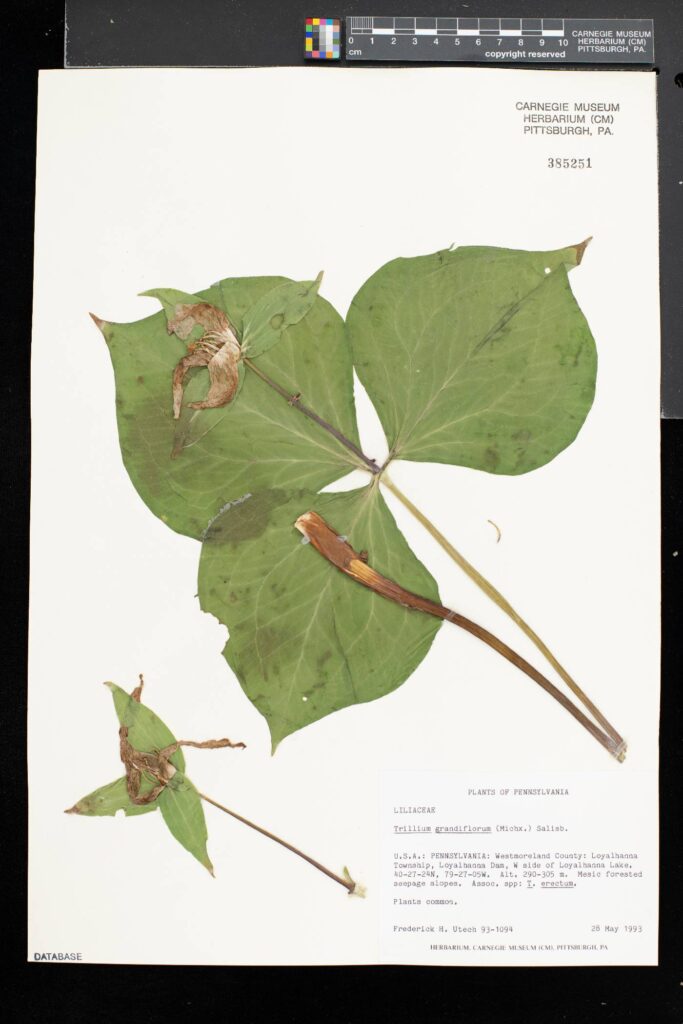
herbarium specimen of white trillium

Spring flowers fade, but some leaves hang on

This specimen of white trillium (Trillium grandiflorum) was collected by Fred Utech in Loyalhanna Township, Pennsylvania on May 28, 1993.  Fred Utech was Curator of Botany at Carnegie Museum of Natural History from 1976-1999. You can find this specimen here and search for many more trillium at midatlanticherbaria.org.

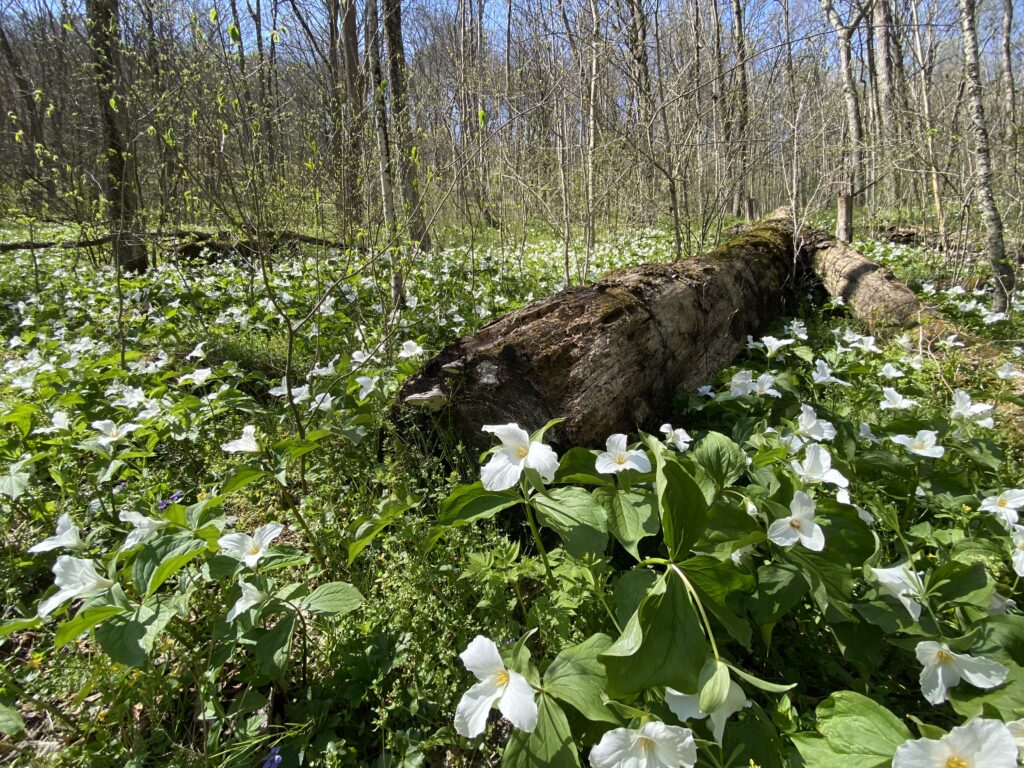
Trillium grandiflorum (white large-flowered trillium) is perhaps the most common trillium species in western Pennsylvania, along with Trillium erectum (red trillium, though petals can be white, red/purple, or occasionally yellow; the ovary is deep red, unlike white trillium).  Peak blooms of this species can be breathtaking when covering hillsides. Deer also enjoy trillium, and herbarium specimens have been used to understand their impact.

numerous white trillium flowers growing in a forest

As the heat of summer is upon us, these spring blooming species begin to fade. Or at least their flowers do.  Some trillium keep their leaves into the deep shade of summer. Though light levels are low due to the shade of overstory trees, early summer is an important time for many spring blooming species to develop their fruits.  A local study from our group found more than 20% of photosynthetic energy gains in Trillium grandiflorum after overstory trees produced leaves.

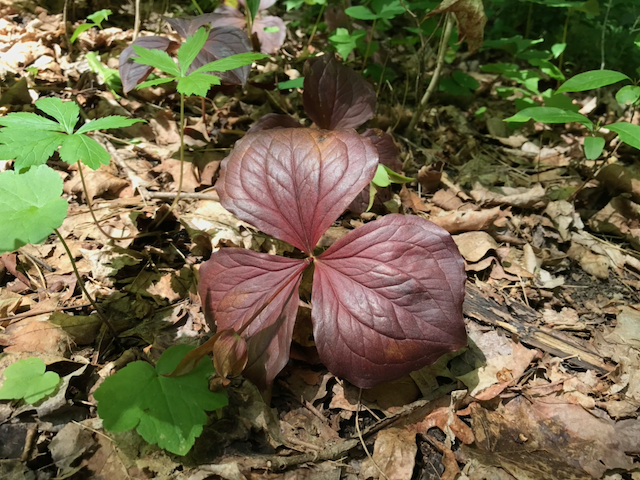
White trillium leaves do die back in mid-summer, however.  We often think of leaf coloration in the fall, but some trillium curiously have leaves that turn a deep red as they fade in mid-summer.  We are currently working up an undergraduate students-led project on this intriguing natural history phenomenon. Only about 10% of plants turn red (but highly variable), and first results suggest there doesn’t seem to be a method to the madness that explains why. More soon!  For now, enjoy the “fall” foliage of summer below.

red leaved white trillium growing in the woods

Mason Heberling is Assistant Curator of Botany at Carnegie Museum of Natural History.

Related Content

Collected On This Day in 1925: A Flower with No Leaves?

Collected On This Day in 1982: One Specimen Isn’t Always Enough!

Mayapple at Powdermill [Video]

Carnegie Museum of Natural History Blog Citation Information

Blog author: Heberling, Mason
Publication date: May 30, 2023

Share this post!

  • Share on Twitter Share on Twitter
  • Share on Facebook Share on Facebook
  • Share on Pinterest Share on Pinterest
  • Share on LinkedIn Share on LinkedIn
  • Share on Reddit Share on Reddit
  • Share via Email Share via Email

Filed Under: Blog Tagged With: Botany, collected on this day, Hall of Botany, liocf, Mason Heberling, Science News

May 24, 2023 by Erin Southerland

Bringing A Little O-Gah-Pah to Pittsburgh

by Amy L. Covell-Murthy

It is important for Carnegie Museum of Natural History (CMNH) to maintain relationships with the diverse Indigenous communities whose stories we hope to share with the Greater Pittsburgh Area. This ensures that we are centering Indigenous knowledge in how we collect, display, care for, and interpret cultural material. A very important part of this work is to continuously consult with tribal representatives and Indigenous advisors. This is most evident in the process of repatriation, which is governed in the United States by a federal law called the Native American Graves Protection and Repatriation Act (NAGPRA), which was signed in 1991. 

In November 2022, as the concluding action of nearly ten years of consultation, I travelled 962 miles West to complete a NAGPRA transfer with a representative of the Quapaw Nation. I met Carrie Wilson, Quapaw NAGPRA Director, at the Arkansas Archaeological Survey at the University of Arkansas, where we rejoined human remains from Poinsette County with other Quapaw people to await a proper and private reinternment in the future. Afterward, by volunteering at the O-Gah-Pah “Quapaw” Fall Gathering in Northeastern Oklahoma at the Downstream Resort and Casino, I had the pleasure of a brief immersion in some aspects of Quapaw Culture. 

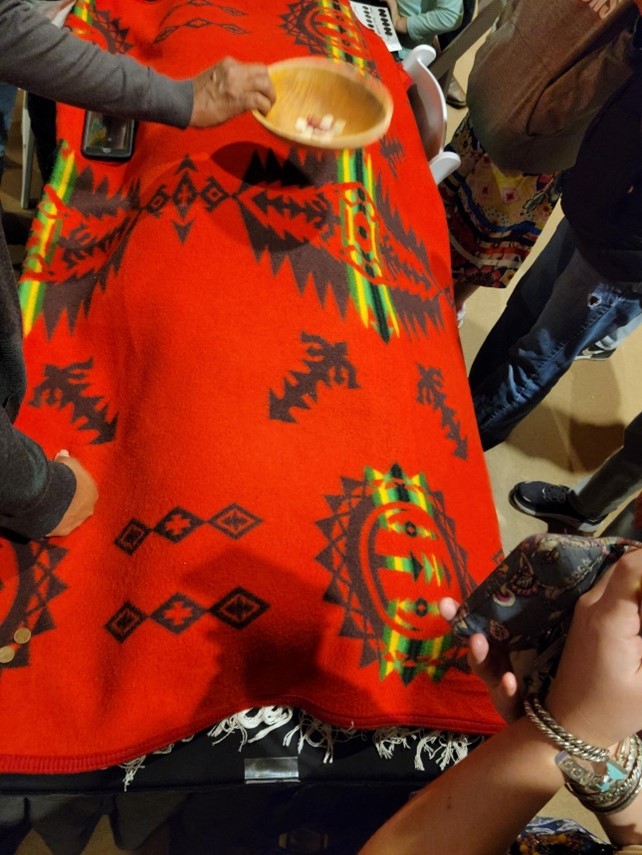
Quapaw Dice Game, photo by Amy Covell-Murthy
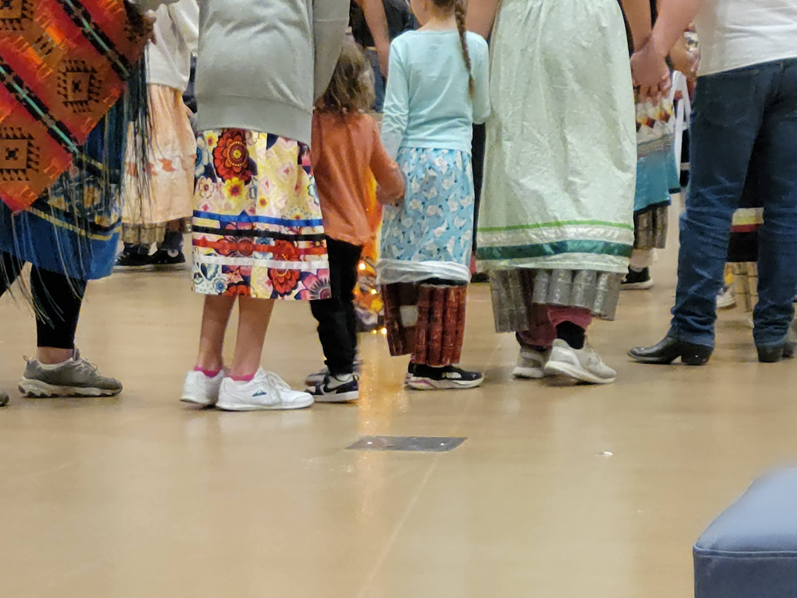
Stomp Dance Participants, photo by Amy Covell-Murthy

Carrie and I had our work cut out for us preparing for the Fall Gathering. We got to know one another better over lunch and then drove to Quapaw, Oklahoma to get ready. On the day of the event, I rolled up my sleeves and helped sell 50/50 raffle tickets, organize games for kids, keep track of auction items, and set up for the Stomp Dance. I learned how to play Quapaw Dice and cheered everyone on in the foot races. I met so many wonderful people and was humbled by the welcome I received. I ate my share of fry bread and chili and paused to be thankful for the opportunity to forge such meaningful relationships.

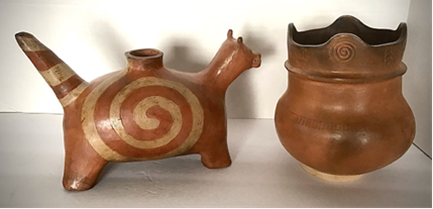
Dog Effigy and Quapaw Pot by Betty Gaedtke, photo by Betty Gaedtke

While volunteering I was able to meet Betty Gaedtke or Te-mi-zhi-ka (little buffalo woman). Betty is an accomplished Quapaw artist who specializes in authentic Quapaw and Mississippian Pottery. While Betty’s pieces are authentic, they are not archaeological and provide a window into Quapaw style and technique. Her work can be seen in fifteen different venues, including the Crystal Bridges Museum, the Museum of The Ghost Ranch, and the Gilcrease Museum. Thanks to a generous endowment, CMNH was able to purchase two pieces from Betty in 2023 to add to our collection and help us bring the story of the Quapaw to Pittsburgh. These pieces are a great reminder that the Quapaw Nation is alive and well.

O-Gah-Pah logo at the Downstream Casino, Photo by Amy Covell-Murthy

So many things in Pittsburgh are inspired by the confluence of our three rivers. Things are named after them, transported on them, and festivals are held on and around them. Like the important role the three rivers play in our local culture, the Mississippi River is very significant to the Quapaw Nation and instrumental in how their name formed. According to the Quapaw Nation website: “The Quapaw were a division of a larger group known as the Dhegiha Sioux many years ago. The Dhegiha split into the tribes known today as the Quapaw, Osage, Ponca, Kansa, and Omaha when they left the Ohio Valley. The Quapaw moved down the Mississippi River into Arkansas, this is the origin of the word Ogaxpa, which can be translated as “downstream people.” You can learn more by visiting QuapawTribe.com.

Caring for culturally significant collections takes empathy and the willingness to accept Indigenous ways of knowing when making decisions on behalf of the material. We are working hard to bring authentic and diverse voices into the narratives that CMNH shares. So, join me in learning more about the O-Gah-Pah and remember to stop relegating Indigenous people and communities to the past when they are thriving across our country. 

Amy L. Covell-Murthy is Archaeological Collection Manager at Carnegie Museum of Natural History.

Related Content

New Vision of Old Rock Art

A Trip to Grave Creek Mound

Grass Baskets of the Chumash

Carnegie Museum of Natural History Blog Citation Information

Blog author: Covell-Murthy, Amy
Publication date: May 24, 2023

Share this post!

  • Share on Twitter Share on Twitter
  • Share on Facebook Share on Facebook
  • Share on Pinterest Share on Pinterest
  • Share on LinkedIn Share on LinkedIn
  • Share on Reddit Share on Reddit
  • Share via Email Share via Email

Filed Under: Blog Tagged With: Amy Covell-Murthy, anthropology, archaeology, Science News

May 18, 2023 by Erin Southerland

Can’t Choose Just One: Asking an Entomologist to Name Their Favorite Native Species

by Bob Androw

I was recently asked what my favorite native species of beetle is. A seemingly simple question, but one with no simple answer. I thought first of my primary group of study, the Cerambycidae – the long-horned beetles. But with nearly 1,300 species in North America – which one? Then I pondered the scarab beetles, which I call my “mistress” group – the one I mess around with when the cerambycids aren’t looking. The week before I was asked this question, I was in southern Georgia looking for specimens of an undescribed (new to science) species of scarab beetle in the genus Serica – but while a current priority, I can’t call that my “favorite”.

Then, I remembered the species of long-horned beetle that I looked for in Georgia but did not see. Along a sandy county road, I noticed a lush stand of common elderberry, Sambucus canadensis L. that was in the early stages of blooming. I stopped to check those blooms for any flower-visiting cerambycids and was dismayed to find no insect activity – probably a result of the unusually cool and windy weather.

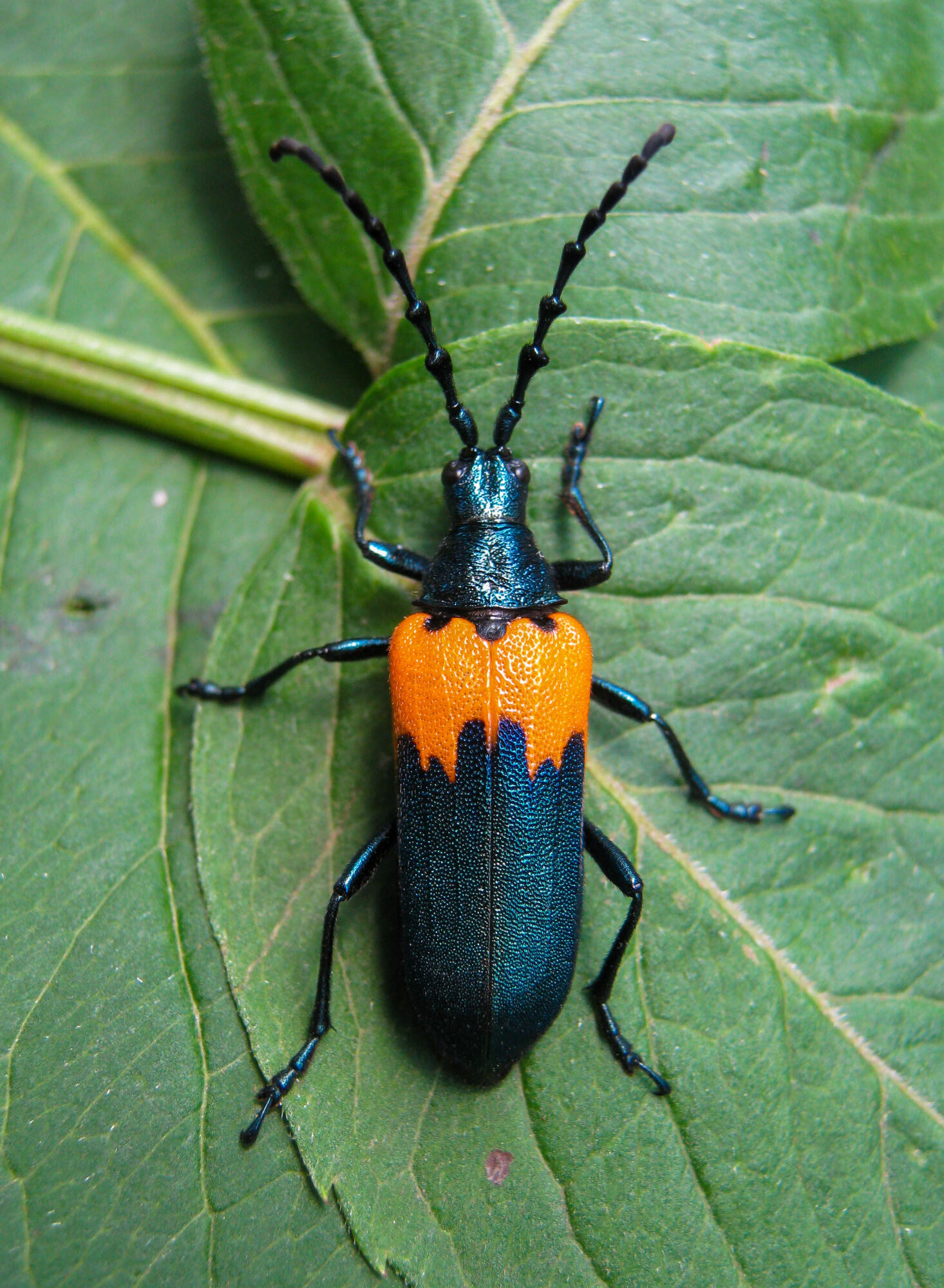
As I was examining the elderberry plants, visions of one of the eastern United States’ more aesthetic species of Cerambycidae flashed into my head – that of Desmocerus palliatus (Forster), or as it’s known by its common name, the elderberry borer. The larvae of the beetle bore in the living pith at the base of the stems. The adults are a beautiful metallic blue with the basal half of their elytra vivid orange. The beetle can be found on elderberry plants, either walking on the stems or clinging to the underside of the leaves. On hot days from May to early July, they can sometimes be found flying around the plants in search of mates. 

But, despite a thorough search by squatting low under the plants and looking upward for hiding beetles, none were seen. My timing may have been off for their flight period in that area, the unseasonably cool weather may have delayed their emergence, or there just may not be a population in that particular stand of elderberry. 

Female Desmocerus palliatus, on elderberry leaf in Lancaster County, PA.
Image from BugGuide, credit: Chris Rorabaugh, Florida.
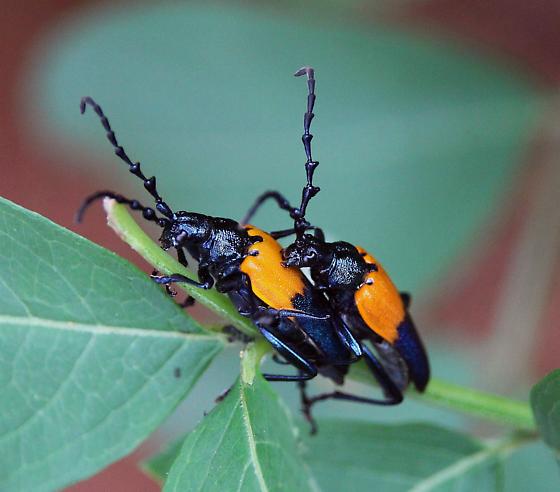
Mating pair of Desmocerus palliatus, on elderberry in Franklin County, Missouri.
Image from BugGuide, credit: James Trager, Missouri

I think that most could agree that Desmocerus palliatus is one of the finest U.S. cerambycids and while not necessarily uncommon, it is just elusive enough to make every encounter a pleasant experience. And I guess that’s reason enough to consider it my favorite – at that moment, in that place…

Bob Androw is Collection Manager of Invertebrate Zoology at Carnegie Museum of Natural History.

Related Content

The BSF – Leveraging Our Collections and Expertise to Help Fight Invasive Species

So, Just What is a Wheel Bug?

Do No Harm: Dealing with Spotted Lanternflies

Carnegie Museum of Natural History Blog Citation Information

Blog author: Androw, Bob
Publication date: May 18, 2023

Share this post!

  • Share on Twitter Share on Twitter
  • Share on Facebook Share on Facebook
  • Share on Pinterest Share on Pinterest
  • Share on LinkedIn Share on LinkedIn
  • Share on Reddit Share on Reddit
  • Share via Email Share via Email

Filed Under: Blog Tagged With: Bob Androw, Bug Hall, Invertebrate Zoology, Science News

  • « Go to Previous Page
  • Page 1
  • Interim pages omitted …
  • Page 8
  • Page 9
  • Page 10
  • Page 11
  • Page 12
  • Interim pages omitted …
  • Page 25
  • Go to Next Page »

sidebar

About

  • Mission & Commitments
  • Directors Team
  • Museum History

Get Involved

  • Volunteer
  • Membership
  • Carnegie Discoverers
  • Donate
  • Employment
  • Events

Bring a Group

  • Groups of 10 or More
  • Birthday Parties at the Museum
  • Field Trips

Powdermill

  • Powdermill Nature Reserve
  • Powdermill Field Trips
  • Powdermill Staff
  • Research at Powdermill

More Information

  • Image Permission Requests
  • Science Stories
  • Accessibility
  • Shopping Cart
  • Contact
  • Visitor Policies
Stay in the loop! Sign up for our newsletter(s).
One of the Four Carnegie Museums | © Carnegie Institute | Privacy Policy | Terms of Use | Accessibility
Rad works here logo