• Skip to primary navigation
  • Skip to main content
  • Skip to primary sidebar

Carnegie Museum of Natural History

One of the Four Carnegie Museums of Pittsburgh

  • Visit
    • Buy Tickets
    • Visitor Information
    • Exhibitions
    • Events
    • Dining at the Museum
    • Celebrate at the Museum
    • Powdermill Nature Reserve
    • Event Venue Rental
    • Gift Cards
  • Learn
    • Field Trips
    • Educator Information
    • Programs at the Museum
    • Bring the Museum to You
    • Guided Programs FAQ
    • Programs Online
    • Climate and Rural Systems Partnership
  • Research
    • Scientific Sections
    • Science Stories
    • Science Videos
    • Senior Science & Research Staff
    • Museum Library
    • Science Seminars
    • Scientific Publications
    • Specimen and Artifact Identification
  • About
    • Mission & Commitments
    • Directors Team
    • Museum History
  • Tickets
  • Give
  • Shop

wpengine

March 31, 2021 by wpengine

MESOZOIC MONTHLY: Volaticotherium

by Lindsay Kastroll

Once again, spring has sprung. Prepare to see the gorgeous forests of Pennsylvania launch back into action. I, for one, can’t wait to get outside and explore as the weather continues to improve. I was recently reminded of the fact that Pennsylvania is home to two species of flying squirrels, and I am definitely adding them to my list of things to see. But of course, this is Mesozoic Monthly, so flying squirrels can’t be the stars of this article. Instead, the superficially flying squirrel-like “ancient gliding beast” Volaticotherium antiquum is stealing the spotlight!

Although Volaticotherium was about the size of a modern flying squirrel at 5–6 inches (13–15 cm) long, it belonged to a group of early mammals called eutriconodonts that includes some of the largest mammals that lived alongside non-avian dinosaurs. “Eutriconodont” means “true three-coned tooth,” in reference to the three longitudinally aligned cusps on their molars. Although not all mammals today have three-cusped molars, the ancestors of modern mammals did. Does this mean that modern mammals evolved from a eutriconodont? The answer is no, though they did evolve from a mammal with eutriconodont-like teeth.

We can split modern mammals into two main groups: the monotremes, which are egg-laying mammals like the platypus, and the therians, which include both marsupial and placental mammals (like kangaroos or humans, respectively). The ancestors of monotremes diverged (meaning, formed their own ‘branch’ of the evolutionary tree) before eutriconodonts and therians evolved. Eutriconodonts and therians share a different, more recent, and as-yet unknown common ancestor. Monotremes, therians, and eutriconodonts actually lived alongside one another for over one hundred million years before eutriconodonts became extinct near the end of the Cretaceous Period (the third and final division in the Mesozoic Era, or ‘Age of Dinosaurs’).
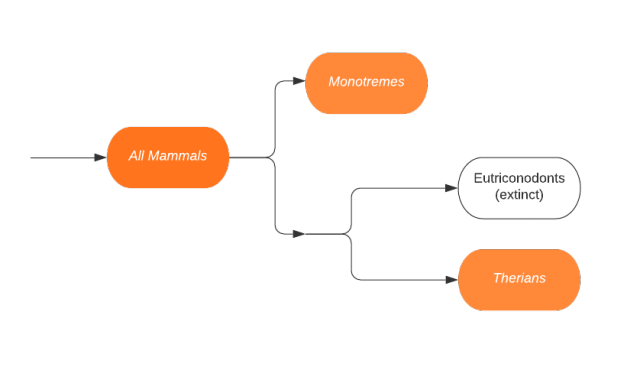
 

This flowchart represents a simplified phylogeny (aka, evolutionary tree) of the relationships discussed in the previous paragraph. A lot of ‘branches’ and intermediate steps are missing from this phylogeny to make it easier to follow.

The canines and molars of eutriconodonts were pointy, suggesting that these mammals were carnivores or insectivores. Volaticotherium is no exception, which makes it particularly unique, as most other gliding mammals are herbivores! Because it was so small, Volaticotherium was probably an insectivore, but a larger cousin, Jugulator, could probably eat small vertebrates. As an arboreal glider, Volaticotherium could soar from tree to tree to catch insects in midair. Instead of wings, it had a patagium, a broad flap of skin that stretched between the fore- and hind limbs, creating enough surface area to achieve gliding descents. The various limb adaptations necessary to make Volaticotherium an efficient glider also made it poor at maneuvering on the ground. It can be hard to understand why an animal would evolve features that would hinder its terrestrial movement, and multiple hypotheses have been put forth to try to explain this. Most of these focus on the benefits of leaping out of trees to escape predators or to quickly traverse territory between arboreal food sources, scenarios based on herbivorous mammals. Because Volaticotherium was a gliding predator, perhaps gliding conferred other advantages to this eutriconodont.
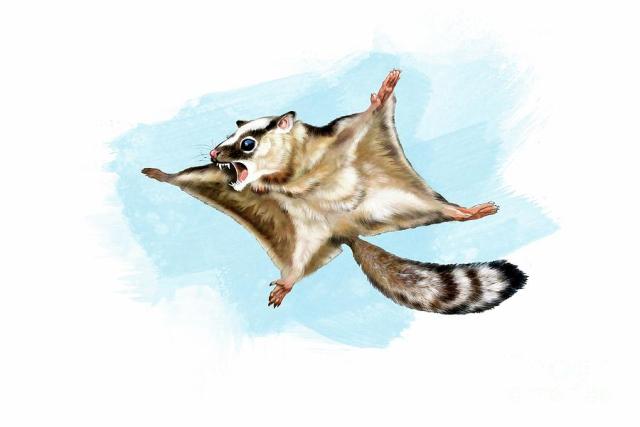
Restoration of Volaticotherium in mid-glide by Jose Antonio Peñas, used with permission. Take note of those sharp canine teeth, useful for catching tasty insects! You can find more of Peñas’ art on their DeviantArt, ArtStation, or YouTube.

The fossilized remains of Volaticotherium were found in a layer of rock called the Daohugou Bed in China. This deposit consists of lakebed sediment and volcanic ash compacted into solid rock over millions of years as more heavy sediment was deposited on top of it. There is a debate about how old the Daohugou Bed is, but most estimates place it near the middle or end of the Jurassic Period (the middle period of the Mesozoic). Getting the timing right is important. Because Volaticotherium is among the oldest known gliding mammals, its discovery pushes the origin of mammalian gliding back as much as 70 million years earlier than previously thought!

A variety of factors have led geologists to struggle in determining the age of the Daohugou Bed. In an ideal geologic record, rock layers would be perfectly horizontal, creating a continuous stack with the oldest layers on the bottom and the newest layers on top. However, this is rarely the case. Sediment may be eroded before new layers are deposited, creating a gap of time without record in that sequence of rocks. This phenomenon, where two rock layers do not represent a continuous progression of time and have a gap of data missing between them, is called an unconformity. Other issues with dating rock layers involve the squeezing, stretching, folding, melting, and chemical alteration of rock layers when they’re subjected to geologic processes. These forces can result in old rock layers being placed on top of younger ones, making it hard to determine the actual sequential order of the rocks. Changes can also occur within the minerals that compose the rocks, making radiometric dating much more difficult.

The Daohugou Bed has an unconformity above and below it, and it has been folded, which makes attributing an exact age to it that much harder. When you go out hiking in the beautiful spring weather on the horizon, take a moment to look at the rock outcrops you pass and think about what those layers might have experienced on their journey to where they are today. And if you continue your hike after sunset, be sure to keep your eyes peeled. If you’re lucky, you might just catch a glimpse of a flying squirrel gliding through the forest!

Lindsay Kastroll is a volunteer and paleontology student working in the Section of Vertebrate Paleontology at Carnegie Museum of Natural History. Museum staff, volunteers, and interns are encouraged to blog about their unique experiences and knowledge gained from working at the museum.

Related Content

Mesozoic Monthly: Nasutoceratops

Researchers Announce Surprising Clue in the Evolution of the Mammalian Middle Ear

Ah, Snap! Dino Named for Marvel’s Thanos

Carnegie Museum of Natural History Blog Citation Information

Blog author: Kastroll, Lindsay
Publication date: March 31, 2021
Share this post!

  • Share on Twitter Share on Twitter
  • Share on Facebook Share on Facebook
  • Share on Pinterest Share on Pinterest
  • Share on LinkedIn Share on LinkedIn
  • Share on Reddit Share on Reddit
  • Share via Email Share via Email

Share this post!

  • Share on Twitter Share on Twitter
  • Share on Facebook Share on Facebook
  • Share on Pinterest Share on Pinterest
  • Share on LinkedIn Share on LinkedIn
  • Share on Reddit Share on Reddit
  • Share via Email Share via Email

Filed Under: Blog Tagged With: dinosaurs in their time, Lindsay Kastroll, Science News, Vertebrate Paleontology

March 29, 2021 by wpengine

The Hunt Is On! Eggs-traordinary Animals That Hide Their Eggs

by Shelby Wyzykowski

Just once every year, an eggs-tra special day rolls around when a certain long-eared, fluffy-tailed fellow comes hopping down the bunny trail to your home. He brings with him all of the egg-ceptionally tasty springtime goodies that he knows will satisfy your sweet tooth. Your basket gets filled to the brim with chocolate rabbits, pastel-colored confections, and chick-shaped marshmallows, just to name a few delectable treats. It’s a holiday candy lover’s dream! But then you may just notice one thing that’s missing…where are all the eggs? No, the Easter Bunny didn’t forget them. He’s giving you a bit of a challenge this year. He’s remembered an old German tradition that started hundreds of years ago. It was so long ago that he had a different name…Osterhase! Osterhase would secretly lay eggs in the back garden so children could enjoy the outdoors and hunt for their Easter eggs. So, like long ago, you get to look outside (virtually) for eggs too! But as you search and discover egg after egg, little do you know that, beyond your garden, there are many more eggs concealed in secret spots. In fact, they’re all over the world…in mountain forests, on ocean shores, and in steamy swamps. But they’re not hidden by the Easter Bunny. All sorts of animals hide their eggs too! Let’s take some time to eggs-plore the planet and learn more about these eggs-traordinary creatures. Let’s go on an egg hunt!

First let’s search out West for the eggs of a plump, short-tailed bird called the American Dipper. They love to live in and around pristine mountain streams ranging from way up in Alaska and all the way down into Panama! That’s a lot of places for them to hide their eggs, so, for now, let’s just focus on one of the Dipper’s favorite spots in Montana’s Rocky Mountains. Dippers are the only songbirds in the United States that love to routinely swim. And they have several adaptations that make dunking and diving quite easy for them. At the base of their tails, they have what is called a uropygial (oil) gland. They use their beak to collect oil from this gland and, when they preen, it makes their feathers waterproof. They also have nictitating membranes (extra eyelids) and flaps of skin covering their nostrils that protect their eyes and beak when they’re submerged.

But all these swim-friendly features can also help immensely when Dippers nest. To keep their eggs safe from predators, they sometimes build their nests in hard-to-reach spots like cliff ledges, on boulders, and under bridges. But there is one very special, watery way that Dippers like to raise their chicks…behind waterfalls! It can get wet if you live behind a waterfall, so a Dipper nest is specially designed to withstand such damp conditions. The dome-shaped nest is about the size of a soccer ball and has multiple layers of moss, bark, leaves, and coarse grass. The thick, outside shell of moss absorbs moisture so the inside, lined with grass, stays cozy and dry. After around two weeks of incubation, the clutch of four to five eggs hatch. Mom spends a lot of time on the nest, but both parents feed the sparsely-downed chicks up to twenty times an hour! They must fly back and forth through the veil of falling water to get to and from their hungry babies.

After a little over three weeks, the fledgling Dippers are old enough to leave the nest. So, they must bravely make their first trip through the curtain of cascading water. Then they watch and learn from their parents how to wade, swim, and dive in the stream to hunt for food. Sadly, the Dipper’s preferred meals (crayfish, tadpoles, fish eggs, and aquatic insects) become scarce when streams are tainted by humans. Poor practices in logging, mining, and farming can cause these birds to abandon polluted areas. Luckily, for now, they do manage to find new locations with clean, cold, rushing water that they can happily call home.

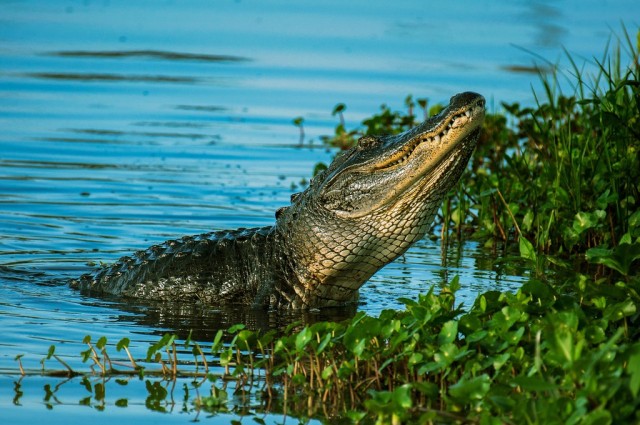
Now let’s travel a few states over to Florida, one of several Southern states where the American Alligator glides through the waters of slow-moving rivers, lakes, and sweltering marshes. In June and July, the female alligator creates a huge nest out of mud, plants, and sticks. It can be up to two to three feet high and as wide as seven to ten feet! The nest needs to be this big because the mother alligator lays as many as thirty-five to ninety eggs. Once the nest is filled with eggs, she completely covers them up with more vegetation. As the eggs rest hidden and undisturbed for several weeks, an interesting process occurs within the massive mound.

alligator in the water
Photo credit: Rene Ferrer from Pexels.

Alligator embryos do not have chromosomes that determine gender, so the temperature of the nest determines how many of the young are girls and how many are boys. If, for example, the nest is located on a sunny riverbank (somewhere around 91 to 93 degrees Fahrenheit), the offspring are mostly male. The temperature of a nest in a cool, shady spot might hover around 86 degrees, and that environment produces mostly females. Around the end of August, the baby gators, still safe in their eggs, start making high-pitched noises. This lets their mom know that they’re ready to break out. She uncovers the nest for them to hatch. When the hatchlings are tiny, they hang out in a small group called a “pod”, but mom is always close by keeping a watchful eye on them. Unfortunately, climate change is beginning to affect the behavior of temperature-dependent species like the alligator. They are beginning to nest earlier and earlier in the year to preserve the correct male to female ratio. The alligators instinctively know that they need to keep a gender balance to allow their species to successfully thrive!

Our last stop covers a wide area, so get ready for the toughest challenge of our hunt! We’re going to search for the eggs of the Loggerhead Turtle. They like to swim in the Atlantic, Pacific, and Indian Oceans, and the Mediterranean Sea. But between late April and early September, the females leave their aquatic homes to nest on the beaches where they themselves hatched decades earlier. Safely under the cover of darkness, a female Loggerhead will use her powerful rear flippers to dig a hole in the sand. After she lays around one hundred eggs, she once again uses her flippers to expertly cover up her eggs. She does such a thorough job that she erases any sign of her nest…it’s a safe and cozy hiding place for her eggs! They need to be well-hidden because the mother Loggerhead does not watch over her nest. Instead, she returns to the sea, leaving the concealed eggs to develop on their own.

Like alligators, the gender of sea turtle embryos is temperature dependent. A nest in warmer sand produces more females (this biological fact concerns marine scientists because global warming will disrupt the proper male to female ratio). After about two months of incubation, the baby turtles hatch and wait for nightfall. Then in a joint effort, they all climb out of the nest together and make a mad dash for the ocean waves. But their journey is fraught with danger.

Predators such as birds, crabs, dogs, and even raccoons are anxiously waiting to make these little turtles into scrumptious evening snacks. And the hatchlings have another, more insidious hazard to deal with…artificial light. To reach the ocean, the hatchlings use the natural light (the moon and stars) horizon to guide them. But beachfront lighting, highway lights, and campfires can disorient them and lead them in the wrong direction. It’s true that the odds are stacked against them, and even though it’s a treacherous trek to the water’s edge, many do make it. And then the real adventure begins for these little ones in their new ocean home!

Now that we’ve finished our egg hunting eggs-pedition, and you’ve fervently feasted on your Easter treats, your once-filled basket contains only some crumpled foil, a clump of Easter grass, and one squashed jelly bean. And, unfortunately, the only thing that you’ve got plenty of are the pangs of an eggs-cruciating stomachache. But while you’re laying back in your favorite comfy chair recovering from the day’s egg-citement, think about all those creatures out there in the world that work so hard to hide their eggs in the most interesting of places. And that leads you to wondering that maybe, just maybe, there might be one more egg still hidden in your garden. It might be hiding behind the daffodils or under the old wheelbarrow or in the tulip bed. And when you feel better, and you go back outside and find that last egg, it seems to me that would be an egg-cellent way to end an eggs-tra special day.

four painted eggs on a white background

Shelby Wyzykowski is a Gallery Experience Presenter in CMNH’s Life Long Learning Department. Museum staff, volunteers, and interns are encouraged to blog about their unique experiences and knowledge gained from working at the museum.

Related Content

Egg Hunt Coloring Pages

Spring-o Bingo

Spring Birds in Your Backyard

Carnegie Museum of Natural History Blog Citation Information

Blog author: Wyzykowski, Shelby
Publication date: March 29, 2021

Share this post!

  • Share on Twitter Share on Twitter
  • Share on Facebook Share on Facebook
  • Share on Pinterest Share on Pinterest
  • Share on LinkedIn Share on LinkedIn
  • Share on Reddit Share on Reddit
  • Share via Email Share via Email

Share this post!

  • Share on Twitter Share on Twitter
  • Share on Facebook Share on Facebook
  • Share on Pinterest Share on Pinterest
  • Share on LinkedIn Share on LinkedIn
  • Share on Reddit Share on Reddit
  • Share via Email Share via Email

Filed Under: Blog, Super Science Saturday Tagged With: sssegghunt

March 25, 2021 by wpengine

Carnegie’s Cactus: Carnegie gigantea

by Patrick McShea

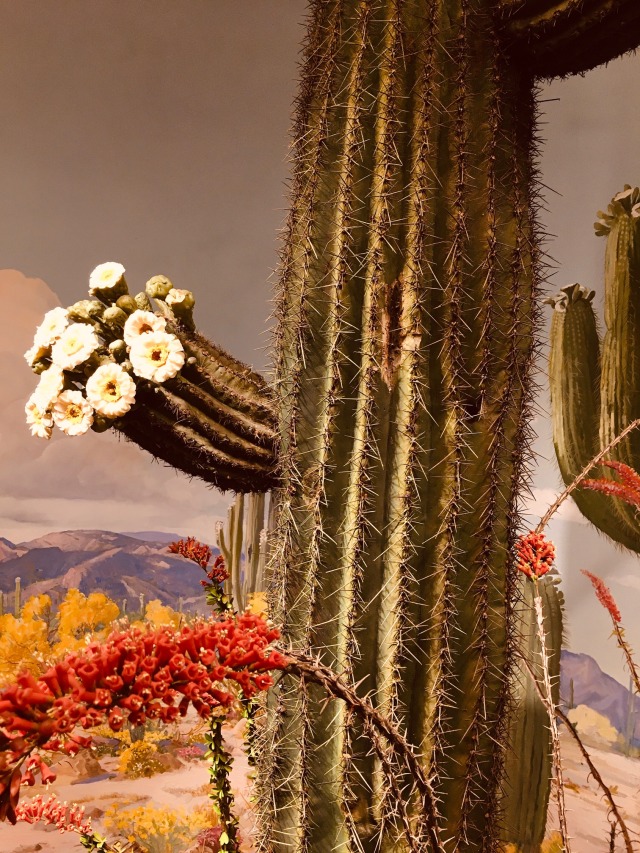
Diplodocus carnegii, a sauropod star of Dinosaurs in Their Time, is not the only large organism exhibited at Carnegie Museum of Natural History that bears the founder’s name. Within the Hall of Botany, the tree-sized saguaro cactus whose prickly form visually anchors the Sonoran Desert diorama is a species know to science as Carnegie gigantea.

Carnegie gigantea
A blooming saguaro in a diorama depicting the Sonoran Desert of southern Arizona.

The name honors Andrew Carnegie’s support, through the Carnegie Institution, for the 1903 establishment of the Desert Botanical Laboratory in Tucson, Arizona. This groundbreaking research facility, which enabled long-term studies of desert plant adaptations, was sold to the U.S. Forest Service in 1940, and later was purchased by the University of Arizona in 1956.

Today the facility is known simply as the Desert Laboratory, and visitors to its website find an immediate reference to its location on Tumamoc Hill, a site of cultural and spiritual significance to the Tohono O’odham and other Native peoples. A mission statement follows, clarifying the expanded scope of the Laboratory’s work:

The role of the Desert Laboratory is to build on the complementary strengths of culture, science, and community rooted at Tumamoc Hill and the larger Sonoran Desert to become an integrative hub of novel research, education, and outreach about how linked human and natural systems face the future of life in the desert.

Ongoing studies of the Desert Laboratory’s 5,800 saguaros fit perfectly into this mission because of the plant’s importance to the region’s Native peoples for thousands of years.

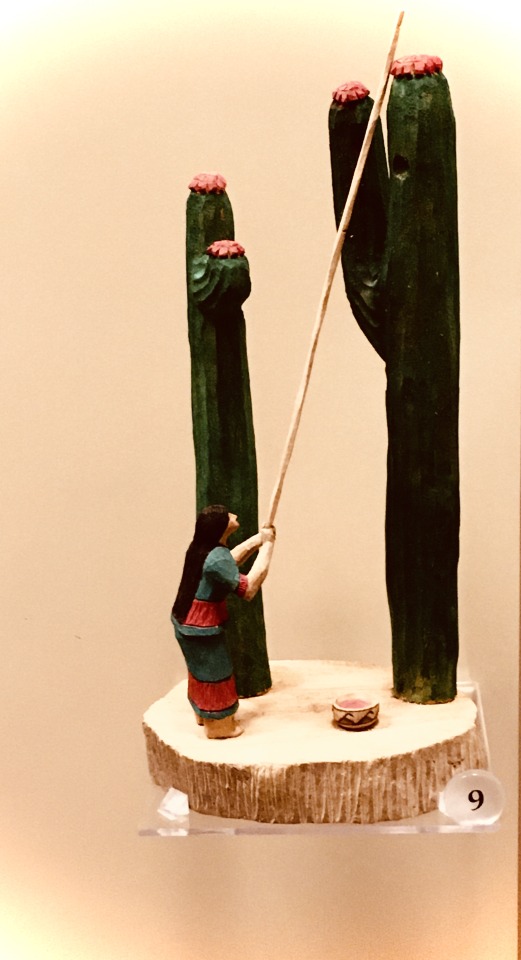
A carving depicting the saguaro harvest.

In Pittsburgh, museum visitors can learn something about the ancient connection between people and the iconic cactus by following a Hall of Botany stop with one in the Alcoa Foundation Hall of American Indians. Here, near the middle of the exhibition’s central corridor, a series of displays exploring use of plants by Native peoples includes a carving by artist Danny Flores (Tohono O’odham) that depicts the traditional harvest of saguaro fruit by Tohono O’odham women.

Consider the walk between the blooming life-sized saguaro in the Sonoran Desert diorama and the tiny carved replica to represent a spring-into-summer transition when white cactus blossoms, pollinated by bird, bat, or insect, transform into ripening red fruit.

A text panel near the model explains how gathered fruit is boiled to create a syrup which is then fermented into wine used in rituals invoking the summer rains to begin. The label also identifies the source of the specialized harvesting tool, an implement as long as a saguaro is tall. The pole is a saguaro rib, a part of the wood skeleton that once helped to hold a massive cactus upright.

Patrick McShea works in the Education and Visitor Experience department of Carnegie Museum of Natural History. Museum employees are encouraged to blog about their unique experiences and knowledge gained from working at the museum.

Related Content

Cactuses, and the Spine of Appalachia

Plant Blindness

Groundhog Architecture

Carnegie Museum of Natural History Blog Citation Information

Blog author: McShea, Patrick
Publication date: March 25, 2021

Share this post!

  • Share on Twitter Share on Twitter
  • Share on Facebook Share on Facebook
  • Share on Pinterest Share on Pinterest
  • Share on LinkedIn Share on LinkedIn
  • Share on Reddit Share on Reddit
  • Share via Email Share via Email

Share this post!

  • Share on Twitter Share on Twitter
  • Share on Facebook Share on Facebook
  • Share on Pinterest Share on Pinterest
  • Share on LinkedIn Share on LinkedIn
  • Share on Reddit Share on Reddit
  • Share via Email Share via Email

Filed Under: Blog Tagged With: Andrew Carnegie, botany hall, Educators, Museum from Home, Pat McShea

March 24, 2021 by wpengine

Spring Birds in Your Backyard

by Annie Lindsay

On spring mornings that I’m not banding birds, I like to sit on my back porch with my binoculars, watching for movement at the edge of the woods behind my house, keeping my ears tuned in to songs and short, usually high-pitched, chip and contact notes. On mornings following a night of heavy migration, small flocks of mixed species often move through the trees, feeding on insects as they refuel for the next stage of migration. These flocks often have warblers, thrushes, tanagers, grosbeaks, or sparrows foraging in their own niches: warblers tend to be in mid- to high-canopy, whereas thrushes stay low and sparrows are often on the ground.

Occasionally, I’ll stand outside in a quiet, dark spot just before dawn and listen for the soft, high-pitched flight calls of migrants settling into habitat after a night of flying. I’m an avid birder: I love to see both new and familiar birds, and watch the species that use my yard and favorite birding patches.

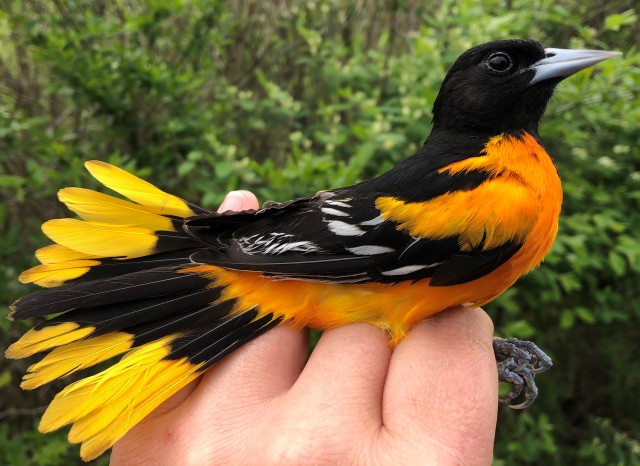
Baltimore Orioles arrive in southwest PA by mid-to late-April. Providing fresh orange halves on spikes can bring them to your feeders from spring through fall migration.

Last year, many people discovered birding. We spent much of the spring working from home, perhaps gazing out of our windows at our bird feeders or backyard plants, and for the first time noticed birds that we didn’t know existed or didn’t realize visited our yards. The opportunity to learn about the diversity of birds in our area and develop a passion for watching them was a bright spot (both literally and metaphorically!) in an otherwise difficult year. The seasons progressed, and now we once again eagerly anticipate the arrival of beautiful and colorful migratory songbirds. Let’s explore common spring backyard birds in southwest Pennsylvania and how to attract and find them!

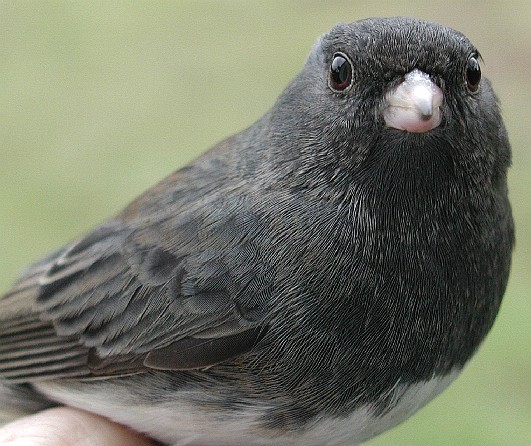
Dark-eyed Juncos are a species we usually associate with winter in southwest PA. They start singing in March, then do an elevational migration up the nearby mountains.

Each year, as the temperature warms, migratory birds move through our area in search of their breeding grounds. Although arrival timing is a bit variable between years due to annual variation in weather patterns, there is a predictable progression of species, so we know what to expect next relative to what we’ve already seen. The first, and often most conspicuous, to arrive are Red-winged Blackbirds and Common Grackles, usually in late February. They are followed by “peenting” American Woodcocks in early March, Eastern Phoebes in mid-March, and kinglets peaking in late-March. Keep your eyes to the sky any time you’re outdoors during these early spring weeks to watch for migrating waterfowl and raptors.

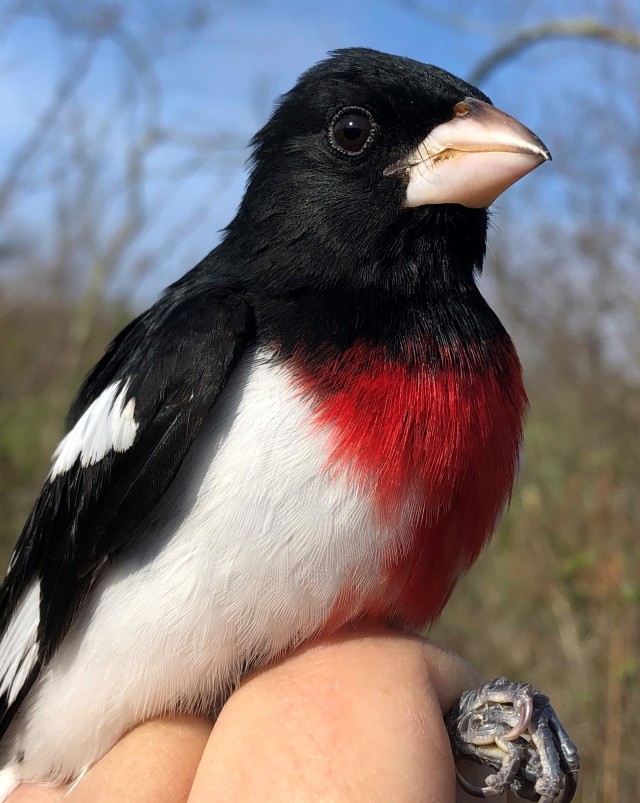
Rose-breasted Grosbeaks readily visit feeders with black oil sunflower seeds or safflower seeds usually in early- to mid-May before moving off into the forest to set up breeding territories.

By April, more songbirds, including vireos, swallows, early warblers, Blue-gray Gnatcatcher (a tiny bird with a wheezy song), House Wren, and the fan favorite, Gray Catbird make their way through our region, many remaining here to set up their breeding territories. In May, the migration floodgates open and some of the most brilliantly plumaged birds we’ve ever seen, like Baltimore Oriole, Rose-breasted Grosbeak, Ruby-throated Hummingbird, Scarlet Tanager, Indigo Bunting, and several warblers, may visit our yards and feeders, along with the less flashy, but equally beautiful, sparrows and thrushes.

Orioles readily come to feeders with orange halves, especially during migration, and seed-eating species like grosbeaks, buntings, and sparrows often visit feeders with sunflower or other seeds (or, in the case of many sparrows, clean up seeds on the ground under feeders!). Hummingbirds come to feeders with nectar (four parts water to one part white sugar, please avoid using food dyes or commercial nectar that has been dyed red). Most of these species are insectivorous, especially during spring migration, and are often observed picking things like caterpillars, midges, and spiders from foliage.

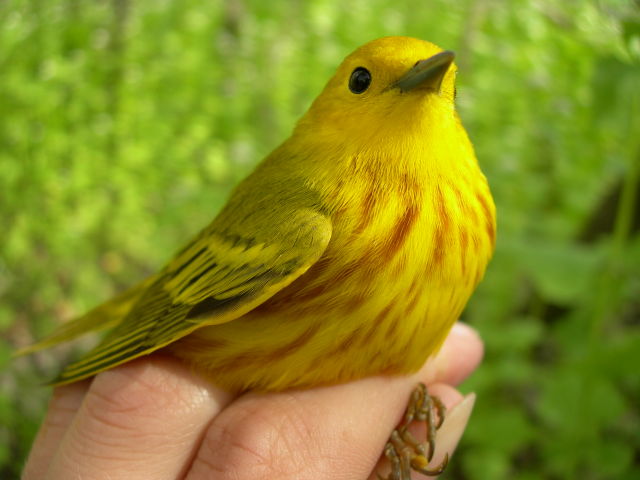
Yellow Warblers are often recognized by their signature “sweet sweet I’m so sweet!” song. You may see them flitting through small woody plants like dogwoods as they forage for caterpillars.

In addition to the migratory species that we see and hear in the spring, many birds that are year-round residents also frequent our yards. Black-capped and Carolina Chickadees, Tufted Titmice, White-breasted Nuthatches, Carolina Wrens, five species of woodpeckers (Downy, Hairy, Red-bellied, Pileated, and Northern Flicker, plus two more if we’re lucky – Red-headed Woodpecker and Yellow-bellied Sapsucker), and the colorful American Goldfinch, Northern Cardinal, and Eastern Bluebird mix with migratory birds. Most of these species visit bird feeders filled with sunflower or safflower seeds (chickadees, titmice, cardinals, nuthatches, woodpeckers), suet (woodpeckers, wrens), nyjer seed (finches), and mealworms (bluebirds, titmice, chickadees).

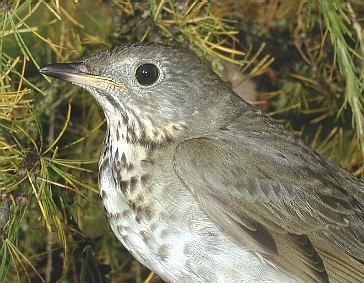
Gray-cheeked Thrushes are cryptic and secretive, but can be found skulking on the forest floor in mid- to late-May before they continue northward migration. They have a beautiful, flutey song and a distinctive call note.

One of the best ways to attract birds to your yard is planting native trees, shrubs, wildflowers, and other plants. Native plants are hosts for a high diversity of insects, especially during their larval stages, and provide nutritious seeds and fruit, all of which are important food resources for birds. These plants are also valuable as cover for safety and nest sites. Although often overlooked, a source of clean, fresh water, as simple as a bird bath or as complex as a pond with a bubbler or waterfall, can make your yard especially attractive to birds. And one of the easiest and most popular ways to attract birds for close viewing is providing bird food in clean, safe feeders. I recommend visiting your local bird feeding specialty store.

You may see all of the birds mentioned in this blog in your yard, but this is a non-exhaustive list and you may even see something unexpected. Visiting a local birding hotspot with complex and diverse habitats is certainly worth the effort as well. Birding these spots several times throughout the season will reward you with an impressive list and will boost your knowledge of natural history. The combination of a good pair of binoculars and a field guide with identification tips, range maps, and text about habitat is one of the best ways to maximize your birding, whether at home or in the field.

Please visit CMNH’s blog page to find bird ID tips and field guide recommendations.

The Audubon Society put together a great guide to the best binoculars at various price ranges.

You can put your bird observation skills to good use (or further develop those skills) by participating this spring in a broad survey of local wildlife and plants called the City Nature Challenge. The observation portion of this event is April 30 – May 3.

Annie Lindsay is the Bird Banding Program Manager at Carnegie Museum of Natural History’s Powdermill Nature Reserve. Museum employees are encouraged to blog about their unique experiences and knowledge gained from working at the museum.

Related Content

The Christmas Bird Count During an Irruption Year

Wind and Migration

Bird Banding with a Crew of One

Carnegie Museum of Natural History Blog Citation Information

Blog author: Lindsay, Annie
Publication date: March 24, 2021

Share this post!

  • Share on Twitter Share on Twitter
  • Share on Facebook Share on Facebook
  • Share on Pinterest Share on Pinterest
  • Share on LinkedIn Share on LinkedIn
  • Share on Reddit Share on Reddit
  • Share via Email Share via Email

Share this post!

  • Share on Twitter Share on Twitter
  • Share on Facebook Share on Facebook
  • Share on Pinterest Share on Pinterest
  • Share on LinkedIn Share on LinkedIn
  • Share on Reddit Share on Reddit
  • Share via Email Share via Email

Filed Under: Blog Tagged With: Annie Lindsay, Birds, City Nature Challenge, Powdermill Nature Reserve, Science News

March 18, 2021 by wpengine

Center Court Culture Sharing

by Patrick McShea

In the final hour of a Saturday-long visit to the museum by a Kent State University class, a student who played high school basketball volunteered to read aloud to nine college classmates. “With that experience you’ll do a great job,” I explained as I handed her a paper bearing a single long paragraph, and then directed her toward a quiet corner of the exhibit hall to a practice the assignment.

While the majority of the 40-student class opted to spend the unscheduled block of time exploring the exhibits and visiting the museum shop, ten students had accepted my offer to guide them on a tour of the Alcoa Foundation Hall of American Indians.

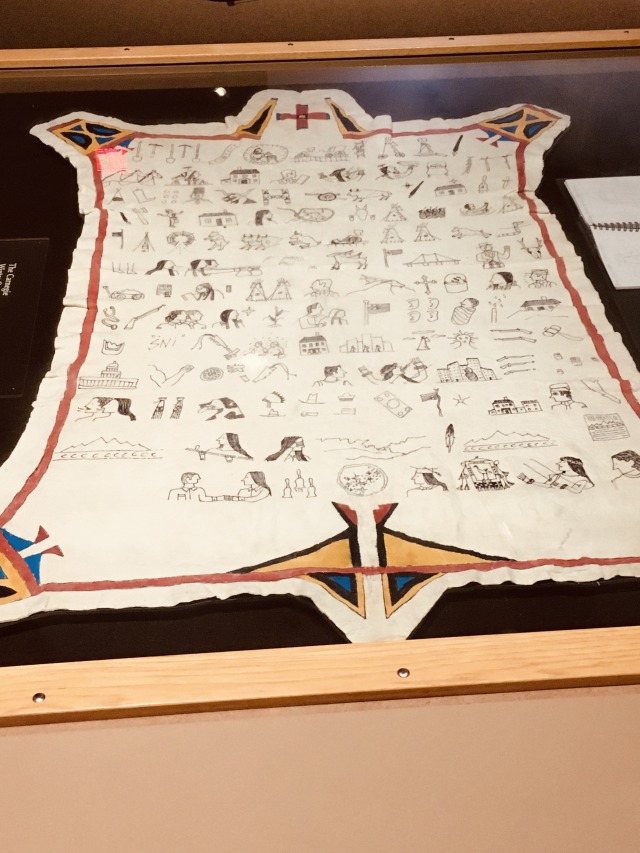
The now 23-year-old exhibition is divided into quadrants with a different culture presented as a focal point in each, the Tlingit of the Northwest Coast, the Hopi of the Southwest, the Iroquois Nations of the Northeast, and the Lakota and their neighbors of the Great Plains. The twin themes of Native diversity and the continued vibrancy of Native cultures are repeatedly addressed in the hall’s displays. When I paused the group at the Lakota Winter Count display, and recruited the volunteer reader, I hoped to delve a little deeper into both themes.

photograph of a winter count on display in the museum

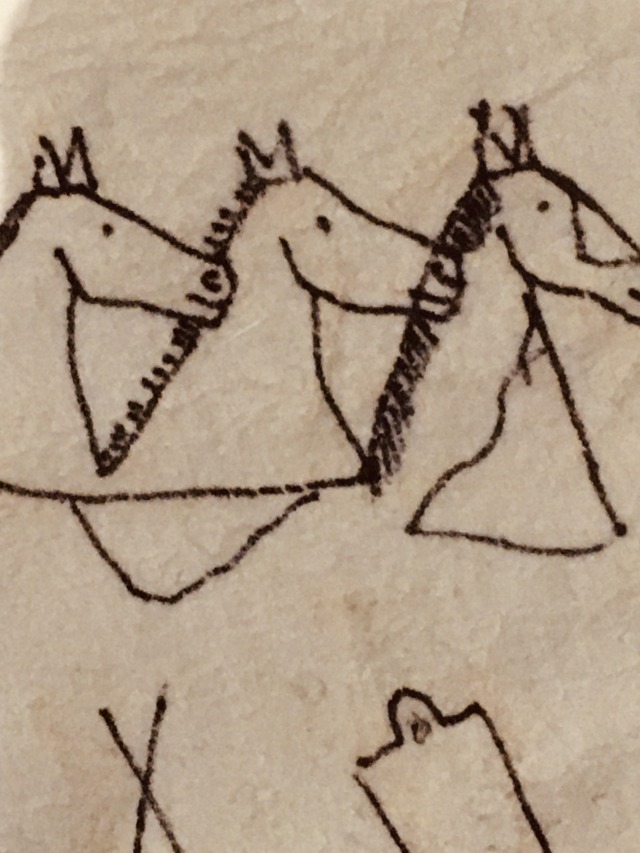
Winter counts are a method by which groups of Lakota People record and remember their history through pictographs on a tanned animal hide or sturdy cloth. Each year, after leaders review important events and agree upon the previous year’s most significant occurrence, a new entry is added to the unique document. A designated count keeper holds the responsibility to annually recite, in sequence, the story behind each pictograph, and thereby orally pass along the group’s history to a listening audience.

The Winter Count on display, which covers a period of 125 years for the Sicangu Lakota people on the Rosebud Reservation in South Dakota, was created specifically for the exhibit by Dr. Thomas Red Owl Haukaas (Lakota/Creole). After summarizing the importance of winter counts for the students, I read aloud the artist’s explanation of his work from a nearby label: “My winter count is from a contemporary viewpoint. It purposely includes community and national events, men and women, fullbloods, and mixedbloods as an attempt to capture the richness and complexity of our tribe.”

close up of winter count showing animals drawn in black on off-white background

The mention of contemporary viewpoint provided the opportunity to introduce another, albeit non-Native one, author Ian Frazier’s description of high school basketball star SuAnne Big Crow in On the Rez, his 2001 account of life on the Pine Ridge American Indian Reservation.

I called back the volunteer reader and provided background for the description of an event that might be judged worthy of winter count commemoration. “The quote you’re about to hear is pulled from a considerably longer story. It describes how in 1988, SuAnne Big Crow, who was then a 14-year-old basketball player from the Pine Ridge Reservation, transformed the racially charged playoff game atmosphere during pre-game warm-ups at a school in Lead, South Dakota, a white town located outside the reservation. Her actions were brave, clever, defiant, desperate, and heroic – all at the same time.”

“Swish!” by Targuman is licensed under CC BY-NC-ND 2.0.

As someone who experienced the intimidating atmosphere of away basketball games, the volunteer brought an authentic voice to her task, confidently reading Frazier’s account of SuAnne dribbling as she led her team onto the court of the “deafeningly loud” high school gym. Her voice shifted to a slightly higher register, however, when the narrative departed from normal pre-game procedure.

Then she stepped into the jump-ball circle at center court, in front of the Lead fans. She unbuttoned her warm-up jacket, took it off, draped it over her shoulders, and began to do the Lakota shawl dance. SuAnne knew all the traditional dances – she had competed in many powwows as a little girl – and the dance she chose is a young woman’s dance, graceful and modest and show-offy all at the same time.

The reader’s calmer voice returned where the account quoted the impressions of SuAnne’s surprised teammates, then turned higher as the action continued.

SuAnne began to sing in Lakota, swaying back and forth in the jump-ball circle, doing the shawl dance, using her warm-up jacket for a shawl. The crowd went completely silent. ‘All that stuff the Lead fans were yelling – it was like she reversed it somehow,’ a teammate said. In the sudden quiet, all you could hear was her Lakota song. SuAnne stood up, dropped her jacket, took the ball from Doni De Cory, and ran a lap around the court dribbling expertly and fast. The fans began to cheer and applaud. She sprinted to the basket, went up in the air, and laid the ball through the hoop, with the fans cheering loudly now. Of course, Pine Ridge went on to win the game.

The reader earned a sincere round of applause from her classmates for her efforts. I, in turn, felt a rewarding sense of accomplishment when she asked to keep the now deeply creased paper in her hands.

Patrick McShea works in the Education and Visitor Experience department of Carnegie Museum of Natural History. Museum employees are encouraged to blog about their unique experiences and knowledge gained from working at the museum.

Related Content

Museum Conservation: Cleaning the Kayak in Wyckoff Hall

A Steeler Prayer

Winter Wanderers on a Water Tower

Carnegie Museum of Natural History Blog Citation Information

Blog author: McShea, Patrick
Publication date: March 18, 2021

Share this post!

  • Share on Twitter Share on Twitter
  • Share on Facebook Share on Facebook
  • Share on Pinterest Share on Pinterest
  • Share on LinkedIn Share on LinkedIn
  • Share on Reddit Share on Reddit
  • Share via Email Share via Email

Share this post!

  • Share on Twitter Share on Twitter
  • Share on Facebook Share on Facebook
  • Share on Pinterest Share on Pinterest
  • Share on LinkedIn Share on LinkedIn
  • Share on Reddit Share on Reddit
  • Share via Email Share via Email

Filed Under: Blog Tagged With: Alcoa Foundation Hall of American Indians, anthropology, Pat McShea

March 15, 2021 by wpengine

Collected on this Day in 1957

Spring at Powdermill.

An early bloomer.

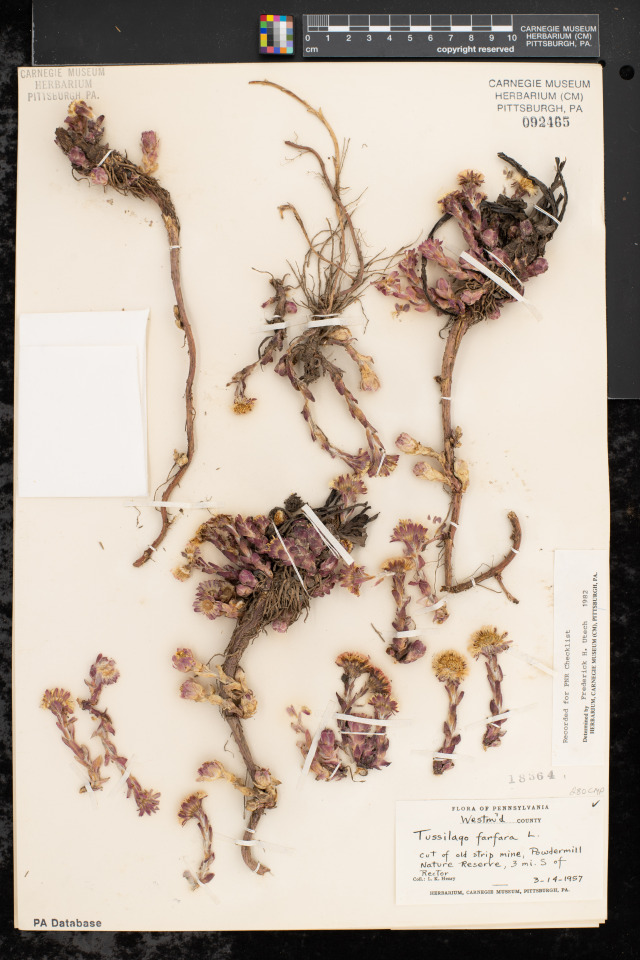
dried specimen of coltsfoot on an herbarium sheet

This specimen of coltsfoot (Tussilago farfara) was collected at Powdermill Nature Reserve, the field station of Carnegie Museum of Natural History in 1957, just one year after the facility was established. It was collected by Leroy Henry, a Curator of Botany at the museum from 1937 until 1972 (though he was also affiliated with the museum before and after this period). Henry is an important collector for our region, with >36,000 specimens in the Carnegie Museum herbarium.

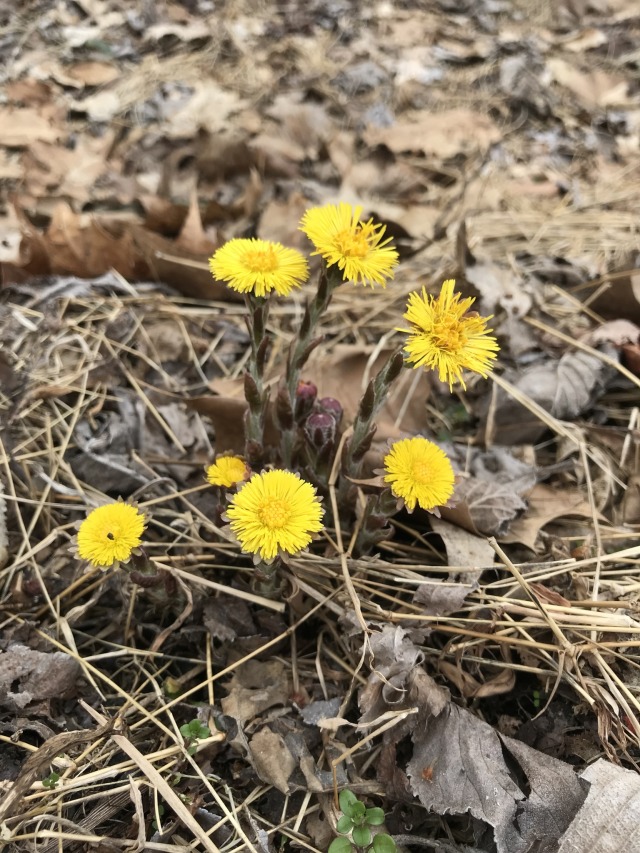
coltsfoot flowering in spring

At first look, the plant may be confused with your common dandelion. It has definite similarities, as it is in the same plant family, Asteraceae, and bears yellow flowers. But, as you’ll notice from the specimen – flowering coltsfoot doesn’t have leaves!

Coltsfoot, which is native to Europe, was introduced to Pennsylvania, and is quite unique in our state’s flora. The plant blooms very early in the spring, with dandelion-like flowers frequently poking through the soil of otherwise barren slopes. The leaves soon follow, and they are shaped like – well – a colt’s foot! Quite different than the familiar serrated edge shape of dandelion leaves.

Coltsfoot’s early appearance also makes it a great species to track changes in bloom time using herbarium specimens. The species was among the first to be used in a pioneering study published in 2006 using herbarium specimens by Claud Lavoie and Daniel Lachance. In Southern Quebec, they found coltsfoot bloomed 15-31 days earlier in recent decades, compared to pre-1950. Earlier blooming was strongly linked to climate change in the region. The plants also showed a clear signal of flowering earlier in the city (due to a phenomenon known as urban heat island effect).

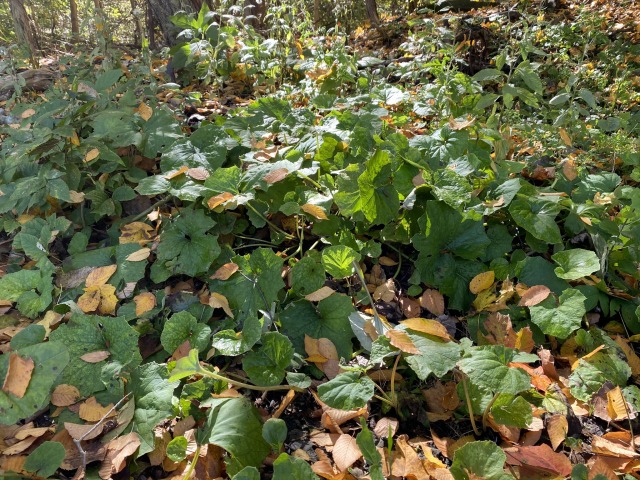
coltsfoot leaves in the fall

We have plenty of spring ephemerals that bloom early, but unlike these plants, coltsfoot doesn’t die off by summer. The plant keeps its leaves well after it blooms, into late fall.

This strategy is interesting, and I can’t think of many plants in our flora with similar growth patterns. Is the plant on to something?

Keep an eye out for coltsfoot, especially along wooded roadsides. Once you see a big bloom, check the same site later in the year. The leaves can grow to a surprisingly large size.

Find this specimen and more here.

Check back for more! Botanists at the Carnegie Museum of Natural History share digital specimens from the herbarium on dates they were collected. They are in the midst of a three-year project to digitize nearly 190,000 plant specimens collected in the region, making images and other data publicly available online. This effort is part of the Mid-Atlantic Megalopolis Project (mamdigitization.org), a network of thirteen herbaria spanning the densely populated urban corridor from Washington, D.C. to New York City to achieve a greater understanding of our urban areas, including the unique industrial and environmental history of the greater Pittsburgh region. This project is made possible by the National Science Foundation under grant no. 1801022.

Mason Heberling is Assistant Curator of Botany at Carnegie Museum of Natural History. Museum employees are encouraged to blog about their unique experiences and knowledge gained from working at the museum.

Related Content

Collected on this Day in 1998: Common chickweed

Spring is in the Air, Botanists are in the Field

Ask a Scientist: What is biogeochemistry? 

Carnegie Museum of Natural History Blog Citation Information

Blog author: Heberling, Mason
Publication date: March 14, 2021

Share this post!

  • Share on Twitter Share on Twitter
  • Share on Facebook Share on Facebook
  • Share on Pinterest Share on Pinterest
  • Share on LinkedIn Share on LinkedIn
  • Share on Reddit Share on Reddit
  • Share via Email Share via Email

Share this post!

  • Share on Twitter Share on Twitter
  • Share on Facebook Share on Facebook
  • Share on Pinterest Share on Pinterest
  • Share on LinkedIn Share on LinkedIn
  • Share on Reddit Share on Reddit
  • Share via Email Share via Email

Filed Under: Blog Tagged With: Botany, collected on this day, Mason Heberling, Science News

  • « Go to Previous Page
  • Page 1
  • Interim pages omitted …
  • Page 9
  • Page 10
  • Page 11
  • Page 12
  • Page 13
  • Interim pages omitted …
  • Page 206
  • Go to Next Page »

sidebar

About

  • Mission & Commitments
  • Directors Team
  • Museum History

Get Involved

  • Volunteer
  • Membership
  • Carnegie Discoverers
  • Donate
  • Employment
  • Events

Bring a Group

  • Groups of 10 or More
  • Birthday Parties at the Museum
  • Field Trips

Powdermill

  • Powdermill Nature Reserve
  • Powdermill Field Trips
  • Powdermill Staff
  • Research at Powdermill

More Information

  • Image Permission Requests
  • Science Stories
  • Accessibility
  • Shopping Cart
  • Contact
  • Visitor Policies
Stay in the loop! Sign up for our newsletter(s).
One of the Four Carnegie Museums | © Carnegie Institute | Privacy Policy | Terms of Use | Accessibility
Rad works here logo