• Skip to primary navigation
  • Skip to main content
  • Skip to primary sidebar

Carnegie Museum of Natural History

One of the Four Carnegie Museums of Pittsburgh

  • Visit
    • Buy Tickets
    • Visitor Information
    • Exhibitions
    • Events
    • Dining at the Museum
    • Celebrate at the Museum
    • Powdermill Nature Reserve
    • Event Venue Rental
  • Learn
    • Field Trips
    • Educator Information
    • Programs at the Museum
    • Bring the Museum to You
    • Guided Programs FAQ
    • Programs Online
    • Climate and Rural Systems Partnership
  • Research
    • Scientific Sections
    • Science Stories
    • Science Videos
    • Senior Science & Research Staff
    • Museum Library
    • Science Seminars
    • Scientific Publications
    • Specimen and Artifact Identification
  • About
    • Mission & Commitments
    • Directors Team
    • Museum History
  • Tickets
  • Give
  • Shop

wpengine

December 10, 2020 by wpengine

Staying Connected to Nature in the Winter Months

December brought in a thick blanket of snow, and Pittsburgh looked like a winter wonderland. As I write, from my chair looking out into the wonderland, I am reminded of the beauty that nature has to offer and the splendor of Pittsburgh’s seasonal climate. While all I want to do today is curl up with a good book next to a fire sipping a hot drink, I am aware that too much indoor time is not the best for my wellbeing as it can reinforce the “winter blues.”

I personally find that getting outdoors is the best way to re-center, reconnect, and restore my wellbeing. As described by Bratman et al. (2012), “for hundreds of years and across many cultures of the world, influential traditions in science, philosophy, poetry, and religion have emphasized the role that nature plays in providing feelings of wellbeing. In the modern era of scientific enterprise, a large body of work has demonstrated the importance of nature to human physical health, characterizing the numerous ways in which people depend on the natural environment for security in the supply of food, water, energy, climate stability, and other material ingredients of well-being.”

However, while beautiful, winter can make it difficult to get out and get reconnected with nature. So, how do I get out in nature during the winter months? Here are some tricks that I use to keep a hike comfortable during the colder months:

1.     Stay local! The days are short, and there are limited daylight hours – if you stay local, you get to make the most of the shorter days. Staying local also allows shorter outdoor time commitments if it’s too cold, too wet, or there’s just not enough time in the day.

2.     Layer up! We produce a lot of heat when we are active, and we might need to add or take away layers while outside. Layering up (or having layers available) allows us to maintain a more comfortable temperature while outdoors.

3.     Protect your feet! This is a big one for me. My feet’s comfort are my gauge for how long I can stay out. Good socks (or layered socks) with waterproof boots or shoes can really make an outdoor adventure in winter enjoyable. If you are really into the winter hiking, snow shoes or shoes with ice spikes might be necessary for the more adventurous types.

4.     Eat! Bring snacks and keep your metabolism going. Being outdoors in colder weather requires a lot of energy; so bring those snacks! Don’t be afraid of those Christmas cookies if you’re outside burning all those calories!

5.     Be Cautious! Do your homework on where you are going and bring a friend if possible. Knowing the terrain ahead of time and looking up the safest route(s) can help you make the most of your trip. Having someone with you is also important for both safety and overall enjoyment.

Sometimes, it’s just not possible to hike safely during the winter months. Poor road conditions can make hiking sites inaccessible, and extreme temperatures and weather can create hazards. Sometimes, you just don’t have the time, or you are feeling under the weather. Well, there are little ways that you can still reconnect with “nature” indoors. You can grow indoor plants, watch nature TV or programs, read about nature, or even paint/draw nature. Get creative on how you bring the outdoors inside.

If you are feeling the winter blues or you feel out of sorts – try reconnecting with nature. It could be the boost to your wellbeing that you need to get through the indoor season.

Heather Hulton VanTassel is Assistant Director of Science and Research at Carnegie Museum of Natural History. Museum employees are encouraged to blog about their unique experiences and knowledge gained from working at the museum.

Bratman et al. (2012). 118–136. New York Academy of Sciences. doi: 10.1111/j.1749-6632.2011.06400.x.
Related Content

Woodlands in White

What Do Bugs Do During the Winter?

Ask a Scientist: How do you find rare plants? 

Filed Under: Blog Tagged With: Heather Hulton VanTassel, Museum from Home, Science News

December 9, 2020 by wpengine

The Bromacker Fossil Project Part XII: Tambacarnifex unguifalcatus, the Tambach executioner

New to this series? Read The Bromacker Fossil Project Part I, Part II, Part III, Part IV, Part V, Part VI, Part VII, Part VIII, Part IX, Part X, and Part XI. 

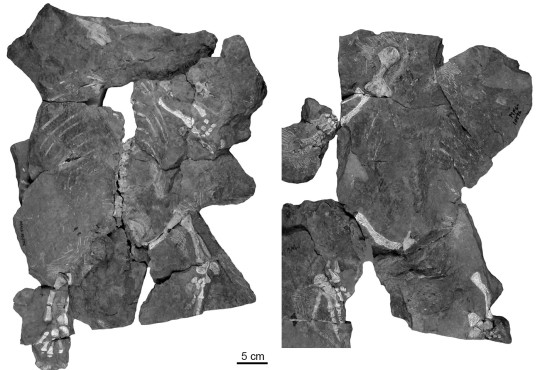
Holotype specimen of Tambacarnifex unguifalcatus, preserved in couterparts. Photographs by Dave Berman, 2010.

Tambacarnifex unguifalcatus was discovered by Thomas Martens and his father Max in 1995 in the same pocket of fossils from which the first-discovered specimen of the herbivorous basal synapsid Martensius bromackerensis was recovered. Because numerous fossil animals were jumbled together, Thomas and Max weren’t able to collect individual specimens from the bone pocket using our standard technique of surrounding a specimen in a plaster and burlap jacket. Instead, they collected all the individual pieces of rock that contained bone or at least appeared to contain bone, as most rock pieces were coated in goopy mud. Thomas cleaned the rock pieces with water to reveal the bone, and then pieced together the various specimens.

He eventually sent us the specimen that became the holotype of Tambacarnifex, along with pieces that he thought might go with it. Dave and I spent hours piecing together the remainder of the skeleton, and we searched the collections at the Museum der Natur, Gotha for missing pieces in subsequent field seasons. The majority of the specimen was recovered, but the skull, a few vertebrae, and distal finger and toe bones are missing. A rock piece with the greater portion of a lower jaw with teeth was also collected from the bone pocket, though it couldn’t be associated with the skeleton and may represent a second individual. A lot of bone was lost from the specimen, but impressions of missing bone were preserved, which proved useful for identifying wrist and ankle bones, among others. Dave used a white pencil to color in the bone impressions so they would stand out for study and in photographs of the specimen. Ultimately, we realized that Martensius and Tambacarnifex were preserved one on top of the other, though separated by several inches of rock.

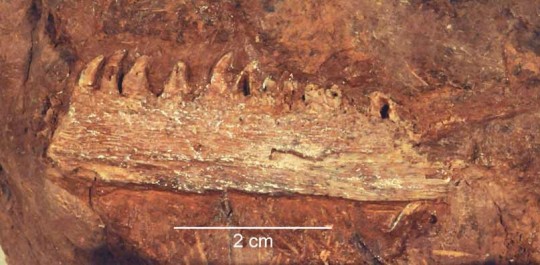
The lower jaw piece of Tambacarnifex unguifalcatus. Photograph by Dave Berman, 2008.

The teeth of Tambacarnifex preserved in the lower jaw are strongly recurved and flattened side-to-side, which, along with other features preserved in the skeleton, indicate it is a member of the basal synapsid group (family) Varanopidae and in the subfamily Varanopinae. The Varanopidae have been likened to the actively predaceous modern monitor lizards in the family Varanidae, hence the similar name. Varanopids were the most diverse and longest-surviving basal synapsids, being known from the Late Carboniferous–Middle Permian (~309–260 million years ago) of North America, Europe, Asia, and Africa. With their sharp, recurved teeth and a gracile skeleton, scientists think varanopids were agile predators, at least compared to other animals of their time. They range from about 12–78 inches in length, with the smallest ones probably being insectivorous and the larger ones carnivorous. Tambacarnifex has an estimated body size of about 35 inches, and as a medium-sized varanopid with gracile limbs it would have been an agile carnivore, preying on on any of the Bromacker vertebrates that it could catch.

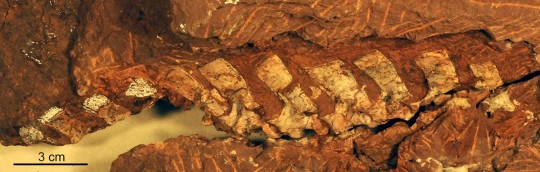
An articulated but incompletely preserved series of 11 vertebrae of Tambacarnifex unguifalcatus. Notice that the neural spines are low and subrectangular, so it is unlikely that they supported a sail, as occurs in some other basal synapsids such as Dimetrodon teutonis. The front of the animal is to the left. Photo by Dave Berman, 2008.

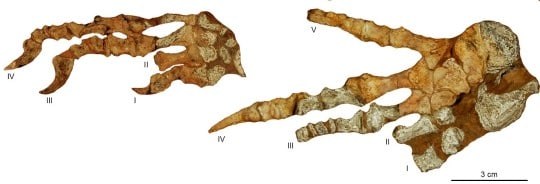
Unlike Dimetrodon teutonis, the other apex predator at the Bromacker, Tambacarnifex has broad, low neural spines that alternate in height. It differs from other varanopines in the shape and anterior inclination of its neural spines and in having greatly elongated and recurved bony claw supports in its hands and feet. The generic name Tambacarnifex was coined in reference to its position in the food chain: “Tamba,” for the Tambach Basin, which the holotype inhabited, and the Latin “carnifex,” meaning executioner, for its role as an apex predator. “Unguifalcatus” was derived from the Latin “unguis,” nail or claw, and “falcatus,” meaning sickle-shaped, in reference to the long, strongly recurved bony claw supports.

Incomplete front (left) and hind (right) feet of Tambacarnifex unguifalcatus. Notice the extremely long bony claw supports preserved on the first, third, and fourth fingers of the front foot and the fourth toe of the hind foot. I–V refer to finger and toe numbers. Photos by Dave Berman, 2008.

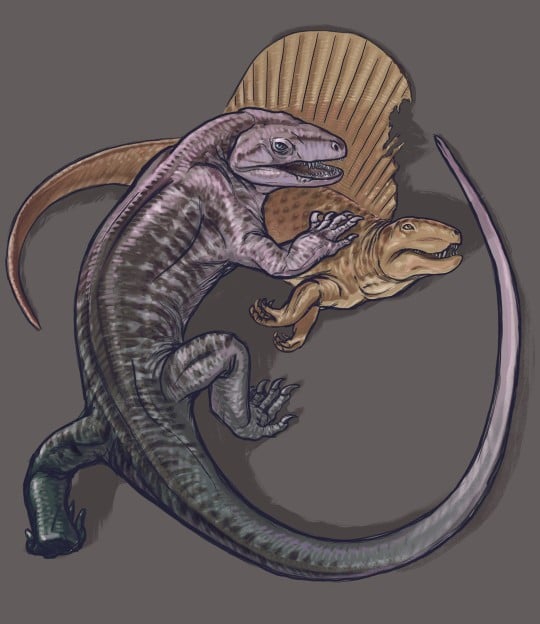
Illustration of Tambacarnifex unguifalcatus consuming a Dimetrodon teutonis carcass. Outline drawing by Matt Celeskey, colored (with permission) by Carnegie Museum of Natural History Vertebrate Paleontology Scientific Illustrator Andrew McAfee.

Stay tuned for the final post of this series, which will summarize what we’ve learned about the Bromacker. Click here if you would like to download your own copy of the outline drawing of Tambacarnifex consuming Dimetrodon to color in. The paper describing Tambacarnifex unguifalcatus can be viewed by clicking here.

Amy Henrici is Collection Manager in the Section of Vertebrate Paleontology at Carnegie Museum of Natural History. Museum employees are encouraged to blog about their unique experiences and knowledge gained from working at the museum.

Related Content

Ask a Scientist: What is it like to discover a new species? 

Mesozoic Monthly: Gargoyleosaurus

Cephalopod Fossils from Lyme Regis, England

Filed Under: Blog Tagged With: Amy Henrici, dinosaurs in their time, Museum from Home, Science News, Vertebrate Paleontology

December 8, 2020 by wpengine

Bobcats

With winter approaching, visitors to Powdermill Nature Reserve can anticipate seeing the tracks in the snow of one of our most splendid residents, the bobcat! These wild felines do not hibernate, rather they remain very active in winter because of their high metabolism. Although they are commonly photographed on trail cameras at Powdermill Nature Reserve, bobcats have excellent vision and hearing and are unlikely to show themselves to people. The stealthy and efficient predators are found state-wide, and the range for the species known scientifically as Lynx rufus stretches across the North American continent from southern Canada to northern Mexico.

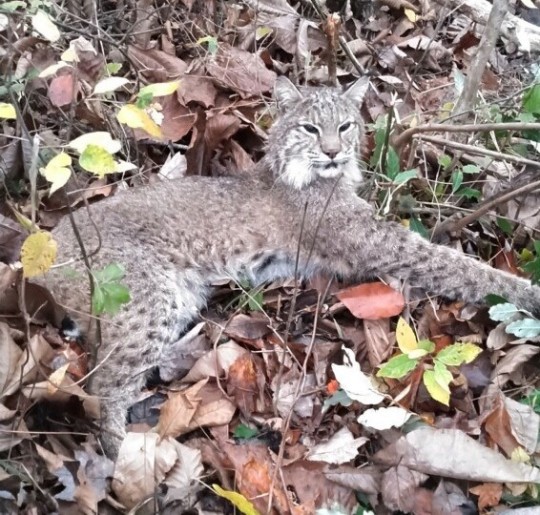
This adult female was photographed in late October, but photos do not really capture the full beauty of these animals. Image credit: John Wilkinson.

Bobcats are known to walk on top of fallen logs to move silently through the understory. Adults weigh up to 20 pounds, feed mostly on rodents and birds, but are capable of taking small fawns and perhaps even yearling deer. Bobcats are highly adaptable and do well even in close proximity to humans and coyotes. In our area, males wander over areas as large as 10 square miles, territories that span the smaller territories of several females. Bobcats are protected except for a brief trapping season in winter. Their coats are highly variable, and pelts are considered prime in winter, and more valuable when spotted. The highest quality, large pelts from the Rocky Mountains may sell for as much as $900. However, luckily for our cats, the market here is unlikely to provide $40 for a pelt, which will keep them safe from most trappers.

John Wenzel is the Director at Powdermill Nature Reserve, Carnegie Museum of Natural History’s environmental research center. Museum employees are encouraged to blog about their unique experiences and knowledge gained from working at the museum.

Related Content

The Christmas Bird Count During an Irruption Year

Ask a Scientist: What are murder hornets?

Brood VIII Birthday Bash

Filed Under: Blog Tagged With: John Wenzel, mammals, Powdermill, Powdermill Nature Reserve

December 8, 2020 by wpengine

The Christmas Bird Count During an Irruption Year

Since 1900, the National Audubon Society has hosted the Christmas Bird Count (CBC), a fun day for birders and bird watchers of all skill levels to get outside and count everything they see and hear within a designated count circle. The CBC was started with the purpose of creating a new way of censusing winter birds. Before binoculars and optics were widely available, people used shotguns during a competition to see who could bring back the biggest pile of birds and mammals. In 1900, conservationists developed a non-destructive way to tally what they saw, and the Christmas Bird Count was born. The CBC’s initial 25 count circles have blossomed into coverage across the continent, in Central and South America, and to the Pacific Islands.

Each year, Powdermill Nature Reserve sponsors the Rector, PA Christmas Bird Count. This year, with some extra pandemic-related safety precautions, an intrepid group of local birders will canvass a 15-mile diameter circle centered just a bit north of Powdermill on Sunday, December 20. Upcoming counts promise to be interesting and exciting locally and across much of North America due to the irruption of many species of “winter finches.”

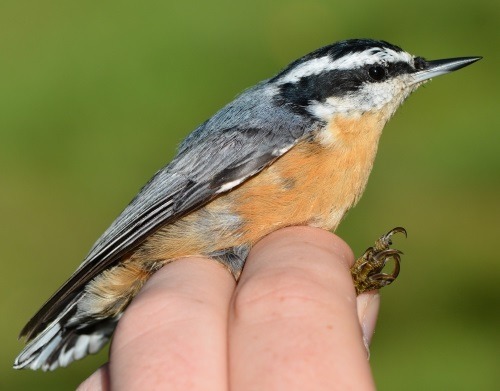
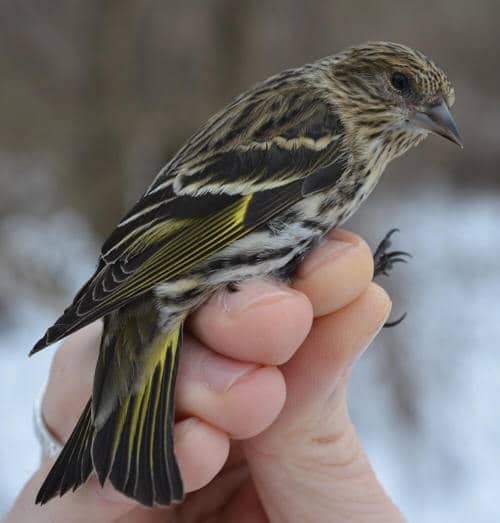
So, what is an irruption and what birds might we expect to see during an irruption year? Irruptive migration happens most often when there’s a change in food availability over much of a species’ normal range. It’s less predictable than the annual migration that we observe every spring and fall, and often happens in a cyclical pattern, reflecting normal changes in abundance of food items. Species that breed in the far north and winter generally farther north than Pennsylvania are those most likely to be irruptive migrants. When there is a poor seed crop, birds that eat things like conifer seeds, such as Pine Siskins, Red-breasted Nuthatches, and Evening Grosbeaks, as well as birds that prey upon small seed-eating animals, such as Snowy Owls, are often seen south of their typical range. This year has already proven to be a major irruption year and the season has barely begun!

image
Red-breasted nuthatch

At the beginning of September, we started to see Red-breasted Nuthatches at Powdermill in higher numbers than in previous years. They were followed in early October by large flocks of Pine Siskins, small finches that look a bit like streaky goldfinches. Although many remain in the area, quite a few siskins continued south and are currently flocking to feeders in the Carolinas and beyond! Even more exciting was the influx of Evening Grosbeaks, which first appeared in mid-October. This species’ population is in steep decline: these birds used to be commonly seen here in the winter until about 30-35 years ago, but now visit during only the biggest irruption years.

image
Pine Siskin
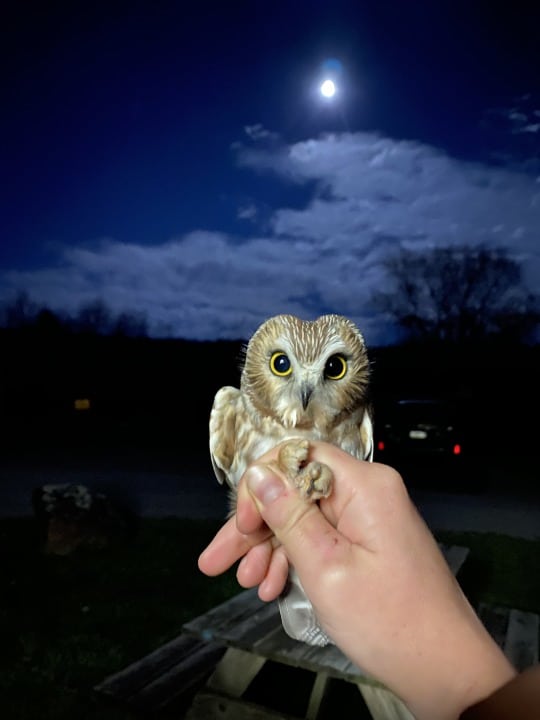
Northern Saw-whet Owl. Photo credit: Catherine Werth

Northern Saw-whet Owls are a species that we generally see each year, but this year banders are catching more than usual. One evening at Powdermill the team caught eight individuals, three of which were foreign recaptures! (This term refers to birds that were banded and recaptured at different banding stations. The three owls from that evening came from northeastern Pennsylvania, southeastern Ontario, and, for a bird initially banded four years ago, western Virginia.) Even familiar and common species that we see year-round but that have ranges that extend far north, such as Black-capped Chickadees and Purple Finches, are being seen in higher numbers this year.

image
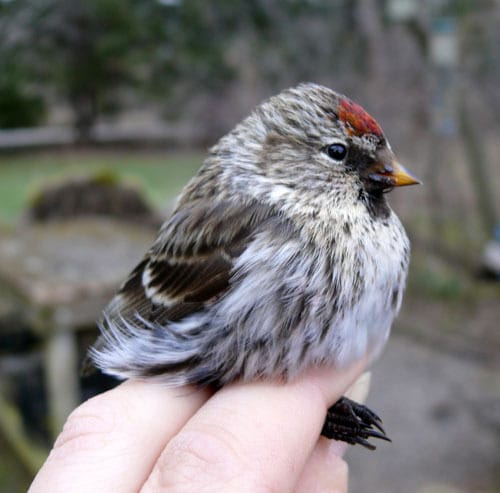
Common Redpoll

What species can we expect next? Red Crossbills and Common Redpolls haven’t been reported in the Powdermill area yet but are creeping ever closer, and if we’re really lucky perhaps we may even spot White-winged Crossbills, Pine Grosbeaks, or Hoary Redpolls. So, keep your eyes peeled, your ears primed for unfamiliar calls, your binoculars polished, and a field guide nearby, and you may have a spectacular Christmas Bird Count season!

For more information about the Christmas Bird Count, please visit: https://www.audubon.org/conservation/join-christmas-bird-count

And for a fun kickoff to the Christmas Bird Count season, Powdermill avian researchers, along with colleagues and a very special guest, will be hosting a watch party of the movie The Big Year the evening of December 18. For more information and to register: https://carnegiemnh.org/event/the-big-year-watch-party/

Annie Lindsay is the Bird Banding Program Manager at Carnegie Museum of Natural History’s Powdermill Nature Reserve. Museum employees are encouraged to blog about their unique experiences and knowledge gained from working at the museum.

Related Content

Bird Safe Glass Installed at Carnegie Museums

Camouflage in Your Yard?

One Man’s Trash is Another Man’s Weather Instrument

Filed Under: Blog Tagged With: Annie Lindsay, Birds, parc, Powdermill Nature Reserve

December 7, 2020 by wpengine

“Quaran-Teened”: Closed Spaces, Open Minds

laptop keyboard

We are living in a time of drastic changes, uncertain futures, and confounding boundaries. The pandemic shook our core values by keeping everyone physically separated. Here at Carnegie Museum of Natural History, educators had to think outside-the-box for ways to keep staff connected and our audiences engaged. Creating virtual programs was no small feat, but a special group of young people embraced the changes.

A handful of museum educators with responsibility for summer camp programs pressed onward with a group of returning teen volunteers, including some who have been volunteering with CMNH for a several years. Creating virtual programs was no small feat as Online Museum sessions replaced in person camps. Our teens embraced the changes and helped participants feel comfortable in this new normal by providing positive energy and continual encouragement. As part of their transformation from classroom helpers to virtual instruction assistants, several teen volunteers developed insightful, natural history-related literature in the form of blog posts. The Museum is proud to introduce these keyboard warriors, our very first cohort of teenage volunteer bloggers. You may have already read some of these blogs, and there are more to come! Meet just a few of these promising young writers:

Claire Ianachione: Hi, my name is Claire Ianachione, and I am excited to be writing blogs for the museum. I love learning new things about history and sharing them with other people. I cannot wait to start sharing blogs and I hope people enjoy reading them.

Samhita Vasudevan: My name is Samhita Vasudevan, and I’m super excited to write blogs for the museum! In my free time, I enjoy baking, going on runs, listening to music, and watching movies. My favorite exhibits at the museum are the Hillman Hall of Minerals & Gems and the Art of the Diorama.

Caroline Lee: My name is Caroline Lee and I’ve been involved with Powdermill since I was 10. When I heard of this great opportunity to write blogs for the museum, I was very excited to start because while I love PNR and Carnegie Museums, I also love writing! In my free time I am a musician in my school marching band, and a member of the “Science Matters” club!

Niko Borish: A longtime admirer of natural science, I attended summer camp at Powdermill Nature Reserve several times before becoming a volunteer there. Though primarily interested in herpetofauna, I enjoy investigating all aspects of the natural world whenever I can. Currently a junior in high school, I plan to study environmental science in college.

Angela Wu: Most of my passions can be summarized by “I love to create.” I’m interested in software development and its many applications in a variety of fields, but I also create writings, drawings, paintings, and music (albeit not very well). In my spare time, I enjoy reading, writing, and eating Ramen.

Xavier Ramirez: I am a sophomore in high school. I enjoy acting, music, and STEM. Currently, I keep myself busy with writing and long games of Risk.

Teen volunteers are an integral part of making summer camp a meaningful experience for campers. While 2020 brought about some difficult challenges that radically changed the summer camp experience, we want to extend a big thank you to all of our teen volunteers who helped the program!

Sara Klingensmith is an Environmental Educator & Naturalist at Powdermill Nature Reserve and Brandon Lyle is a Museum Educator at Carnegie Museum of Natural History. Museum employees are encouraged to blog about their unique experiences and knowledge gained from working at the museum.

Related Content

Teaching About Teeth

Digital Developments: Why Archiving and Herpetology Go Hand-in-Hand

How-to Make Hatchable Dinosaur Eggs

Filed Under: Blog Tagged With: Educators, Museum from Home, volunteers

December 7, 2020 by wpengine

Teaching About Teeth

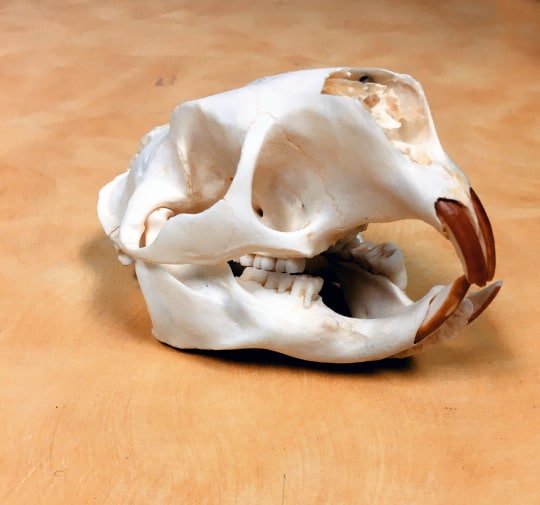
Porcupine skull from the Educator Loan Collection

The term “teachable moment” doesn’t accurately capture the opportunity first grade teachers have to guide their students in making observations about dental structure and function. “First graders are all about teeth,” explains Carolyn Mericle of the University of Pittsburgh’s Falk Laboratory School. The 29-year teaching veteran has long noted how the shared experience of tooth loss and replacement among these young students creates a high level of interest in all things dental that lasts for months, not moments.

Carolyn shared these observations during a recent phone conversation about how the mammal skulls she recently borrowed from the museum’s Educator Loan Collection would enhance student learning. Ideally, she explained, the students’ observations of the diversity of dental arrangements represented in the dozen skulls (a set which included black bear, white-tailed deer, striped skunk, and porcupine), would help them make connections to each creature’s diet. This experience would in turn lead to a better understanding of related classification terms such as, carnivore, herbivore, and omnivore.

Like every educator who is teaching through the COVID-19 pandemic, however, Carolyn is facing the necessity of modifying and adapting established plans. “Everything is hard this year.” she summarized, citing a school year that began with some of her students in her classroom and others at home, before a recent transformation to all remote instruction.

In the past, her students encountered the skulls firsthand by circulating among classroom tables where the objects were displayed. Each table included enough adjacent elbow room for students to make tooth-focused observational drawings. This week Carolyn plans to photograph the skulls and share the resulting images electronically to create a similar observational opportunity. “You have to re-think everything,” she adds, “because we’re working with a different set of tools.”

When the conversation concluded with a question about hope, Carolyn’s answer came without any hesitation. “The resilience of children gives me hope. They make the best of it. They’re powered by curiosity.”

Patrick McShea works in the Education and Visitor Experience department of Carnegie Museum of Natural History. Museum employees are encouraged to blog about their unique experiences and knowledge gained from working at the museum.

Related Content

A Gorilla for Our Imagination

Holiday Stowaway: Northern Saw-whet Owl 

Ask a Scientist: What is one of the more unique mammals of western PA?

Filed Under: Blog Tagged With: Educator Loan Program, Educators, Museum from Home, Pat McShea

  • « Go to Previous Page
  • Page 1
  • Interim pages omitted …
  • Page 18
  • Page 19
  • Page 20
  • Page 21
  • Page 22
  • Interim pages omitted …
  • Page 206
  • Go to Next Page »

sidebar

About

  • Mission & Commitments
  • Directors Team
  • Museum History

Get Involved

  • Volunteer
  • Membership
  • Carnegie Discoverers
  • Donate
  • Employment
  • Events

Bring a Group

  • Groups of 10 or More
  • Birthday Parties at the Museum
  • Field Trips

Powdermill

  • Powdermill Nature Reserve
  • Powdermill Field Trips
  • Powdermill Staff
  • Research at Powdermill

More Information

  • Image Permission Requests
  • Science Stories
  • Accessibility
  • Shopping Cart
  • Contact
  • Visitor Policies
One of the Four Carnegie Museums | © Carnegie Institute | Privacy Policy | Terms of Use | Accessibility
Rad works here logo