• Skip to primary navigation
  • Skip to main content
  • Skip to primary sidebar

Carnegie Museum of Natural History

One of the Four Carnegie Museums of Pittsburgh

  • Visit
    • Buy Tickets
    • Visitor Information
    • Exhibitions
    • Events
    • Dining at the Museum
    • Celebrate at the Museum
    • Powdermill Nature Reserve
    • Event Venue Rental
    • Gift Cards
  • Learn
    • Field Trips
    • Educator Information
    • Programs at the Museum
    • Bring the Museum to You
    • Guided Programs FAQ
    • Programs Online
    • Climate and Rural Systems Partnership
  • Research
    • Scientific Sections
    • Science Stories
    • Science Videos
    • Senior Science & Research Staff
    • Museum Library
    • Science Seminars
    • Scientific Publications
    • Specimen and Artifact Identification
  • About
    • Mission & Commitments
    • Directors Team
    • Museum History
  • Tickets
  • Give
  • Shop

Blogs from our Scientific Researchers

Carnegie Museum of Natural History is home to active research and vast scientific collections. Our scientific researchers regularly contribute to the blog at the museum.

December 20, 2021 by Erin Southerland

Sea Snails from Christmas Island

by Timothy A. Pearce

There really is a Christmas Island. It is in the Indian Ocean about 250 km (155 mi) SW of Java and it is administered by Australia. Christmas Island, which was uninhabited by humans until the late 1800s, has a highly endemic flora and fauna, reflecting little human disturbance. Nearly two-thirds of the island is designated as a national park. 

Carnegie Museum of Natural History has two species of sea snails from Christmas Island. Neither of these species is endemic to the island, and neither is rare.

Money Cowries from Christmas Island
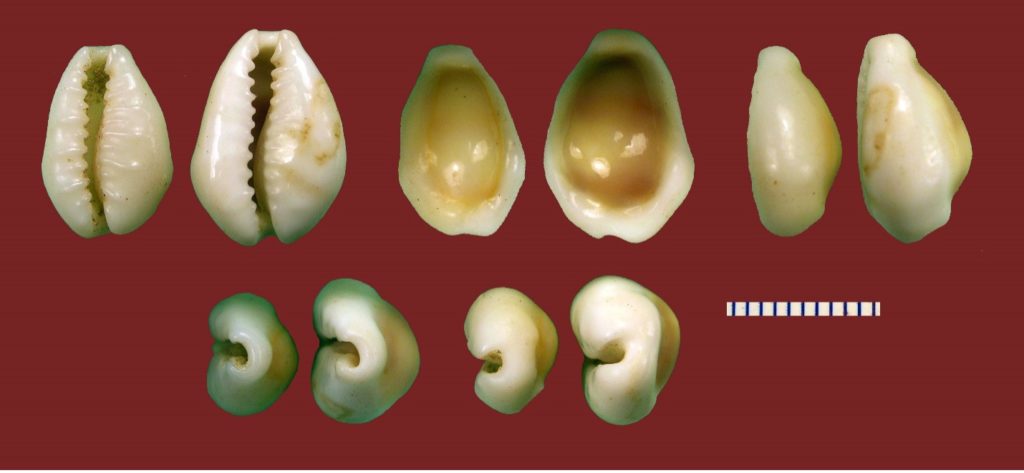
Ten Monetaria moneta snail shells from Christmas Island on a red background.
Fig. 1. Monetaria moneta, the money cowry, from Christmas Island. Views from top left: aperture, dorsal, left side, anterior, posterior. Specimen CM 123323 at Carnegie Museum of Natural History. Scale in mm. Photo by T.A. Pearce. 

These Moneteria moneta (Fig. 1), also known as money cowries, are from Christmas Island. They were donated to the museum by Casimir Potyraj, Jr. in September of 2012, although we don’t know when they were collected. These specimens are smaller than average M. monetaria. This species of cowry is used as decoration and was used as currency in many islands of the south Pacific Ocean region into the 1800s. Both the genus and the species names, Monetaria moneta, reflect their use as currency. This species occurs broadly in tropical areas of the Indian and Pacific Oceans, but not in the Atlantic. Monetaria moneta is in the cowry family, Cypraeidae, a group of snails appreciated around the world for their shiny, colorful shells, that look like they have a zipper underneath.

Castor Bean Shells from Christmas Island
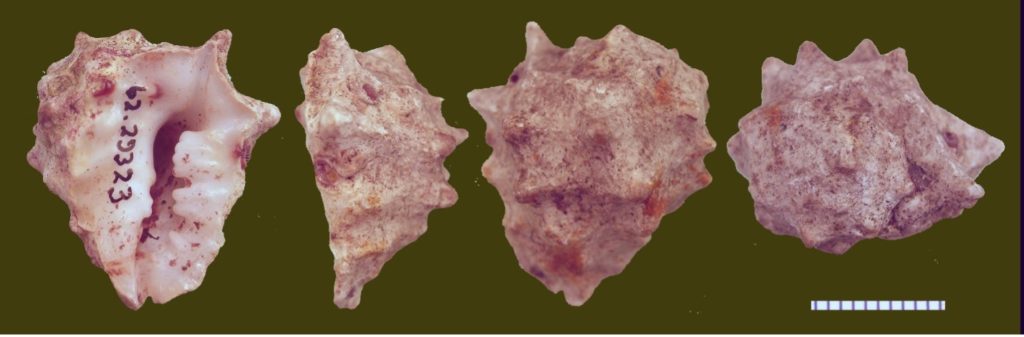
Four castor bean shells from Christmas Island on a green background.
Fig. 2. Drupa ricina, the castor bean shell, from Christmas Island. Views from left: aperture, side, dorsal, spire. Specimen CM 62.29323 at Carnegie Museum of Natural History. Scale in mm. Photo by T.A. Pearce. 

This Drupa ricinus (Fig. 2), also known as the castor bean shell, is also a sea snail from Christmas Island. It came to Carnegie Museum of Natural History by way of the British Museum of Natural Science on July 25, 1935. It’s unclear whether that was the date the British Museum gave it to us, or the date it was collected; my guess is the former. Like the Monetaria moneta, Drupa ricinus also occurs broadly in tropical areas of the Indian and Pacific Oceans, but not in the Atlantic. Drupa ricinus is in the murex family, Muricidae, which includes snails that produce the purple dye prized by the Romans and Phoenicians.

Every day is Christmas on Christmas Island! We wish Merry Christmas to all the creatures there.

Timothy A. Pearce, PhD, is the head of the mollusks section at Carnegie Museum of Natural History. Museum employees are encouraged to blog about their unique experiences and knowledge gained from working at the museum.

Related Content

A Perfect Mineral for the Christmas Season

Ask a Scientist: How did snails evolve from living in water to living on land?

Collected on Christmas Eve 1883: Mistletoe

Carnegie Museum of Natural History Blog Citation Information

Blog author: Pearce, Timothy A.
Publication date: December 20, 2021
Share this post!

  • Share on Twitter Share on Twitter
  • Share on Facebook Share on Facebook
  • Share on Pinterest Share on Pinterest
  • Share on LinkedIn Share on LinkedIn
  • Share on Reddit Share on Reddit
  • Share via Email Share via Email

Filed Under: Blog Tagged With: Carnegie Museum of Natural History, mollusks, Science News, Tim Pearce

December 14, 2021 by Erin Southerland

Carnegie’s Water Fountains

by Albert D. Kollar

Potable Water Sources

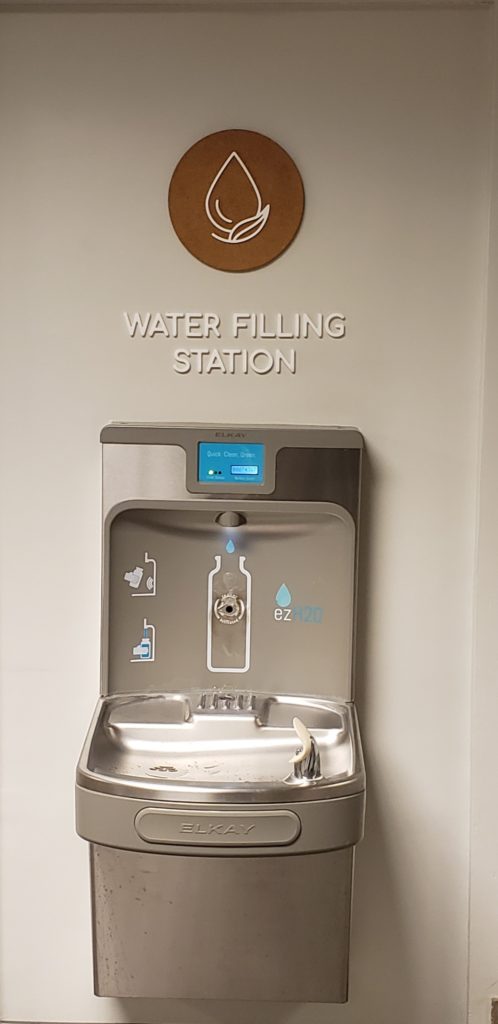
Access to drinking water from a water fountain seems to be passé today with the ubiquitous availability of plastic water bottles from vending machines. In 2018, as an effort to ‘change the culture’ in the use of plastic water bottles by museum staff and patrons, the Oakland museums, Carnegie Museum of Natural History, and Carnegie Museum of Art (respectively CMNH and CMOA), installed filling stations for reusable water bottles. These eco-friendly “fountains” are located adjacent to the Fossil Fuels Cafeteria in CMNH, and in the rest room lobby of CMOA1 (Fig. 1), and their rapid and wide acceptance invites a deeper consideration of drinking water as an amenity in a public facility.  

gray and silver water fountain
Fig. 1.

The public water supply in the massive Oakland building comes from the Pittsburgh Water and Sewer Authority’s Herron Hill Reservoir, which in turn draws its supply from the Highland Park Reservoir in the city’s East End1. The water, which is initially sourced from the Allegheny River, undergoes several treatments before it is pumped to the reservoir. 

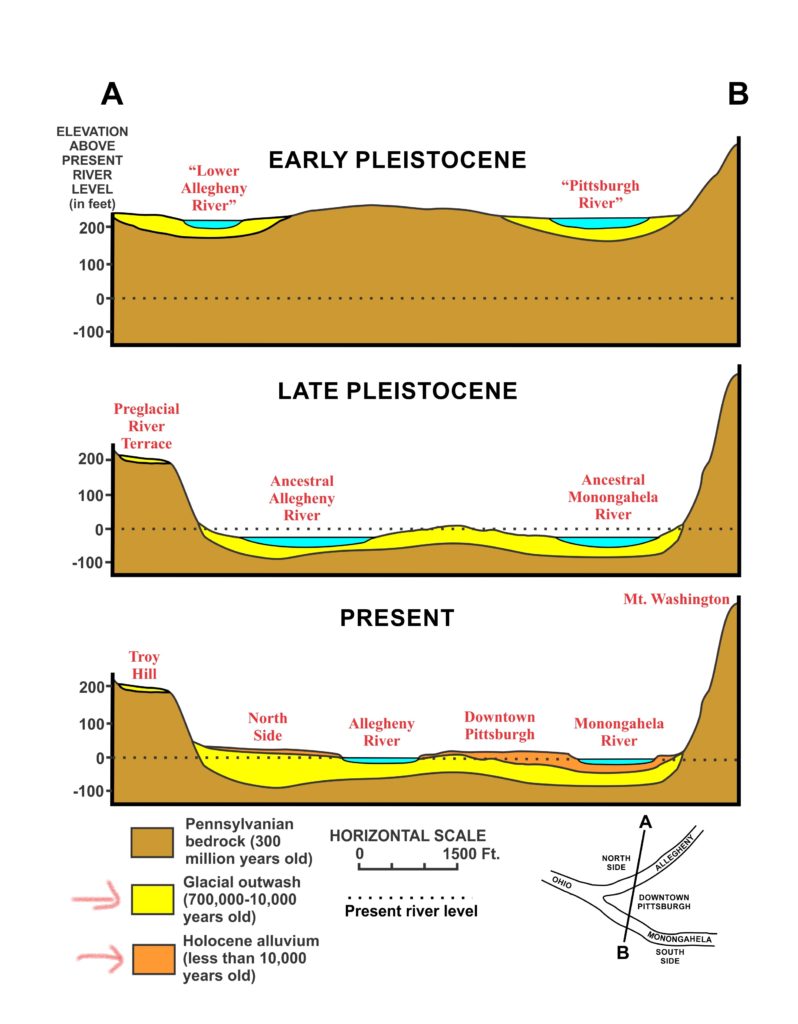
The geologic perspective on our water supply also bears mention here. The glacial melt waters of the Pleistocene Epoch filled the potable aquifers of western Pennsylvania2 (Fig. 2 red arrows). With population growth in the 20th Century, water demands for agricultural, industrial, and residential uses led to the depletion of these aquifers within the Allegheny River Basin. Today potable waters stored in reservoirs are principally drawn from the three rivers of Pittsburgh, waterways replenished to a significant degree by rain fall and snow melt.

chart looking at glacial outwash in the Allegheny River Basin in the Pleistocene and at present
Fig. 2

A myth in the minds of many Pittsburghers is the city’s Fourth River. According to a 2016 publication by John Harper2, the Fourth River does not exist as underground caves, fissures, or cavities under any of the three rivers. As shown in Fig. 2, (red arrows) glacial outwash and Holocene alluvium comprise thick deposits of sediment within the river valleys, and tiny interconnected pore spaces between sand grains and pebbles allow water from the rivers and their adjoining floodplains and riverbanks, to move slowly but freely through this sediment. At some locations this subterranean flow is accessed by artesian wells, the most prominent example being the fountain in Point State Park.  

Carnegie’s Water Fountains

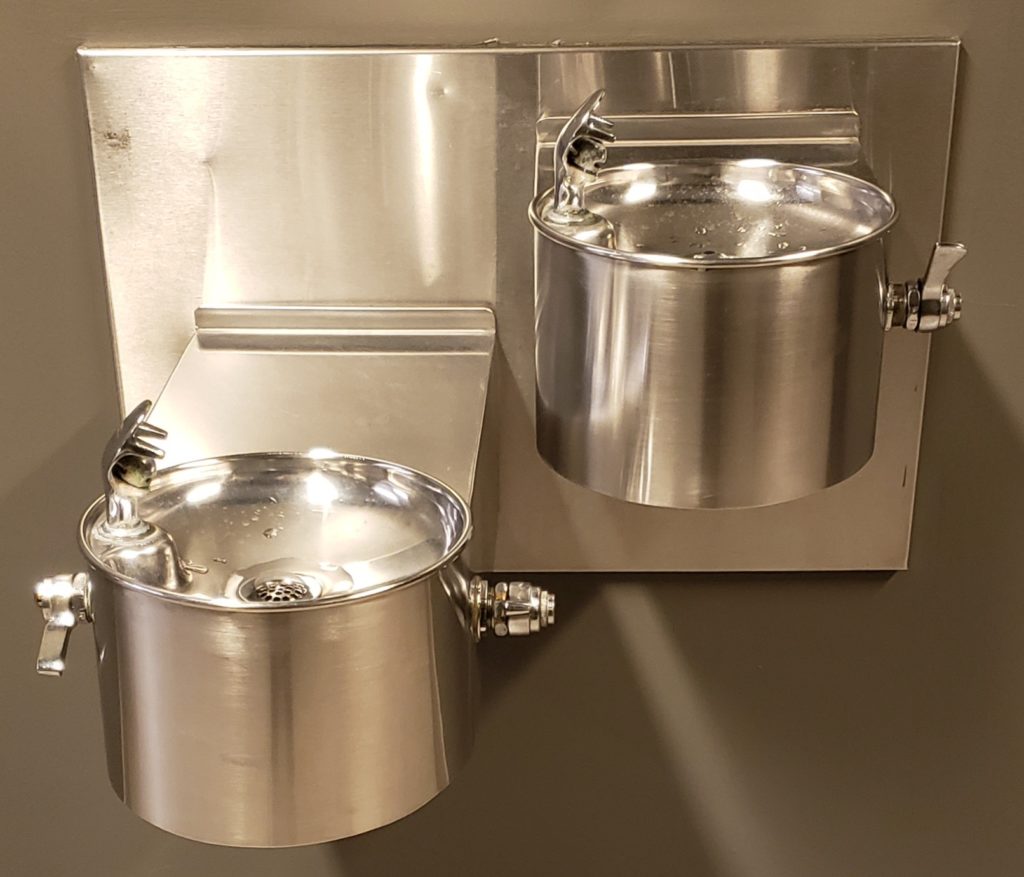
Presentation is important, especially for something as vital as drinking water, and within the halls and hallways of the Carnegie building complex in Oakland, carved stone is frequently part of the refreshment package. Visitors encounter three types of water fountains. In the 1907 Carnegie Institute Extension, a Beaux-Arts masterpiece designed by architects Alden and Harlow, water fountains are plumbed through either white Carrara Marble from Italy or yellow Hauteville fossil limestone of France. In the Museum of Art wing built in 1974, thirsty patrons are served by chrome water fountains (Fig. 3). 

two chrome water fountains
Fig. 3

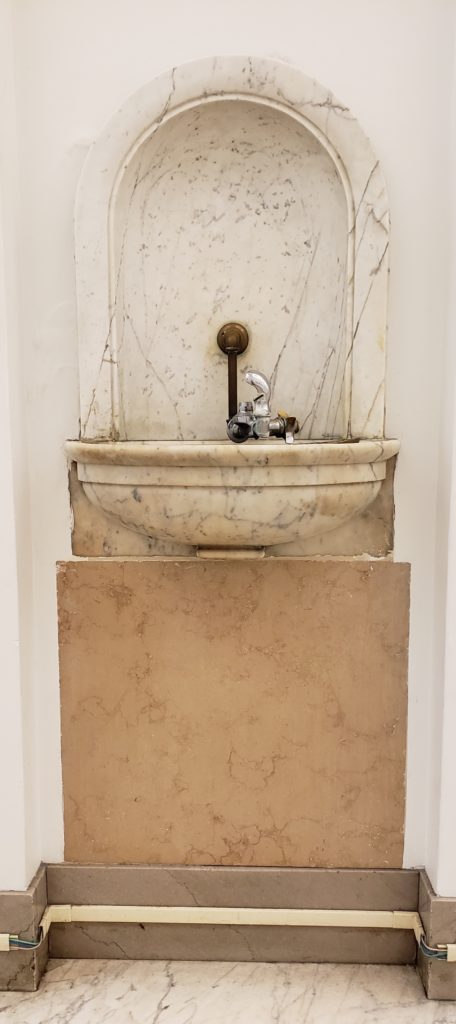
Carrara Marble was created during the Cenozoic Era when limestones formed during the Triassic or early Jurassic age limestones underwent metamorphosis.4 The locations of the eighteen Carrara Marble fountains in the 1907 building include the engine room, basement hallways, the Carnegie Library of Pittsburgh first floor lobby (Fig. 4), Carnegie Music Hall vestibule hallway, the Carnegie Lecture Hall, and exhibit halls on the second and third floors of Carnegie Museum of Natural History.3 Although the Carrara Marble fountains originally had red brass fixtures (Fig. 4), some now operate with replacement fixtures of chrome1. 

marble water fountain
Fig. 4

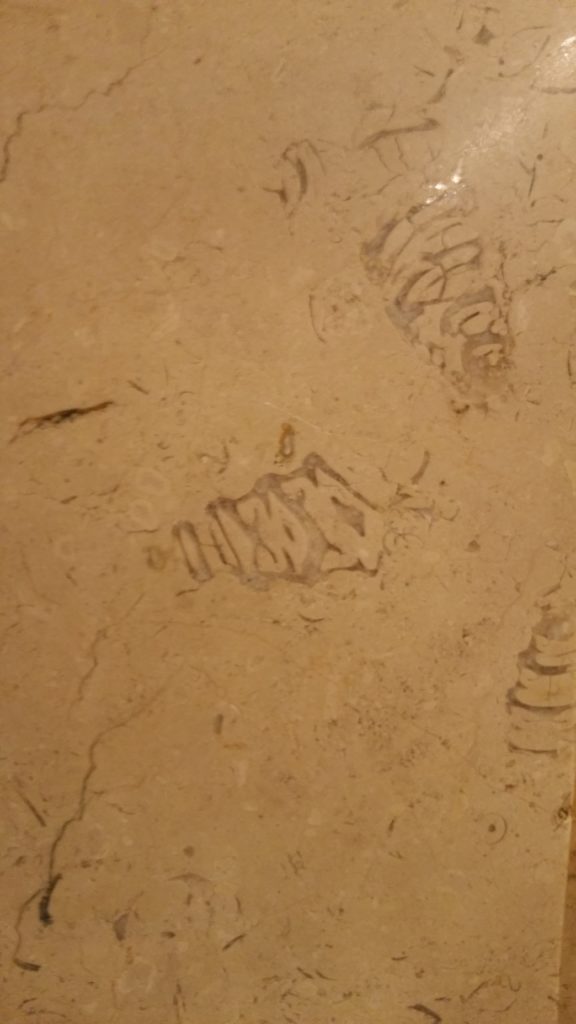
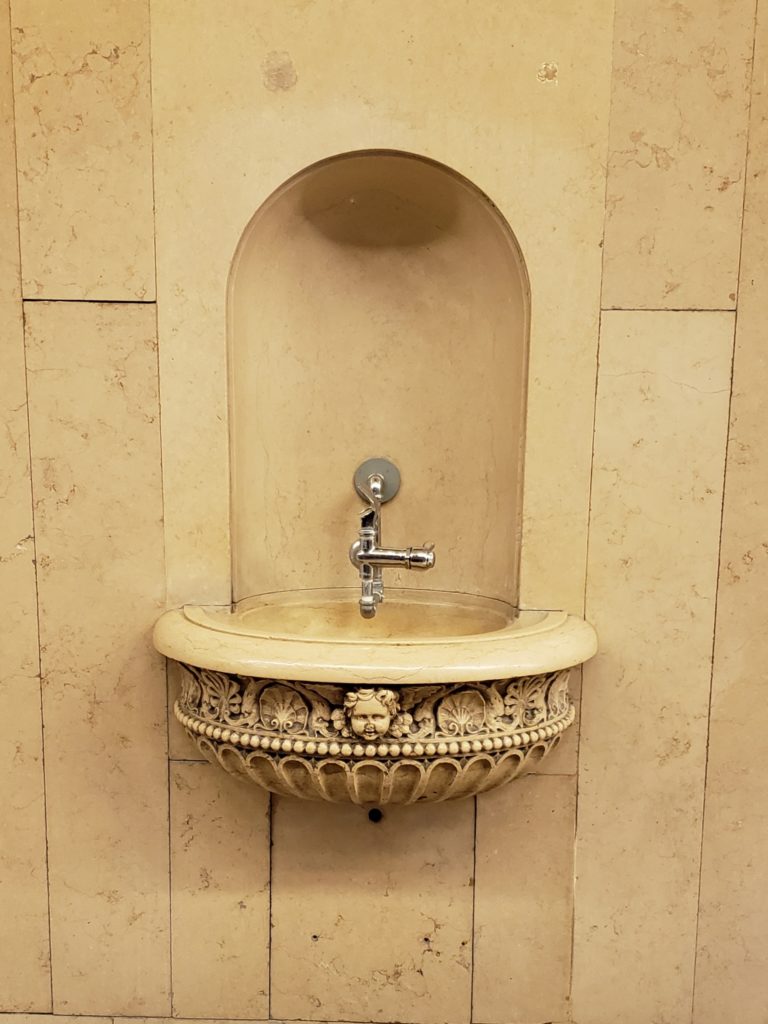
There are three Hauteville limestone fountains along the walls of the three floors in the Grand Staircase Hall. These neo-Baroque fountains feature carvings that represent a diverse group of invertebrate fossils and an allegory human face (Fig. 5). The fountains are surrounded by the Hauteville limestone wall panels with Cretaceous age snail Nerinea (Fig. 6) visible in many Hauteville floor tiles, walls, door framing, and pedestals.5 Some 350 tons of Hauteville limestone were used for the interior stone in the Grand Staircase and throughout the Carnegie Institute Extension.6 The Hauteville fountains also originally used red brass fixtures, and now function with chrome replacements.

limestone water fountain
Fig. 5
snail fossils in limestone
Fig. 6

A World-Famous Fountain In Rome And More

If there’s a place in a discussion of fountains to consider the top of the scale, an Italian reference belongs here. One of the most famous water fountains in the world is the Baroque Trevi Fountain (Nicola Salvi, Giuseppe Pannini, architects) that opened in 1762 in Rome7. The fountain had its moments in classic movies such as, Federico Fellini’s La Dolce Vita (1960) with Marcello Mastroianni and Anita Ekberg in the leads8 (Fig. 7, image by Hernán Piñera).  

Trevi Fountain
Fig. 7

Around 19 BC, aqueducts were constructed in ancient Rome to bring pure water to the city from mountains 13 km (8.1 mi) from Rome9. Roman citizens enjoyed the function of a fountain not only as a source of clean water but as a gathering place.  

The Trevi Fountain is made of travertine, a sedimentary limestone (calcium carbonate) quarried in the Italian village of Bogni di Tivoli10. The village is noted for travertine quarries that produced the exterior stone for the Roman Amphitheater opened in 80 AD11 and the building of the Getty Museum in Los Angeles, California (1997). 

Travertine forms when ground water combines with carbon dioxide in the soils to form carbonic acid waters that then dissolve subsurface limestone. As these calcium carbonate-concentrated waters flow through the cracks in the bedrock they eventually precipitate a new rock called travertine. 

An excellent example of travertine formation can be observed at Mammoth Hot Springs in Yellowstone National Park. High above the Hot Springs, rainwater seeps into the buried Cretaceous age limestone where it mixes with carbon dioxide gas that rises from a subterranean magma chamber dissolving the calcium carbonate that is carried along in the underground streams through fractures in the overlying strata. Once the water exits the bedrock, travertine terraces start to build as the carbon dioxide gas escapes, leaving behind the calcium carbonate mineral. 

Travertine in Oakland: In an abandoned sandstone quarry behind Phipps Conservancy in Schenley Park travertine deposits is preserved on the exterior of the quarry rock12.  The site is no longer open for visitors.

Albert D. Kollar is the Collection Manager for the Section of Invertebrate Paleontology. Museum employees are encouraged to blog about their unique experiences and knowledge gained from working at the museum.

References

  1. Young, T. Carnegie Museum of Pittsburgh Facilities. 
  2. Harper, J. A. 2016. The Geological Evolution of Pittsburgh’s Three River. PAlS Publication 21. 
  3. Kollar et al. 2020. Connemara Marble at the Carnegie Institute Extension. ACM, 86, 207-2
  4. Price, M. T. 2007. The Sourcebook of Decorative Stone: An Illustrated identification guide. 287 pp.
  5. Kollar, A. D. 2020. https://carnegiemnh.org/a-journey-to-france-to-uncover-the-mysteries-of-the-carnegies-grand-staircase/
  6. Kollar, A. D. 2021 DE L’ÉCHAILLON À L’ANNEXE DU CARNEGIE INSTITUTE DE PITTSBURGH Saint-Quentin-sur-Isère, 18 Septembre 2021.
  7. Pinto, J. A. 1986. The Trevi Fountain. Yale University Press. 326 pp. 
  8. Fellini, F. 1960. La Dolce Vita. The Criterion Collection, Paramount Home Entertainment
  9. Beard, M. 2015. SPOR A History of Ancient Rome. Liveright Publishing Corporation. 606 pp.
  10. Hirt, A. M. 2010. Imperial Mines and Quarries in the Roman World Organizational Aspects 27 BC-AD 235. Oxford Press, 551 pp. 
  11. Acocella, A. 2013. Travertine, An Italian Stone. Journal ARCHITETTURA DI PIETRA.
  12. Kollar, A. D. The Geology of Oakland, in manuscript. 

Related Content

Understanding Fossil Fuels through Carnegie Museum Exhibits

A Century Ago, a Donor Walked into the Museum

The Connemara Marble: A Cross-Atlantic Connection Between Ireland and Pittsburgh

Carnegie Museum of Natural History Blog Citation Information

Blog author: Kollar, Albert D.
Publication date: December 14, 2021

Share this post!

  • Share on Twitter Share on Twitter
  • Share on Facebook Share on Facebook
  • Share on Pinterest Share on Pinterest
  • Share on LinkedIn Share on LinkedIn
  • Share on Reddit Share on Reddit
  • Share via Email Share via Email

Filed Under: Blog Tagged With: Albert Kollar, Carnegie Museum of Natural History, invertebrate paleontology, Science News

December 1, 2021 by Erin Southerland

How to Talk with an Extra-Terrestrial Alien? Practice with an Octopus

by Timothy A. Pearce

Despite typical depictions of outer space creatures in movies and on TV, the chance that extra-terrestrial aliens will look like us is vanishingly small, and they are also likely to think and communicate very differently than we do. Most species on Earth communicate with smells (note that most animal species on Earth are insects), while fewer species, including humans, communicate primarily with sight and sound. As far as I know, humans are the only ones on Earth using radio waves to communicate, although radio transmitters and receivers are external to our biological bodies. (Nerds will point out that radio waves and light waves are all part of the electromagnetic spectrum, just pulses of the same phenomenon at different frequencies.) 

illustration of a green creature with big black eyes

If we humans actually made contact with extra-terrestrial alien intelligence, how would we communicate with them? Extra-terrestrial organisms, likely being completely separate instances of life, and potentially evolving under dramatically different temperatures and chemical environments (think cold moons of Jupiter or Saturn where the solvent of life could be liquid hydrocarbons instead of water), might not use smell, sight, or sound as Earth creatures do. They might have very different ways of conveying information. 

I suggest if we want to practice communicating with space aliens, we should look no further than our 8-legged ocean intelligence: the octopus. The octopus is evolutionarily the most different of all the intelligences on Earth. Here, I include in the “intelligence club” organisms such as primates (including humans), cetaceans (dolphins and whales), certain birds (parrots, jays, and crows), and cephalopods (particularly octopus). If you’d like to include other favorite creatures capable of acquiring and applying knowledge, such as elephants, dogs, and horses, well sure, we can include them in the intelligence club. What I want you to notice is that all of them except the cephalopods are vertebrate animals, and all but the birds are mammals. 

illustration of a maroon octopus

The cephalopods are the most different of all those intelligences. The cephalopod and vertebrate lineages split from each other more than half a billion years ago. Although the common ancestors of the different vertebrate lineages were not likely highly intelligent, something about the vertebrate body plan might have been a precursor for intelligence. If this is the case, we might expect similarities in the different instances of vertebrate intelligence. On the other hand, because cephalopods and their intelligence came from a very different ancient ancestor, it is as different an intelligence as we can find on Earth. To appreciate how different, look up the fundamental difference between protostomes (including octopus) and deuterostomes (including vertebrates).

I suggest that our best chance to practice communicating with space aliens is to practice communicating with octopuses.

One other non-vertebrate I can think of that might be considered for the intelligence club is the jumping spider (family Salticidae, particularly genus Portia), whose intelligent hunting behaviors indicate they can reason and learn. And hey, they have eight legs, just like the octopus. Coincidence? What do you think?

Timothy A. Pearce, PhD, is the head of the mollusks section at Carnegie Museum of Natural History. Museum employees are encouraged to blog about their unique experiences and knowledge gained from working at the museum.

Related Content

Octopus Mystery: How Do They See Color?

Cuttlefish Pass Marshmallow Test

Vampire Squid: Cutest Dracula

Carnegie Museum of Natural History Blog Citation Information

Blog author: Pearce, Timothy A.
Publication date: December 1, 2021

Share this post!

  • Share on Twitter Share on Twitter
  • Share on Facebook Share on Facebook
  • Share on Pinterest Share on Pinterest
  • Share on LinkedIn Share on LinkedIn
  • Share on Reddit Share on Reddit
  • Share via Email Share via Email

Filed Under: Blog Tagged With: mollusks, Science News, Tim Pearce

November 12, 2021 by Erin Southerland

Collected on this Day in 1930: Native…or Not?

by Mason Heberling

Though the supercontinent Pangea broke apart many millions of years ago, the Anthropocene is marked by a new kind of Pangea. The globalization of human activities has brought species from around the world into contact which otherwise would never interact. Though the seven continents as they are today may not be physically connected into a single landmass, they are perhaps more connected than they have ever been. 

Some species are intentionally moved from one continent to another, such as the plants in gardens, while other introductions are accidental, mere unintentional passengers of humans increasingly global activities. Introduced species can fundamentally alter the landscape and are regarded as one of the top threats to native biodiversity.

Invasive species are those introduced species which are non-native and spread without human intervention. Many invasive species alter ecosystem functioning and change regional biodiversity. Invasive plant species have become a common part of our landscape. Some were brought over hundreds of years ago by European colonists. Others have arrived much more recently. 

In Pennsylvania, the invasion of some plant species is obvious – that is, a unique species arrives, thrives, and become abundant. These invasive species have no record of being in the area and can spread rapidly, sometimes over the course of a human lifetime or shorter. Many invasive species are still actively spreading across the landscape. For instance, garlic mustard (Alliaria petiolata) is a well-known forest herb from Europe introduced to North America in the mid-1800s. After more than a century, the plant is now common across Pennsylvania’s forests. Another obvious example is giant knotweed (Reynoutria sachalinensis), a native to parts of East Asia, first recorded in western Pennsylvania in the 1920s, and since spread to line many of Pennsylvania’s rivers and streams. You can’t go far in the Pittsburgh region without seeing invasive knotweed.

Other species invasions are less obvious. These so called “cryptic invasions” are the introductions of very closely related species or subspecies which originated elsewhere. 

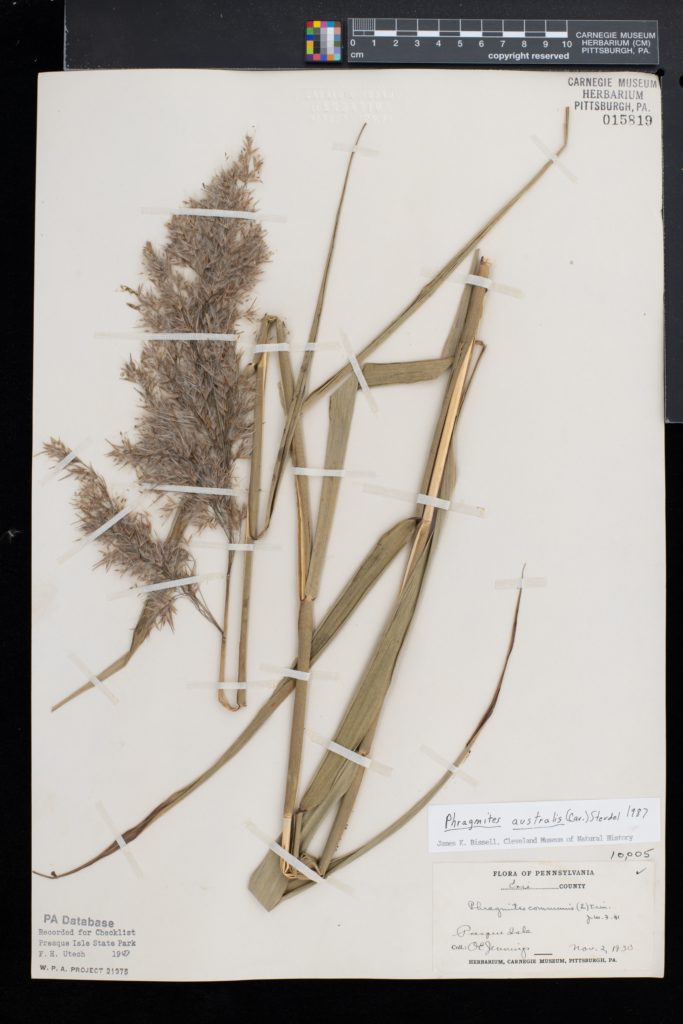
specimen of common reed on an herbarium sheet

This specimen of common reed (Phragmites australis) tells the tale of a widespread cryptic invasion. The specimen was collected by Carnegie Museum botany curator Otto Jennings on November 2, 1930 along the shores of Lake Erie at Presque Isle, Pennsylvania. Common reed is a major problematic invasive species, crowding out native species in this unique habitat at Presque Isle. When this specimen was collected over 90 years ago, it was not nearly as abundant as it is now. 

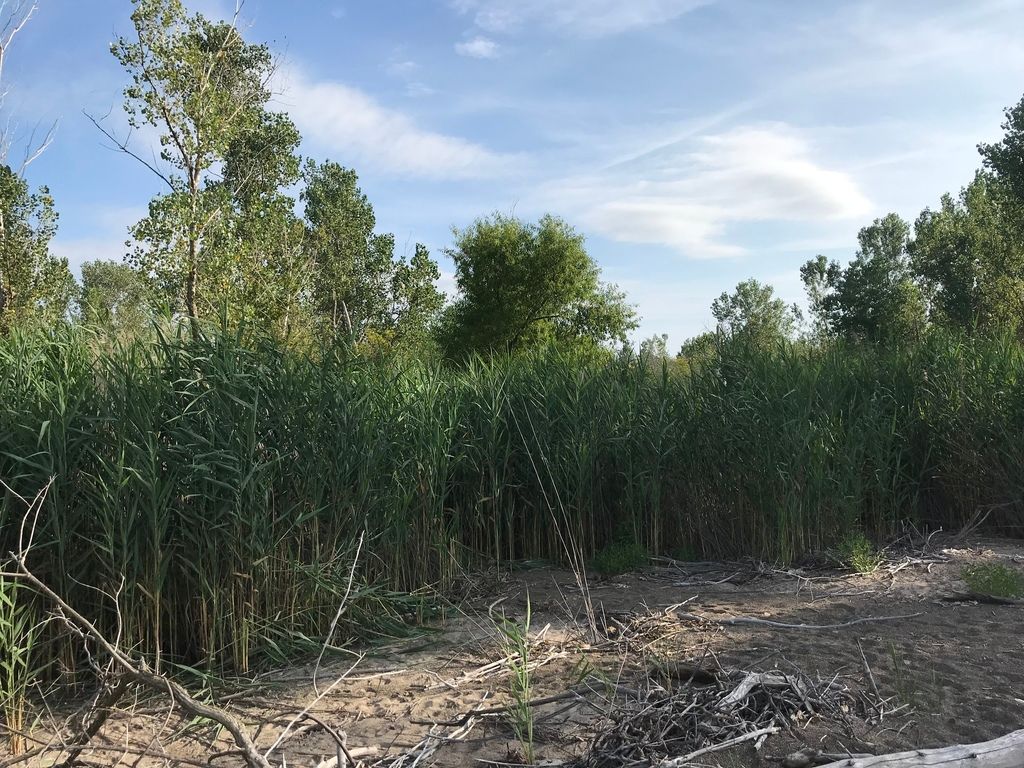
common reed plants with trees outside
A large stand of Phragmites at Presque Isle State Park, August 2019.

But is it non-native? Common reed, or often simply called Phragmites, has a very widespread distribution, found in wetlands and shores across all continents except Antarctica. It is even a common site along wet areas near highways. Common reed is among the most widely distributed plants in the world.

Reed is non-native to the United States…well, mostly. In the 1800s, botanists considered Phragmites to be a relatively uncommon plant. Evidence from fossils and paleoecological research show that the species has indeed been in North America for many thousands of years. However, it didn’t start to become abundant until the early 1900s and after. Some botanists suggested the sudden success of the species could be due to human disturbance.  A pioneering herbarium-based study from 2002 published in PNAS by Dr. Kristin Saltonstall sequenced DNA from herbarium specimens collected before 1910 and recent collections to show that the spread of Phragmites in the United States was due to the introduction of a non-native strain of the species that originated from Europe. 

Pretty cool, huh? And this finding was made possible with herbarium specimens.

So, is this particular specimen native or not? I don’t actually know, but with expert examination and genetic analysis, we could find out! 

Find this specimen and 149 more in the Carnegie Museum herbarium here.

Check back for more! Botanists at the Carnegie Museum of Natural History share digital specimens from the herbarium on dates they were collected. These scientists are in the midst of a three-year project to digitize nearly 190,000 plant specimens collected in the region, making images and other data publicly available online. This effort is part of the Mid-Atlantic Megalopolis Project (mamdigitization.org), a network of thirteen herbaria spanning the densely populated urban corridor from Washington, D.C. to New York City to achieve a greater understanding of our urban areas, including the unique industrial and environmental history of the greater Pittsburgh region. This project is made possible by the National Science Foundation under grant no. 1801022.

Mason Heberling is Assistant Curator of Botany at Carnegie Museum of Natural History. Museum employees are encouraged to blog about their unique experiences and knowledge gained from working at the museum.

Related Content

The Circle of Life…and Invasion

Ask a Scientist: How do you find rare plants? [Video]

Collected on This Day in 1982: One specimen isn’t always enough!

Carnegie Museum of Natural History Blog Citation Information

Blog author: Heberling, Mason
Publication date: November 12, 2021

Share this post!

  • Share on Twitter Share on Twitter
  • Share on Facebook Share on Facebook
  • Share on Pinterest Share on Pinterest
  • Share on LinkedIn Share on LinkedIn
  • Share on Reddit Share on Reddit
  • Share via Email Share via Email

Filed Under: Blog Tagged With: Botany, collected on this day, Mason Heberling, Science News, Uprooted, We Are Nature 2

October 29, 2021 by Erin Southerland

Meet the Mysterious Mr. Ernest Bayet

by Joann Wilson and Albert Kollar

Imagine accumulating tens of thousands of fossils? While the exact number of fossils in Bayet’s collection has yet to be determined, estimates range from 20,000 to over 100,000. In 1903, William Holland, Director of the Carnegie Museum, negotiated a blockbuster deal to bring Bayet’s entire collection to Pittsburgh. The deal dazzled the public and made front page news in the New York Times. For over two years, the Section of Invertebrate Paleontology has been uncovering the stories of the collectors and dealers behind Bayet’s magnificent collection. Notable dealers include Lucien Stilwell, Frederick Stearns, and Dr. Friedrich Krantz, to name a few. But what about Bayet himself? What is his story?

Thanks to ongoing translations of the Bayet archive by volunteer Lucien Schoenmakers, we are excited to begin a series introducing Ernest Bayet, the person behind the collection.  

How old was Bayet when he sold his fossil collection?

Bayet, who was Born in 1859, was just 44 years old in 1903 when he sold his collection to the Carnegie Museum.  

How long did Bayet collect fossils?

Archival documents, that in 1903 arrived in Pittsburgh from Brussels with the purchased materials, indicate Bayet acquired the bulk of his collection in under 20 years. Assuming a range of 20,000 -100,000 fossils, Bayet would have acquired fossils at the blistering pace of 1,000-5,000 specimens per year. When you consider the logistics of shipping, along with the perpetual letter writing required to transact deals in the late 19th century, his acquisition rate is an amazing feat. 

Signature on a piece of paper
Is this Ernest Bayet’s signature? Portion of a recently re-discovered fossil label.

Why did Bayet sell his collection?

In July of 1902, Bayet married countess, Maria van der Burch. The Bayet family had their first child in 1903. A second child followed in 1905. Was this a factor in Bayet’s decision to downsize his entire fossil collection? We are not yet sure of Bayet’s plans or motives. For over a century it was rumored that Bayet sold his fossils to pay for a new chateau, or home.  In a letter to Andrew Carnegie dated June 8, 1903, William Holland, then Director of the Carnegie Museum, reported this as a possible explanation for the fossil sale. Although we have yet to verify that a chateau was acquired within that period, such a purchase is a possibility.  

How long did Bayet live?

The Mysterious Mr. Ernest Bayet died in 1935 at the age of 76. What was his life like after the sale? To learn more about Bayet and how his fossils arrived in Pittsburgh, check out Annals of Carnegie Museum’s new publication, “Unraveling the 120 Year Mystery of Ernest Bayet and His Fossil Collection at Carnegie Museum”.

We are continually grateful to volunteer and Netherlands resident Lucien Schoenmakers for ongoing efforts to translate archival Bayet documents. Joann Wilson is an Interpreter in the Education Department at Carnegie Museum of Natural History. Albert Kollar is Collections Manager for the Section of Invertebrate Paleontology. Museum employees are encouraged to blog about their unique experiences and knowledge gained from working at the museum.   

Related Content

Bayet and Krantz: 16 Words

Bayet’s Bounty: The Invertebrates That Time Forgot

From Collector to Director

Carnegie Museum of Natural History Blog Citation Information

Blog author: Wilson, Joann; Kollar, Albert
Publication date: October 29, 2021

Share this post!

  • Share on Twitter Share on Twitter
  • Share on Facebook Share on Facebook
  • Share on Pinterest Share on Pinterest
  • Share on LinkedIn Share on LinkedIn
  • Share on Reddit Share on Reddit
  • Share via Email Share via Email

Filed Under: Blog Tagged With: Albert Kollar, invertebrate paleontology, Joann Wilson, Science News, SWK2

October 20, 2021 by Erin Southerland

It Isn’t Easy Being Different

by Stephen P. Rogers
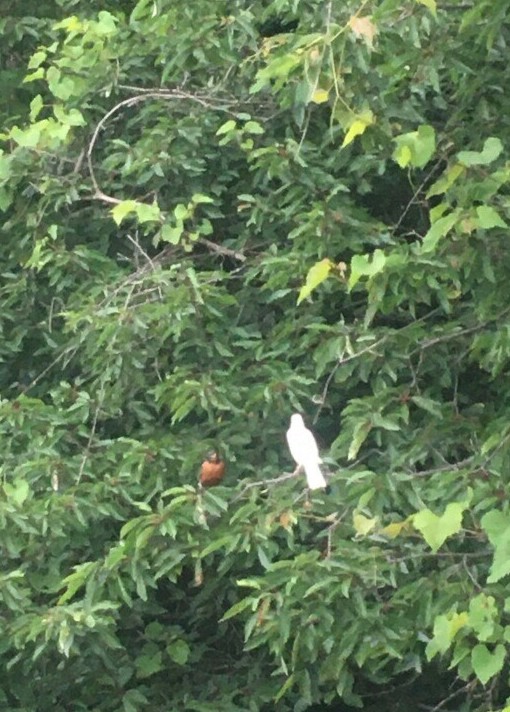
White bird and a robin in a tree

In nature there is always variation among individuals. In fact, the ability of an organism’s genes to pass along variation to a subsequent generation accounts for how species evolve. When enough variation develops among a group of individuals that are in some way isolated from other similar individuals, a new species might evolve. Often, however, a variation leads to such a unique set of features that the individual does not survive long enough to reproduce.

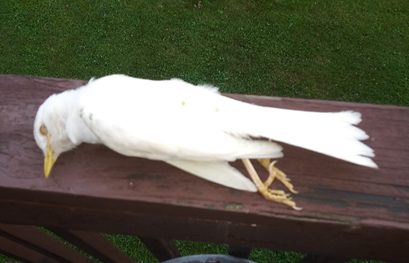
In June, I received a call from a person named Joseph who enjoys watching birds near his home in Plum Borough. He and a neighbor had been watching an albino American Robin in the field behind their apartment complex for a few days. One afternoon three standard colored Robins began harassing this albino and chased it rapidly towards the field’s wooded edge. When Joseph heard a ‘thunk’ as the bird hit a poplar tree, he put on his boots to search for it.  After some effort he found the bird, unfortunately dead. He called the National Aviary to report his find, and a representative he spoke with forwarded his number to me. I visited Joseph to retrieve the rare specimen, and he later sent me pictures of the living bird as well as an immediate post-mortem image showing pink eyes, a feature which designates the creature as a true albino.

albino American Robin laying on its side outdoors

Adding the Albino Robin to the Museum Collection

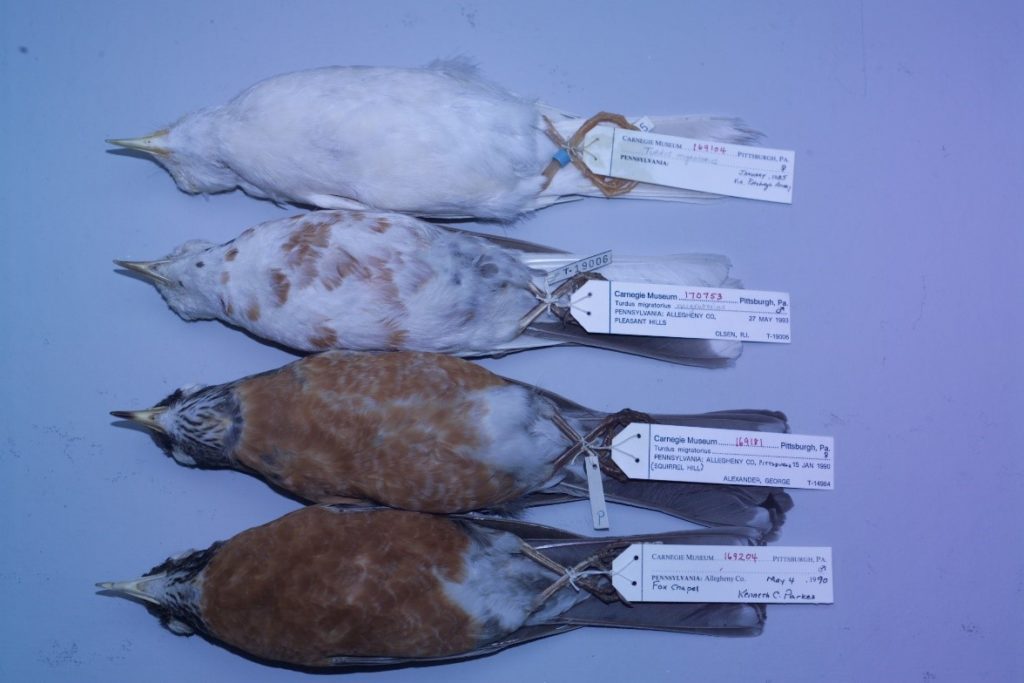
I contacted Annie Lindsay, Powdermill Nature Reserve’s Banding Program Manager, to ask if she had ever seen an albino at the museum’s field research station. She had not, but reported some encounters with birds bearing leucistic feathers. The term refers to feathers without pigment. Sometimes birds who lose individual feathers when they are not molting replace a lost colored feather with one that is white. I have seen this phenomenon in some birds I have prepared. I have also occasionally prepared birds with leucism, a condition caused by a genetic mutation that results in a partial reduction of color in a bird’s plumage, resulting certain areas white and other areas the typical colors of the species.

Among the American Robins in the CMNH collection we have an example of both a full albino and a leucistic individual. Both are pictured below alongside a male and female robin in normal coloration. The leucistic bird had been watched for three years before it was found dead. This lifespan can be interpreted as evidence that other robins must have accepted its’ coloration.

Four study skins of American Robins

All of these birds are from the Pittsburgh area, a region which has been the primary source of birds added to the collection for many years. Typical collection addition situations involved vigilant bird watchers who found a bird that had been hit by a car (one of these individuals) or had been found dead near a window. Over the past 40 years I’ve transformed thousands of such feathered accident victims into museum specimens for current and future scientific studies. During this time, I’ve noticed a trend. If a person finds a dead bird, they may or may not contact the museum to see if we want the specimen. However, if it appears to be extra colorful, or rare by distribution, or in the case of the Plum Borough robin, albino, they may make a special effort to reach out to Carnegie Museum of Natural History. The albino American Robin is still in a museum freezer awaiting preparation. Perhaps it may become a taxidermy specimen rather than a study skin.

Stephen P. Rogers is Collection Manager in the Section of Birds at Carnegie Museum of Natural History. Museum employees are encouraged to blog about their unique experiences and knowledge gained from working at the museum.

Related Content

Halloween and Birds

Lights Out for Birds

Turkeys

Carnegie Museum of Natural History Blog Citation Information

Blog author: Rogers, Stephen P.
Publication date: October 21, 2021

Share this post!

  • Share on Twitter Share on Twitter
  • Share on Facebook Share on Facebook
  • Share on Pinterest Share on Pinterest
  • Share on LinkedIn Share on LinkedIn
  • Share on Reddit Share on Reddit
  • Share via Email Share via Email

Filed Under: Blog Tagged With: Birds, Science News, Stephen Rogers

  • « Go to Previous Page
  • Page 1
  • Interim pages omitted …
  • Page 12
  • Page 13
  • Page 14
  • Page 15
  • Page 16
  • Interim pages omitted …
  • Page 43
  • Go to Next Page »

sidebar

About

  • Mission & Commitments
  • Directors Team
  • Museum History

Get Involved

  • Volunteer
  • Membership
  • Carnegie Discoverers
  • Donate
  • Employment
  • Events

Bring a Group

  • Groups of 10 or More
  • Birthday Parties at the Museum
  • Field Trips

Powdermill

  • Powdermill Nature Reserve
  • Powdermill Field Trips
  • Powdermill Staff
  • Research at Powdermill

More Information

  • Image Permission Requests
  • Science Stories
  • Accessibility
  • Shopping Cart
  • Contact
  • Visitor Policies
Stay in the loop! Sign up for our newsletter(s).
One of the Four Carnegie Museums | © Carnegie Institute | Privacy Policy | Terms of Use | Accessibility
Rad works here logo