• Skip to primary navigation
  • Skip to main content
  • Skip to primary sidebar

Carnegie Museum of Natural History

One of the Four Carnegie Museums of Pittsburgh

  • Visit
    • Buy Tickets
    • Visitor Information
    • Exhibitions
    • Events
    • Dining at the Museum
    • Celebrate at the Museum
    • Powdermill Nature Reserve
    • Event Venue Rental
  • Learn
    • Field Trips
    • Educator Information
    • Programs at the Museum
    • Bring the Museum to You
    • Guided Programs FAQ
    • Programs Online
    • Climate and Rural Systems Partnership
  • Research
    • Scientific Sections
    • Science Stories
    • Science Videos
    • Senior Science & Research Staff
    • Museum Library
    • Science Seminars
    • Scientific Publications
    • Specimen and Artifact Identification
  • About
    • Mission & Commitments
    • Directors Team
    • Museum History
  • Tickets
  • Give
  • Shop

Blogs from our Scientific Researchers

Carnegie Museum of Natural History is home to active research and vast scientific collections. Our scientific researchers regularly contribute to the blog at the museum.

October 13, 2020 by wpengine

Early Bats: Ancient Origins of a Halloween Icon

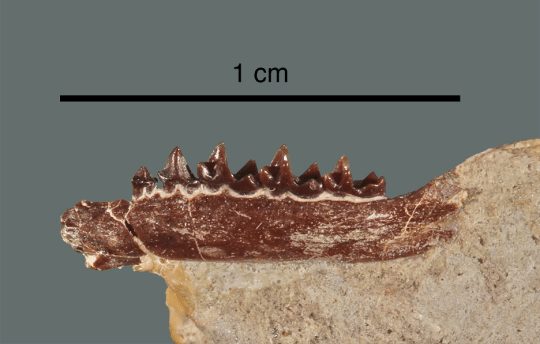
Specimen Carnegie Museum (CM) 62641, the holotypic, or name-bearing, right dentary (lower jaw bone) of the tiny fossil bat Honrovits tsuwape in lingual (= internal) view, still partially encased in ~50-million-year-old rock of the Wind River Formation of west-central Wyoming. Note the length of the scale bar, only 1 cm (less than half an inch)!

Did you know that bats have been around for at least 55 million years? In 1992, several fossils in the Carnegie Museum of Natural History collection, including the lower jaw bone shown above, were described as representing a new genus and species of ancient bat, Honrovits tsuwape—Shoshone for “bat” and “ghost,” respectively—by a team that included two former curators in the museum’s Section of Vertebrate Paleontology, Christopher Beard and Leonard Krishtalka, both now of the University of Kansas. Honrovits dates to the early part of the Eocene Epoch of the Cenozoic Era (the ‘Age of Mammals’), about 50 million years ago, and is a member of a now-extinct bat group called the Onychonycteridae.
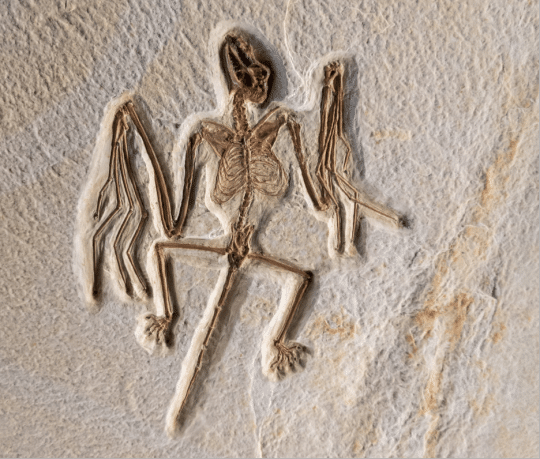
Replica of a beautifully preserved fossil skeleton of Onychonycteris finneyi, a close relative of Carnegie Museum of Natural History’s own Eocene-aged bat Honrovits tsuwape, on display at Fossil Butte National Monument in Wyoming. Photo by Matthew Dillon.

Interestingly, Honrovits shares dental characteristics with a mammal group known as insectivores, which includes today’s hedgehogs, shrews, and moles, and in that sense, it differs from the condition in most other bats. However, bat teeth possess distinctive diagnostic features, so although Honrovits is known only from a few tooth-bearing jaw bones and a skull fragment, there’s no doubt that the diminutive beast was indeed an early bat. The fragmentary nature of its fossils means that we don’t know for sure what Honrovits looked like in life, though it’s a good bet that it bore a close resemblance to other onychonycterid bats, such as Onychonycteris finneyi, which is known from exquisitely preserved skeletons (such as the one shown above).
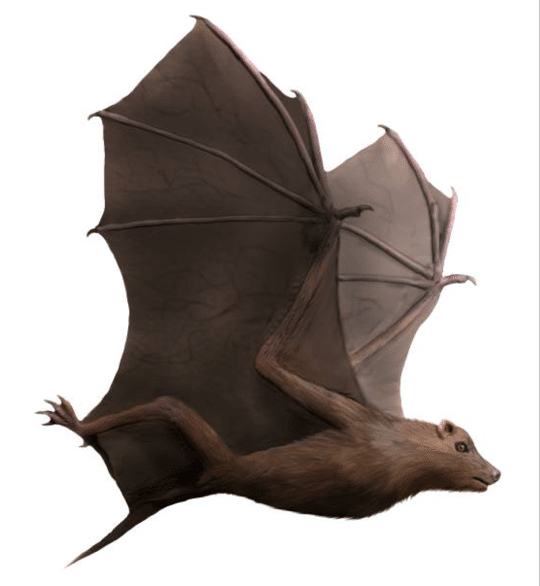
Flesh reconstruction of the ~50-million-year-old bat Onychonycteris finneyi. There’s an excellent chance that Honrovits tsuwape would have looked like this. Art by Nobu Tamura.

The incompleteness of the Honrovits fossils is, unfortunately, the norm rather than the exception when it comes to prehistoric bats. Fossils of these creatures are exceedingly rare because most bats have very small, light skeletons and achieve their greatest diversity and abundance in areas that have low potential for fossil preservation, such as tropical forests. Occasionally, complete skeletons such as those of Onychonycteris are found, but not nearly as often as fragments.

So, this autumn, if you happen to catch a glimpse of a bat silhouetted against the evening sky, acrobatically wheeling and plunging in pursuit of flying insects, pause and reflect on the history of these extraordinary flying mammals whose ancestry dates nearly to the time of the dinosaurs.

Linsly Church is a Curatorial Assistant in the Section of Vertebrate Paleontology at Carnegie Museum of Natural History. Museum staff, volunteers, and interns are encouraged to blog about their unique experiences and knowledge gained from working at the museum.

Related Content

Halloween and Birds

How Do You Preserve a Giant Pumpkin?

Ask a Scientist: What is the newly discovered “Crazy Beast?”
Filed Under: Blog Tagged With: halloween, Linsly Church, mammals, Science News, Vertebrate Paleontology

October 8, 2020 by wpengine

How Do You Preserve a Giant Pumpkin?

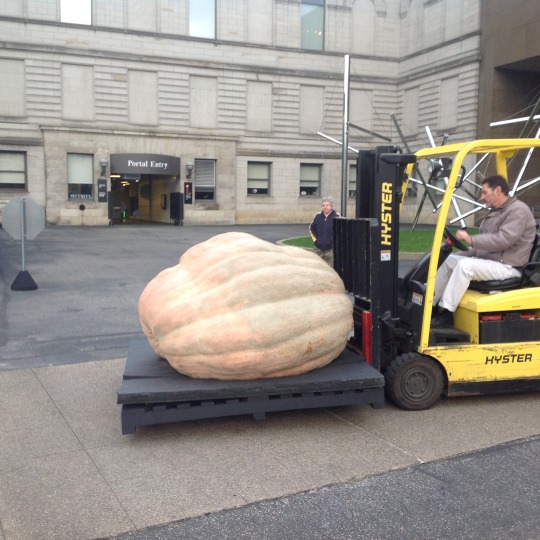
giant pumpkin being moved with a forklift

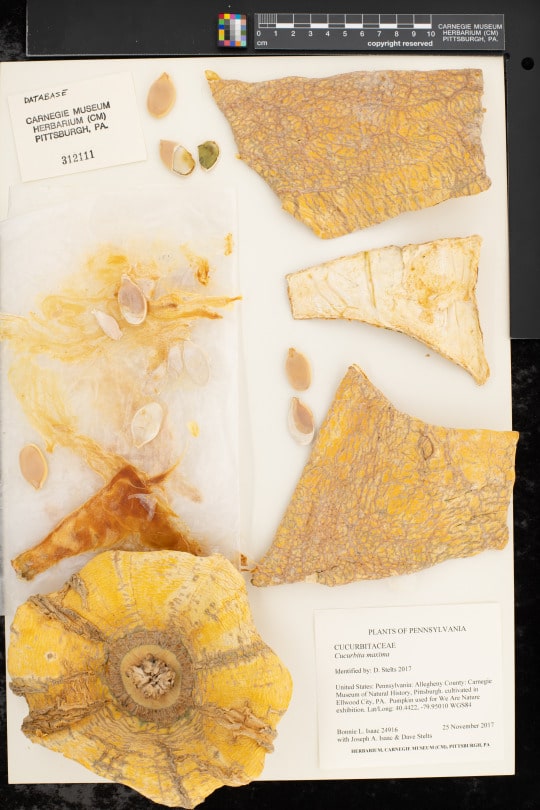
A few years ago, I came across a dilemma that I wasn’t sure how to resolve. The Section of Botany was given permission to preserve, for the scientific collection, part of the giant pumpkin that was in the exhibition, We Are Nature: Living in the Anthropocene. This was an intriguing offer. I just wasn’t sure how to go about it. Preserving any large fruits or plant parts can be a real challenge. Plant materials must be dried before they rot, and the process must happen at a temperature low enough to prevent the material from being cooked. The normal procedure of putting a plant or plant part into a plant press and drying it with warm dry air was not really an option; at least not for a 2,090-pound pumpkin that wouldn’t even fit in my car, let alone my plant press.

Pumpkins are a type of squash, but trying to literally squash one to dry it seemed a bit daunting. The farmers who grew this giant pumpkin were more than willing to give us whatever parts of the pumpkin we wanted to preserve, and they were even willing to help with cutting them from the pumpkin. We decided on trying to keep the unique parts of the pumpkin, like the stem and the blossom end (bottom). We also saved some of the inner tissue and a few seeds. The seeds on a pumpkin this large are a prize commodity. If a pumpkin from which seeds are properly harvested was a champion, as this one was, each seed could sell for $30 to upwards of $50. It was very generous of the farmers to allow us to have some of these seeds for our collection.

dried pieces of a pumpkin on an herbarium sheet

Pumpkin farmers keep close tabs on the genetics of these giants and actively work at growing larger pumpkins. You can actually find family tree information for this very pumpkin online if you search for it. Who knows how large mankind will eventually enable pumpkins to grow? The plants that grow these large squashes (the Cucurbita maxima variety known as ‘Atlantic Giant’) are a variety of the same species that produce Hubbard Squash. This species, which was originally from South America, has become one of the more diverse domesticated plants.

Giant pumpkins have been a focal point of imagination and literature for some time. Think of Cinderella. There are several variants on the Cinderella tale going back hundreds of years that involve large squash. Back when these stories were written though, it was a fantasy to think there actually could be a pumpkin that a person could fit inside.

Now that we are using QR codes on our herbarium labels, it’s easy to add photographs to plant specimen records. I wish we had thought to do this  before the massive pumpkin was cut up. Maybe I will go back and add a QR code to the label, so the actual pumpkin can be seen again in its full glory. What we have in the collection now are bits and pieces, mere remnants of the gentle giant that grew 45-50 pounds per day in 2017.

Getting back to my original question, how do you preserve a giant pumpkin? I guess the answer is a little bit at a time!

More on this giant pumpkin:

Sasquatch Squash

Giant Pumpkin Seed Harvest 

Collected on This Day: November 25, 2017

Bonnie Isaac is the Collection Manager in the Section of Botany. Museum staff, volunteers, and interns are encouraged to blog about their unique experiences and knowledge gained from working at the museum.

Filed Under: Blog Tagged With: Anthropocene Studies, Bonnie Isaac, Botany, Hall of Botany, halloween, Science News, Section of Botany

October 7, 2020 by wpengine

Halloween and Birds

Birds, being the happy creatures they are, don’t seem to me to connect with Halloween. Sure, death scenes in old movies, or exaggerated depictions of nighttime itself, are often populated with vultures, owls and corvids (crows and ravens), but Halloween itself, not so much. About the only “scary” term I can think of relating to birds is the group popularly referred to as “GOATSUCKERS.”

Early stories about goatsuckers can be credited to Aristotle and Pliny over 2000 years ago. Rumors about a group of birds now classified Caprimulgids, indicated they would suck the milk out of goats, and afterwards the goats would go blind. Of course, the stories are false, but the persistence the common group name might very well continue to frighten young children.

The 70 species of Caprimulgids remain saddled with a Family name, and in some cases a Genus name, that translates from Latin, “capra” for nanny goat, and “mulgēre” to milk, as “milker of goats,” or considering how a bird might attempt such a feat, “goatsucker.”

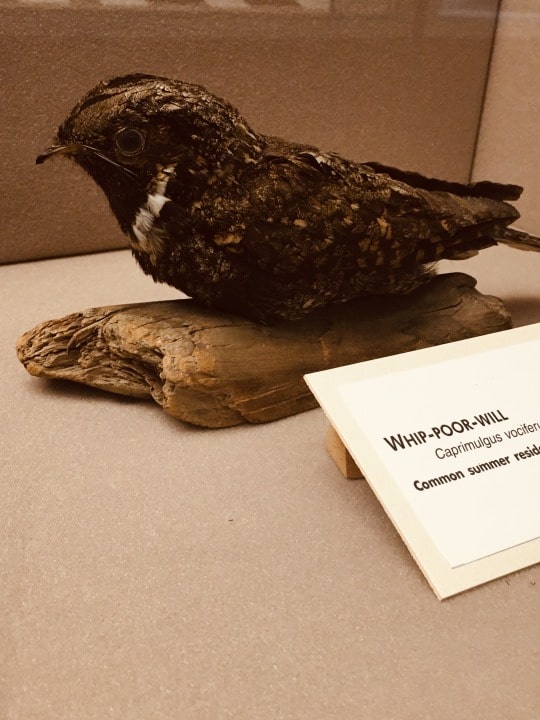
taxidermy mount of whip-poor-will
Image credit: Pat McShea

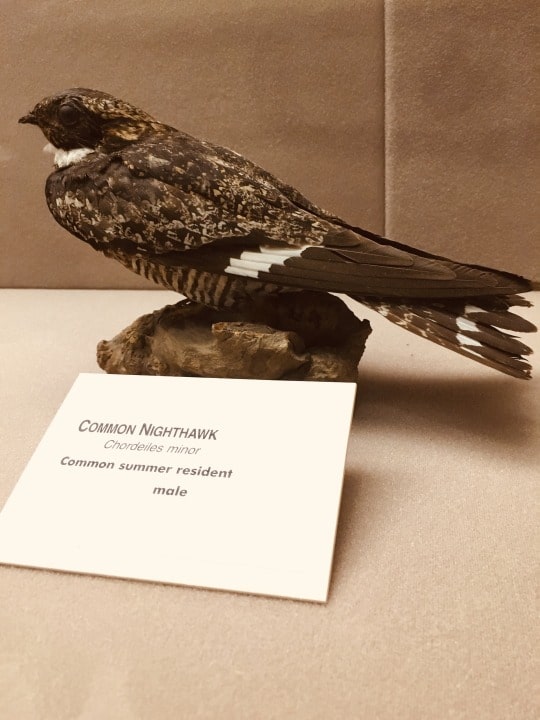
The family Caprimulgidae is a nocturnal group of birds referred to as nightjars or nighthawks that live worldwide except in New Zealand and on some islands in Oceania. In Pennsylvania the only birds of this group seen routinely are the Common Nighthawk and the Whip-poor-will, and both species are declining in numbers. Both are insectivorous birds with what appears to be small mouths that can actually open extremely wide to swallow insects in flight. The sounds of Whip-poor-wills can be haunting to those unfamiliar with them. For an image of the bird and a recording of their distinctive sound click this YouTube link.

taxidermy mount of common nighthawk
Image credit: Pat McShea

The CMNH Section of Birds collection, with nearly 207,000 records, includes only three “goatsuckers” collected on Halloween. Two are Pauraques (Nyctidromus albicollis yucatanensis) from Veracruz, Mexico collected in 1963, and a single Common Nighthawk (Chordeiles minor minor) found dead by former Amphibian and Reptiles Curator Jack McCoy in Schenley Park on Halloween night 1989. Migration should have happened long before that date – in fact this fall Pittsburgh’s estimated peak occurred September 14, when an estimated flight of 50,000 birds of various species passed overhead overnight.

Stephen Rogers is Collection Manager in the Section of Birds at Carnegie Museum of Natural History. Museum employees are encouraged to blog about their unique experiences and knowledge gained from working at the museum.

Related Content

Sympathy For the Devil

Collected on This Day in 1967: Fall Blooms Rival Those of Spring

Ask a Scientist: How do you tell the difference between a raven and a crow?

Filed Under: Blog Tagged With: Birds, Hall of Birds, halloween, Science News, Section of Birds, Stephen Rogers

October 6, 2020 by wpengine

Sympathy for the Devil

Bats and devils are among the most popular topics associated with Hallowe’en.  Of course, the research collection in the Section of Mammals has worldwide examples of bats species, but we don’t find them scary and we think about bats and their vital ecological roles all year long.  Perhaps more mysterious and less well-known are the two Devil specimens stored among the wombats, kangaroos, and koalas in our collection.  Even school children have heard about *our* kind of devils.  Yes, the Tasmanian devil (Sarcophilus harrisii) is a marsupial – a pouched mammal, like our opossum – that is found only on the island of Tasmania, located some 140 miles off the southeast coast of Australia.  Fossil evidence tells us that it once lived on the Australian mainland, but it may have been wiped out on the continent by the introduction of the Dingo, Australia’s legendary wild dog.

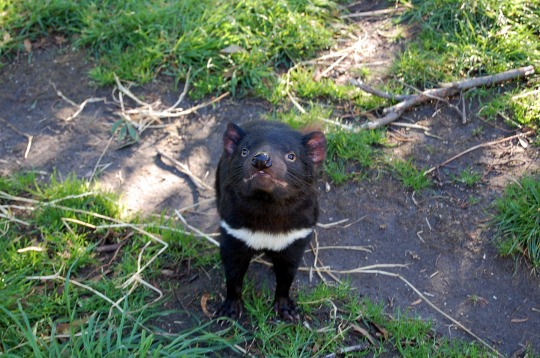
photograph of Tasmanian devil

The Tasmanian devil is a stocky mammal with short legs, short black fur and a distinctive white throat patch. Its head is noticeably large for the size of the body. An adult male may weigh up to 20 lbs. They are nocturnal with a good sense of sight, smell, and touch. Devils are known to cover significant distances nightly, in search of carrion or prey. They can move surprisingly fast and seem to enjoy swimming. In the wild, individuals can live between five and seven years, but many die within the first year of birth. Although it is the largest living marsupial carnivore, the Tasmanian devil is predominantly a scavenger.

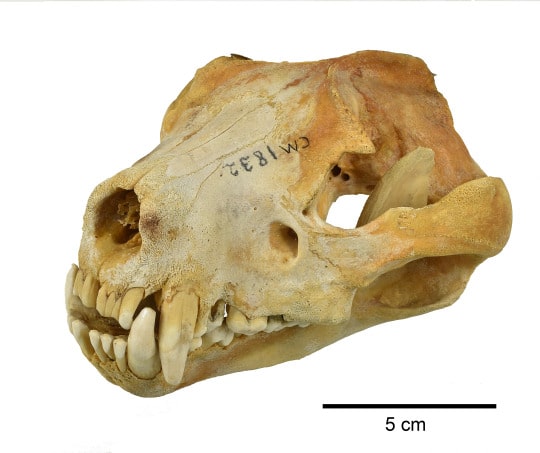
Tasmanian devil skull

A close look at the skull shows evidence of space on the side of the head for large jaw muscles. For its size, the Tasmanian devil has the strongest bite force of any mammal – more powerful than even a hyena! With the large masseter muscles and especially large molars, it can easily crush bone. In fact, devils are such efficient carrion-eaters that they willingly consume an entire carcass, including the fur.

Although this animal gained a reputation for having a bad disposition, it is speculated that this impression was derived from the poor conditions it was kept in when first captured for observations. Since then, it sometimes has been kept humanely as a pet and been found to be much friendlier than initially reported. Tasmanian devils do not seek each other’s company except during the mating period. However, they often come together to feed on a dead animal, where vocalizations and as many as nineteen different behavioral cues are used for communication. These communal gatherings are characterized by aggression and loud sounds, described as “frequent growling” and “blood-curdling screams”!

In 1996, a sad chapter began in the existence of the Tasmanian devil. A deadly infectious cancer called devil facial tumor disease, began to spread within the population. In 2012, the Australian government transferred 30 disease-free individuals to tiny Maria Island off the coast of Tasmania, in what was called ‘island insurance’, while researchers worked on perfecting a vaccine. By 2017, the disease had led to a 90% extinction rate on Tasmania. In hopeful news, by 2019 there were indications that surviving individuals’ immune systems may be undergoing modifications to fight the disease. In early September 2020, a consortium of conservation groups released 11 Tasmanian devils to a wildlife sanctuary in the state of New South Wales, placing the Tasmanian devil on the Australian mainland for the first time in more than 3000 years.  An additional 15 devils were released in early October and more releases are planned.

Currently, the Tasmanian devil is not extinct, but its recovery hangs in the balance. It would be tragic if we are left only with museum specimens and Taz, the Looney Tunes cartoon image, of this fascinating mammal.

Suzanne B. McLaren is the Collection Manager in the Section of Mammals at Carnegie Museum of Natural History. Museum employees are encouraged to share their unique experiences from working at the museum.

Related Content

Scientists Live: Mammalogist Suzanne McLaren on Bats

Vampire Squid: Cutest Dracula

Do Snakes Believe in the Tooth Fairy?

Filed Under: Blog Tagged With: mammals, Museum from Home, Science News, Section of Mammals, Suzanne McLaren

October 2, 2020 by wpengine

Vampire Squid: Cutest Dracula

The Vampire Squid is your go-to mollusk for Halloween. It’s covered with glow-in-the-dark spots, and it can hoist its cape-like webbed arms over its head to transform into a pumpkin shape complete with outward-pointing fleshy spines. But wait, there’s more. With the largest eyes relative to body size of any animal, this has got to be the cutest Dracula you ever saw. And the scientific name, inspired by the cloak-like webbing and the dark body color, literally translates to “vampire squid from hell.”

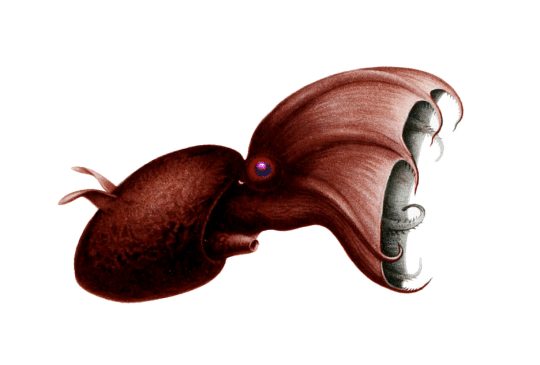
Vampire Squid, showing cloak-like webbing between arms, large eye, and ear-like fins. [Image from Wikimedia Commons]

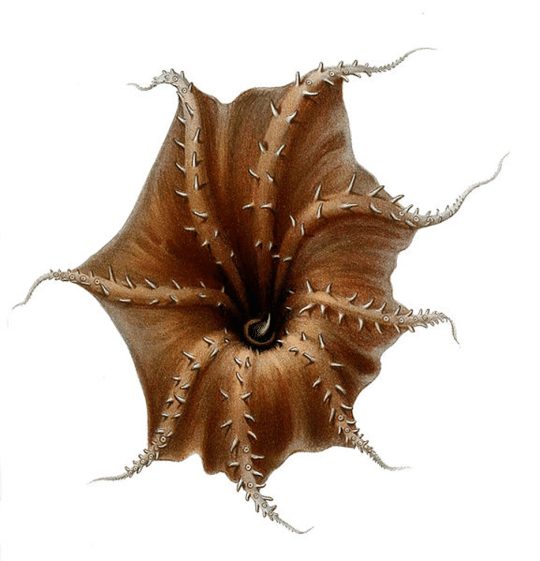
The Vampire Squid (Vampyroteuthis infernalis) is an extreme deep-water cephalopod more closely related to octopuses than to squids. It is so bizarre that scientists classify it in its own taxonomic order, Vampyromorphida, to show that it differs markedly from other living cephalopods. Like octopuses, it has 8 arms with webbing between them, but unlike octopuses that have suckers on the entire length of the arms, the Vampire Squid bears suckers only on their outermost half. The prominent feature on the arms of the Vampire Squid are fleshy spines or cirri. In addition to the eight arms, it has two velar filaments, in pouches in the webbing, that are analogous (and maybe homologous) to the two long tentacles of squids.

Regarding superlatives, the Vampire Squid has the largest eyes relative to its body size of any other animal, a detail noted in the Guinness World Records. A fully-grown individual can be 28 cm (11 inches) long with eyes 2.5 cm (1 inch) in diameter. Adding to the cuteness factor, they have adorable ear-like fins, which adults use for swimming; juveniles also have fins, but primarily use jet propulsion to move around.

They live in the lightless ocean depths 600-900 m (2000-3000 feet) deep in temperate and tropical oceans world-wide. The ocean at these depths is an oxygen minimum zone with so little dissolved oxygen that most complex organisms cannot survive. But the vampire squid survives perfectly well with a low metabolism and blue blood that is more efficient at carrying oxygen than that of other cephalopods. They use ammonium in their tissues to regulate their buoyancy (ammonium is a wee bit lighter than water), reducing the need for active swimming. Living in the oxygen minimum zone probably helps it to avoid predators.

If disturbed, the Vampire Squid kind of turns itself inside-out into the “pumpkin” or “pineapple” posture by curling its arms and webbing up to cover the body with the spiny cirri pointing outward. Their body is covered by photophores, or light-emitting organs, which they can use to flash a wide range of patterns. In the pumpkin pose, they conceal most of the photophores, but they can light up the tips of the arms and wave them around to distract predators. If it gets really annoyed, the Vampire Squid can release a sticky cloud of luminous mucus that glows for nearly 10 minutes, presumably long enough for the Vampire Squid to make a get-away into the inky darkness.

Vampire Squid, underside of arms showing fleshy spines. [Image from Wikimedia Commons]

Much of what we know about their behavior comes from videos made by Remotely Operated Vehicles. It is hard to keep Vampire Squids alive in aquariums at the much lower pressure of our human world, but the Monterey Bay Aquarium succeeded for a while and has some great videos. Aquarium scientists were able to solve the mystery about what the Vampire Squid eats. No, it doesn’t eat blood! It eats detritus (organic debris), also known as marine snow. As the Vampire Squid drifts in the current, any debris that touches an extended filament is moved by the creature’s arms to its mouth. Unusual for being the only known cephalopod to eat non-living food, the Vampire Squid is adapted to eat material that falls through the oxygen minimum zone. Marine snow includes dead bodies, feces, and a lot of mucus from above, and because of the mucus, it is sometimes jokingly referred to as marine snot.

I imagine if Dracula learned about the Vampire Squid, he might exclaim, “I thought it was eating blood, but it’s snot!”

Timothy A. Pearce, PhD, is the head of the mollusks section at Carnegie Museum of Natural History. Museum employees are encouraged to blog about their unique experiences and knowledge gained from working at the museum.

Related Content

Extremely Rapid Evolution of Cone Snail Toxins

Ask a Scientist: Are slugs and snails the same thing?

Chasing Snails in the Great Smoky Mountains

Filed Under: Blog Tagged With: Museum from Home, Science News, Section of Mollusks, Tim Pearce

October 2, 2020 by wpengine

Do Snakes Believe in the Tooth Fairy?

When a child loses a baby tooth, the Tooth Fairy will sneakily appear a short time later to snatch that tooth up and leave behind a little treat. But what happens when vipers or other snakes with large fangs lose their teeth? I doubt the Tooth Fairy would be too keen about sneaking up on a sleeping snake…and as someone who studies and admires snakes, I would not recommend it!

image
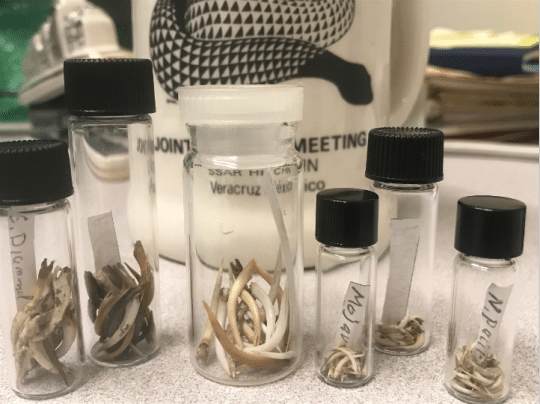
Vials containing Viperidae snake fangs. The middle vial (with clear lid) contains fangs of the Gaboon viper.

I recently learned the answer to this question when I was given seven tiny vials containing dozens of fangs. These fangs came from various species of snakes in the Viperidae family, including the Mojave green rattlesnake (Crotalus scutulatus), the Northern Pacific rattlesnake (Crotalus oreganus), and the Gaboon viper (Bitis gabonica), which has the longest fangs of any snake species. The researcher who gifted us these fangs was curious about the outcome of shed snake teeth and wanted to determine how frequently snake fangs may be swallowed and passed through the snake’s digestive tract. To answer this question, he dissected and examined dried snake feces for the possible presence of shed fangs.*

As it turns out, snakes will occasionally swallow their shed fangs! Vipers are carnivores that have to hunt down and subdue live prey in order to eat and survive. Often there is a struggle between predator and prey and, in that process, a fang may be wiggled lose. Instead of falling out of a snake’s mouth, the snake may swallow the fang along with the prey item. The fang will ultimately pass through the snake’s digestive system and emerge in its feces.

image
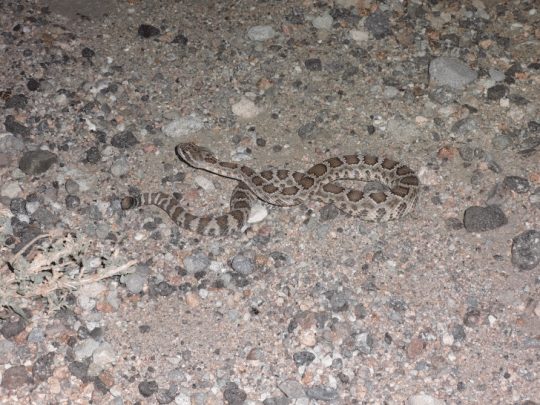
Pacific rattlesnake (Crotalus oreganus) in the Mojave Desert, California. One of the vials contained fangs from this species, but from snakes in the northern portion of the species’ range.

As the collection manager of the Section of Amphibians and Reptiles, I oversee and care for the museum’s massively beautiful and useful collection of cool and creepy herpetofaunal specimens. These specimens include full body wet specimens preserved in alcohol, the osteology collection of bones and turtle shells, and other items such as histology slides, gut contents, and even fangs. Regardless of their preservation form, all the reptile and amphibian specimens within the collection are useful for researchers and could serve to answer future scientific questions. Although the fangs within these seven seemingly unimposing vials have already answered one burning scientific question, they will be added to the collection so see what other answers they can provide!

*Researchers take careful precautions when handling feces as it can carry disease. Do not handle feces you may see in the wild.

Stevie Kennedy-Gold is the collection manager for the Section of Amphibians and Reptiles at Carnegie Museum of Natural History. Museum employees are encouraged to blog about their unique experiences and knowledge gained from working at the museum.

Related Content

Ask a Scientist: What is an Alcohol House?

The Enduring Appeal of Snakes

Poisons of the Carnegie: Timber Rattlesnake

Filed Under: Blog Tagged With: herpetology, Museum from Home, Science News, Stevie Kennedy-Gold

  • « Go to Previous Page
  • Page 1
  • Interim pages omitted …
  • Page 26
  • Page 27
  • Page 28
  • Page 29
  • Page 30
  • Interim pages omitted …
  • Page 43
  • Go to Next Page »

sidebar

About

  • Mission & Commitments
  • Directors Team
  • Museum History

Get Involved

  • Volunteer
  • Membership
  • Carnegie Discoverers
  • Donate
  • Employment
  • Events

Bring a Group

  • Groups of 10 or More
  • Birthday Parties at the Museum
  • Field Trips

Powdermill

  • Powdermill Nature Reserve
  • Powdermill Field Trips
  • Powdermill Staff
  • Research at Powdermill

More Information

  • Image Permission Requests
  • Science Stories
  • Accessibility
  • Shopping Cart
  • Contact
  • Visitor Policies
One of the Four Carnegie Museums | © Carnegie Institute | Privacy Policy | Terms of Use | Accessibility
Rad works here logo