• Skip to primary navigation
  • Skip to main content
  • Skip to primary sidebar

Carnegie Museum of Natural History

One of the Four Carnegie Museums of Pittsburgh

  • Visit
    • Buy Tickets
    • Visitor Information
    • Exhibitions
    • Events
    • Dining at the Museum
    • Celebrate at the Museum
    • Powdermill Nature Reserve
    • Event Venue Rental
    • Gift Cards
  • Learn
    • Field Trips
    • Educator Information
    • Programs at the Museum
    • Bring the Museum to You
    • Guided Programs FAQ
    • Programs Online
    • Climate and Rural Systems Partnership
  • Research
    • Scientific Sections
    • Science Stories
    • Science Videos
    • Senior Science & Research Staff
    • Museum Library
    • Science Seminars
    • Scientific Publications
    • Specimen and Artifact Identification
  • About
    • Mission & Commitments
    • Directors Team
    • Museum History
  • Tickets
  • Give
  • Shop

Blogs from our Scientific Researchers

Carnegie Museum of Natural History is home to active research and vast scientific collections. Our scientific researchers regularly contribute to the blog at the museum.

November 9, 2020 by wpengine

Thanksgiving and Nutritional Mineralogy

by Travis Olds

We each have plenty to be thankful and hopeful for this year, but did you know that our traditional American Thanksgiving feast “with all the fixings,” would not be possible without minerals or the people who mine, process, and manufacture the mineral-related materials found in our kitchens?
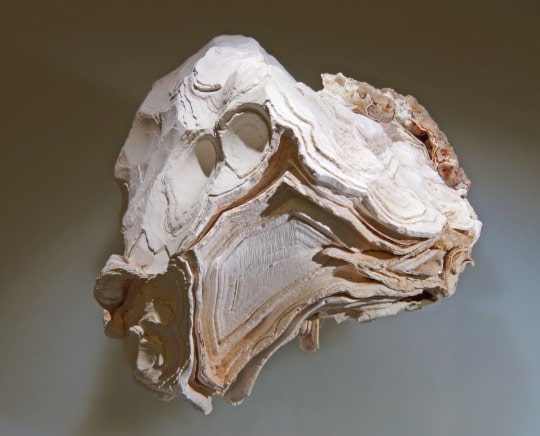
Kaolinite
Kaolinite. Photo Credit: Debra Wilson

You should thank miners, in part, for the kaolinite clay used to make the fine porcelain china or ceramic plates at your dinner table. When kaolinite is fired in the factory, it partially melts, and crystals of an aluminum-silicate mineral called mullite that hold the ceramic together and give it high heat resistance form on cooling. Also, whether you eat and serve food with silver, steel, or aluminum utensils, extensive work and energy were needed to extract and refine the silver, iron, or aluminum metal necessary for their creation. Silver ore, for example, usually contains many other elements, including lead, zinc, copper, and gold, which can require lengthy chemical or electrochemical processes to separate.
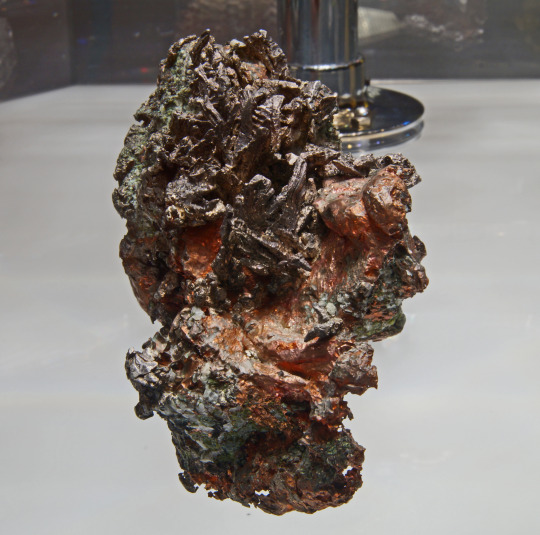
silver on copper
Silver on copper. Photo credit: Debra Wilson

There might also be some unwanted mineral interactions occurring at the dinner table. If your gluttonous Uncle Ned consumes too much salt (sodium) with his gravy and potatoes (high in oxalate) this year, his body may begin to form kidney stones; which are biologically formed minerals made up of crystals of the phosphate mineral struvite and the calcium oxalate mineral whewellite. These biominerals, which can form when your bladder isn’t fully emptied after a sodium or oxalate-rich meal, can be extremely painful, so be sure to drink plenty of water with your meal. Large crystals take time to grow and drinking more water can reduce the concentration of sodium and oxalate in your body, slowing growth of the kidney stones.

Turkey meat, the mainstay of many Thanksgiving meals, also depends heavily on minerals. Did you know that turkeys actually need to swallow small rocks and pebbles, which are made of minerals, in order to digest their food? “Gastroliths,” or stomach stones, are used by other species of birds, reptiles, amphibians, worms, whales, and even some fish to crush their food and provide more nutrients! Fortunately, we humans have a variety of enzymes and strong stomach acids to break down nutrients in the food we eat.

A surprising amount of nutritional science is applied to raising turkeys; their diet is closely monitored and controlled for proper protein and “mineral” content so that they grow large. You have likely heard the term “mineral” applied to many of our dietary items as well, from mineral water, to a variety of products being fortified with vitamins and minerals, or even the advice that it’s important to maintain a healthy balance of minerals in your diet. The term is somewhat misleading because “minerals” in this sense typically refers to individual atomic elements such as potassium or iron, or to other compounds containing these elements, rather than actual minerals in the strict sense. To a mineralogist like me, minerals are naturally occurring crystalline solids made from a specific combination of elements.
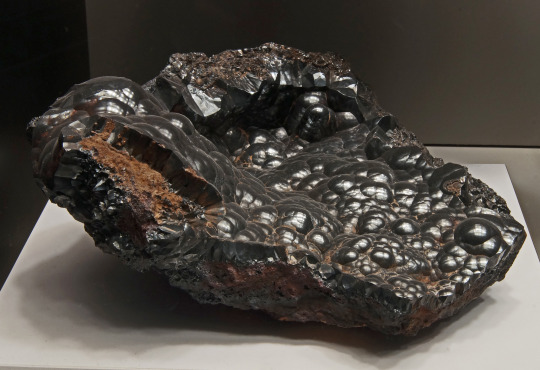
hematite
Hematite. Photo credit: Debra Wilson

Most often, the elements essential for our diet have been pre-digested, extracted or processed by another plant or animal, or have been chemically separated from a mineral source that makes it easier for our bodies to absorb. For example, most rice and cereal in the U.S. is fortified with B-vitamins and iron with a coating of finely ground nutrient powder. While the source of iron used in the fortifying powder varies, it all originates with the iron-oxide minerals hematite and goethite. Plants, bacteria, or stomach acids break down these minerals into iron cations that are easier for our body to process.

Thanksgiving vegetable dishes deserve special attention because plants can be the best sources for certain nutrients. In many cases, fruits and veggies grown on the farm also need help with their diet. Feldspar minerals present in soil hold on strongly to certain elements like K, more commonly known as potassium, making it hard for plants to extract this element. Farmers address this problem by using fertilizers like manure, containing predigested and readily absorbed phosphorous, nitrogen, and potassium, to produce a bountiful harvest

This year, please extend a bit of thankfulness to minerals, but mostly give thanks and recognition to the people that work hard to make your Thanksgiving possible; be it a miner, factory worker, your grocer, butcher, farmer, doctor, or all those working behind the scenes and on the front lines that keep us happy, healthy, and well fed.

Travis Olds is Assistant Curator of Minerals at Carnegie Museum of Natural History. Museum employees are encouraged to blog about their unique experiences working at the museum.

Related Content

Ask a Scientist: What is biogeochemistry? 

Why Do Leaves Change Color?

Beauty From the Ashes

Carnegie Museum of Natural History Blog Citation Information

Blog author: Olds, Travis
Publication date: November 9, 2020
Share this post!

  • Share on Twitter Share on Twitter
  • Share on Facebook Share on Facebook
  • Share on Pinterest Share on Pinterest
  • Share on LinkedIn Share on LinkedIn
  • Share on Reddit Share on Reddit
  • Share via Email Share via Email

Filed Under: Blog Tagged With: gems and minerals, Hillman Hall of Minerals and Gems, minerals, minerals and gems, Museum from Home, Science News, Section of Minerals, Travis Olds

November 9, 2020 by wpengine

The Surrounding Trees Whispered with Their Leaves

A fictional short story about a new era of inter-being communication and earth healing from past human mistakes.

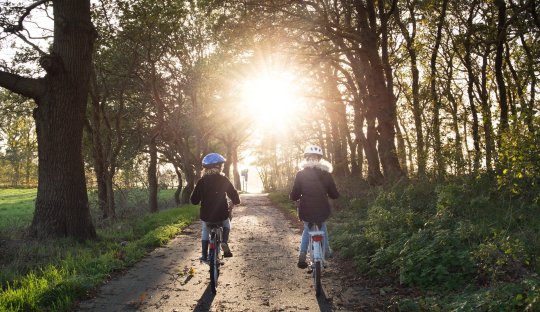
two children on bicycles riding on a path in the woods

As a transdisciplinary scholar, I am always pushing myself to experiment with new ways of communicating and exploring ideas. This summer, I was invited with my long-term collaborator, Tomas Matza, associate professor of Anthropology at University of Pittsburgh, to contribute to a Post-Covid Fantasies blog series published by the journal American Ethnologist. The prompt was to “propose imagined or speculative future scenarios for how things could be better in a post-covid world than previously.”

Writing this fantasy illustrated to me the power of speculative fiction for confronting the complexity of the Anthropocene. Anthropocene problems – climate change, biodiversity loss, pandemics – are overwhelming. How are we possibly going to solve the myriad of challenges that we all face living on a crowded, hot planet? It’s hard enough these days just to go to the grocery store!  But with speculative fiction – or imagining futures, we can transcend the practical affairs of “real life” and let our minds wander freely. We can explore unthinkable changes and fantastical scenarios.

For me one of the most surprising aspects of the pandemic experience was how it caused society to stop, at least for a while. The sudden downturn in consumerism, production, travel, and consequently large drops in carbon emissions, was remarkable and unprecedented (documented in the scientific literature here and here). It made me wonder…how will society change in the 21st century? How might people in the future look back at the world today and see it from a radically different perspective? What will trigger the changes that result in our society becoming sustainable? Rather than being through incremental policy work and gradual change, perhaps it will come in a most unexpected way – a giant jump forward – caused by interspecies mingling beyond our wildest dreams?

I hope you enjoy our fantasy, and the other contributions in this series. And I encourage you to write your own post-covid fantasy! What do you imagine for the future?

Nicole Heller is Curator of Anthropocene Studies at the Carnegie Museum of Natural History. Museum employees are encouraged to blog about their unique experiences working at the museum.

Related Content

Anthropocene Living Room (Video)

The Inequity of Summer Heat

From the Allegheny to Our Kitchen Sinks

Filed Under: Blog Tagged With: Anthropocene, Anthropocene Living Room, Museum from Home, Nicole Heller, Science News

November 6, 2020 by wpengine

Why Do Leaves Change Color?

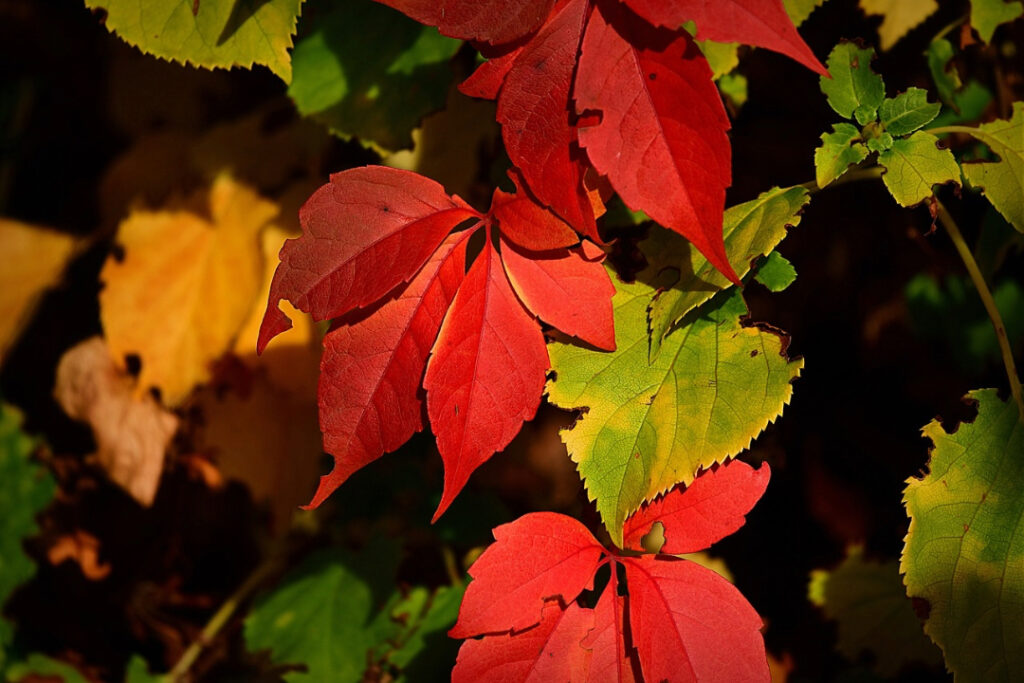
Image by 👀 Mabel Amber, who will one day from Pixabay.

This fall seemed to sneak up on me as time has been simultaneously moving at a rapid pace and in slow motion. As someone once told me when I became a parent, “the days are long, but the years are short,” and this global pandemic brings those words even closer to home. Nevertheless, I took the time to slow down and bask in the beauty of the changing fall leaves this October.  For me, nature is truly restorative, and there aren’t many things more beautiful than driving through the mountains of Western Pennsylvania during peak color change.

But, why do leaves change their color?

During the warmer months in Pennsylvania, trees take advantage of the increasing amount of light and good weather available from longer and warmer days. Using their leaves, trees absorb energy from sunlight, breathe in carbon dioxide, drink up water to produce their own food sources – sugar and starch. This process is only possible through chlorophyll housed in the leaf cells – giving leaves their vibrant green coloration.

Leaves also contain other color pigments ranging from yellow to orange – these pigments are often masked by great amounts of green coloring. But in the fall, the tree begins to prepare for shorter days and colder weather, and the leaves stop their food-making process. To prepare for the upcoming winter, the chlorophyll begins to break down, causing the green color to disappear. This change allows the ever-present yellow, orange, and red pigments to become visible. While chlorophyll breaks down, other chemical changes in the leaves can occur, creating an additional ray of colors through the development of red anthocyanin pigments. The yellow and orange pigments mixed with the red anthocyanin pigments give rise to the reddish and purplish fall colors of trees, such as dogwoods and sumacs.

Each species of tree shows off their own fall color. All these colors are due to the mixing of varying amounts of the chlorophyll residue and other pigments in the leaf during the fall season. This winter preparation creates a nature show like no other.

Another aspect of the leaves changing colors is that those leaves will eventually drop to the ground. Most of the broad-leaved trees in Pennsylvania shed their leaves in the fall (some trees retain their dead leaves until new growth starts in the spring). So, what should you do with your leaves in the fall? According to the U.S. Environmental Protection Agency, leaves and other yard debris account for more than 13% of the nation’s solid waste—33 million tons a year. In typical landfills, there isn’t enough oxygen to decompose the yard waste, causing the development and release of the greenhouse gas methane.

So, what do I do? LEAF IT! (get it?). Leave your leaves where they fall in the fall – or at least, find a nice place in your yard to pile the leaves. Leaf litter can act as both a fertilizer returning the nutrients back into the ground, and as a weed suppressant by acting as a ground cover. Leaf litter is also a vital habitat for much of our favorite wildlife. Many critters – from insects to mammals and everything in between – rely on leaf litter for food, shelter, and nesting material. Many of our favorite moth and butterfly caterpillars overwinter in fallen leaves before emerging in spring! So, if you want free mulch and fertilizer, to create wildlife habitat, and have more free time – LEAF IT!

Heather Hulton VanTassel is Assistant Director of Science and Research at Carnegie Museum of Natural History. Museum employees are encouraged to blog about their unique experiences and knowledge gained from working at the museum.

Related Content

Ask a Scientist: What makes poinsettias so special?

Turkeys

Clams in the Concrete! How Old is This Sidewalk?

Filed Under: Blog Tagged With: Botany, Heather Hulton VanTassel, Museum from Home, Science News

November 4, 2020 by wpengine

The Bromacker Fossil Project Part XI: Dimetrodon teutonis, an apex predator

New to this series? Read The Bromacker Fossil Project Part I, Part II, Part III, Part IV, Part V, Part VI, Part VII, Part VIII, Part IX, and Part X. 

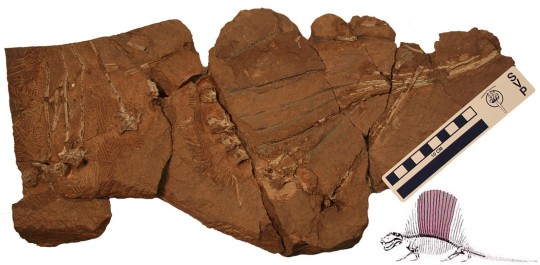
Holotype specimen of Dimetrodon teutonis, which consists of a partial vertebral column. The preserved portion of this vertebral column is highlighted in the reconstruction of Dimetrodon (lower right). Photograph by the author, 2007. Dimetrodon reconstruction modified from Romer and Price, 1940.

Specimens of two top predators have been discovered at the Bromacker quarry. Like Martensius, both are basal members of the group Synapsida, the later members of which gave rise to mammals. You might be familiar with one of them – Dimetrodon, a synapsid sometimes incorrectly portrayed with dinosaurs, which carried a tall sail on its back that was supported by bony spines. The other is a new genus and species that will be presented in my next post.

The fossil pictured above, the first-discovered specimen of Dimetrodon from the Bromacker quarry, may not look like much, but it was the first record of Dimetrodon outside of North America. The circumstances under which it was found were very different from the discovery of other fossils from the Bromacker quarry. Before Dave Berman and I arrived for the 1999 field season, Thomas Martens noticed that someone, possibly a fossil poacher, had been in the quarry overnight and knocked some rocks off the quarry lip. The rocks apparently broke upon hitting the ground, which exposed some bones. Thomas carefully picked them up and took them to his lab at the Museum der Natur, Gotha (MNG). When Dave and I met Thomas at the quarry on our first day of the field season, Thomas mentioned the find and told us that he thought the bones were ribs. We didn’t think much of it, other than horror at learning a fossil poacher might have visited the quarry overnight, one of our worst fears.

As planned, Dave and I spent the last day of the field season in the museum collections, and when Thomas let us in that morning, he reminded us to look at the potential ribs and told us where they were. Shortly after we began examining them, Dave and I simultaneously realized that the “ribs” were actually spines of Dimetrodon. We couldn’t believe our eyes, because of all the Early Permian fossils known from North America, Dimetrodon was Thomas’ favorite. Indeed, he’d used an image of it on signs at the Bromacker and included a model of Dimetrodon in a diorama, once on display in the MNG, that showed models of Bromacker animals in their environment. Thomas jumped for joy later that day when we gave him the news.

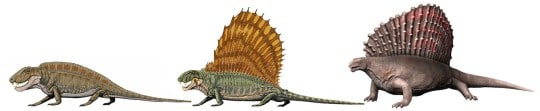
So how did Dave and I so quickly realize that the “ribs” were spines of Dimetrodon? Besides Dimetrodon, some other basal synapsids had sails, the function of which remains unknown, though scientists have speculated they could’ve been used for display or regulating body temperature. The spines (known as neural spines) supporting the sails vary in shape and length, with those of Dimetrodon and its herbivorous relative Edaphosaurus being tall and narrow, and those of another relative, the carnivorous Sphenacodon, being shorter and blade-like. Neural spines of Dimetrodon are easy to distinguish, because in addition to being long they bear fore and aft grooves, which create a dumbbell-shaped cross-sectional outline, and they lack the ‘crossbars’ that occur on the long neural spines of Edaphosaurus. When Dave and I saw the fore and aft grooves, the dumbbell-shaped cross-sectional outline of some broken spine ends, and an absence of crossbars, we knew that the “ribs” were indeed spines of Dimetrodon.

Flesh reconstructions of Sphenacodon sp. (left), Dimetrodon grandis (middle), and Edaphosaurus pogonias (right) to show the differences between their sails. Note that Dimetrodon and Sphenacodon are more closely related to one another than they are to Edaphosaurus, despite their different sail shapes. Reconstructions of Sphenacodon and Dimetrodon by Dmitry Bogdanov and that of Edaphosaurus by Nobu Tamura, all from Wikimedia Commons.

The Bromacker Dimetrodon is considerably smaller than other known species of the genus, and this is one character among other more detailed anatomical features that distinguishes it. For the new species name, Dave selected the Latin “teutonis,” which means an individual of a German tribe, in reference to the geographic origin of the holotype specimen.

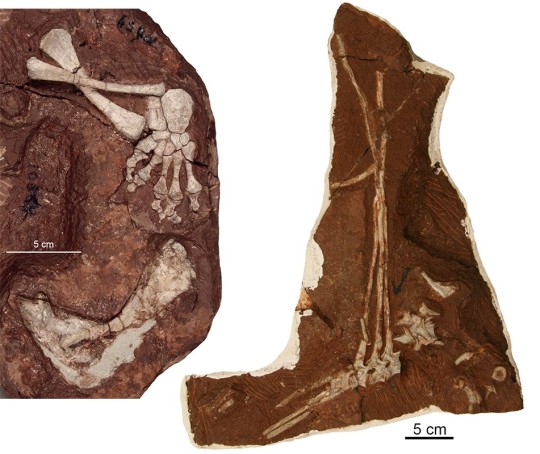
Two additional specimens of Dimetrodon teutonis. Left, hindleg and shoulder girdle bone (fused scapulocoracoid) and right, several vertebrae bearing complete to nearly complete neural spines of an individual that was larger and presumably more mature than the holotype. Photographs by the author, 2007.

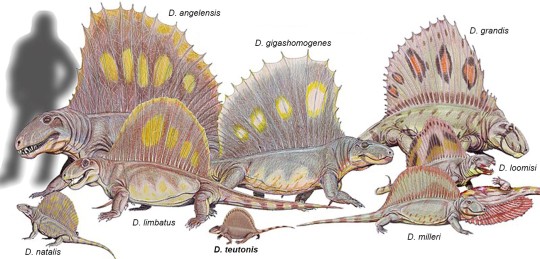
Dave was able to use a mathematical equation involving measurements of the vertebrae to estimate the holotype’s weight as a living animal at 31 pounds. In contrast, other known Dimetrodon species have estimated weights of about 81–550 pounds. We later discovered additional partial specimens of Dimetrodon at the Bromacker quarry, and Dave estimated the weight of the largest specimen with vertebrae at 53 pounds, still considerably less than that of what had previously been the smallest species, D. natalis from Texas. Dimetrodon is otherwise known from numerous species from the American mid-continent and southwest that generally got larger through time.

Reconstructions of various species of Dimetrodon drawn to scale. The diminutive D. teutonis is at bottom center and D. natalis, no longer the smallest species, is at bottom left. Illustration adapted from Dmitry Bogdanov via Wikimedia Commons.

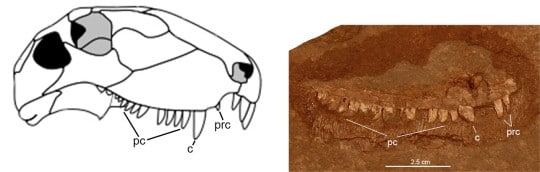
All Dimetrodon species have teeth adapted for meat-eating in being teardrop-shaped with sharp edges for slashing flesh. By size and jaw position these sharp teeth are divided into precanines, canines, and postcanines of varying numbers. Unlike D. teutonis, some species even had fine serrations on their tooth edges. The only known upper jaw bone of Dimetrodon teutonis clearly has two canines, but one is missing and represented by a large gap in the tooth row that would have accommodated this tooth. The second canine is represented only by its broad base, but it too must have been large. Although it was a small animal, the teeth of D. teutonis indicate that it was a meat-eater and as such would have preyed on other vertebrates from the Bromacker, many of which were even smaller.

Diagrammatic drawing of the skull of Dimetrodon (left) and photograph of the maxilla or upper jaw bone (right) of D.teutonis. Abbreviations: c, canine; pc, postcanine; prc, precanine. Photographs by the author, 2007. Drawing of skull from Wikimedia Commons.

Stay tuned for my next post, which will be about the second-known apex carnivore from the Bromacker. In the meantime, here are links to scientific papers on Dimetrodon teutonis:

https://www.researchgate.net/publication/325670232_A_new_species_of_Dimetrodon_Synapsida_Sphenacodontidae_from_the_Lower_Permian_of_Germany_records_first_occurrence_of_genus_outside_of_North_America

https://www.researchgate.net/publication/288544821_New_materials_of_Dimetrodon_teutonis_Synapsida_Sphenacodontidae_from_the_Lower_Permian_of_Germany

Amy Henrici is Collection Manager in the Section of Vertebrate Paleontology at Carnegie Museum of Natural History. Museum employees are encouraged to blog about their unique experiences and knowledge gained from working at the museum.

Keep Reading

The Bromacker Fossil Project Part XII: Tambacarnifex unguifalcatus, the Tambach Executioner 

Filed Under: Blog Tagged With: Amy Henrici, Museum from Home, Science News, Section of Vertebrate Paleontology, The Bromacker Fossil Project, Vertebrate Paleontology

October 29, 2020 by wpengine

Mesozoic Monthly: Gargoyleosaurus

Do you know what you’re going to dress up as for Halloween? This year, I’ll be going to work dressed as Velma Dinkley from Scooby-Doo. For the October edition of Mesozoic Monthly, I’ll be ‘unmasking’ a dinosaur with a monstrous name: Gargoyleosaurus parkpinorum, an armored dinosaur from the Jurassic Period!

image
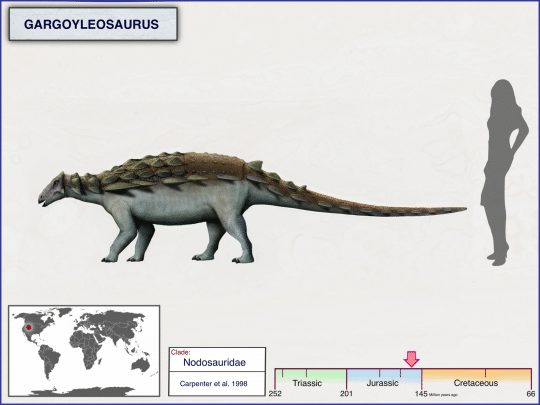
Handy infographic of the ankylosaur Gargoyleosaurus parkpinorum showing its appearance, size, geographic and temporal occurrence, and more. Art by cisiopurple on DeviantArt, used with permission.

Gargoyleosaurus belongs to my favorite group of dinosaurs: the ankylosaurs! The group Ankylosauria is comprised of many big-bodied herbivores covered in osteoderms, which are pieces of bone embedded in the skin that act like armor. Their osteoderms came in many shapes and sizes, from tiny ossicles that protected their bellies, to large, fused pieces of bone that formed club-like structures on their tails. In most cases you can easily distinguish between the two major groups of ankylosaurs based on their style of osteoderms (though there are other features that distinguish them as well). Ankylosaurids are famous for their tail clubs: the last vertebrae in their tail overlap to form a rigid ‘handle’ that ends with a mass of fused osteoderms akin to a club. Nodosaurids, their sister group, sported massive osteoderm spikes on their shoulders instead of clubs on their tails. Some paleontologists distinguish a third group of ankylosaurs, called polacanthids, which have a rectangular ‘pelvic shield’ made of fused osteoderms that rests over the hips. There’s a lot of overlap between ‘nodosaurid’ and ‘polacanthid’ characteristics, though, so ankylosaurs with pelvic shields are typically grouped in with the nodosaurids instead of being recognized as their own group.

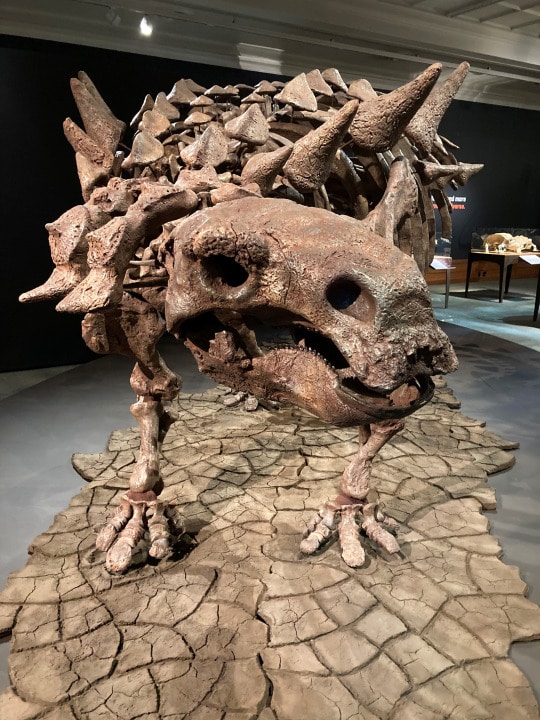
Conveniently, the Dinosaur Armor temporary exhibition at Carnegie Museum of Natural History features representatives of all three (or both, depending on your taxonomic preference!) ankylosaur subgroups: the ankylosaurid Akainacephalus, the nodosaurid Peloroplites, and the polacanthid (= nodosaurid?) Gastonia.

image
The imposing nodosaurid ankylosaur Peloroplites as seen in CMNH’s Dinosaur Armor exhibition. Check out those giant, spike-shaped shoulder osteoderms, a nodosaurid hallmark. Photo by Matt Lamanna.

There’s been some debate over where to place Gargoyleosaurus on the ankylosaur family tree because it displays a range of features from both major groups. It has pointy, horn-like osteoderms on the back of its head, which is a feature of ankylosaurids, but its skeleton lacks evidence of a tail club or other ankylosaurid characteristics. It also has a long snout, shoulder spines, and a pelvic shield, all features of nodosaurid (or polacanthid) ankylosaurs. The best explanation for the mix of features seen in Gargoyleosaurus is that it was one of the most basal nodosaurids, meaning it was one of the earliest nodosaurids to evolve and is therefore located at the base of the group’s evolutionary tree. If Gargoyleosaurus was a basal nodosaurid, that would explain why it still had features similar to those of ankylosaurids: because it had only recently evolved from the common ancestor of ankylosaurids and nodosaurids, not enough time had elapsed for features of that common ancestor (such as ankylosaurid-like skull osteoderms) to be removed by natural selection. This would be in keeping with the status of Gargoyleosaurus as one of the geologically oldest ankylosaurs of any kind discovered to date.

image
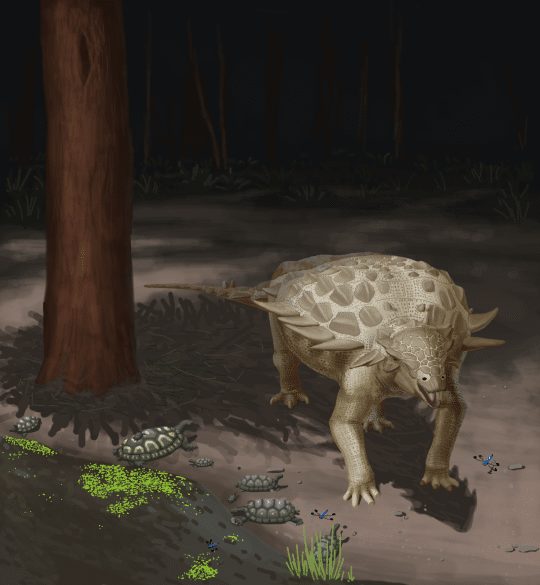
Albany County, Wyoming, ca. 150,000,000 B.P.: a solitary Gargoyleosaurus enjoys a shady spot by a stream in its Morrison Formation ecosystem. Art by Batavotyrannus on DeviantArt, used with permission.

No matter which ankylosaur subgroup Gargoyleosaurus belongs to, everyone can agree that it was a well-armored tank. Armor is a very useful defense against predators, since it generally covers the most vulnerable places on the body, such as the neck. Gargoyleosaurus lived in what is now the Morrison Formation, a famous set of rocks in the western US made of sediment deposited during the late Jurassic Period (the second of three periods in the Mesozoic Era, or Age of Dinosaurs). Most of the Jurassic dinosaurs on display at CMNH come from the Morrison Formation, such as our beloved long-necked sauropod Diplodocus, the even more massive sauropod Apatosaurus, and the forever popular Stegosaurus. But the Morrison ecosystem was home to a horde of formidable carnivores too—Allosaurus, Ceratosaurus, and Torvosaurus among them—so the armor of Gargoyleosaurus undoubtedly came in very handy. Contrary to what certain “Jurassic” franchises would lead you to believe, though, Tyrannosaurus rex did not live during the Jurassic Period, and so it never interacted with Gargoyleosaurus or any other members of the Morrison dinosaur community. That said, if trick-or-treating had been a possibility in the Jurassic, I’d imagine those inflatable T. rex Halloween costumes might have been very popular. Who doesn’t love those silly costumes?!

Lindsay Kastroll is a volunteer and paleontology student working in the Section of Vertebrate Paleontology at Carnegie Museum of Natural History. Museum staff, volunteers, and interns are encouraged to blog about their unique experiences and knowledge gained from working at the museum.

Related Content

Mesozoic Monthly: Protostega

Armored Advantage

Ask a Scientist: What is still unknown about “the chicken from Hell”?

Filed Under: Blog Tagged With: dinofest, dinosaurs in their time, Lindsay Kastroll, Science News, Section of Vertebrate Paleontology, Vertebrate Paleontology

October 27, 2020 by wpengine

Clams in the Concrete! How Old is this Sidewalk?

Mollusk shells persist long after the death of the soft-bodied animals whose secretions formed the protective covers. These sturdy remains can inform us about species living in an area at that time. Many mollusks occur in specific habitats and during certain time periods in Earth’s history. When we find mollusks in sediment with dinosaur bones, for example, we receive a clue about the geologic age and habitat in which those dinosaurs lived. When mollusks first appear in an area, deposits containing their shells allow us to estimate when events in Earth’s history occurred, including archaeological events, or even relatively recent construction projects.

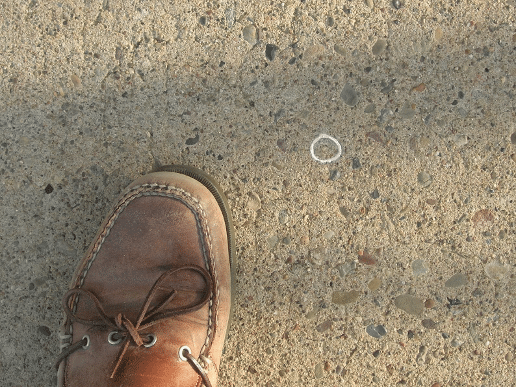
This morning as I walked across the Panther Hollow bridge near Carnegie Museum of Natural History in Pittsburgh, Pennsylvania, I noticed clam shells in the concrete of the sidewalk. What can the presence of these clam shells tell me about how long that sidewalk has been there?

tip of boat shoe on sidewalk near clam shell for scale
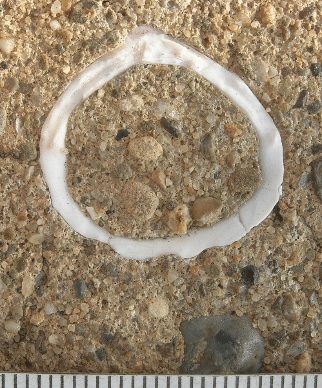
clam shell embedded in concrete
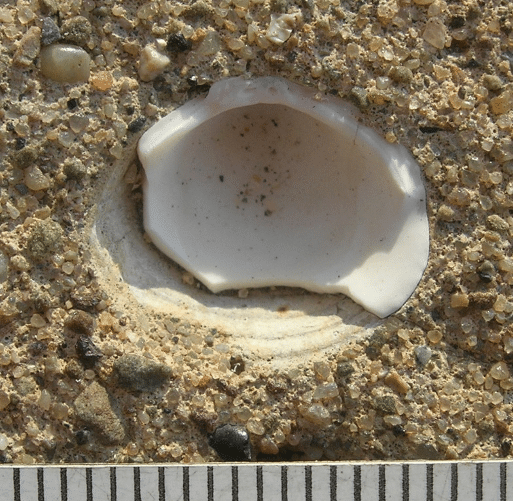
Top: Clam shell in sidewalk on Panther Hollow Bridge. Bottom: Close-up of clam shell, inside view. Scale in mm.

Concrete is a mixture of cement with sand and gravel. When sand and gravel are taken from rivers, this natural resource sometimes contains clam shells. I believe the clam shells in this sidewalk were scooped up along with the sand and gravel to make the concrete. Then after the sidewalk was poured, but before it fully hardened, the clam shells floated to the upper surface.  

As an aside, information about comparative densities is instructive here. Two common crystal forms of calcium carbonate are calcite and aragonite, which have different densities (calcite 2.71g/cc, aragonite 2.93). Most mollusks form shells of aragonite. However, shells are not pure aragonite, containing small amounts of protein and other substances, so clam shells can have densities around 2.5-2.6. In comparison, the density of quartz, which makes up much of the sand used in making concrete, is 2.65. The clam shells are slightly lighter than the sand, which probably explains why they floated up to the sidewalk surface.

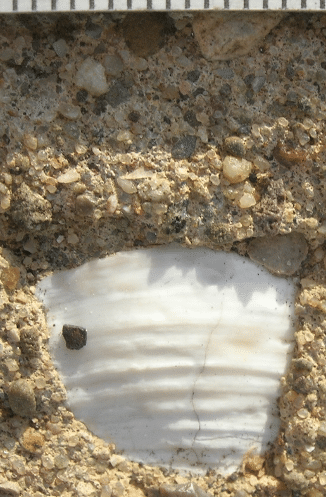
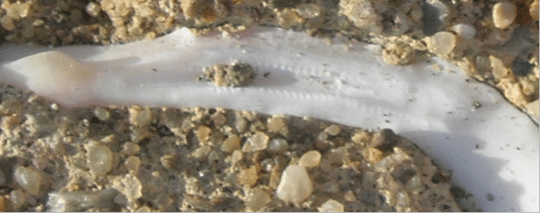
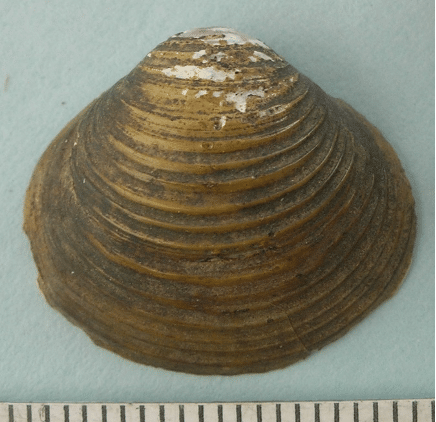
I identified these clam shells as Corbicula fluminea (common name: the Asian clam). They have the characteristic shape and size, the outside has strong regular growth ribs, and on the inside, the lateral teeth bear minute serrations. This species was first recorded in North America in British Columbia about 1924. As an invasive species, it has spread, through human activity, to at least 46 US States.

clam shell embedded in concrete
broken clam shell embedded in concrete
close up of clam shell embedded in concrete
Top: Outside view of clam showing strong ribs. Middle: Partly broken clam, inside view showing external rib impressions in concrete below. Bottom: Close-up of clam’s lateral teeth showing minute serrations. Scale in mm.

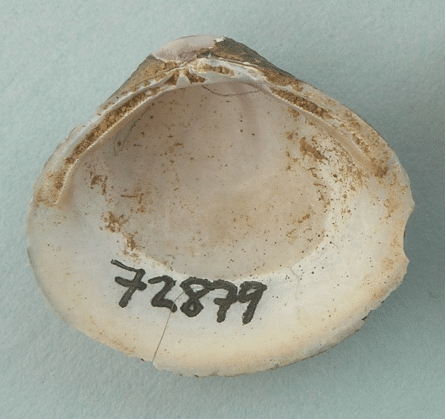
When did the species appear in southwestern Pennsylvania? There is a record of Corbicula fluminea in 1979 from the Ohio River just downstream from Pittsburgh and another in Greene County, southwestern Pennsylvania from 1981. Museum records of this species became more common after about 1993, suggesting that the clam probably became more common about then.

clam shell labeled with numbers 72879
top of clam shell on blue background
Corbicula fluminea collected in 1993 from Loyalhanna Creek, Southwestern Pennsylvania. Top: inside of shell. Bottom: outside of shell showing strong ribs. Scale in mm.

Consequently, I conclude that the Corbicula fluminea-containing concrete sidewalk on the bridge next to Carnegie Museum must have been poured after the late 1970s, and possibly after 1993, when the clam became abundant in freshwater of western Pennsylvania, the region where Pittsburgh is located.

Museum collections provide useful information about when non-native species arrived in an area. Now you know that one of the many uses of mollusks is estimating ages of things.

Although some people might think of clams as an abstract concept, here is an example of clams in the concrete!

Timothy A. Pearce, PhD, is the head of the mollusks section at Carnegie Museum of Natural History. Museum employees are encouraged to blog about their unique experiences and knowledge gained from working at the museum.

Related Content

Ask a Scientist: What is the biggest snail? 

Stalking the Freshwater Sponges of Western Pennsylvania

A Day at the Beach: The Anthropocene on Vacation

Filed Under: Blog Tagged With: Anthropocene Living Room, Science News, Section of Mollusks, Tim Pearce

  • « Go to Previous Page
  • Page 1
  • Interim pages omitted …
  • Page 25
  • Page 26
  • Page 27
  • Page 28
  • Page 29
  • Interim pages omitted …
  • Page 43
  • Go to Next Page »

sidebar

About

  • Mission & Commitments
  • Directors Team
  • Museum History

Get Involved

  • Volunteer
  • Membership
  • Carnegie Discoverers
  • Donate
  • Employment
  • Events

Bring a Group

  • Groups of 10 or More
  • Birthday Parties at the Museum
  • Field Trips

Powdermill

  • Powdermill Nature Reserve
  • Powdermill Field Trips
  • Powdermill Staff
  • Research at Powdermill

More Information

  • Image Permission Requests
  • Science Stories
  • Accessibility
  • Shopping Cart
  • Contact
  • Visitor Policies
Stay in the loop! Sign up for our newsletter(s).
One of the Four Carnegie Museums | © Carnegie Institute | Privacy Policy | Terms of Use | Accessibility
Rad works here logo