• Skip to primary navigation
  • Skip to main content
  • Skip to primary sidebar

Carnegie Museum of Natural History

One of the Four Carnegie Museums of Pittsburgh

  • Visit
    • Buy Tickets
    • Visitor Information
    • Exhibitions
    • Events
    • Dining at the Museum
    • Celebrate at the Museum
    • Powdermill Nature Reserve
    • Event Venue Rental
    • Gift Cards
  • Learn
    • Field Trips
    • Educator Information
    • Programs at the Museum
    • Bring the Museum to You
    • Guided Programs FAQ
    • Programs Online
    • Climate and Rural Systems Partnership
  • Research
    • Scientific Sections
    • Science Stories
    • Science Videos
    • Senior Science & Research Staff
    • Museum Library
    • Science Seminars
    • Scientific Publications
    • Specimen and Artifact Identification
  • About
    • Mission & Commitments
    • Directors Team
    • Museum History
  • Tickets
  • Give
  • Shop

Blogs from our Scientific Researchers

Carnegie Museum of Natural History is home to active research and vast scientific collections. Our scientific researchers regularly contribute to the blog at the museum.

December 9, 2020 by wpengine

The Bromacker Fossil Project Part XII: Tambacarnifex unguifalcatus, the Tambach executioner

New to this series? Read The Bromacker Fossil Project Part I, Part II, Part III, Part IV, Part V, Part VI, Part VII, Part VIII, Part IX, Part X, and Part XI. 

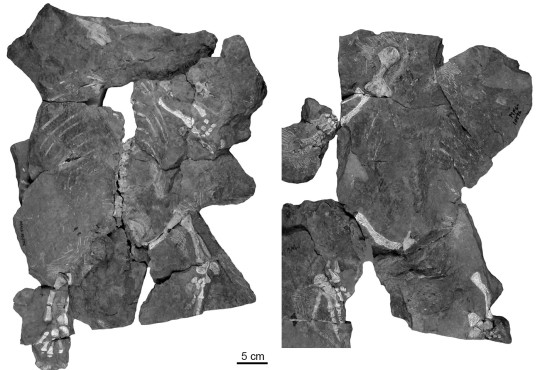
Holotype specimen of Tambacarnifex unguifalcatus, preserved in couterparts. Photographs by Dave Berman, 2010.

Tambacarnifex unguifalcatus was discovered by Thomas Martens and his father Max in 1995 in the same pocket of fossils from which the first-discovered specimen of the herbivorous basal synapsid Martensius bromackerensis was recovered. Because numerous fossil animals were jumbled together, Thomas and Max weren’t able to collect individual specimens from the bone pocket using our standard technique of surrounding a specimen in a plaster and burlap jacket. Instead, they collected all the individual pieces of rock that contained bone or at least appeared to contain bone, as most rock pieces were coated in goopy mud. Thomas cleaned the rock pieces with water to reveal the bone, and then pieced together the various specimens.

He eventually sent us the specimen that became the holotype of Tambacarnifex, along with pieces that he thought might go with it. Dave and I spent hours piecing together the remainder of the skeleton, and we searched the collections at the Museum der Natur, Gotha for missing pieces in subsequent field seasons. The majority of the specimen was recovered, but the skull, a few vertebrae, and distal finger and toe bones are missing. A rock piece with the greater portion of a lower jaw with teeth was also collected from the bone pocket, though it couldn’t be associated with the skeleton and may represent a second individual. A lot of bone was lost from the specimen, but impressions of missing bone were preserved, which proved useful for identifying wrist and ankle bones, among others. Dave used a white pencil to color in the bone impressions so they would stand out for study and in photographs of the specimen. Ultimately, we realized that Martensius and Tambacarnifex were preserved one on top of the other, though separated by several inches of rock.
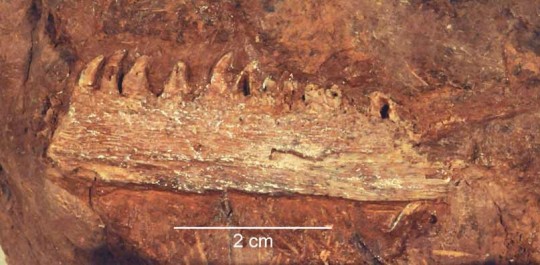
The lower jaw piece of Tambacarnifex unguifalcatus. Photograph by Dave Berman, 2008.

The teeth of Tambacarnifex preserved in the lower jaw are strongly recurved and flattened side-to-side, which, along with other features preserved in the skeleton, indicate it is a member of the basal synapsid group (family) Varanopidae and in the subfamily Varanopinae. The Varanopidae have been likened to the actively predaceous modern monitor lizards in the family Varanidae, hence the similar name. Varanopids were the most diverse and longest-surviving basal synapsids, being known from the Late Carboniferous–Middle Permian (~309–260 million years ago) of North America, Europe, Asia, and Africa. With their sharp, recurved teeth and a gracile skeleton, scientists think varanopids were agile predators, at least compared to other animals of their time. They range from about 12–78 inches in length, with the smallest ones probably being insectivorous and the larger ones carnivorous. Tambacarnifex has an estimated body size of about 35 inches, and as a medium-sized varanopid with gracile limbs it would have been an agile carnivore, preying on on any of the Bromacker vertebrates that it could catch.
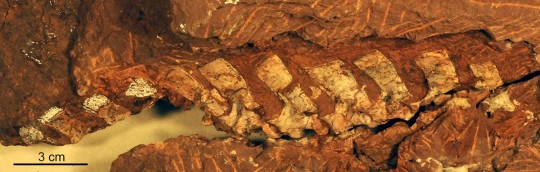
An articulated but incompletely preserved series of 11 vertebrae of Tambacarnifex unguifalcatus. Notice that the neural spines are low and subrectangular, so it is unlikely that they supported a sail, as occurs in some other basal synapsids such as Dimetrodon teutonis. The front of the animal is to the left. Photo by Dave Berman, 2008.

Unlike Dimetrodon teutonis, the other apex predator at the Bromacker, Tambacarnifex has broad, low neural spines that alternate in height. It differs from other varanopines in the shape and anterior inclination of its neural spines and in having greatly elongated and recurved bony claw supports in its hands and feet. The generic name Tambacarnifex was coined in reference to its position in the food chain: “Tamba,” for the Tambach Basin, which the holotype inhabited, and the Latin “carnifex,” meaning executioner, for its role as an apex predator. “Unguifalcatus” was derived from the Latin “unguis,” nail or claw, and “falcatus,” meaning sickle-shaped, in reference to the long, strongly recurved bony claw supports.
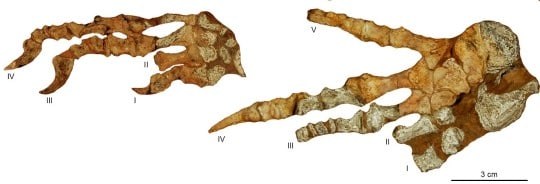
Incomplete front (left) and hind (right) feet of Tambacarnifex unguifalcatus. Notice the extremely long bony claw supports preserved on the first, third, and fourth fingers of the front foot and the fourth toe of the hind foot. I–V refer to finger and toe numbers. Photos by Dave Berman, 2008.
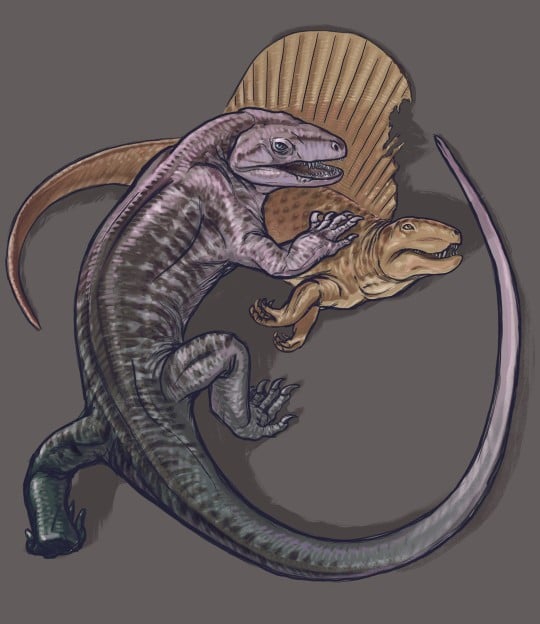
Illustration of Tambacarnifex unguifalcatus consuming a Dimetrodon teutonis carcass. Outline drawing by Matt Celeskey, colored (with permission) by Carnegie Museum of Natural History Vertebrate Paleontology Scientific Illustrator Andrew McAfee.

Stay tuned for the final post of this series, which will summarize what we’ve learned about the Bromacker. Click here if you would like to download your own copy of the outline drawing of Tambacarnifex consuming Dimetrodon to color in. The paper describing Tambacarnifex unguifalcatus can be viewed by clicking here.

Amy Henrici is Collection Manager in the Section of Vertebrate Paleontology at Carnegie Museum of Natural History. Museum employees are encouraged to blog about their unique experiences and knowledge gained from working at the museum.

Related Content

Ask a Scientist: What is it like to discover a new species? 
Mesozoic Monthly: Gargoyleosaurus

Cephalopod Fossils from Lyme Regis, England

Filed Under: Blog Tagged With: Amy Henrici, dinosaurs in their time, Museum from Home, Science News, Vertebrate Paleontology

December 1, 2020 by wpengine

Digital Developments: Why Archiving and Herpetology Go Hand-in-Hand

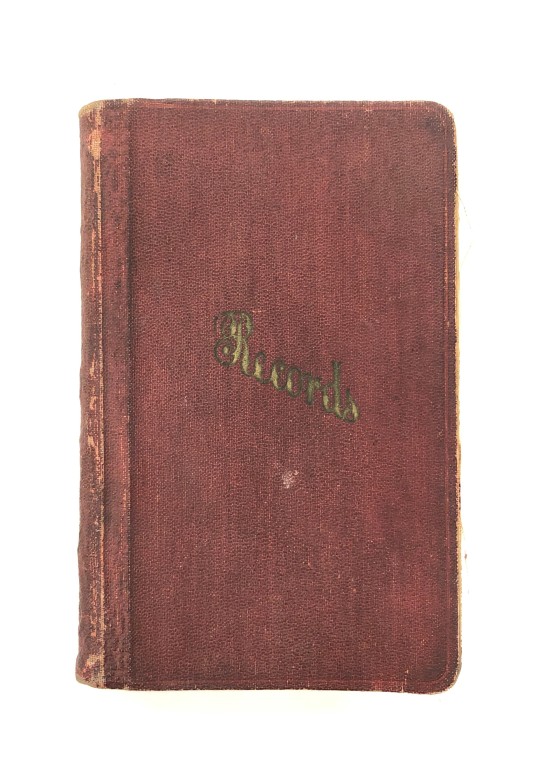
This field notebook from 1945 belonged to Paul Walker. It contains observations and specimen measurements, all of which are organized by date.

Careers in librarianship are often depicted as quiet, solitary positions that allow ample time for reading on the job. Images associated with archival librarianship (a career usually pertaining to the collection, preservation, and management of historically relevant materials) get even more visually specific than the first, for they frequently involve mahogany framed spaces filled to the brim with dusty, leather-bound, centuries-old texts. Though whimsical, these notions about texts and their caretakers cause people to overlook a critical part of archival work: digital management of texts and data.

Our society’s emphasis on the importance of technological advances and virtual storage has not only advanced the librarian’s ability to scan and virtually distribute texts and documents with ease; it has also gone so far as to set the expectation that archival texts will be digitized, or converted into a digital form. This digitization both protects data from being lost to physical damage and, through mechanisms like databases, helps interested people gain greater levels of insight into the exciting and unique collections that exist around the world.

While libraries have always housed a wide range of texts and items from a variety of professional fields, the level of priority placed on digitizing archival collections has ultimately allowed for even more crossover between people of different professional backgrounds. My job in the Section of Amphibians and Reptiles is a prime example of this. Though I have been entrusted with caring for and scanning the section’s 20th-century field notebooks, my area of expertise is not herpetological by any means. I come from a strictly literary background, with my research focusing on 19th-century magazines for children. How, then, do these professional paths intersect?

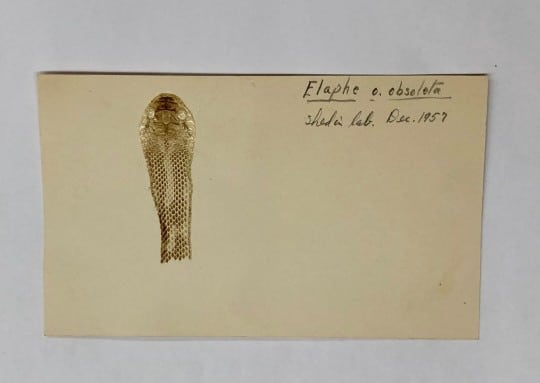
Paper is not the only archival material that needs to be scanned. The museum is home to large flatbed scanners made for digitizing delicate materials like this one, a 1957 skin sample of a Black Rat Snake.

Apart from the fact that I have handled older texts before, my background and the needs of the Section of Amphibians and Reptiles exist in harmony because of a mutual recognition of the value of accessibility. While working with archival databases through transcription-based volunteer projects and past research positions, I learned that accessibility is as much about small details as it is about sharing the museum’s materials with other institutions and, ultimately, the public. For example, if my scans are too dark or are surrounded by too much black space, the readability of the document may be affected and people with limited access to printer ink may not be able to make copies of the material. Digitization may appear to simply prevent a loss of information, but the need for accessibility causes it to take on new meaning. As a future archivist, I prioritize scan quality and the organization of digital files so that museum employees and the public alike can always find and use these important scientific materials with ease. Though we come from different fields, the Section of Amphibians and Reptiles consistently prioritizes its concern with the use of these materials in the long run as well.

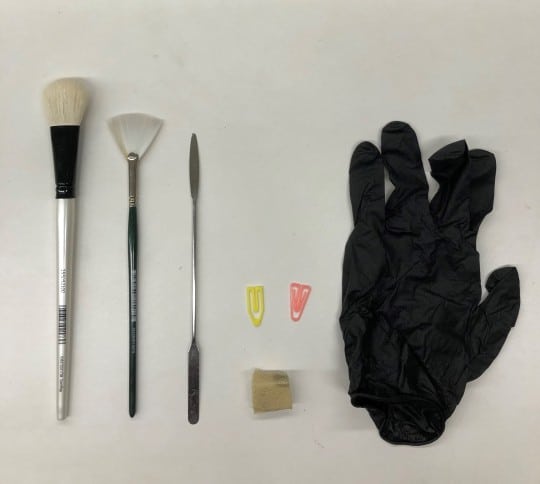
These tools are just some of the necessary pieces of equipment used to handle texts and materials during digitization. Pictured (from left to right): brushes for removing dust and dirt, a metal tool for the delicate removal of metal objects like staples and paperclips, plastic paperclips for keeping pages together without the risk of rust, a sponge for soot removal, and nitrile gloves for safely handling negatives and photos.

I am grateful that I am continuing to learn about the relevance of scientific specializations like herpetology to other fields. Likewise, I am glad that my understanding of librarianship continues to intersect with fields that I may not otherwise encounter. Perhaps, then, popular depictions of librarians and archivists can begin to recognize their preoccupation not only with reading and quieting patrons, but also with collaborating across disciplines to expand people’s access to information.

Ren Jordan is a Curatorial Assistant in the Section of Amphibians and Reptiles. Museum staff, volunteers, and interns are encouraged to blog about their unique experiences and knowledge gained from working at the museum.

Related Content

The Enduring Appeal of Snakes

Ask a Scientist: What is the creepiest specimen in the Alcohol House? 

A Holotype with a History

Filed Under: Blog Tagged With: amphibians and reptiles, herpetology, Museum from Home, Ren Jordan, Science News

November 30, 2020 by wpengine

Mesozoic Monthly: Scipionyx

My high school calculus teacher, Mr. Surovchak, once told me about a competition he and his brother had every Thanksgiving. They would weigh themselves before and after dinner to indisputably measure who was able to eat the most. When it comes to dinosaurs, it’s typically much harder to tell what and how much they ate. However, a few fossils give us windows into the guts of dinosaurs – literally! Paleontologists are extremely thankful for spectacular fossils like that of Scipionyx samniticus, a small theropod dinosaur with several internal organs preserved!

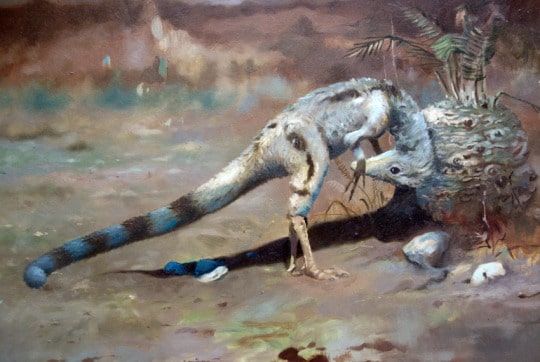
Oil painting of Scipionyx samniticus in its Early Cretaceous environment by Emiliano Troco, used with permission. You can find more of their work on their Tumblr and contact them via their WordPress site.

Theropods, like Scipionyx, are dinosaurs that stand on two legs, usually with only three prominent toes on each hind foot. Some of the most famous dinosaurs are theropods, like Tyrannosaurus, Velociraptor, and previous Mesozoic Monthly honoree Citipati (does that make it famous? I like to think so). Most theropods interacted with the world primarily with their heads rather than their hands, hence why several of them look like they have oversized skulls and relatively underdeveloped forelimbs. Many also had hollow bones, and, as we can see in extremely well-preserved fossils, feathers. Is this all starting to sound familiar? That’s because these are also features of birds! If you’ve ever heard someone say that birds are dinosaurs, that’s because modern birds, which are called Aves or Neornithes, are just one evolutionary subset of theropod dinosaurs! Birds have all these features of theropod dinosaurs, plus others like toothless beaks and wings made partly from fused wrist and hand bones. If you are eating turkey for Thanksgiving dinner, remember that you’re eating a dinosaur!

Scipionyx didn’t look much like a turkey, though. It belonged to a group of theropods called compsognathids, which were long-tailed, slender, and relatively small predators. It wasn’t imposing size or an especially fascinating appearance that made Scipionyx special – it was the way the only known specimen was fossilized. It is so well preserved that many of its internal organs are intact in its body cavity! Petrified tissue from the trachea, small intestine, and even rectum can be seen in the fossil, as well as muscle tissue, blood vessels, and traces of other organs. We can tell from the bones and scales in its digestive tract that it ate several meals of lizards and fish before it died. There is such a wealth of biological information preserved in this single specimen, and we can learn even more when we consider its relatives. Although skin didn’t preserve in Scipionyx, at least one fossil of another compsognathid named Sinosauropteryx has such well-preserved skin and filament-like ‘protofeathers’ that we can even see pigments preserved! Based on Sinosauropteryx, we can assume that Scipionyx had some sort of filamentous or fuzzy covering as well, at least over some parts of its body.

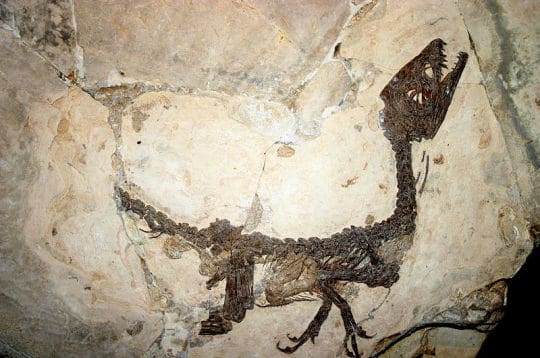
The incredible fossil of Scipionyx preserves the dinosaur’s internal organs in 3D! For example, the sinuous shape of the small intestine is visible immediately behind the right elbow. Photo by Giovanni Dall’Orto on Wikimedia Commons. You can read more about this specimen in a paper by Dal Sasso and Maganuco (2011).

The fossil of Scipionyx is very small because the individual in question was just a hatchling when it died. Paleontologists can tell it was a hatchling, and not a small adult animal, because its proportions are similar to those of other juvenile dinosaur fossils and many of its bones had not yet fused together (you can learn more about how bones fuse as organisms get older in the Nemicolopterus edition of Mesozoic Monthly). The baby Scipionyx individual represented by the fossil would have measured around 18 inches (46 cm) long in life, and estimates based on how other compsognathids grew suggest that its species reached about 7 feet (2.1 meters) in length at adulthood. Not much is known about its habitat, but it was likely one of the largest animals around. Scipionyx was found in deposits laid down in a marine environment in what is now Italy. Back in the early part of the Cretaceous Period (the third and final division of the Mesozoic Era, or ‘Age of Dinosaurs’), when Scipionyx was alive, Italy was mostly under a shallow sea dotted with small islands, and the dinosaur would have lived on one of these. Since then, tectonic activity has dramatically changed the region, creating new mountains and lowering sea level to what it is today.

So, this Thanksgiving, if you’re looking for a conversation starter at the dinner table/family video call (or if you urgently need to divert discussion from a more sensitive topic), here’s an idea: ask your dining partners whether they think non-avian theropods like Scipionyx would have tasted more like turkey or chicken! Or, if your loved ones would rather learn than debate, you could perhaps offer to read them any of the 12 Mesozoic Monthly animal spotlights (that’s right, December makes one whole year of Mesozoic Monthly!). I’d certainly feel honored to make an appearance at your Thanksgiving feast.

Lindsay Kastroll is a volunteer and paleontology student working in the Section of Vertebrate Paleontology at Carnegie Museum of Natural History. Museum staff, volunteers, and interns are encouraged to blog about their unique experiences and knowledge gained from working at the museum.

Related Content

Mesozoic Monthly: Champsosaurus

The Two-Headed Dinosaur

Ask a Scientist: What is still unknown about “The Chicken from Hell?”

Filed Under: Blog Tagged With: dinofest, dinosaurs, dinosaurs in their time, Lindsay Kastroll, Mesozoic Monthly, Science News, Vertebrate Paleontology

November 24, 2020 by wpengine

One man’s trash is another man’s weather instrument

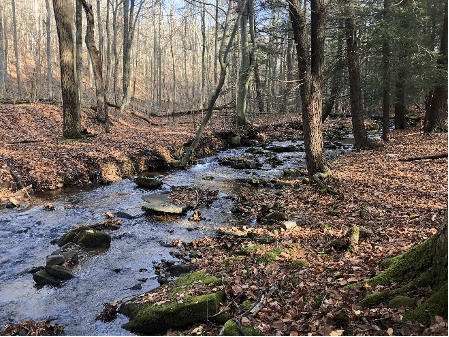
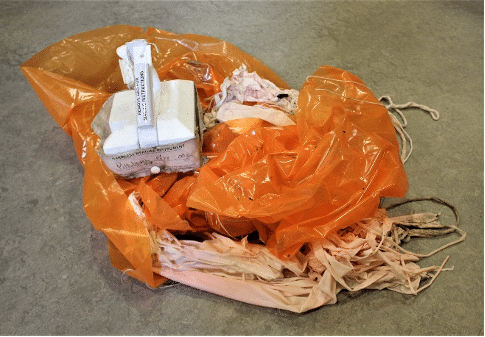
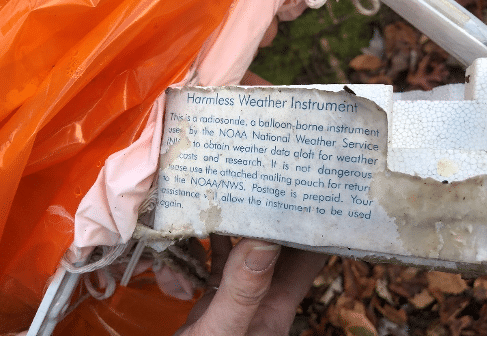
A piece of debris was recovered by staff Friday afternoon while hiking along Powdermill Run at Carnegie Museum of Natural History’s biological research station, Powdermill Nature Reserve. What initially looked like nothing more than a pile of orange plastic garbage turned out to be something much more exciting! It was actually the remains of a weather balloon carrying a recording instrument called a radiosonde.

Powdermill Run, where the instrument was found. Thank you to Bobby Ankney, Maintenance Manager at Powdermill, for wading across the stream to recover it!

These devices are deployed by the National Weather Service in order to gather data about the upper atmosphere. A large balloon (5 feet in diameter) filled with helium or hydrogen gas carries the radiosonde upward at a rate of 1,000 feet/minute. The balloon can reach an altitude of over 20 miles before it expands (due to decreasing air pressure) to a diameter of 20-25 feet and pops. Temperatures at that height can be as cold as -130⁰F!

crumpled weather balloon

During its ascent, the radiosonde transmits data on temperature, pressure, humidity, and GPS location to a ground tracking antenna. GPS data indicate wind speed and direction during the flight. After the balloon pops, an orange parachute carries the spent instrument slowly to the ground, where it may be recovered and returned to the National Weather Service to be reused.

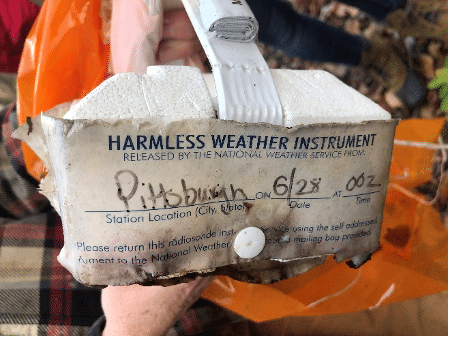
close up of weather balloon label that says "Harmless Weather Instrument"
label on weather balloon

The radiosonde we found was deployed in Pittsburgh on June 28, 2020. Pittsburgh is one of 69 stations in the contiguous United States and over 800 worldwide. Weather balloons at each station are typically deployed at the same time each day, 365 days a year. Data from these instruments are used in weather forecasting, air pollution modelling, and climate change research. While removing litter from the environment is a great thing to do anyway, in this case there was a bonus learning and recycling opportunity included. Cool!

Andrea Kautz is a Research Entomologist at Carnegie Museum of Natural History’s Powdermill Nature Reserve. Museum employees are encouraged to blog about their unique experiences and knowledge gained from working at the museum.

Related Content

Finding Nature in Your Local Streams

The Molecular Lab at Powdermill

Lasius Will Amaze-i-Us

Filed Under: Blog Tagged With: Andrea Kautz, Powdermill Nature Reserve, Science News

November 18, 2020 by wpengine

Seldom seen—archaeological textiles in the eastern United States

In my very first “Introduction to Anthropology” class, the professor, a cultural anthropologist, tried to steer us away from archaeology by telling us it was a childish pursuit for those who liked to play in the mud and hunt for treasure. That sounded like it was right up my alley.  I ended up spending my summers and an internship term working in Plymouth, Massachusetts, doing historical archaeology.  In addition, I also spent a lot of time in the collections of the college anthropology museum, found that I especially loved working with textiles and basketry, and eventually learned to weave both.

Working in the eastern United States, it’s hard to find archaeological textiles; the very world is against it. Acid soils and a temperate climate create conditions where little organic material survives to be studied, except in the rare instances of charred material or pieces in contact with copper, or still rarer, textiles deposited in dry caves. Even then the evidence is usually fragile and fragmentary.

What eastern archaeologists find is a lot of pottery, and luckily for us, much of it has been impressed with cordage or fabric. As part of the pottery making process, clay coils were consolidated by being beaten with a wooden paddle, a tool frequently wrapped with cordage or fabric. This technique may have initially developed to create decoration, but the resulting roughened surface also made for a better grip, and the increased surface area caused pots to heat quicker in cooking.

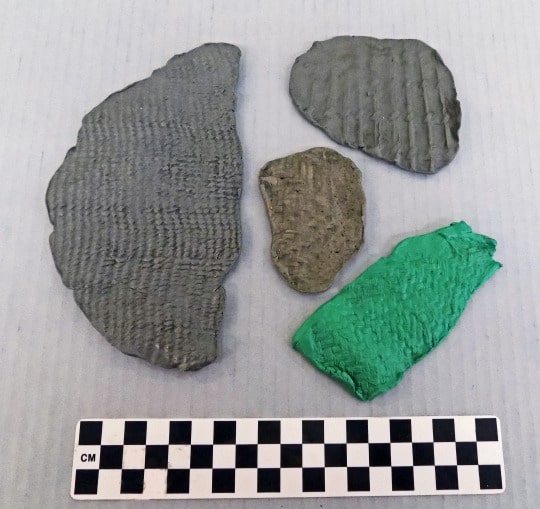
Archaeologists study the long-vanished textiles by making durable impressions of pottery surfaces with modeling clay or dental impression material. The information revealed through the thorough study of such impressions is not limited to the determination of just what type of cord or textile was used in making the original object.

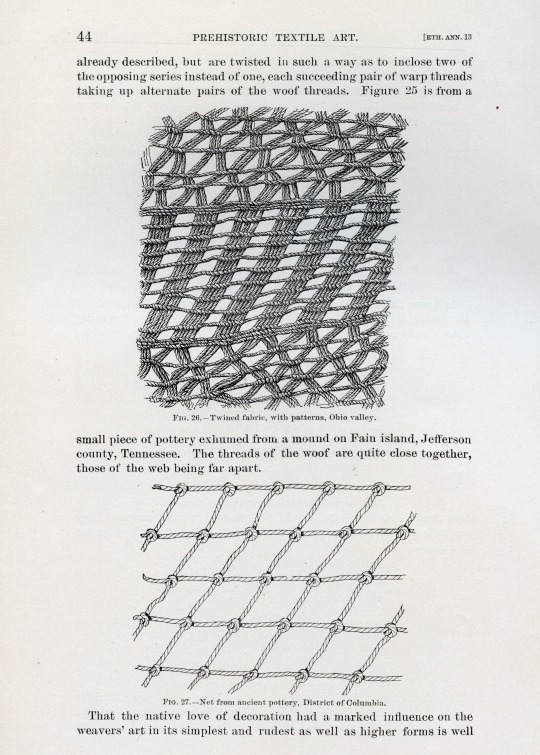
The making of pottery impressions to look at textiles was first published by the pioneering archaeologist, W.H. Holmes, in “Prehistoric Textile Art of the Eastern United States.” Holmes started his scientific career as an illustrator, and included schematic drawings of the textile structures in his article.

image
Textile illustrations by Holmes.

When I worked at what is now the Florida Museum of Natural History, I got interested in the earliest pottery found in Florida, from what is known as the Orange culture. Dating from about 1500 BCE, these distinctive pieces were thick and very simply decorated. Their most interesting feature, at least to me, was that the clay pot bottoms had been pounded flat on matting, and the applied force made deep impressions. At least three different techniques were used, with variations and patterns within each, including several different matting materials.

Mat impressions from flat-bottomed pots, Tick Island, Volusia County, FL.

In one instance, a thick pot sherd had a smooth top surface, but a deep dent in the bottom; evidence the potter hadn’t removed a small pebble that was under the mat before the pot making.

Many studies have been done since W.H. Holmes, looking at such things as direction of the twist in cordage—a majority of right-handed or left-handed twist could indicate a culture-wide preference. Similar twist types in neighboring geographic areas might indicate related cultural or kin groups, while different twist types could indicate a cultural boundary. The type of material used [soft fiber, hard rods, flat cane-like splints] may indicate cultural preference, or perhaps the materials available in the immediate environment.

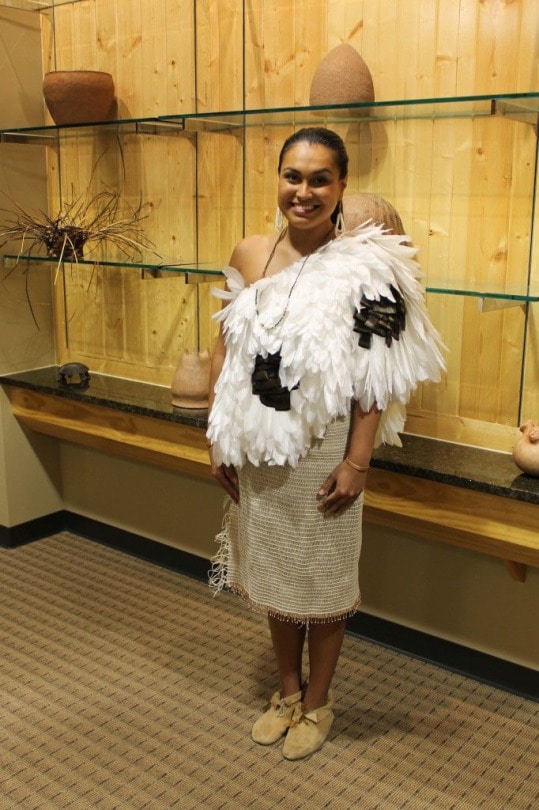
One study by Dr. Penelope Drooker, Mississippian Village Textiles at Wickliffe, introduced me both to some incredible textile impressions in pottery and the information that can be gleaned from them. Drooker’s work also analyzed and illustrated some textiles preserved in dry caves of eastern Tennessee, part of the Cherokee people’s ancestral lands. Among the materials she studied were skirts and bags from the Cliffty Creek Cave, artifacts now housed at the Smithsonian Institution. Working with the Museum of the Cherokee Indian in Cherokee, NC, I was able to re-introduce members of the tribe to one of the oldest weaving techniques of their ancestors. A few tribal members have visited the Smithsonian to photograph Cliffty Creek Cave pieces [as have I], and are now making skirts for use in festivals and pageants. Several are making decorated bags for their own use, and for sale.

Kara Martin McKinney wearing reproduction of Cliffty Creek Cave skirt, and reproduction woman’s feather cape. Image Credit: Scott McKie, reporter for the Cherokee One Feather weekly newspaper in Cherokee, NC.

One of the great things about textiles or pottery is that you could spend your entire life studying them, and still not learn all that these materials embody–techniques, cultural traditions, and art, all rolled into one. My grandfather, who kept his faculties up to his death in his mid-90s, said, “The day you stop learning is the day you start to die.” I try to live by that.

Deborah Harding is the Collection Manager of the Section of Anthropology at Carnegie Museum of Natural History. Museum employees are encouraged to blog about their unique experiences and knowledge gained from working at the museum.

References and further reading:

Drooker, Penelope Ballard 1992  Mississippian village textiles at Wickliffe,  University of Alabama Press: Tuscaloosa and London

Holmes, W. H. 1896 “Prehistoric Textile Art of the Eastern United States” Thirteenth Annual Report of the Bureau of American Ethnology to the Secretary of the Smithsonian Institution 1891–1892, Government Printing Office Washington, pages 3–46.

Milanich, Jerald T. and Charles H. Fairbanks 1980 Florida Archaeology Academic Press: New York

Petersen, James B [editor] 1996 A most indispensable art: native fiber industries from Eastern North America, University of Tennessee Press: Knoxville

http://www.phmc.state.pa.us/portal/communities/archaeology/native-american/early-middle-woodland-period.html

Related Content

The Unseen Museum: Ka’apor Necklace

Super Science: The Virtual Amazon

Ancient Egypt Through its Pottery

Filed Under: Blog Tagged With: anthropology, Deborah Harding, Museum from Home, Science News

November 13, 2020 by wpengine

Collected on this Day 105 years ago

So long, leaves.

Autumn has fallen.

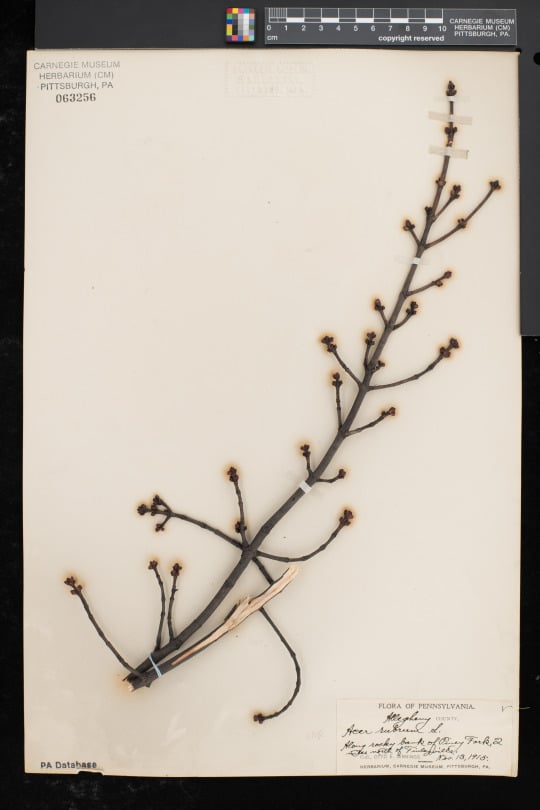
specimen of red maple on herbarium sheet

This specimen of red maple (Acer rubrum) was collected on November 13, 1915 by Otto Jennings near Finleyville, Pennsylvania (about 30 miles south of Pittsburgh).  Jennings was an influential botany curator (and biology professor at University of Pittsburgh and director of Carnegie Museum, among many other roles through his many decades career at the museum).

Just imagine how beautifully red these leaves must have been.   And you’ll have to imagine because this specimen is just twigs!

But upon closer look, the twigs have a lot to admire.  As with other deciduous trees in Pennsylvania, the buds are primed and ready.  In spring (as early as March for red maple!), these buds will swell and flowers will emerge.  Leaves will follow.

But first, we wait it out through winter.

Pay attention to tree buds this winter. They have a lot to say.

Find this red maple specimen here (along with 512 others!).

Check back for more! Botanists at the Carnegie Museum of Natural History share digital specimens from the herbarium on dates they were collected. They are in the midst of a three-year project to digitize nearly 190,000 plant specimens collected in the region, making images and other data publicly available online. This effort is part of the Mid-Atlantic Megalopolis Project (mamdigitization.org), a network of thirteen herbaria spanning the densely populated urban corridor from Washington, D.C. to New York City to achieve a greater understanding of our urban areas, including the unique industrial and environmental history of the greater Pittsburgh region. This project is made possible by the National Science Foundation under grant no. 1801022.

Mason Heberling is Assistant Curator of Botany at Carnegie Museum of Natural History. Museum employees are encouraged to blog about their unique experiences and knowledge gained from working at the museum.

Related Content

Collected On This Day 98 Years Ago (Chestnuts)

Who Likes Teaberry? Collected 56 Years Ago

Ask a Scientist: How do you find rare plants?

Filed Under: Blog Tagged With: Botany, botany hall, collected on this day, Hall of Botany, Mason Heberling, Museum from Home, Science News

  • « Go to Previous Page
  • Page 1
  • Interim pages omitted …
  • Page 24
  • Page 25
  • Page 26
  • Page 27
  • Page 28
  • Interim pages omitted …
  • Page 43
  • Go to Next Page »

sidebar

About

  • Mission & Commitments
  • Directors Team
  • Museum History

Get Involved

  • Volunteer
  • Membership
  • Carnegie Discoverers
  • Donate
  • Employment
  • Events

Bring a Group

  • Groups of 10 or More
  • Birthday Parties at the Museum
  • Field Trips

Powdermill

  • Powdermill Nature Reserve
  • Powdermill Field Trips
  • Powdermill Staff
  • Research at Powdermill

More Information

  • Image Permission Requests
  • Science Stories
  • Accessibility
  • Shopping Cart
  • Contact
  • Visitor Policies
Stay in the loop! Sign up for our newsletter(s).
One of the Four Carnegie Museums | © Carnegie Institute | Privacy Policy | Terms of Use | Accessibility
Rad works here logo