• Skip to primary navigation
  • Skip to main content
  • Skip to primary sidebar

Carnegie Museum of Natural History

One of the Four Carnegie Museums of Pittsburgh

  • Visit
    • Buy Tickets
    • Visitor Information
    • Exhibitions
    • Events
    • Dining at the Museum
    • Celebrate at the Museum
    • Powdermill Nature Reserve
    • Event Venue Rental
  • Learn
    • Field Trips
    • Educator Information
    • Programs at the Museum
    • Bring the Museum to You
    • Guided Programs FAQ
    • Programs Online
    • Climate and Rural Systems Partnership
  • Research
    • Scientific Sections
    • Science Stories
    • Science Videos
    • Senior Science & Research Staff
    • Museum Library
    • Science Seminars
    • Scientific Publications
    • Specimen and Artifact Identification
  • About
    • Mission & Commitments
    • Directors Team
    • Museum History
  • Tickets
  • Give
  • Shop

Blogs about Birds

Birds are incredibly important to Carnegie Museum of Natural History. The museum's Section of Birds contains nearly 190,000 specimens of birds. The most important of these are the 555 holotypes and syntypes. The Section of Birds staff also cares for approximately 196 specimens of extinct birds as well as specimens of many rare species collected decades—if not more than a century—ago.

April 29, 2020 by wpengine

Wind and Migration

Spring is just around the corner, even if it doesn’t feel like it the last few days.  In the Laurel Highlands, the trout lilies and trillium are blooming, the closed umbrella forms of May apples are poking through the leaf litter, and the migrating birds are on their way.  Some are already here.  For many birders, spring is the most exciting time of year.  We’ve waited months to see something different, all dressed up fancy and bright after growing new feathers over the winter.  We also get a chance to see some birds as they lay over, northward bound to the boreal forest or arctic tundra.   So, when will they be here?  That depends on two things: time and wind.

Birds want to arrive as soon as there’s food to eat so they can stake their claim on a nice plot of land to raise a family.  Since the tundra is still frozen, birds that breed there, like the Grey-cheeked Thrush, won’t be coming until around the second week of May.  Louisiana Waterthrushes on the other hand, arrived the beginning of April, as soon as insects were flying along the mountain streams they call home.  Both species know when to depart their wintering grounds based on daylength, honed over thousands of years through natural selection.
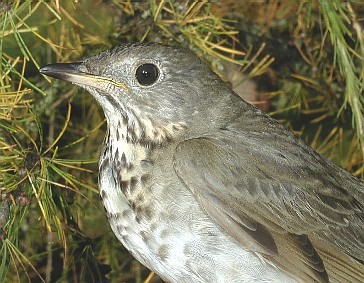
Gray-cheeked Thrush
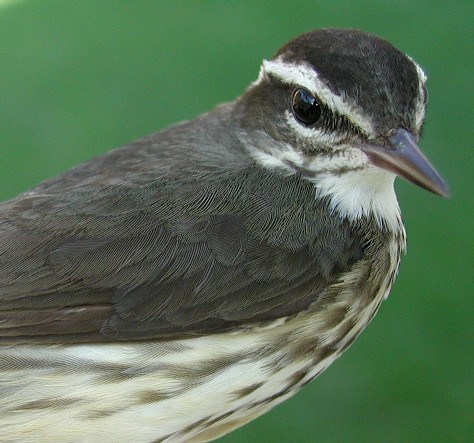
Louisiana Waterthrush

The other thing birds base their decision to leave upon is weather, specifically wind.  And it effects how many migrants might be arriving on a particular day at a particular place.  Put another way, birds’ instincts effect the range of dates they arrive, weather influences the specific dates.

How is wind important? Hawks soar using thermals (warm air rising from heated land masses) or ridges (wind pushed up by ridges). Songbirds on the other hand, migrate at night and fly when the winds are light or are in the direction they are heading (when they literally have a tail wind). Because low pressure systems spin counter-clockwise fall migrants will move after a low front passes in the fall or before a low front arrives in the spring. We like to use Hint.fm wind maps to help predict when and where migrants can move. Besides being informative, these maps show the beautiful complexity of wind patterns.
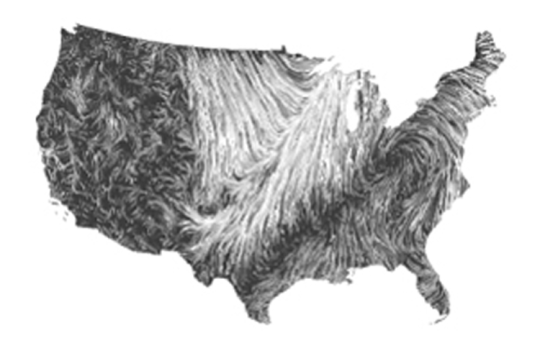
You might now be wondering how we use these maps. Let’s use Sept 19th, 2012 as an example. At 1pm EST there are light, southerly winds along the eastern seaboard and throughout the Southeast. There are also strong southerly winds in the western part of the Midwest. If you imagine that these patterns will slowly move eastward (say half an inch by sunset) you might predict strong migration for the eastern seaboard, the southeast, and the Midwest.
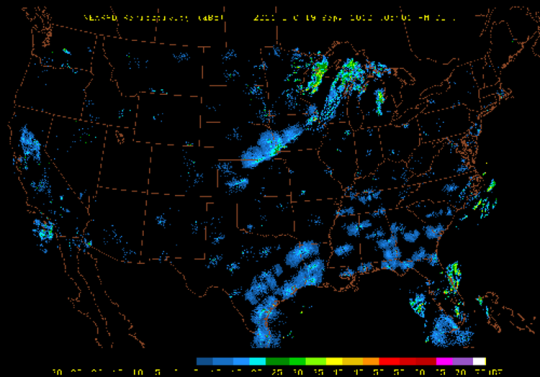
If you made such a prediction you would be right, but you don’t have to take our word for it. It turns out that birds taking off and migrating at night are picked up on radar. Here’s a radar loop from 5pm EST Sept 19th to 1:40am EST Sept 20th. At the very beginning you can see storm systems across Wisconsin and Iowa. As the frames progress you can see intense circular “clouds” appearing across the east, Southeast, and Midwest. These “clouds” are millions of birds taking off after sunset and continuing to migrate throughout the night. They’re circular because they are centered around each radar. We call these appearances “blooms” because they blossom around the radar sites.

Notice that where the storm system is and several hundred miles to the east (about an inch) there aren’t any blooms. That’s because this is the area which is experiencing strong northerly winds. Rather than fighting the headwind, birds in this area are staying put until more favorable winds come through. The winds along the gulf appear to be favorable for a trans-gulf crossing and you can see the clouds of birds take off and begin to move off the gulf coast shoreline (especially Texas). Looking at the longer loop from 3pm EST the 19th to 2pm EST the 20th you can also see birds taking off in Illinois and Iowa after the front has passed through.
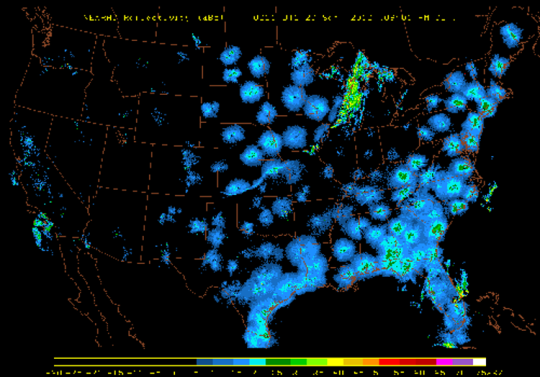
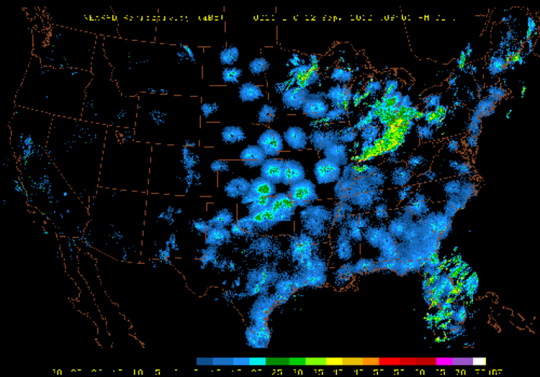
What about the spring you ask?  Remember, since the low-pressure systems spin counter clockwise birds migrate ahead of a front.  A few days ago, the night of April 11th, there were southerly winds resulting in good movement northward across the southeastern U.S.  Looking ahead, the next significant warm-up with nightly, light, southerly winds won’t occur until next week, mid-week (around Tuesday April 21st). If piecing together wind patterns and radar isn’t your thing, Cornell Lab of Ornithology has you covered.  They’ve put together something they call BirdCast which puts combines weather, radar, and bird data (ebird) to forecast bird migration for the U.S.
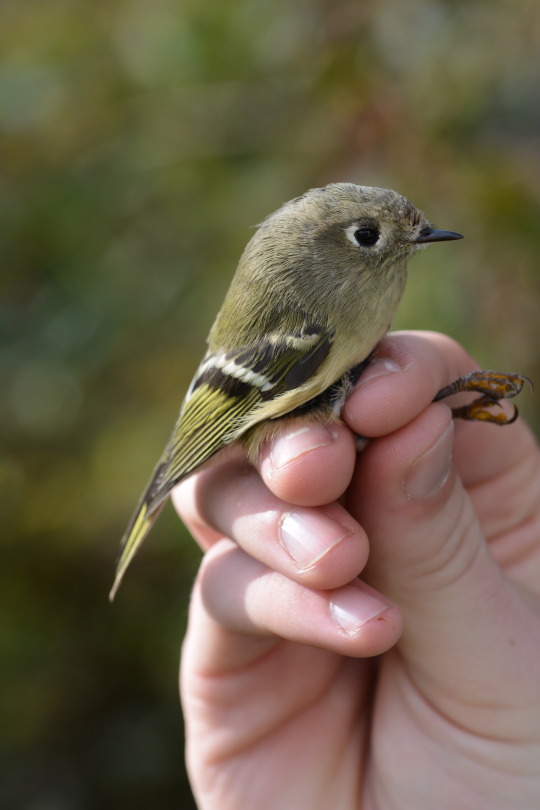
Ruby-crowned Kinglet

We may be quarantined but that doesn’t mean we have to miss the magic of migration.  As I write, there’s a ruby-crowned kinglet singing in a maple across the street.  We can bird, or learn birds, in our backyard or neighborhood.  We can bird a new local patch and contribute what we see to science by logging our sightings into ebird.com.  Over the last few years people in Pennsylvania have found some amazing birds in their own backyard.  A Black-backed Oriole from Mexico, a Painted Bunting which overshot the Carolinas by more than a few states, and even a Bahama Woodstar.  With migration, we never know exactly what we’re going to get.  To me that’s part of the magic.  That, and knowing that it’s time for them to come, carried hundreds or even thousands of miles by their wings and the wind.

Luke DeGroote is the avian research coordinator at Powdermill Nature Reserve, Carnegie Museum of Natural History’s environmental research center. Museum staff, volunteers, and interns are encouraged to blog about their unique experiences and knowledge gained from working at the museum.
Filed Under: Blog Tagged With: Birds, Luke DeGroote, Museum from Home, parc, Science News

April 1, 2020 by wpengine

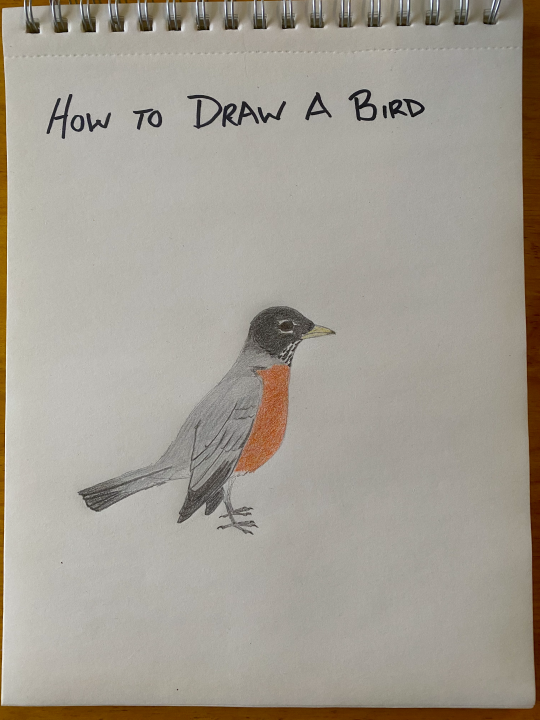
Draw a Bird!

Have you been spending a lot of time looking out your window?  I have and I’ve decided to do something about it.  So, let me show you how to draw the birds that you see.

Illustrating or drawing nature is a method that some scientists use while taking notes.  Sometimes a photo doesn’t always capture the details that a scientist wants to make notes about, so they’ll draw an animal, plant, insect, or even a whole scene in order to fully record what is happening.  It’s also fun to make a sketch of your favorite flower or animal.

This time of year, there are a lot of robins around my neighborhood, so I’ll show you how I created this sketch of one and you can follow along too.

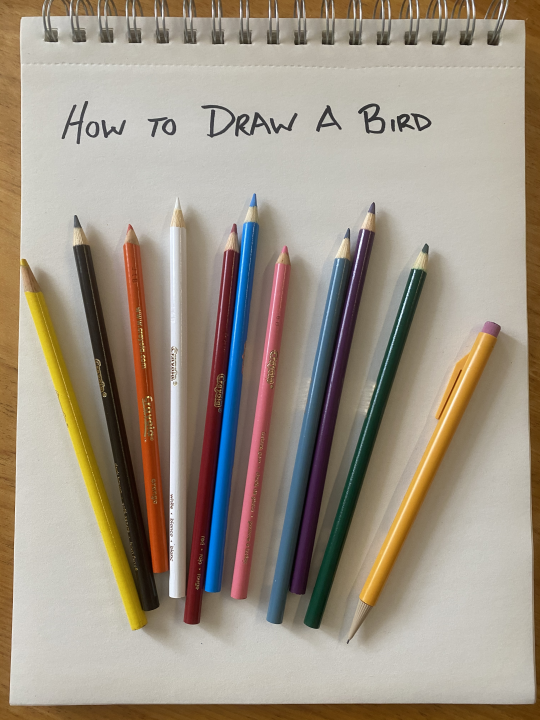
Before we get started you might need to gather some supplies.  Use a pencil and eraser, just in case you make some mistakes (it’s okay to make a mistake).  Get some paper and a comfy spot to draw—make sure you cover your table to avoid making marks on it.  Don’t forget the colors!  I like colored pencils, but you can use markers, crayons, paint, or anything else to color with.

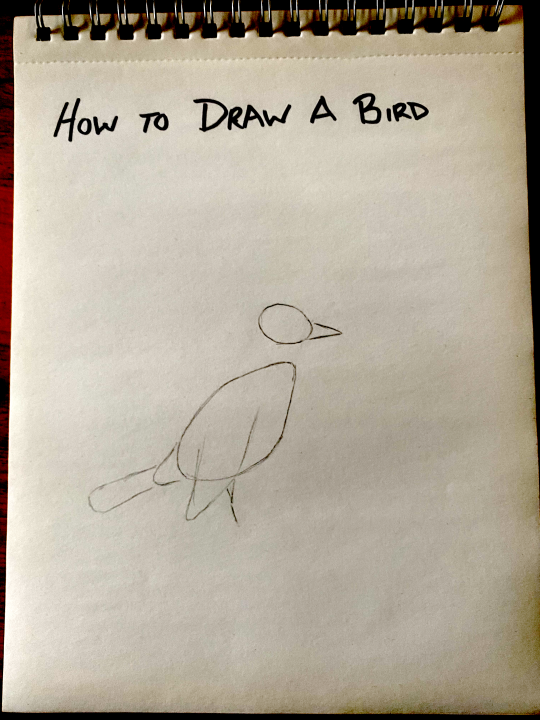
Step 1: Shapes

Use some basic shapes—circles, triangles, squares, and lines—to make the general shape of what you want to draw.  Use light pencil strokes so that they’ll be easy to erase later.

Try to keep all of your shapes balanced to one another—you don’t want your bird to have a huge head!  I like to use a photo that I’ve taken or found online to use as a reference for what I’m drawing.

If you want to take it to the next level, you can also check out the different field marks on a bird.

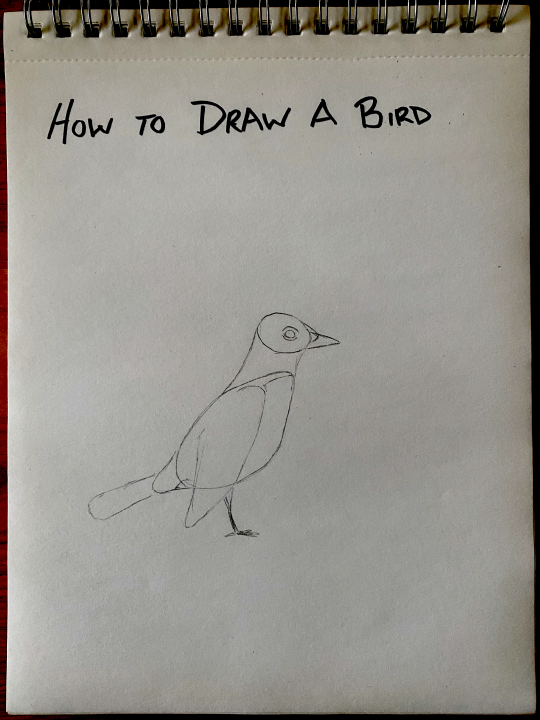
Step 2: Silhouette

Next let’s connect our shapes so that we can have a good outline of our subject.  You can add eyes and some of the rough edges.  Try to zone out where your colors will change too—for instance the robin’s red belly will be different than its grey back, so I’ll add a line to mark that.

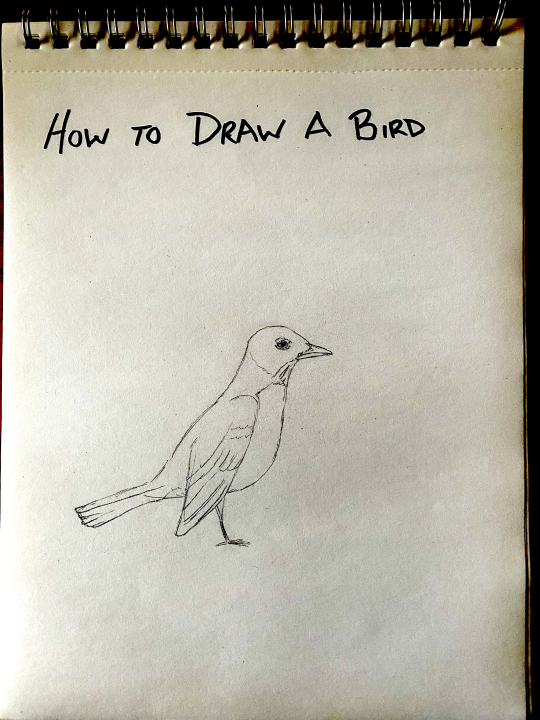
Step 3: Details

Add more details.  Add feathers on the wing and tail, add in details on the beak, head, and eye.  You can also erase some of those shapes we made in step 1 and feel free to make a few changes to those shapes if you want to.

It’s also important in this step to know how detailed you want to be—sometimes simple is good.  If your sketch is small, then less details might be better, but if your sketch is big, then you can add lots of little details.  It’s up to you!

Step 4: Color

This step is optional, sometimes scientists will just write down what colors they noticed because they can’t always carry around a whole art kit.  However, if you have some time, then adding color to your drawing can really bring it to life.

You can use crayons, markers, paint, or any other color tool you want.  It’s always a good idea to test your colors on a separate piece of paper to see if they’re right for you or to try out a mix of colors.  Birds can be lots of different colors!

Be proud of your sketches!  No one else could have made it the same way that you did.  By drawing and coloring plants, animals, and other nature you can sharpen your observation skills and gain a better appreciation for the beauty and uniqueness of all life.

Aaron Young is a museum educator on Carnegie Museum of Natural History’s Outreach team. Museum staff, volunteers, and interns are encouraged to blog about their unique experiences and knowledge gained from working at the museum.
Filed Under: Blog Tagged With: activities, Birds, Education, Museum from Home

March 25, 2020 by wpengine

Robin Watch

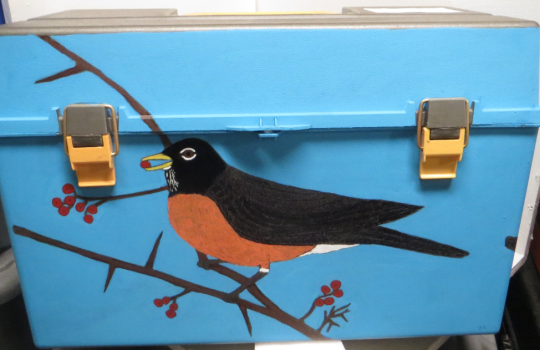
(above) The American Robin Box in the CMNH Educator Loan Program, with art work by John Franc. The loaning of educational materials has been suspended during the Covid-19 pandemic.

As a bird watcher, I’m out of the house early at this time of the year, listening for the calls of newly arrived migrating birds. New days begin in a still dark neighborhood with a steadily growing feathered chorus. Although the calls of a few Northern cardinals and Carolina wrens are close enough for me to guess the location of each singers’ perch, they are far outnumbered by American robins whose blended notes reach my ears from every compass point.

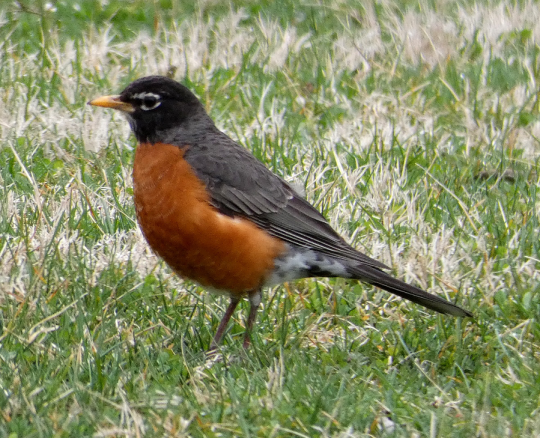
On recent mornings I’ve come to value the abundant presence of robins as a tonic to human nerves frazzled by the life-disrupting spread of Covid-19. The species’ horizon-wide dawn concert is a prelude to an active visible presence in the same territory all day. With minimal effort, little prior planning, and without violating protocol for social distance spacing, you can observe robins flying to and from cover, hopping over grassy feeding areas in search of worms, fighting rivals for mates and territory, and even gathering dried grass and mud for nest construction.

Photo by Amy Henrici.

Through such simple observations it’s possible to reach what naturalist Margaret Renkl, writing recently in The New York Times, termed “the alternate world we need right now, one that exists far beyond the impulse to scroll and scroll.”

A pre-pandemic, but still contemporary call for all of us to become better robin watchers can be found in A Season On The Wind, ornithologist Ken Kaufman’s 2019 account of spring bird migration near his home along the Lake Erie shore in western Ohio.

“Their songs are loud and rich and their colors are bold, from the deep yellow of the beak to the bright rufous orange of the chest. If the American robin were a rare bird, we would climb mountains or walk through fire to catch a glimpse of it. Why should we appreciate it any less just because it’s around us every day?”     (A SEASON ON THE WIND, Inside the World of Spring Migration, Houghton Mifflin Harcourt, 2019.)

A far older robin endorsement can be found in the writings of John James Audubon. In early June of 1833, when the renowned bird artist arrived on the barren coast of Labrador, he encountered a robin singing from a snow-free patch of grass.

“That song brought with it a thousand pleasing associations referring to the beloved land of my youth, and soon inspired me with resolution to persevere in my hazardous enterprise.”

Audubon’s praise for the species continues for several paragraphs, and his deep appreciation for the wide-ranging bird includes an aspect unfamiliar to modern robin watchers. After describing how wintering robins in the American south feed on “the fruits of our woods,” he reminds readers that under these circumstances “they are fat and juicy and afford excellent eating.”

For more information about robins including song recordings:

https://www.allaboutbirds.org/guide/American_Robin/id

For read a fuller account of Audubon’s praise for robins:

https://www.audubon.org/birds-of-america/american-robin

For Margaret Renkl’s full essay about the value of nature observation:

https://www.nytimes.com/2020/03/23/opinion/coronavirus-nature-outdoors.html

Patrick McShea works in the Education and Visitor Experience department of Carnegie Museum of Natural History. Museum employees are encouraged to blog about their unique experiences and knowledge gained from working at the museum.
Filed Under: Blog Tagged With: Birds, Education, Museum from Home, Patrick McShea

March 13, 2020 by wpengine

An Introduction to BirdSafe Pittsburgh

It is estimated that 599 million birds die every year in North America after colliding with buildings. BirdSafe Pittsburgh was created in 2014 to research why birds collide with windows and how best to resolve this immense problem. Since then, every Spring and Fall the Downtown area of Pittsburgh, and some surrounding areas, have been monitored for migrating birds that have collided with windows.

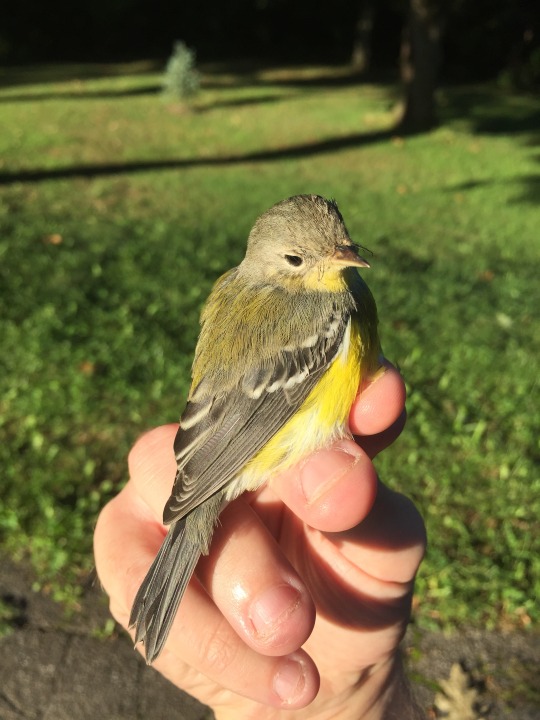
Fall first year female magnolia warbler. It was caught after colliding with a window downtown and later released in Schenley Park.

The unfortunate birds found dead are brought back to the museum where they become part of our collection. The birds found alive after a collision are taken to a local rehabilitation center and are eventually released if they survive their injuries. These efforts help us understand what about a building makes it dangerous to a bird and using this information we can mitigate deadly areas with the help of building owners and managers.

Every person’s effort makes a difference, volunteering to walk a predetermined route downtown or monitoring your own home helps us continue to learn and spread the word of this problem. For more information about the project and how you can get involved visit our website: birdsafepgh.org, our facebook page: facebook.com/birdsafepgh/, or contact Jonathan Rice at ricej@carnegiemnh.org.

Jon Rice Urban Bird Conservation Coordinator is at Carnegie Museum of Natural History’s Powdermill Nature Reserve. Museum employees are encouraged to blog about their unique experiences and knowledge gained from working at the museum.
Filed Under: Blog Tagged With: Birds, birdsafe pittsburgh, Science News

February 27, 2020 by wpengine

The Real James Bond and his Connection to CMNH

Bondi. Tyto alba bondi.

Did you know a subspecies of barn owl (Tyto alba bondi) is named after James Bond? James Bond the ornithologist that is.

The holotype specimen of Tyto alba bondi was collected by past Carnegie Museum of Natural History curator Arthur C. Twomey on April 7, 1947 at French Harbor, Isla Roatan, Honduras and later described by Kenneth C. Parkes, another curator at CMNH, together with Allan R. Phillips.

A soon-to-be-released book The Real James Bond: A True Story of Identity Theft, Avian Intrigue and Ian Fleming tells the story of the ornithologist and author of Birds of the West Indies, and how his name became the name of Fleming’s incredibly popular epic thriller series. Fleming, an avid birder himself, admits to lifting the name directly from Birds of the West Indies and acknowledges that the real James Bond’s actions outshine anything the fictional James Bond has done.

Photo credit: Kaylin Martin

The new book includes an image of museum specimen CM P131548, Tyto alba bondi, a subspecies first described in the Annals of the Carnegie Museum. It is endemic to Roatán and Guanaja in the Bay Islands off the coast of Honduras.

Tyto alba bondi is not the only nod to birds that Ian Fleming made in his James Bond stories. Goldeneye is a species of duck, the name of Ian Fleming’s estate in Jamaica, and a 1995 James Bond movie. Not only that, in Die Another Day, 007 goes undercover in Cuba as an ornithologist, a nice little “Easter egg” for those who know the real story of James Bond.

Want to learn more about the James Bond Barn Owl? Consult the December 1978 issue of Annals of the Carnegie Museum, available online here.

Holotype of Tyto alba bondi. Parkes, Kenneth C., and Allan R. Phillips. 1978. Two new Caribbean subspecies of Barn Owl (Tyto alba) with remarks on variation in other populations. Annals Carnegie Museum, 479-492. Page 486, Published 1 December 1978.

Filed Under: Blog Tagged With: Birds

August 12, 2019 by wpengine

Travels with a Sketchbook: A Natural History Artist’s Observations at the Museum

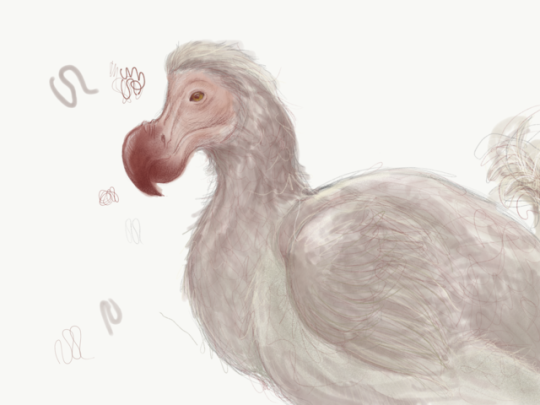
Carnegie Museum of Natural History has a large and expansive collection of artifacts, oddities, and wonders. It also has its fair share of mounted animals and skeletons on display, which makes it an ideal spot for the wandering artist. Where else can an artist study both extinct and extant species up close and in great detail? If, like me, you’re an illustrator who loves to draw animals, you could, for example, grab your sketchbook and head to the museum’s Bird Hall to get a close look at the flightless dodo (Raphus cucullatus). Driven to extinction by European colonists during the 1600s, early artists’ renderings provide some of the best evidence for the dodo’s appearance in life. Perhaps surprisingly, this bird is now known to be closely related to pigeons!

Dodo (Raphus cucullatus) in Bird Hall at Carnegie Museum of Natural History. Sketch by the author.

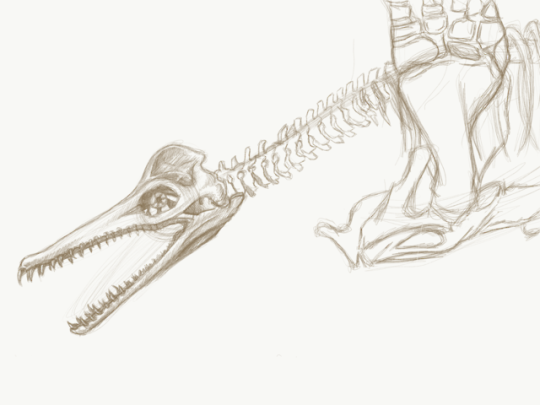
If your tastes are more prehistoric, check out the museum’s sprawling Dinosaurs in Their Time exhibition. Travel back in time to ancient seas and imagine the graceful movements of the plesiosaur Dolichorhynchops bonneri while the giant carnivorous mosasaur Tylosaurus proriger hovers ominously above you. These marine reptile groups vanished in the mass extinction that also wiped out non-avian dinosaurs roughly 66 million years ago.

Skeleton of the short-necked plesiosaur Dolichorhynchops bonneri in the Dinosaurs in Their Time exhibition at Carnegie Museum of Natural History. Sketch by the author.

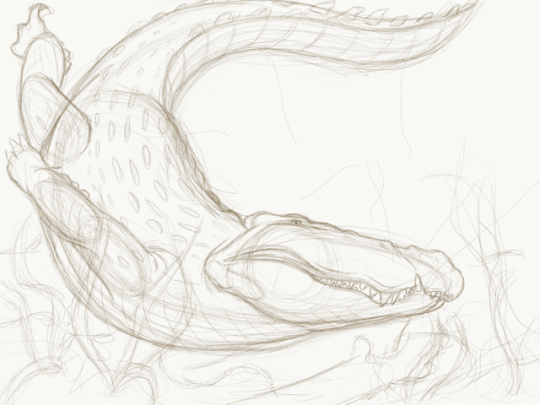
Or perhaps you’re more interested in observing and sketching modern day animals? If so, visit the Hall of North American Wildlife and Hall of African Wildlife on the museum’s second floor. Get up close and personal with the Nile crocodile (Crocodylus niloticus) trio and capture their anatomy in detail. It’s the safest way to do so – not to mention the only way to do so here in Western Pennsylvania! (Reports of alligators in our rivers notwithstanding.)

Nile crocodile (Crocodylus niloticus) in the Hall of African Wildlife at Carnegie Museum of Natural History. Sketch by the author.

So, my fellow artists and nature lovers, as I hope this post has shown, there are scores of species to inspire you here at the museum. Grab your sketchbook and come on over!

Hannah Smith is an intern working with Scientific Illustrator Andrew McAfee in the Section of Vertebrate Paleontology at Carnegie Museum of Natural History. Museum employees, interns, and volunteers are encouraged to blog about their unique experiences and knowledge gained from working at the museum.
Related Content

Celebrating Women in the Natural History Art Collection

Art and the Animal

New Vision of Old Rock Art

Carnegie Museum of Natural History Blog Citation Information

Blog author: Smith, Hannah
Publication date: August 12, 2019

Share this post!

  • Share on Twitter Share on Twitter
  • Share on Facebook Share on Facebook
  • Share on Pinterest Share on Pinterest
  • Share on LinkedIn Share on LinkedIn
  • Share on Reddit Share on Reddit
  • Share via Email Share via Email

Filed Under: Blog Tagged With: Andrew McAfee, bird hall, Birds, dinosaurs in their time, fossils, Hall of African Wildlife, Vertebrate Paleontology

  • « Go to Previous Page
  • Page 1
  • Interim pages omitted …
  • Page 5
  • Page 6
  • Page 7
  • Page 8
  • Page 9
  • Interim pages omitted …
  • Page 20
  • Go to Next Page »

sidebar

About

  • Mission & Commitments
  • Directors Team
  • Museum History

Get Involved

  • Volunteer
  • Membership
  • Carnegie Discoverers
  • Donate
  • Employment
  • Events

Bring a Group

  • Groups of 10 or More
  • Birthday Parties at the Museum
  • Field Trips

Powdermill

  • Powdermill Nature Reserve
  • Powdermill Field Trips
  • Powdermill Staff
  • Research at Powdermill

More Information

  • Image Permission Requests
  • Science Stories
  • Accessibility
  • Shopping Cart
  • Contact
  • Visitor Policies
One of the Four Carnegie Museums | © Carnegie Institute | Privacy Policy | Terms of Use | Accessibility
Rad works here logo