• Skip to primary navigation
  • Skip to main content
  • Skip to primary sidebar

Carnegie Museum of Natural History

One of the Four Carnegie Museums of Pittsburgh

  • Visit
    • Buy Tickets
    • Visitor Information
    • Exhibitions
    • Events
    • Dining at the Museum
    • Celebrate at the Museum
    • Powdermill Nature Reserve
    • Event Venue Rental
    • Gift Cards
  • Learn
    • Field Trips
    • Educator Information
    • Programs at the Museum
    • Bring the Museum to You
    • Guided Programs FAQ
    • Programs Online
    • Climate and Rural Systems Partnership
  • Research
    • Scientific Sections
    • Science Stories
    • Science Videos
    • Senior Science & Research Staff
    • Museum Library
    • Science Seminars
    • Scientific Publications
    • Specimen and Artifact Identification
  • About
    • Mission & Commitments
    • Directors Team
    • Museum History
  • Tickets
  • Give
  • Shop

Blogs from our Scientific Researchers

Carnegie Museum of Natural History is home to active research and vast scientific collections. Our scientific researchers regularly contribute to the blog at the museum.

January 7, 2021 by wpengine

Mesozoic Monthly: Vegavis

Disclaimer: Our dinosaur paleontologist Matt Lamanna typically edits Lindsay Kastroll’s Mesozoic Monthly posts before they go live, but due to some much-needed holiday revelry he was late in getting to this one. As such, it’s being posted in January rather than in December as Lindsay had intended. Matt sends his apologies!

‘Tis the season for eating candy canes, singing Christmas carols, and kicking off a new year of Mesozoic Monthly! That’s right – one year ago, the first Mesozoic Monthly debuted in December 2019, spotlighting the ceratopsian dinosaur with a candy cane-shaped nasal horn, Einiosaurus. This December, we’ll move from candy canes to carols as we feature Vegavis iaai, the first Mesozoic bird known to have had a syrinx (the avian “voice box”)!
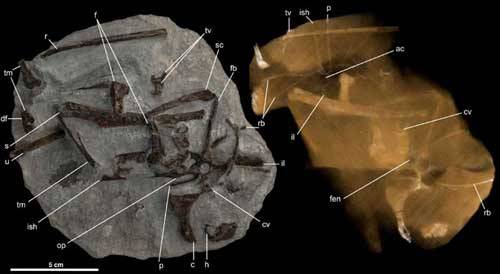
Photo (left) and computed tomographic (CT) scan image (right) of the type, or name-bearing, specimen of Vegavis iaai, a partial skeleton inside a ~70-million-year-old rock concretion from Vega Island, Antarctica. Photo from the Antarctic Peninsula Paleontology Project website.

Birds evolved during the Mesozoic Era, the so-called “Age of Dinosaurs,” before non-avian dinosaurs became extinct. Last month, for the November edition of Mesozoic Monthly, we discussed what makes modern birds members of the group of theropod dinosaurs, but what I didn’t mention is that birds lived alongside non-avian dinosaurs! Birds evolved around 165 to 150 million years ago during the Jurassic Period, the second of three time periods in the Mesozoic. The Jurassic dinosaur Archaeopteryx represents a transitional stage between birds and non-avian dinosaurs: its fossils display obvious flight feathers like a bird, but it also has many non-avian dinosaur characteristics such as a toothy mouth, a long bony tail, and even a miniature version of a killing claw like that of Velociraptor.
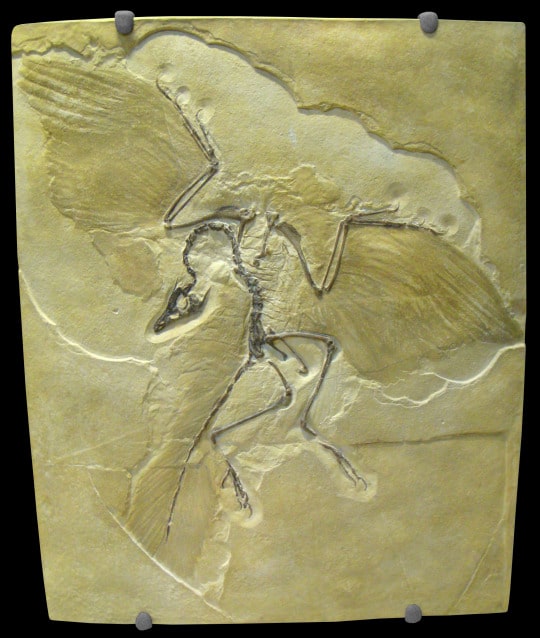
Replica skeleton of Archaeopteryx lithographica on display here at CMNH. Photo from Wikimedia Commons.

Birds lived and evolved alongside their non-avian relatives for almost 100 million years, and by the end of the Cretaceous Period (the third and final time period of the Mesozoic), the distinct groups of birds that we recognize today were beginning to originate. Vegavis was an ancient relative of ducks and geese discovered on Vega Island, an island off the coast of the Antarctic Peninsula (the part of Antarctica that juts northward towards South America). At that time, Antarctica was warmer than it is now and home to lush temperate forests.
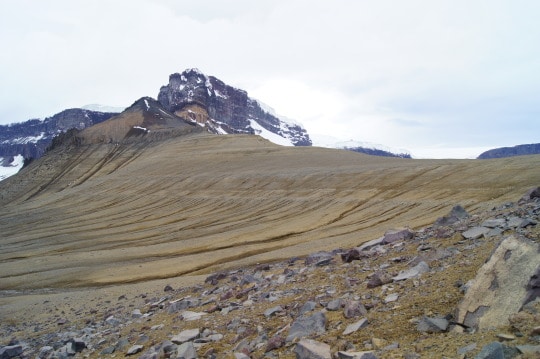
Sandwich Bluff, the site on Vega Island, Antarctica that has produced all known fossils of Vegavis. Photo by Eric Roberts, James Cook University.

With many skeletal features suggesting that it was a diving bird that propelled itself with its feet, Vegavis was probably as well-adapted to life in the water as it was to life in the skies. While it’s certainly incredible that scientists are able to deduce this much information about its behavior from just its skeleton, the story gets better: one specimen of Vegavis includes a fossilized syrinx, the organ that birds use to produce sound! A syrinx’s shape is directly related to the sounds it can make, and the fossilized syrinx of Vegavis was a distinctively goose-like asymmetrical shape. So, this ancient bird may well have honked! If it did, it would have sounded much more like six geese-a-laying than, say, four calling birds, three French hens, two turtle doves, or a partridge in a pear tree.

Lindsay Kastroll is a volunteer and paleontology student working in the Section of Vertebrate Paleontology at Carnegie Museum of Natural History. Museum staff, volunteers, and interns are encouraged to blog about their unique experiences and knowledge gained from working at the museum.

Related Content

Ask a Scientist: What kind of dinosaur is a megaraptorid?
The Bromacker Fossil Project XIII: What We Learned

Pebble or Jaw?

Filed Under: Blog Tagged With: dinosaurs in their time, Lindsay Kastroll, Mesozoic Monthly, Science News, Vertebrate Paleontology

December 30, 2020 by wpengine

The Bromacker Fossil Project Part XIII: What We Learned

New to this series? Need to catch up on your reading? Here are all the previous posts for the Bromacker Fossil Project: Part I, Part II, Part III, Part IV, Part V, Part VI, Part VII, Part VIII, Part IX, Part X, Part XI, and Part XII. 

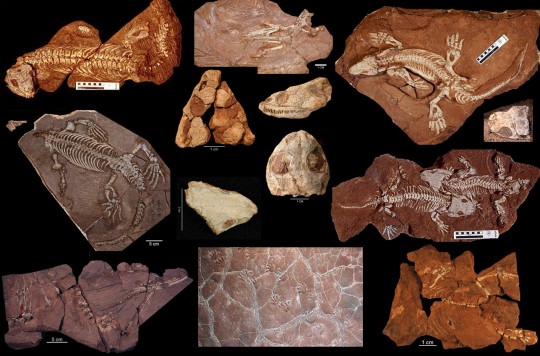
Collage of the fossils highlighted in this series. Images not to scale. Photos by the author, Dave Berman, and Thomas Martens.

The Bromacker quarry is a rare site in that it preserves exquisite, articulated fossils of a unique vertebrate fauna that lived in an atypical or rarely recorded Early Permian (~290 million years ago) setting. Early in our work at the Bromacker, we became aware that the fossil vertebrates we were finding were unknown or extremely rare in Europe but were closely related or identical to species commonly found in North America. Until then, most of the fossil vertebrates found in Europe were discovered in gray to black sediments deposited in ancient lake beds, whereas the fossils from the Bromacker quarry occurred in red beds representing a terrestrial setting. Paleontologists looking for fossils in Europe typically prospected the gray to black sediments where fossils were relatively plentiful rather than red beds, which were thought to represent arid environments not conducive to fossil preservation.

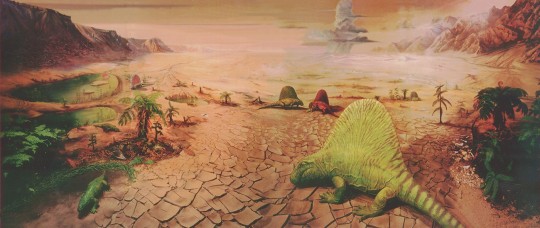
Photograph of a diorama showing the Tambach Basin 290 million years ago, which was once exhibited at the Museum der Natur, Gotha. It was built in 1996, so many of the inhabitants of the basin weren’t yet discovered. One of these is Dimetrodon teutonis, which was inadvertently depicted as being large and numerous. Image provided by Thomas Martens, 2020.

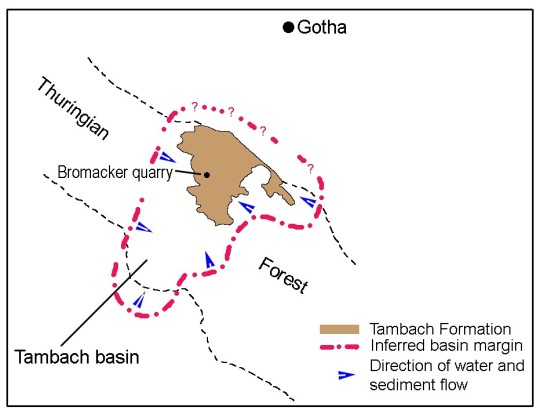
In a collaborative effort to help determine how the fossil deposit at the Bromacker quarry formed and why its vertebrate fauna is unique, Dave Berman invited his colleague David Eberth to join us for the 1998 field season. David is a geologist/vertebrate paleontologist who was then employed by the Royal Tyrrell Museum of Palaeontology in Canada but is now retired. The sediments preserving the Bromacker fossils are part of a rock unit called the Tambach Formation and were deposited in the Tambach Basin. The results of David’s study, built in part upon investigations by other geologists and paleontologists, indicate that the Tambach Basin was situated within an ancient mountain range and isolated from river systems. At the time the fossils were deposited, the basin was internally drained, and as a result, when it rained, water would flow towards the basin center and form ephemeral ponds and lakes. Based on the geology, fossil plant assemblage, and geographic setting of the Tambach Basin, David concluded that the climate was possibly similar to the wet‑and‑dry tropical climate of modern North African savannas, Brazilian Campos, or the Venezuelan Llanos.

Map showing the areal extent of the Tambach Formation today and the inferred boundary of the Tambach Basin, with arrows indicating direction of water flow. The northern boundary of the basin is not preserved, but it was thought to have been closed when the Bromacker fossil deposit formed. Modified from Eberth et al., 1997.

Most of the fossils discovered at the Bromacker quarry came from two massive units, the more fossiliferous of which is about 21 inches thick, that formed in separate major flooding events. David theorized that these deposits formed when heavy rain caused a sheet-flood of sediment‑laden water to sweep down the sides of the Tambach Basin and across the basin floor, killing any animals that couldn’t escape the flow. The sheet-flood transported the carcasses to the basin center where they were deposited, rapidly buried, and eventually fossilized. These deposits record a unique snapshot of vertebrate life in the Tambach Basin, because only animals inhabiting the basin would have been captured by the sheet-flood.

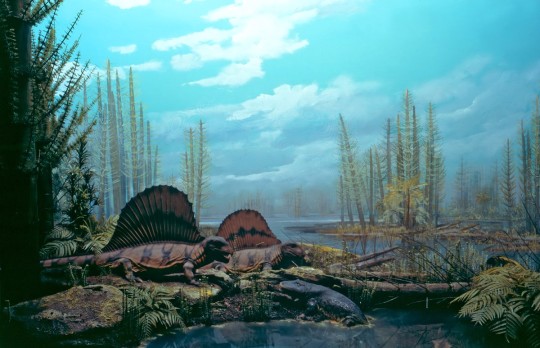
In contrast, most Early Permian fossil‑bearing deposits in North America formed on coastal or alluvial plains. Carcasses would’ve been transported to the deposition sites by rivers, some of which had a large geographic reach. These types of deposits can accumulate over a long period of time and have potential to mix together fossils from different environments.

Photograph of a diorama once exhibited at Carnegie Museum of Natural History that shows a typical Early Permian peat swamp or backwater swamp of a major river system. A similar modern environment would be the Okefenokee Swamp, Georgia. Photo by Mindy McNaugher, 2007.

Besides having an atypical geographic setting, the makeup of the Bromacker vertebrate fauna differs from those known from other Early Permian sites. The Bromacker vertebrate fauna has a low diversity of terrestrial tetrapods, but more importantly, it lacks fishes and aquatic to semi‑aquatic constituents. This is probably due to the Tambach Basin’s isolation from regional river systems and because it experienced seasonal to sub‑seasonal drying, making it difficult for water-reliant vertebrates to become established. Based on numeric counts of individual specimens, we determined that the relatively large‑sized herbivores Diadectes, Orobates, and Martensius greatly outnumbered the synapsid apex predators Dimetrodon and Tambacarnifex. We think the rarity and low diversity of synapsid carnivores is probably due to the lack of an aquatic to semi‑aquatic component in the food chain.

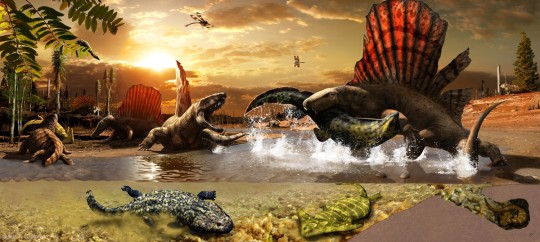
In contrast, most Early Permian North American localities preserve a diverse, mixed aquatic‑terrestrial fauna that either lived in water or was closely associated with water and aquatic food chains. Herbivores were rare in terms of both diversity and numbers, whereas synapsid apex predators were diverse and numerous.

A more dynamic North American Early Permian scene that includes a mixed aquatic‑terrestrial vertebrate fauna. The Dimetrodon on the right has caught a freshwater shark, demonstrating the importance of aquatic animals in the food chain. © Julius Csotonyi/Houston Museum of Natural Science.

The Bromacker is the oldest known terrestrial vertebrate ecosystem in which herbivores greatly outnumber apex carnivores, and in that respect, it resembles terrestrial vertebrate ecosystems of today. A modern example is the African savanna in which large herds of herbivores such as zebra, wildebeest, and buffalo provide a food source for a much smaller number of carnivores including lions, cheetahs, and hyaenas. Indeed, we consider the Bromacker to represent an early stage in the development of the modern terrestrial vertebrate ecosystem and that these early stages were restricted to upland areas isolated from aquatic‑based food chains.

This summary concludes the Bromacker Fossil Project blog post series. I hope that you’ve enjoyed reading it. Cast replicas of many of the fossils described in this series are exhibited in the Fossil Frontiers display case in CMNH’s Dinosaurs in Their Time exhibition, so be sure to look for them on your next visit. I’m grateful to Dave Berman, Albert Kollar, Thomas Martens, and Stuart Sumida, who answered numerous questions and provided photographs, and to Patrick McShea and Matt Lamanna for their editing skills. Click here to read the paper by Eberth et al. 2000.

Amy Henrici is Collection Manager in the Section of Vertebrate Paleontology at Carnegie Museum of Natural History. Museum employees are encouraged to blog about their unique experiences and knowledge gained from working at the museum.

Related Content

Vertebrate Fossils from Bears Ears National Monument, Utah

Mesozoic Monthly: Scipionyx

Ask a Scientist: What is the “Crazy Beast?”

Filed Under: Blog Tagged With: Amy Henrici, dinosaurs in their time, Museum from Home, Science News, Vertebrate Paleontology

December 23, 2020 by Erin Southerland

Collected on this Day in 1934

Has your Charlie Brown tree lost its needles yet?

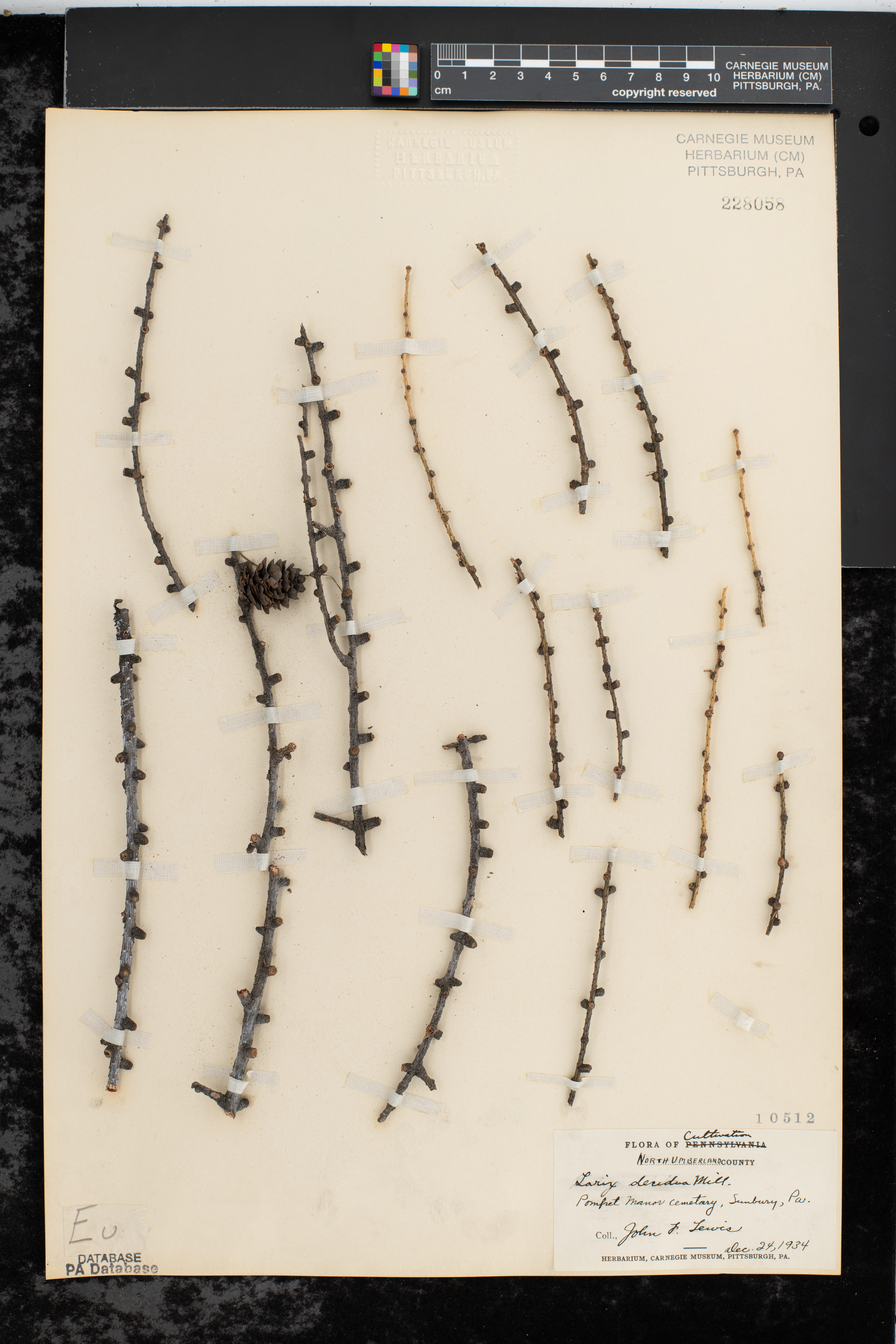
dried specimen of larch on an herbarium sheet

Not all needled-leaved trees are evergreen! Yes, there are deciduous species in the Pine family (Pinaceae).  That is, unlike most needle-leaved trees that retain their leaves all year long (evergreen), there are several conifer species that shed their leaves each year for the winter. Perhaps most famous are a group of species called larches.

No, this needle-free specimen of twigs and a cone wasn’t collected by Charlie Brown on Christmas Eve. Rather, this humble yet festive specimen of European larch (Larix decidua) was collected by J.F. Lewis on December 24, 1934.  Native to the mountains of central Europe, this species was planted in a cemetery in Northumberland county (central Pennsylvania).  It is highly likely the tree is still there – many decades later – as European larches can live for many hundreds of years (perhaps even a thousand years!).  

The herbarium at California University of Pennsylvania is named for the person who collected this specimen – John Franklin Lewis.

European larch recently made the big time news too, featured in a new study published in the scientific journal Science. The researchers used leaf out and leaf fall data collected from across Europe since the late 1940s for four tree species (including European larch). Surprisingly they found that trees may drop their leaves much earlier than expected with ongoing climate change.  In other words, as spring temperatures warm, deciduous trees produce leaves earlier in the spring, but this also causes trees to drop their leaves earlier in the fall.  This means that climate change may not result in longer growing seasons, as has been previously predicted.  You can read more about this study here.

Find this Charlie Brown larch specimen (and more) here.

Check back for more! Botanists at the Carnegie Museum of Natural History share digital specimens from the herbarium on dates they were collected. They are in the midst of a three-year project to digitize nearly 190,000 plant specimens collected in the region, making images and other data publicly available online. This effort is part of the Mid-Atlantic Megalopolis Project (mamdigitization.org), a network of thirteen herbaria spanning the densely populated urban corridor from Washington, D.C. to New York City to achieve a greater understanding of our urban areas, including the unique industrial and environmental history of the greater Pittsburgh region. This project is made possible by the National Science Foundation under grant no. 1801022.

Mason Heberling is Assistant Curator of Botany at Carnegie Museum of Natural History. Museum employees are encouraged to blog about their unique experiences and knowledge gained from working at the museum.

RELATED CONTENT

Collected on This Day in 1884: Beech Drops

Peppermint: A Hybrid Herb for the Holidays

Ask a Scientist: What makes poinsettias so special?

Filed Under: Blog Tagged With: Botany, collected on this day, Mason Heberling, Science News

December 18, 2020 by wpengine

Tuscarora Nu Yah

NU YAH! NU YAH! NU YAH! The sounds of the New Year at Tuscarora Nation in western New York.  For the past one hundred years and longer the Tuscarora have celebrated the New Year in a very unique way.

Three days before the new year our men go out on a hunting competition. Old men versus young men is the battle. It doesn’t matter if you are 60 and have no children you are considered a young man.  Old men are considered anyone with children. Only the reservation boundaries are eligible for the hunt. Rabbits, pheasant, and deer beware this day our men are looking for game to slay for the New Year’s Feast.

The hunt takes place from sunup to sun down. At 8:00 p.m. sharp all game must be at the Old Gym for The Count. There is a young man captain and an old man captain. Each present their group’s game and proceed to count in Tuscarora to see who will win the prize! The prize? The winner gets to watch the loser clean all the game.

The women of the territory will prepare the game for The Feast which will take place at noon on New Year’s Day.

The highlight of our New Year’s festival is the morning of January 1st when Nu Yah takes place. Young and old go door to door calling “Nu Yah! Nu Yah!” at each resident’s door. You must yell loud to be heard. If you don’t yell loud enough adults will prompt you to “say it again.”

Homemade cookies, brownies, rice krispie treats, doughnuts, and sometimes an apple are given from each home very similar to Halloween but adults participate too. Many visitors request a treat for the driver.

In the old days when I still participated in Nu Yah (before my family came along and I had to stay home to watch the door while my husband took our children Nu Yahing) we would often find a store bought cookie or an apple tossed to the side of the road. Homemade goods were the desired treats of the day.

If it was 10 degrees out we bundled up like snowmen and ran from the car to the house and yelled Nu Yah, threw our treats in our bag and headed right back to the warm car that waited. If it was warm out our Ma, Aunt, or Uncle or whoever was our driver would usually come to the door with us and spend some time standing at the door visiting and catching up with friends and family.

While our clan system of bear, deer, wolf, beaver, turtle, eel, and snipe runs through our maternal line, on New Year’s Day we also celebrated our father’s clan. If your father’s clan was a member of the house you visited for Nu Yah you also called out “Uwiire” to receive a special treat sometimes a gingerbread man or a piece of pie. In this way on this special day of the year the men were also recognized and important.

My mother who is 80, and one of 10 children, recalls her father walking with them to Nu Yah and directing them to his family clan homes so they knew which houses to ask for uwiire. I imagine this was also a way of teaching them to know who their family was. Her mother was a beaver just as all her sons and daughters were. Her father was a bear. A household that included a bear was a bonus for them to collect an extra goodie.

In the old days she said people would start coming at 6:00 a.m. and it was custom to yell Nu Yah and just walk in and grab your treat which was usually ready and waiting on a table by the door. Nowadays the first visitors arrive about 8:00 a.m.

While we looked forward with great anticipation to go Nu Yahing, we also looked forward to being old enough to help serve at The Feast. The women cooked for 3 days to prepare for this special day. The rabbits were soaked in water to make rabbit pie. The deer cooked to serve as a side dish.

While the men prepared the cornbread and cornsoup, the women peeled potatoes for mashed potatoes, baked hams and about 150 different pies all while visiting and laughing together. On the day of the feast when we got to be teenagers we would rush home from Nu Yah, change our clothes to something nice and get to the Old Gym to help bring the plates to the guests.

Everyone is welcome to come to The Feast. Many families planned their visits home on this special day so they could see and visit as many family members as possible.

The past few years at our Tuscarora Elementary School, our culture teacher has organized a school wide Nu Yah for our students. They go by grade to different rooms in the school and yell Nu Yah to receive their cookies. The Tuscarora Language teacher bakes cookies with the students for the adults to pass out. In this way each child can participate in Nu Yah and know our tradition even if, for some reason, they don’t get out to take part on New Year’s Day.

The best Nu Yah times that I can remember always involved the adults participating with us, coming in to the homes and taking a few minutes to visit.

To come from a cold, crisp morning into a cozy house with smiling faces and delicious aromas, relatives happy to see us, happy to share their lovely goods, and leave with a Nu Yah! Nu Yah! warmed us better than huddling over my grandparent’s old kerosene heat stove.

We always knew who had the best baked goods, who would be the happiest to see us, who would say every year, “gosh, you look just like your ma!” It was a good feeling to belong to such a loving community where our special New Year’s Festival has happened every year for over a hundred years because of the efforts and dedication of all our Tuscarora people.

Angela Jonathon is a resident of the Tuscarora Nation and affiliated with the Seneca-Iroquois Museum thorough the Tuscarora History Group. She has written this blog at the request of Dr. Joe Stahlman, Director of the Seneca-Iroquois Museum.

Related Content

Dutch Letters: A Sinterklaasavond Treat

The Feast of the Seven Fishes 

Ask a Scientist: What does the motif on this vessel mean?

Filed Under: Blog Tagged With: anthropology, HATW, Museum from Home, Science News, Super Science

December 18, 2020 by wpengine

Mary Anning:  For the Love of the Blue Lias

image
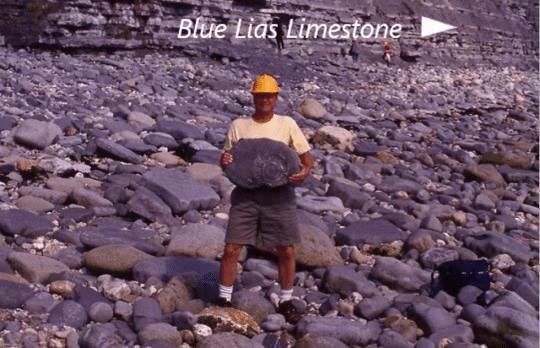
Figure 1:  Albert Kollar holding a fossil, Lyme Regis, 1999.

Two hundred million years before the birth of Mary Anning, a village in southeast England known as Lyme Regis, (Figure 1) was a shallow, watery world filled with pointy toothed reptiles, fish, and an abundance of ammonites.   By 1799, the year of Mary’s birth, these ancient seas that deposited lime, silt and mud, had long receded, but evidence of the watery past remained in the Lyme Regis limestone and mudstone cliffs.  Today, this region is part of a geologic formation of early Jurassic age known as the Blue Lias.

image
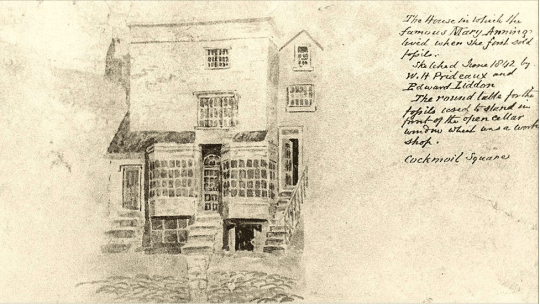
Figure 2:  Drawing of Mary Anning’s house in Lyme Regis, Dorset, England. June 1842. Text on the drawing reads: The House in which the famous Mary Anning lived when she first sold fossils. Sketched June 1842 by W. H. Prideaux and Edward Liddon. The round table for the fossils used to stand in front of the open cellar window which was a work shop. Cockmoil Square

Mary’s father, Richard Anning, hunted fossils along the Lyme Regis coast to supplement his meager carpentry income.   Mary and her brother, Joseph, accompanied their father along the landslide prone cliff in search of fossils to collect and sell to wealthy patrons and the scientific community.  When she was 11, Mary’s father died of tuberculosis. His death left Mary, her mother and brother destitute.  Despite the loss, they continued the family fossil business.  At the age of 12, just one year after her father’s death, Mary excavated and identified the first ichthyosaur.   Although Mary had no formal education and received no formal recognition for her monumental find, word of her abilities spread in the male dominated paleontological community.  By the 1820’s, she managed the family fossil shop (Figure 2), a business where survival depended on finding major new specimens.   At the age of 24, Mary uncovered the first plesiosaur skeleton and just five years later, the first pterosaur discovered in England.

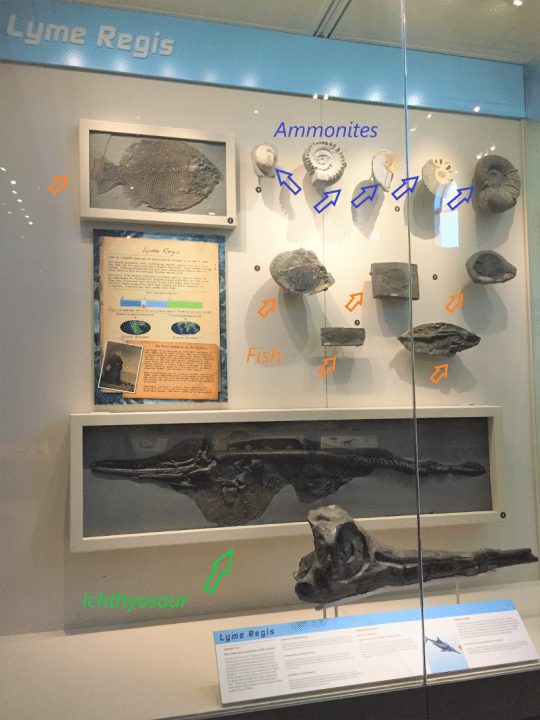
Figure 3:  Carnegie Museum of Natural History Lyme Regis display, Dinosaurs in Their Time exhibition.  Includes real fish, ammonites and an ichthyosaur.

Visitors to Carnegie Museum of Natural History’s Dinosaurs in Their Time exhibition can scrutinize fish scale sized details in fossils from the Lyme Regis cliffs, an extraordinary level of preservation that Albert Kollar witnessed in the field when he collected fossils from the locality in 1999. (Figure 3).

A new movie, titled “Ammonite,” staring Kate Winslet as Mary Anning, promises to captivate a new generation with this often-overlooked chapter in the history of paleontology.

Despite hardship, lack of recognition, and danger, Mary continued working until her death from breast cancer in 1847. Her contributions to science were not formally recognized for over a century. In 2010, the Royal Society of London named her “one of the ten most influential women scientists in British History”

In a recent CMNH blog post, William Vincett, University of Delaware graduate student and Collecting Assistant for the Section of Invertebrate Paleontology, wrote, “It’s easy to see how she developed a love of fossils after discovering such a magnificent creature as a child.”   Yes.  Mary wondered, suffered, and persevered for the love of the Blue Lias.

Joann Wilson is an Interpreter for the Department of Education and volunteer with the Section of Invertebrate Paleontology and Albert Kollar is Collections Manager for the Section of Invertebrate Paleontology.  Thanks to author Barry Alfonso for thoughtful insight. Museum staff, volunteers, and interns are encouraged to blog about their unique experiences and knowledge gained from working at the museum.

Related Content

The Hidden Fossil Treasures of the Section of Invertebrate Paleontology

Millions, Billions, and Trillions

Ask a Scientist: What is a trilobite?

Filed Under: Blog Tagged With: Albert Kollar, invertebrate paleontology, Joann Wilson, Museum from Home, Science News

December 16, 2020 by wpengine

A Steeler Prayer

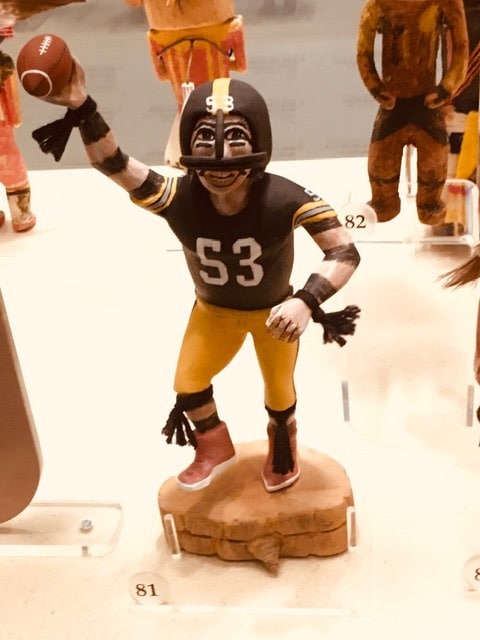
carved figure of a Pittsburgh Steelers football player holding a football

A celebratory touchdown dance in carved cottonwood has been quietly occurring at Carnegie Museum of Natural History for more than 22 years. Within the Alcoa Foundation Hall of American Indians, in the quadrant of the exhibition devoted to conveying information about the Hopi and their culture, a nine-inch high figure of a Pittsburgh Steelers player wearing number 53 holds a football aloft in his right hand. The wide-eyed grinning figure is displayed with plenty of colorful company, and its significance is best understood in terms of this carefully assembled cast.

The carved figures, which are properly called tihus, and more frequently referred to as katsinas, represent the benevolent spirit beings who live among the Hopi on three high mesas of northern Arizona for approximately a six-month period each year. An important role for the carvings is the imparting of knowledge and understanding of these beings or katsinam, and the target audiences for these life lessons are the Hopi themselves.

This aspect of limited cultural sharing was explained to museum educators in the months before the exhibition hall opened in 1998 when Hartman Lomawaima, a Hopi consultant, conducted a training session about the carvings. After a 90-minute presentation that included information about how the katsinas displayed in the hall had not been used in sacred ceremonies, he fielded a particularly pertinent question. “When we take students through the hall we won’t have the time you’ve just shared with us,” explained an experienced interpreter. “What can we tell students about these figures in a minute or two?” “That’s easy,’’ replied Hartman, “just tell them they’re three-dimensional prayers.”

A little more information about the black and gold figure can be gleaned from exhibit text. Here the carving is described as PITTSBURGH STEELER CLOWN KOYAALA, the carver identified as Regina Naha, and the creation date listed as 1992. A reputable reference on katsinas describes the word “Koyaala” as referring to clown figures of the village of Hano on First Mesa, and an internet search under the artist’s name reveals that she is from Hano.

For Steeler fans, and perhaps even for the team’s players, coaches, and administrators, there might be small comfort in knowing a “three-dimensional” prayer clad in their team’s uniform resides under the same roof as Tyrannosaurus rex. For fans of the city itself, the story of how the carving came to be on display offers another example of Pittsburgh Pride. In a font smaller than the rest of the display’s text, the figure is noted to be a “gift of Les and Joan Becker.” Deborah Harding, Collection Manager in the museum’s Section of Anthropology, was able to share some information about the couple. “Les and Joan were long-time and valuable volunteers in this section. During a visit to Arizona they spotted the Steeler carving in the shop at The Heard Museum in Phoenix, and bought it for the museum with the approval of the curator directing the hall’s development. According to the story I heard, Les was able to barter for a lower price by arguing that the figure would be displayed where it belonged, in Pittsburgh.”

Patrick McShea works in the Education and Visitor Experience department of Carnegie Museum of Natural History. Museum employees are encouraged to blog about their unique experiences and knowledge gained from working at the museum.

Related Content

Deeper Dig: Ancient Egypt Through Its Pottery

Carved Wooden Gope Board

Ice and Snow: The effects of temperature

Filed Under: Blog Tagged With: anthropology, Museum from Home, Pat McShea, Science News

  • « Go to Previous Page
  • Page 1
  • Interim pages omitted …
  • Page 22
  • Page 23
  • Page 24
  • Page 25
  • Page 26
  • Interim pages omitted …
  • Page 43
  • Go to Next Page »

sidebar

About

  • Mission & Commitments
  • Directors Team
  • Museum History

Get Involved

  • Volunteer
  • Membership
  • Carnegie Discoverers
  • Donate
  • Employment
  • Events

Bring a Group

  • Groups of 10 or More
  • Birthday Parties at the Museum
  • Field Trips

Powdermill

  • Powdermill Nature Reserve
  • Powdermill Field Trips
  • Powdermill Staff
  • Research at Powdermill

More Information

  • Image Permission Requests
  • Science Stories
  • Accessibility
  • Shopping Cart
  • Contact
  • Visitor Policies
Stay in the loop! Sign up for our newsletter(s).
One of the Four Carnegie Museums | © Carnegie Institute | Privacy Policy | Terms of Use | Accessibility
Rad works here logo